



Simple Harmonic Motion
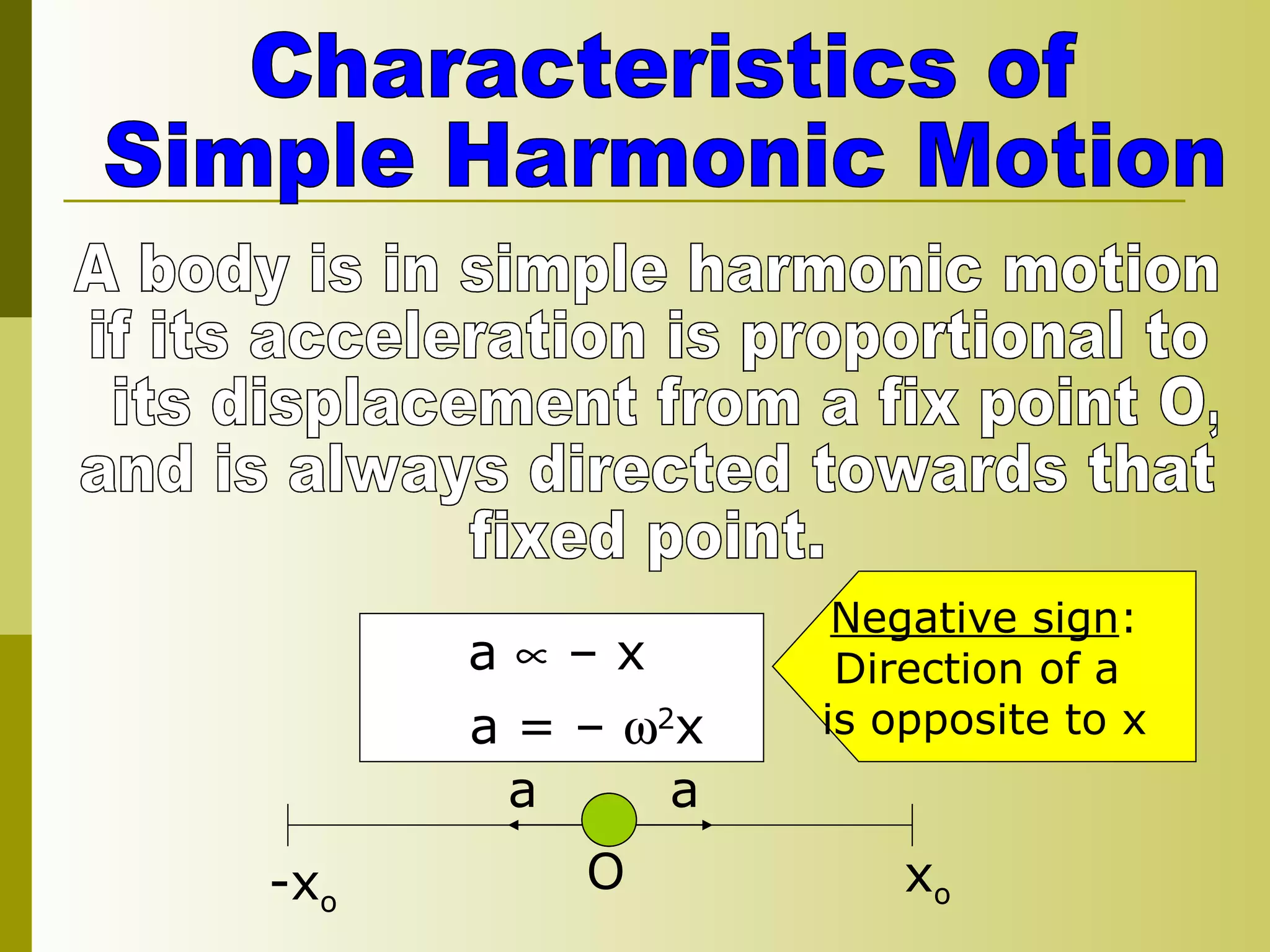
Characteristics of  Simple Harmonic Motion A body is in simple harmonic motion if its acceleration is proportional to its displacement from a fix point O, and is always directed towards that  fixed point. a    – x  a = –   2 x  Negative sign : Direction of a  is opposite to x O -x o x o a a
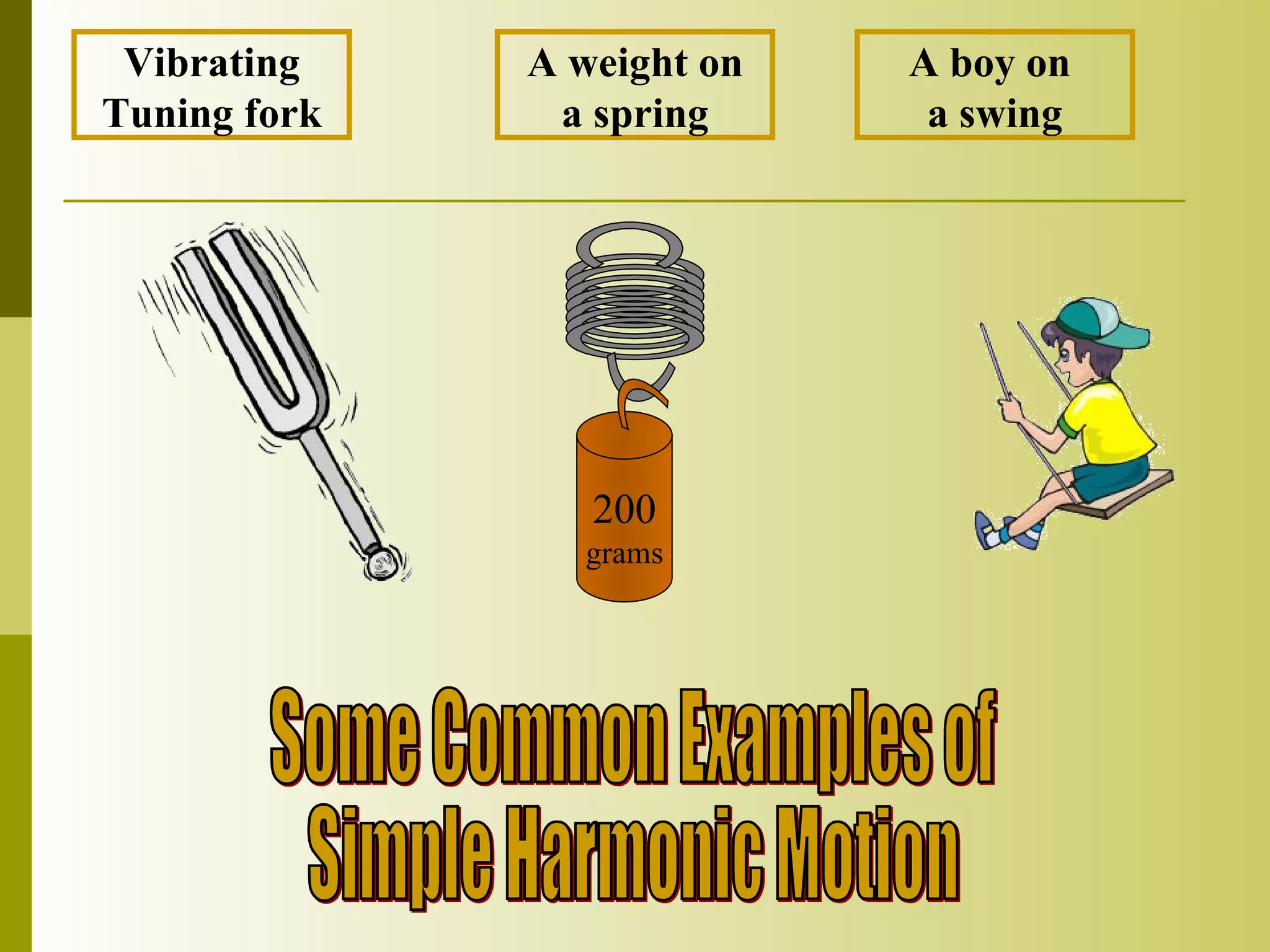
Some Common Examples of  Simple Harmonic Motion Vibrating Tuning fork A weight on a spring A boy on  a swing 200 grams
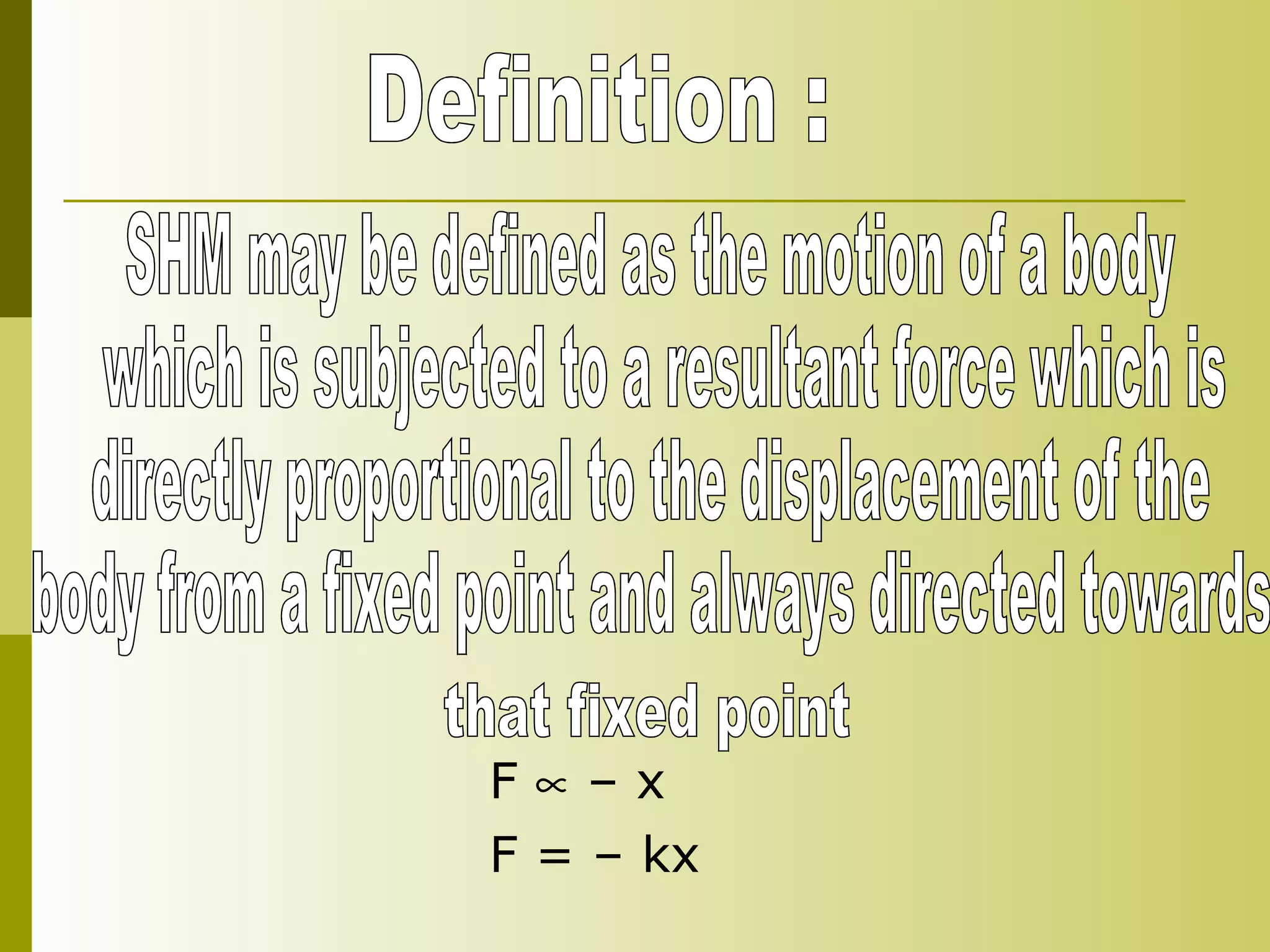
Definition : SHM may be defined as the motion of a body which is subjected to a resultant force which is directly proportional to the displacement of the  body from a fixed point and always directed towards  that fixed point F    – x  F = – kx
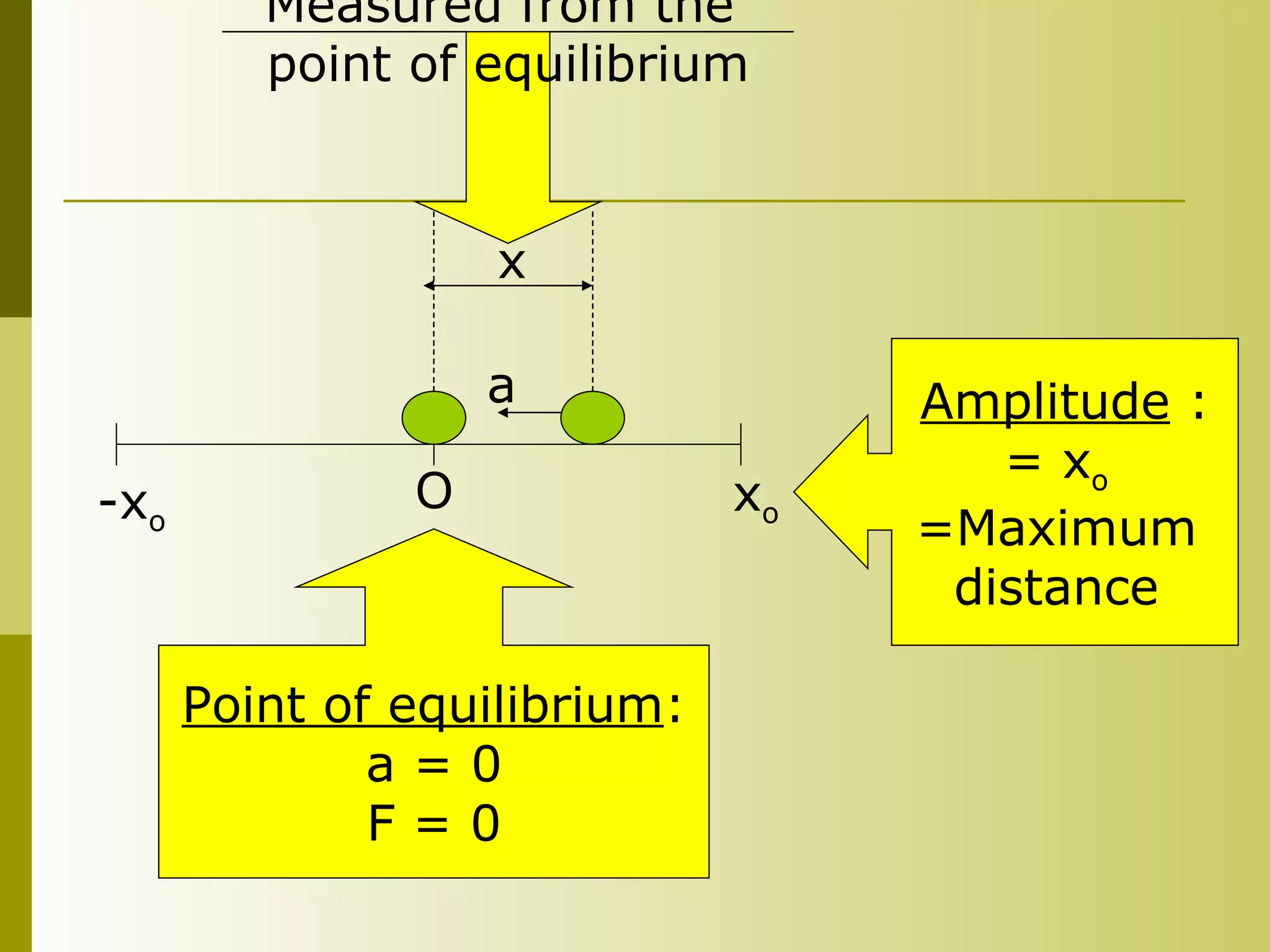
O -x o x o Point of equilibrium : a = 0 F = 0 a x Measured from the  point of equilibrium Amplitude  : = x o   =Maximum  distance
Tutorial 24 Quick check 8.1 page 177
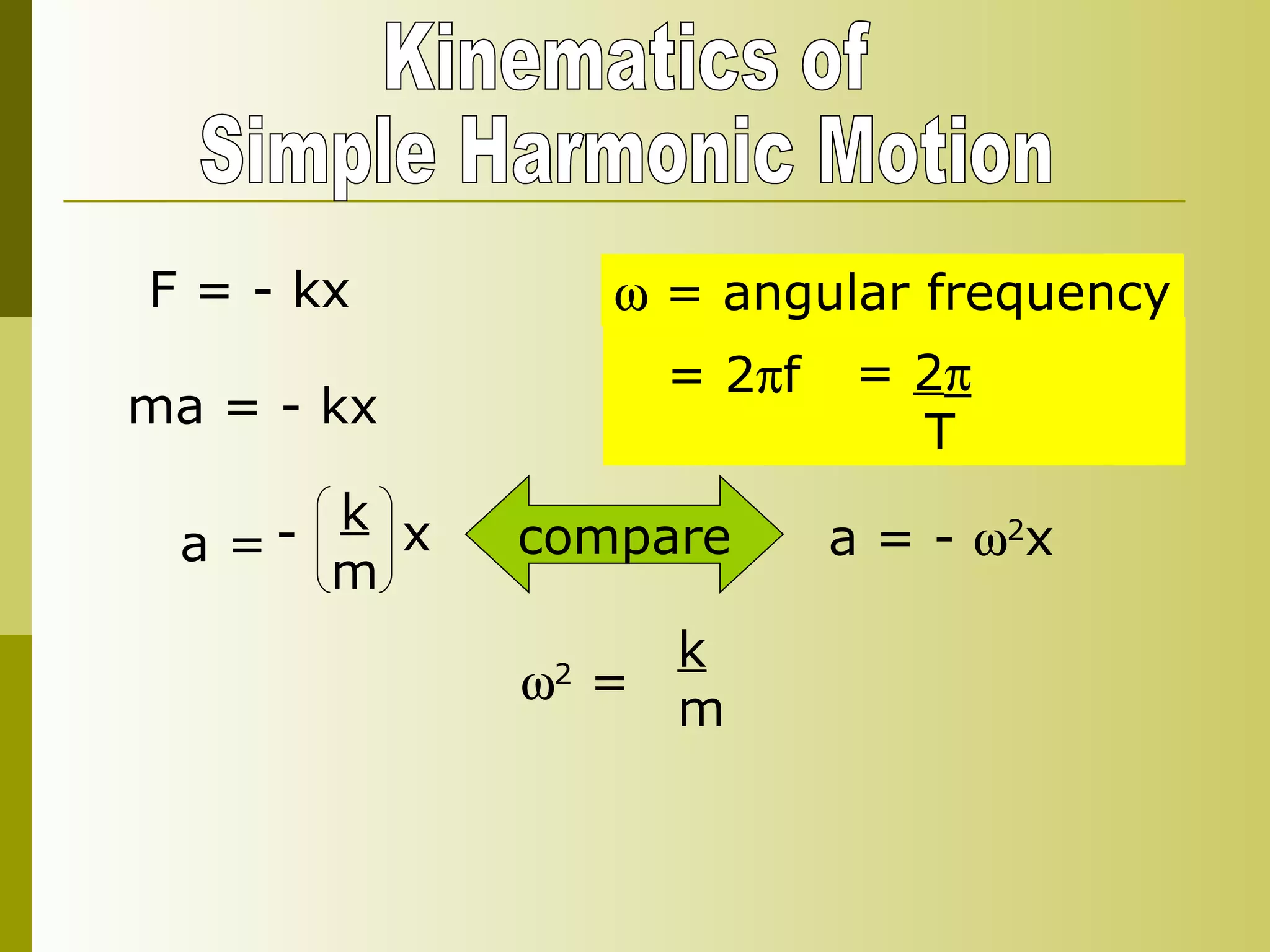
Kinematics of Simple Harmonic Motion F = - kx ma = - kx a =  k m -  x a = -   2 x compare  2  = k m    = angular frequency = 2  f =  2  T
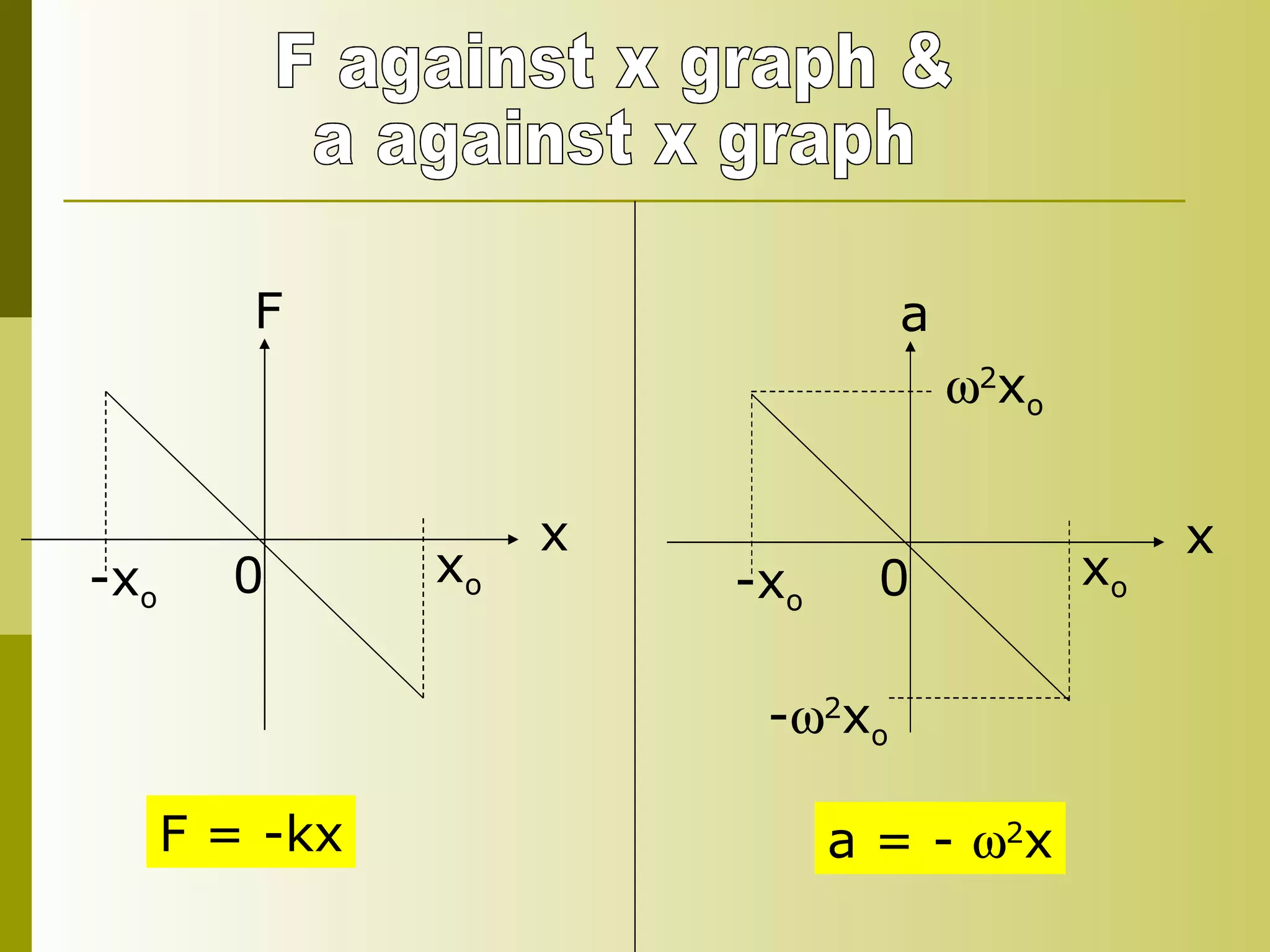
F against x graph & a against x graph F  x 0 x o -x o a  x 0 x o -x o  2 x o -  2 x o F = -kx a = -   2 x
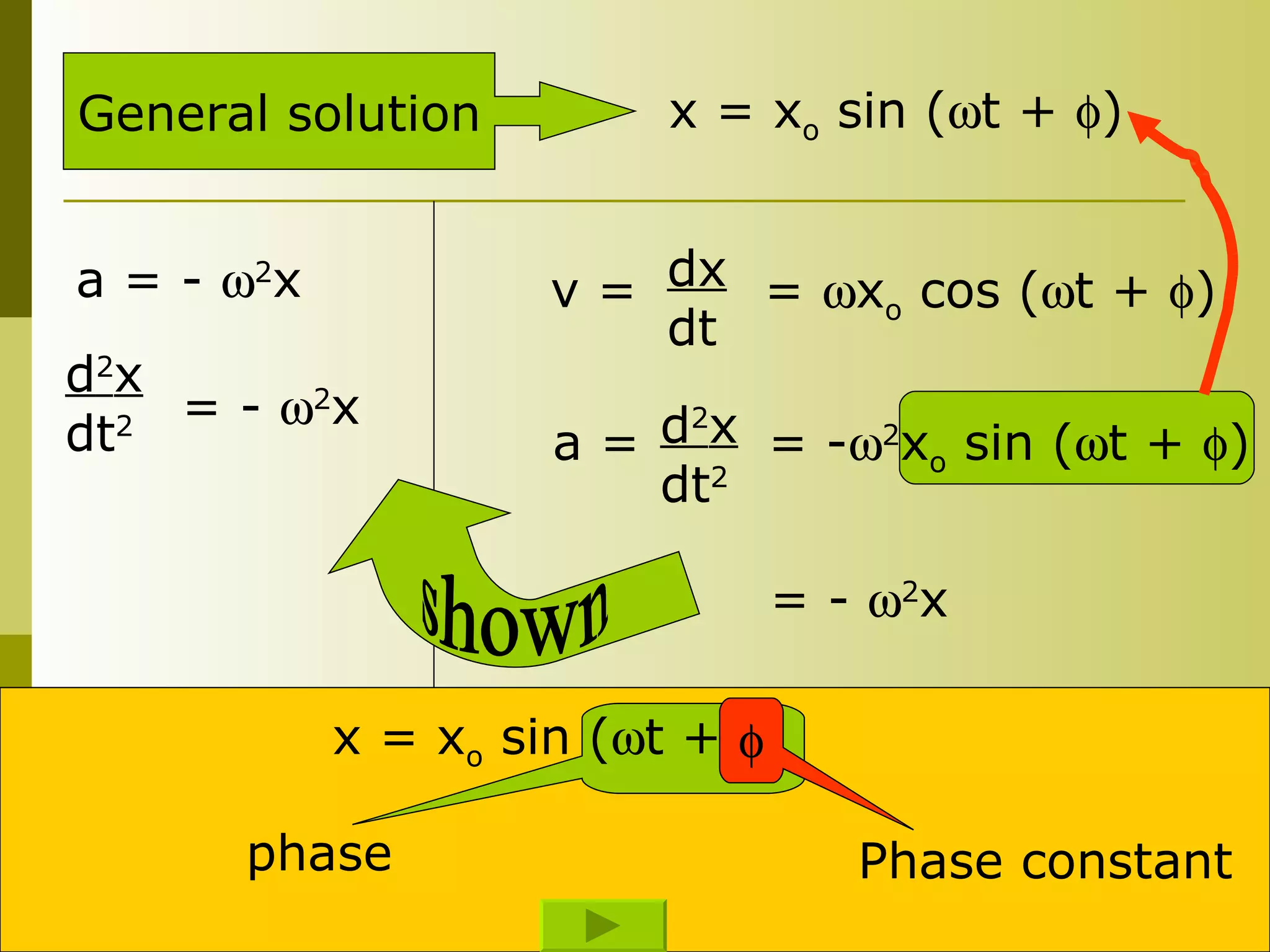
a = -   2 x  d 2 x dt 2 = -   2 x x = x o  sin (  t +   ) General solution dx dt =   x o  cos (  t +   ) v = d 2 x dt 2 = -  2 x o  sin (  t +   ) a = = -   2 x shown x = x o  sin (  t +   ) phase  Phase constant
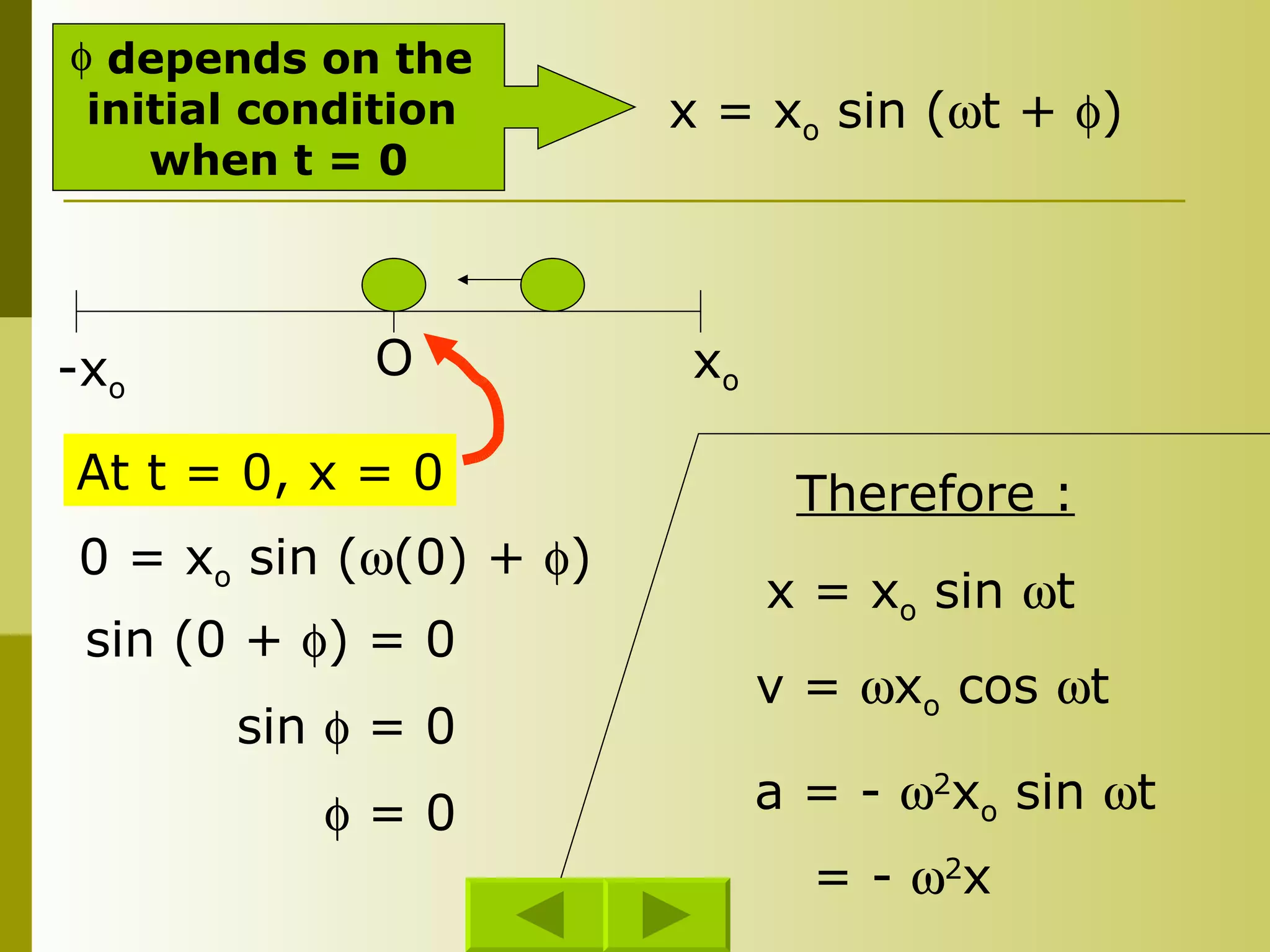
x = x o  sin (  t +   ) depends on the  initial condition  when t = 0 O -x o x o At t = 0, x = 0 0 = x o  sin (  (0) +   ) sin (0 +   ) = 0  sin    = 0     = 0  Therefore : x = x o  sin   t v =   x o  cos   t a = -   2 x o  sin   t = -   2 x
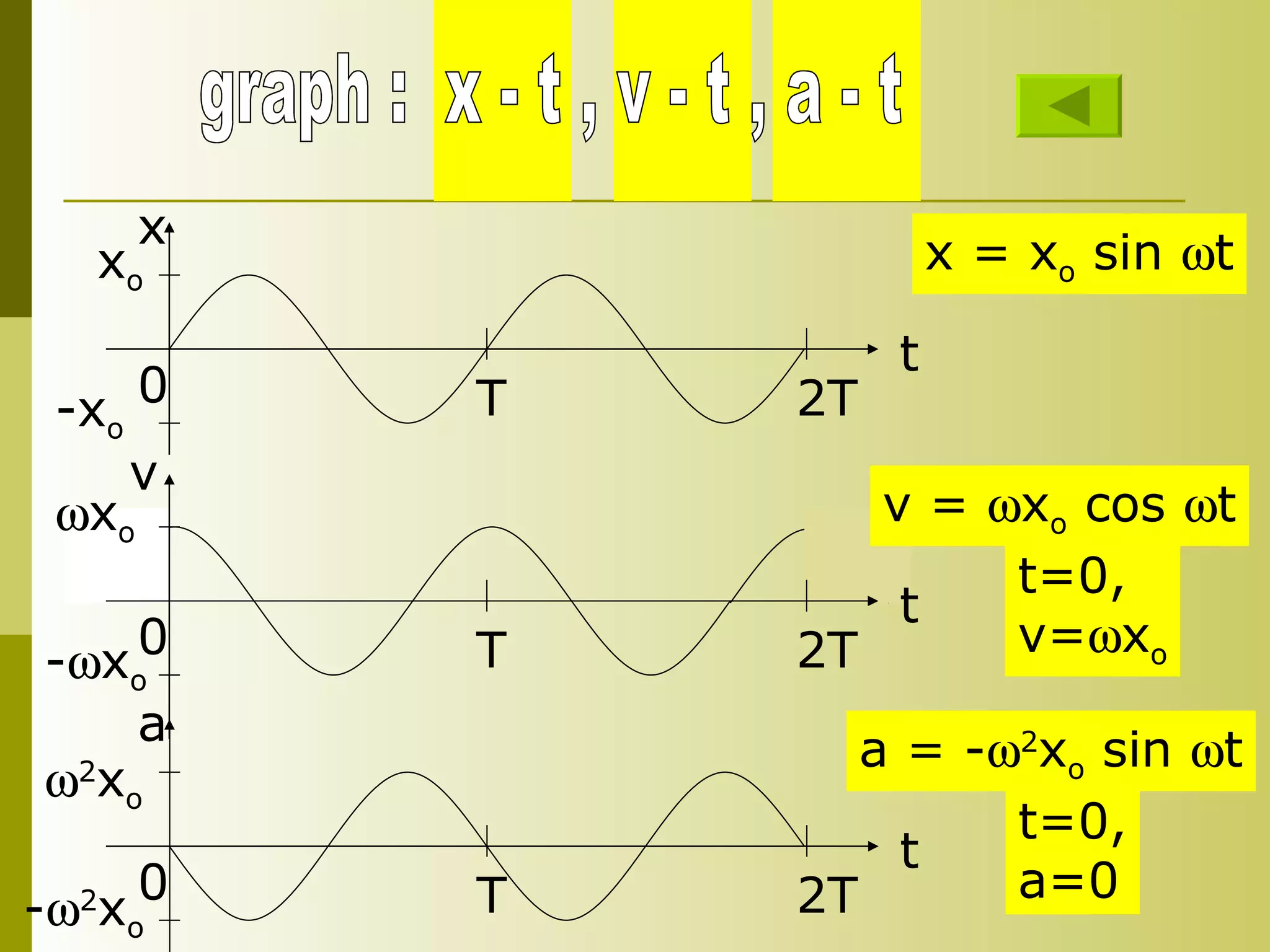
graph :  x - t , v - t , a - t x t 0 x = x o  sin   t x o -x o T 2T v T 0 -  x o  x o v =   x o  cos   t t 2T a t 0 a = -  2 x o  sin   t  2 x o -  2 x o T 2T t=0, v=  x o t=0, a=0
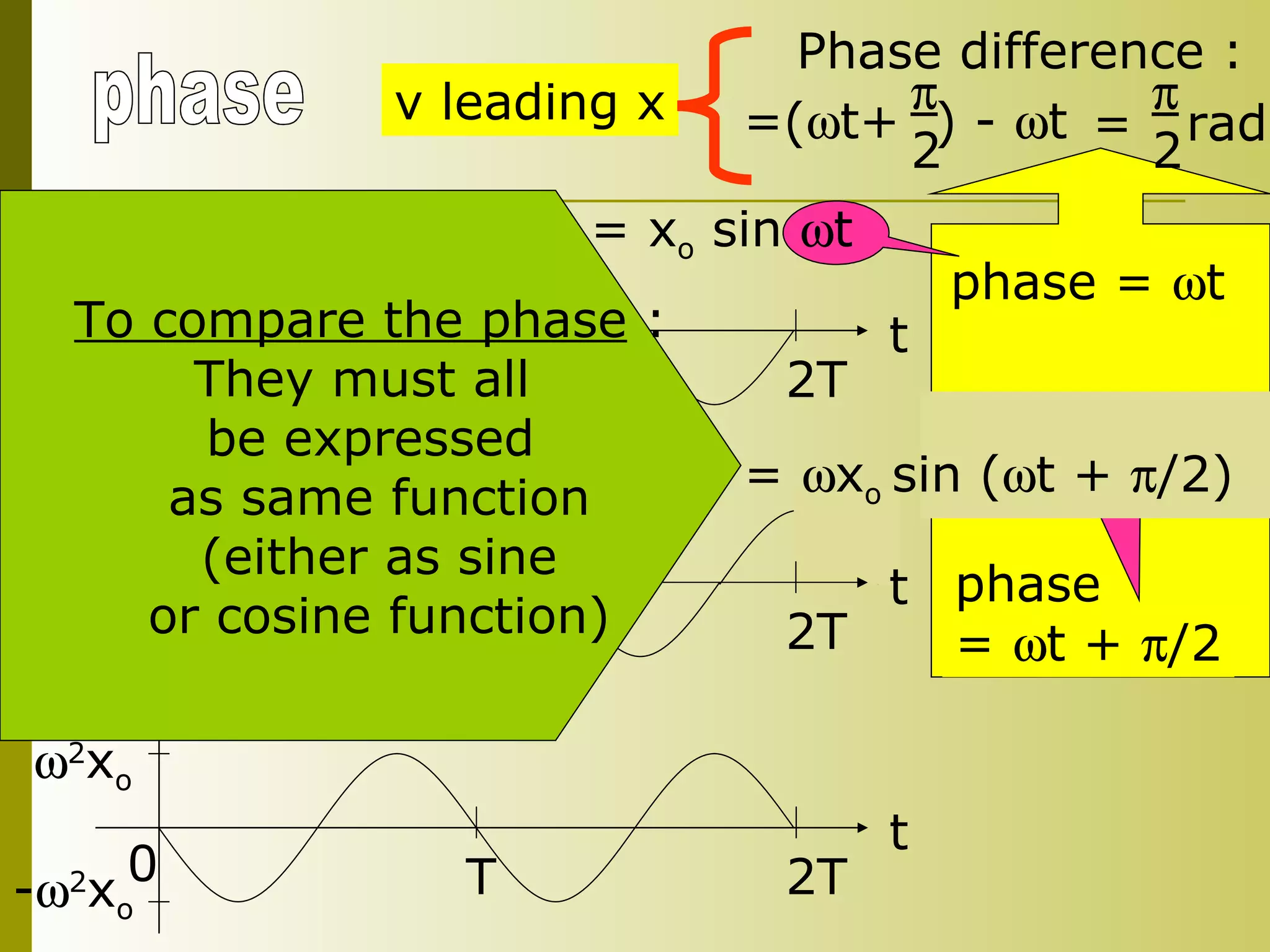
phase  =   t +   /2 phase =   t phase x = x o  sin   t v =   x o  cos   t To compare the phase  : They must all  be expressed as same function (either as sine or cosine function) Phase difference : =(  t+  ) -   t   2 =  2 rad =   x o  sin (  t +   /2) v leading x x t 0 x o -x o T 2T v T 0 -  x o  x o t 2T a t 0  2 x o -  2 x o T 2T
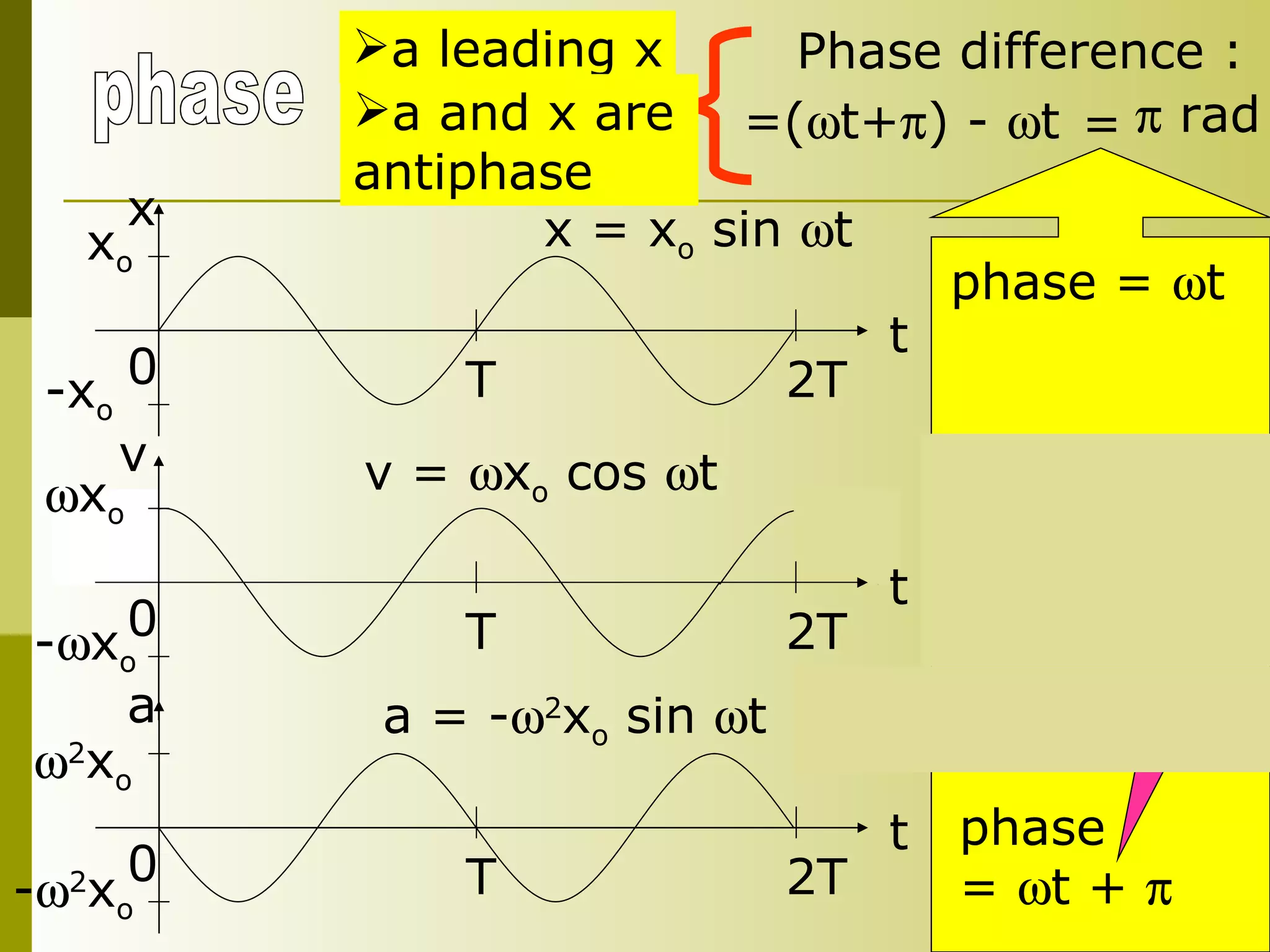
phase  =   t +   phase x = x o  sin   t phase =   t v =   x o  cos   t phase  =   t +   /2 a = -  2 x o  sin   t =   2 x o  sin (  t +   ) Phase difference : =(  t+  ) -   t  =    rad a leading x a and x are  antiphase x t 0 x o -x o T 2T v T 0 -  x o  x o t 2T a t 0  2 x o -  2 x o T 2T
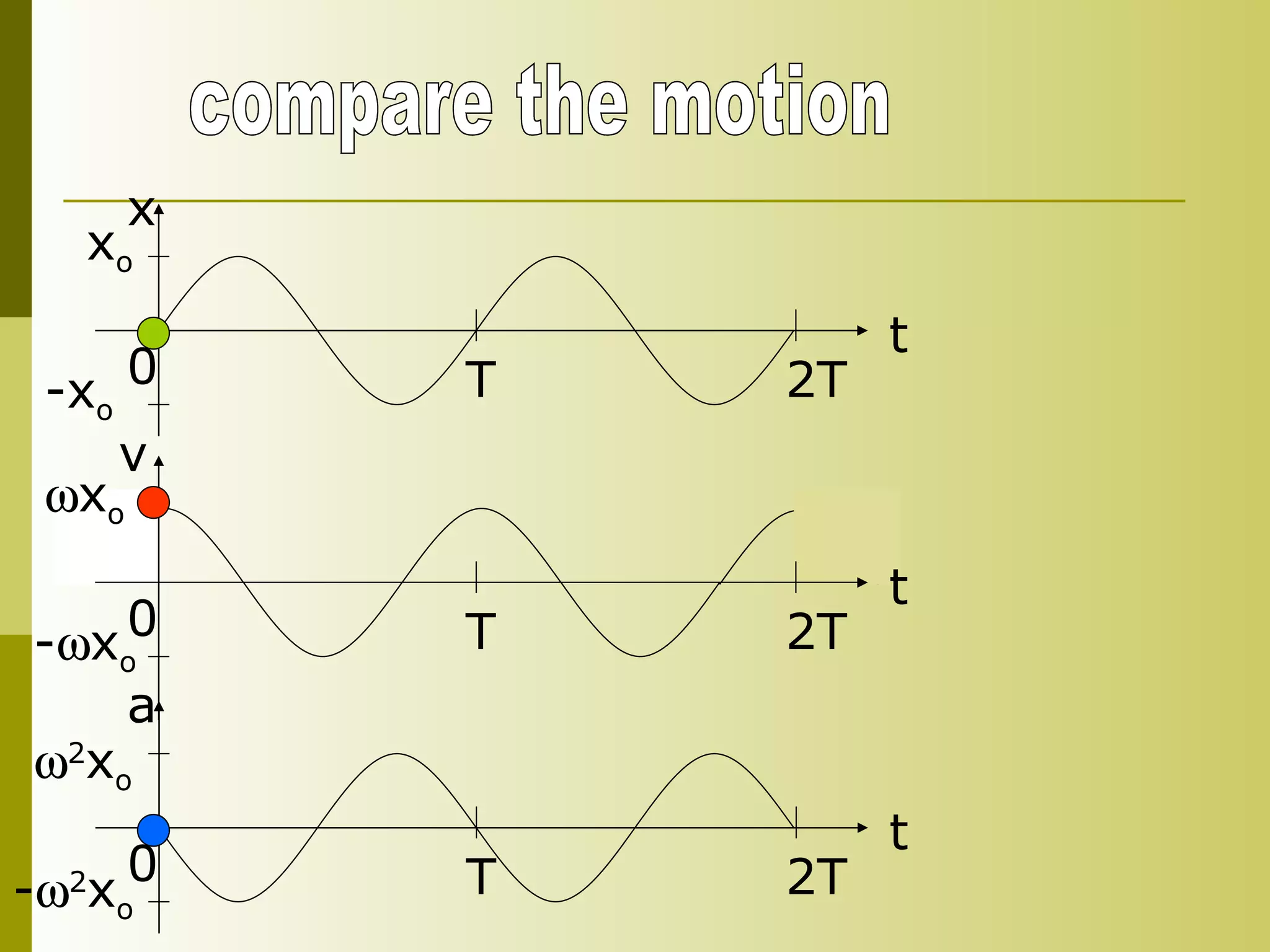
compare the motion x t 0 x o -x o T 2T v T 0 -  x o  x o t 2T a t 0  2 x o -  2 x o T 2T
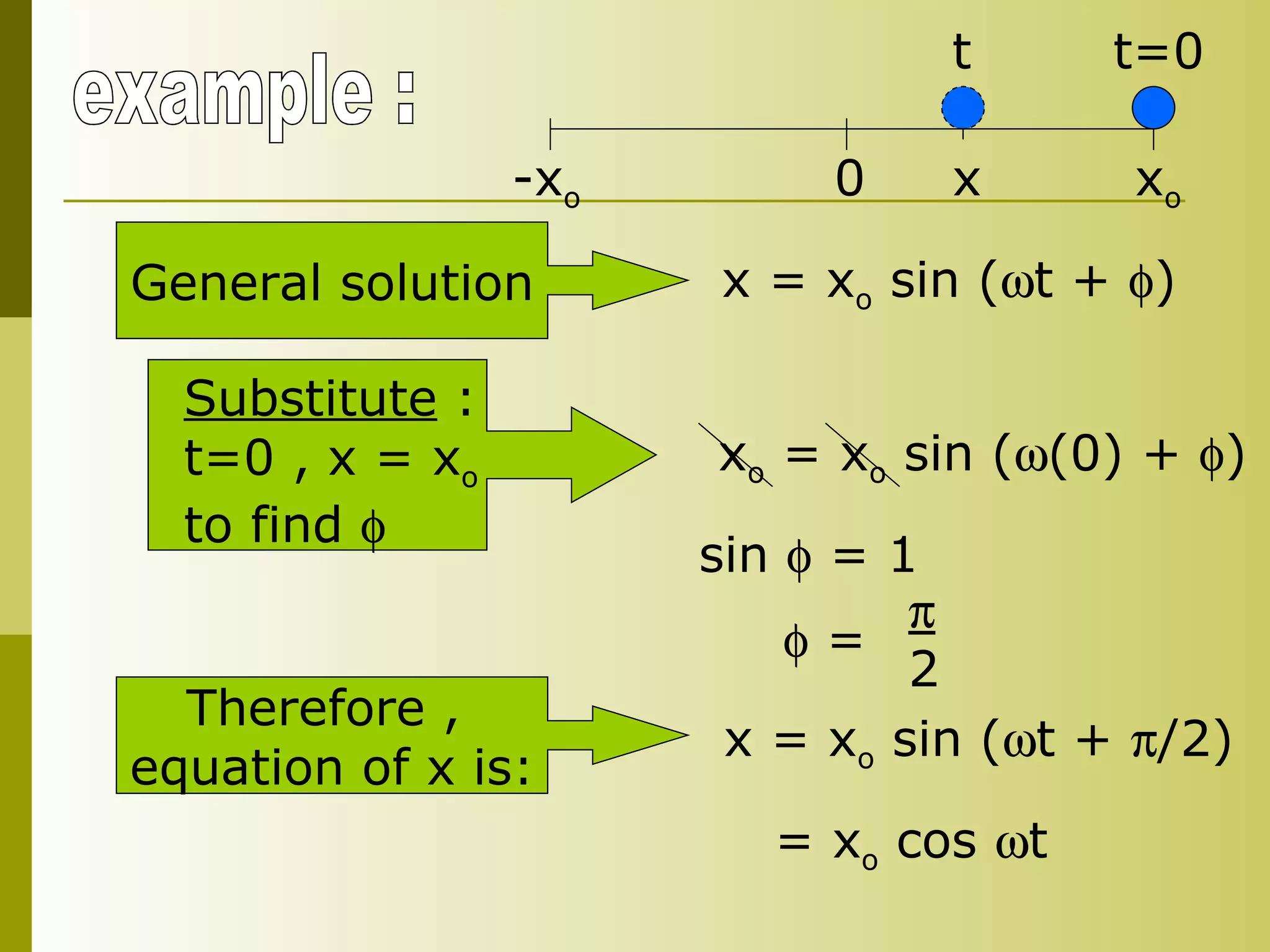
example : -x o x o 0 t=0 x x = x o  sin (  t +   ) General solution Substitute  : t=0 , x = x o to find     x o  = x o  sin (  (0) +   ) sin    = 1     =  2 Therefore ,  equation of x is: x = x o  sin (  t +   /2) t = x o  cos   t
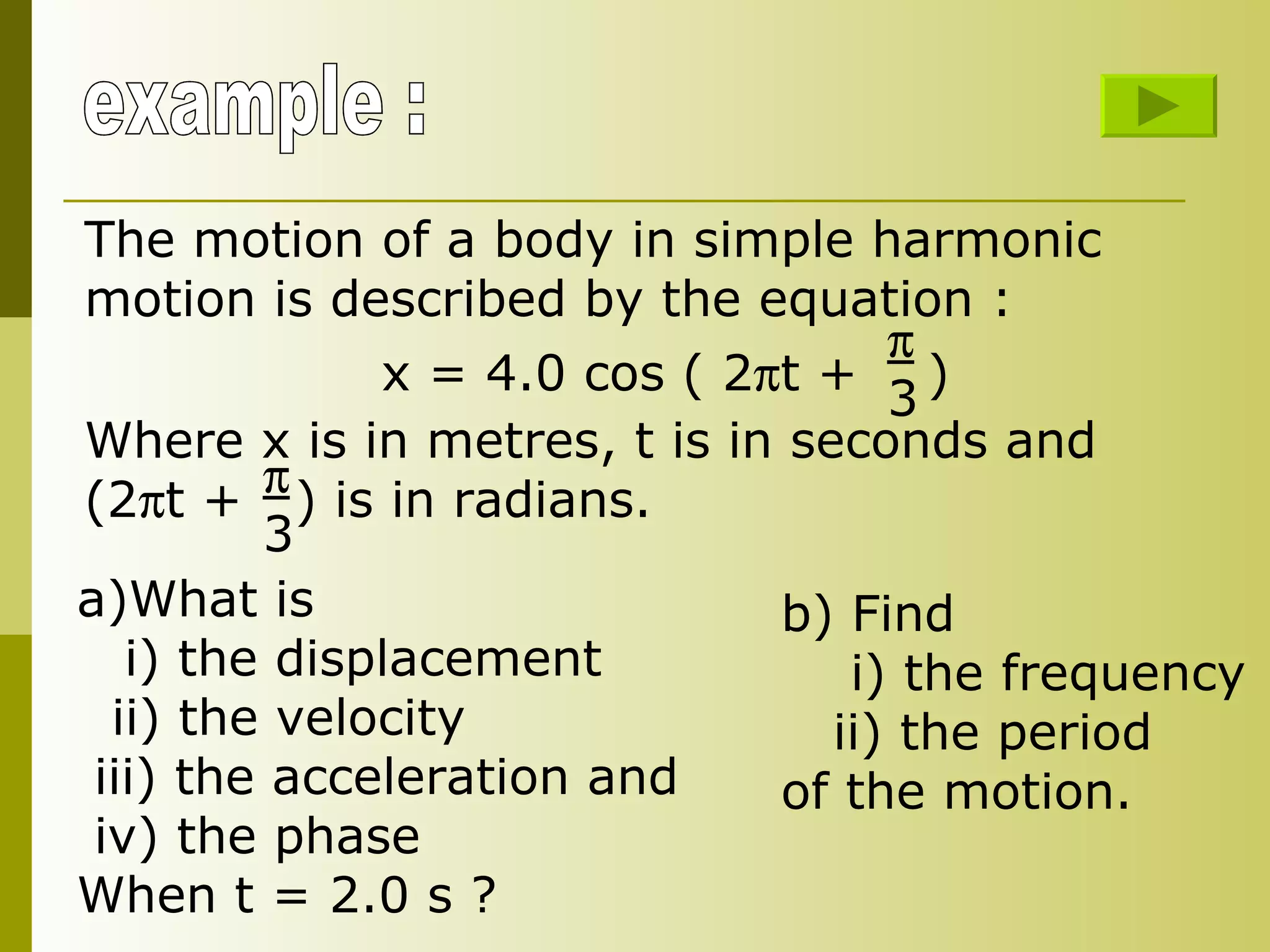
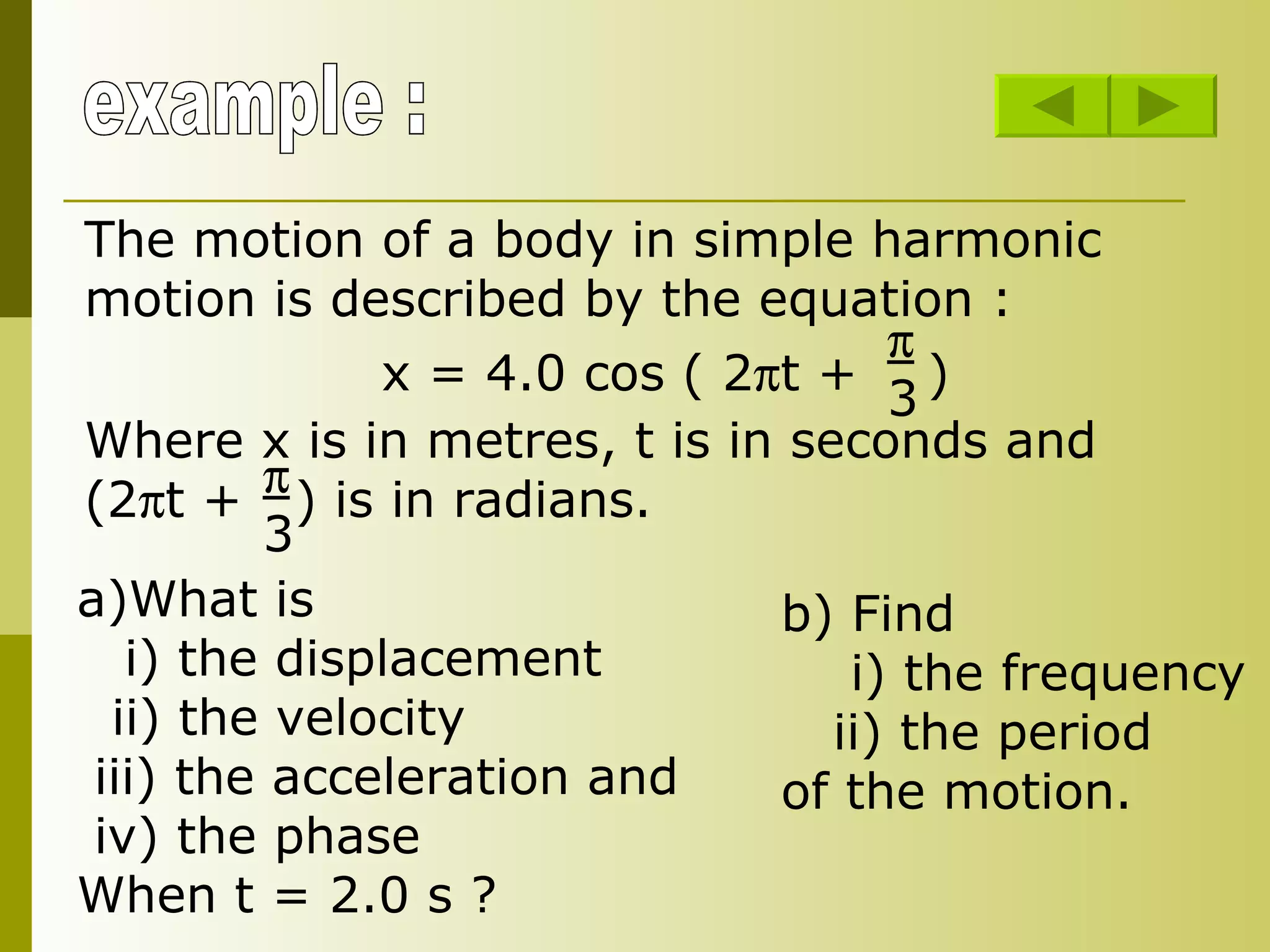
example : The motion of a body in simple harmonic motion is described by the equation : x = 4.0 cos ( 2  t +  )  3 Where x is in metres, t is in seconds and (2  t +  ) is in radians.   3 What is i) the displacement ii) the velocity iii) the acceleration and iv) the phase When t = 2.0 s ? b) Find  i) the frequency ii) the period of the motion.
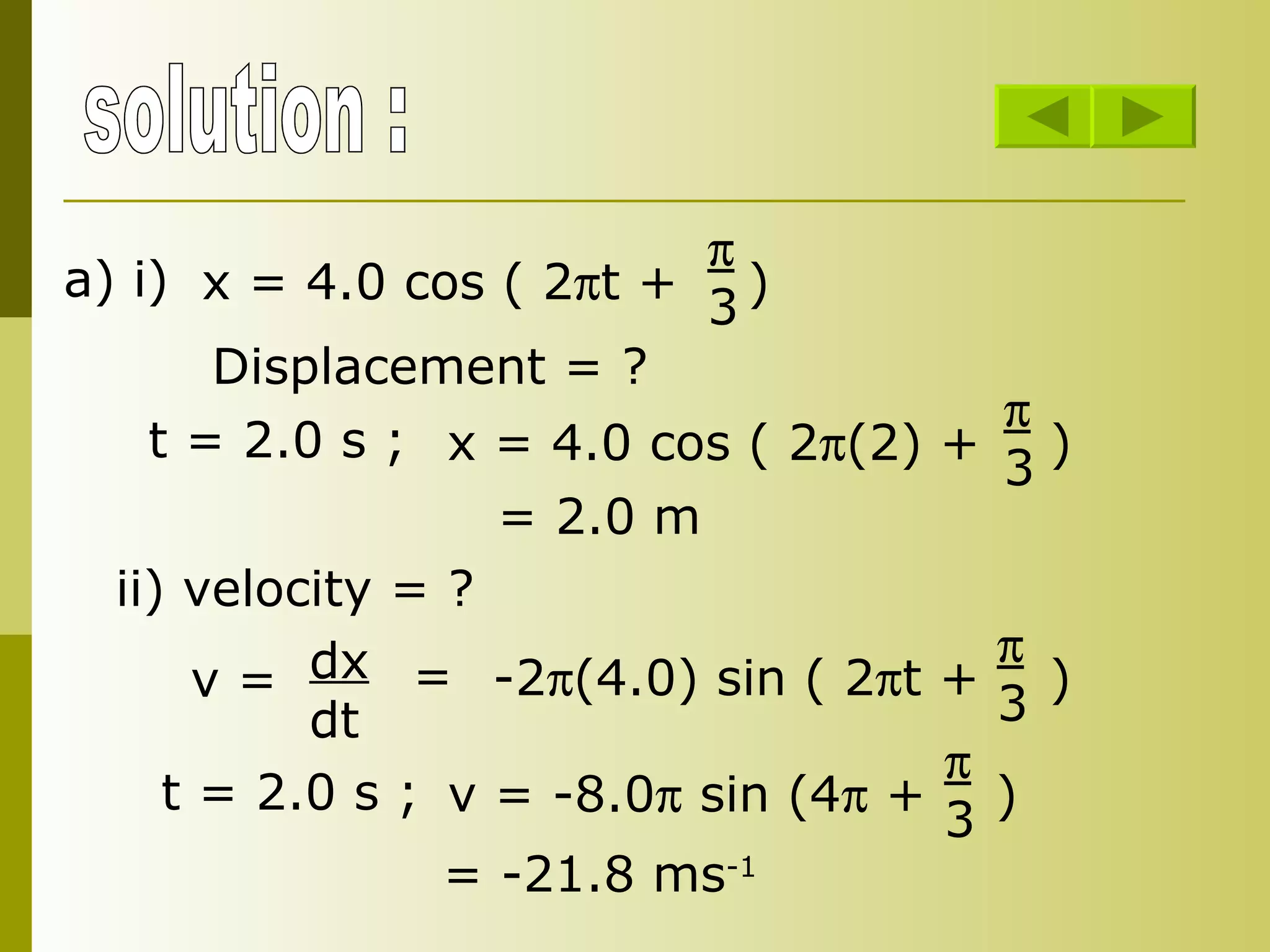
solution : x = 4.0 cos ( 2  t +  )  3 a) i) Displacement = ? t = 2.0 s ; x = 4.0 cos ( 2  (2) +  )  3 = 2.0 m ii) velocity = ? v =  dx dt = -2  (4.0) sin ( 2  t +  )  3  v = -8.0   sin (4   +  ) t = 2.0 s ;  3  = -21.8 ms -1
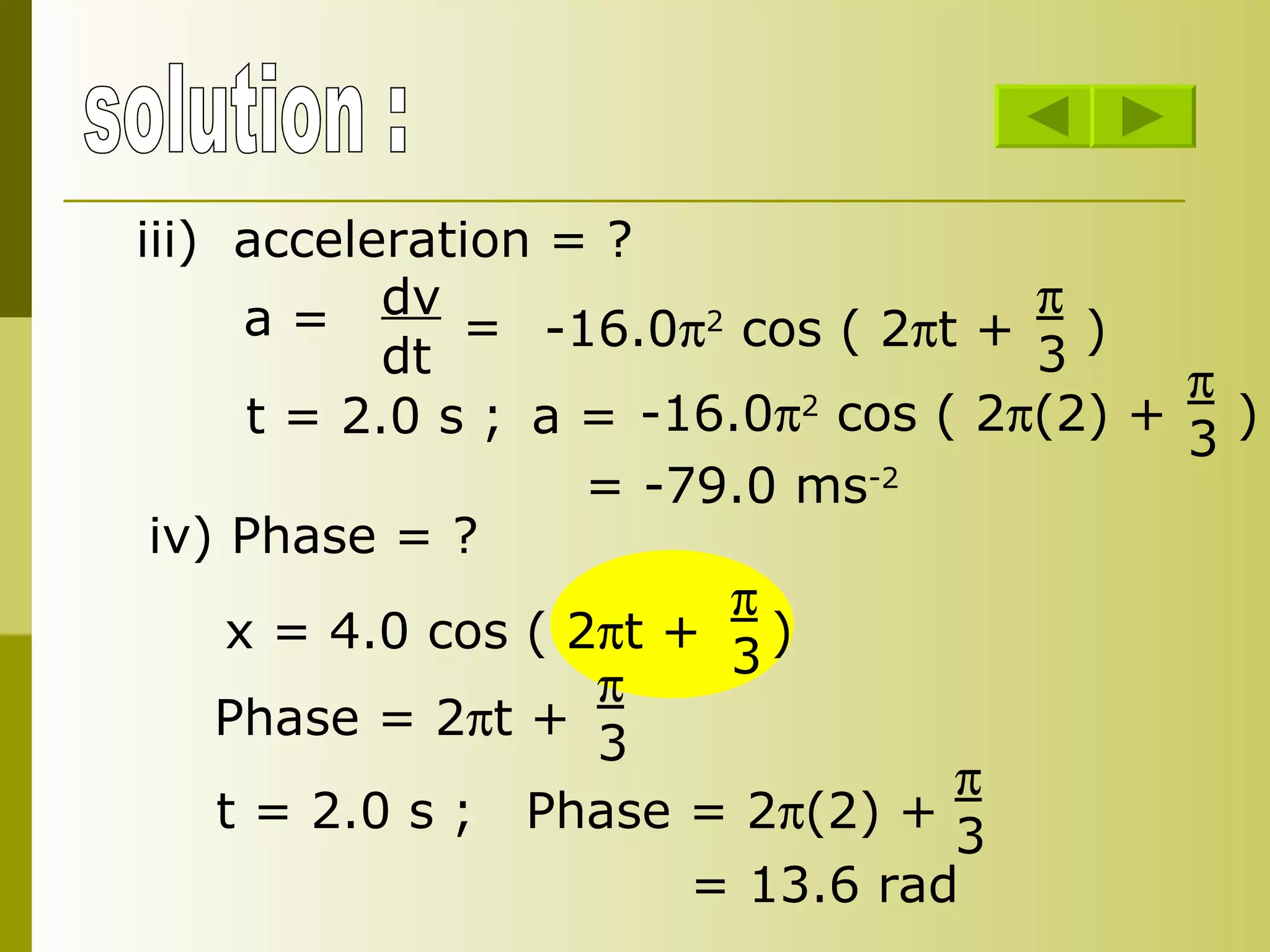
solution : iii) acceleration = ? a = dv dt = -16.0  2  cos ( 2  t +  )  3  t = 2.0 s ; a = -16.0  2  cos ( 2  (2) +  )  3  = -79.0 ms -2 iv) Phase = ? x = 4.0 cos ( 2  t +  )  3 Phase = 2  t +   3 t = 2.0 s ; Phase = 2  (2) +   3 = 13.6 rad
example : The motion of a body in simple harmonic motion is described by the equation : x = 4.0 cos ( 2  t +  )  3 Where x is in metres, t is in seconds and (2  t +  ) is in radians.   3 What is i) the displacement ii) the velocity iii) the acceleration and iv) the phase When t = 2.0 s ? b) Find  i) the frequency ii) the period of the motion.
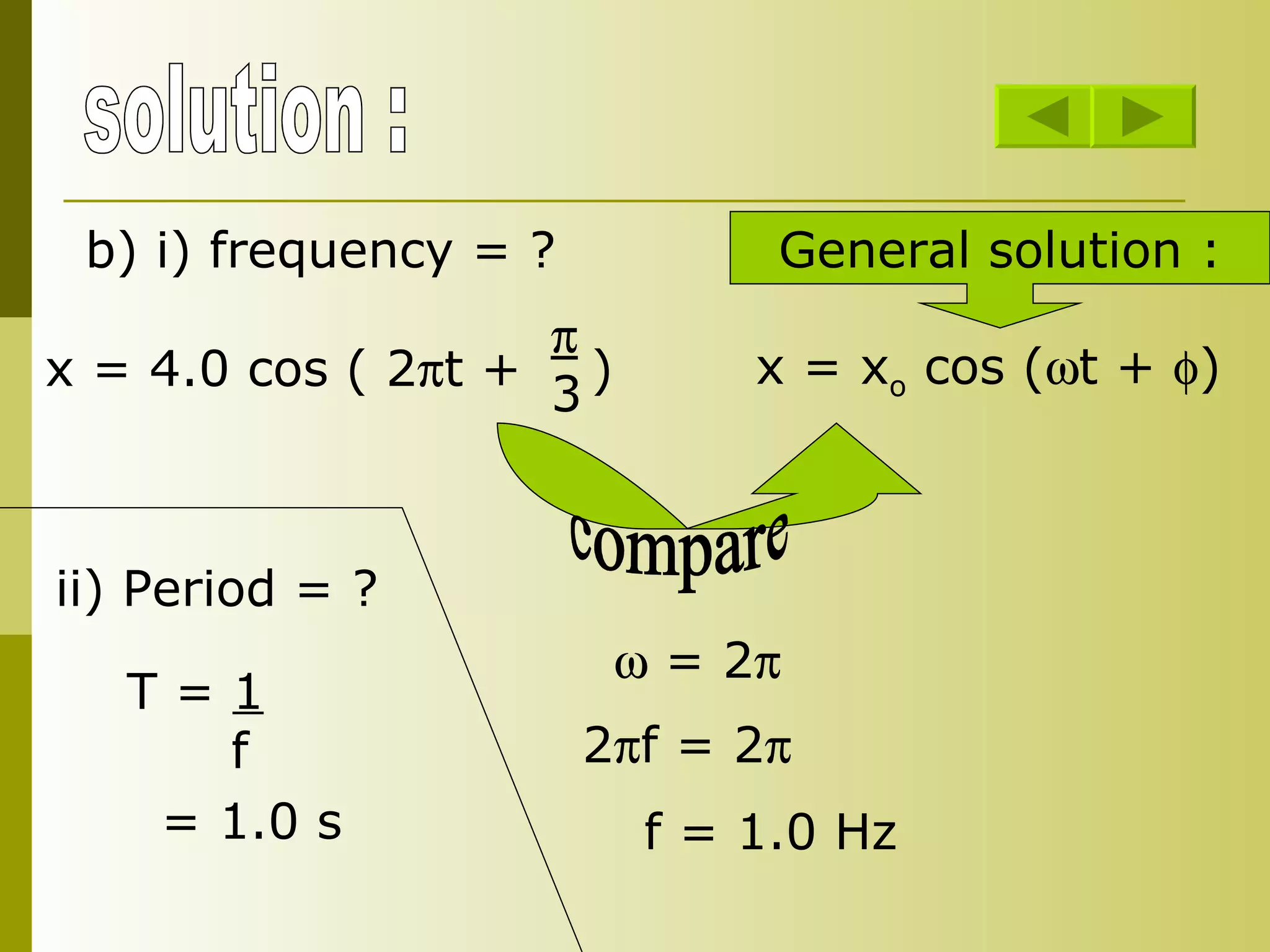
solution : x = 4.0 cos ( 2  t +  )  3 b) i) frequency = ? x = x o  cos (  t +   ) General solution : compare    = 2  2  f = 2  f = 1.0 Hz ii) Period = ? T =  1 f = 1.0 s
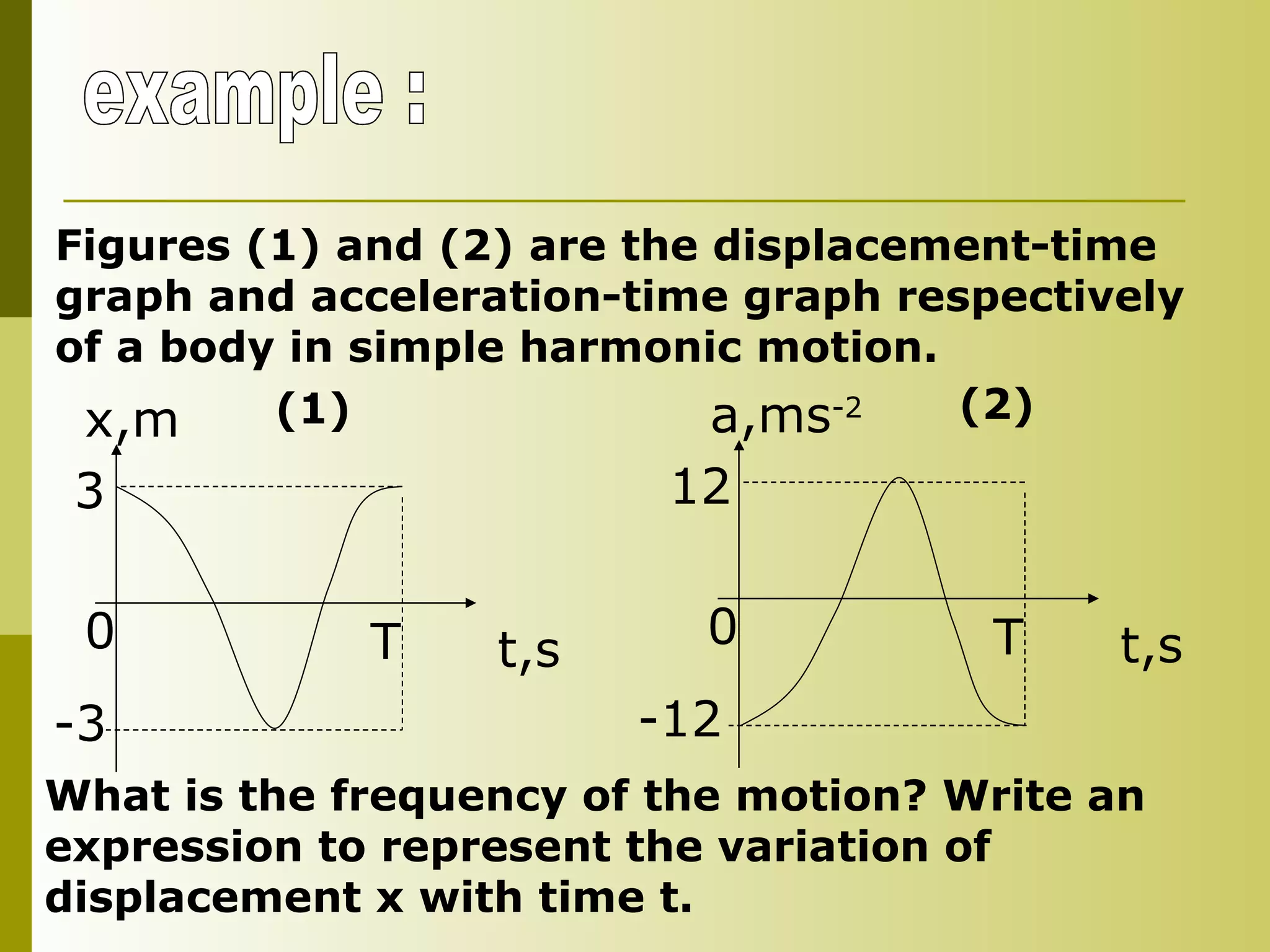
example : Figures (1) and (2) are the displacement-time graph and acceleration-time graph respectively of a body in simple harmonic motion. x,m 3 -3 t,s T 0 (1) a,ms -2 12 -12 t,s T 0 (2) What is the frequency of the motion? Write an expression to represent the variation of displacement x with time t.
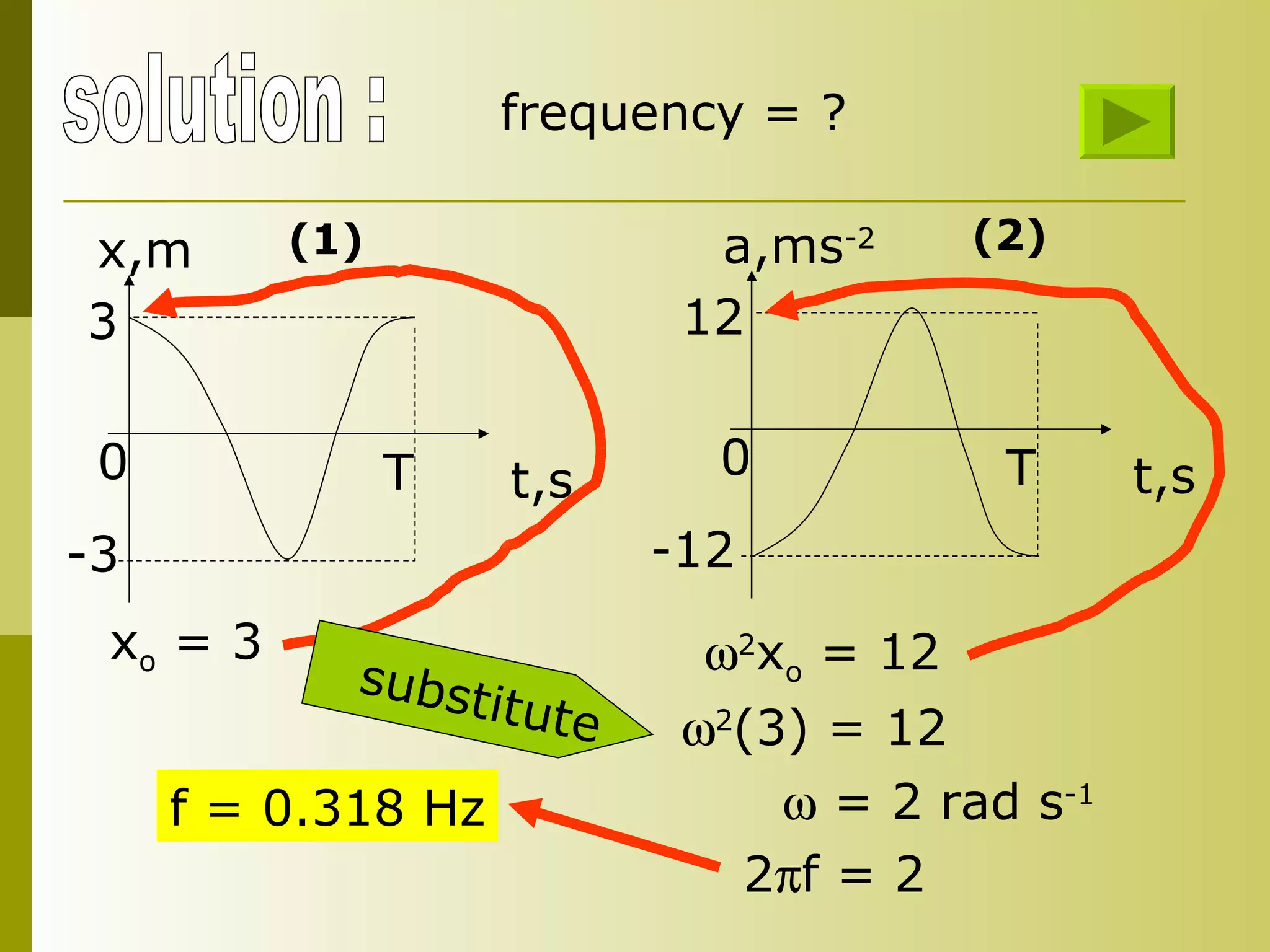
solution : frequency = ? x o  = 3  2 x o  = 12  2 (3) = 12 substitute    = 2 rad s -1 2  f = 2 f = 0.318 Hz x,m 3 -3 t,s T 0 (1) a,ms -2 12 -12 t,s T 0 (2)
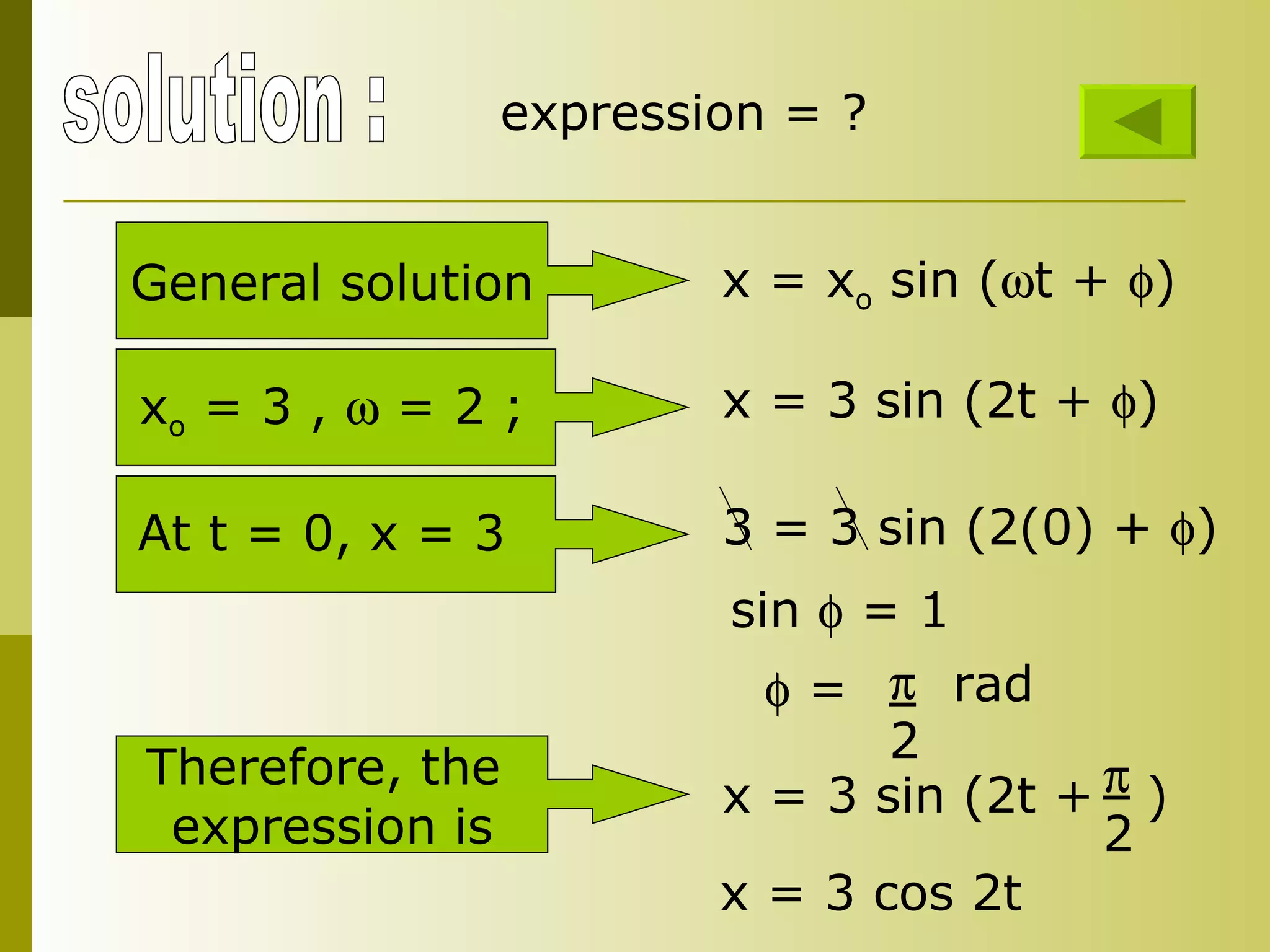
solution : expression = ? x = x o  sin (  t +   ) General solution x o  = 3 ,    = 2 ; x = 3 sin (2t +   ) At t = 0, x = 3  3 = 3 sin (2(0) +   ) sin    = 1    =   2 rad Therefore, the  expression is x = 3 sin (2t +  )  2 x = 3 cos 2t
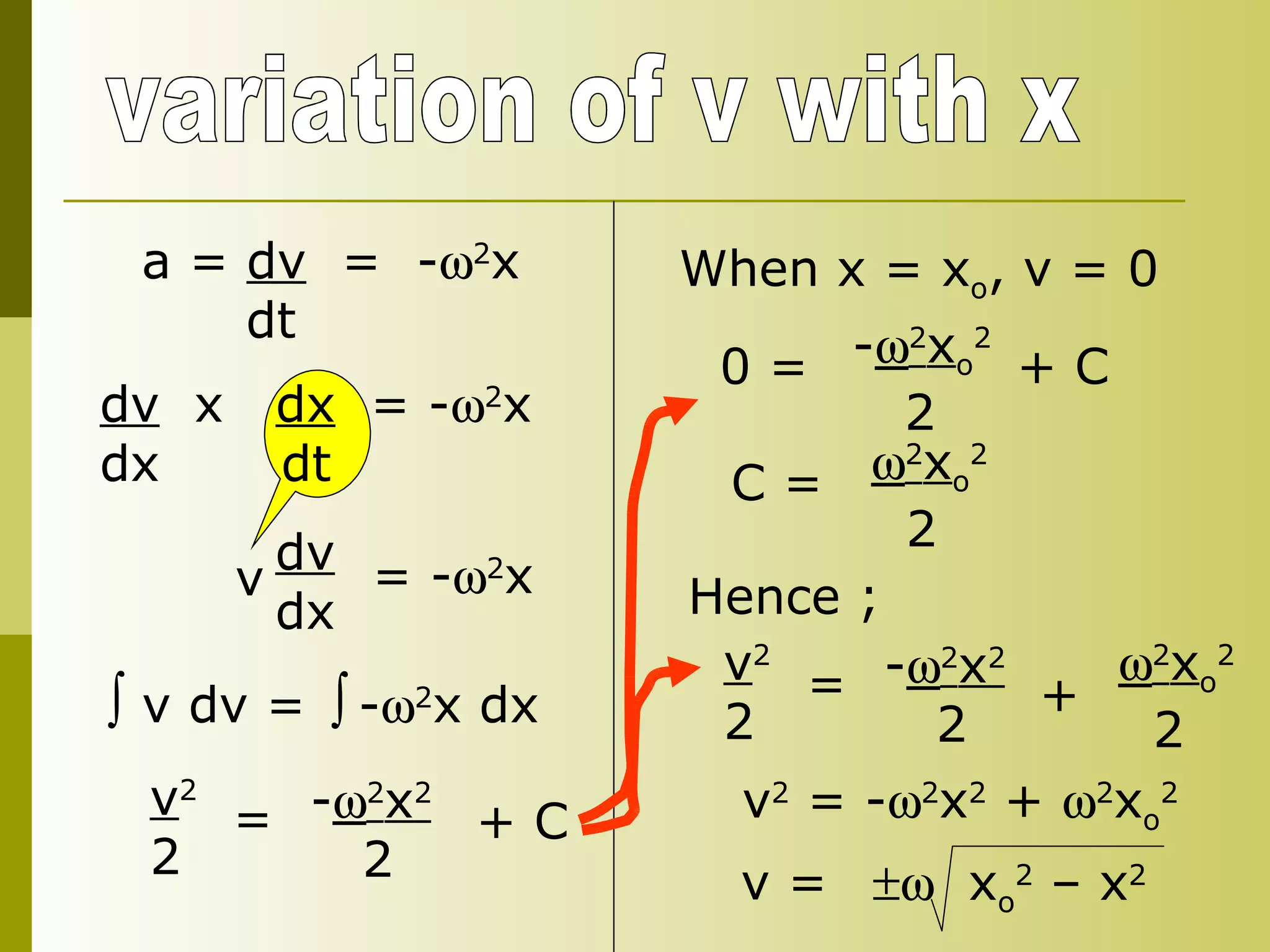
variation of v with x a =  dv   =  -  2 x dt dv   x  dx   = -  2 x dx  dt v dv =  -  2 x dx   v 2 2 = -  2 x 2   2 + C When x = x o , v = 0 0 = -  2 x o 2   2 + C C =  2 x o 2   2 Hence ; v 2 2 = -  2 x 2   2  2 x o 2   2 + v 2  = -  2 x 2  +   2 x o 2   v =    x o 2  – x 2 v dv dx = -  2 x
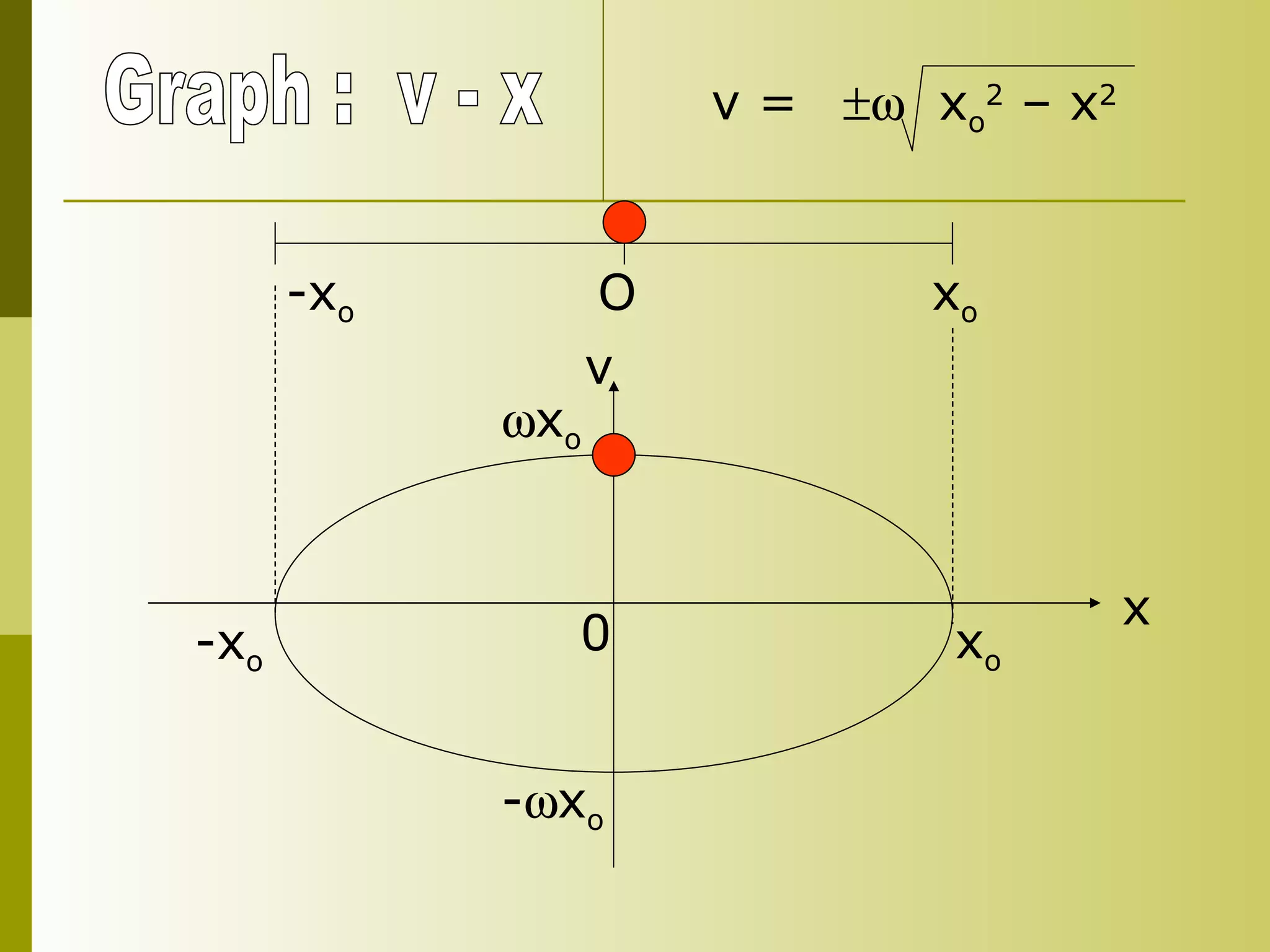
Graph :  v - x  x o -  x o x o -x o v x 0 -x o   O  x o v =    x o 2  – x 2
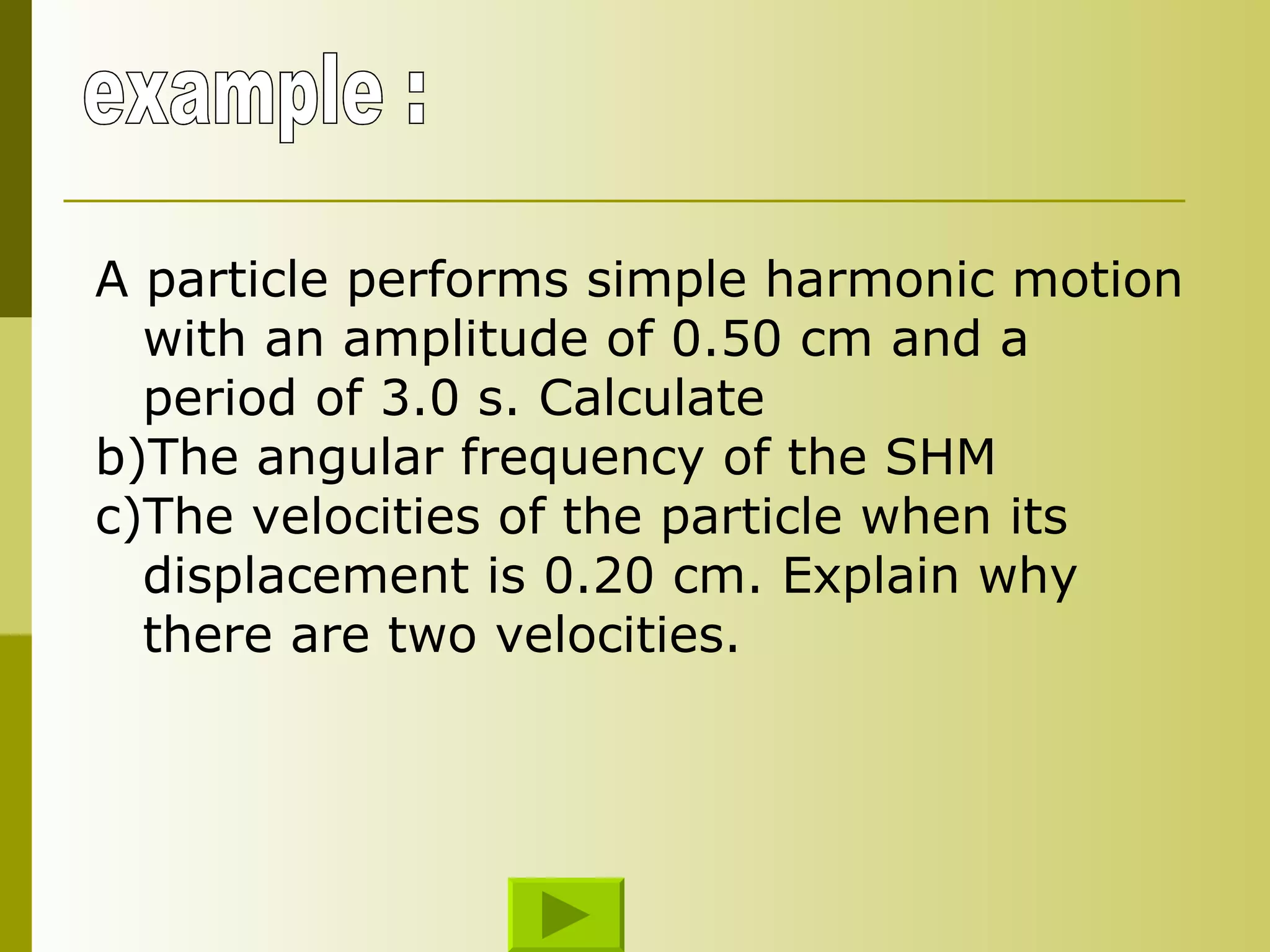
example : A particle performs simple harmonic motion with an amplitude of 0.50 cm and a period of 3.0 s. Calculate  The angular frequency of the SHM The velocities of the particle when its displacement is 0.20 cm. Explain why there are two velocities.
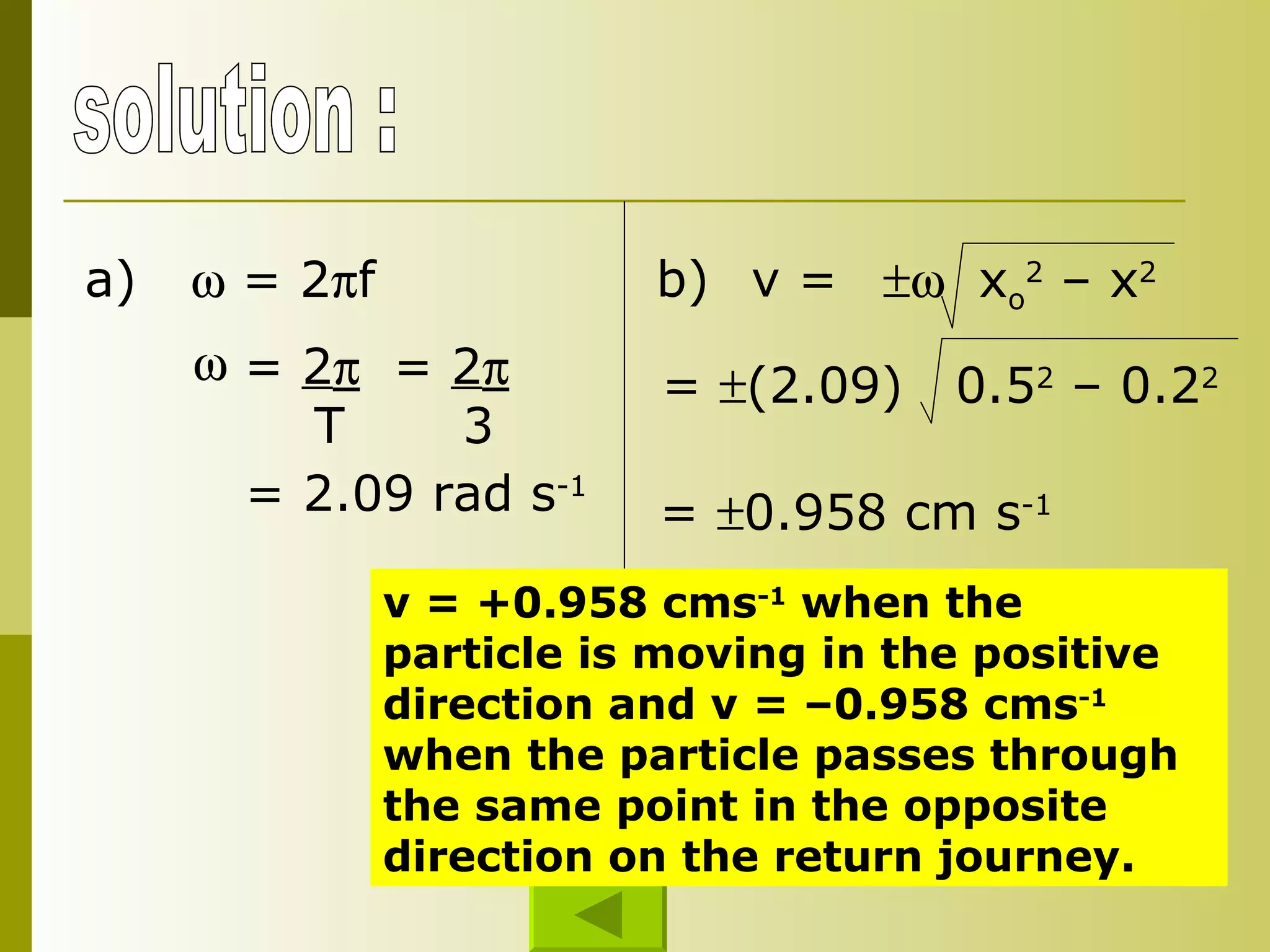
solution : a)    = 2  f =  2  T =  2  3 = 2.09 rad s -1 b) =   (2.09)  0.5 2  – 0.2 2 =   0.958 cm s -1 v = +0.958 cms -1  when the particle is moving in the positive direction and v = –0.958 cms -1  when the particle passes through the same point in the opposite direction on the return journey. v =    x o 2  – x 2
Tutorial 24 Quick check 8.1 and 8.2 page 177 and 183
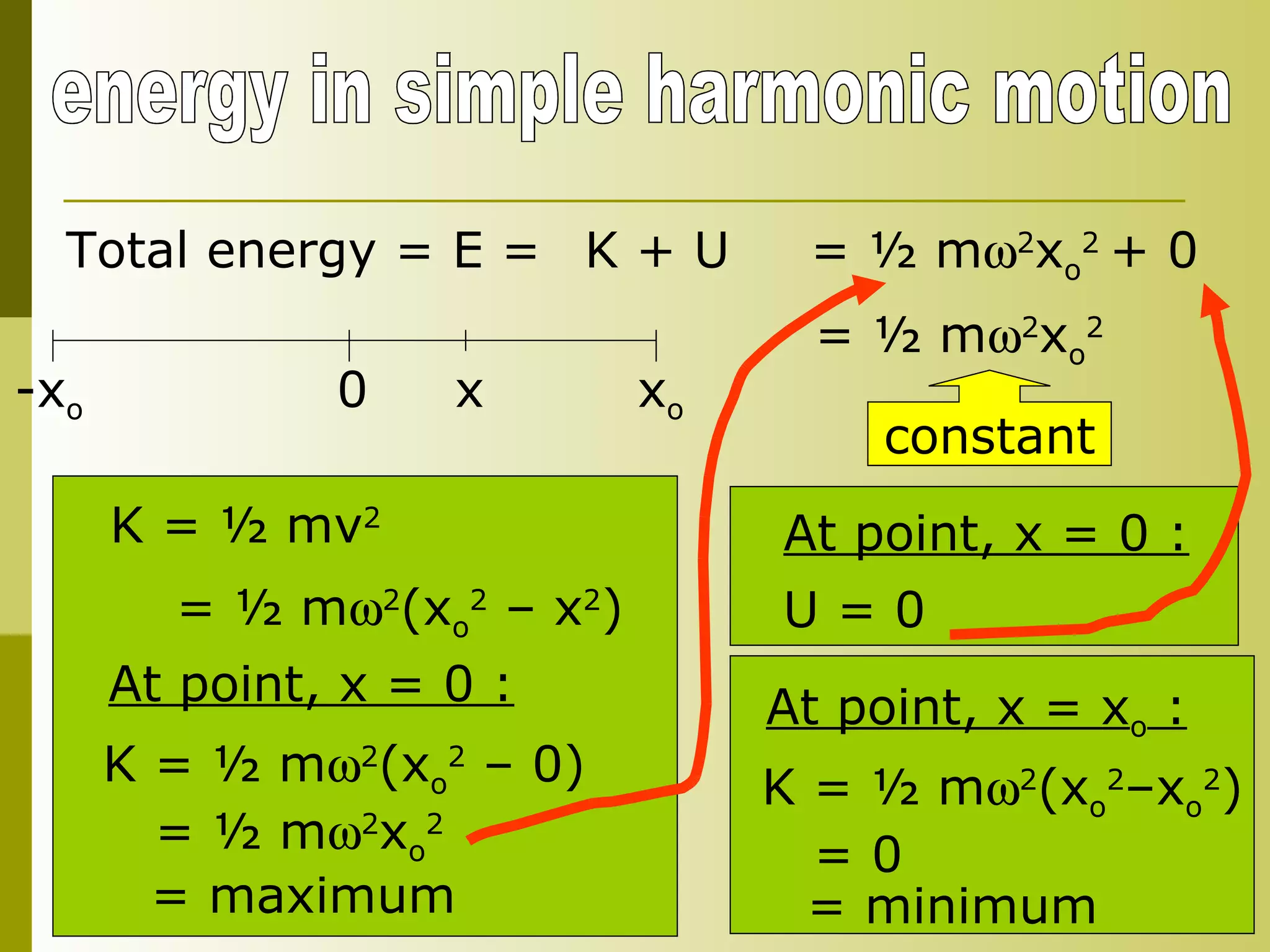
energy in simple harmonic motion Total energy = E = K + U At point, x = 0 : K = ½ mv 2   = ½ m  2 (x o 2  – x 2 ) K = ½ m  2 (x o 2  – 0) = ½ m  2 x o 2 At point, x = 0 : U = 0 = maximum = ½ m  2 x o 2  + 0 = ½ m  2 x o 2  constant At point, x = x o  : K = ½ m  2 (x o 2 –x o 2 ) = 0 = minimum -x o x o 0 x
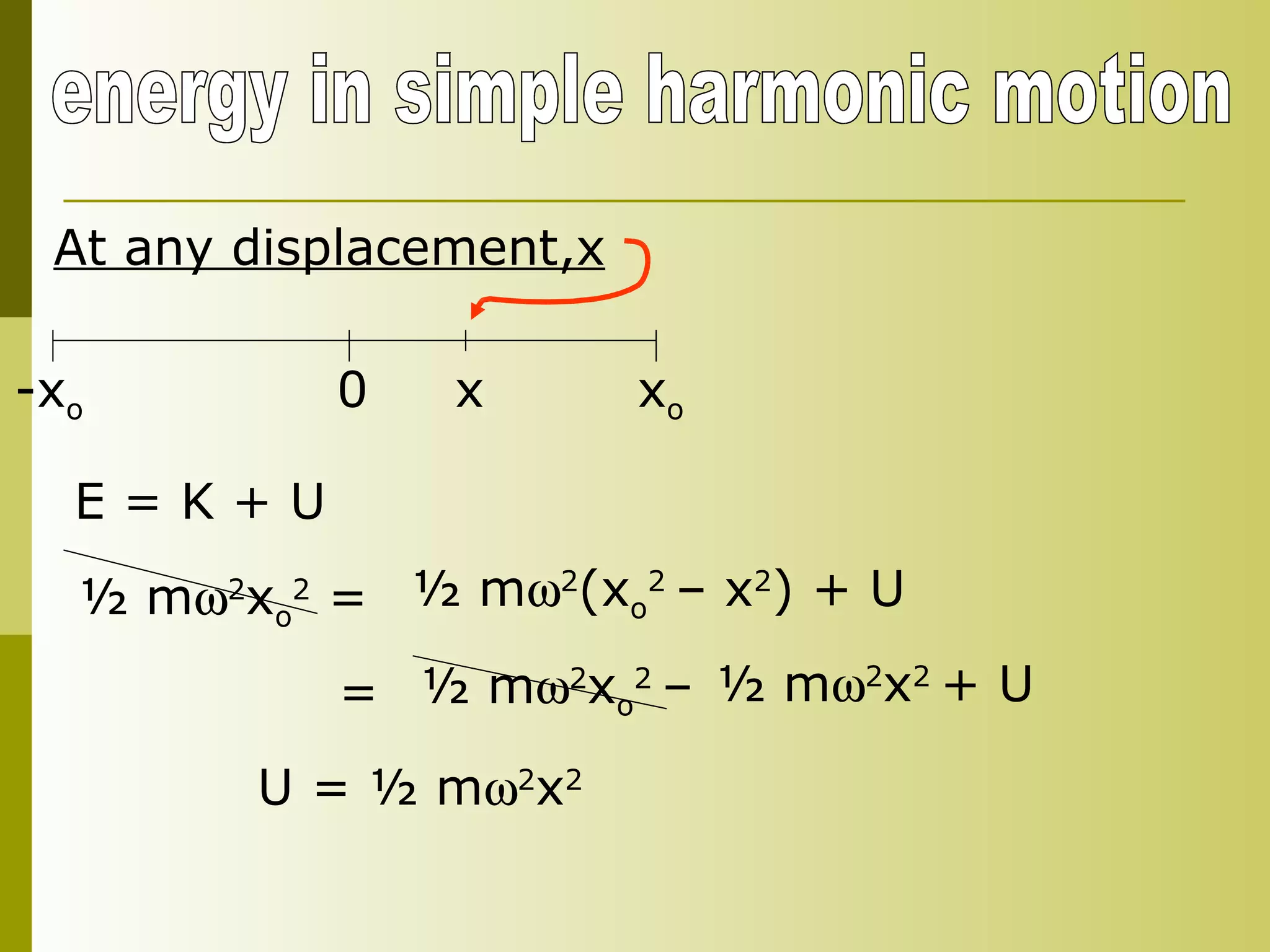
energy in simple harmonic motion At any displacement,x E = K + U ½ m  2 x o 2  = ½ m  2 (x o 2  – x 2 ) + U = ½ m  2 x o 2  –  ½ m  2 x 2  + U  U = ½ m  2 x 2 -x o x o 0 x
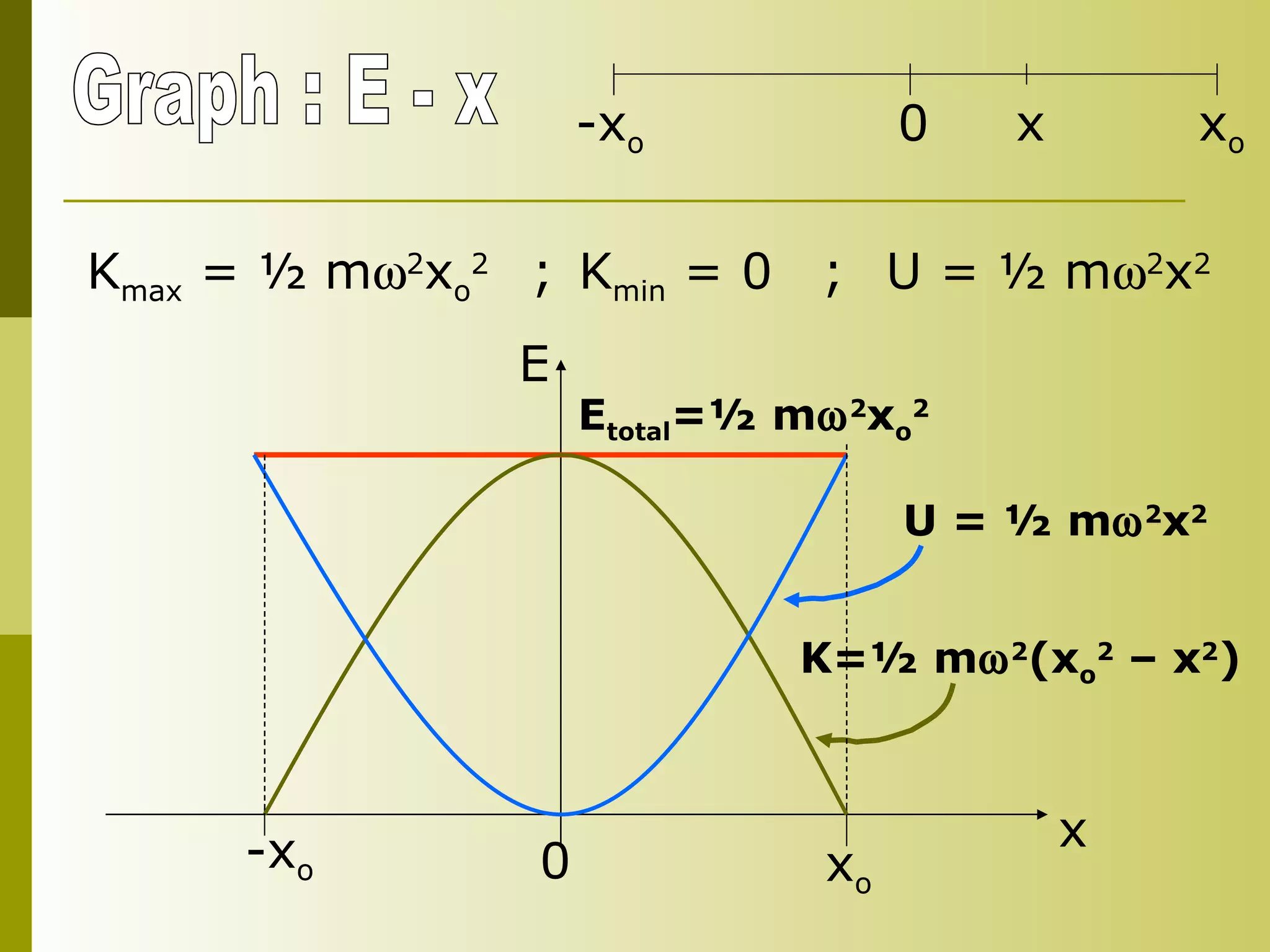
Graph : E - x K max  = ½ m  2 x o 2 U = ½ m  2 x 2 K min  = 0 ; ; E total =½ m  2 x o 2 K=½ m  2 (x o 2  – x 2 ) U = ½ m  2 x 2 0 E  x -x o x o -x o x o 0 x
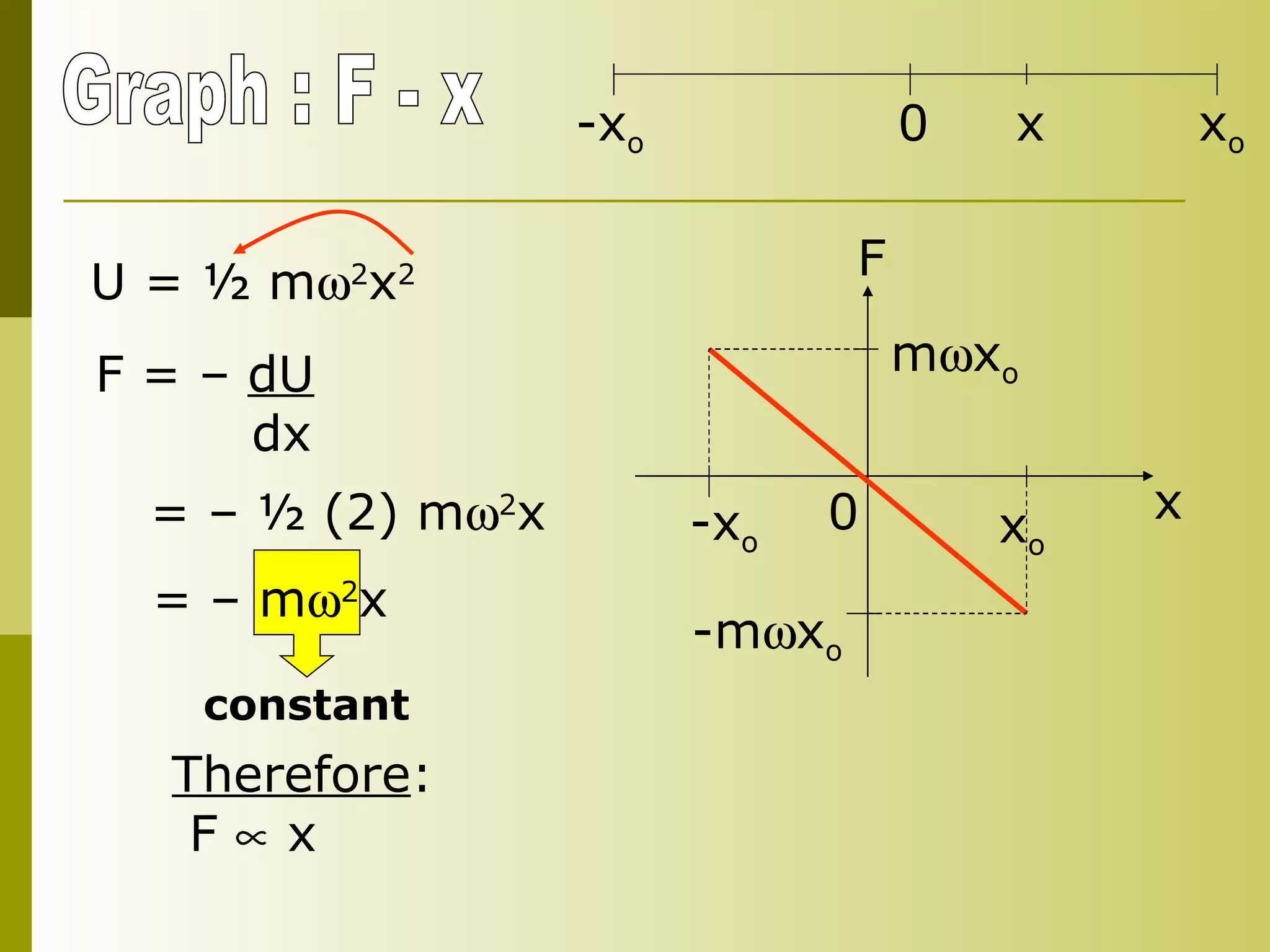
Graph : F - x U = ½ m  2 x 2 F = –  dU dx = – ½ (2) m  2 x = – m  2 x constant Therefore : F    x -x o x o m  x o -m  x o -x o x o 0 x 0 F  x
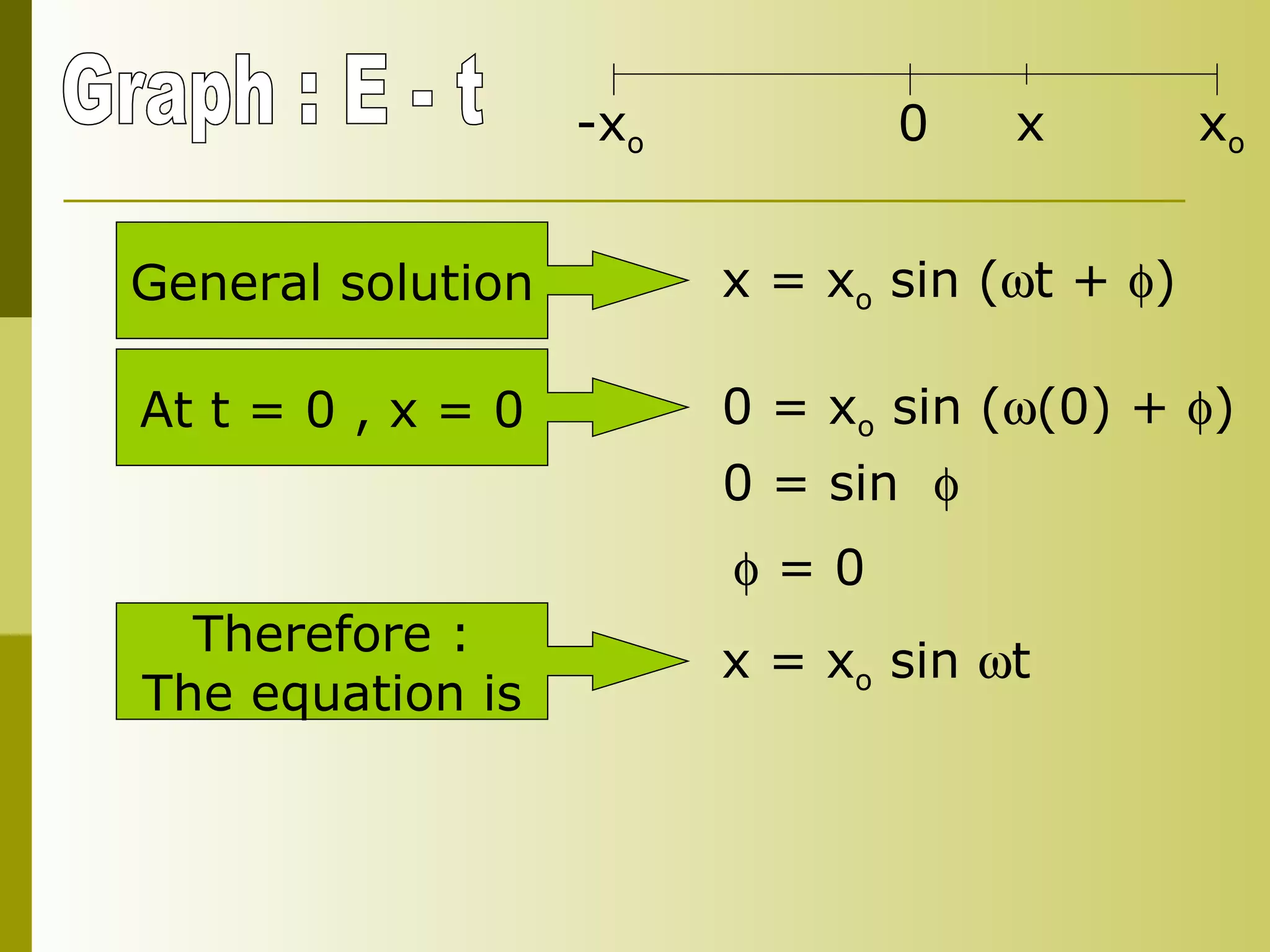
Graph : E - t x = x o  sin (  t +   ) General solution 0 = x o  sin (  (0) +   ) At t = 0 , x = 0 0 = sin      = 0 x = x o  sin   t  Therefore : The equation is -x o x o 0 x
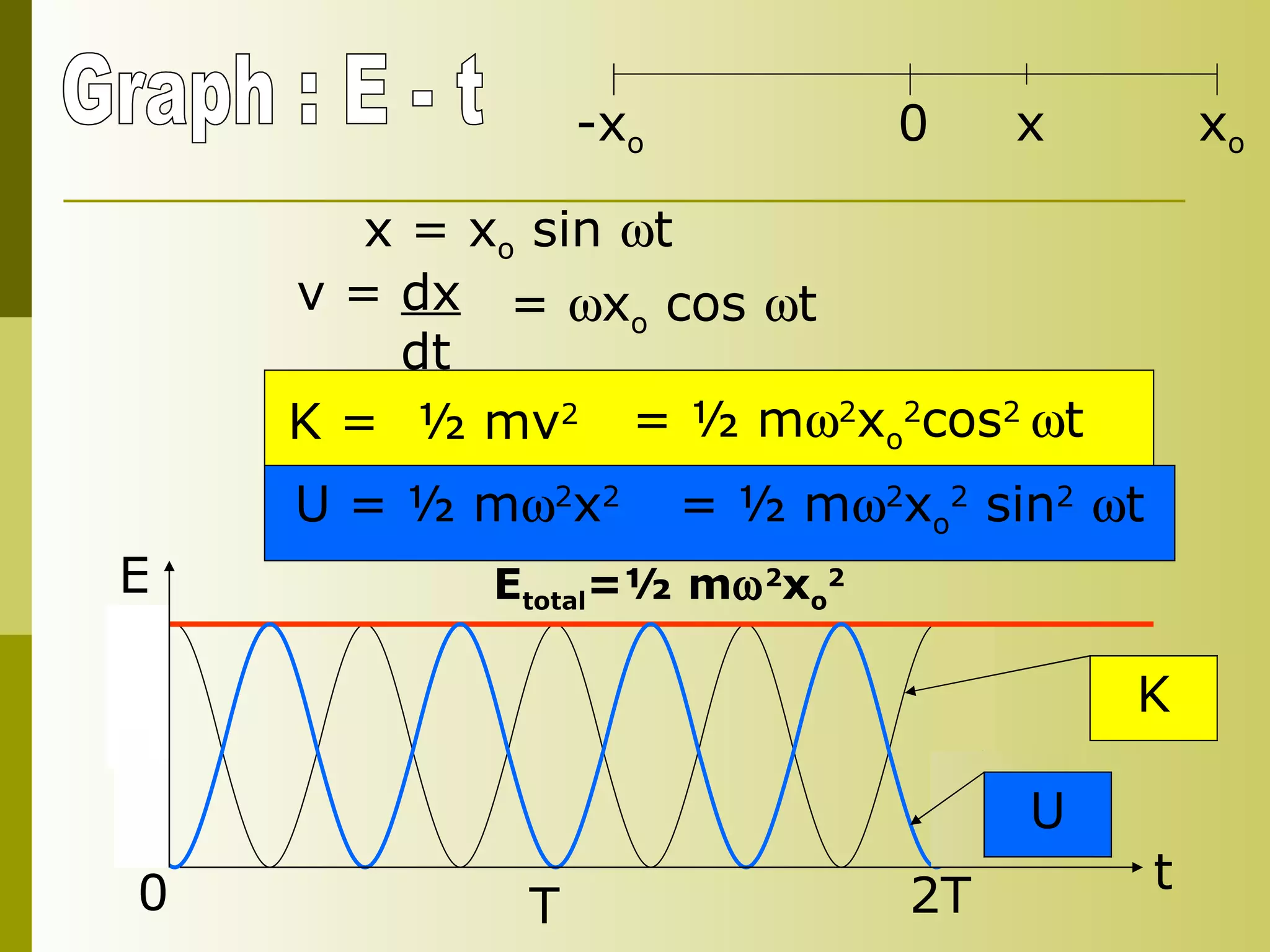
Graph : E - t x = x o  sin   t  v =  dx dt =   x o  cos   t K =  ½ mv 2 = ½ m  2 x o 2 cos 2   t U = ½ m  2 x 2 = ½ m  2 x o 2  sin 2    t E total =½ m  2 x o 2 T 2T K U -x o x o 0 x 0 E  t
Tutorial 25 Quick check 8.3  page 186

Simple harmonic motion1

  • 1.
  • 2.
    Characteristics of Simple Harmonic Motion A body is in simple harmonic motion if its acceleration is proportional to its displacement from a fix point O, and is always directed towards that fixed point. a  – x a = –  2 x Negative sign : Direction of a is opposite to x O -x o x o a a
  • 3.
    Some Common Examplesof Simple Harmonic Motion Vibrating Tuning fork A weight on a spring A boy on a swing 200 grams
  • 4.
    Definition : SHMmay be defined as the motion of a body which is subjected to a resultant force which is directly proportional to the displacement of the body from a fixed point and always directed towards that fixed point F  – x F = – kx
  • 5.
    O -x ox o Point of equilibrium : a = 0 F = 0 a x Measured from the point of equilibrium Amplitude : = x o =Maximum distance
  • 6.
    Tutorial 24 Quickcheck 8.1 page 177
  • 7.
    Kinematics of SimpleHarmonic Motion F = - kx ma = - kx a = k m - x a = -  2 x compare  2 = k m  = angular frequency = 2  f = 2  T
  • 8.
    F against xgraph & a against x graph F x 0 x o -x o a x 0 x o -x o  2 x o -  2 x o F = -kx a = -  2 x
  • 9.
    a = -  2 x d 2 x dt 2 = -  2 x x = x o sin (  t +  ) General solution dx dt =  x o cos (  t +  ) v = d 2 x dt 2 = -  2 x o sin (  t +  ) a = = -  2 x shown x = x o sin (  t +  ) phase  Phase constant
  • 10.
    x = xo sin (  t +  ) depends on the initial condition when t = 0 O -x o x o At t = 0, x = 0 0 = x o sin (  (0) +  ) sin (0 +  ) = 0 sin  = 0  = 0 Therefore : x = x o sin  t v =  x o cos  t a = -  2 x o sin  t = -  2 x
  • 11.
    graph : x - t , v - t , a - t x t 0 x = x o sin  t x o -x o T 2T v T 0 -  x o  x o v =  x o cos  t t 2T a t 0 a = -  2 x o sin  t  2 x o -  2 x o T 2T t=0, v=  x o t=0, a=0
  • 12.
    phase =  t +  /2 phase =  t phase x = x o sin  t v =  x o cos  t To compare the phase : They must all be expressed as same function (either as sine or cosine function) Phase difference : =(  t+ ) -  t  2 =  2 rad =  x o sin (  t +  /2) v leading x x t 0 x o -x o T 2T v T 0 -  x o  x o t 2T a t 0  2 x o -  2 x o T 2T
  • 13.
    phase =  t +  phase x = x o sin  t phase =  t v =  x o cos  t phase =  t +  /2 a = -  2 x o sin  t =  2 x o sin (  t +  ) Phase difference : =(  t+  ) -  t =  rad a leading x a and x are antiphase x t 0 x o -x o T 2T v T 0 -  x o  x o t 2T a t 0  2 x o -  2 x o T 2T
  • 14.
    compare the motionx t 0 x o -x o T 2T v T 0 -  x o  x o t 2T a t 0  2 x o -  2 x o T 2T
  • 15.
    example : -xo x o 0 t=0 x x = x o sin (  t +  ) General solution Substitute : t=0 , x = x o to find  x o = x o sin (  (0) +  ) sin  = 1  =  2 Therefore , equation of x is: x = x o sin (  t +  /2) t = x o cos  t
  • 16.
    example : Themotion of a body in simple harmonic motion is described by the equation : x = 4.0 cos ( 2  t + )  3 Where x is in metres, t is in seconds and (2  t + ) is in radians.  3 What is i) the displacement ii) the velocity iii) the acceleration and iv) the phase When t = 2.0 s ? b) Find i) the frequency ii) the period of the motion.
  • 17.
    solution : x= 4.0 cos ( 2  t + )  3 a) i) Displacement = ? t = 2.0 s ; x = 4.0 cos ( 2  (2) + )  3 = 2.0 m ii) velocity = ? v = dx dt = -2  (4.0) sin ( 2  t + )  3 v = -8.0  sin (4  + ) t = 2.0 s ;  3 = -21.8 ms -1
  • 18.
    solution : iii)acceleration = ? a = dv dt = -16.0  2 cos ( 2  t + )  3 t = 2.0 s ; a = -16.0  2 cos ( 2  (2) + )  3 = -79.0 ms -2 iv) Phase = ? x = 4.0 cos ( 2  t + )  3 Phase = 2  t +  3 t = 2.0 s ; Phase = 2  (2) +  3 = 13.6 rad
  • 19.
    example : Themotion of a body in simple harmonic motion is described by the equation : x = 4.0 cos ( 2  t + )  3 Where x is in metres, t is in seconds and (2  t + ) is in radians.  3 What is i) the displacement ii) the velocity iii) the acceleration and iv) the phase When t = 2.0 s ? b) Find i) the frequency ii) the period of the motion.
  • 20.
    solution : x= 4.0 cos ( 2  t + )  3 b) i) frequency = ? x = x o cos (  t +  ) General solution : compare  = 2  2  f = 2  f = 1.0 Hz ii) Period = ? T = 1 f = 1.0 s
  • 21.
    example : Figures(1) and (2) are the displacement-time graph and acceleration-time graph respectively of a body in simple harmonic motion. x,m 3 -3 t,s T 0 (1) a,ms -2 12 -12 t,s T 0 (2) What is the frequency of the motion? Write an expression to represent the variation of displacement x with time t.
  • 22.
    solution : frequency= ? x o = 3  2 x o = 12  2 (3) = 12 substitute  = 2 rad s -1 2  f = 2 f = 0.318 Hz x,m 3 -3 t,s T 0 (1) a,ms -2 12 -12 t,s T 0 (2)
  • 23.
    solution : expression= ? x = x o sin (  t +  ) General solution x o = 3 ,  = 2 ; x = 3 sin (2t +  ) At t = 0, x = 3 3 = 3 sin (2(0) +  ) sin  = 1  =  2 rad Therefore, the expression is x = 3 sin (2t + )  2 x = 3 cos 2t
  • 24.
    variation of vwith x a = dv = -  2 x dt dv x dx = -  2 x dx dt v dv = -  2 x dx   v 2 2 = -  2 x 2 2 + C When x = x o , v = 0 0 = -  2 x o 2 2 + C C =  2 x o 2 2 Hence ; v 2 2 = -  2 x 2 2  2 x o 2 2 + v 2 = -  2 x 2 +  2 x o 2 v =  x o 2 – x 2 v dv dx = -  2 x
  • 25.
    Graph : v - x  x o -  x o x o -x o v x 0 -x o O x o v =  x o 2 – x 2
  • 26.
    example : Aparticle performs simple harmonic motion with an amplitude of 0.50 cm and a period of 3.0 s. Calculate The angular frequency of the SHM The velocities of the particle when its displacement is 0.20 cm. Explain why there are two velocities.
  • 27.
    solution : a) = 2  f = 2  T = 2  3 = 2.09 rad s -1 b) =  (2.09) 0.5 2 – 0.2 2 =  0.958 cm s -1 v = +0.958 cms -1 when the particle is moving in the positive direction and v = –0.958 cms -1 when the particle passes through the same point in the opposite direction on the return journey. v =  x o 2 – x 2
  • 28.
    Tutorial 24 Quickcheck 8.1 and 8.2 page 177 and 183
  • 29.
    energy in simpleharmonic motion Total energy = E = K + U At point, x = 0 : K = ½ mv 2 = ½ m  2 (x o 2 – x 2 ) K = ½ m  2 (x o 2 – 0) = ½ m  2 x o 2 At point, x = 0 : U = 0 = maximum = ½ m  2 x o 2 + 0 = ½ m  2 x o 2 constant At point, x = x o : K = ½ m  2 (x o 2 –x o 2 ) = 0 = minimum -x o x o 0 x
  • 30.
    energy in simpleharmonic motion At any displacement,x E = K + U ½ m  2 x o 2 = ½ m  2 (x o 2 – x 2 ) + U = ½ m  2 x o 2 – ½ m  2 x 2 + U U = ½ m  2 x 2 -x o x o 0 x
  • 31.
    Graph : E- x K max = ½ m  2 x o 2 U = ½ m  2 x 2 K min = 0 ; ; E total =½ m  2 x o 2 K=½ m  2 (x o 2 – x 2 ) U = ½ m  2 x 2 0 E x -x o x o -x o x o 0 x
  • 32.
    Graph : F- x U = ½ m  2 x 2 F = – dU dx = – ½ (2) m  2 x = – m  2 x constant Therefore : F  x -x o x o m  x o -m  x o -x o x o 0 x 0 F x
  • 33.
    Graph : E- t x = x o sin (  t +  ) General solution 0 = x o sin (  (0) +  ) At t = 0 , x = 0 0 = sin   = 0 x = x o sin  t Therefore : The equation is -x o x o 0 x
  • 34.
    Graph : E- t x = x o sin  t v = dx dt =  x o cos  t K = ½ mv 2 = ½ m  2 x o 2 cos 2  t U = ½ m  2 x 2 = ½ m  2 x o 2 sin 2  t E total =½ m  2 x o 2 T 2T K U -x o x o 0 x 0 E t
  • 35.
    Tutorial 25 Quickcheck 8.3 page 186