SECTION 5.4

Mechanical Vibrations

In this section we discuss four types of free motion of a mass on a spring — undamped,
underdamped, critically damped, and overdamped. However, the undamped and underdamped
cases — in which actual oscillations occur — are emphasized because they are both the most
interesting and the most important cases for applications.

1.     Frequency: ω 0 = k / m = 16 / 4 = 2 rad / sec = 1/ π Hz
       Period: P = 2π / ω 0 = 2π / 2 = π sec

2.     Frequency ω 0 = k / m = 48 / 0.75 = 8 rad / sec = 4 / π Hz
       Period: P = 2π / ω 0 = 2π / 8 = π / 4 sec

3.     The spring constant is k = 15 N/0.20 m = 75 N/m. The solution of 3x″ + 75x = 0
       with x(0) = 0 and x′(0) = -10 is x(t) = -2 sin 5t. Thus the amplitude is 2 m; the
       frequency is ω 0 = k / m = 75 / 3 = 5 rad / sec = 2.5 / π Hz ; and the period is 2π/5 sec.

4.     (a)     With m = 1/4 kg and k = (9 N)/(0.25 m) = 36 N/m we find that ω0 = 12
       rad/sec. The solution of x″ + 144x = 0 with x(0) = 1 and x′(0) = -5 is

                             x(t) = cos 12t - (5/12)sin 12t
                                  = (13/12)[(12/13)cos 12t - (5/13)sin 12t]
                             x(t) = (13/12)cos(12t - α)

       where α = 2π - tan-1(5/12) ≈ 5.8884.

       (b)    C = 13/12 ≈ 1.0833 ft and T = 2π/12 ≈ 0.5236 sec.

5.     The gravitational acceleration at distance R from the center of the earth is g = GM/R2.
       According to Equation (6) in the text the (circular) frequency ω of a pendulum is given
       by ω2 = g/L = GM/R2L, so its period is p = 2π/ω = 2πR L / GM .

6.     If the pendulum in the clock executes n cycles per day (86400 sec) at Paris, then its
       period is p1 = 86400/n sec. At the equatorial location it takes 24 hr 2 min 40 sec =
       86560 sec for the same number of cycles, so its period there is p2 = 86560/n sec. Now
       let R1 = 3956 mi be the Earth′s "radius" at Paris, and R2 its "radius" at the equator.
       Then substitution in the equation p1 /p2 = R1 /R2 of Problem 5 (with L1 = L2) yields
       R2 = 3963.33 mi. Thus this (rather simplistic) calculation gives 7.33 mi as the thickness
       of the Earth's equatorial bulge.
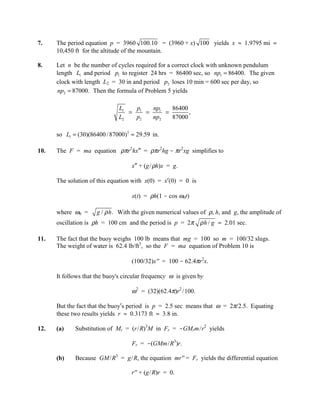
7.    The period equation p = 3960 100.10 = (3960 + x) 100 yields x ≈ 1.9795 mi ≈
      10,450 ft for the altitude of the mountain.

8.    Let n be the number of cycles required for a correct clock with unknown pendulum
      length L1 and period p1 to register 24 hrs = 86400 sec, so np1 = 86400. The given
      clock with length L2 = 30 in and period p2 loses 10 min = 600 sec per day, so
       np2 = 87000. Then the formula of Problem 5 yields

                               L1   p   np1   86400
                                  = 1 =     =       ,
                               L2   p2  np2   87000

      so L1 = (30)(86400 / 87000)2 ≈ 29.59 in.

10.   The F = ma equation ρπr2hx″ = ρπr2hg - πr2xg simplifies to

                                    x″ + (g/ ρh)x = g.

      The solution of this equation with x(0) = x′(0) = 0 is

                                    x(t) = ρh(1 - cos ω0t)

      where ω0 =      g / ρ h . With the given numerical values of ρ, h, and g, the amplitude of
      oscillation is ρh = 100 cm and the period is p = 2π ρ h / g ≈ 2.01 sec.

11.   The fact that the buoy weighs 100 lb means that mg = 100 so m = 100/32 slugs.
      The weight of water is 62.4 lb/ft3, so the F = ma equation of Problem 10 is

                                    (100/32)x'' = 100 - 62.4πr2x.

      It follows that the buoy's circular frequency ω is given by

                                    ω2 = (32)(62.4π)r2 /100.

      But the fact that the buoy′s period is p = 2.5 sec means that ω = 2π/2.5. Equating
      these two results yields r ≈ 0.3173 ft ≈ 3.8 in.

12.   (a)    Substitution of Mr = (r/R)3M in Fr = -GMrm/r2 yields

                                    Fr = -(GMm/R3)r.

      (b)    Because GM/R3 = g/R, the equation mr'' = Fr yields the differential equation

                                    r'' + (g/R)r = 0.
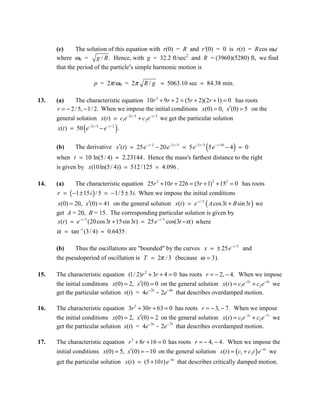
(c)     The solution of this equation with r(0) = R and r'(0) = 0 is r(t) = Rcos ω0t
      where ω0 = g / R . Hence, with g = 32.2 ft/sec2 and R = (3960)(5280) ft, we find
      that the period of the particle′s simple harmonic motion is

                          p = 2π/ω0 = 2π R / g ≈ 5063.10 sec ≈ 84.38 min.

13.   (a)     The characteristic equation 10r 2 + 9r + 2 = (5r + 2)(2r + 1) = 0 has roots
      r = − 2 / 5, − 1/ 2. When we impose the initial conditions x(0) = 0, x′(0) = 5 on the
      general solution x(t ) = c1e −2 t / 5 + c2 e − t / 2 we get the particular solution
                    (                 )
      x(t ) = 50 e −2 t / 5 − e − t / 2 .

      (b)                                                                    (            )
               The derivative x′(t ) = 25 e− t / 2 − 20 e−2 t / 5 = 5 e−2 t / 5 5 e− t /10 − 4 = 0
      when t = 10 ln(5 / 4) ≈ 2.23144 . Hence the mass's farthest distance to the right
      is given by x(10 ln(5 / 4)) = 512 /125 = 4.096 .

14.   (a)      The characteristic equation 25r 2 + 10r + 226 = (5r + 1) 2 + 152 = 0 has roots
      r = ( −1 ± 15 i ) / 5 = − 1/ 5 ± 3 i. When we impose the initial conditions
      x(0) = 20, x′(0) = 41 on the general solution x(t ) = e − t / 5 ( A cos 3t + B sin 3t ) we
      get A = 20, B = 15. The corresponding particular solution is given by
      x(t ) = e − t / 5 (20 cos 3t + 15sin 3t ) = 25 e − t / 5 cos(3t − α ) where
      α = tan −1 (3 / 4) ≈ 0.6435 .

      (b)    Thus the oscillations are "bounded" by the curves x = ± 25 e− t / 5 and
      the pseudoperiod of oscillation is T = 2π / 3 (because ω = 3 ).

15.   The characteristic equation (1/ 2)r 2 + 3r + 4 = 0 has roots r = − 2, − 4. When we impose
      the initial conditions x(0) = 2, x′(0) = 0 on the general solution x(t ) = c1e −2 t + c2 e−4 t we
      get the particular solution x(t) = 4e-2t - 2e-4t that describes overdamped motion.

16.   The characteristic equation 3r 2 + 30r + 63 = 0 has roots r = − 3, − 7. When we impose
      the initial conditions x(0) = 2, x′(0) = 2 on the general solution x(t ) = c1e −3 t + c2 e −7 t we
      get the particular solution x(t) = 4e-3t - 2e-7t that describes overdamped motion.

17.   The characteristic equation r 2 + 8r + 16 = 0 has roots r = − 4, − 4. When we impose the
      initial conditions x(0) = 5, x′(0) = − 10 on the general solution x(t ) = ( c1 + c2t ) e −4 t we
      get the particular solution x(t ) = (5 + 10 t ) e−4 t that describes critically damped motion.
18.   The characteristic equation 2r 2 + 12r + 50 = 0 has roots r = − 3 ± 4 i. When we impose
      the initial conditions x(0) = 0, x′(0) = − 8 on the general solution
      x(t ) = e−3t ( A cos 4t + B sin 4t ) we get the particular solution
      x(t ) = − 2 e −3t sin 4t = 2 e −3t cos(4t − π / 2) that describes underdamped motion.

19.   The characteristic equation 4r 2 + 20r + 169 = 0 has roots r = − 5 / 2 ± 6 i. When we
      impose the initial conditions x(0) = 4, x′(0) = 16 on the general solution
       x(t ) = e−5 t / 2 ( A cos 6t + B sin 6t ) we get the particular solution

              x(t) = e-5t/2 [4 cos 6t + (13/3) sin 2t] ≈ (1/3) 313 e-5t/2 cos(6t - 0.8254)

      that describes underdamped motion.

20.   The characteristic equation 2r 2 + 16r + 40 = 0 has roots r = − 4 ± 2 i. When we impose
      the initial conditions x(0) = 5, x′(0) = 4 on the general solution
      x(t ) = e−4 t ( A cos 2t + B sin 4t ) we get the particular solution

              x(t) = e-4t (5 cos 2t + 12 sin 2t) ≈ 13 e-4t cos(2t - 1.1760)

      that describes underdamped motion.

21.   The characteristic equation r 2 + 10r + 125 = 0 has roots r = − 5 ± 10 i. When we impose
      the initial conditions x(0) = 6, x′(0) = 50 on the general solution
       x(t ) = e−5 t ( A cos10t + B sin10t ) we get the particular solution

              x(t) = e-5t (6 cos 10t + 8 sin 10t) ≈ 10 e-5t cos(10t - 0.9273)

      that describes underdamped motion.

22.   (a)     With m = 12/32 = 3/8 slug, c = 3 lb-sec/ft, and k = 24 lb/ft, the differential
      equation is equivalent to 3x″ + 24x′ + 192x = 0. The characteristic equation
      3r 2 + 24r + 192 = 0 has roots r = − 4 ± 4 3 i. When we impose the initial conditions
                                                                   (                      )
      x(0) = 1, x′(0) = 0 on the general solution x(t ) = e−4 t A cos 4t 3 + B sin 4t 3 we get
      the particular solution

                                x(t) = e-4t [cos 4t 3 + (1/ 3 )sin 4t 3 ]

                                     = (2/ 3 )e-4t [( 3 /2)cos 4t 3 + (1/2)sin 4t 3 ]

                                x(t) = (2/ 3 )e-4t cos(4t 3 – π / 6 ).
(b)     The time-varying amplitude is 2/ 3 ≈ 1.15 ft; the frequency is 4 3 ≈ 6.93
      rad/sec; and the phase angle is π / 6 .

23.   (a)    With m = 100 slugs we get ω =               k /100 . But we are given that

                                ω = (80 cycles/min)(2π)(1 min/60 sec) = 8π/3,

      and equating the two values yields k ≈ 7018 lb/ft.

      (b)      With ω1 = 2π(78/60) sec-1, Equation (21) in the text yields c ≈ 372.31
      lb/(ft/sec). Hence p = c/2m ≈ 1.8615. Finally e-pt = 0.01 gives t ≈ 2.47 sec.

30.   In the underdamped case we have

                         x(t) = e-pt [A cos ω1t + B sin ω1t],
                         x′(t) = -pept [A cos ω1t + B sin ω1t] + e-pt [-Aω1sin ω1t + Bω1cos ω1t].

      The conditions x(0) = x0, x′(0) = v0 yield the equations A = x0 and
      -pA + Bω1 = v0, whence B = (v0 + px0)/ ω1.

31.   The binomial series

                                      α (α − 1) 2 α (α − 1)(α − 2) 3
             (1 + x )
                     α
                          = 1+α x +            x +                x +
                                         2!              3!

      converges if x  1. (See, for instance, Section 11.8 of Edwards and Penney, Calculus
      with Analytic Geometry, 5th edition, Prentice Hall, 1998.) With α = 1/ 2 and
      x = − c 2 / 4mk in Eq. (21) of Section 5.4 in this text, the binomial series gives

                                        k   c2         k     c2
             ω1 =        ω0 − p 2 =
                          2
                                          −    =         1−
                                        m 4m 2         m    4 mk
                         k       c2   c4                    c2 
                 =            1−    −    2 2
                                              −   ≈ ω 0 1 −    .
                         m    8mk 128m k                 8mk 


32.   If x(t) = Ce-pt cos(ω1t - α) then

                         x′(t) = -pCe-pt cos(ω1t - α) + Cω1e-pt sin(ω1t - α) = 0

      yields tan(ω1t - α) = -p/ ω1.
33.   If x1 = x(t1) and x2 = x(t2) are two successive local maxima, then ω1t2 = ω1t1 + 2π
      so
                     x1 = C exp(-pt1) cos(ω1t1 - α),
                       x2 = C exp(-pt2) cos(ω1t2 - α) = C exp(-pt2) cos(ω1t1 - α).

      Hence x1 /x2 = exp[-p(t1 - t2)], and therefore

                                ln(x1 /x2) = -p(t1 - t2) = 2πp/ ω1.

34.   With t1 = 0.34 and t2 = 1.17 we first use the equation ω1t2 = ω1t1 + 2π from
      Problem 32 to calculate ω1 = 2π/(0.83) ≈ 7.57 rad/sec. Next, with x1 = 6.73 and
      x2 = 1.46, the result of Problem 33 yields

                                p = (1/0.83) ln(6.73/1.46) ≈ 1.84.

      Then Equation (16) in this section gives

                                c = 2mp = 2(100/32)(1.84) ≈ 11.51 lb-sec/ft,

      and finally Equation (21) yields

                                k = (4m2ω12 + c2)/4m ≈ 189.68 lb/ft.

35.   The characteristic equation r 2 + 2r + 1 = 0 has roots r = − 1, − 1. When we impose the
      initial conditions x(0) = 0, x′(1) = 0 on the general solution x(t ) = ( c1 + c2t ) e − t we get
      the particular solution x1 (t ) = t e − t .

36.   The characteristic equation r 2 + 2r + (1 − 10 −2 n ) = 0 has roots r = − 1 ± 10− n. When we
      impose the initial conditions x(0) = 0, x′(1) = 0 on the general solution

                                (             )           (          )
               x(t ) = c1 exp  −1 + 10− n t  + c1 exp  −1 − 10− n t 
                                                                    
      we get the equations
               c1 + c2 = 0,     (−1 + 10 ) c + (−1 − 10 ) c
                                         −n
                                                  1
                                                          −n
                                                               2   = 1

      with solution c1 = 2n −15n , c2 = 2 n −15n. This gives the particular solution

                                    exp(10− n t ) − exp( −10− n t ) 
               x2 (t ) = 10n e − t                                        n −t      −n
                                                                      = 10 e sinh(10 t ).
                                                   2                
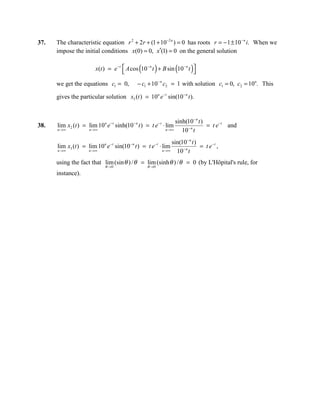
37.   The characteristic equation r 2 + 2r + (1 + 10−2 n ) = 0 has roots r = − 1 ± 10− n i. When we
      impose the initial conditions x(0) = 0, x′(1) = 0 on the general solution

                                                (       )            (
                         x(t ) = e − t  A cos 10 − n t + B sin 10− n t 
                                                                        )
      we get the equations c1 = 0,             − c1 + 10− n c2 = 1 with solution c1 = 0, c2 = 10n. This

      gives the particular solution x3 (t ) = 10n e− t sin(10− n t ).


                                                                  sinh(10− n t )
38.   lim x2 (t ) = lim 10 n e − t sinh(10 − n t ) = t e − t ⋅ lim     −n
                                                                                 = t e − t and
      n →∞            n →∞                                   n →∞    10 t
                                                                 sin(10− n t )
      lim x3 (t ) = lim 10 n e − t sin(10− n t ) = t e − t ⋅ lim      −n
                                                                               = t e−t ,
      n →∞            n →∞                                  n →∞   10 t
      using the fact that lim (sin θ ) / θ = lim (sinh θ ) / θ = 0 (by L'Hôpital's rule, for
                              θ →0                  θ →0
      instance).

Sect5 4

  • 1.
    SECTION 5.4 Mechanical Vibrations Inthis section we discuss four types of free motion of a mass on a spring — undamped, underdamped, critically damped, and overdamped. However, the undamped and underdamped cases — in which actual oscillations occur — are emphasized because they are both the most interesting and the most important cases for applications. 1. Frequency: ω 0 = k / m = 16 / 4 = 2 rad / sec = 1/ π Hz Period: P = 2π / ω 0 = 2π / 2 = π sec 2. Frequency ω 0 = k / m = 48 / 0.75 = 8 rad / sec = 4 / π Hz Period: P = 2π / ω 0 = 2π / 8 = π / 4 sec 3. The spring constant is k = 15 N/0.20 m = 75 N/m. The solution of 3x″ + 75x = 0 with x(0) = 0 and x′(0) = -10 is x(t) = -2 sin 5t. Thus the amplitude is 2 m; the frequency is ω 0 = k / m = 75 / 3 = 5 rad / sec = 2.5 / π Hz ; and the period is 2π/5 sec. 4. (a) With m = 1/4 kg and k = (9 N)/(0.25 m) = 36 N/m we find that ω0 = 12 rad/sec. The solution of x″ + 144x = 0 with x(0) = 1 and x′(0) = -5 is x(t) = cos 12t - (5/12)sin 12t = (13/12)[(12/13)cos 12t - (5/13)sin 12t] x(t) = (13/12)cos(12t - α) where α = 2π - tan-1(5/12) ≈ 5.8884. (b) C = 13/12 ≈ 1.0833 ft and T = 2π/12 ≈ 0.5236 sec. 5. The gravitational acceleration at distance R from the center of the earth is g = GM/R2. According to Equation (6) in the text the (circular) frequency ω of a pendulum is given by ω2 = g/L = GM/R2L, so its period is p = 2π/ω = 2πR L / GM . 6. If the pendulum in the clock executes n cycles per day (86400 sec) at Paris, then its period is p1 = 86400/n sec. At the equatorial location it takes 24 hr 2 min 40 sec = 86560 sec for the same number of cycles, so its period there is p2 = 86560/n sec. Now let R1 = 3956 mi be the Earth′s "radius" at Paris, and R2 its "radius" at the equator. Then substitution in the equation p1 /p2 = R1 /R2 of Problem 5 (with L1 = L2) yields R2 = 3963.33 mi. Thus this (rather simplistic) calculation gives 7.33 mi as the thickness of the Earth's equatorial bulge.
  • 2.
    7. The period equation p = 3960 100.10 = (3960 + x) 100 yields x ≈ 1.9795 mi ≈ 10,450 ft for the altitude of the mountain. 8. Let n be the number of cycles required for a correct clock with unknown pendulum length L1 and period p1 to register 24 hrs = 86400 sec, so np1 = 86400. The given clock with length L2 = 30 in and period p2 loses 10 min = 600 sec per day, so np2 = 87000. Then the formula of Problem 5 yields L1 p np1 86400 = 1 = = , L2 p2 np2 87000 so L1 = (30)(86400 / 87000)2 ≈ 29.59 in. 10. The F = ma equation ρπr2hx″ = ρπr2hg - πr2xg simplifies to x″ + (g/ ρh)x = g. The solution of this equation with x(0) = x′(0) = 0 is x(t) = ρh(1 - cos ω0t) where ω0 = g / ρ h . With the given numerical values of ρ, h, and g, the amplitude of oscillation is ρh = 100 cm and the period is p = 2π ρ h / g ≈ 2.01 sec. 11. The fact that the buoy weighs 100 lb means that mg = 100 so m = 100/32 slugs. The weight of water is 62.4 lb/ft3, so the F = ma equation of Problem 10 is (100/32)x'' = 100 - 62.4πr2x. It follows that the buoy's circular frequency ω is given by ω2 = (32)(62.4π)r2 /100. But the fact that the buoy′s period is p = 2.5 sec means that ω = 2π/2.5. Equating these two results yields r ≈ 0.3173 ft ≈ 3.8 in. 12. (a) Substitution of Mr = (r/R)3M in Fr = -GMrm/r2 yields Fr = -(GMm/R3)r. (b) Because GM/R3 = g/R, the equation mr'' = Fr yields the differential equation r'' + (g/R)r = 0.
  • 3.
    (c) The solution of this equation with r(0) = R and r'(0) = 0 is r(t) = Rcos ω0t where ω0 = g / R . Hence, with g = 32.2 ft/sec2 and R = (3960)(5280) ft, we find that the period of the particle′s simple harmonic motion is p = 2π/ω0 = 2π R / g ≈ 5063.10 sec ≈ 84.38 min. 13. (a) The characteristic equation 10r 2 + 9r + 2 = (5r + 2)(2r + 1) = 0 has roots r = − 2 / 5, − 1/ 2. When we impose the initial conditions x(0) = 0, x′(0) = 5 on the general solution x(t ) = c1e −2 t / 5 + c2 e − t / 2 we get the particular solution ( ) x(t ) = 50 e −2 t / 5 − e − t / 2 . (b) ( ) The derivative x′(t ) = 25 e− t / 2 − 20 e−2 t / 5 = 5 e−2 t / 5 5 e− t /10 − 4 = 0 when t = 10 ln(5 / 4) ≈ 2.23144 . Hence the mass's farthest distance to the right is given by x(10 ln(5 / 4)) = 512 /125 = 4.096 . 14. (a) The characteristic equation 25r 2 + 10r + 226 = (5r + 1) 2 + 152 = 0 has roots r = ( −1 ± 15 i ) / 5 = − 1/ 5 ± 3 i. When we impose the initial conditions x(0) = 20, x′(0) = 41 on the general solution x(t ) = e − t / 5 ( A cos 3t + B sin 3t ) we get A = 20, B = 15. The corresponding particular solution is given by x(t ) = e − t / 5 (20 cos 3t + 15sin 3t ) = 25 e − t / 5 cos(3t − α ) where α = tan −1 (3 / 4) ≈ 0.6435 . (b) Thus the oscillations are "bounded" by the curves x = ± 25 e− t / 5 and the pseudoperiod of oscillation is T = 2π / 3 (because ω = 3 ). 15. The characteristic equation (1/ 2)r 2 + 3r + 4 = 0 has roots r = − 2, − 4. When we impose the initial conditions x(0) = 2, x′(0) = 0 on the general solution x(t ) = c1e −2 t + c2 e−4 t we get the particular solution x(t) = 4e-2t - 2e-4t that describes overdamped motion. 16. The characteristic equation 3r 2 + 30r + 63 = 0 has roots r = − 3, − 7. When we impose the initial conditions x(0) = 2, x′(0) = 2 on the general solution x(t ) = c1e −3 t + c2 e −7 t we get the particular solution x(t) = 4e-3t - 2e-7t that describes overdamped motion. 17. The characteristic equation r 2 + 8r + 16 = 0 has roots r = − 4, − 4. When we impose the initial conditions x(0) = 5, x′(0) = − 10 on the general solution x(t ) = ( c1 + c2t ) e −4 t we get the particular solution x(t ) = (5 + 10 t ) e−4 t that describes critically damped motion.
  • 4.
    18. The characteristic equation 2r 2 + 12r + 50 = 0 has roots r = − 3 ± 4 i. When we impose the initial conditions x(0) = 0, x′(0) = − 8 on the general solution x(t ) = e−3t ( A cos 4t + B sin 4t ) we get the particular solution x(t ) = − 2 e −3t sin 4t = 2 e −3t cos(4t − π / 2) that describes underdamped motion. 19. The characteristic equation 4r 2 + 20r + 169 = 0 has roots r = − 5 / 2 ± 6 i. When we impose the initial conditions x(0) = 4, x′(0) = 16 on the general solution x(t ) = e−5 t / 2 ( A cos 6t + B sin 6t ) we get the particular solution x(t) = e-5t/2 [4 cos 6t + (13/3) sin 2t] ≈ (1/3) 313 e-5t/2 cos(6t - 0.8254) that describes underdamped motion. 20. The characteristic equation 2r 2 + 16r + 40 = 0 has roots r = − 4 ± 2 i. When we impose the initial conditions x(0) = 5, x′(0) = 4 on the general solution x(t ) = e−4 t ( A cos 2t + B sin 4t ) we get the particular solution x(t) = e-4t (5 cos 2t + 12 sin 2t) ≈ 13 e-4t cos(2t - 1.1760) that describes underdamped motion. 21. The characteristic equation r 2 + 10r + 125 = 0 has roots r = − 5 ± 10 i. When we impose the initial conditions x(0) = 6, x′(0) = 50 on the general solution x(t ) = e−5 t ( A cos10t + B sin10t ) we get the particular solution x(t) = e-5t (6 cos 10t + 8 sin 10t) ≈ 10 e-5t cos(10t - 0.9273) that describes underdamped motion. 22. (a) With m = 12/32 = 3/8 slug, c = 3 lb-sec/ft, and k = 24 lb/ft, the differential equation is equivalent to 3x″ + 24x′ + 192x = 0. The characteristic equation 3r 2 + 24r + 192 = 0 has roots r = − 4 ± 4 3 i. When we impose the initial conditions ( ) x(0) = 1, x′(0) = 0 on the general solution x(t ) = e−4 t A cos 4t 3 + B sin 4t 3 we get the particular solution x(t) = e-4t [cos 4t 3 + (1/ 3 )sin 4t 3 ] = (2/ 3 )e-4t [( 3 /2)cos 4t 3 + (1/2)sin 4t 3 ] x(t) = (2/ 3 )e-4t cos(4t 3 – π / 6 ).
  • 5.
    (b) The time-varying amplitude is 2/ 3 ≈ 1.15 ft; the frequency is 4 3 ≈ 6.93 rad/sec; and the phase angle is π / 6 . 23. (a) With m = 100 slugs we get ω = k /100 . But we are given that ω = (80 cycles/min)(2π)(1 min/60 sec) = 8π/3, and equating the two values yields k ≈ 7018 lb/ft. (b) With ω1 = 2π(78/60) sec-1, Equation (21) in the text yields c ≈ 372.31 lb/(ft/sec). Hence p = c/2m ≈ 1.8615. Finally e-pt = 0.01 gives t ≈ 2.47 sec. 30. In the underdamped case we have x(t) = e-pt [A cos ω1t + B sin ω1t], x′(t) = -pept [A cos ω1t + B sin ω1t] + e-pt [-Aω1sin ω1t + Bω1cos ω1t]. The conditions x(0) = x0, x′(0) = v0 yield the equations A = x0 and -pA + Bω1 = v0, whence B = (v0 + px0)/ ω1. 31. The binomial series α (α − 1) 2 α (α − 1)(α − 2) 3 (1 + x ) α = 1+α x + x + x + 2! 3! converges if x 1. (See, for instance, Section 11.8 of Edwards and Penney, Calculus with Analytic Geometry, 5th edition, Prentice Hall, 1998.) With α = 1/ 2 and x = − c 2 / 4mk in Eq. (21) of Section 5.4 in this text, the binomial series gives k c2 k c2 ω1 = ω0 − p 2 = 2 − = 1− m 4m 2 m 4 mk k  c2 c4   c2  =  1− − 2 2 −  ≈ ω 0 1 − . m  8mk 128m k   8mk  32. If x(t) = Ce-pt cos(ω1t - α) then x′(t) = -pCe-pt cos(ω1t - α) + Cω1e-pt sin(ω1t - α) = 0 yields tan(ω1t - α) = -p/ ω1.
  • 6.
    33. If x1 = x(t1) and x2 = x(t2) are two successive local maxima, then ω1t2 = ω1t1 + 2π so x1 = C exp(-pt1) cos(ω1t1 - α), x2 = C exp(-pt2) cos(ω1t2 - α) = C exp(-pt2) cos(ω1t1 - α). Hence x1 /x2 = exp[-p(t1 - t2)], and therefore ln(x1 /x2) = -p(t1 - t2) = 2πp/ ω1. 34. With t1 = 0.34 and t2 = 1.17 we first use the equation ω1t2 = ω1t1 + 2π from Problem 32 to calculate ω1 = 2π/(0.83) ≈ 7.57 rad/sec. Next, with x1 = 6.73 and x2 = 1.46, the result of Problem 33 yields p = (1/0.83) ln(6.73/1.46) ≈ 1.84. Then Equation (16) in this section gives c = 2mp = 2(100/32)(1.84) ≈ 11.51 lb-sec/ft, and finally Equation (21) yields k = (4m2ω12 + c2)/4m ≈ 189.68 lb/ft. 35. The characteristic equation r 2 + 2r + 1 = 0 has roots r = − 1, − 1. When we impose the initial conditions x(0) = 0, x′(1) = 0 on the general solution x(t ) = ( c1 + c2t ) e − t we get the particular solution x1 (t ) = t e − t . 36. The characteristic equation r 2 + 2r + (1 − 10 −2 n ) = 0 has roots r = − 1 ± 10− n. When we impose the initial conditions x(0) = 0, x′(1) = 0 on the general solution ( ) ( ) x(t ) = c1 exp  −1 + 10− n t  + c1 exp  −1 − 10− n t      we get the equations c1 + c2 = 0, (−1 + 10 ) c + (−1 − 10 ) c −n 1 −n 2 = 1 with solution c1 = 2n −15n , c2 = 2 n −15n. This gives the particular solution  exp(10− n t ) − exp( −10− n t )  x2 (t ) = 10n e − t  n −t −n  = 10 e sinh(10 t ).  2 
  • 7.
    37. The characteristic equation r 2 + 2r + (1 + 10−2 n ) = 0 has roots r = − 1 ± 10− n i. When we impose the initial conditions x(0) = 0, x′(1) = 0 on the general solution ( ) ( x(t ) = e − t  A cos 10 − n t + B sin 10− n t    ) we get the equations c1 = 0, − c1 + 10− n c2 = 1 with solution c1 = 0, c2 = 10n. This gives the particular solution x3 (t ) = 10n e− t sin(10− n t ). sinh(10− n t ) 38. lim x2 (t ) = lim 10 n e − t sinh(10 − n t ) = t e − t ⋅ lim −n = t e − t and n →∞ n →∞ n →∞ 10 t sin(10− n t ) lim x3 (t ) = lim 10 n e − t sin(10− n t ) = t e − t ⋅ lim −n = t e−t , n →∞ n →∞ n →∞ 10 t using the fact that lim (sin θ ) / θ = lim (sinh θ ) / θ = 0 (by L'Hôpital's rule, for θ →0 θ →0 instance).