Copyright © 2013 Quintiles
Biosimilars Knowledge Connect Slide Resource
This slide deck has been designed to be used as a central resource from which pertinent slides can be extracted as
needed and is not intended for use in its entirety
Pooja Rani
Submitted by: Submitted To:
DR. Suneel Gupta
2
Introduction to biological medicines
and biosimilars
• A biosimilar is an approved version of a biological medicine with an
identical primary amino acid sequence to the originator and developed with
the intention to be as close to the originator as possible
• Like biological medicines, biosimilars are complex protein molecules that are
produced by living organisms
• During the past 15 years, biological medicines have had a profound impact on
healthcare
> primarily in the areas of rheumatology and oncology
> as well as endocrinology, cardiology, dermatology, gastroenterology, and neurology
• Many of the world’s top-selling medicines are now biological medicines
• However, biological medicines are expensive (sometimes by several orders of
magnitude more than small-molecule chemical drugs), limiting patient access
• As many biological medicines come off patent globally, there is great interest
in the development of biosimilars, which are likely to be more affordable
3
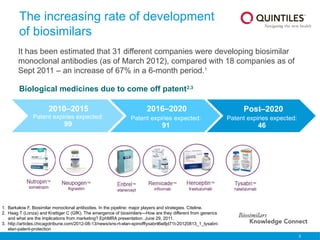
The increasing rate of development
of biosimilars
Patent expiries expected:
99
Patent expiries expected:
91
Patent expiries expected:
46
Biological medicines due to come off patent2,3
It has been estimated that 31 different companies were developing biosimilar
monoclonal antibodies (as of March 2012), compared with 18 companies as of
Sept 2011 – an increase of 67% in a 6-month period.1
1. Barkalow F, Biosimilar monoclonal antibodies. In the pipeline: major players and strategies. Citeline.
2. Haag T (Lonza) and Krattiger C (GfK). The emergence of biosimilars—How are they different from generics
and what are the implications from marketing? EphMRA presentation. June 29, 2011.
3. http://articles.chicagotribune.com/2012-08-13/news/sns-rt-elan-spinofftysabril6e8jd71t-20120813_1_tysabri-
elan-patent-protection
2010–2015 2016–2020 Post–2020
4
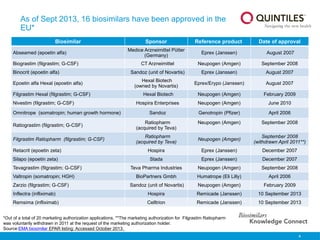
As of Sept 2013, 16 biosimilars have been approved in the
EU*
Biosimilar Sponsor Reference product Date of approval
Abseamed (epoetin alfa)
Medice Arzneimittel Pütter
(Germany)
Eprex (Janssen) August 2007
Biograstim (filgrastim; G-CSF) CT Arzneimittel Neupogen (Amgen) September 2008
Binocrit (epoetin alfa) Sandoz (unit of Novartis) Eprex (Janssen) August 2007
Epoetin alfa Hexal (epoetin alfa)
Hexal Biotech
(owned by Novartis)
Eprex/Erypo (Janssen) August 2007
Filgrastim Hexal (filgrastim; G-CSF) Hexal Biotech Neupogen (Amgen) February 2009
Nivestim (filgrastim; G-CSF) Hospira Enterprises Neupogen (Amgen) June 2010
Omnitrope (somatropin; human growth hormone) Sandoz Genotropin (Pfizer) April 2006
Ratiograstim (filgrastim; G-CSF)
Ratiopharm
(acquired by Teva)
Neupogen (Amgen) September 2008
Filgrastim Ratiopharm (filgrastim; G-CSF)
Ratiopharm
(acquired by Teva)
Neupogen (Amgen)
September 2008
(withdrawn April 2011**)
Retacrit (epoetin zeta) Hospira Eprex (Janssen) December 2007
Silapo (epoetin zeta) Stada Eprex (Janssen) December 2007
Tevagrastim (filgrastim; G-CSF) Teva Pharma Industries Neupogen (Amgen) September 2008
Valtropin (somatropin; HGH) BioPartners Gmbh Humatrope (Eli Lilly) April 2006
Zarzio (filgrastim; G-CSF) Sandoz (unit of Novartis) Neupogen (Amgen) February 2009
Inflectra (infliximab) Hospira Remicade (Janssen) 10 September 2013
Remsima (infliximab) Celltrion Remicade (Janssen) 10 September 2013
*Out of a total of 20 marketing authorization applications. **The marketing authorization for Filgrastim Ratiopharm
was voluntarily withdrawn in 2011 at the request of the marketing authorization holder.
Source:EMA biosimilar EPAR listing: Accessed October 2013.
5
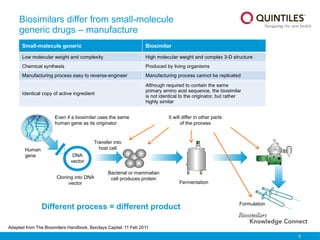
Even if a biosimilar uses the same
human gene as its originator
It will differ in other parts
of the process
Human
gene DNA
vector
Cloning into DNA
vector
Transfer into
host cell
Bacterial or mammalian
cell produces protein
Fermentation
Formulation
Different process = different product
Small-molecule generic Biosimilar
Low molecular weight and complexity High molecular weight and complex 3-D structure
Chemical synthesis Produced by living organisms
Manufacturing process easy to reverse-engineer Manufacturing process cannot be replicated
Identical copy of active ingredient
Although required to contain the same
primary amino acid sequence, the biosimilar
is not identical to the originator, but rather
highly similar
Biosimilars differ from small-molecule
generic drugs – manufacture
Adapted from The Biosimilars Handbook, Barclays Capital, 11 Feb 2011
6
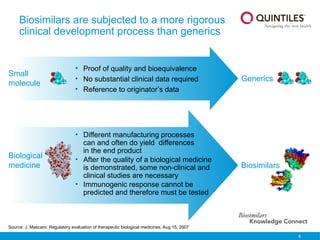
Biosimilars are subjected to a more rigorous
clinical development process than generics
Biosimilars
Generics
• Proof of quality and bioequivalence
• No substantial clinical data required
• Reference to originator’s data
• Different manufacturing processes
can and often do yield differences
in the end product
• After the quality of a biological medicine
is demonstrated, some non-clinical and
clinical studies are necessary
• Immunogenic response cannot be
predicted and therefore must be tested
Source: J. Mascaro: Regulatory evaluation of therapeutic biological medicines, Aug 15, 2007
Small
molecule
Biological
medicine
7
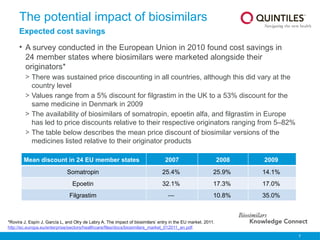
The potential impact of biosimilars
• A survey conducted in the European Union in 2010 found cost savings in
24 member states where biosimilars were marketed alongside their
originators*
> There was sustained price discounting in all countries, although this did vary at the
country level
> Values range from a 5% discount for filgrastim in the UK to a 53% discount for the
same medicine in Denmark in 2009
> The availability of biosimilars of somatropin, epoetin alfa, and filgrastim in Europe
has led to price discounts relative to their respective originators ranging from 5–82%
> The table below describes the mean price discount of biosimilar versions of the
medicines listed relative to their originator products
Expected cost savings
Mean discount in 24 EU member states 2007 2008 2009
Somatropin 25.4% 25.9% 14.1%
Epoetin 32.1% 17.3% 17.0%
Filgrastim ‐‐‐ 10.8% 35.0%
*Rovira J, Espín J, García L, and Olry de Labry A. The impact of biosimilars’ entry in the EU market. 2011.
http://ec.europa.eu/enterprise/sectors/healthcare/files/docs/biosimilars_market_012011_en.pdf.
8
Adapted with permission from Macmillan Publishers Ltd: Clin Pharmacol Ther (McCamish M and Woollett G. The
state of the art in the development of biosimilars. 91(3):405–417), © 2012
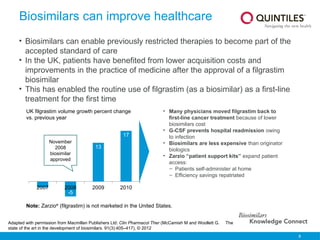
Biosimilars can improve healthcare
• Biosimilars can enable previously restricted therapies to become part of the
accepted standard of care
• In the UK, patients have benefited from lower acquisition costs and
improvements in the practice of medicine after the approval of a filgrastim
biosimilar
• This has enabled the routine use of filgrastim (as a biosimilar) as a first-line
treatment for the first time
2007 2008 2009 2010
-2
-5
13
17
November
2008
biosimilar
approved
Note: Zarzio®
(filgrastim) is not marketed in the United States.
UK filgrastim volume growth percent change
vs. previous year
• Many physicians moved filgrastim back to
first-line cancer treatment because of lower
biosimilars cost
• G-CSF prevents hospital readmission owing
to infection
• Biosimilars are less expensive than originator
biologics
• Zarzio “patient support kits” expand patient
access:
– Patients self-administer at home
– Efficiency savings repatriated
9
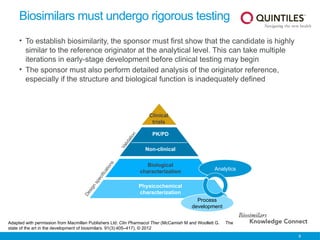
Biosimilars must undergo rigorous testing
• To establish biosimilarity, the sponsor must first show that the candidate is highly
similar to the reference originator at the analytical level. This can take multiple
iterations in early-stage development before clinical testing may begin
• The sponsor must also perform detailed analysis of the originator reference,
especially if the structure and biological function is inadequately defined
Physicochemical
characterization
Biological
characterization
Non-clinical
PK/PD
Clinical
trials
Analytics
D
e
s
i
g
n
s
p
e
c
i
f
i
c
a
t
i
o
n
s
V
a
l
i
d
a
t
i
o
n
Process
development
Adapted with permission from Macmillan Publishers Ltd: Clin Pharmacol Ther (McCamish M and Woollett G. The
state of the art in the development of biosimilars. 91(3):405–417), © 2012
10
Examples of copies of biological medicines
from largely unregulated markets may not
meet today’s rigorous standards
• In the past, copies of biological medicines have been produced in some
countries where a rigorous regulatory pathway had not been established for
biosimilars
• These are known as copy-biologics, alternative biologics or intended copies
of biological products
• They may not meet the current criteria defined by the FDA or EMA for
biosimilarity and would not be approved in most regulated markets at the
present time without additional testing
• As guidelines are established worldwide to standardize the testing of
biosimilars for comparability against an originator product, the development
of such products becomes less widespread*
*Barkalow F, Biosimilar monoclonal antibodies. In the pipeline: major players and strategies. Citeline.
11
Why immunogenicity testing is essential
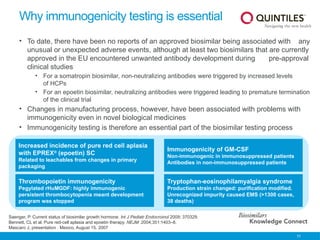
• To date, there have been no reports of an approved biosimilar being associated with any
unusual or unexpected adverse events, although at least two biosimilars that are currently
approved in the EU encountered unwanted antibody development during pre-approval
clinical studies
• For a somatropin biosimilar, non-neutralizing antibodies were triggered by increased levels
of HCPs
• For an epoetin biosimilar, neutralizing antibodies were triggered leading to premature termination
of the clinical trial
• Changes in manufacturing process, however, have been associated with problems with
immunogenicity even in novel biological medicines
• Immunogenicity testing is therefore an essential part of the biosimilar testing process
Saenger, P. Current status of biosimilar growth hormone. Int J Pediatr Endocroinol 2009; 370329.
Bennett, CL et al. Pure red-cell aplasia and epoetin therapy. NEJM 2004;351:1403–8.
Mascaro J, presentation . Mexico, August 15, 2007
Increased incidence of pure red cell aplasia
with EPREX®
(epoetin) SC
Related to leachables from changes in primary
packaging
Immunogenicity of GM-CSF
Non-immunogenic in immunosuppressed patients
Antibodies in non-immunosuppressed patients
Thrombopoietin immunogenicity
Pegylated rHuMGDF: highly immunogenic
persistent thrombocytopenia meant development
program was stopped
Tryptophan-eosinophilamyalgia syndrome
Production strain changed: purification modified.
Unrecognized impurity caused EMS (>1300 cases,
38 deaths)
12
Highly regulated markets ensure
safe biosimilar medicines
• Biosimilar quality is assured by rigorous testing requirements, which include
head-to-head analytical/non-clinical/clinical testing against the reference
originator. In addition, the regulatory authorities, such as the European
Medicines Agency (EMA) and US FDA, require robustness in manufacturing
process
• To date, there have been no reports of a biosimilar medicine in highly
regulated markets being associated with any unusual or unexpected adverse
events as compared to its originator
• In Europe, no unusual or unexpected clinical events have been observed with
biosimilars of somatropin, epoetin, or filgrastim
• In the USA, no unusual or unexpected adverse events have been seen with
products approved as follow-on biologics on the basis of abbreviated data
packages, including Omnitrope®
McCamish M and Woollett G. The state of the art in the development of biosimilars.
Clin Pharmacol Ther 2012;91(3):405–417.
13
http://www.ema.europa.eu/ema/index.jsp?curl=pages/regulation/general/general_content_000408.jsp&mid=WC0b01ac058002958c
The BPCI Act appears in Title VII, subtitle A of the Patient Protection and Affordable Care Act, March 2010.
US Food and Drug Administration. Guidance for industry. Scientific considerations in demonstrating biosimilarity to a reference
product. Draft Guidance. Feb 2012.
Draft revisions
to Overarching
Guideline;
Quality
Guideline;
Non-clinical
and Clinical
Guideline
2004 2009 2011
2006 2007 2008 2012
2010 2013
2005
EMEA Legislative
Pathway
EMEA Regulatory
Guidance [Overarching
Guideline] under
revision
Product Class
Specific Guidelines:
Low molecular
weight heparin,
recombinant
Interferon-alpha
Product Class
Monoclonal
antibodies –
non-clinical and
clinical issues
Product Class
Specific Guideline:
Erythropoietin
(revised)
Quality Guideline;
Non-Clinical and
Clinical Guideline
(under revision )
Product Class
Specific Guidelines:
Insulin, G-CSF,
Somatropin
Product Class
Immunogenicity
assessment of
monoclonal
antibodies
Public Health
Service Act
amended to
allow the
approval of
biosimilars
Overarching Draft
Guidelines on
biosimilars
Europe US
Biosimilar regulations in EU and
USA: different stages of development
• The EU pioneered the development of
biosimilar regulations
• US overarching guidelines issued
Draft revisions to
Product Class
Specific Guideline:
Insulin, low molecular
weight heparin
Product
Class
Follicle
stimulating
hormone,
Interferon-
beta
14
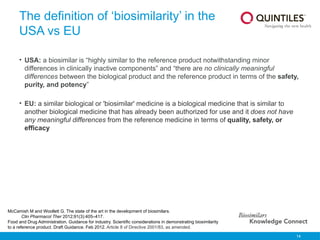
• USA: a biosimilar is “highly similar to the reference product notwithstanding minor
differences in clinically inactive components” and “there are no clinically meaningful
differences between the biological product and the reference product in terms of the safety,
purity, and potency”
• EU: a similar biological or 'biosimilar' medicine is a biological medicine that is similar to
another biological medicine that has already been authorized for use and it does not have
any meaningful differences from the reference medicine in terms of quality, safety, or
efficacy
The definition of ‘biosimilarity’ in the
USA vs EU
McCamish M and Woollett G. The state of the art in the development of biosimilars.
Clin Pharmacol Ther 2012;91(3):405–417.
Food and Drug Administration. Guidance for industry. Scientific considerations in demonstrating biosimilarity
to a reference product. Draft Guidance. Feb 2012. Article 8 of Directive 2001/83, as amended.
15
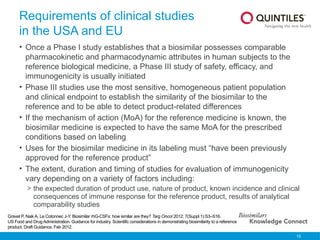
Requirements of clinical studies
in the USA and EU
• Once a Phase I study establishes that a biosimilar possesses comparable
pharmacokinetic and pharmacodynamic attributes in human subjects to the
reference biological medicine, a Phase III study of safety, efficacy, and
immunogenicity is usually initiated
• Phase III studies use the most sensitive, homogeneous patient population
and clinical endpoint to establish the similarity of the biosimilar to the
reference and to be able to detect product-related differences
• If the mechanism of action (MoA) for the reference medicine is known, the
biosimilar medicine is expected to have the same MoA for the prescribed
conditions based on labeling
• Uses for the biosimilar medicine in its labeling must “have been previously
approved for the reference product”
• The extent, duration and timing of studies for evaluation of immunogenicity
vary depending on a variety of factors including:
> the expected duration of product use, nature of product, known incidence and clinical
consequences of immune response for the reference product, results of analytical
comparability studies
Gravel P, Naik A, Le Cotonnec J-Y. Biosimilar rhG-CSFs: how similar are they? Targ Oncol 2012; 7(Suppl 1):S3–S16.
US Food and Drug Administration. Guidance for industry. Scientific considerations in demonstrating biosimilarity to a reference
product. Draft Guidance. Feb 2012.
16
Requirements of clinical studies
in the USA and EU
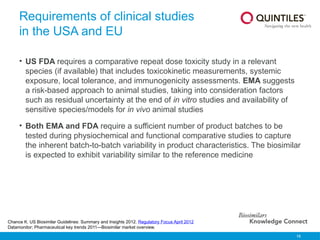
• US FDA requires a comparative repeat dose toxicity study in a relevant
species (if available) that includes toxicokinetic measurements, systemic
exposure, local tolerance, and immunogenicity assessments. EMA suggests
a risk-based approach to animal studies, taking into consideration factors
such as residual uncertainty at the end of in vitro studies and availability of
sensitive species/models for in vivo animal studies
• Both EMA and FDA require a sufficient number of product batches to be
tested during physiochemical and functional comparative studies to capture
the inherent batch-to-batch variability in product characteristics. The biosimilar
is expected to exhibit variability similar to the reference medicine
Chance K. US Biosimilar Guidelines: Summary and Insights 2012. Regulatory Focus April 2012
Datamonitor; Pharmaceutical key trends 2011—Biosimilar market overview.
17
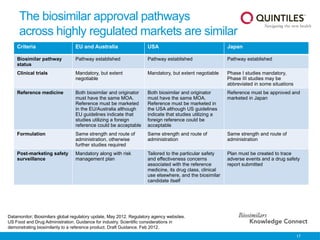
The biosimilar approval pathways
across highly regulated markets are similar
Criteria EU and Australia USA Japan
Biosimilar pathway
status
Pathway established Pathway established Pathway established
Clinical trials Mandatory, but extent
negotiable
Mandatory, but extent negotiable Phase I studies mandatory,
Phase III studies may be
abbreviated in some situations
Reference medicine Both biosimilar and originator
must have the same MOA.
Reference must be marketed
in the EU/Australia although
EU guidelines indicate that
studies utilizing a foreign
reference could be acceptable
Both biosimilar and originator
must have the same MOA.
Reference must be marketed in
the USA although US guidelines
indicate that studies utilizing a
foreign reference could be
acceptable
Reference must be approved and
marketed in Japan
Formulation Same strength and route of
administration, otherwise
further studies required
Same strength and route of
administration
Same strength and route of
administration
Post-marketing safety
surveillance
Mandatory along with risk
management plan
Tailored to the particular safety
and effectiveness concerns
associated with the reference
medicine, its drug class, clinical
use elsewhere, and the biosimilar
candidate itself
Plan must be created to trace
adverse events and a drug safety
report submitted
Datamonitor; Biosimilars global regulatory update, May 2012. Regulatory agency websites.
US Food and Drug Administration. Guidance for industry. Scientific considerations in
demonstrating biosimilarity to a reference product. Draft Guidance. Feb 2012.
18
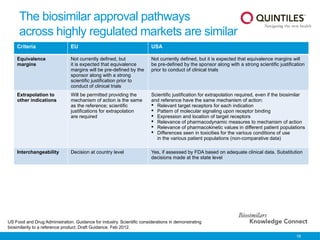
The biosimilar approval pathways
across highly regulated markets are similar
Criteria EU USA
Equivalence
margins
Not currently defined, but
it is expected that equivalence
margins will be pre-defined by the
sponsor along with a strong
scientific justification prior to
conduct of clinical trials
Not currently defined, but it is expected that equivalence margins will
be pre-defined by the sponsor along with a strong scientific justification
prior to conduct of clinical trials
Extrapolation to
other indications
Will be permitted providing the
mechanism of action is the same
as the reference; scientific
justifications for extrapolation
are required
Scientific justification for extrapolation required, even if the biosimilar
and reference have the same mechanism of action:
 Relevant target receptors for each indication
 Pattern of molecular signaling upon receptor binding
 Expression and location of target receptors
 Relevance of pharmacodynamic measures to mechanism of action
 Relevance of pharmacokinetic values in different patient populations
 Differences seen in toxicities for the various conditions of use
in the various patient populations (non-comparative data)
Interchangeability Decision at country level Yes, if assessed by FDA based on adequate clinical data. Substitution
decisions made at the state level
US Food and Drug Administration. Guidance for industry. Scientific considerations in demonstrating
biosimilarity to a reference product. Draft Guidance. Feb 2012.
19
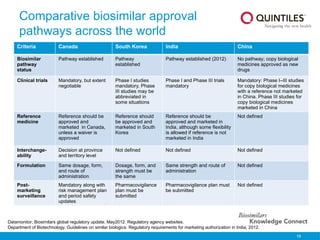
Comparative biosimilar approval
pathways across the world
Criteria Canada South Korea India China
Biosimilar
pathway
status
Pathway established Pathway
established
Pathway established (2012) No pathway; copy biological
medicines approved as new
drugs
Clinical trials Mandatory, but extent
negotiable
Phase I studies
mandatory, Phase
III studies may be
abbreviated in
some situations
Phase I and Phase III trials
mandatory
Mandatory: Phase I–III studies
for copy biological medicines
with a reference not marketed
in China. Phase III studies for
copy biological medicines
marketed in China
Reference
medicine
Reference should be
approved and
marketed in Canada,
unless a waiver is
approved
Reference should
be approved and
marketed in South
Korea
Reference should be
approved and marketed in
India, although some flexibility
is allowed if reference is not
marketed in India
Not defined
Interchange-
ability
Decision at province
and territory level
Not defined Not defined Not defined
Formulation Same dosage, form,
and route of
administration
Dosage, form, and
strength must be
the same
Same strength and route of
administration
Not defined
Post-
marketing
surveillance
Mandatory along with
risk management plan
and period safety
updates
Pharmacovigilance
plan must be
submitted
Pharmacovigilance plan must
be submitted
Not defined
Datamonitor; Biosimilars global regulatory update, May2012. Regulatory agency websites.
Department of Biotechnology. Guidelines on similar biologics: Regulatory requirements for marketing authorization in India, 2012.
20
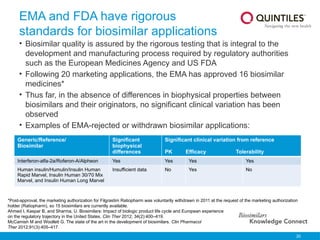
EMA and FDA have rigorous
standards for biosimilar applications
Generic/Reference/
Biosimilar
Significant
biophysical
differences
Significant clinical variation from reference
PK Efficacy Tolerability
Interferon-alfa-2a/Roferon-A/Alpheon Yes Yes Yes Yes
Human insulin/Humulin/Insulin Human
Rapid Marvel, Insulin Human 30/70 Mix
Marvel, and Insulin Human Long Marvel
Insufficient data No Yes No
*Post-approval, the marketing authorization for Filgrastim Ratiopharm was voluntarily withdrawn in 2011 at the request of the marketing authorization
holder (Ratiopharm), so 15 biosimilars are currently available.
Ahmed I, Kaspar B, and Sharma, U. Biosimilars: Impact of biologic product life cycle and European experience
on the regulatory trajectory in the United States. Clin Ther 2012; 34(2):400–419.
McCamish M and Woollett G. The state of the art in the development of biosimilars. Clin Pharmacol
Ther 2012;91(3):405–417.
• Biosimilar quality is assured by the rigorous testing that is integral to the
development and manufacturing process required by regulatory authorities
such as the European Medicines Agency and US FDA
• Following 20 marketing applications, the EMA has approved 16 biosimilar
medicines*
• Thus far, in the absence of differences in biophysical properties between
biosimilars and their originators, no significant clinical variation has been
observed
• Examples of EMA-rejected or withdrawn biosimilar applications:
21
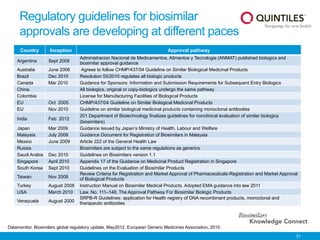
Country Inception Approval pathway
Argentina Sept 2009
Administracion Nacional de Medicamentos, Alimentos y Tecnologia (ANMAT) published biologics and
biosimilar approval guidance
Australia June 2006 Agrees to follow CHMP/437/04 Guideline on Similar Biological Medicinal Products
Brazil Dec 2010 Resolution 55/2010 regulates all biologic products
Canada Mar 2010 Guidance for Sponsors: Information and Submission Requirements for Subsequent Entry Biologics
China All biologics, original or copy-biologics undergo the same pathway
Colombia License for Manufacturing Facilities of Biological Products
EU Oct 2005 CHMP/437/04 Guideline on Similar Biological Medicinal Products
EU Nov 2010 Guideline on similar biological medicinal products containing monoclonal antibodies
India Feb 2012
201 Department of Biotechnology finalizes guidelines for nonclinical evaluation of similar biologics
(biosimilars)
Japan Mar 2009 Guidance issued by Japan’s Ministry of Health, Labour and Welfare
Malaysia July 2008 Guidance Document for Registration of Biosimilars in Malaysia
Mexico June 2009 Article 222 of the General Health Law
Russia Biosimilars are subject to the same regulations as generics
Saudi Arabia Dec 2010 Guidelines on Biosimilars version 1.1
Singapore April 2010 Appendix 17 of the Guidance on Medicinal Product Registration in Singapore
South Korea Sept 2010 Guidelines on the Evaluation of Biosimilar Products
Taiwan Nov 2008
Review Criteria for Registration and Market Approval of Pharmaceuticals-Registration and Market Approval
of Biological Products
Turkey August 2008 Instruction Manual on Biosimilar Medical Products. Adopted EMA guidance into law 2011
USA March 2010 Law. No. 111–148, The Approval Pathway For Biosimilar Biologic Products
Venezuela August 2000
SRPB-R Guidelines: application for Health registry of DNA recombinant products, monoclonal and
therapeutic antibodies
Regulatory guidelines for biosimilar
approvals are developing at different paces
Datamonitor. Biosimilars global regulatory update, May2012. European Generic Medicines Association, 2010.
22
For any queries please visit
www.BiosimilarsKnowledgeConnect.com

Biosimilars Knowledge Connect slide resource.pptx

  • 1.
    Copyright © 2013Quintiles Biosimilars Knowledge Connect Slide Resource This slide deck has been designed to be used as a central resource from which pertinent slides can be extracted as needed and is not intended for use in its entirety Pooja Rani Submitted by: Submitted To: DR. Suneel Gupta
  • 2.
    2 Introduction to biologicalmedicines and biosimilars • A biosimilar is an approved version of a biological medicine with an identical primary amino acid sequence to the originator and developed with the intention to be as close to the originator as possible • Like biological medicines, biosimilars are complex protein molecules that are produced by living organisms • During the past 15 years, biological medicines have had a profound impact on healthcare > primarily in the areas of rheumatology and oncology > as well as endocrinology, cardiology, dermatology, gastroenterology, and neurology • Many of the world’s top-selling medicines are now biological medicines • However, biological medicines are expensive (sometimes by several orders of magnitude more than small-molecule chemical drugs), limiting patient access • As many biological medicines come off patent globally, there is great interest in the development of biosimilars, which are likely to be more affordable
  • 3.
    3 The increasing rateof development of biosimilars Patent expiries expected: 99 Patent expiries expected: 91 Patent expiries expected: 46 Biological medicines due to come off patent2,3 It has been estimated that 31 different companies were developing biosimilar monoclonal antibodies (as of March 2012), compared with 18 companies as of Sept 2011 – an increase of 67% in a 6-month period.1 1. Barkalow F, Biosimilar monoclonal antibodies. In the pipeline: major players and strategies. Citeline. 2. Haag T (Lonza) and Krattiger C (GfK). The emergence of biosimilars—How are they different from generics and what are the implications from marketing? EphMRA presentation. June 29, 2011. 3. http://articles.chicagotribune.com/2012-08-13/news/sns-rt-elan-spinofftysabril6e8jd71t-20120813_1_tysabri- elan-patent-protection 2010–2015 2016–2020 Post–2020
  • 4.
    4 As of Sept2013, 16 biosimilars have been approved in the EU* Biosimilar Sponsor Reference product Date of approval Abseamed (epoetin alfa) Medice Arzneimittel Pütter (Germany) Eprex (Janssen) August 2007 Biograstim (filgrastim; G-CSF) CT Arzneimittel Neupogen (Amgen) September 2008 Binocrit (epoetin alfa) Sandoz (unit of Novartis) Eprex (Janssen) August 2007 Epoetin alfa Hexal (epoetin alfa) Hexal Biotech (owned by Novartis) Eprex/Erypo (Janssen) August 2007 Filgrastim Hexal (filgrastim; G-CSF) Hexal Biotech Neupogen (Amgen) February 2009 Nivestim (filgrastim; G-CSF) Hospira Enterprises Neupogen (Amgen) June 2010 Omnitrope (somatropin; human growth hormone) Sandoz Genotropin (Pfizer) April 2006 Ratiograstim (filgrastim; G-CSF) Ratiopharm (acquired by Teva) Neupogen (Amgen) September 2008 Filgrastim Ratiopharm (filgrastim; G-CSF) Ratiopharm (acquired by Teva) Neupogen (Amgen) September 2008 (withdrawn April 2011**) Retacrit (epoetin zeta) Hospira Eprex (Janssen) December 2007 Silapo (epoetin zeta) Stada Eprex (Janssen) December 2007 Tevagrastim (filgrastim; G-CSF) Teva Pharma Industries Neupogen (Amgen) September 2008 Valtropin (somatropin; HGH) BioPartners Gmbh Humatrope (Eli Lilly) April 2006 Zarzio (filgrastim; G-CSF) Sandoz (unit of Novartis) Neupogen (Amgen) February 2009 Inflectra (infliximab) Hospira Remicade (Janssen) 10 September 2013 Remsima (infliximab) Celltrion Remicade (Janssen) 10 September 2013 *Out of a total of 20 marketing authorization applications. **The marketing authorization for Filgrastim Ratiopharm was voluntarily withdrawn in 2011 at the request of the marketing authorization holder. Source:EMA biosimilar EPAR listing: Accessed October 2013.
  • 5.
    5 Even if abiosimilar uses the same human gene as its originator It will differ in other parts of the process Human gene DNA vector Cloning into DNA vector Transfer into host cell Bacterial or mammalian cell produces protein Fermentation Formulation Different process = different product Small-molecule generic Biosimilar Low molecular weight and complexity High molecular weight and complex 3-D structure Chemical synthesis Produced by living organisms Manufacturing process easy to reverse-engineer Manufacturing process cannot be replicated Identical copy of active ingredient Although required to contain the same primary amino acid sequence, the biosimilar is not identical to the originator, but rather highly similar Biosimilars differ from small-molecule generic drugs – manufacture Adapted from The Biosimilars Handbook, Barclays Capital, 11 Feb 2011
  • 6.
    6 Biosimilars are subjectedto a more rigorous clinical development process than generics Biosimilars Generics • Proof of quality and bioequivalence • No substantial clinical data required • Reference to originator’s data • Different manufacturing processes can and often do yield differences in the end product • After the quality of a biological medicine is demonstrated, some non-clinical and clinical studies are necessary • Immunogenic response cannot be predicted and therefore must be tested Source: J. Mascaro: Regulatory evaluation of therapeutic biological medicines, Aug 15, 2007 Small molecule Biological medicine
  • 7.
    7 The potential impactof biosimilars • A survey conducted in the European Union in 2010 found cost savings in 24 member states where biosimilars were marketed alongside their originators* > There was sustained price discounting in all countries, although this did vary at the country level > Values range from a 5% discount for filgrastim in the UK to a 53% discount for the same medicine in Denmark in 2009 > The availability of biosimilars of somatropin, epoetin alfa, and filgrastim in Europe has led to price discounts relative to their respective originators ranging from 5–82% > The table below describes the mean price discount of biosimilar versions of the medicines listed relative to their originator products Expected cost savings Mean discount in 24 EU member states 2007 2008 2009 Somatropin 25.4% 25.9% 14.1% Epoetin 32.1% 17.3% 17.0% Filgrastim ‐‐‐ 10.8% 35.0% *Rovira J, Espín J, García L, and Olry de Labry A. The impact of biosimilars’ entry in the EU market. 2011. http://ec.europa.eu/enterprise/sectors/healthcare/files/docs/biosimilars_market_012011_en.pdf.
  • 8.
    8 Adapted with permissionfrom Macmillan Publishers Ltd: Clin Pharmacol Ther (McCamish M and Woollett G. The state of the art in the development of biosimilars. 91(3):405–417), © 2012 Biosimilars can improve healthcare • Biosimilars can enable previously restricted therapies to become part of the accepted standard of care • In the UK, patients have benefited from lower acquisition costs and improvements in the practice of medicine after the approval of a filgrastim biosimilar • This has enabled the routine use of filgrastim (as a biosimilar) as a first-line treatment for the first time 2007 2008 2009 2010 -2 -5 13 17 November 2008 biosimilar approved Note: Zarzio® (filgrastim) is not marketed in the United States. UK filgrastim volume growth percent change vs. previous year • Many physicians moved filgrastim back to first-line cancer treatment because of lower biosimilars cost • G-CSF prevents hospital readmission owing to infection • Biosimilars are less expensive than originator biologics • Zarzio “patient support kits” expand patient access: – Patients self-administer at home – Efficiency savings repatriated
  • 9.
    9 Biosimilars must undergorigorous testing • To establish biosimilarity, the sponsor must first show that the candidate is highly similar to the reference originator at the analytical level. This can take multiple iterations in early-stage development before clinical testing may begin • The sponsor must also perform detailed analysis of the originator reference, especially if the structure and biological function is inadequately defined Physicochemical characterization Biological characterization Non-clinical PK/PD Clinical trials Analytics D e s i g n s p e c i f i c a t i o n s V a l i d a t i o n Process development Adapted with permission from Macmillan Publishers Ltd: Clin Pharmacol Ther (McCamish M and Woollett G. The state of the art in the development of biosimilars. 91(3):405–417), © 2012
  • 10.
    10 Examples of copiesof biological medicines from largely unregulated markets may not meet today’s rigorous standards • In the past, copies of biological medicines have been produced in some countries where a rigorous regulatory pathway had not been established for biosimilars • These are known as copy-biologics, alternative biologics or intended copies of biological products • They may not meet the current criteria defined by the FDA or EMA for biosimilarity and would not be approved in most regulated markets at the present time without additional testing • As guidelines are established worldwide to standardize the testing of biosimilars for comparability against an originator product, the development of such products becomes less widespread* *Barkalow F, Biosimilar monoclonal antibodies. In the pipeline: major players and strategies. Citeline.
  • 11.
    11 Why immunogenicity testingis essential • To date, there have been no reports of an approved biosimilar being associated with any unusual or unexpected adverse events, although at least two biosimilars that are currently approved in the EU encountered unwanted antibody development during pre-approval clinical studies • For a somatropin biosimilar, non-neutralizing antibodies were triggered by increased levels of HCPs • For an epoetin biosimilar, neutralizing antibodies were triggered leading to premature termination of the clinical trial • Changes in manufacturing process, however, have been associated with problems with immunogenicity even in novel biological medicines • Immunogenicity testing is therefore an essential part of the biosimilar testing process Saenger, P. Current status of biosimilar growth hormone. Int J Pediatr Endocroinol 2009; 370329. Bennett, CL et al. Pure red-cell aplasia and epoetin therapy. NEJM 2004;351:1403–8. Mascaro J, presentation . Mexico, August 15, 2007 Increased incidence of pure red cell aplasia with EPREX® (epoetin) SC Related to leachables from changes in primary packaging Immunogenicity of GM-CSF Non-immunogenic in immunosuppressed patients Antibodies in non-immunosuppressed patients Thrombopoietin immunogenicity Pegylated rHuMGDF: highly immunogenic persistent thrombocytopenia meant development program was stopped Tryptophan-eosinophilamyalgia syndrome Production strain changed: purification modified. Unrecognized impurity caused EMS (>1300 cases, 38 deaths)
  • 12.
    12 Highly regulated marketsensure safe biosimilar medicines • Biosimilar quality is assured by rigorous testing requirements, which include head-to-head analytical/non-clinical/clinical testing against the reference originator. In addition, the regulatory authorities, such as the European Medicines Agency (EMA) and US FDA, require robustness in manufacturing process • To date, there have been no reports of a biosimilar medicine in highly regulated markets being associated with any unusual or unexpected adverse events as compared to its originator • In Europe, no unusual or unexpected clinical events have been observed with biosimilars of somatropin, epoetin, or filgrastim • In the USA, no unusual or unexpected adverse events have been seen with products approved as follow-on biologics on the basis of abbreviated data packages, including Omnitrope® McCamish M and Woollett G. The state of the art in the development of biosimilars. Clin Pharmacol Ther 2012;91(3):405–417.
  • 13.
    13 http://www.ema.europa.eu/ema/index.jsp?curl=pages/regulation/general/general_content_000408.jsp&mid=WC0b01ac058002958c The BPCI Actappears in Title VII, subtitle A of the Patient Protection and Affordable Care Act, March 2010. US Food and Drug Administration. Guidance for industry. Scientific considerations in demonstrating biosimilarity to a reference product. Draft Guidance. Feb 2012. Draft revisions to Overarching Guideline; Quality Guideline; Non-clinical and Clinical Guideline 2004 2009 2011 2006 2007 2008 2012 2010 2013 2005 EMEA Legislative Pathway EMEA Regulatory Guidance [Overarching Guideline] under revision Product Class Specific Guidelines: Low molecular weight heparin, recombinant Interferon-alpha Product Class Monoclonal antibodies – non-clinical and clinical issues Product Class Specific Guideline: Erythropoietin (revised) Quality Guideline; Non-Clinical and Clinical Guideline (under revision ) Product Class Specific Guidelines: Insulin, G-CSF, Somatropin Product Class Immunogenicity assessment of monoclonal antibodies Public Health Service Act amended to allow the approval of biosimilars Overarching Draft Guidelines on biosimilars Europe US Biosimilar regulations in EU and USA: different stages of development • The EU pioneered the development of biosimilar regulations • US overarching guidelines issued Draft revisions to Product Class Specific Guideline: Insulin, low molecular weight heparin Product Class Follicle stimulating hormone, Interferon- beta
  • 14.
    14 • USA: abiosimilar is “highly similar to the reference product notwithstanding minor differences in clinically inactive components” and “there are no clinically meaningful differences between the biological product and the reference product in terms of the safety, purity, and potency” • EU: a similar biological or 'biosimilar' medicine is a biological medicine that is similar to another biological medicine that has already been authorized for use and it does not have any meaningful differences from the reference medicine in terms of quality, safety, or efficacy The definition of ‘biosimilarity’ in the USA vs EU McCamish M and Woollett G. The state of the art in the development of biosimilars. Clin Pharmacol Ther 2012;91(3):405–417. Food and Drug Administration. Guidance for industry. Scientific considerations in demonstrating biosimilarity to a reference product. Draft Guidance. Feb 2012. Article 8 of Directive 2001/83, as amended.
  • 15.
    15 Requirements of clinicalstudies in the USA and EU • Once a Phase I study establishes that a biosimilar possesses comparable pharmacokinetic and pharmacodynamic attributes in human subjects to the reference biological medicine, a Phase III study of safety, efficacy, and immunogenicity is usually initiated • Phase III studies use the most sensitive, homogeneous patient population and clinical endpoint to establish the similarity of the biosimilar to the reference and to be able to detect product-related differences • If the mechanism of action (MoA) for the reference medicine is known, the biosimilar medicine is expected to have the same MoA for the prescribed conditions based on labeling • Uses for the biosimilar medicine in its labeling must “have been previously approved for the reference product” • The extent, duration and timing of studies for evaluation of immunogenicity vary depending on a variety of factors including: > the expected duration of product use, nature of product, known incidence and clinical consequences of immune response for the reference product, results of analytical comparability studies Gravel P, Naik A, Le Cotonnec J-Y. Biosimilar rhG-CSFs: how similar are they? Targ Oncol 2012; 7(Suppl 1):S3–S16. US Food and Drug Administration. Guidance for industry. Scientific considerations in demonstrating biosimilarity to a reference product. Draft Guidance. Feb 2012.
  • 16.
    16 Requirements of clinicalstudies in the USA and EU • US FDA requires a comparative repeat dose toxicity study in a relevant species (if available) that includes toxicokinetic measurements, systemic exposure, local tolerance, and immunogenicity assessments. EMA suggests a risk-based approach to animal studies, taking into consideration factors such as residual uncertainty at the end of in vitro studies and availability of sensitive species/models for in vivo animal studies • Both EMA and FDA require a sufficient number of product batches to be tested during physiochemical and functional comparative studies to capture the inherent batch-to-batch variability in product characteristics. The biosimilar is expected to exhibit variability similar to the reference medicine Chance K. US Biosimilar Guidelines: Summary and Insights 2012. Regulatory Focus April 2012 Datamonitor; Pharmaceutical key trends 2011—Biosimilar market overview.
  • 17.
    17 The biosimilar approvalpathways across highly regulated markets are similar Criteria EU and Australia USA Japan Biosimilar pathway status Pathway established Pathway established Pathway established Clinical trials Mandatory, but extent negotiable Mandatory, but extent negotiable Phase I studies mandatory, Phase III studies may be abbreviated in some situations Reference medicine Both biosimilar and originator must have the same MOA. Reference must be marketed in the EU/Australia although EU guidelines indicate that studies utilizing a foreign reference could be acceptable Both biosimilar and originator must have the same MOA. Reference must be marketed in the USA although US guidelines indicate that studies utilizing a foreign reference could be acceptable Reference must be approved and marketed in Japan Formulation Same strength and route of administration, otherwise further studies required Same strength and route of administration Same strength and route of administration Post-marketing safety surveillance Mandatory along with risk management plan Tailored to the particular safety and effectiveness concerns associated with the reference medicine, its drug class, clinical use elsewhere, and the biosimilar candidate itself Plan must be created to trace adverse events and a drug safety report submitted Datamonitor; Biosimilars global regulatory update, May 2012. Regulatory agency websites. US Food and Drug Administration. Guidance for industry. Scientific considerations in demonstrating biosimilarity to a reference product. Draft Guidance. Feb 2012.
  • 18.
    18 The biosimilar approvalpathways across highly regulated markets are similar Criteria EU USA Equivalence margins Not currently defined, but it is expected that equivalence margins will be pre-defined by the sponsor along with a strong scientific justification prior to conduct of clinical trials Not currently defined, but it is expected that equivalence margins will be pre-defined by the sponsor along with a strong scientific justification prior to conduct of clinical trials Extrapolation to other indications Will be permitted providing the mechanism of action is the same as the reference; scientific justifications for extrapolation are required Scientific justification for extrapolation required, even if the biosimilar and reference have the same mechanism of action:  Relevant target receptors for each indication  Pattern of molecular signaling upon receptor binding  Expression and location of target receptors  Relevance of pharmacodynamic measures to mechanism of action  Relevance of pharmacokinetic values in different patient populations  Differences seen in toxicities for the various conditions of use in the various patient populations (non-comparative data) Interchangeability Decision at country level Yes, if assessed by FDA based on adequate clinical data. Substitution decisions made at the state level US Food and Drug Administration. Guidance for industry. Scientific considerations in demonstrating biosimilarity to a reference product. Draft Guidance. Feb 2012.
  • 19.
    19 Comparative biosimilar approval pathwaysacross the world Criteria Canada South Korea India China Biosimilar pathway status Pathway established Pathway established Pathway established (2012) No pathway; copy biological medicines approved as new drugs Clinical trials Mandatory, but extent negotiable Phase I studies mandatory, Phase III studies may be abbreviated in some situations Phase I and Phase III trials mandatory Mandatory: Phase I–III studies for copy biological medicines with a reference not marketed in China. Phase III studies for copy biological medicines marketed in China Reference medicine Reference should be approved and marketed in Canada, unless a waiver is approved Reference should be approved and marketed in South Korea Reference should be approved and marketed in India, although some flexibility is allowed if reference is not marketed in India Not defined Interchange- ability Decision at province and territory level Not defined Not defined Not defined Formulation Same dosage, form, and route of administration Dosage, form, and strength must be the same Same strength and route of administration Not defined Post- marketing surveillance Mandatory along with risk management plan and period safety updates Pharmacovigilance plan must be submitted Pharmacovigilance plan must be submitted Not defined Datamonitor; Biosimilars global regulatory update, May2012. Regulatory agency websites. Department of Biotechnology. Guidelines on similar biologics: Regulatory requirements for marketing authorization in India, 2012.
  • 20.
    20 EMA and FDAhave rigorous standards for biosimilar applications Generic/Reference/ Biosimilar Significant biophysical differences Significant clinical variation from reference PK Efficacy Tolerability Interferon-alfa-2a/Roferon-A/Alpheon Yes Yes Yes Yes Human insulin/Humulin/Insulin Human Rapid Marvel, Insulin Human 30/70 Mix Marvel, and Insulin Human Long Marvel Insufficient data No Yes No *Post-approval, the marketing authorization for Filgrastim Ratiopharm was voluntarily withdrawn in 2011 at the request of the marketing authorization holder (Ratiopharm), so 15 biosimilars are currently available. Ahmed I, Kaspar B, and Sharma, U. Biosimilars: Impact of biologic product life cycle and European experience on the regulatory trajectory in the United States. Clin Ther 2012; 34(2):400–419. McCamish M and Woollett G. The state of the art in the development of biosimilars. Clin Pharmacol Ther 2012;91(3):405–417. • Biosimilar quality is assured by the rigorous testing that is integral to the development and manufacturing process required by regulatory authorities such as the European Medicines Agency and US FDA • Following 20 marketing applications, the EMA has approved 16 biosimilar medicines* • Thus far, in the absence of differences in biophysical properties between biosimilars and their originators, no significant clinical variation has been observed • Examples of EMA-rejected or withdrawn biosimilar applications:
  • 21.
    21 Country Inception Approvalpathway Argentina Sept 2009 Administracion Nacional de Medicamentos, Alimentos y Tecnologia (ANMAT) published biologics and biosimilar approval guidance Australia June 2006 Agrees to follow CHMP/437/04 Guideline on Similar Biological Medicinal Products Brazil Dec 2010 Resolution 55/2010 regulates all biologic products Canada Mar 2010 Guidance for Sponsors: Information and Submission Requirements for Subsequent Entry Biologics China All biologics, original or copy-biologics undergo the same pathway Colombia License for Manufacturing Facilities of Biological Products EU Oct 2005 CHMP/437/04 Guideline on Similar Biological Medicinal Products EU Nov 2010 Guideline on similar biological medicinal products containing monoclonal antibodies India Feb 2012 201 Department of Biotechnology finalizes guidelines for nonclinical evaluation of similar biologics (biosimilars) Japan Mar 2009 Guidance issued by Japan’s Ministry of Health, Labour and Welfare Malaysia July 2008 Guidance Document for Registration of Biosimilars in Malaysia Mexico June 2009 Article 222 of the General Health Law Russia Biosimilars are subject to the same regulations as generics Saudi Arabia Dec 2010 Guidelines on Biosimilars version 1.1 Singapore April 2010 Appendix 17 of the Guidance on Medicinal Product Registration in Singapore South Korea Sept 2010 Guidelines on the Evaluation of Biosimilar Products Taiwan Nov 2008 Review Criteria for Registration and Market Approval of Pharmaceuticals-Registration and Market Approval of Biological Products Turkey August 2008 Instruction Manual on Biosimilar Medical Products. Adopted EMA guidance into law 2011 USA March 2010 Law. No. 111–148, The Approval Pathway For Biosimilar Biologic Products Venezuela August 2000 SRPB-R Guidelines: application for Health registry of DNA recombinant products, monoclonal and therapeutic antibodies Regulatory guidelines for biosimilar approvals are developing at different paces Datamonitor. Biosimilars global regulatory update, May2012. European Generic Medicines Association, 2010.
  • 22.
    22 For any queriesplease visit www.BiosimilarsKnowledgeConnect.com

Editor's Notes

  • #2 Biological medicines have added new treatment options for various diseases, including some for which no effective therapies were previously available or were clearly inadequate. For example they have provided lifesaving replacement proteins for patients with rare diseases who cannot produce the proteins themselves (e.g. resistant forms of Gaucher disease).
  • #3 The sales of biosimilars increased from €3.3 million to €65.5 million between 2007 and 2009.
  • #4 Approvals include: 5 epoetin biosimilars, 7 filgratim biosimilars, 2 somatropin biosimilars and 2 infliximab biosimilars Please note: there are 15 current approvals. Filgrastim ratiopharm (Ratiopharm GmbH) was approved Sept 15, 2008, but was then voluntarily withdrawn April 20, 2011. (source: www.gabionline.net/Biosimilars/General/Biosimilars-approved-in-Europe) Full EMA approvals listing can be found here: http://www.ema.europa.eu/ema/index.jsp?curl=pages%2Fmedicines%2Flanding%2Fepar_search.jsp&mid=WC0b01ac058001d125&searchTab=searchByAuthType&alreadyLoaded=true&isNewQuery=true&status=Authorised&status=Withdrawn&status=Suspended&status=Refused&keyword=Enter+keywords&searchType=name&taxonomyPath=&treeNumber=&searchGenericType=biosimilars&genericsKeywordSearch=Submit
  • #6 Biologics and in turn biosimilars are very large molecules compared with small molecule drugs. They are not easy to duplicate, because in many cases the originator biologic is not well characterized. For generics the structure of both the originator and the “copy” drug can be precisely determined and compared, it only remains for bioequivalence to be shown to innovator drug in PK/PD studies (often fed and fasting studies) Much more work required to show comparability for biosimilars: non-clinical and clinical studies often are required. The basic building blocks of biologics are glycoproteins (i.e., amino acids and sugar molecules). These amino acid building blocks are strung together in a specified sequence to form its primary structure (i.e., its amino acid sequence). Even small changes in the folding of the protein can manifest into a clinically meaningful difference in efficacy or toxicity. Also the glycosylation pattern of a biologic drug contributes to its clinical profile. Changes in the pattern of glycosylation can occur based on the cells in which the drug is produced and their intricate, multistep manufacturing process, and these alterations in glycosylation patterns could also alter clinical outcomes. Kuhlmann M, Covic A. The protein science of biosimilars. Nephrol Dial Transplant 2006;21(Suppl 5):v4–v8.
  • #7 Biosimilars can bring the benefits of biological medicines to more patients. Particularly, biosimilars can benefit those who lack private insurance coverage or who live in areas where biological therapies are not covered by state-funded insurance. Other observers have noted that price discounts in Europe for biosimilar medicines typically range from 25-30%. Jelkmann W. Biosimilar epoetins and other “follow-on” biologics: update on the European experiences. Am J Hematol 2010;85:771–780.
  • #10 However, the manufacturers of copy biologics may choose to carry out the required testing in order to access regulated markets in the future.
  • #12 Following 20 marketing applications, the EMA has approved 15 based on comparability to respective reference originators. Thus far, in the absence of differences in biophysical properties between biosimilars and their reference, no significant clinical variation has been observed. Currently 14 biosimilars are available.
  • #14 The US definition of biosimilarity was established in the Biologics Price Competition and Innovation Act (BPCI Act, drafted 2009 and passed into law 2010).
  • #15 Regulatory authorities generally accept that the basic concepts needed for patient treatment, such as dose response, have already been established by the originator product. Therefore, Phase II studies are not usually required for biosimilar candidates. Also, the number of patients in the Phase III trials can be reduced. Consequently, the duration and cost of biosimilars development can be less in than developing original biological medicines. Phase III clinical trials are initiated following satisfactory conclusion of pharmacodynamic and pharmacokinetic studies, and the focus of the Phase III program is predominately on the safety of the biosimilar medicine. These studies are statistically powered to prove the clinical comparability of the biosimilar to the originator. The duration of biosimilar trials is tailored to adequately explore the potential for development of immunogenic responses, as this is one of the main risks of biological medicines.
  • #16 Evaluation of residual risk/uncertainty at each step determines the need for further studies. Some comparative assessments between a biosimilar and its reference product can be tested in vitro, for example the binding of an antibody to its specific target. However, safety and efficacy assessments require in vivo testing in human clinical trials. Regulatory authorities generally accept that the basic concepts needed for patient treatment, such as dose response, have already been established by the originator product. Therefore, Phase II studies are not usually required for biosimilar candidates. Also, the number of patients in the Phase III trials can be reduced. Consequently, the duration and cost of biosimilars development can be less in than developing original biological medicines.
  • #18 Bioequivalence parameters for biosimilar products have not been specifically established, but as with small-molecule generic products, a range of 80–125% similarity is normally accepted as adequate.