Generic Competitive Strategies VI
Porter’s Generic Strategies Porter has suggested three competitive strategies to cope with the five competitive forces: Overall Cost Leadership Differentiation Focus
Factors of Cost Leadership   Aggressive construction of efficient-scale facilities Vigorous pursuit of cost reductions from experience Cost minimization in areas such as R&D, services, sales force and advertising Tight cost and overhead control
Cost Low cost relative to competitors is the main pursuit, not at the cost of quality or service.  The attained low cost position needs strengthening through reinvesting the high margin in new equipment, machinery etc to further enhance the low cost leadership
Differentiation Differentiating a product or service implies creating something that is perceived industry wise as being unique. It can take forms such as  - design or brand image - technology - customer service - dealer network - other special features
Differentiation Differentiation does not mean total disregard to cost rather cost is not the primary strategic target. Differentiation insulates a company from rivalry due to brand loyalty or price insensitivity, supplier power due to high margin, buyer power due to price insensitivity.
Focus Relates to targeting a particular buyer group, segment of product line or geographic market.  The Focus strategy is built on the premises of serving a narrow market so that it can perform more effectively than the competitors who operate more broadly.
Stuck in the Middle The situation when a firm cannot develop one of the three strategies.  The firms lacks the market share, capital investment and resolve to play the low-cost game or the industry wide differentiation to obviate the need for low-cost position or the focus necessary to create a position in a more limited space. Not being able to perform in one of the three areas has other consequential effects such as a blurred corporate culture and a conflicting set of organizational arrangements.
Question Does this imply that the largest (low cost) or the smallest (focus, differentiation) are the most profitable generating a U shaped relationship between profitability and market share?  - The mini mills are more profitable than the larger steel mills in a non-differentiated market.
RISKS The risks in pursuing generic strategies are mainly two; -  failing to attain or sustain the strategy  -  the value provided by the chosen strategy erodes due to industry evolution.
… .to Low-cost Technology changes to nullify past investment or learning Low-cost learning by newcomers through imitation or new investment  Inability to adopt the required changes in the market
… .to Differentiation Buyer need falls Imitation narrows perceived differentiation Cost differential is too wide to hold on to brand loyalty
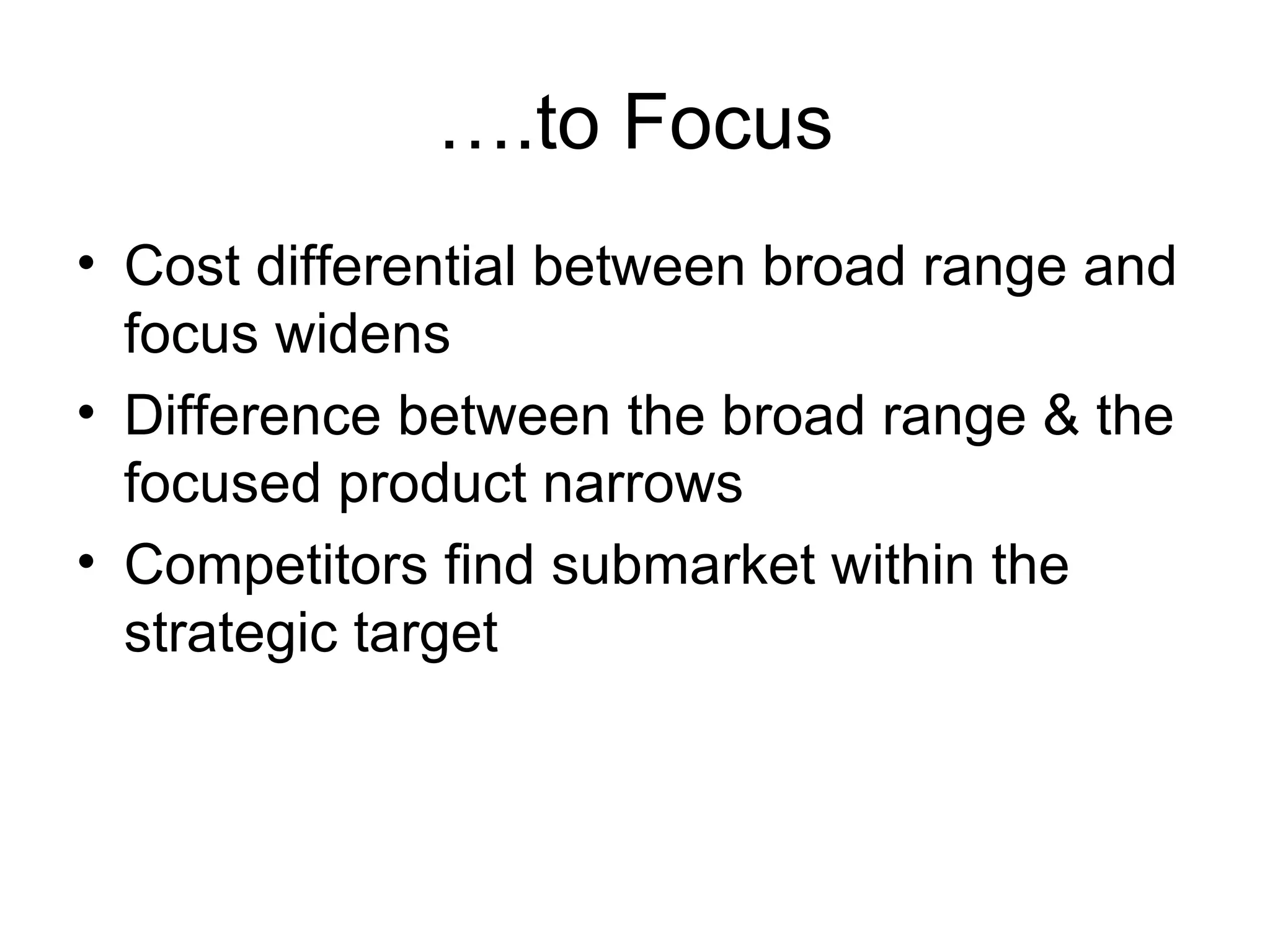
… .to Focus Cost differential between broad range and focus widens Difference between the broad range & the focused product narrows Competitors find submarket within the strategic target
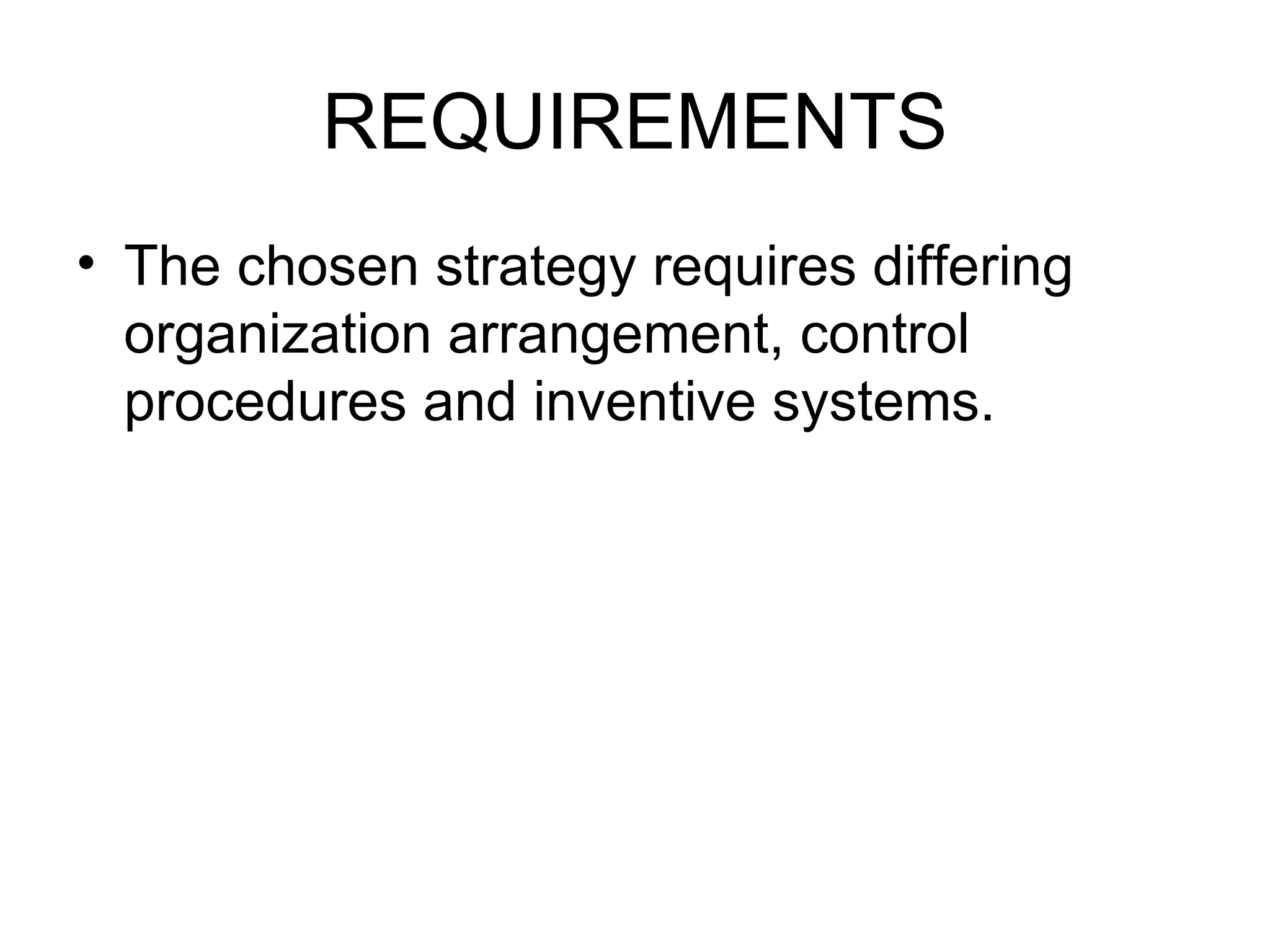
REQUIREMENTS The chosen strategy requires differing organization arrangement, control procedures and inventive systems.
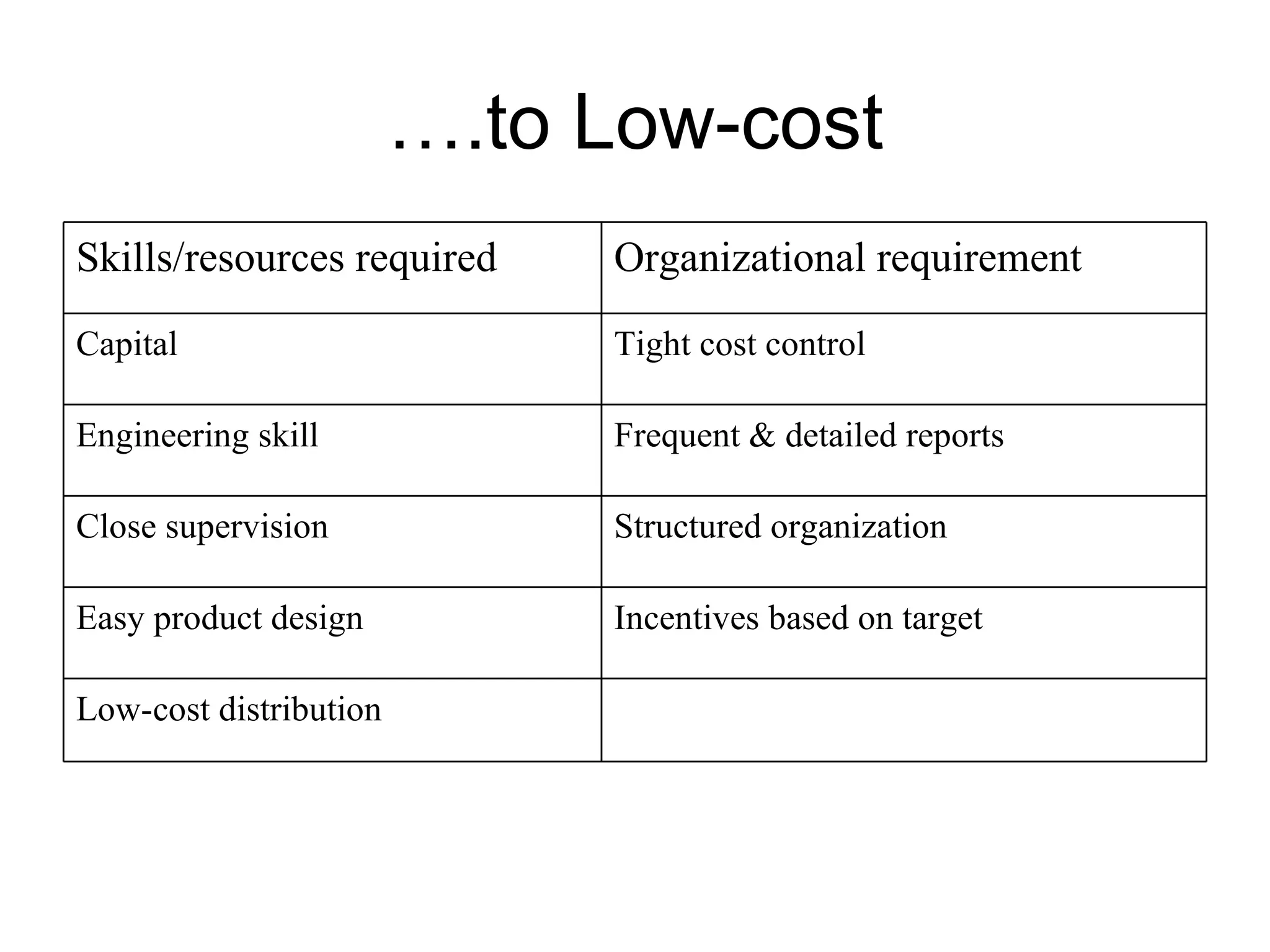
… .to Low-cost Skills/resources required Organizational requirement Capital Tight cost control Engineering skill Frequent & detailed reports Close supervision Structured organization Easy product design Incentives based on target Low-cost distribution
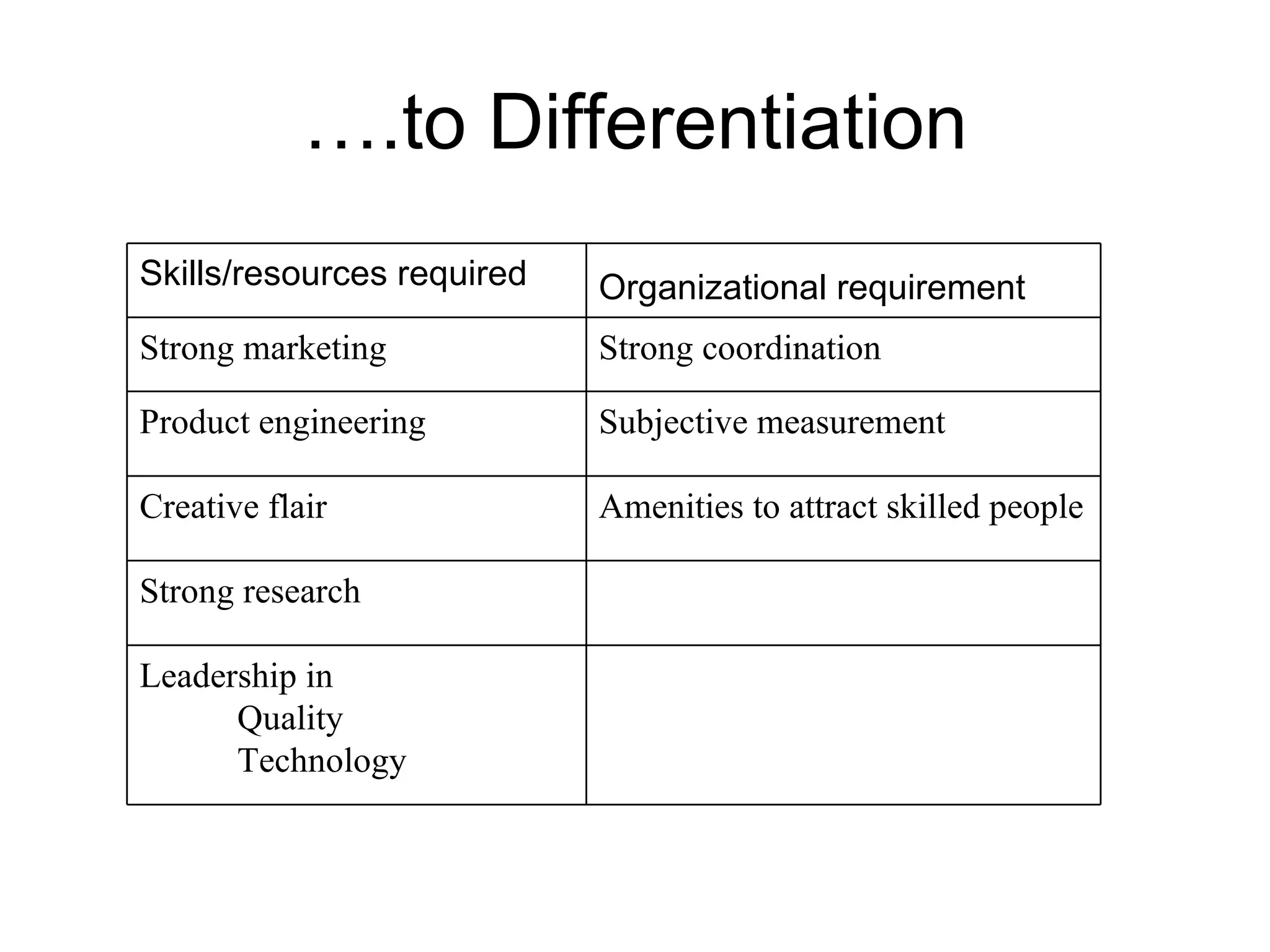
… .to Differentiation Skills/resources required Organizational requirement   Strong marketing Strong coordination Product engineering Subjective measurement Creative flair Amenities to attract skilled people  Strong research Leadership in  Quality  Technology
… .to Focus Combination of the other two (Low-cost and Differentiation) policies directed to particular strategic target

generic strategies

  • 1.
  • 2.
    Porter’s Generic StrategiesPorter has suggested three competitive strategies to cope with the five competitive forces: Overall Cost Leadership Differentiation Focus
  • 3.
    Factors of CostLeadership Aggressive construction of efficient-scale facilities Vigorous pursuit of cost reductions from experience Cost minimization in areas such as R&D, services, sales force and advertising Tight cost and overhead control
  • 4.
    Cost Low costrelative to competitors is the main pursuit, not at the cost of quality or service. The attained low cost position needs strengthening through reinvesting the high margin in new equipment, machinery etc to further enhance the low cost leadership
  • 5.
    Differentiation Differentiating aproduct or service implies creating something that is perceived industry wise as being unique. It can take forms such as - design or brand image - technology - customer service - dealer network - other special features
  • 6.
    Differentiation Differentiation doesnot mean total disregard to cost rather cost is not the primary strategic target. Differentiation insulates a company from rivalry due to brand loyalty or price insensitivity, supplier power due to high margin, buyer power due to price insensitivity.
  • 7.
    Focus Relates totargeting a particular buyer group, segment of product line or geographic market. The Focus strategy is built on the premises of serving a narrow market so that it can perform more effectively than the competitors who operate more broadly.
  • 8.
    Stuck in theMiddle The situation when a firm cannot develop one of the three strategies. The firms lacks the market share, capital investment and resolve to play the low-cost game or the industry wide differentiation to obviate the need for low-cost position or the focus necessary to create a position in a more limited space. Not being able to perform in one of the three areas has other consequential effects such as a blurred corporate culture and a conflicting set of organizational arrangements.
  • 9.
    Question Does thisimply that the largest (low cost) or the smallest (focus, differentiation) are the most profitable generating a U shaped relationship between profitability and market share? - The mini mills are more profitable than the larger steel mills in a non-differentiated market.
  • 10.
    RISKS The risksin pursuing generic strategies are mainly two; - failing to attain or sustain the strategy - the value provided by the chosen strategy erodes due to industry evolution.
  • 11.
    … .to Low-costTechnology changes to nullify past investment or learning Low-cost learning by newcomers through imitation or new investment Inability to adopt the required changes in the market
  • 12.
    … .to DifferentiationBuyer need falls Imitation narrows perceived differentiation Cost differential is too wide to hold on to brand loyalty
  • 13.
    … .to FocusCost differential between broad range and focus widens Difference between the broad range & the focused product narrows Competitors find submarket within the strategic target
  • 14.
    REQUIREMENTS The chosenstrategy requires differing organization arrangement, control procedures and inventive systems.
  • 15.
    … .to Low-costSkills/resources required Organizational requirement Capital Tight cost control Engineering skill Frequent & detailed reports Close supervision Structured organization Easy product design Incentives based on target Low-cost distribution
  • 16.
    … .to DifferentiationSkills/resources required Organizational requirement Strong marketing Strong coordination Product engineering Subjective measurement Creative flair Amenities to attract skilled people Strong research Leadership in Quality Technology
  • 17.
    … .to FocusCombination of the other two (Low-cost and Differentiation) policies directed to particular strategic target