Unilever  in Brazil (1997-2007) Marketing Strategies for Low-Income Consumers
Agenda International Marketing Case - Unilever in Brazil Introduction to the Brazilian Market Why the Low-Income Segment Should be Targeted Implications of Targeting the Low-Income Segment Brand Portfolio and Positioning xxx xxx
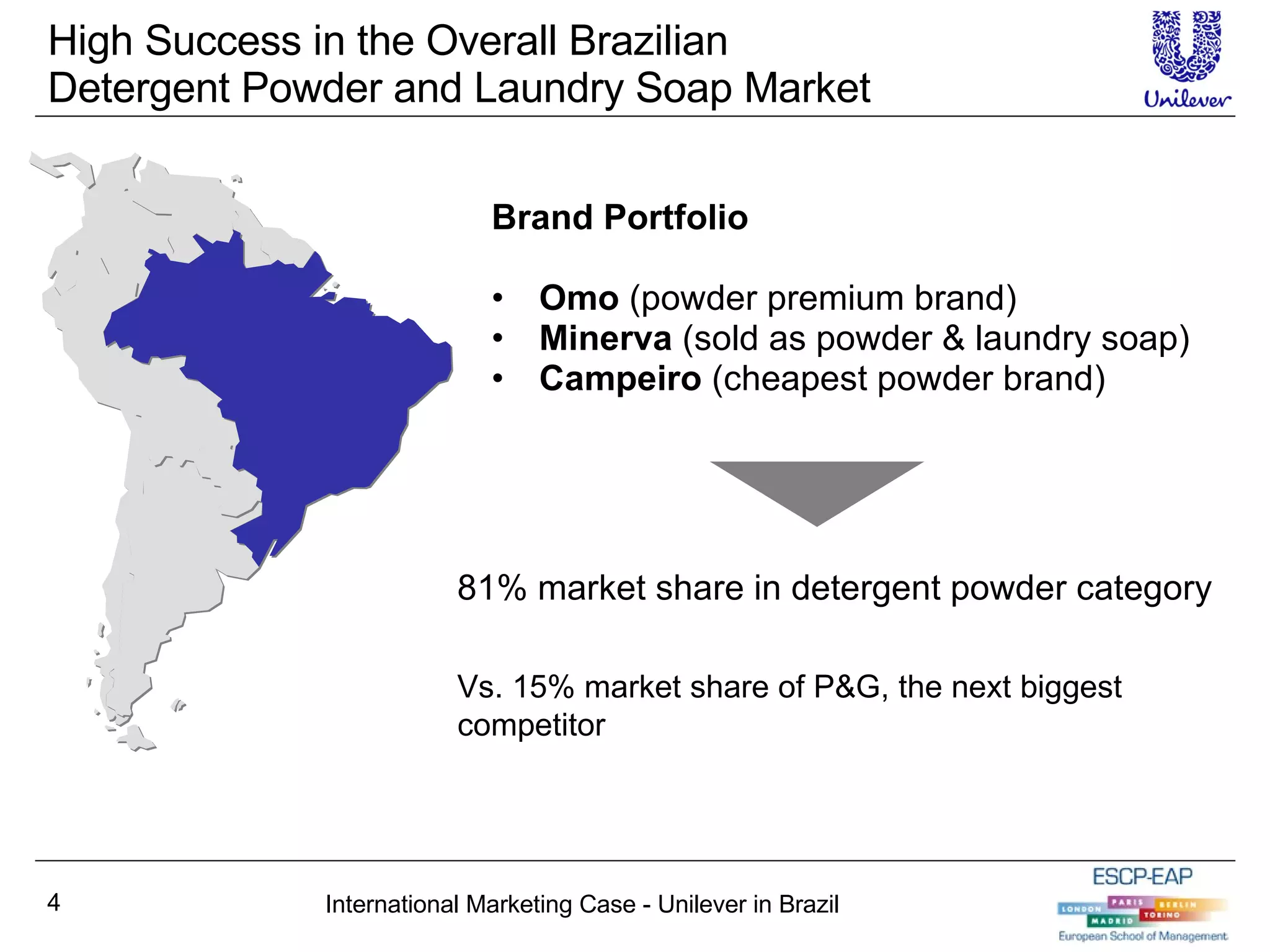
High Success in the Overall Brazilian Detergent Powder and Laundry Soap Market Brand Portfolio Omo  (powder premium brand) Minerva  (sold as powder & laundry soap) Campeiro  (cheapest powder brand) International Marketing Case - Unilever in Brazil 81% market share in detergent powder category Vs. 15% market share of P&G, the next biggest competitor
Low- Income Consumers in Northeastern Brazil Constitute a Large but very Specific Customer Segment International Marketing Case - Unilever in Brazil Demographic Background 48 million low-income consumers 28% of Brazil‘s total population 40% illiterate Per capita income of $ 2,250 53% live on less than two minimum wages Laundry and Detergent Use Patterns Clothes washed frequently due to few clothes and more time Pleasurable activity (washing in a public laundry, river, or pond; meeting and chatting with friends)
Agenda International Marketing Case - Unilever in Brazil Introduction to the Brazilian Market Why the Low-Income Segment Should be Targeted Implications of Targeting the Low-Income Segment   Brand Portfolio and Positioning xxx xxx
Fierce Competition and Multiplication Effect To Other Product Categories International Marketing Case - Unilever in Brazil Detergents are Cash Cow Competition Fuel for  growth  in the food and personal care  categories P&G  drawing on worldwide R&D and  marketing expertise is closing up and will  attack in this segment Threat of  small local brands  targeted at low- income consumers 1 2
Particularly the Detergent Powder Market is Highly Lucrative and Growing but Competitive  International Marketing Case - Unilever in Brazil 17% annual growth rate High barriers to entry Market $106m with share of $79,5m 6% annual growth rate Low barriers to entry Market $102m with share of $19,38m Detergents Powder Market Laundry Soap Market 3 4
Agenda International Marketing Case - Unilever in Brazil Introduction to the Brazilian Market Why the Low-Income Segment Should be Targeted Implications of Targeting the Low-Income Segment   Brand Portfolio and Positioning xxx xxx
More Positive Effects of Targeting the Low-Income Market in the Short- and Long-Term International Marketing Case - Unilever in Brazil Long-Term Implications Short-Term Implications With the right strategy,  low income  consumers will be ready to pay for a new  brand and Omo buyers will not move Becoming a  leader in low-income  consumer marketing Money  has to be invested and therefore  diverted from   premium brands to low price brand Gaining momentum and  first mover    advantage in a fast growing market
Agenda International Marketing Case - Unilever in Brazil Introduction to the Brazilian Market Why the Low-Income Segment Should be Targeted Implications of Targeting the Low-Income Segment   Brand Portfolio and Positioning xxx xxx
Current Brand Portfolio International Marketing Case - Unilever in Brazil
Why Brand Extension required International Marketing Case - Unilever in Brazil
International Marketing Case - Unilever in Brazil Price Index
Positioning Statement Who we are Major manufacturers in Food, Home care and Personal care What business are we looking NE Brazilian Fabric Wash Market Who is the Target Market Low income groups of NE Brazil Need of the Target Market A Detergent powder(like Omo) at an affordable price with better characteristics than detergents like Campeiro Competitors Invicto , Pop, Campeiro The USP The Cleaning ability comparable to a Laundry soap International Marketing Case - Unilever in Brazil
Positioning Statement “ To the women who give cleanliness the highest priority. Campeiro  Plus is a detergent powder which gives you a better cleaning power with much less effort than the similar priced competitors.” International Marketing Case - Unilever in Brazil
Thank You Very Much For Your Attention!

Unilever Brazil Case

  • 1.
    Unilever inBrazil (1997-2007) Marketing Strategies for Low-Income Consumers
  • 2.
    Agenda International MarketingCase - Unilever in Brazil Introduction to the Brazilian Market Why the Low-Income Segment Should be Targeted Implications of Targeting the Low-Income Segment Brand Portfolio and Positioning xxx xxx
  • 3.
    Agenda International MarketingCase - Unilever in Brazil Introduction to the Brazilian Market Why the Low-Income Segment Should be Targeted Implications of Targeting the Low-Income Segment Brand Portfolio and Positioning xxx xxx
  • 4.
    High Success inthe Overall Brazilian Detergent Powder and Laundry Soap Market Brand Portfolio Omo (powder premium brand) Minerva (sold as powder & laundry soap) Campeiro (cheapest powder brand) International Marketing Case - Unilever in Brazil 81% market share in detergent powder category Vs. 15% market share of P&G, the next biggest competitor
  • 5.
    Low- Income Consumersin Northeastern Brazil Constitute a Large but very Specific Customer Segment International Marketing Case - Unilever in Brazil Demographic Background 48 million low-income consumers 28% of Brazil‘s total population 40% illiterate Per capita income of $ 2,250 53% live on less than two minimum wages Laundry and Detergent Use Patterns Clothes washed frequently due to few clothes and more time Pleasurable activity (washing in a public laundry, river, or pond; meeting and chatting with friends)
  • 6.
    Agenda International MarketingCase - Unilever in Brazil Introduction to the Brazilian Market Why the Low-Income Segment Should be Targeted Implications of Targeting the Low-Income Segment Brand Portfolio and Positioning xxx xxx
  • 7.
    Fierce Competition andMultiplication Effect To Other Product Categories International Marketing Case - Unilever in Brazil Detergents are Cash Cow Competition Fuel for growth in the food and personal care categories P&G drawing on worldwide R&D and marketing expertise is closing up and will attack in this segment Threat of small local brands targeted at low- income consumers 1 2
  • 8.
    Particularly the DetergentPowder Market is Highly Lucrative and Growing but Competitive International Marketing Case - Unilever in Brazil 17% annual growth rate High barriers to entry Market $106m with share of $79,5m 6% annual growth rate Low barriers to entry Market $102m with share of $19,38m Detergents Powder Market Laundry Soap Market 3 4
  • 9.
    Agenda International MarketingCase - Unilever in Brazil Introduction to the Brazilian Market Why the Low-Income Segment Should be Targeted Implications of Targeting the Low-Income Segment Brand Portfolio and Positioning xxx xxx
  • 10.
    More Positive Effectsof Targeting the Low-Income Market in the Short- and Long-Term International Marketing Case - Unilever in Brazil Long-Term Implications Short-Term Implications With the right strategy, low income consumers will be ready to pay for a new brand and Omo buyers will not move Becoming a leader in low-income consumer marketing Money has to be invested and therefore diverted from premium brands to low price brand Gaining momentum and first mover advantage in a fast growing market
  • 11.
    Agenda International MarketingCase - Unilever in Brazil Introduction to the Brazilian Market Why the Low-Income Segment Should be Targeted Implications of Targeting the Low-Income Segment Brand Portfolio and Positioning xxx xxx
  • 12.
    Current Brand PortfolioInternational Marketing Case - Unilever in Brazil
  • 13.
    Why Brand Extensionrequired International Marketing Case - Unilever in Brazil
  • 14.
    International Marketing Case- Unilever in Brazil Price Index
  • 15.
    International Marketing Case- Unilever in Brazil Price Index
  • 16.
    Positioning Statement Whowe are Major manufacturers in Food, Home care and Personal care What business are we looking NE Brazilian Fabric Wash Market Who is the Target Market Low income groups of NE Brazil Need of the Target Market A Detergent powder(like Omo) at an affordable price with better characteristics than detergents like Campeiro Competitors Invicto , Pop, Campeiro The USP The Cleaning ability comparable to a Laundry soap International Marketing Case - Unilever in Brazil
  • 17.
    Positioning Statement “To the women who give cleanliness the highest priority. Campeiro Plus is a detergent powder which gives you a better cleaning power with much less effort than the similar priced competitors.” International Marketing Case - Unilever in Brazil
  • 18.
    Thank You VeryMuch For Your Attention!

Editor's Notes

  • #2 Should Unilever target the low-income segment of consumers in the Northeast? What are the short-term and long-term implications of the decision? - Evaluate Unilever's current brand portfolio. Is a new brand necessary to serve the low-income segment or could Unilever reposition one of its existing brands or simply launch a brand extension? If you judge that a new brand is necessary, write its positioning statement and choose its name among Unilever's worldwide brand names. - Design the marketing-mix. Choose the price, promotion (objectives, message and mix), product (formulation and packaging), and distribution that will allow Unilever to create and capture value for low-income in the Northeast of Brazil.