Chapter Five
Strategy Analysis and Choice/Strategy Formulation
5.1 The nature of strategy analysis and choice
In this chapter focuses on generating and evaluating alternative strategies, as well as selecting
strategies to pursue. Strategy analysis and choice seeks to determine alternative courses of action
that could best enable the firm to achieve its mission and objectives. The firm’s present strategies,
objectives, and mission, coupled with the external and internal audit information, provide a basis
for generating and evaluating feasible alternative strategies.
Level of Strategies
A Simple Organization Chart
(Dominant or Related Product Business
1. Business-Level Strategy
Business-level strategy: an integrated and coordinated set of commitments and actions the firm
uses to gain a competitive advantage by exploiting core competencies in specific product
markets
 Purpose: To create differences between position of a firm and its competitors
 Firm must make a deliberate choice to
o Perform activities differently
o Perform different activities
 Impacts how value chain activities will be performed to create unique value
 No strategy better than others
 Contingent on internal and external environment
 Two types of competitive advantage firms must choose between
o Cost (Are our costs LOWER than rivals costs?)
o Uniqueness (Are we DIFFERENT than rivals?)
 Two types of ‘competitive scope’ firms must choose between
o Broad target
o Narrow target
 These combine to yield 5 different generic business level strategies
o Can potentially be used by any organization competing in any industry
a. Cost Leadership Strategy
An integrated set of actions designed to produce or deliver goods or services at the lowest cost
relative to competitors with features that are acceptable to customers
 relatively standardized products
 features acceptable to many customers
 lowest competitive price
Cost saving actions required by this strategy:
 building efficient facilities
 tightly controlling production costs and overhead
 minimizing costs of sales, R&D and service
 building efficient manufacturing facilities
 monitoring costs of activities provided by outsiders
 simplifying production processes
Major Risks of Cost Leadership Strategy
 There can only be one cost leader
 Technological change can eliminate cost advantage
 Spillovers lead to imitation
 Efficiency focus may create blind spots re: customer preferences
b. Differentiation Strategy
An integrated set of actions designed by a firm to produce or deliver goods or services that
customers perceive as adding value
 price may exceed what the firm’s target customers are willing to pay
 Non-commodity products
 customers value differentiated features more than they value low cost
Add downstream value
 lower buyer cost
 raise buyer performance
Cos: Add value to buyer’s value: reduce downstream processing time, search time, transaction
costs, defect rates, direct costs, learning curves, labor, space, installation, etc. (e.g., CRM
software)
Factors That Drive Differentiation
Value: Increase performance of buyer’s value chain (or consumer perception)
 Unique features, performance
 Downstream channels
 New technologies
 Quality of inputs
 Skill or know-how
 Information
Some differentiation actions required by this strategy:
 develop new “systems” and processes
 signal and shape buyer perceptions
 quality focus
 capability in R&D
Implication - maximize human capital contributions
c. Focused Business-Level Strategies
A focus strategy must exploit a narrow target’s differences from the balance of the industry by:
 isolating a particular buyer group
 isolating a unique segment of a product line
 concentrating on a particular geographic market
 finding their “niche”
i. Focused Cost Leadership
 Competitive advantage: Low-cost
 Competitive scope: Narrow industry segment
o Motel 6, Kia
ii. Focused Differentiation
 Competitive advantage: Differentiation
 Competitive scope: Narrow industry segment
o Ritz-Carlton, Apple, Rolls Royce
Factors Driving Focus Strategies
 Large firms overlook small niches
 Firm may lack resources to compete in the broader market
 May be able to serve a narrow market segment more effectively than can larger
industry-wide competitors
 Focus may allow the firm to direct resources to certain value chain activities to build
competitive advantage
Major Risks of Focused Strategies
 Firm may be “out focused” by competitors
 Large competitor may set its sights on your niche market
 Preferences of niche market may change to match those of broad market
d. Integrated Cost Leadership/Differentiation
o Efficiently produce products with differentiated attributes
 Efficiency: Sources of low cost
 Differentiation: Source of unique value
o Involves engaging in primary and support activities that allow a firm to
simultaneously pursue low cost and differentiation
o Low price with somewhat highly differentiated features
o More value for the money
o Often called best-cost strategy
o Examples: Toyota, Target
Risks of Integrated Strategies
 Harder to implement than other strategies
 Must simultaneously reduce costs while increasing differentiation
 Can get ‘stuck in the middle’ resulting in no advantages and poor performance
2. Corporate level Strategy
Corporate strategy is a firm’s overall approach to gaining a competitive advantage by
operating in several businesses simultaneously. Gaining a competitive advantage requires
setting a clear purpose for the entire organization and identifying plans and actions to achieve
that purpose
Four areas of focus
a. Stability strategy
b. Expansion Strategy
c. Defensive strategy
3. Functional level strategies (Reading Assignment)
5.2 Long term objectives
Long-term objectives represent the results expected from pursuing certain strategies. Strategies
represent the actions to be taken to accomplish long-term objectives. The time frame for objectives
and strategies should be consistent, usually from two to five years.
The Nature of Long-Term Objectives
Objectives should be quantitative, measurable, realistic, understandable, challenging, hierarchical,
obtainable, and congruent among organizational units. Each objective should also be associated
with a time line. Objectives are commonly stated in terms such as growth in assets, growth in sales,
profitability, market share, degree and nature of diversification, degree and nature of vertical
integration, earnings per share, and social responsibility. Clearly established objectives offer many
benefits. They provide direction, allow synergy, aid in evaluation, establish priorities, reduce
uncertainty, minimize conflicts, stimulate exertion, and aid in both the allocation of resources and
the design of jobs.
Long-term objectives are needed at the corporate, divisional, and functional levels in an
organization. They are an important measure of managerial performance.
Clearly stated and communicated objectives are vital to success for many reasons. Objectives help
stakeholders understand their role in an organization's future. They also provide a basis for
consistent decision making by managers whose values and attitudes differ. By reaching a
consensus on objectives during strategy-formulation activities, an organization can minimize
potential conflicts later during implementation. Objectives set forth organizational priorities and
stimulate exertion and accomplishment. They serve as standards by which individuals, groups,
departments, divisions, and entire organizations can be evaluated. Objectives provide the basis for
designing jobs and organizing activities to be performed in an organization. They also provide
direction and allow for organizational synergy.
Without long-term objectives, an organization would drift aimlessly toward some unknown end!
It is hard to imagine an organization or individual being successful without clear objectives.
Success only rarely occurs by accident; rather, it is the result of hard work directed toward
achieving certain objectives.
5.3 A comprehensive strategy formulation
Important strategy-formulation techniques can be integrated into a three-stage decision-making
framework, as shown below. The tools presented in this framework are applicable to all sizes and
types of organizations and can help strategists identify, evaluate, and select strategies.
Stage-1 (Formulation Framework)
1. External factor evaluation
2. Competitive matrix profile
3. Internal factor evaluation
Stage-2 (Matching stage)
1. TWOS Matrix (Threats-Opportunities-Weaknesses-Strengths)
2. SPACE Matrix (Strategic Position and Action Evaluation)
3. BCG Matrix (Boston Consulting Group)
4. IE Matrix (Internal and external)
5. GS Matrix (Grand Strategy)
Stage-3 (Decision stage)
1. QSPM (Quantitative Strategic Planning Matrix)
Stage-1 (Formulation Framework)
Stage 1 of the formulation framework consists of the EFE Matrix, the IFE Matrix, and the
Competitive Profile Matrix. Called the Input Stage, Stage 1 summarizes the basic input
information needed to formulate strategies.
External factor evaluation
Competitive matrix profile
. Internal factor evaluation
1. The External Factor Evaluation (EFE) Matrix
An External Factor Evaluation (EFE) Matrix allows strategists to summarize and evaluate
economic, social, cultural, demographic, environmental, political, governmental, legal,
technological, and competitive information. The EFE matrix consists of five steps process.
Five-Step process:
• List key external factors (10-20)
Opportunities & threats
You have to prepare a list of all external factors which will affect the EFE matrix. These factors
should be two points to be kept in mind these are opportunities and threats.
• Assign weight to each (0 to 1.0)
Sum of all weights = 1.0
Now you have to arrange them according to their weight age that which factor is most important.
It should be weight age in % ages. The sum of the total of all the factors should always be one.
• Assign 1-4 rating to each factor
• Firm’s current strategies response to the factor: how well firms response to these factors.
• Multiply each factor’s weight by its rating
• Produces a weighted score
How the firm will respond to these factors external factors. Such criteria are known as rating.
• Sum the weighted scores for each
Determines the total weighted score for the organization.
• Highest possible weighted score for the organization is 4.0; the lowest, 1.0. Average = 2.5
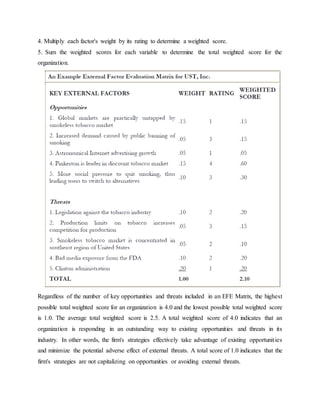
Illustrated in Table 3-11, the EFE Matrix can be developed in five steps:
1. List key external factors as identified in the external-audit process. Include a total of from ten
to twenty factors, including both opportunities and threats affecting the firm and its industry. List
the opportunities first and then the threats. Be as specific as possible, using percentages, ratios,
and comparative numbers whenever possible.
2. Assign to each factor a weight that ranges from 0.0 (not important) to 1.0 (very important). The
weight indicates the relative importance of that factor to being successful in the firm's industry.
Opportunities often receive higher weights than threats, but threats too can receive high weights if
they are especially severe or threatening. Appropriate weights can be determined by comparing
successful with unsuccessful competitors or by discussing the factor and reaching a group
consensus. The sum of all weights assigned to the factors must equal 1.0.
3. Assign a 1-to-4 rating to each key external factor to indicate how effectively the firm's current
strategies respond to the factor, where 4 5 the response is superior, 3 5 the response is above
average, 2 5 the response is average, and 1 5 the response is poor. Ratings are based on
effectiveness of the firm's strategies. Ratings are, thus, company based, whereas the weights in
Step 2 are industry based. It is important to note that both threats and opportunities can receive a
1, 2, 3, or 4.
4. Multiply each factor's weight by its rating to determine a weighted score.
5. Sum the weighted scores for each variable to determine the total weighted score for the
organization.
Regardless of the number of key opportunities and threats included in an EFE Matrix, the highest
possible total weighted score for an organization is 4.0 and the lowest possible total weighted score
is 1.0. The average total weighted score is 2.5. A total weighted score of 4.0 indicates that an
organization is responding in an outstanding way to existing opportunities and threats in its
industry. In other words, the firm's strategies effectively take advantage of existing opportunities
and minimize the potential adverse effect of external threats. A total score of 1.0 indicates that the
firm's strategies are not capitalizing on opportunities or avoiding external threats.
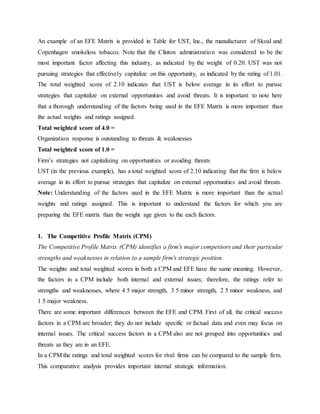
An example of an EFE Matrix is provided in Table for UST, Inc., the manufacturer of Skoal and
Copenhagen smokeless tobacco. Note that the Clinton administration was considered to be the
most important factor affecting this industry, as indicated by the weight of 0.20. UST was not
pursuing strategies that effectively capitalize on this opportunity, as indicated by the rating of 1.01.
The total weighted score of 2.10 indicates that UST is below average in its effort to pursue
strategies that capitalize on external opportunities and avoid threats. It is important to note here
that a thorough understanding of the factors being used in the EFE Matrix is more important than
the actual weights and ratings assigned.
Total weighted score of 4.0 =
Organization response is outstanding to threats & weaknesses
Total weighted score of 1.0 =
Firm’s strategies not capitalizing on opportunities or avoiding threats
UST (in the previous example), has a total weighted score of 2.10 indicating that the firm is below
average in its effort to pursue strategies that capitalize on external opportunities and avoid threats.
Note: Understanding of the factors used in the EFE Matrix is more important than the actual
weights and ratings assigned. This is important to understand the factors for which you are
preparing the EFE matrix than the weight age given to the each factors.
1. The Competitive Profile Matrix (CPM)
The Competitive Profile Matrix (CPM) identifies a firm's major competitors and their particular
strengths and weaknesses in relation to a sample firm's strategic position.
The weights and total weighted scores in both a CPM and EFE have the same meaning. However,
the factors in a CPM include both internal and external issues; therefore, the ratings refer to
strengths and weaknesses, where 4 5 major strength, 3 5 minor strength, 2 5 minor weakness, and
1 5 major weakness.
There are some important differences between the EFE and CPM. First of all, the critical success
factors in a CPM are broader; they do not include specific or factual data and even may focus on
internal issues. The critical success factors in a CPM also are not grouped into opportunities and
threats as they are in an EFE.
In a CPM the ratings and total weighted scores for rival firms can be compared to the sample firm.
This comparative analysis provides important internal strategic information.
A sample Competitive Profile Matrix is provided in Table. In this example, advertising and global
expansion are the most important critical success factors, as indicated by a weight of 0.20. Avon's
and L'Oreal's product quality is superior, as evidenced by a rating of 4; L'Oreal's "financial
position" is good, as indicated by a rating of 3; Procter & Gamble is the weakest firm overall, as
indicated by a total weighted score of 2.80.
Other than the critical success factors listed in the example CPM, other factors often included in
this analysis include breadth of product line, effectiveness of sales distribution, proprietary or
patent advantages, location of facilities, production capacity and efficiency, experience, union
relations, technological advantages, and e-commerce expertise.
A word on interpretation: Just because one firm receives a 3.2 rating and another receives a 2.8
rating in a Competitive Profile Matrix, it does not follow that the first firm is 20 percent better than
the second.
Numbers reveal the relative strength of firms, but their implied precision is an illusion. Numbers
are not magic. The aim is not to arrive at a single number but rather to assimilate and evaluate
information in a meaningful way that aids in decision making.
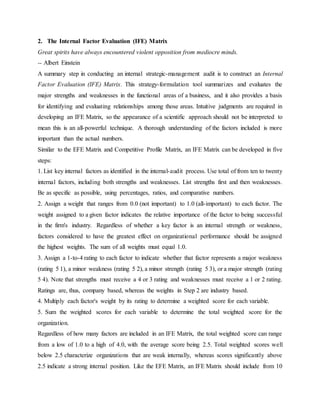
2. The Internal Factor Evaluation (IFE) Matrix
Great spirits have always encountered violent opposition from mediocre minds.
-- Albert Einstein
A summary step in conducting an internal strategic-management audit is to construct an Internal
Factor Evaluation (IFE) Matrix. This strategy-formulation tool summarizes and evaluates the
major strengths and weaknesses in the functional areas of a business, and it also provides a basis
for identifying and evaluating relationships among those areas. Intuitive judgments are required in
developing an IFE Matrix, so the appearance of a scientific approach should not be interpreted to
mean this is an all-powerful technique. A thorough understanding of the factors included is more
important than the actual numbers.
Similar to the EFE Matrix and Competitive Profile Matrix, an IFE Matrix can be developed in five
steps:
1. List key internal factors as identified in the internal-audit process. Use total of from ten to twenty
internal factors, including both strengths and weaknesses. List strengths first and then weaknesses.
Be as specific as possible, using percentages, ratios, and comparative numbers.
2. Assign a weight that ranges from 0.0 (not important) to 1.0 (all-important) to each factor. The
weight assigned to a given factor indicates the relative importance of the factor to being successful
in the firm's industry. Regardless of whether a key factor is an internal strength or weakness,
factors considered to have the greatest effect on organizational performance should be assigned
the highest weights. The sum of all weights must equal 1.0.
3. Assign a 1-to-4 rating to each factor to indicate whether that factor represents a major weakness
(rating 5 1), a minor weakness (rating 5 2), a minor strength (rating 5 3), or a major strength (rating
5 4). Note that strengths must receive a 4 or 3 rating and weaknesses must receive a 1 or 2 rating.
Ratings are, thus, company based, whereas the weights in Step 2 are industry based.
4. Multiply each factor's weight by its rating to determine a weighted score for each variable.
5. Sum the weighted scores for each variable to determine the total weighted score for the
organization.
Regardless of how many factors are included in an IFE Matrix, the total weighted score can range
from a low of 1.0 to a high of 4.0, with the average score being 2.5. Total weighted scores well
below 2.5 characterize organizations that are weak internally, whereas scores significantly above
2.5 indicate a strong internal position. Like the EFE Matrix, an IFE Matrix should include from 10
to 20 key factors. The number of factors has no effect upon the range of total weighted scores
because the weights always sum to 1.0.
When a key internal factor is both strength and weakness, the factor should be included twice in
the IFE Matrix, and a weight and rating should be assigned to each statement. For example, the
Playboy logo both helps and hurts Playboy Enterprises; the logo attracts customers to the Playboy
magazine, but it keeps the Playboy cable channel out of many markets.
An example of an IFE Matrix for Circus Circus Enterprises is provided in Table. Note that the
firm's major strengths are its size, occupancy rates, property, and long-range planning as indicated
by the rating of 4. The major weaknesses are locations and recent joint venture. The total weighted
score of 2.75 indicates that the firm is above average in its overall internal strength.
Stage-2 (Matching stage)
Stage 2, called the Matching Stage, focuses upon generating feasible alternative strategies by
aligning key external and internal factors. Stage 2 techniques include :
TWOS Matrix (Threats-Opportunities-Weaknesses-Strengths)
SPACE Matrix (Strategic Position and Action Evaluation)
BCG Matrix (Boston Consulting Group)
IE Matrix (Internal and external)
GS Matrix (Grand Strategy)
1. THREATS-OPPORTUNITIES-WEAKNESSES-STRENGTHS (TOWS) MATRIX
The Threats-Opportunities-Weaknesses-Strengths (TOWS) is also named as SWOT analysis. A
TWOS Analysis is a strategic planning tool used to evaluate the Threats, Opportunities and
Strengths, Weaknesses, involved in a project or in a business venture or in any other situation
requiring a decision.
This is an important tool in order to formulate strategy. This Matrix is an important matching tool
that helps managers develops four types of strategies: SO Strategies (strength-opportunities), WO
Strategies (weakness- opportunities), ST Strategies (strength-threats), and WT Strategies
(weakness-threats).The most difficult part of TOWS matrix is to match internal and external factor.
TOWS are defined precisely as follows:
Strengths are attributes of the organization that are helpful to the achievement of the objective.
Weaknesses areattributes of the organization that are harmful to the achievement of the objective.
Opportunities are external conditions that are helpful to the achievement of the objective.
Threats are external conditions that are harmful to the achievement of the objective.
Strengths and weaknesses are internal factors. For example, strength could be your specialist
marketing expertise. A weakness could be the lack of a new product.
Opportunities and threats are external factors. For example, an opportunity could be a
developing distribution channel such as the Internet, or changing consumer lifestyles that
potentially increase demand for a company's products. A threat could be a new competitor in an
important existing market or a technological change that makes existing products potentially
obsolete. it is worth pointing out that SWOT analysis can be very subjective - two people rarely
come-up with the same version of a SWOT analysis even when given the same information about
the same business and its environment. Accordingly, SWOT analysis is best used as a guide and
not a prescription. Adding and weighting criteria to each factor increases the validity of the
analysis.
SO Strategies: Every firm desires to obtain benefit from its resources such benefit can
only be obtained if utilize its strength to take external opportunity. Resources (Assets) an
important firm’s strength to get opportunity for external resources. For example the firm
enjoying a good financial position which is strength for a firm and externally opportunity
to expand business. The strong financial position provides an opportunity to expand the
business. The matched strategy is known as SO strategy.
WO Strategies: WO Strategies developed to match weakness with opportunities of the
firm. WO strategy is very useful if the firm take advantage to external resources in order
to overcome the weakness. For example the firm is in the critical financial problems that
is weakness and firm is availing merger with Multinational Corporation.
ST Strategies: ST Strategies is an important strategy to overcome external threats. This
does not mean that a strong organization should always meet threats in the external
environment head-on. This strategy is adopted by various colleges by opening new
branches in order to overcome competitive threat.
WT Strategies: Every firm has a desire to overcome its weakness and reducing threats.
This type of strategy helpful when weaknesses are removed to overcome external threats.
It is difficult to target WT strategy. For example weak distribution network creating many
problems for the firm if it strong many external threats can be removed.
Steps for developing strategies:
There are eight steps involved in constructing a TOWS Matrix:
1. Rank external opportunities
2. Rank external threats
3. Rank internal strength
4. Rank internal weaknesses.
5. Match internal strengths with external opportunities and mention the result in the SO Strategies
cell.
6. Match internal weaknesses with external opportunities and mention the result in the WO
Strategies cell.
7. Match internal strengths with external threats and mention the result in the ST Strategies cell.
8. Match internal weaknesses with external threats and mention the result in the WT strategies cell.
2. THE STRATEGIC POSITION AND ACTION EVALUATION (SPACE) MATRIX
The Strategic Position and Action Evaluation (SPACE) Matrix is another important Stage 2
matching tool of formulation framework. It explains that what is our strategic position and what
possible action can be taken. It is not closed matrix. It is prepared on graph. It is closed matrix.
This follow counter clock wise direction. It contains four-quadrant named aggressive,
conservative, defensive, or competitive strategies.
The axes of the SPACE Matrix represent two internal dimensions financial strength [FS] and
competitive advantage [CA]) and two external dimensions (environmental stability [ES] and
industry strength [IS]).
These four factors are the most important determinants of an organization's overall strategic
position.
It is divided into two internal and external dimensions which are as follow (Internal dimensions)
financial strength, competitive advantage, (External dimensions) environment stability and
industry strength. This sequence is convention to be followed as graphed above. This frame work
determines appropriate set of strategies for each quadrant.
First quadrant is aggressive the firm fall in this quadrant that fellow the aggressive
strategy. Second quadrant is conservative all those firms that fall n this quadrant that must
fallow conservative strategy and in next the firm fellow the defensive strategy. All the
firms fall on competitive follow that strategy. After a rating is assigned ranging from +1
(worst) to +6 (best) to each of the variables that make up the financial strength and industry
strength dimensions. Assign a numerical value ranging from -1 (best) to -6 (worst) to each
of the variables that make up the environment stability and Competitive advantage
dimensions.
These dimensions are explained below:
After the selection of variables the rating is assigned to each. After the addition of these
variables taking the average. For example financial strength is explain below
Financial Strength (FS) Rating
High Return on investment 3
Large amount of capital 2
Consistently increasing revenue 4
Working capital condition 1
Financial strength average is (3+2+4+1)/4 = 2.5
The industry strength is explained as follows
Industry Strength (IS) Rating
Demand and supply factors 5
Resource utilization 3
Profit potential 3
Technological know-how 6
Ease of entry into market 2
Industry strength average is (5+3+3+6+2)/5 = 3.8. It is plotted on graph:
The graph indicates that firm adopts aggressive strategy
Steps for the preparation of SPACE Matrix
The steps required to develop a SPACE Matrix are as follows:
1. Select a set of variables to relating to financial strength, competitive advantage, environmental
stability, and industry strength.
2. Assign a numerical value ranging from +1 (worst) to +6 (best) to each of the variables that make
up the financial strength and industry strength dimensions. Assign a numerical value ranging from
-1 (best) to -6 (worst) to each of the variables that make up the environmental stability and
competitive advantage dimensions.
3. Compute an average score and dividing by the number of variables
4. Plot the average scores in the SPACE Matrix.
5. Add the two scores on the x-axis and plot the resultant point on X. Add the two scores on the y
axis and plot the resultant point on Y. Plot the intersection of the new xy point.
6. Draw a directional vector from the origin of the SPACE Matrix through the new intersection
point.
This vector reveals the type of strategies recommended for the organization: aggressive,
competitive, defensive, or conservative.
3. BOSTON CONSULTING GROUP (BCG) MATRIX
The Boston Consulting Group (BCG) is a management consulting firm founded by Harvard
Business School alum Bruce Henderson in 1963. The growth-share matrix is a chart created by
group in 1970 to help corporation analyze their business units or product lines, and decide where
to allocate cash. It was popular for two decades, and is still used as an analytical tool.
To use the chart, corporate analysts would plot a scatter graph of their business units, ranking their
relative market shares and the growth rates of their respective industries. This led to a
categorization of four different types of businesses:
Cash cows Units with high market share in a slow-growing industry. These units typically
generate cash in excess of the amount of cash needed to maintain the business. They are
regarded as staid and boring, in a "mature" market, and every corporation would be thrilled
to own as many as possible. They are to be "milked" continuously with as little investment
as possible, since such investment would be wasted in an industry with low growth.
Dogs More charitably called pets, units with low market share in a mature, slow-growing
industry. These units typically "break even", generating barely enough cash to maintain the
business's market share. Though owning a break-even unit provides the social benefit of
providing jobs and possible synergies that assist other business units, from an accounting
point of view such a unit is worthless, not generating cash for the company. They depress
a profitable company's return on assets ratio, used by many investors to judge how well a
company is being managed. Dogs, it is thought, should be sold off.
Question marks Units with low market share in a fast-growing industry. Such business
units require large amounts of cash to grow their market share. The corporate goal must be
to grow the business to become a star. Otherwise, when the industry matures and growth
slows, the unit will fall down into the dog’s category.
Stars Units with a high market share in a fast-growing industry. The hope is that stars
become the next cash cows. Sustaining the business unit's market leadership may require
extra cash, but this is worthwhile if that's what it takes for the unit to remain a leader. When
growth slows, stars become cash cows if they have been able to maintain their category
leadership.
4. The Internal-External (IE) Matrix
This is also an important matrix of matching stage of strategy formulation. This matrix already
explains earlier. It relate to internal (IFE) and external factor evaluation (EFE). The findings form
internal and external position and weighted score plot on it. It contains nine cells. Its characteristics
is a s follow
 Positions an organization’s various divisions in a nine-cell display.
Similar to BCG Matrix except the IE Matrix:
o Requires more information about the divisions
o Strategic implications of each matrix are different
• Based on two key dimensions
 The IFE total weighted scores on the x-axis
 The EFE total weighted scores on the y-axis
• Divided into three major regions
 Grow and build – Cells I, II, or IV
 Hold and maintain – Cells III, V, or VII
 Harvest or divest – Cells VI, VIII, or IX
Steps for the development of IE matrix
1. Based on two key dimensions IFE and EFE.
2. Plot IFE total weighted scores on the x-axis and the EFE total weighted scores on the y axis
3. On the x-axis of the IE Matrix, an IFE total weighted score of 1.0 to 1.99 represents a weak
internal position; a score of 2.0 to 2.99 is considered average; and a score of 3.0 to 4.0 is strong.
4. On the y-axis, an EFE total weighted score of 1.0 to 1.99 is considered low; a score of 2.0 to
2.99 is medium; and a score of 3.0 to 4.0 is high.
5. IE Matrix divided into three major regions.
 Grow and build – Cells I, II, or IV
 Hold and maintain – Cells III, V, or VII
 Harvest or divest – Cells VI, VIII, or IX
5. GRAND STRATEGY MATRIX
This is also an important matrix of strategy formulation frame work. Grand strategy matrix it is
popular tool for formulating alternative strategies. In this matrix all organization divides into four
quadrants.
Any organization should be placed in any one of four quadrants. Appropriate strategies for an
organization to consider are listed in sequential order of attractiveness in each quadrant of the
matrix.
It is based two major dimensions
1. Market growth
2. Competitive position
All quadrant contain all possible strategies
Qurdant-1 contains that company’s strong having competitive situation and rapid market growth.
Firms located in Quadrant I of the Grand Strategy Matrix are in an excellent strategic position.
These firms must focus on current market and appropriate to follow market penetration, market
development and products development are appropriate strategies.
Qurdant-2 contains that company’s having weak competitive situation and rapid market growth.
Firms positioned in Quadrant II need to evaluate their present approach to the marketplace
seriously.
Although their industry is growing, they are unable to compete effectively, and they need to
determine why the firm's current approach is ineffectual and how the company can best change to
improve its competitiveness. Because Quadrant II firms are in a rapid-market-growth industry, an
intensive strategy (as opposed to integrative or diversification) is usually the first option that
should be considered.
Qurdant-3 contains that company’s weak competitive situation and slow market growth. The
firms fall in this quadrant compete in slow-growth industries and have weak competitive positions.
These firms must make some drastic changes quickly to avoid further demise and possible
liquidation. Extensive cost and asset reduction (retrenchment) should be pursued first. An
alternative strategy is to shift resources away from the current business into different areas. If all
else fails, the final options for
Quadrant III businesses are divestiture or liquidation.
Qurdant-4 contains that company’s strong competitive situation and slow market growth. Finally,
Quadrant IV businesses have a strong competitive position but are in a slow-growth industry.
These firms have the strength to launch diversified programs into more promising growth areas.
Quadrant IV firms have characteristically high cash flow levels and limited internal growth needs
and often can pursue concentric, horizontal, or conglomerate diversification successfully.
Quadrant IV firms also may pursue joint ventures
Conclusion
Every firm fall any one four quadrants and if the firm fall in quadrant-1 it must follow the list of
strategies given in it. As further if the firm falls in quarrant-2 must adopt the strategies given in
quadrant-2 and so on.
Stage-3 (Decision stage)
Stage 3, called the Decision Stage, and involves a single technique, the Quantitative Strategic
Planning Matrix (QSPM). A QSPM uses input information from Stage 1 to objectively evaluate
feasible alternative strategies identified in Stage 2. A QSPM reveals the relative attractiveness of
alternative strategies and, thus, provides an objective basis for selecting specific strategies.
The Quantitative Strategic Planning Matrix (QSPM)
The last stage of strategy formulation is decision stage. In this stage it is decided that which way
is most appropriate or which alternative strategy should be select. This stage contains QSPM that
is only tool for objective evaluation of alternative strategies. A quantitative method used to collect
data and prepare a matrix for strategic planning. It is based on identified internal and external
crucial success factors. That is only technique designed to determine the relative attractiveness of
feasible alternative action. This technique objectively indicates which alternative strategies are
best. The QSPM uses input from Stage 1 analyses and matching results from Stage 2 analyses to
decide objectively among alternative strategies. That is, the EFE Matrix, IFE Matrix, and
Competitive Profile Matrix that make up Stage 1, coupled with the TOWS Matrix, SPACE
Analysis, BCG Matrix, IE Matrix, and Grand Strategy Matrix that make up Stage 2, provide the
needed information for setting up the QSPM (Stage 3).
Preparation of matrix
Now the question is that how to prepare QSPM matrix. First it contains key internal and external
factors. An internal factor contains (strength and weakness) and external factor include
(opportunities and threats). It relates to previously IFE and EFE in which weight to all factors.
Weight means importance to internal and external factor. The sum of weight must be equal to one.
After assigning the weights examine stage-2 matrices and identify alternatives strategies that the
organization should consider implementing. The top row of a QSPM consists of alternative
strategies derived from the TOWS Matrix, SPACE Matrix, BCG Matrix, IE Matrix, and Grand
Strategy Matrix. These matching tools usually generate similar feasible alternatives. However, not
every strategy suggested by the matching techniques has to be evaluated in a QSPM. Strategists
should use good intuitive judgment in selecting strategies to include in a QSPM. After assigning
the weight to strategy, determine the attractiveness score of each and afterwards total attractiveness
score. The highest total attractiveness score strategy is most feasible.
Steps in preparation of QSPM
1. List of the firm's key external opportunities/threats and internal strengths/weaknesses in the left
column of the QSPM.
2. Assign weights to each key external and internal factor
3. Examine the Stage 2 (matching) matrices and identify alternative strategies that the organization
should consider implementing
4. Determine the Attractiveness Scores (AS)
5. Compute the Total Attractiveness Scores
6. Compute the Sum Total Attractiveness Score
Limitations
1. Requires intuitive judgments and educated assumptions
2. Only as good as the prerequisite inputs
3. Only strategies within a given set are evaluated relative to each other
Advantages
1. Sets of strategies considered simultaneously or sequentially
2. Integration of pertinent external and internal factors in the decision making process
6.5 The balanced scorecard (BSC model )
Objective setting is not an isolated process. As has already been discussed there is a need for
managers to know the key criteria by which their performance against objectives will be measured.
There is a clear link between setting objectives and the setting of performance measures. The
balanced scorecard (Kaplan and Norton, 1992, 1993) is an approach that more clearly links these
two activities. Kaplan and Norton suggest that a balanced set of objectives should be created and
at the same time a coherent set of performance measures should be developed alongside them.
At the core of the balanced scorecard approach is the belief that managers have to be able
to look at a business from four key perspectives:
1. Customer perspective: How customers see a business is critical, but financial measures
alone do not provide this view. Customers are generally concerned with, quality,
performance, service and time. For each of these categories the organization should
develop objectives and performance measures. Obviously how these categories are defined
has to be from the customer’s perspective. This will allow the organization to track how
customers view the business overtime.
2. Internal perspective: Managers have to identify the critical internal processes that will
allow them to satisfy customer needs. Identifying the processes that are important to
customer satisfaction allows managers to identify the functions and competencies in which
they need to excel.
3. Innovation and learning perspective: An organization’s ability to create value is
inextricably linked to its capacity to continually improve through innovation and learning.
4. Financial perspective: This allows the organization to see how the business looks from the
shareholders point of view. This financial performance measures the success, not only of
an organization’s strategy, but also of its implementation.
The balanced scorecard widens the view managers have of the business rather than
concentrating purely on financial criteria. For each of these perspectives the organization
has to create distinct objectives and at the same time develop the accompanying
performance measures. This process also forces managers to understand many complex
relationships and to surmount some of the traditional functional barriers that hamper
strategic development (see Figure).
Figure: The balanced scorecard (Source: Adapted from Kaplan and Norton, 1992, 1993)
The balanced scorecard approach also addresses one other potential problem that of
ensuring consistency between objectives. This can be difficult in practice because
objectives are formed in a range of areas, at different levels and on different time scales
(effectively objectives are formed both horizontally and vertically through the
organization).
6.6 The 7’S model (The seven S’s)
The McKinsey and Company’s ‘Seven-S’ model provides a useful summation of these ideas. The
model can be adapted as seen in Figure and split into:
HRM – dealing with the people-based aspects of implementation and
(ii) Process – the policy, procedures, reporting and systems aspects of implementation.
Skills
The appropriate skills mix is required in order to achieve any aim or goal. Within the context of
implementing marketing strategy ‘softer’ human resource management (HRM) skills can be
lacking. It should be remembered that project management is a skill in its own right.
To summaries, successful implementation requires skills such as:
Technical/marketing skills for example, design, market research, industry analysis.
HRM skills for example, delegation, performance appraisal, training.
Project management skills for example, budgeting, resourcing, forecasting.
Strategy
To state the obvious, there must be a strategy to implement. However the fact that a strategy exists
may not be apparent to everyone.
Additionally, the strategy may not be seen as appropriate by all staff. The project leader must
ensure people are aware of the strategy, the reason for it and their role in making it work. Potential
strategy should be screened to ensure that it is appropriate to current circumstances. For example,
what is the basis of competitive advantage? What organizational changes need to take place?
Systems
Several systems are important in the implementation process and fall into two general groups:
reporting and forecasting. It is necessary to have systems which aid management decision making.
Note: These are aids to decision making and not replacements for decision making.
Such systems will cover areas such as finance and budgeting, project evaluation/refinement and
market research. The key factor is often the interpretation of information rather than the system
itself.
Structure
The structure of any organisation, or project, has two primary functions. Firstly, it defines lines of
authority denoting levels of responsibility. Current management thinking promotes a move
towards flatter structures with more devolved authority. Secondly, structure is a basis for
communication. Structures can filter out information making senior management remote from the
customer. In the area of implementation consideration should be given to how communication
occurs.
In relation to developing marketing strategy, it can be advisable to have multi-functional teams. A
group with a diverse range of backgrounds can promote ownership of projects, identify operational
problems in advance and enhance overall quality.

Chapter 5

  • 1.
    Chapter Five Strategy Analysisand Choice/Strategy Formulation 5.1 The nature of strategy analysis and choice In this chapter focuses on generating and evaluating alternative strategies, as well as selecting strategies to pursue. Strategy analysis and choice seeks to determine alternative courses of action that could best enable the firm to achieve its mission and objectives. The firm’s present strategies, objectives, and mission, coupled with the external and internal audit information, provide a basis for generating and evaluating feasible alternative strategies. Level of Strategies A Simple Organization Chart (Dominant or Related Product Business 1. Business-Level Strategy Business-level strategy: an integrated and coordinated set of commitments and actions the firm uses to gain a competitive advantage by exploiting core competencies in specific product markets  Purpose: To create differences between position of a firm and its competitors  Firm must make a deliberate choice to
  • 2.
    o Perform activitiesdifferently o Perform different activities  Impacts how value chain activities will be performed to create unique value  No strategy better than others  Contingent on internal and external environment  Two types of competitive advantage firms must choose between o Cost (Are our costs LOWER than rivals costs?) o Uniqueness (Are we DIFFERENT than rivals?)  Two types of ‘competitive scope’ firms must choose between o Broad target o Narrow target  These combine to yield 5 different generic business level strategies o Can potentially be used by any organization competing in any industry a. Cost Leadership Strategy An integrated set of actions designed to produce or deliver goods or services at the lowest cost relative to competitors with features that are acceptable to customers  relatively standardized products  features acceptable to many customers  lowest competitive price Cost saving actions required by this strategy:  building efficient facilities  tightly controlling production costs and overhead  minimizing costs of sales, R&D and service
  • 3.
     building efficientmanufacturing facilities  monitoring costs of activities provided by outsiders  simplifying production processes Major Risks of Cost Leadership Strategy  There can only be one cost leader  Technological change can eliminate cost advantage  Spillovers lead to imitation  Efficiency focus may create blind spots re: customer preferences b. Differentiation Strategy An integrated set of actions designed by a firm to produce or deliver goods or services that customers perceive as adding value  price may exceed what the firm’s target customers are willing to pay  Non-commodity products  customers value differentiated features more than they value low cost Add downstream value  lower buyer cost  raise buyer performance Cos: Add value to buyer’s value: reduce downstream processing time, search time, transaction costs, defect rates, direct costs, learning curves, labor, space, installation, etc. (e.g., CRM software) Factors That Drive Differentiation Value: Increase performance of buyer’s value chain (or consumer perception)  Unique features, performance  Downstream channels  New technologies  Quality of inputs  Skill or know-how  Information Some differentiation actions required by this strategy:  develop new “systems” and processes  signal and shape buyer perceptions  quality focus  capability in R&D
  • 4.
    Implication - maximizehuman capital contributions c. Focused Business-Level Strategies A focus strategy must exploit a narrow target’s differences from the balance of the industry by:  isolating a particular buyer group  isolating a unique segment of a product line  concentrating on a particular geographic market  finding their “niche” i. Focused Cost Leadership  Competitive advantage: Low-cost  Competitive scope: Narrow industry segment o Motel 6, Kia ii. Focused Differentiation  Competitive advantage: Differentiation  Competitive scope: Narrow industry segment o Ritz-Carlton, Apple, Rolls Royce Factors Driving Focus Strategies  Large firms overlook small niches  Firm may lack resources to compete in the broader market  May be able to serve a narrow market segment more effectively than can larger industry-wide competitors  Focus may allow the firm to direct resources to certain value chain activities to build competitive advantage Major Risks of Focused Strategies  Firm may be “out focused” by competitors  Large competitor may set its sights on your niche market  Preferences of niche market may change to match those of broad market d. Integrated Cost Leadership/Differentiation o Efficiently produce products with differentiated attributes  Efficiency: Sources of low cost  Differentiation: Source of unique value o Involves engaging in primary and support activities that allow a firm to simultaneously pursue low cost and differentiation o Low price with somewhat highly differentiated features o More value for the money o Often called best-cost strategy o Examples: Toyota, Target
  • 5.
    Risks of IntegratedStrategies  Harder to implement than other strategies  Must simultaneously reduce costs while increasing differentiation  Can get ‘stuck in the middle’ resulting in no advantages and poor performance 2. Corporate level Strategy Corporate strategy is a firm’s overall approach to gaining a competitive advantage by operating in several businesses simultaneously. Gaining a competitive advantage requires setting a clear purpose for the entire organization and identifying plans and actions to achieve that purpose Four areas of focus a. Stability strategy b. Expansion Strategy c. Defensive strategy 3. Functional level strategies (Reading Assignment)
  • 6.
    5.2 Long termobjectives Long-term objectives represent the results expected from pursuing certain strategies. Strategies represent the actions to be taken to accomplish long-term objectives. The time frame for objectives and strategies should be consistent, usually from two to five years. The Nature of Long-Term Objectives Objectives should be quantitative, measurable, realistic, understandable, challenging, hierarchical, obtainable, and congruent among organizational units. Each objective should also be associated with a time line. Objectives are commonly stated in terms such as growth in assets, growth in sales, profitability, market share, degree and nature of diversification, degree and nature of vertical integration, earnings per share, and social responsibility. Clearly established objectives offer many benefits. They provide direction, allow synergy, aid in evaluation, establish priorities, reduce uncertainty, minimize conflicts, stimulate exertion, and aid in both the allocation of resources and the design of jobs. Long-term objectives are needed at the corporate, divisional, and functional levels in an organization. They are an important measure of managerial performance. Clearly stated and communicated objectives are vital to success for many reasons. Objectives help stakeholders understand their role in an organization's future. They also provide a basis for consistent decision making by managers whose values and attitudes differ. By reaching a consensus on objectives during strategy-formulation activities, an organization can minimize potential conflicts later during implementation. Objectives set forth organizational priorities and stimulate exertion and accomplishment. They serve as standards by which individuals, groups, departments, divisions, and entire organizations can be evaluated. Objectives provide the basis for designing jobs and organizing activities to be performed in an organization. They also provide direction and allow for organizational synergy. Without long-term objectives, an organization would drift aimlessly toward some unknown end! It is hard to imagine an organization or individual being successful without clear objectives. Success only rarely occurs by accident; rather, it is the result of hard work directed toward achieving certain objectives. 5.3 A comprehensive strategy formulation
  • 7.
    Important strategy-formulation techniquescan be integrated into a three-stage decision-making framework, as shown below. The tools presented in this framework are applicable to all sizes and types of organizations and can help strategists identify, evaluate, and select strategies. Stage-1 (Formulation Framework) 1. External factor evaluation 2. Competitive matrix profile 3. Internal factor evaluation Stage-2 (Matching stage) 1. TWOS Matrix (Threats-Opportunities-Weaknesses-Strengths) 2. SPACE Matrix (Strategic Position and Action Evaluation) 3. BCG Matrix (Boston Consulting Group) 4. IE Matrix (Internal and external) 5. GS Matrix (Grand Strategy) Stage-3 (Decision stage) 1. QSPM (Quantitative Strategic Planning Matrix) Stage-1 (Formulation Framework) Stage 1 of the formulation framework consists of the EFE Matrix, the IFE Matrix, and the Competitive Profile Matrix. Called the Input Stage, Stage 1 summarizes the basic input information needed to formulate strategies. External factor evaluation Competitive matrix profile . Internal factor evaluation 1. The External Factor Evaluation (EFE) Matrix An External Factor Evaluation (EFE) Matrix allows strategists to summarize and evaluate economic, social, cultural, demographic, environmental, political, governmental, legal, technological, and competitive information. The EFE matrix consists of five steps process. Five-Step process: • List key external factors (10-20) Opportunities & threats
  • 8.
    You have toprepare a list of all external factors which will affect the EFE matrix. These factors should be two points to be kept in mind these are opportunities and threats. • Assign weight to each (0 to 1.0) Sum of all weights = 1.0 Now you have to arrange them according to their weight age that which factor is most important. It should be weight age in % ages. The sum of the total of all the factors should always be one. • Assign 1-4 rating to each factor • Firm’s current strategies response to the factor: how well firms response to these factors. • Multiply each factor’s weight by its rating • Produces a weighted score How the firm will respond to these factors external factors. Such criteria are known as rating. • Sum the weighted scores for each Determines the total weighted score for the organization. • Highest possible weighted score for the organization is 4.0; the lowest, 1.0. Average = 2.5 Illustrated in Table 3-11, the EFE Matrix can be developed in five steps: 1. List key external factors as identified in the external-audit process. Include a total of from ten to twenty factors, including both opportunities and threats affecting the firm and its industry. List the opportunities first and then the threats. Be as specific as possible, using percentages, ratios, and comparative numbers whenever possible. 2. Assign to each factor a weight that ranges from 0.0 (not important) to 1.0 (very important). The weight indicates the relative importance of that factor to being successful in the firm's industry. Opportunities often receive higher weights than threats, but threats too can receive high weights if they are especially severe or threatening. Appropriate weights can be determined by comparing successful with unsuccessful competitors or by discussing the factor and reaching a group consensus. The sum of all weights assigned to the factors must equal 1.0. 3. Assign a 1-to-4 rating to each key external factor to indicate how effectively the firm's current strategies respond to the factor, where 4 5 the response is superior, 3 5 the response is above average, 2 5 the response is average, and 1 5 the response is poor. Ratings are based on effectiveness of the firm's strategies. Ratings are, thus, company based, whereas the weights in Step 2 are industry based. It is important to note that both threats and opportunities can receive a 1, 2, 3, or 4.
  • 9.
    4. Multiply eachfactor's weight by its rating to determine a weighted score. 5. Sum the weighted scores for each variable to determine the total weighted score for the organization. Regardless of the number of key opportunities and threats included in an EFE Matrix, the highest possible total weighted score for an organization is 4.0 and the lowest possible total weighted score is 1.0. The average total weighted score is 2.5. A total weighted score of 4.0 indicates that an organization is responding in an outstanding way to existing opportunities and threats in its industry. In other words, the firm's strategies effectively take advantage of existing opportunities and minimize the potential adverse effect of external threats. A total score of 1.0 indicates that the firm's strategies are not capitalizing on opportunities or avoiding external threats.
  • 10.
    An example ofan EFE Matrix is provided in Table for UST, Inc., the manufacturer of Skoal and Copenhagen smokeless tobacco. Note that the Clinton administration was considered to be the most important factor affecting this industry, as indicated by the weight of 0.20. UST was not pursuing strategies that effectively capitalize on this opportunity, as indicated by the rating of 1.01. The total weighted score of 2.10 indicates that UST is below average in its effort to pursue strategies that capitalize on external opportunities and avoid threats. It is important to note here that a thorough understanding of the factors being used in the EFE Matrix is more important than the actual weights and ratings assigned. Total weighted score of 4.0 = Organization response is outstanding to threats & weaknesses Total weighted score of 1.0 = Firm’s strategies not capitalizing on opportunities or avoiding threats UST (in the previous example), has a total weighted score of 2.10 indicating that the firm is below average in its effort to pursue strategies that capitalize on external opportunities and avoid threats. Note: Understanding of the factors used in the EFE Matrix is more important than the actual weights and ratings assigned. This is important to understand the factors for which you are preparing the EFE matrix than the weight age given to the each factors. 1. The Competitive Profile Matrix (CPM) The Competitive Profile Matrix (CPM) identifies a firm's major competitors and their particular strengths and weaknesses in relation to a sample firm's strategic position. The weights and total weighted scores in both a CPM and EFE have the same meaning. However, the factors in a CPM include both internal and external issues; therefore, the ratings refer to strengths and weaknesses, where 4 5 major strength, 3 5 minor strength, 2 5 minor weakness, and 1 5 major weakness. There are some important differences between the EFE and CPM. First of all, the critical success factors in a CPM are broader; they do not include specific or factual data and even may focus on internal issues. The critical success factors in a CPM also are not grouped into opportunities and threats as they are in an EFE. In a CPM the ratings and total weighted scores for rival firms can be compared to the sample firm. This comparative analysis provides important internal strategic information.
  • 11.
    A sample CompetitiveProfile Matrix is provided in Table. In this example, advertising and global expansion are the most important critical success factors, as indicated by a weight of 0.20. Avon's and L'Oreal's product quality is superior, as evidenced by a rating of 4; L'Oreal's "financial position" is good, as indicated by a rating of 3; Procter & Gamble is the weakest firm overall, as indicated by a total weighted score of 2.80. Other than the critical success factors listed in the example CPM, other factors often included in this analysis include breadth of product line, effectiveness of sales distribution, proprietary or patent advantages, location of facilities, production capacity and efficiency, experience, union relations, technological advantages, and e-commerce expertise. A word on interpretation: Just because one firm receives a 3.2 rating and another receives a 2.8 rating in a Competitive Profile Matrix, it does not follow that the first firm is 20 percent better than the second. Numbers reveal the relative strength of firms, but their implied precision is an illusion. Numbers are not magic. The aim is not to arrive at a single number but rather to assimilate and evaluate information in a meaningful way that aids in decision making.
  • 12.
    2. The InternalFactor Evaluation (IFE) Matrix Great spirits have always encountered violent opposition from mediocre minds. -- Albert Einstein A summary step in conducting an internal strategic-management audit is to construct an Internal Factor Evaluation (IFE) Matrix. This strategy-formulation tool summarizes and evaluates the major strengths and weaknesses in the functional areas of a business, and it also provides a basis for identifying and evaluating relationships among those areas. Intuitive judgments are required in developing an IFE Matrix, so the appearance of a scientific approach should not be interpreted to mean this is an all-powerful technique. A thorough understanding of the factors included is more important than the actual numbers. Similar to the EFE Matrix and Competitive Profile Matrix, an IFE Matrix can be developed in five steps: 1. List key internal factors as identified in the internal-audit process. Use total of from ten to twenty internal factors, including both strengths and weaknesses. List strengths first and then weaknesses. Be as specific as possible, using percentages, ratios, and comparative numbers. 2. Assign a weight that ranges from 0.0 (not important) to 1.0 (all-important) to each factor. The weight assigned to a given factor indicates the relative importance of the factor to being successful in the firm's industry. Regardless of whether a key factor is an internal strength or weakness, factors considered to have the greatest effect on organizational performance should be assigned the highest weights. The sum of all weights must equal 1.0. 3. Assign a 1-to-4 rating to each factor to indicate whether that factor represents a major weakness (rating 5 1), a minor weakness (rating 5 2), a minor strength (rating 5 3), or a major strength (rating 5 4). Note that strengths must receive a 4 or 3 rating and weaknesses must receive a 1 or 2 rating. Ratings are, thus, company based, whereas the weights in Step 2 are industry based. 4. Multiply each factor's weight by its rating to determine a weighted score for each variable. 5. Sum the weighted scores for each variable to determine the total weighted score for the organization. Regardless of how many factors are included in an IFE Matrix, the total weighted score can range from a low of 1.0 to a high of 4.0, with the average score being 2.5. Total weighted scores well below 2.5 characterize organizations that are weak internally, whereas scores significantly above 2.5 indicate a strong internal position. Like the EFE Matrix, an IFE Matrix should include from 10
  • 13.
    to 20 keyfactors. The number of factors has no effect upon the range of total weighted scores because the weights always sum to 1.0. When a key internal factor is both strength and weakness, the factor should be included twice in the IFE Matrix, and a weight and rating should be assigned to each statement. For example, the Playboy logo both helps and hurts Playboy Enterprises; the logo attracts customers to the Playboy magazine, but it keeps the Playboy cable channel out of many markets. An example of an IFE Matrix for Circus Circus Enterprises is provided in Table. Note that the firm's major strengths are its size, occupancy rates, property, and long-range planning as indicated by the rating of 4. The major weaknesses are locations and recent joint venture. The total weighted score of 2.75 indicates that the firm is above average in its overall internal strength.
  • 14.
    Stage-2 (Matching stage) Stage2, called the Matching Stage, focuses upon generating feasible alternative strategies by aligning key external and internal factors. Stage 2 techniques include : TWOS Matrix (Threats-Opportunities-Weaknesses-Strengths) SPACE Matrix (Strategic Position and Action Evaluation) BCG Matrix (Boston Consulting Group)
  • 15.
    IE Matrix (Internaland external) GS Matrix (Grand Strategy) 1. THREATS-OPPORTUNITIES-WEAKNESSES-STRENGTHS (TOWS) MATRIX The Threats-Opportunities-Weaknesses-Strengths (TOWS) is also named as SWOT analysis. A TWOS Analysis is a strategic planning tool used to evaluate the Threats, Opportunities and Strengths, Weaknesses, involved in a project or in a business venture or in any other situation requiring a decision. This is an important tool in order to formulate strategy. This Matrix is an important matching tool that helps managers develops four types of strategies: SO Strategies (strength-opportunities), WO Strategies (weakness- opportunities), ST Strategies (strength-threats), and WT Strategies (weakness-threats).The most difficult part of TOWS matrix is to match internal and external factor. TOWS are defined precisely as follows: Strengths are attributes of the organization that are helpful to the achievement of the objective. Weaknesses areattributes of the organization that are harmful to the achievement of the objective. Opportunities are external conditions that are helpful to the achievement of the objective. Threats are external conditions that are harmful to the achievement of the objective. Strengths and weaknesses are internal factors. For example, strength could be your specialist marketing expertise. A weakness could be the lack of a new product. Opportunities and threats are external factors. For example, an opportunity could be a developing distribution channel such as the Internet, or changing consumer lifestyles that potentially increase demand for a company's products. A threat could be a new competitor in an important existing market or a technological change that makes existing products potentially obsolete. it is worth pointing out that SWOT analysis can be very subjective - two people rarely come-up with the same version of a SWOT analysis even when given the same information about the same business and its environment. Accordingly, SWOT analysis is best used as a guide and not a prescription. Adding and weighting criteria to each factor increases the validity of the analysis. SO Strategies: Every firm desires to obtain benefit from its resources such benefit can only be obtained if utilize its strength to take external opportunity. Resources (Assets) an
  • 16.
    important firm’s strengthto get opportunity for external resources. For example the firm enjoying a good financial position which is strength for a firm and externally opportunity to expand business. The strong financial position provides an opportunity to expand the business. The matched strategy is known as SO strategy. WO Strategies: WO Strategies developed to match weakness with opportunities of the firm. WO strategy is very useful if the firm take advantage to external resources in order to overcome the weakness. For example the firm is in the critical financial problems that is weakness and firm is availing merger with Multinational Corporation. ST Strategies: ST Strategies is an important strategy to overcome external threats. This does not mean that a strong organization should always meet threats in the external environment head-on. This strategy is adopted by various colleges by opening new branches in order to overcome competitive threat. WT Strategies: Every firm has a desire to overcome its weakness and reducing threats. This type of strategy helpful when weaknesses are removed to overcome external threats. It is difficult to target WT strategy. For example weak distribution network creating many problems for the firm if it strong many external threats can be removed. Steps for developing strategies: There are eight steps involved in constructing a TOWS Matrix: 1. Rank external opportunities 2. Rank external threats 3. Rank internal strength 4. Rank internal weaknesses. 5. Match internal strengths with external opportunities and mention the result in the SO Strategies cell. 6. Match internal weaknesses with external opportunities and mention the result in the WO Strategies cell. 7. Match internal strengths with external threats and mention the result in the ST Strategies cell. 8. Match internal weaknesses with external threats and mention the result in the WT strategies cell.
  • 17.
    2. THE STRATEGICPOSITION AND ACTION EVALUATION (SPACE) MATRIX The Strategic Position and Action Evaluation (SPACE) Matrix is another important Stage 2 matching tool of formulation framework. It explains that what is our strategic position and what possible action can be taken. It is not closed matrix. It is prepared on graph. It is closed matrix. This follow counter clock wise direction. It contains four-quadrant named aggressive, conservative, defensive, or competitive strategies. The axes of the SPACE Matrix represent two internal dimensions financial strength [FS] and competitive advantage [CA]) and two external dimensions (environmental stability [ES] and industry strength [IS]). These four factors are the most important determinants of an organization's overall strategic position.
  • 18.
    It is dividedinto two internal and external dimensions which are as follow (Internal dimensions) financial strength, competitive advantage, (External dimensions) environment stability and industry strength. This sequence is convention to be followed as graphed above. This frame work determines appropriate set of strategies for each quadrant. First quadrant is aggressive the firm fall in this quadrant that fellow the aggressive strategy. Second quadrant is conservative all those firms that fall n this quadrant that must fallow conservative strategy and in next the firm fellow the defensive strategy. All the firms fall on competitive follow that strategy. After a rating is assigned ranging from +1 (worst) to +6 (best) to each of the variables that make up the financial strength and industry strength dimensions. Assign a numerical value ranging from -1 (best) to -6 (worst) to each of the variables that make up the environment stability and Competitive advantage dimensions. These dimensions are explained below:
  • 20.
    After the selectionof variables the rating is assigned to each. After the addition of these variables taking the average. For example financial strength is explain below Financial Strength (FS) Rating High Return on investment 3 Large amount of capital 2 Consistently increasing revenue 4 Working capital condition 1 Financial strength average is (3+2+4+1)/4 = 2.5 The industry strength is explained as follows Industry Strength (IS) Rating Demand and supply factors 5 Resource utilization 3 Profit potential 3 Technological know-how 6 Ease of entry into market 2 Industry strength average is (5+3+3+6+2)/5 = 3.8. It is plotted on graph:
  • 21.
    The graph indicatesthat firm adopts aggressive strategy Steps for the preparation of SPACE Matrix The steps required to develop a SPACE Matrix are as follows: 1. Select a set of variables to relating to financial strength, competitive advantage, environmental stability, and industry strength. 2. Assign a numerical value ranging from +1 (worst) to +6 (best) to each of the variables that make up the financial strength and industry strength dimensions. Assign a numerical value ranging from -1 (best) to -6 (worst) to each of the variables that make up the environmental stability and competitive advantage dimensions. 3. Compute an average score and dividing by the number of variables 4. Plot the average scores in the SPACE Matrix. 5. Add the two scores on the x-axis and plot the resultant point on X. Add the two scores on the y axis and plot the resultant point on Y. Plot the intersection of the new xy point. 6. Draw a directional vector from the origin of the SPACE Matrix through the new intersection point. This vector reveals the type of strategies recommended for the organization: aggressive, competitive, defensive, or conservative.
  • 22.
    3. BOSTON CONSULTINGGROUP (BCG) MATRIX The Boston Consulting Group (BCG) is a management consulting firm founded by Harvard Business School alum Bruce Henderson in 1963. The growth-share matrix is a chart created by group in 1970 to help corporation analyze their business units or product lines, and decide where to allocate cash. It was popular for two decades, and is still used as an analytical tool. To use the chart, corporate analysts would plot a scatter graph of their business units, ranking their relative market shares and the growth rates of their respective industries. This led to a categorization of four different types of businesses: Cash cows Units with high market share in a slow-growing industry. These units typically generate cash in excess of the amount of cash needed to maintain the business. They are regarded as staid and boring, in a "mature" market, and every corporation would be thrilled to own as many as possible. They are to be "milked" continuously with as little investment as possible, since such investment would be wasted in an industry with low growth. Dogs More charitably called pets, units with low market share in a mature, slow-growing industry. These units typically "break even", generating barely enough cash to maintain the business's market share. Though owning a break-even unit provides the social benefit of providing jobs and possible synergies that assist other business units, from an accounting point of view such a unit is worthless, not generating cash for the company. They depress a profitable company's return on assets ratio, used by many investors to judge how well a company is being managed. Dogs, it is thought, should be sold off.
  • 23.
    Question marks Unitswith low market share in a fast-growing industry. Such business units require large amounts of cash to grow their market share. The corporate goal must be to grow the business to become a star. Otherwise, when the industry matures and growth slows, the unit will fall down into the dog’s category. Stars Units with a high market share in a fast-growing industry. The hope is that stars become the next cash cows. Sustaining the business unit's market leadership may require extra cash, but this is worthwhile if that's what it takes for the unit to remain a leader. When growth slows, stars become cash cows if they have been able to maintain their category leadership. 4. The Internal-External (IE) Matrix This is also an important matrix of matching stage of strategy formulation. This matrix already explains earlier. It relate to internal (IFE) and external factor evaluation (EFE). The findings form internal and external position and weighted score plot on it. It contains nine cells. Its characteristics is a s follow  Positions an organization’s various divisions in a nine-cell display. Similar to BCG Matrix except the IE Matrix: o Requires more information about the divisions o Strategic implications of each matrix are different • Based on two key dimensions  The IFE total weighted scores on the x-axis  The EFE total weighted scores on the y-axis • Divided into three major regions  Grow and build – Cells I, II, or IV  Hold and maintain – Cells III, V, or VII  Harvest or divest – Cells VI, VIII, or IX
  • 24.
    Steps for thedevelopment of IE matrix 1. Based on two key dimensions IFE and EFE. 2. Plot IFE total weighted scores on the x-axis and the EFE total weighted scores on the y axis 3. On the x-axis of the IE Matrix, an IFE total weighted score of 1.0 to 1.99 represents a weak internal position; a score of 2.0 to 2.99 is considered average; and a score of 3.0 to 4.0 is strong. 4. On the y-axis, an EFE total weighted score of 1.0 to 1.99 is considered low; a score of 2.0 to 2.99 is medium; and a score of 3.0 to 4.0 is high. 5. IE Matrix divided into three major regions.  Grow and build – Cells I, II, or IV  Hold and maintain – Cells III, V, or VII  Harvest or divest – Cells VI, VIII, or IX 5. GRAND STRATEGY MATRIX This is also an important matrix of strategy formulation frame work. Grand strategy matrix it is popular tool for formulating alternative strategies. In this matrix all organization divides into four quadrants. Any organization should be placed in any one of four quadrants. Appropriate strategies for an organization to consider are listed in sequential order of attractiveness in each quadrant of the matrix.
  • 25.
    It is basedtwo major dimensions 1. Market growth 2. Competitive position All quadrant contain all possible strategies Qurdant-1 contains that company’s strong having competitive situation and rapid market growth. Firms located in Quadrant I of the Grand Strategy Matrix are in an excellent strategic position. These firms must focus on current market and appropriate to follow market penetration, market development and products development are appropriate strategies. Qurdant-2 contains that company’s having weak competitive situation and rapid market growth. Firms positioned in Quadrant II need to evaluate their present approach to the marketplace seriously. Although their industry is growing, they are unable to compete effectively, and they need to determine why the firm's current approach is ineffectual and how the company can best change to improve its competitiveness. Because Quadrant II firms are in a rapid-market-growth industry, an
  • 26.
    intensive strategy (asopposed to integrative or diversification) is usually the first option that should be considered. Qurdant-3 contains that company’s weak competitive situation and slow market growth. The firms fall in this quadrant compete in slow-growth industries and have weak competitive positions. These firms must make some drastic changes quickly to avoid further demise and possible liquidation. Extensive cost and asset reduction (retrenchment) should be pursued first. An alternative strategy is to shift resources away from the current business into different areas. If all else fails, the final options for Quadrant III businesses are divestiture or liquidation. Qurdant-4 contains that company’s strong competitive situation and slow market growth. Finally, Quadrant IV businesses have a strong competitive position but are in a slow-growth industry. These firms have the strength to launch diversified programs into more promising growth areas. Quadrant IV firms have characteristically high cash flow levels and limited internal growth needs and often can pursue concentric, horizontal, or conglomerate diversification successfully. Quadrant IV firms also may pursue joint ventures Conclusion Every firm fall any one four quadrants and if the firm fall in quadrant-1 it must follow the list of strategies given in it. As further if the firm falls in quarrant-2 must adopt the strategies given in quadrant-2 and so on. Stage-3 (Decision stage) Stage 3, called the Decision Stage, and involves a single technique, the Quantitative Strategic Planning Matrix (QSPM). A QSPM uses input information from Stage 1 to objectively evaluate feasible alternative strategies identified in Stage 2. A QSPM reveals the relative attractiveness of alternative strategies and, thus, provides an objective basis for selecting specific strategies. The Quantitative Strategic Planning Matrix (QSPM) The last stage of strategy formulation is decision stage. In this stage it is decided that which way is most appropriate or which alternative strategy should be select. This stage contains QSPM that is only tool for objective evaluation of alternative strategies. A quantitative method used to collect data and prepare a matrix for strategic planning. It is based on identified internal and external
  • 27.
    crucial success factors.That is only technique designed to determine the relative attractiveness of feasible alternative action. This technique objectively indicates which alternative strategies are best. The QSPM uses input from Stage 1 analyses and matching results from Stage 2 analyses to decide objectively among alternative strategies. That is, the EFE Matrix, IFE Matrix, and Competitive Profile Matrix that make up Stage 1, coupled with the TOWS Matrix, SPACE Analysis, BCG Matrix, IE Matrix, and Grand Strategy Matrix that make up Stage 2, provide the needed information for setting up the QSPM (Stage 3). Preparation of matrix Now the question is that how to prepare QSPM matrix. First it contains key internal and external factors. An internal factor contains (strength and weakness) and external factor include (opportunities and threats). It relates to previously IFE and EFE in which weight to all factors. Weight means importance to internal and external factor. The sum of weight must be equal to one. After assigning the weights examine stage-2 matrices and identify alternatives strategies that the organization should consider implementing. The top row of a QSPM consists of alternative strategies derived from the TOWS Matrix, SPACE Matrix, BCG Matrix, IE Matrix, and Grand Strategy Matrix. These matching tools usually generate similar feasible alternatives. However, not every strategy suggested by the matching techniques has to be evaluated in a QSPM. Strategists should use good intuitive judgment in selecting strategies to include in a QSPM. After assigning the weight to strategy, determine the attractiveness score of each and afterwards total attractiveness score. The highest total attractiveness score strategy is most feasible. Steps in preparation of QSPM 1. List of the firm's key external opportunities/threats and internal strengths/weaknesses in the left column of the QSPM. 2. Assign weights to each key external and internal factor 3. Examine the Stage 2 (matching) matrices and identify alternative strategies that the organization should consider implementing 4. Determine the Attractiveness Scores (AS) 5. Compute the Total Attractiveness Scores 6. Compute the Sum Total Attractiveness Score
  • 28.
    Limitations 1. Requires intuitivejudgments and educated assumptions 2. Only as good as the prerequisite inputs 3. Only strategies within a given set are evaluated relative to each other Advantages 1. Sets of strategies considered simultaneously or sequentially 2. Integration of pertinent external and internal factors in the decision making process 6.5 The balanced scorecard (BSC model ) Objective setting is not an isolated process. As has already been discussed there is a need for managers to know the key criteria by which their performance against objectives will be measured. There is a clear link between setting objectives and the setting of performance measures. The balanced scorecard (Kaplan and Norton, 1992, 1993) is an approach that more clearly links these two activities. Kaplan and Norton suggest that a balanced set of objectives should be created and at the same time a coherent set of performance measures should be developed alongside them. At the core of the balanced scorecard approach is the belief that managers have to be able to look at a business from four key perspectives:
  • 29.
    1. Customer perspective:How customers see a business is critical, but financial measures alone do not provide this view. Customers are generally concerned with, quality, performance, service and time. For each of these categories the organization should develop objectives and performance measures. Obviously how these categories are defined has to be from the customer’s perspective. This will allow the organization to track how customers view the business overtime. 2. Internal perspective: Managers have to identify the critical internal processes that will allow them to satisfy customer needs. Identifying the processes that are important to customer satisfaction allows managers to identify the functions and competencies in which they need to excel. 3. Innovation and learning perspective: An organization’s ability to create value is inextricably linked to its capacity to continually improve through innovation and learning. 4. Financial perspective: This allows the organization to see how the business looks from the shareholders point of view. This financial performance measures the success, not only of an organization’s strategy, but also of its implementation. The balanced scorecard widens the view managers have of the business rather than concentrating purely on financial criteria. For each of these perspectives the organization has to create distinct objectives and at the same time develop the accompanying performance measures. This process also forces managers to understand many complex relationships and to surmount some of the traditional functional barriers that hamper strategic development (see Figure).
  • 30.
    Figure: The balancedscorecard (Source: Adapted from Kaplan and Norton, 1992, 1993) The balanced scorecard approach also addresses one other potential problem that of ensuring consistency between objectives. This can be difficult in practice because objectives are formed in a range of areas, at different levels and on different time scales (effectively objectives are formed both horizontally and vertically through the organization).
  • 31.
    6.6 The 7’Smodel (The seven S’s) The McKinsey and Company’s ‘Seven-S’ model provides a useful summation of these ideas. The model can be adapted as seen in Figure and split into: HRM – dealing with the people-based aspects of implementation and (ii) Process – the policy, procedures, reporting and systems aspects of implementation. Skills The appropriate skills mix is required in order to achieve any aim or goal. Within the context of implementing marketing strategy ‘softer’ human resource management (HRM) skills can be lacking. It should be remembered that project management is a skill in its own right. To summaries, successful implementation requires skills such as: Technical/marketing skills for example, design, market research, industry analysis. HRM skills for example, delegation, performance appraisal, training. Project management skills for example, budgeting, resourcing, forecasting. Strategy To state the obvious, there must be a strategy to implement. However the fact that a strategy exists may not be apparent to everyone. Additionally, the strategy may not be seen as appropriate by all staff. The project leader must ensure people are aware of the strategy, the reason for it and their role in making it work. Potential strategy should be screened to ensure that it is appropriate to current circumstances. For example, what is the basis of competitive advantage? What organizational changes need to take place? Systems
  • 32.
    Several systems areimportant in the implementation process and fall into two general groups: reporting and forecasting. It is necessary to have systems which aid management decision making. Note: These are aids to decision making and not replacements for decision making. Such systems will cover areas such as finance and budgeting, project evaluation/refinement and market research. The key factor is often the interpretation of information rather than the system itself. Structure The structure of any organisation, or project, has two primary functions. Firstly, it defines lines of authority denoting levels of responsibility. Current management thinking promotes a move towards flatter structures with more devolved authority. Secondly, structure is a basis for communication. Structures can filter out information making senior management remote from the customer. In the area of implementation consideration should be given to how communication occurs. In relation to developing marketing strategy, it can be advisable to have multi-functional teams. A group with a diverse range of backgrounds can promote ownership of projects, identify operational problems in advance and enhance overall quality.