Presentation Outline
• Signal Conditioning: An Introduction
• Sensor nonlinearity representation
• Nonlinearity compensation techniques
• Analog & Digital Techniques
• ANN based technique
•ADALINE based network
• MLNN based network
• Implementation of trained MLNN for real time
application.
• Virtual implementation of a measurement system.
• Labview based condition monitoring and self
maintenance.
• Conclusion.
Sensor Signal Conditioning
• Operations performed on sensor signals to compensate the
imperfections present and to make them compatible for
interface with next stage elements.
Important Signal Conditioning Issues:
• Signal level & bias adjustment
• Linearization
• Conversions
• Filtering & impedance matching
• Loading
• Imperfection Compensation
Significance Of Linear Response
Characteristics
 With linear response characteristic, resultant measurement
requires minimum no. of calibration data points.
 With linear response characteristic resultant measurement
system will have single sensitivity value and it will be easier
in this case to make the instrument direct reading type.
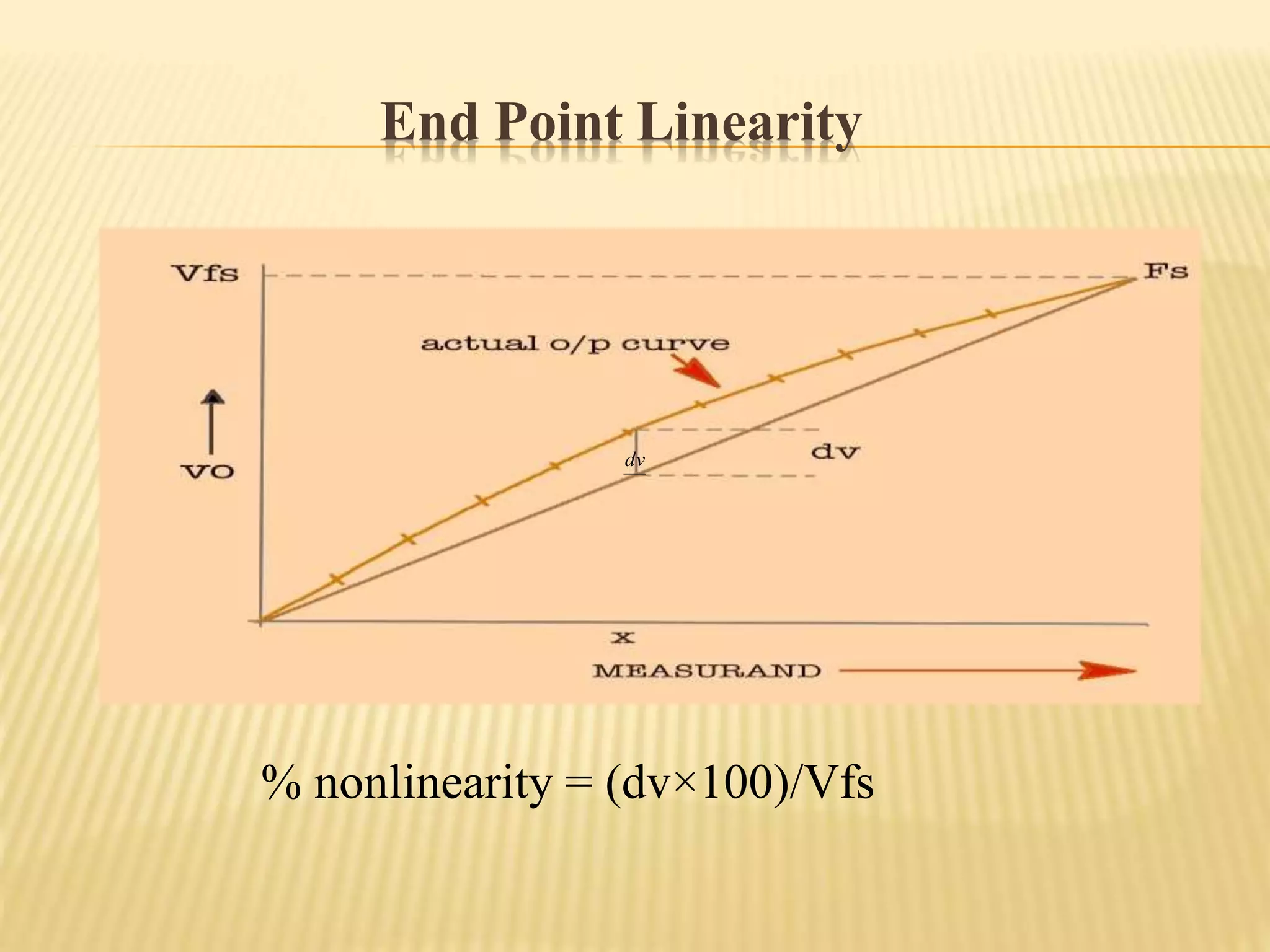
End Point Linearity
dv
% nonlinearity = (dv×100)/Vfs
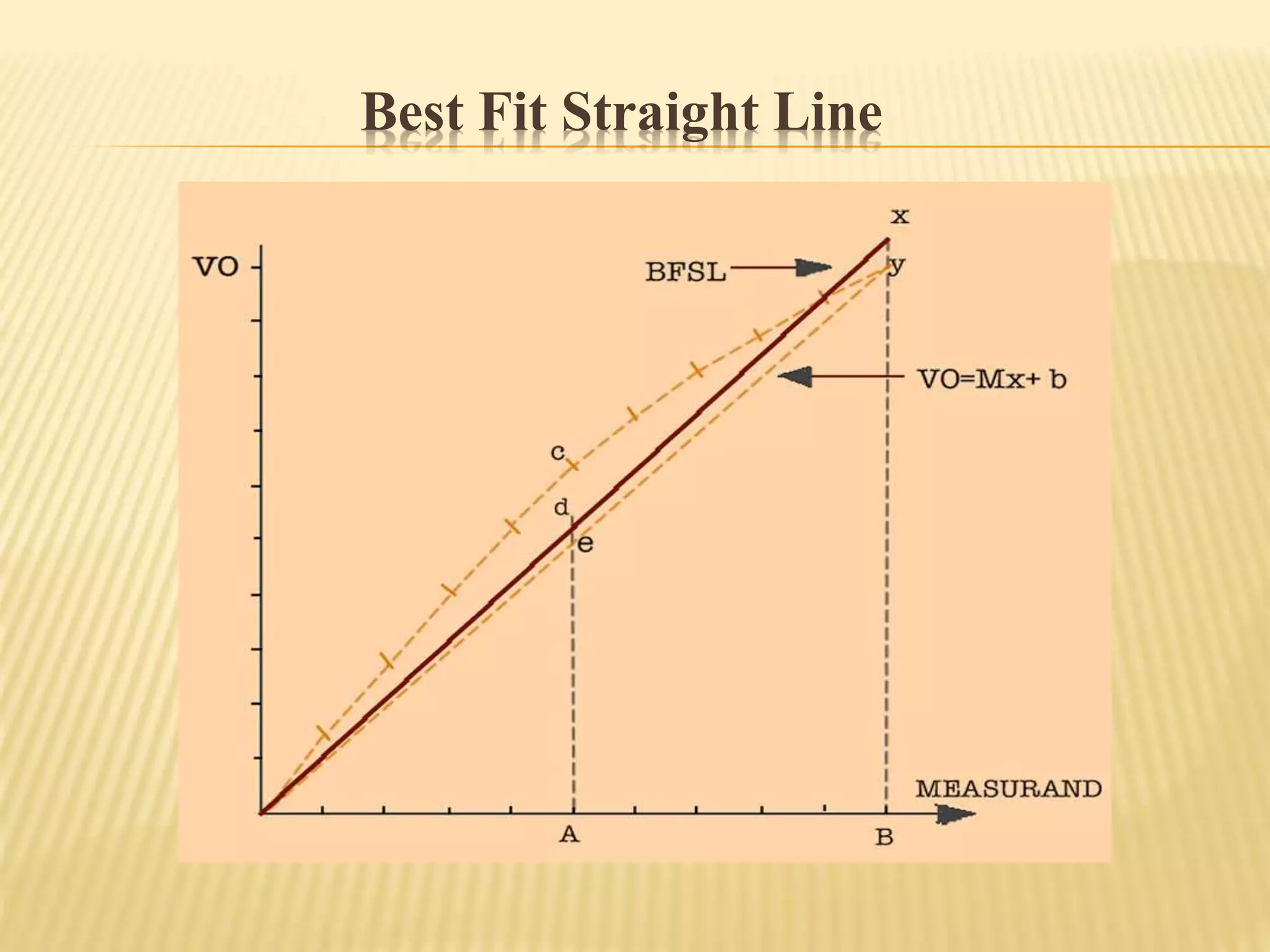
Best Fit Straight Line
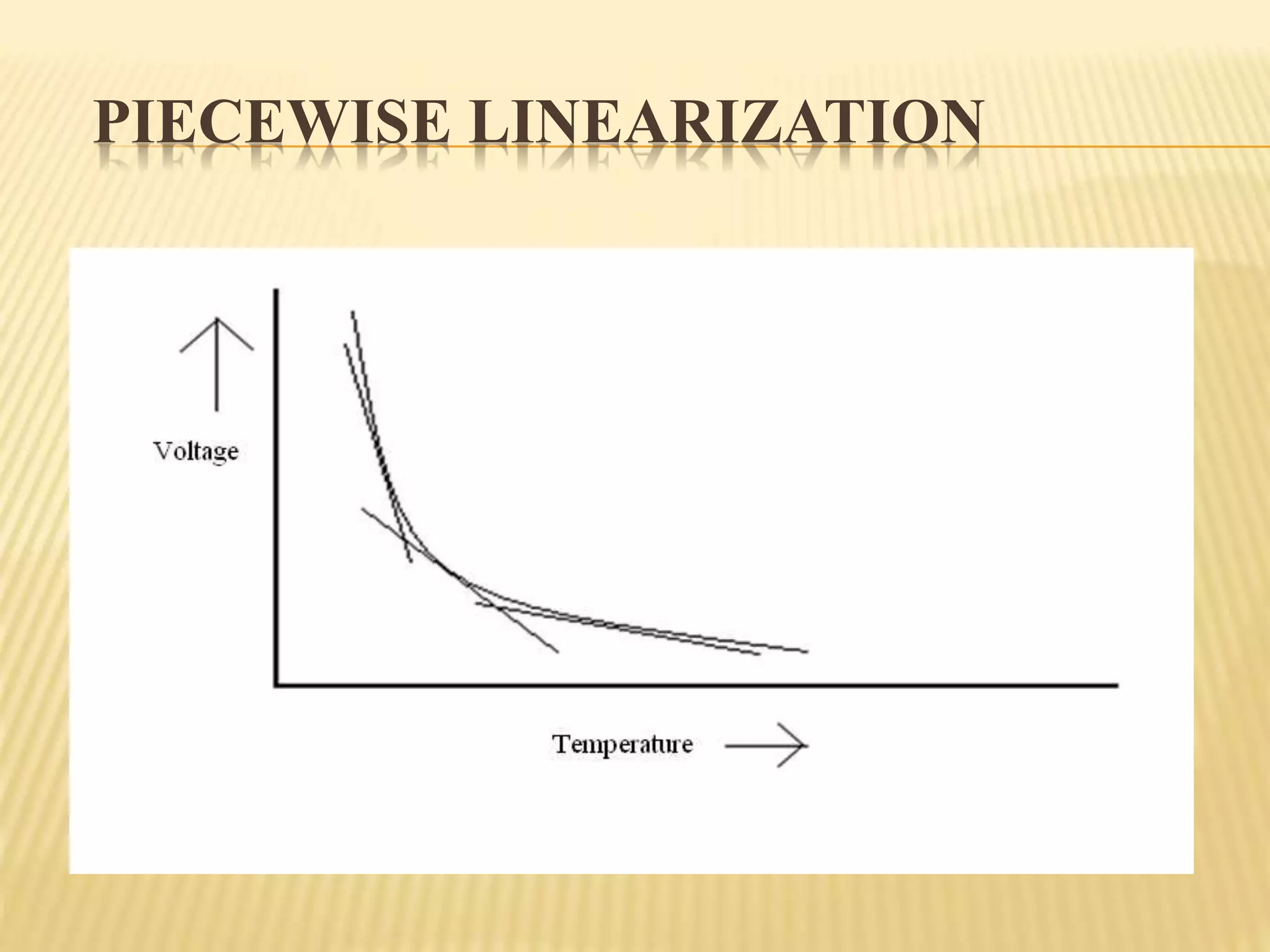
PIECEWISE LINEARIZATION
LINEARIZATION TECHNIQUES
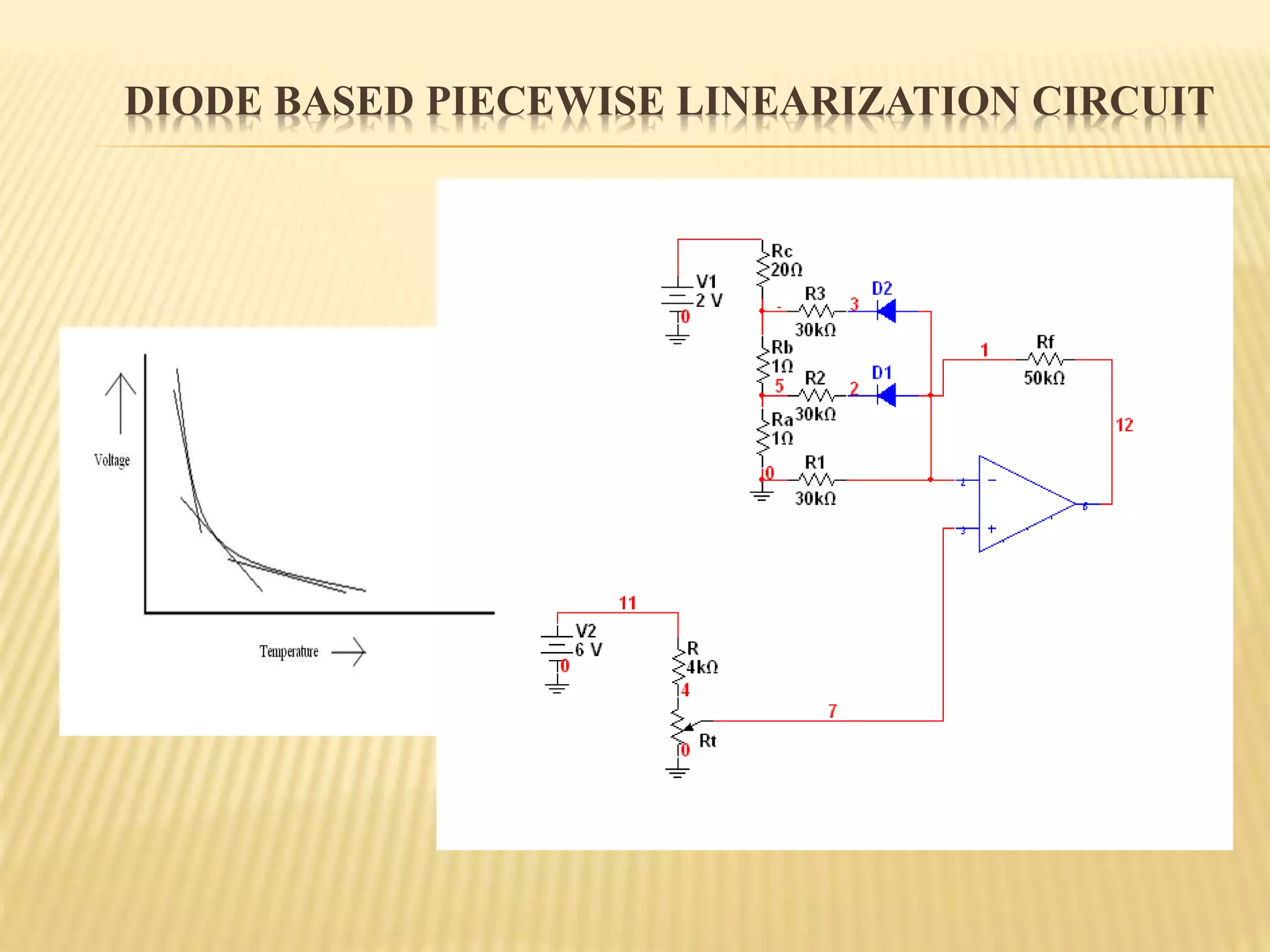
DIODE BASED PIECEWISE LINEARIZATION CIRCUIT
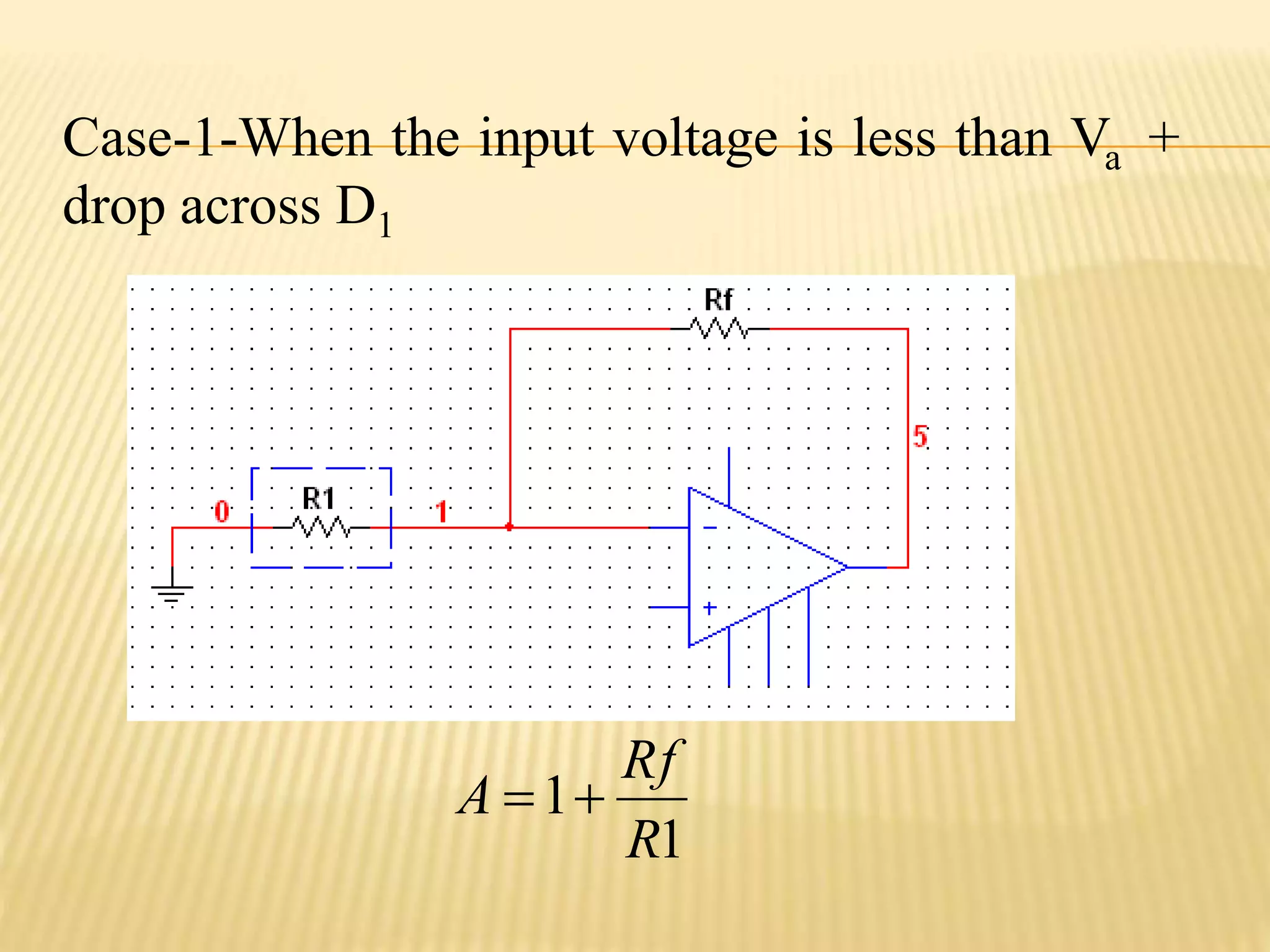
Case-1-When the input voltage is less than Va +
drop across D1
1
1
R
Rf
A 
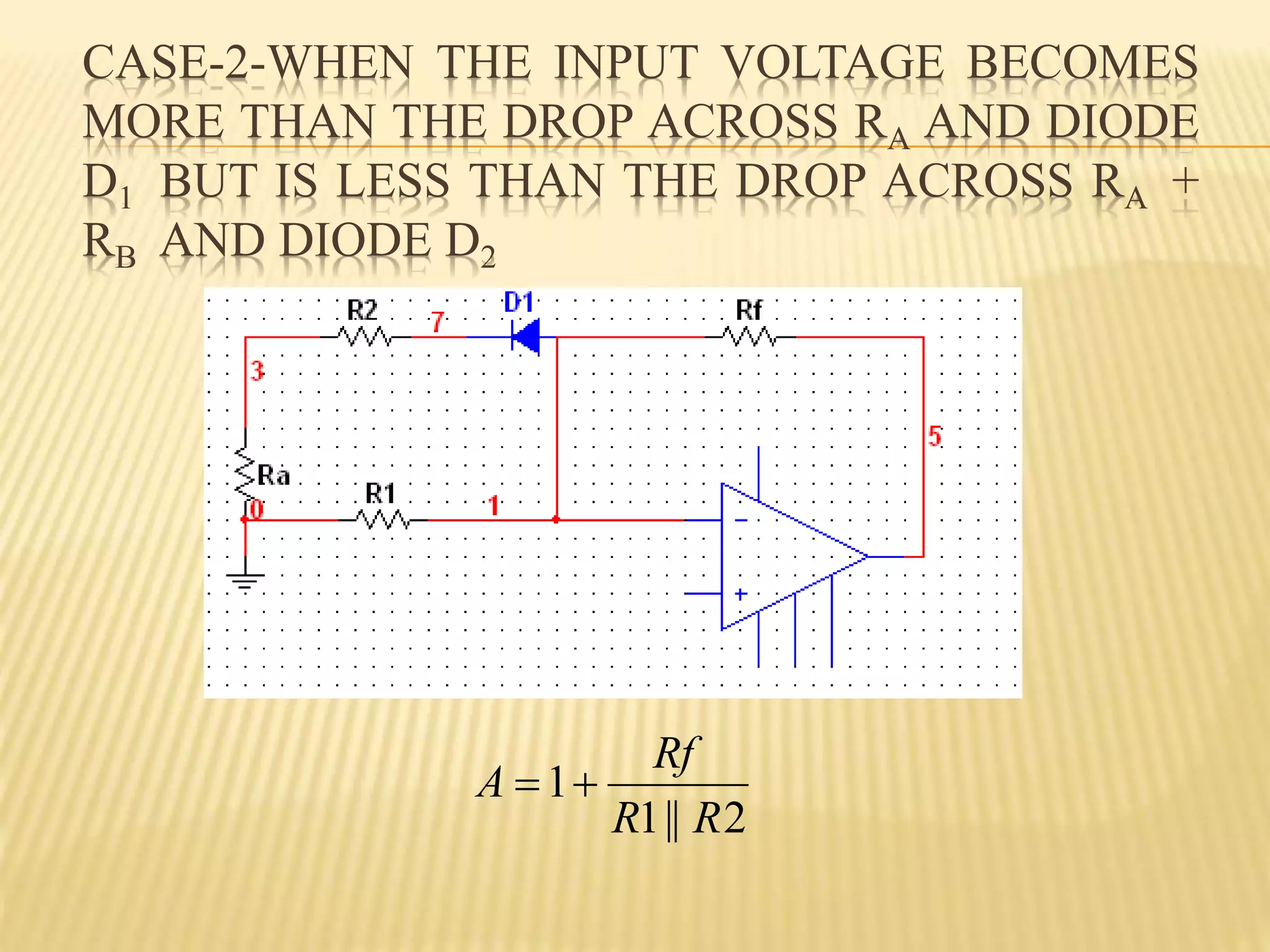
CASE-2-WHEN THE INPUT VOLTAGE BECOMES
MORE THAN THE DROP ACROSS RA AND DIODE
D1 BUT IS LESS THAN THE DROP ACROSS RA +
RB AND DIODE D2
2||1
1
RR
Rf
A 
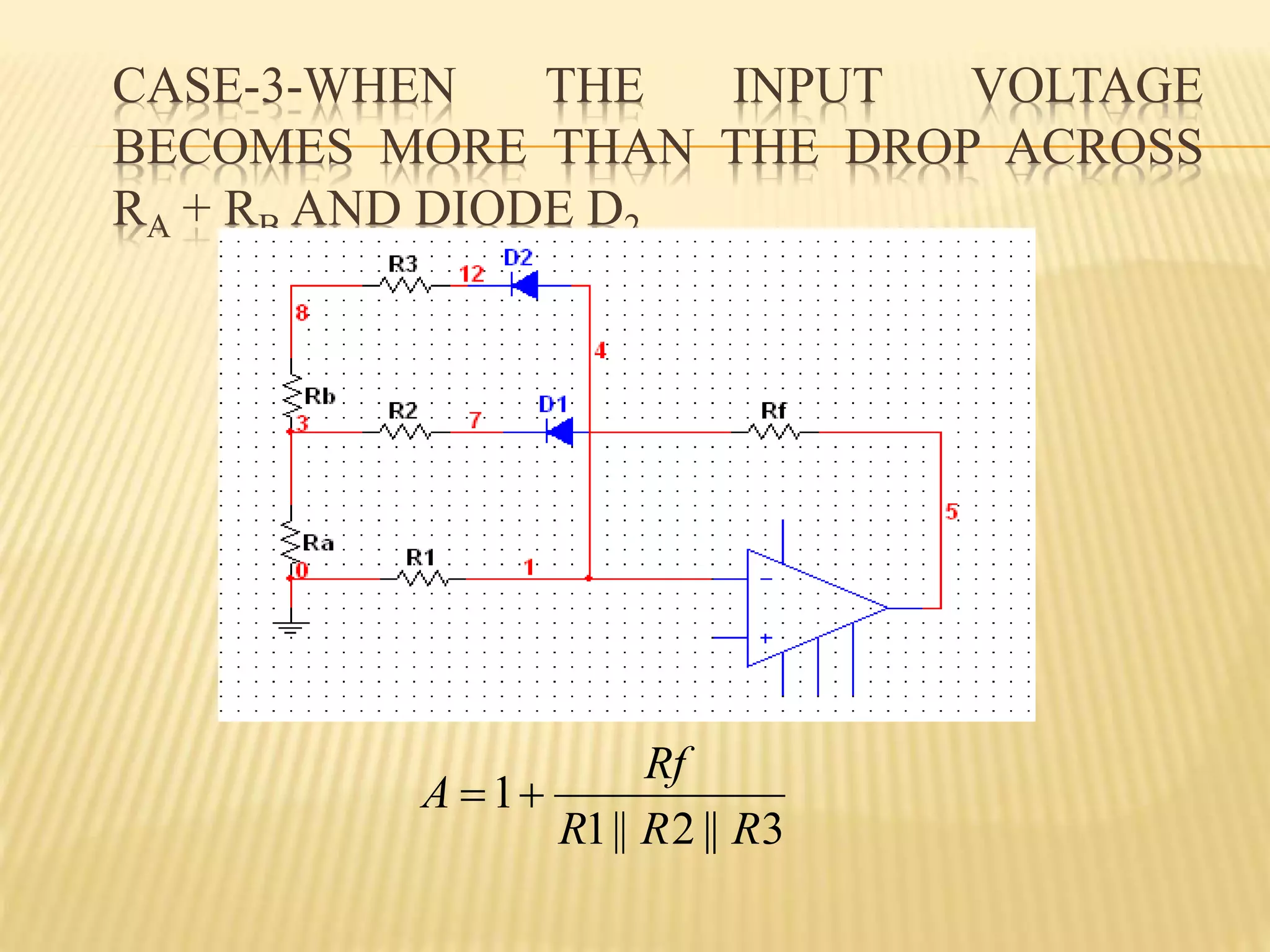
CASE-3-WHEN THE INPUT VOLTAGE
BECOMES MORE THAN THE DROP ACROSS
RA + RB AND DIODE D2
3||2||1
1
RRR
Rf
A 
Linearization By Equation Inversion
 Consider a transducer, that converts pressure into voltage as:
V=K [p]^0.5
 V is converted into a binary no. by ADC.
 DV varies as [p]^0.5.
 Squaring this DV
p varies as DV*DV
 Thus a program would input a sample DV and multiply it by
itself.
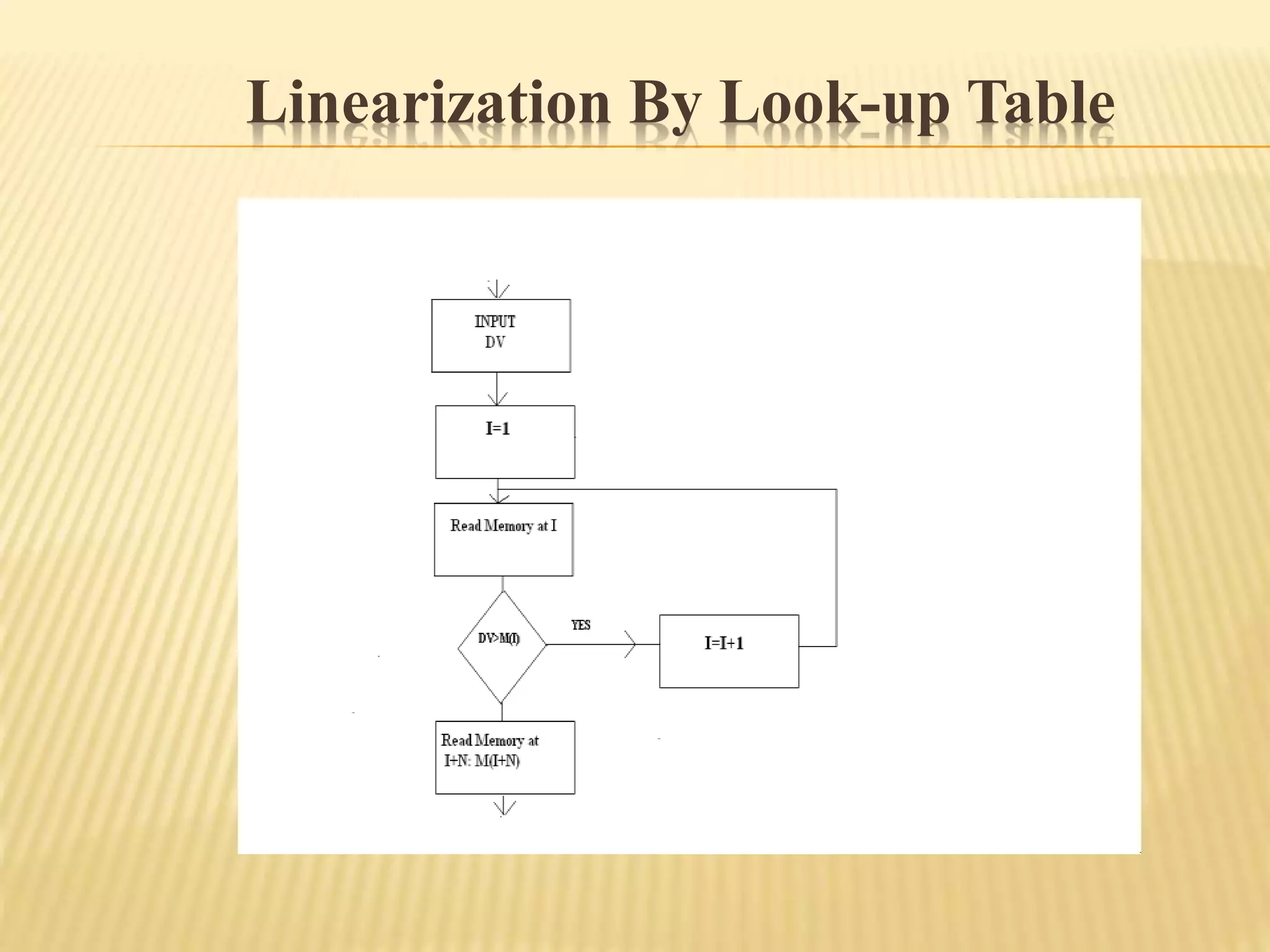
Linearization By Look-up Table
ARTIFICIAL NEURAL NETWORK
BASED NONLINEARITY
COMPENSATION
Artificial Neural Network (ANN) is an information processing
paradigm that is inspired by the way biological nervous
systems, such as the brain, processes the information.
The key element of this paradigm is the novel structure of the
information processing system. It is composed of a large
number of highly interconnected processing elements
(neurons) working to solve specific problems.
Artificial Neural Networks
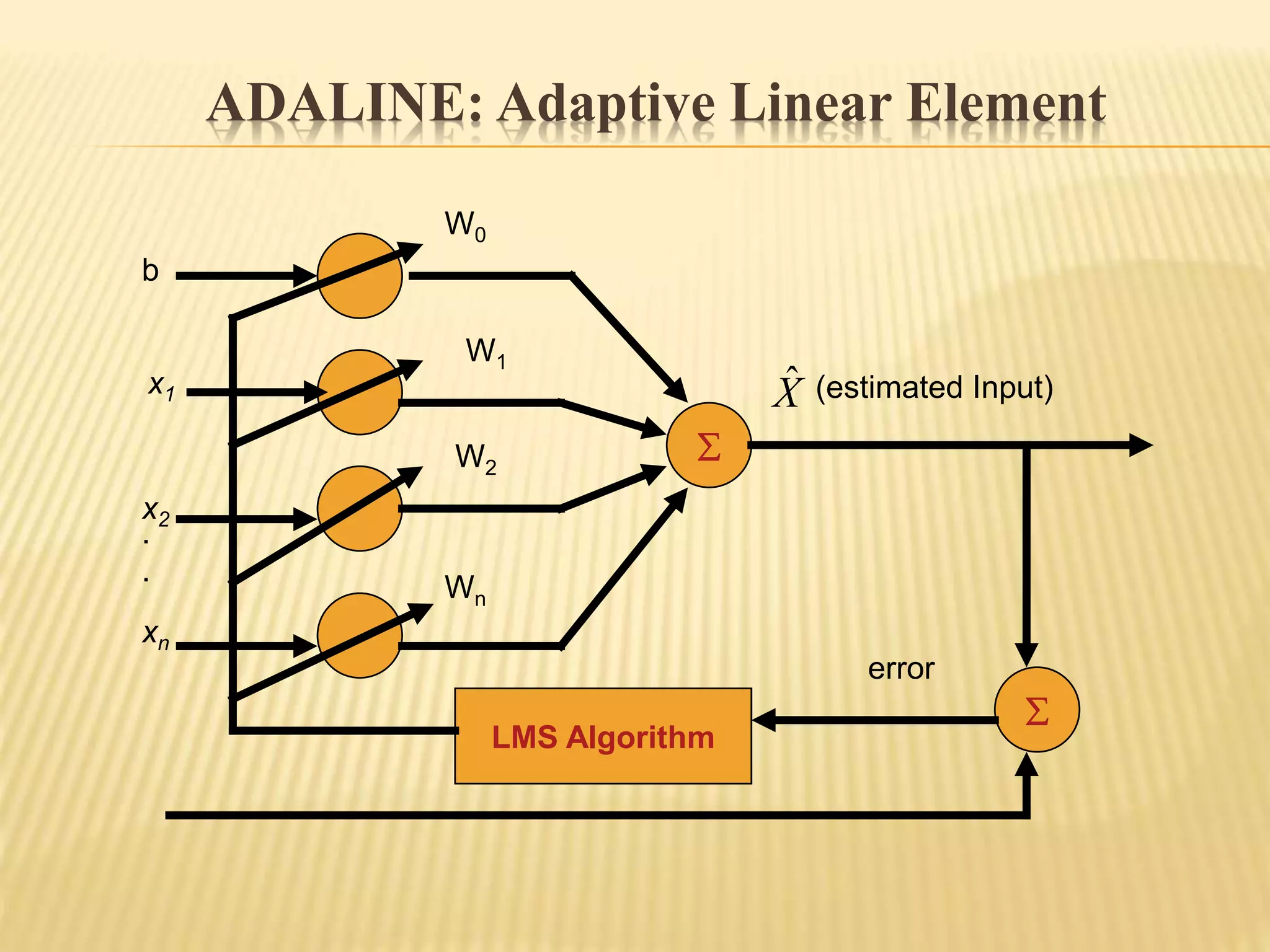
ADALINE: Adaptive Linear Element


LMS Algorithm
b
x1
W0
W1
W2
Wn
(estimated Input)
error
Xˆ
x2
.
.
xn
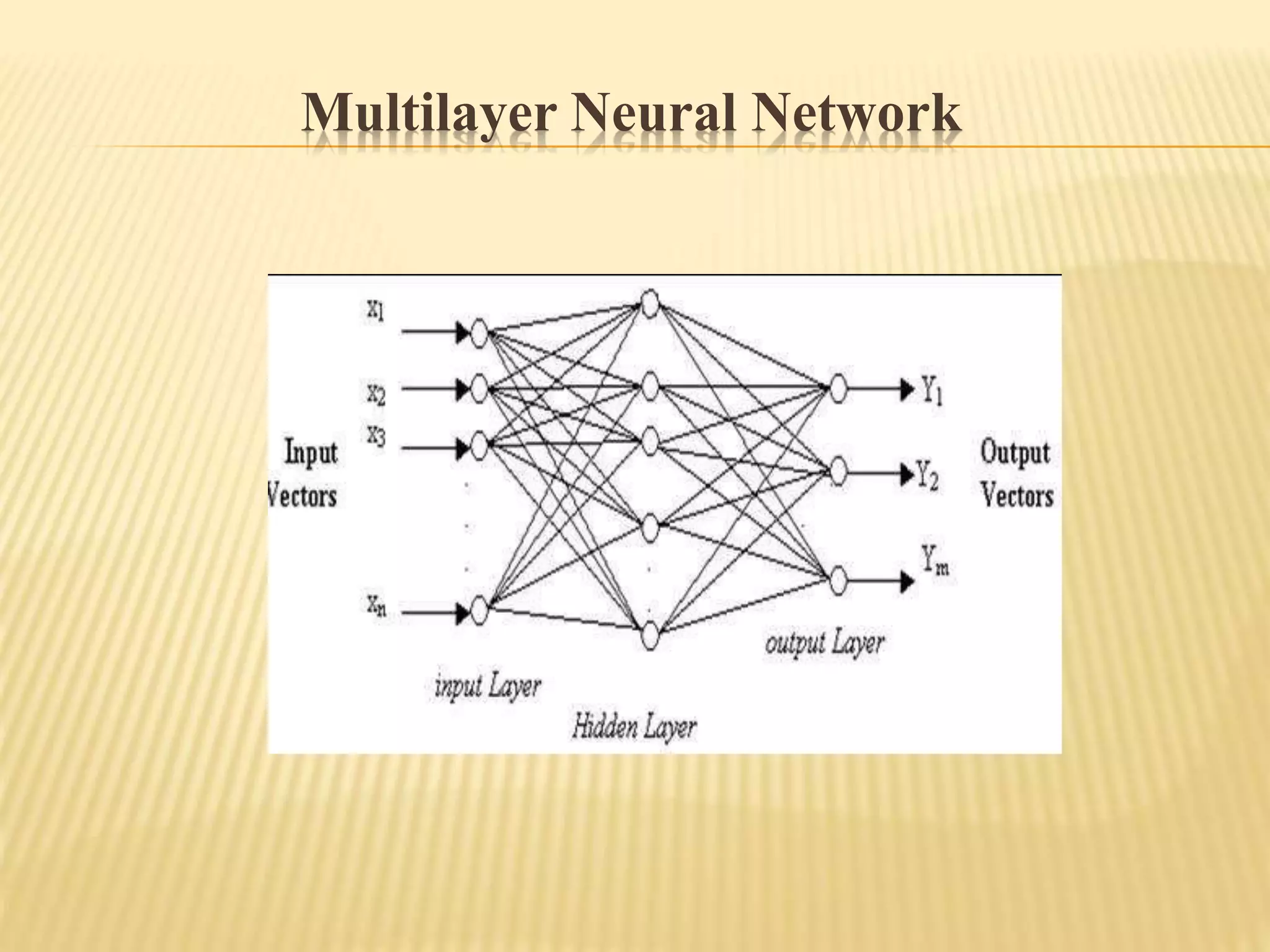
Multilayer Neural Network
20
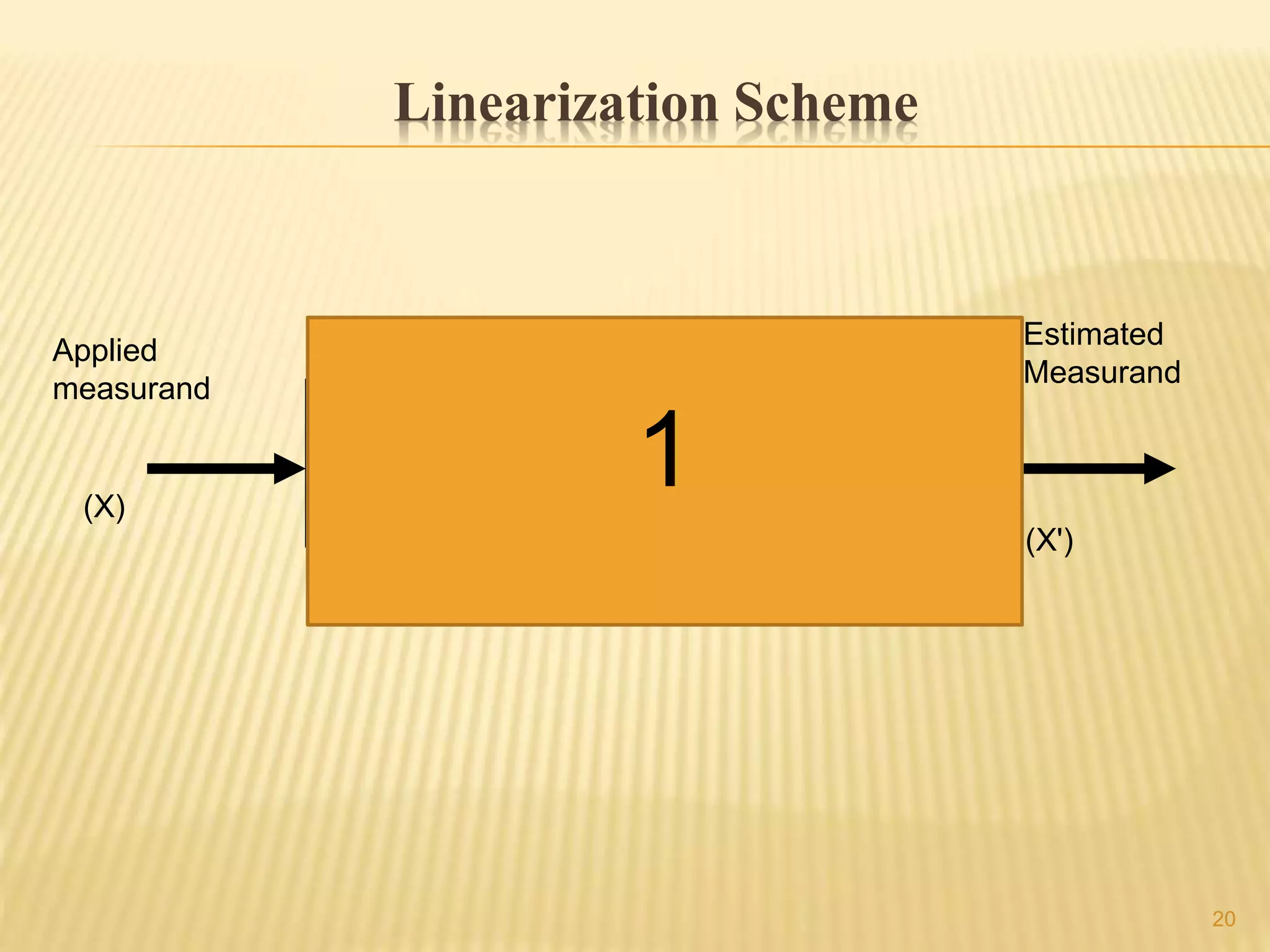
Linearization Scheme
Sensor Inverse Model
Applied
measurand
Estimated
Measurand
(X)
(Y)
(X')
Sensor response
1
Modeling Methodology
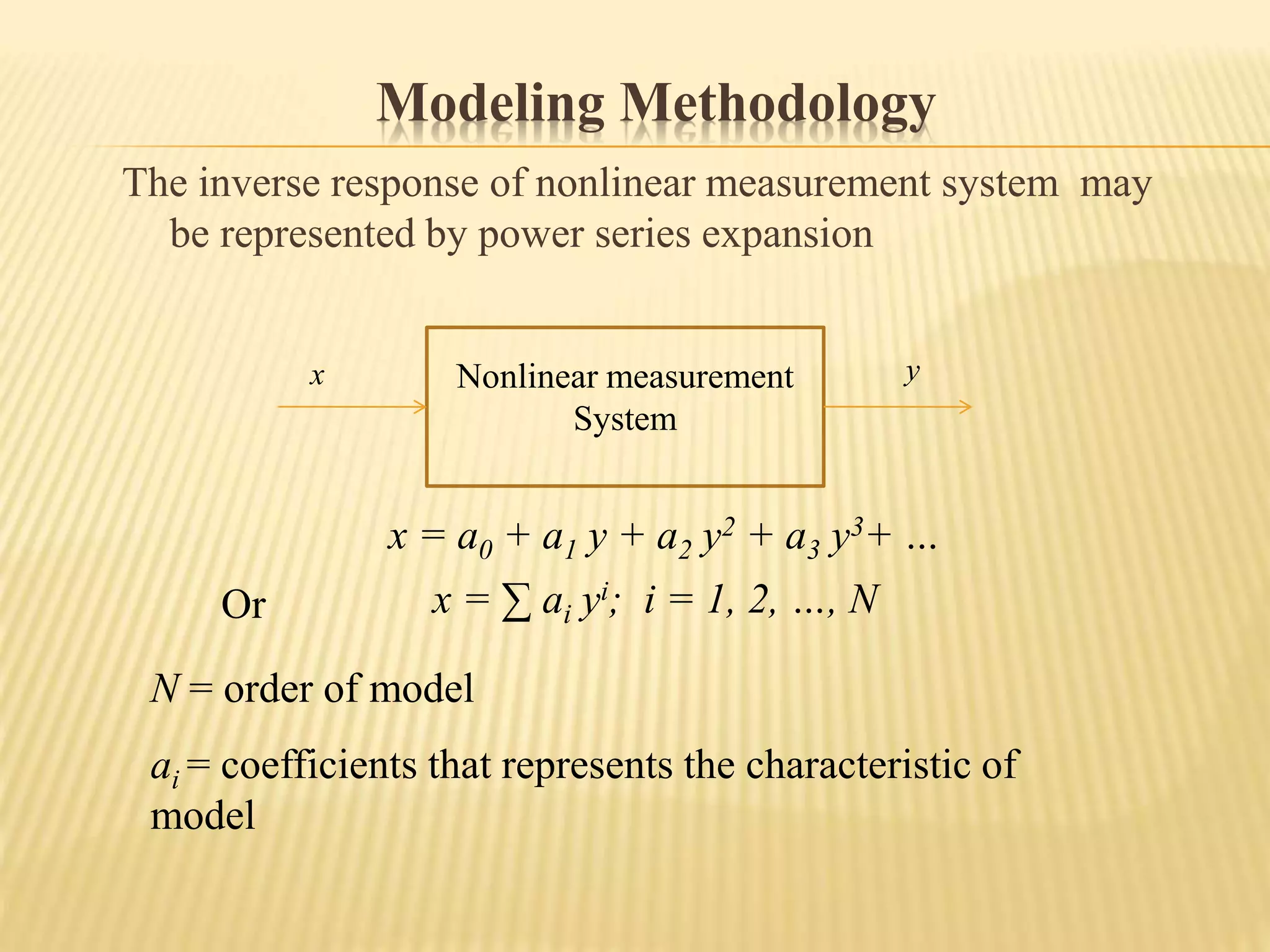
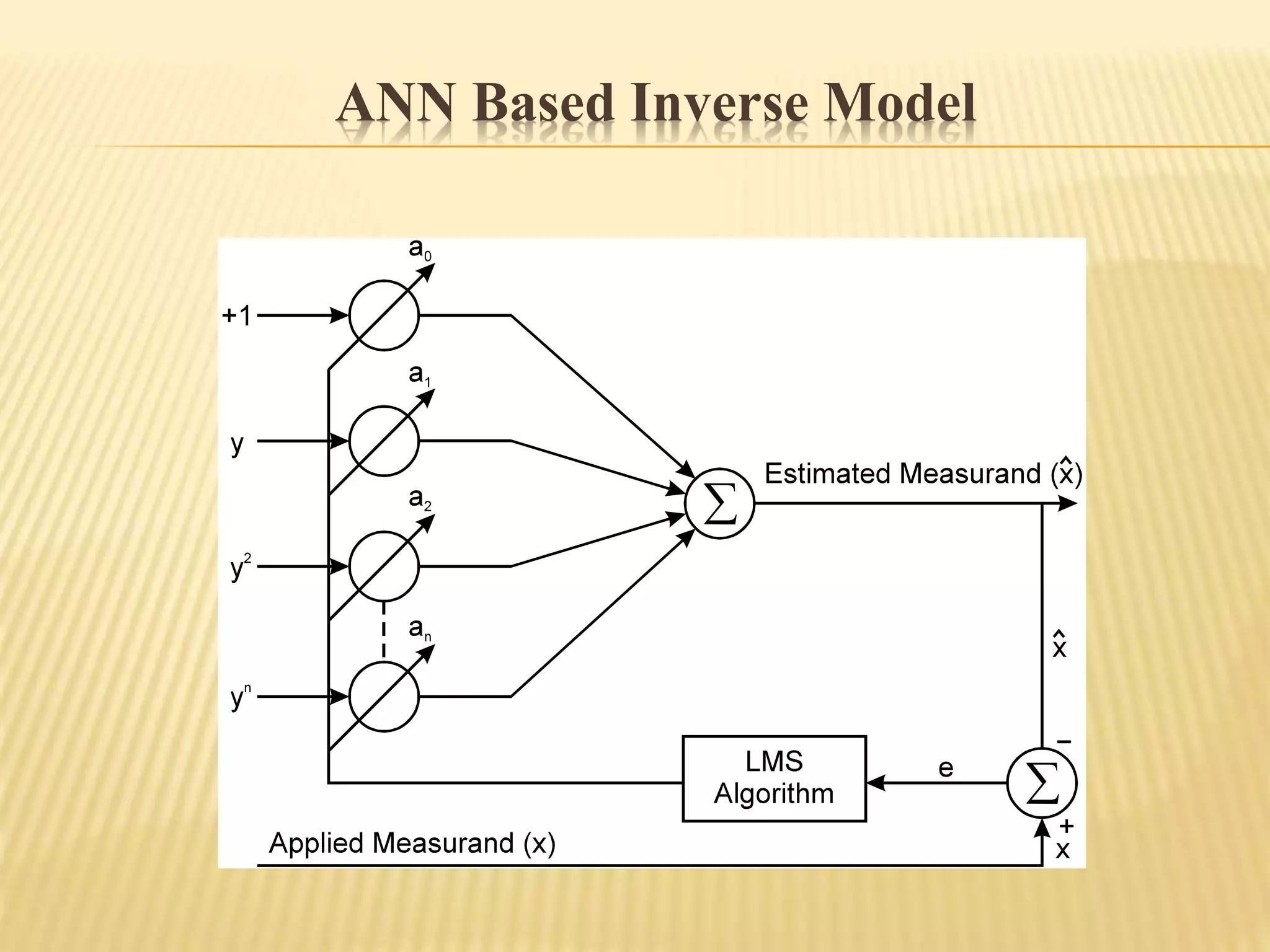
The inverse response of nonlinear measurement system may
be represented by power series expansion
x = a0 + a1 y + a2 y2 + a3 y3+ …
x = ∑ ai yi; i = 1, 2, …, NOr
x yNonlinear measurement
System
N = order of model
ai = coefficients that represents the characteristic of
model
ANN Based Inverse Model
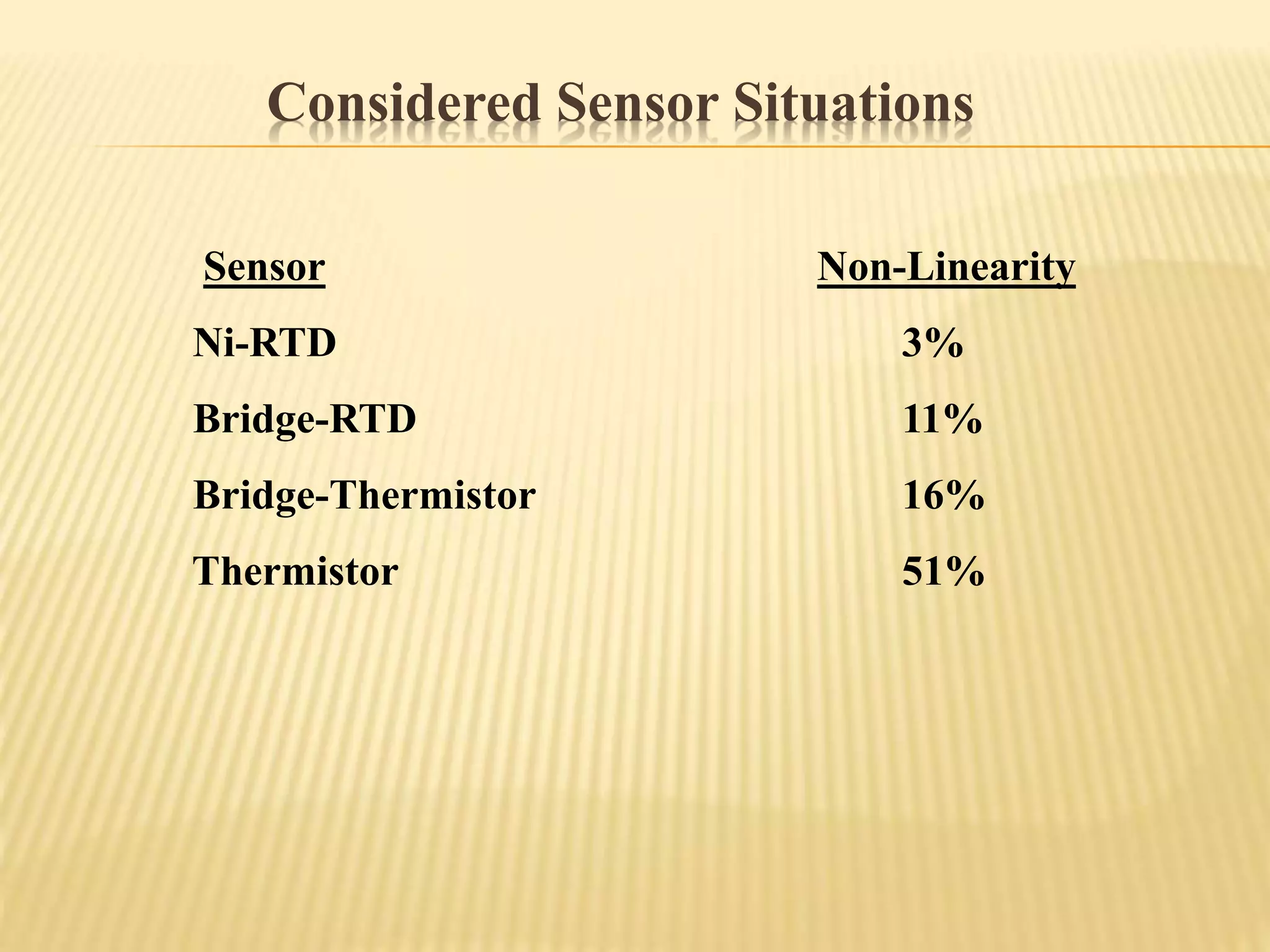
Considered Sensor Situations
Sensor Non-Linearity
Ni-RTD 3%
Bridge-RTD 11%
Bridge-Thermistor 16%
Thermistor 51%
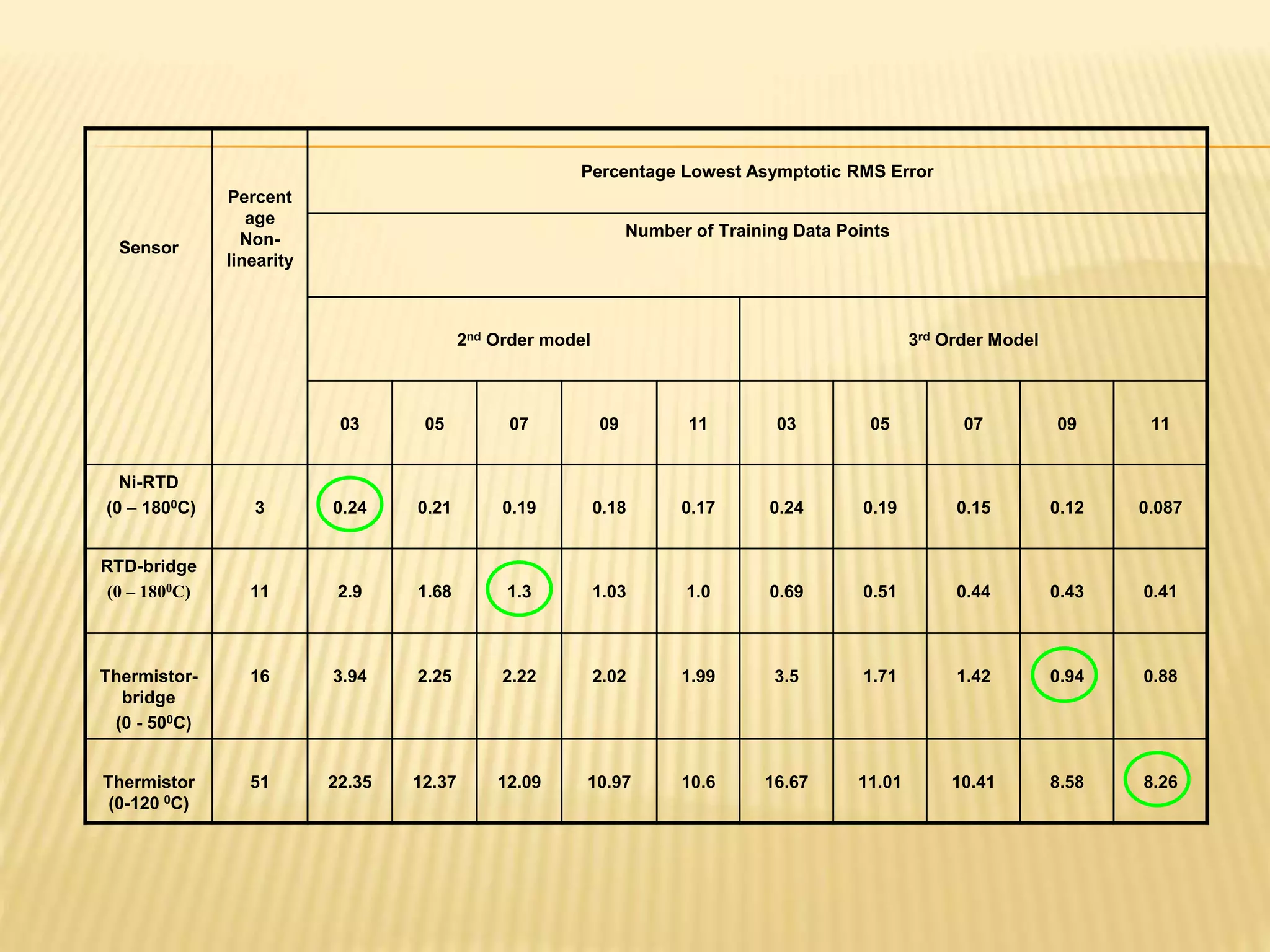
Sensor
Percent
age
Non-
linearity
Percentage Lowest Asymptotic RMS Error
Number of Training Data Points
2nd Order model 3rd Order Model
03 05 07 09 11 03 05 07 09 11
Ni-RTD
(0 – 1800C) 3 0.24 0.21 0.19 0.18 0.17 0.24 0.19 0.15 0.12 0.087
RTD-bridge
(0 – 1800C) 11 2.9 1.68 1.3 1.03 1.0 0.69 0.51 0.44 0.43 0.41
Thermistor-
bridge
(0 - 500C)
16 3.94 2.25 2.22 2.02 1.99 3.5 1.71 1.42 0.94 0.88
Thermistor
(0-120 0C)
51 22.35 12.37 12.09 10.97 10.6 16.67 11.01 10.41 8.58 8.26
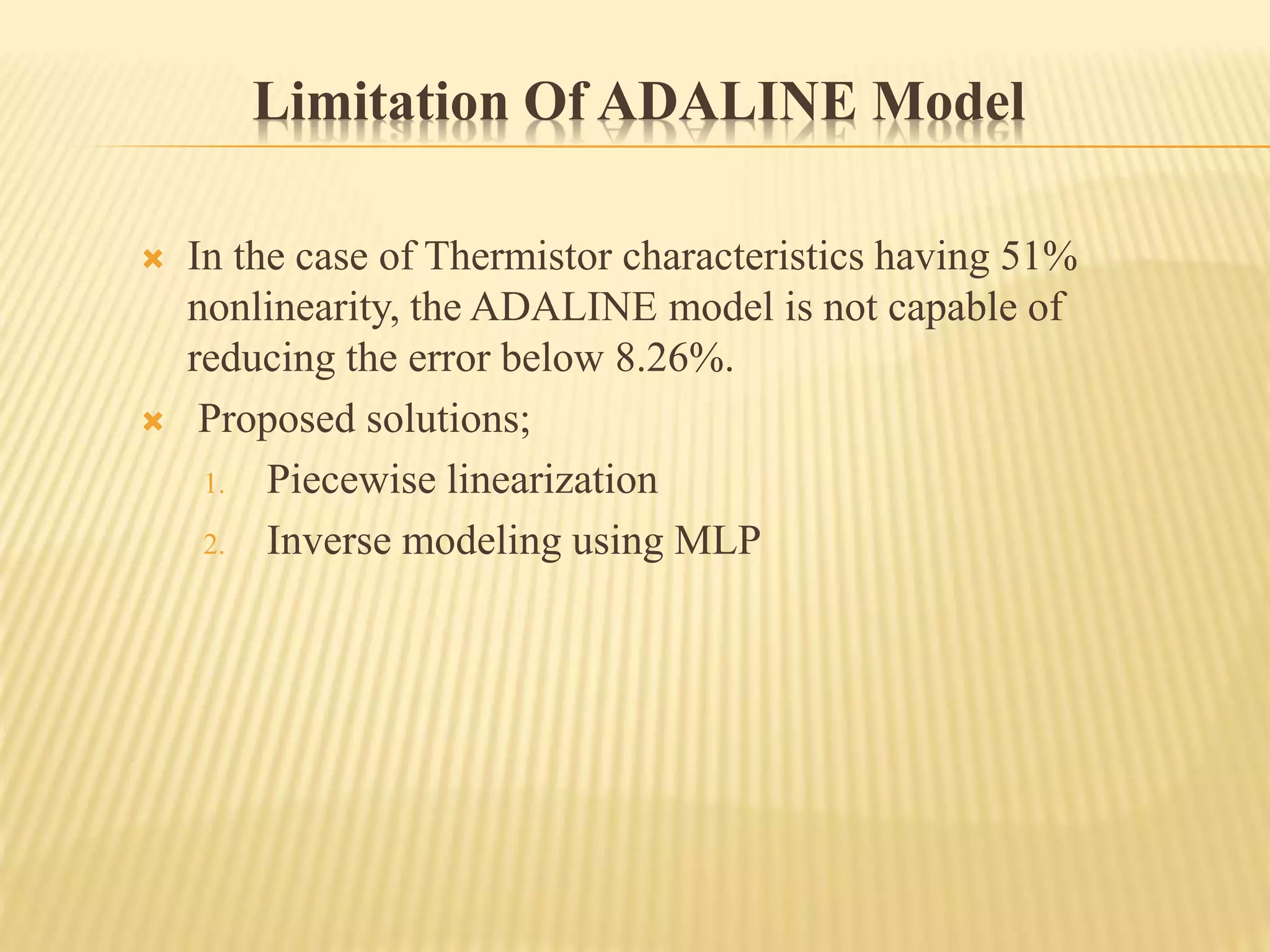
Limitation Of ADALINE Model
 In the case of Thermistor characteristics having 51%
nonlinearity, the ADALINE model is not capable of
reducing the error below 8.26%.
 Proposed solutions;
1. Piecewise linearization
2. Inverse modeling using MLP
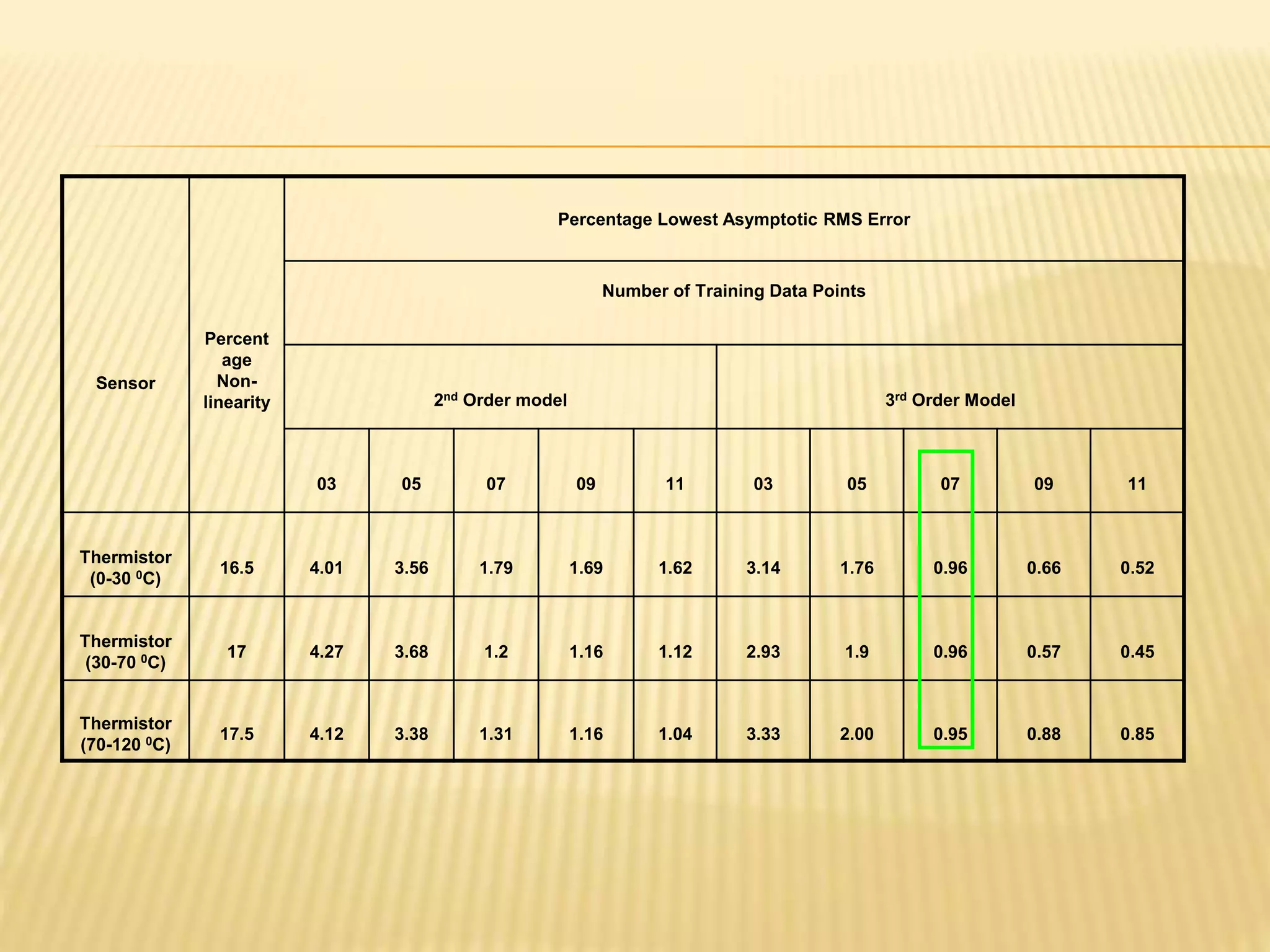
Sensor
Percent
age
Non-
linearity
Percentage Lowest Asymptotic RMS Error
Number of Training Data Points
2nd Order model 3rd Order Model
03 05 07 09 11 03 05 07 09 11
Thermistor
(0-30 0C)
16.5 4.01 3.56 1.79 1.69 1.62 3.14 1.76 0.96 0.66 0.52
Thermistor
(30-70 0C)
17 4.27 3.68 1.2 1.16 1.12 2.93 1.9 0.96 0.57 0.45
Thermistor
(70-120 0C)
17.5 4.12 3.38 1.31 1.16 1.04 3.33 2.00 0.95 0.88 0.85
Multi Layer Perceptron (MLP) Based
Model
• Needs powerful and costly device for stand alone
implementation for real time applications.
• Computer based implementation is proposed for this
alternative .
• Proposed computer based measurement system
comprises two implementation steps;
1. Offline training using MATLAB®.
2. Implementation of trained network in real time
using DAQ card and LabVIEW® software.
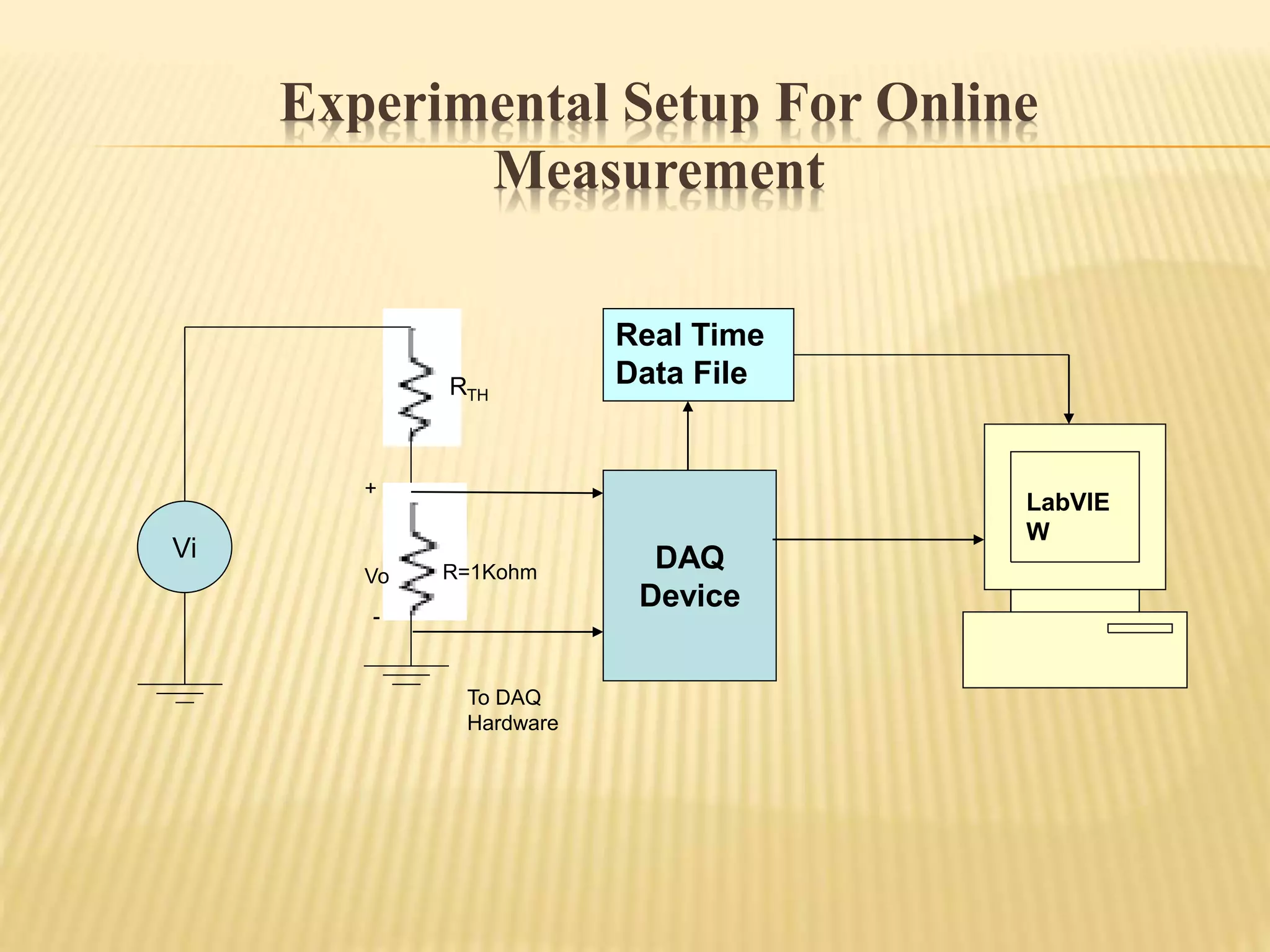
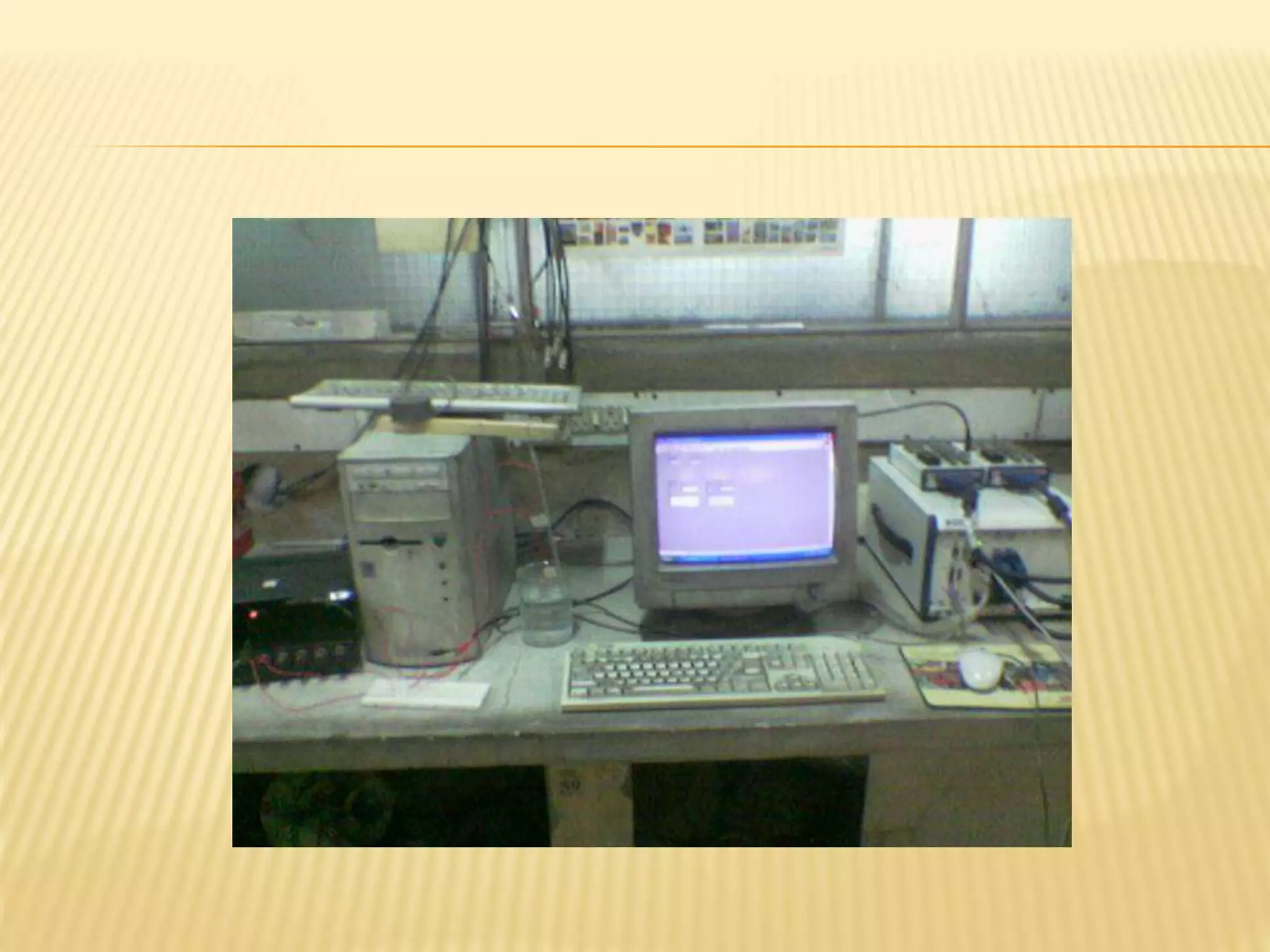
Experimental Setup For Online
Measurement
Vi
RTH
R=1Kohm
To DAQ
Hardware
DAQ
Device
LabVIE
W
Vo
+
-
Real Time
Data File
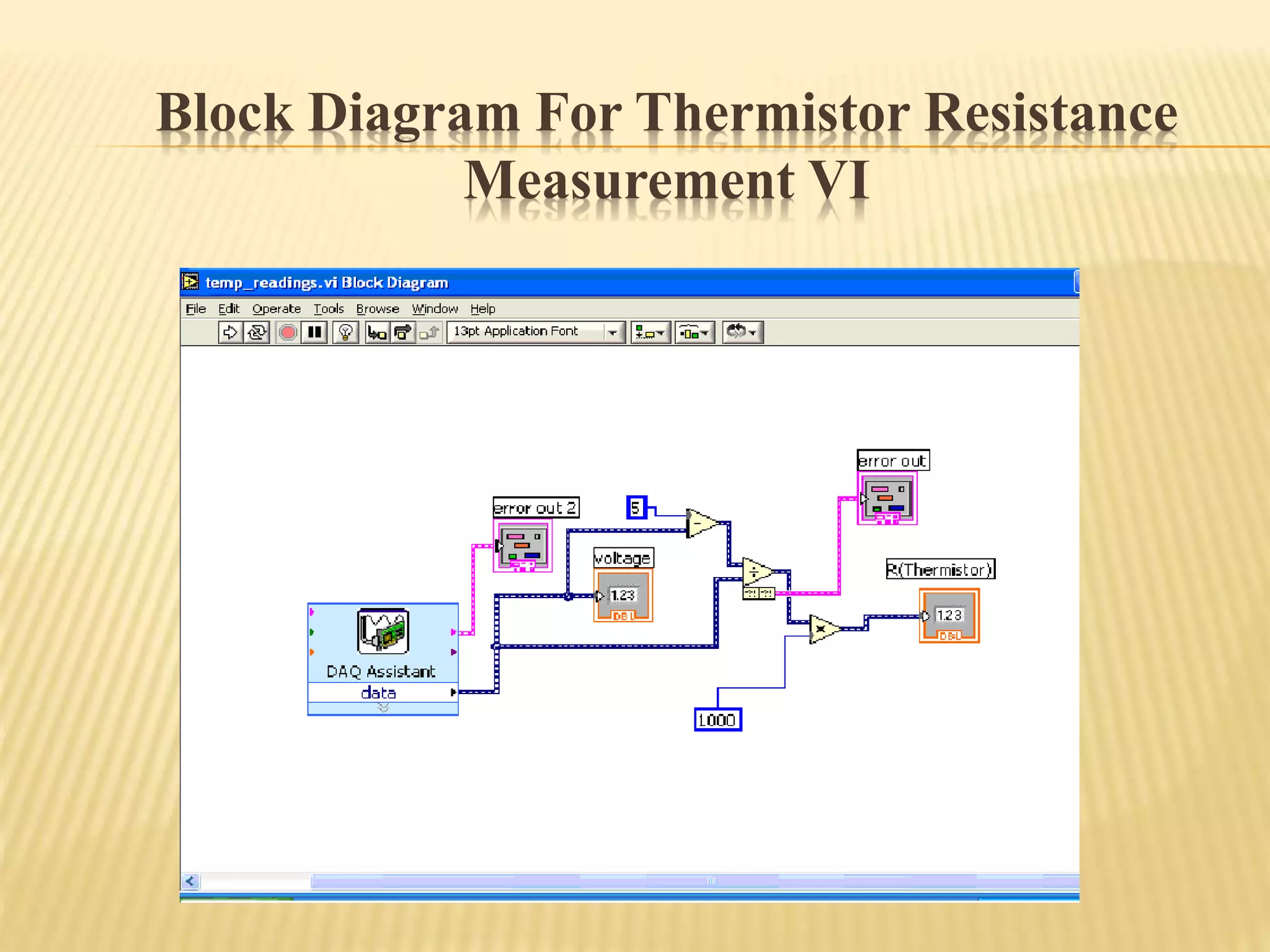
Block Diagram For Thermistor Resistance
Measurement VI
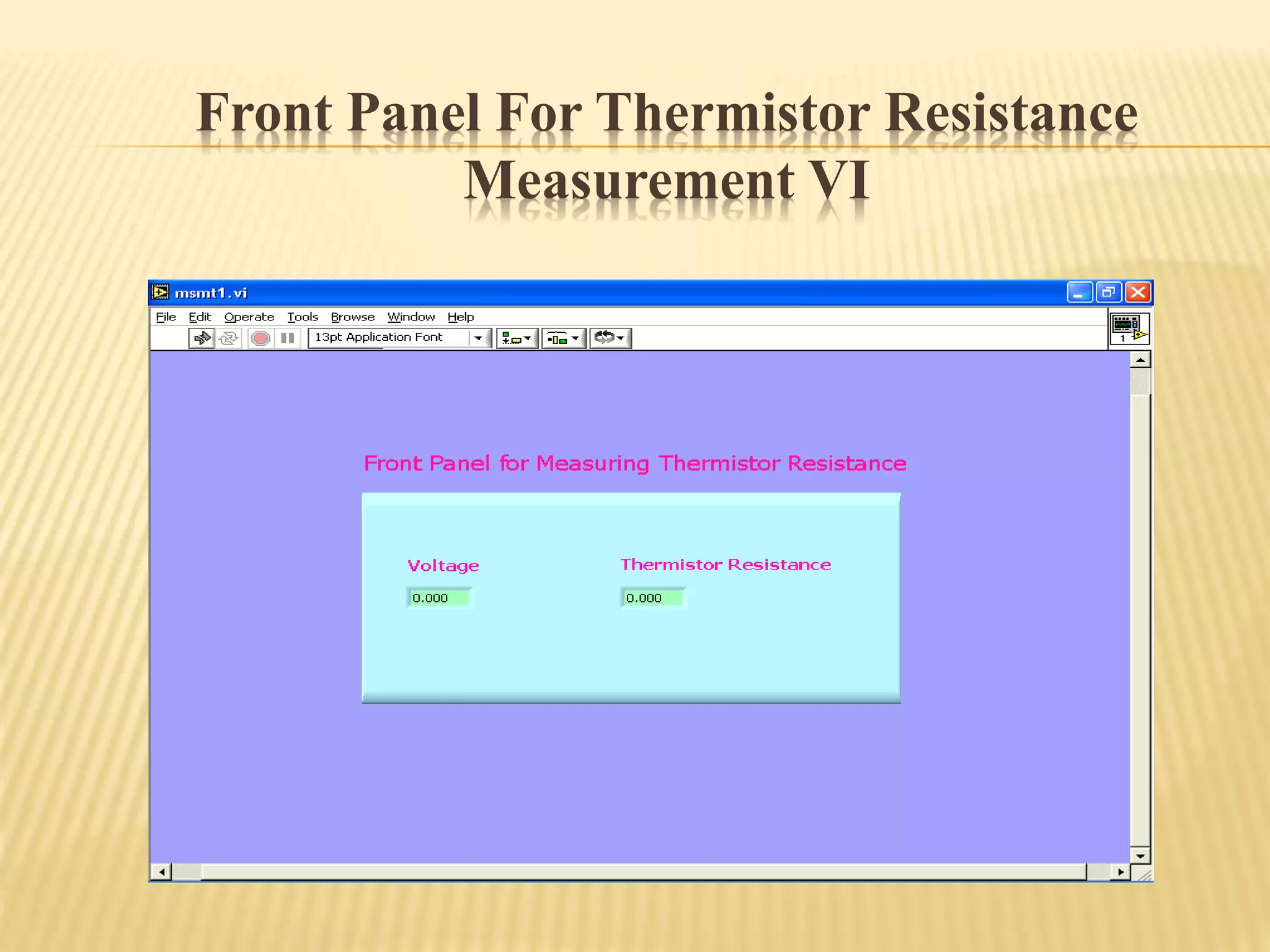
Front Panel For Thermistor Resistance
Measurement VI
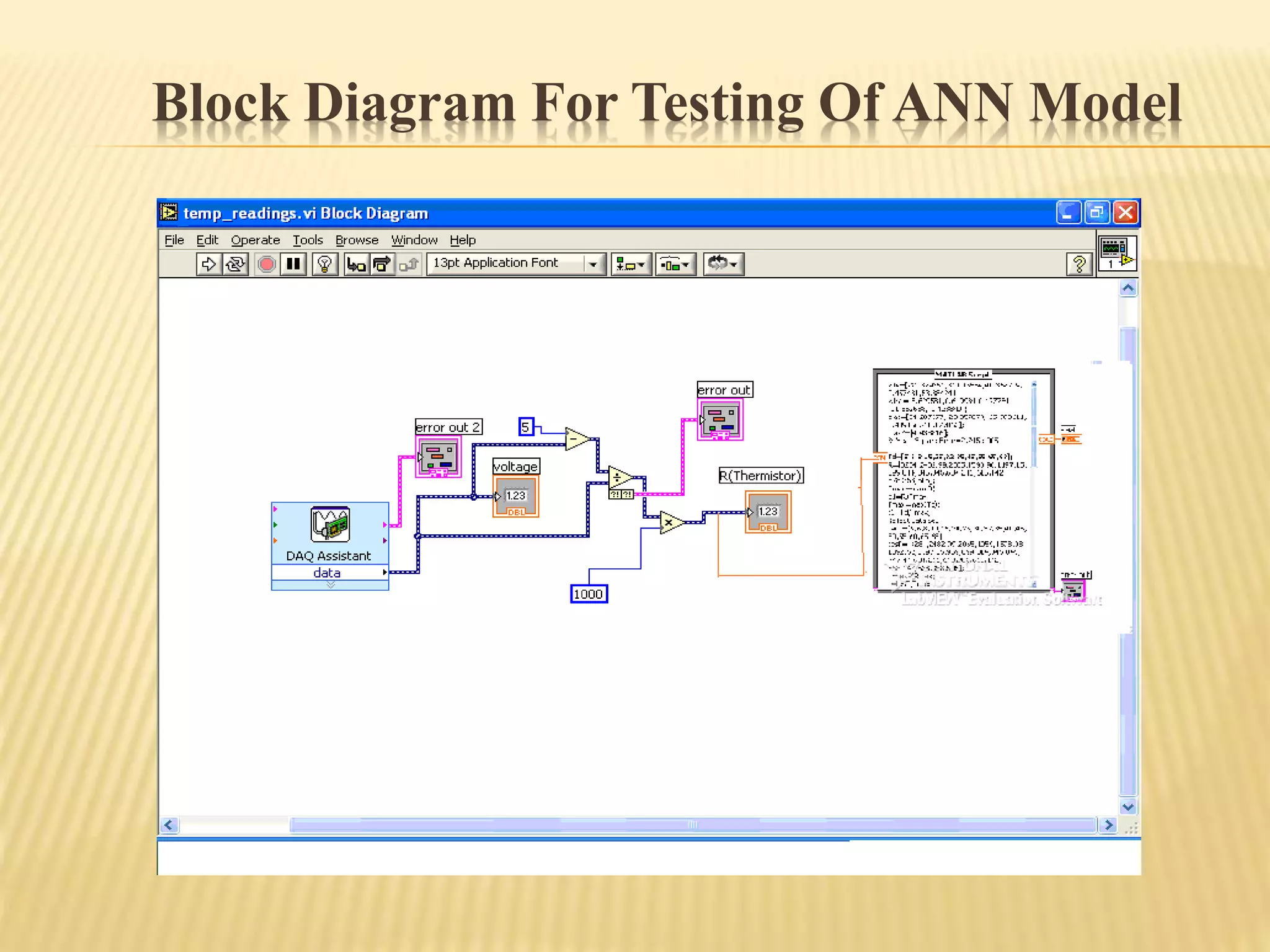
Block Diagram For Testing Of ANN Model
Front Panel For Testing Of ANN Model
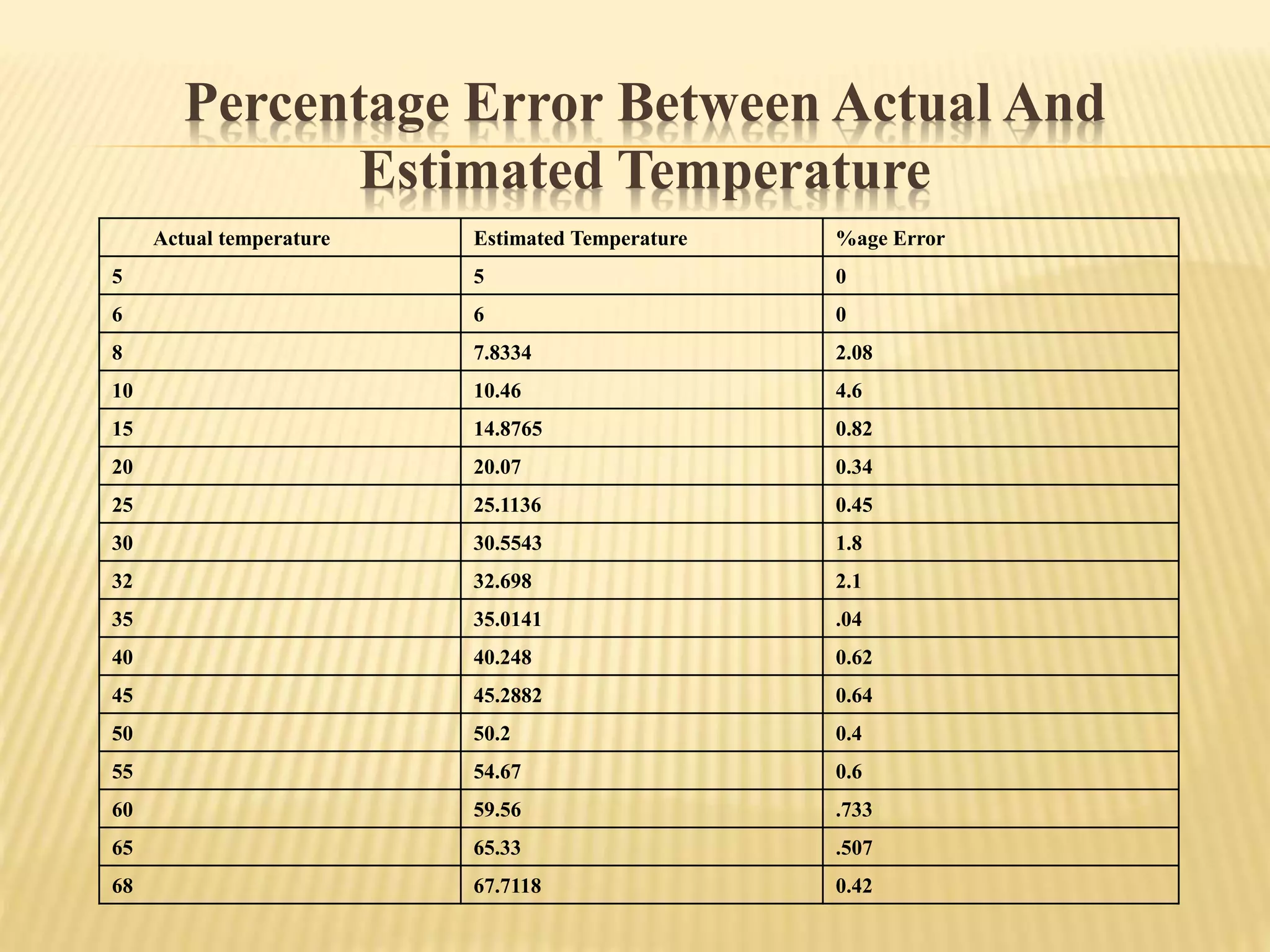
Percentage Error Between Actual And
Estimated Temperature
Actual temperature Estimated Temperature %age Error
5 5 0
6 6 0
8 7.8334 2.08
10 10.46 4.6
15 14.8765 0.82
20 20.07 0.34
25 25.1136 0.45
30 30.5543 1.8
32 32.698 2.1
35 35.0141 .04
40 40.248 0.62
45 45.2882 0.64
50 50.2 0.4
55 54.67 0.6
60 59.56 .733
65 65.33 .507
68 67.7118 0.42
Virtual Implementation of a
Measurement System
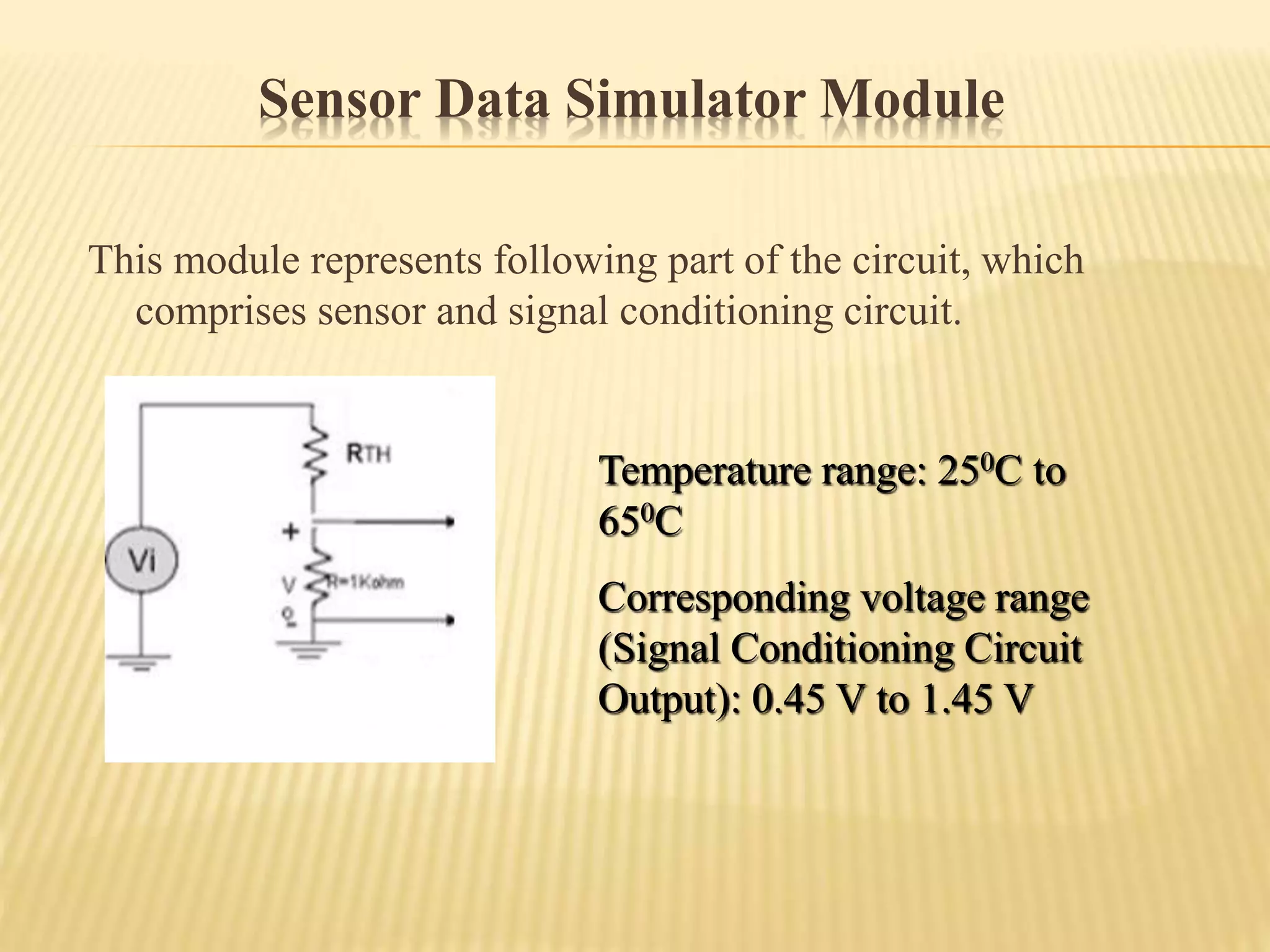
Sensor Data Simulator Module
This module represents following part of the circuit, which
comprises sensor and signal conditioning circuit.
Temperature range: 250C to
650C
Corresponding voltage range
(Signal Conditioning Circuit
Output): 0.45 V to 1.45 V
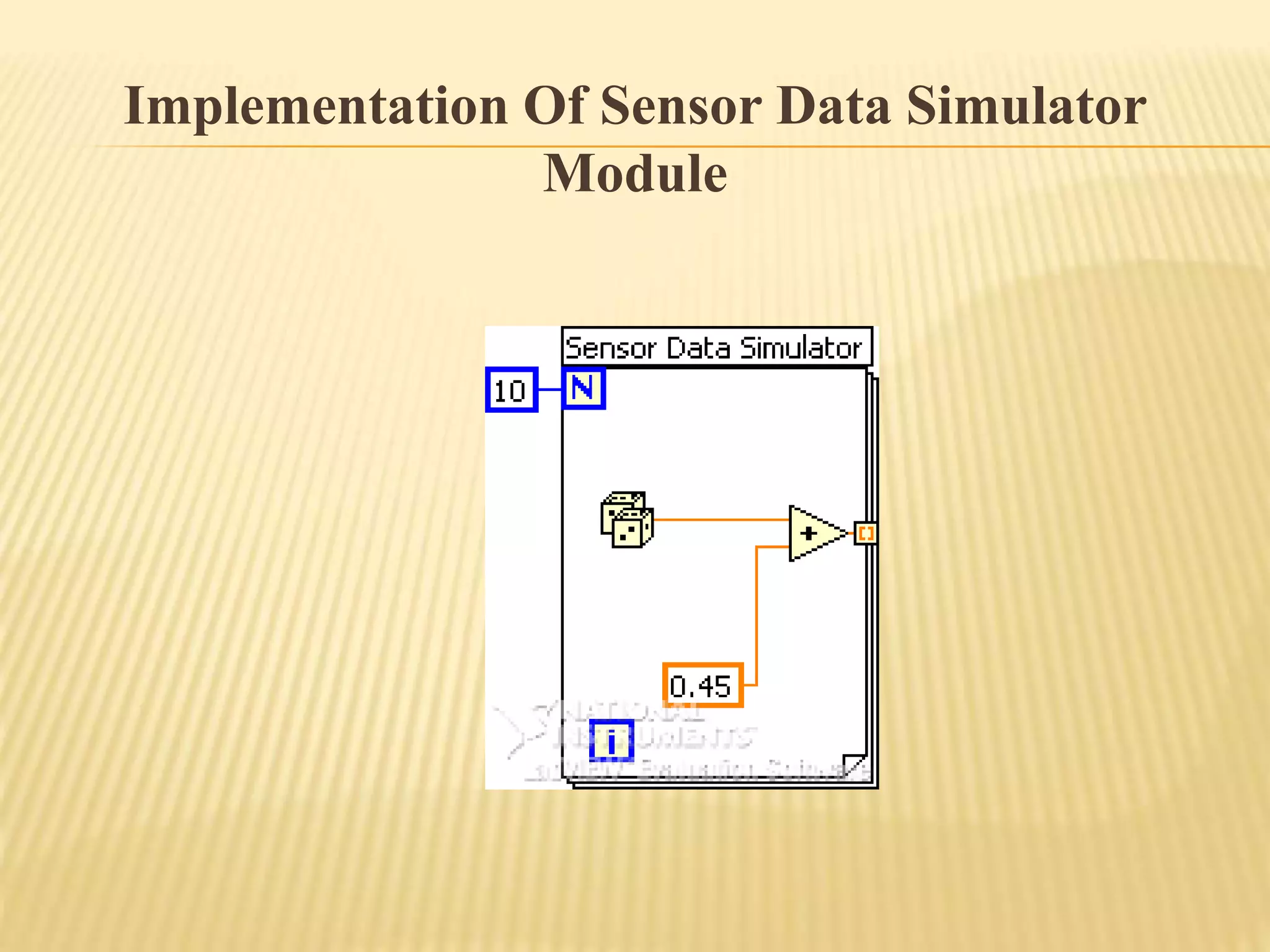
Implementation Of Sensor Data Simulator
Module
Voltage To Thermistor Resistance Converter
Module
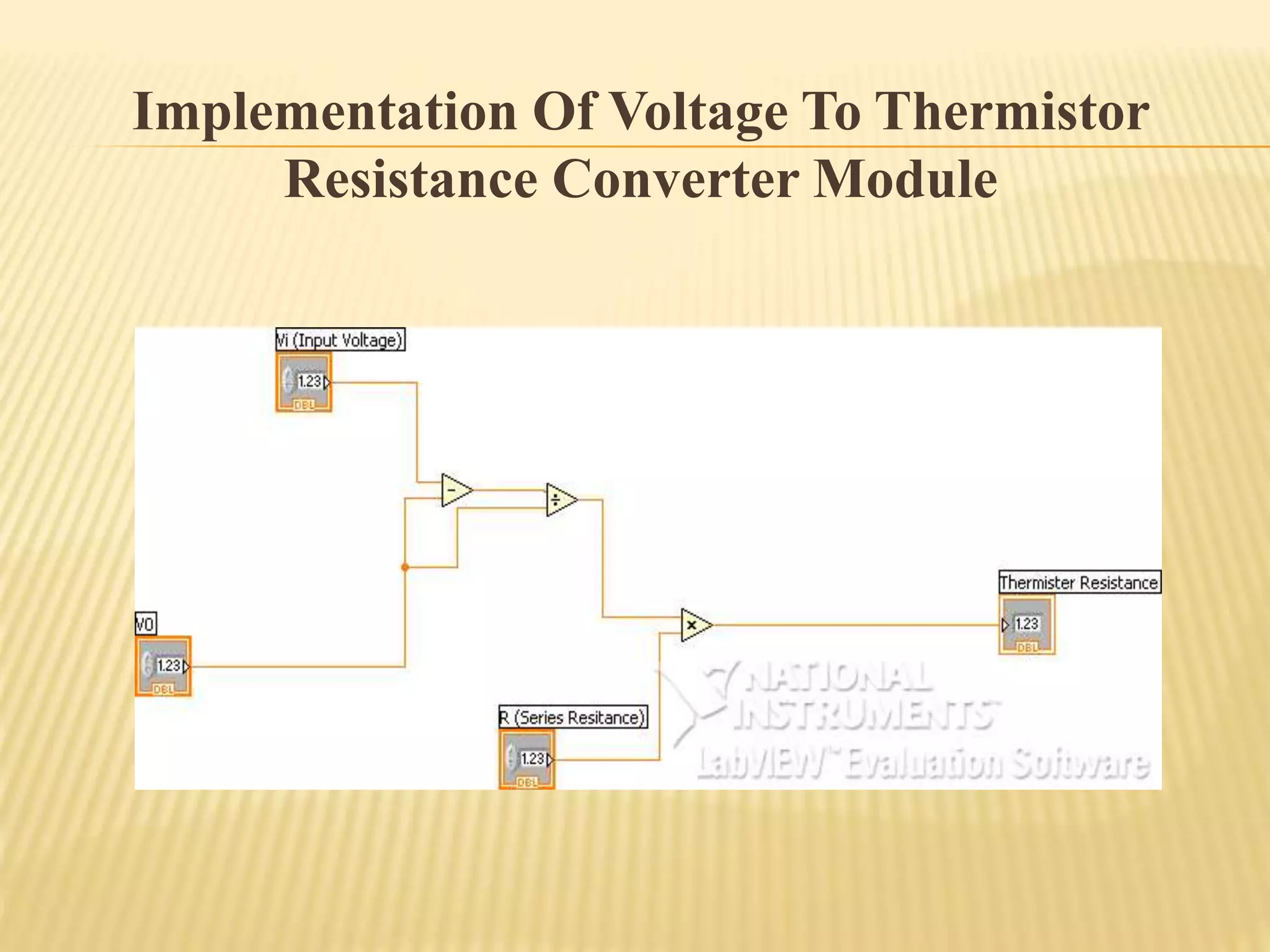
In this module following equation is implemented;
Rth =((Vi – V0) / V0 ) * Rs
Where;
Rth – Thermistor Resistance
Vi – Input voltage (= 5 V)
Rs – Series resistance (= 1 K-ohm)
V0 – Voltage across Rs
Implementation Of Voltage To Thermistor
Resistance Converter Module
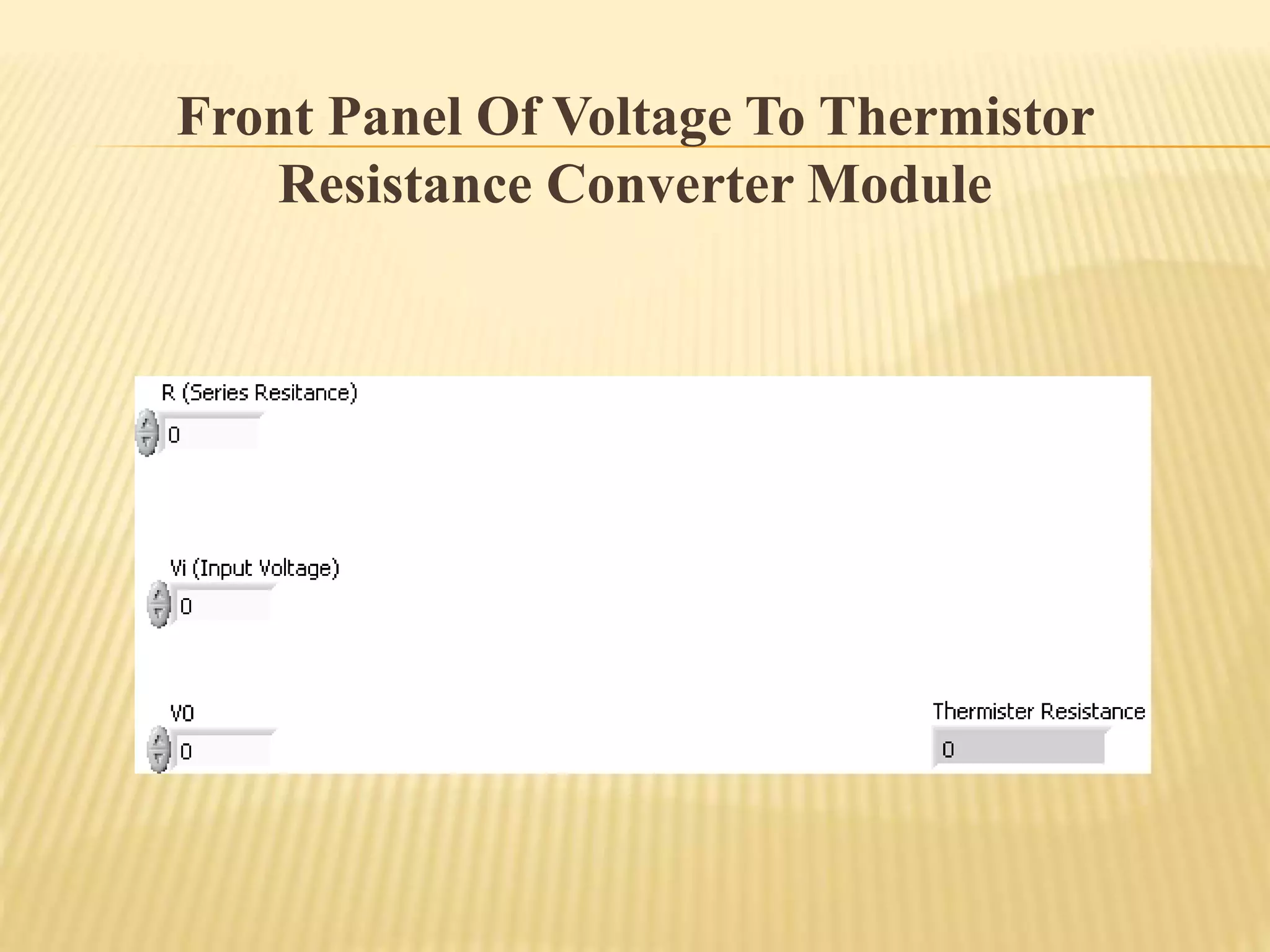
Front Panel Of Voltage To Thermistor
Resistance Converter Module
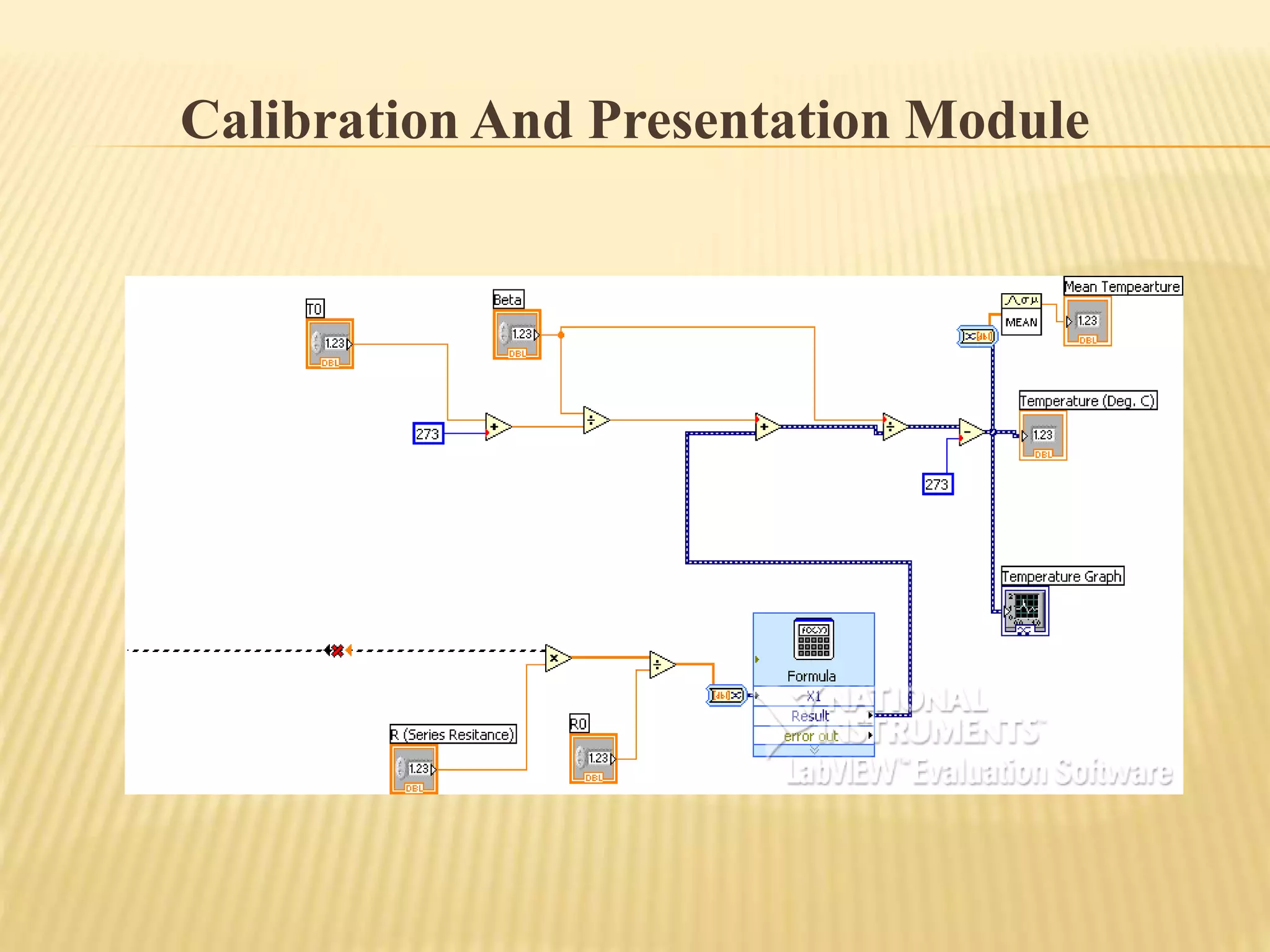
Calibration And Presentation Module
The calibration module implements following expression:-
T = /[{ln(Rth/ R0)}+ /T0]
Where
Rth Thermistor resistance at T (K)
T Thermistor temperature (K)
R0 Resistance at T0 (K)
 Thermistor characteristics constant (K)
Calibration And Presentation Module
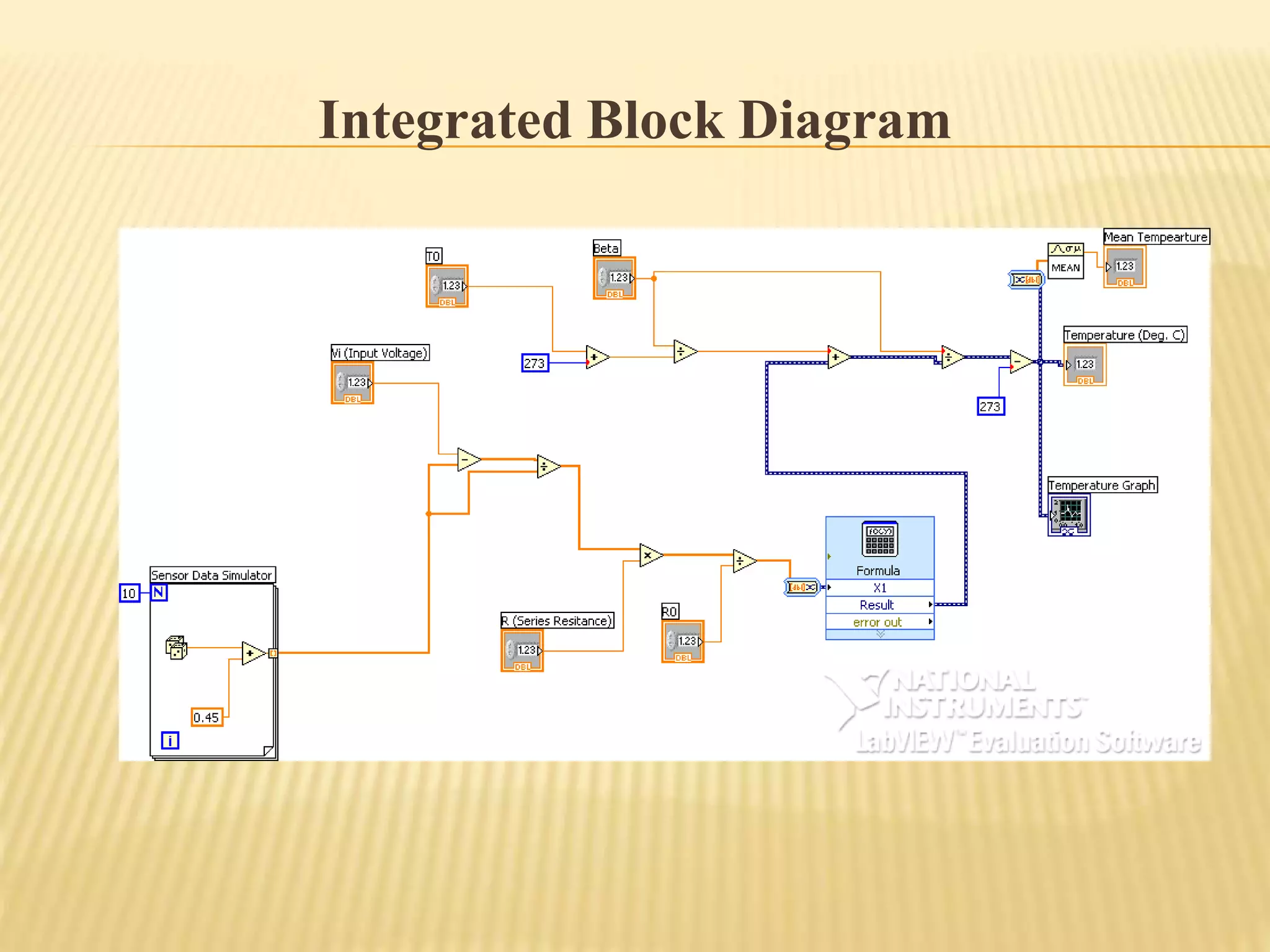
Integrated Block Diagram
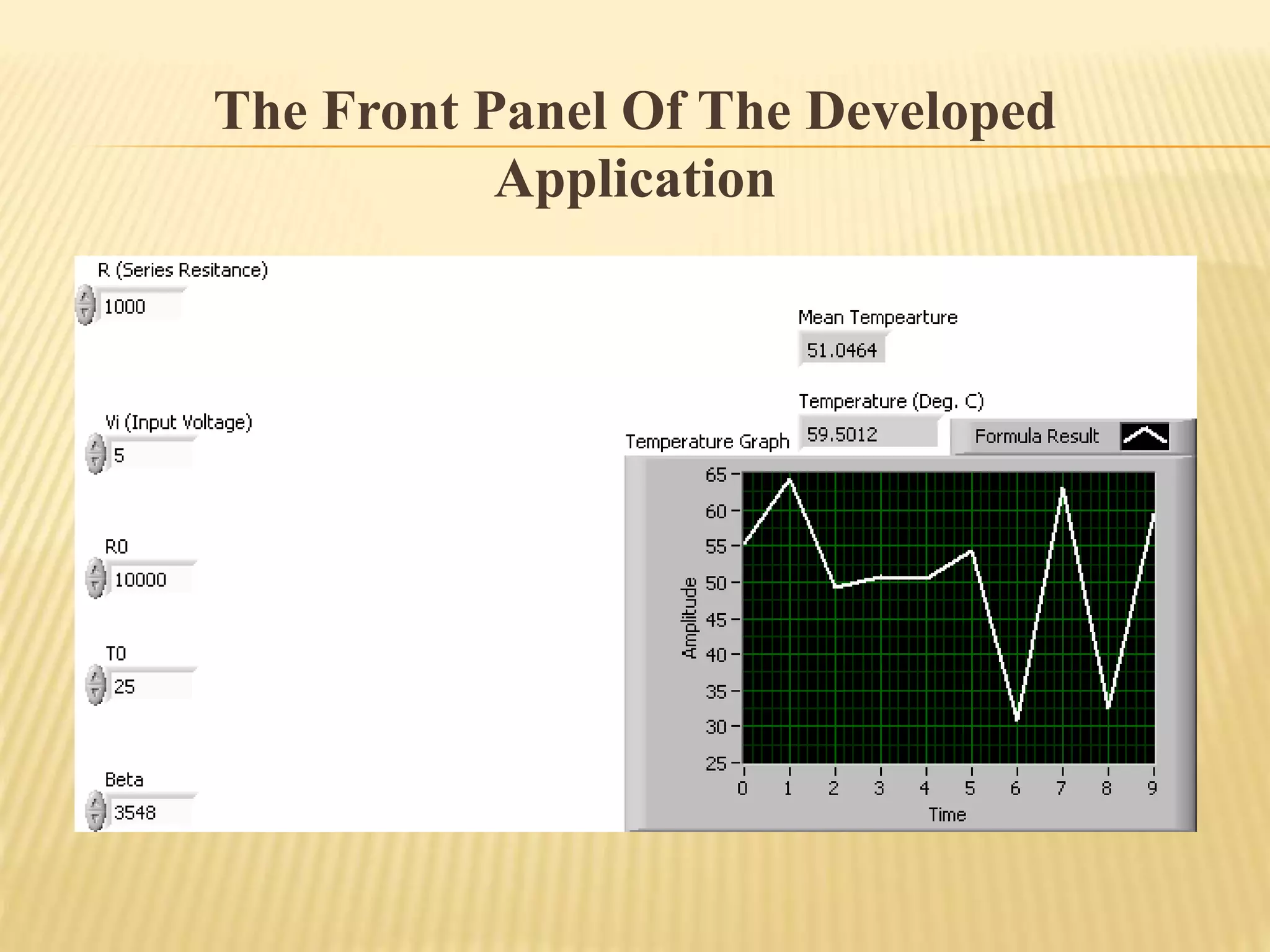
The Front Panel Of The Developed
Application
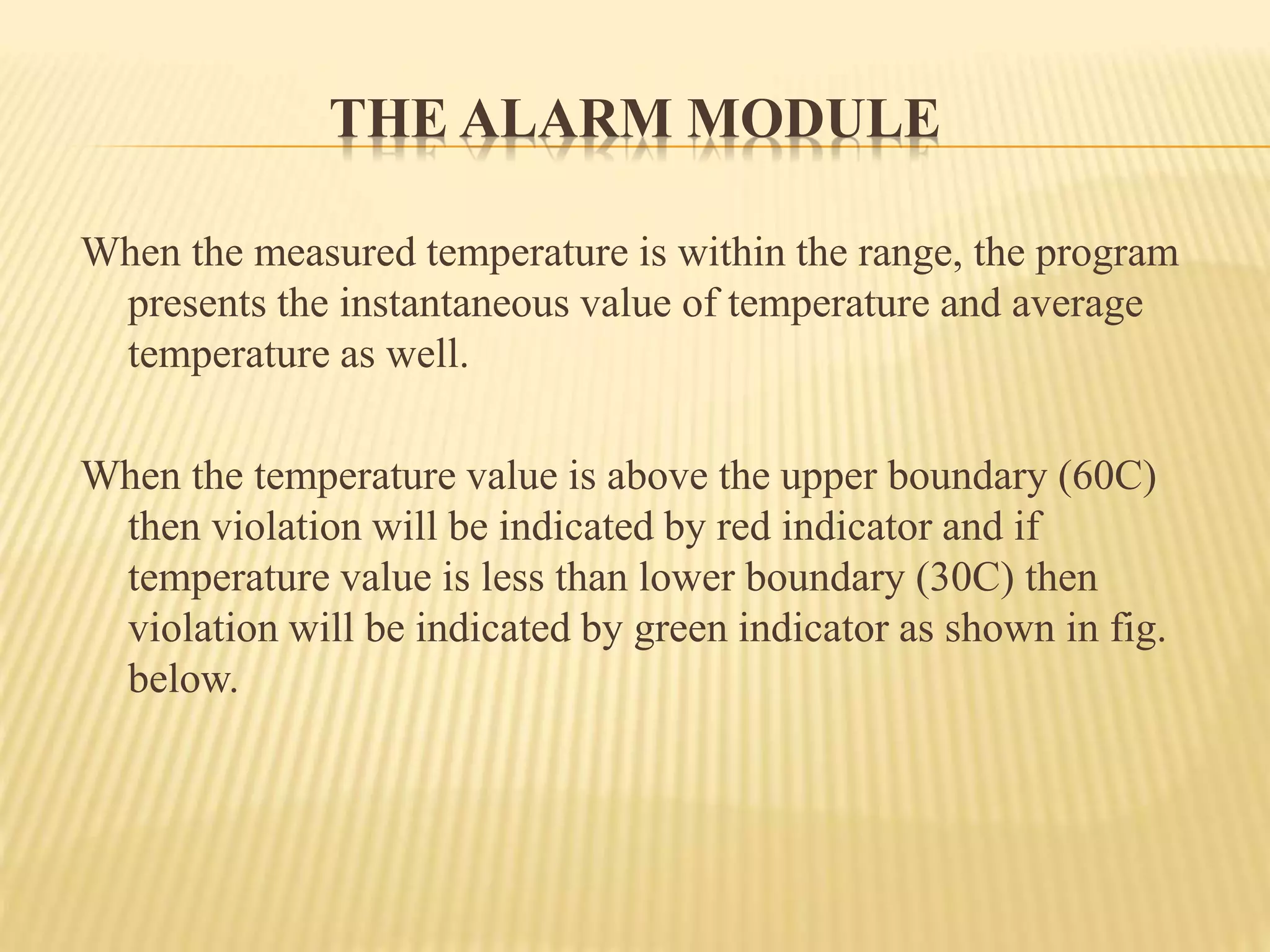
THE ALARM MODULE
When the measured temperature is within the range, the program
presents the instantaneous value of temperature and average
temperature as well.
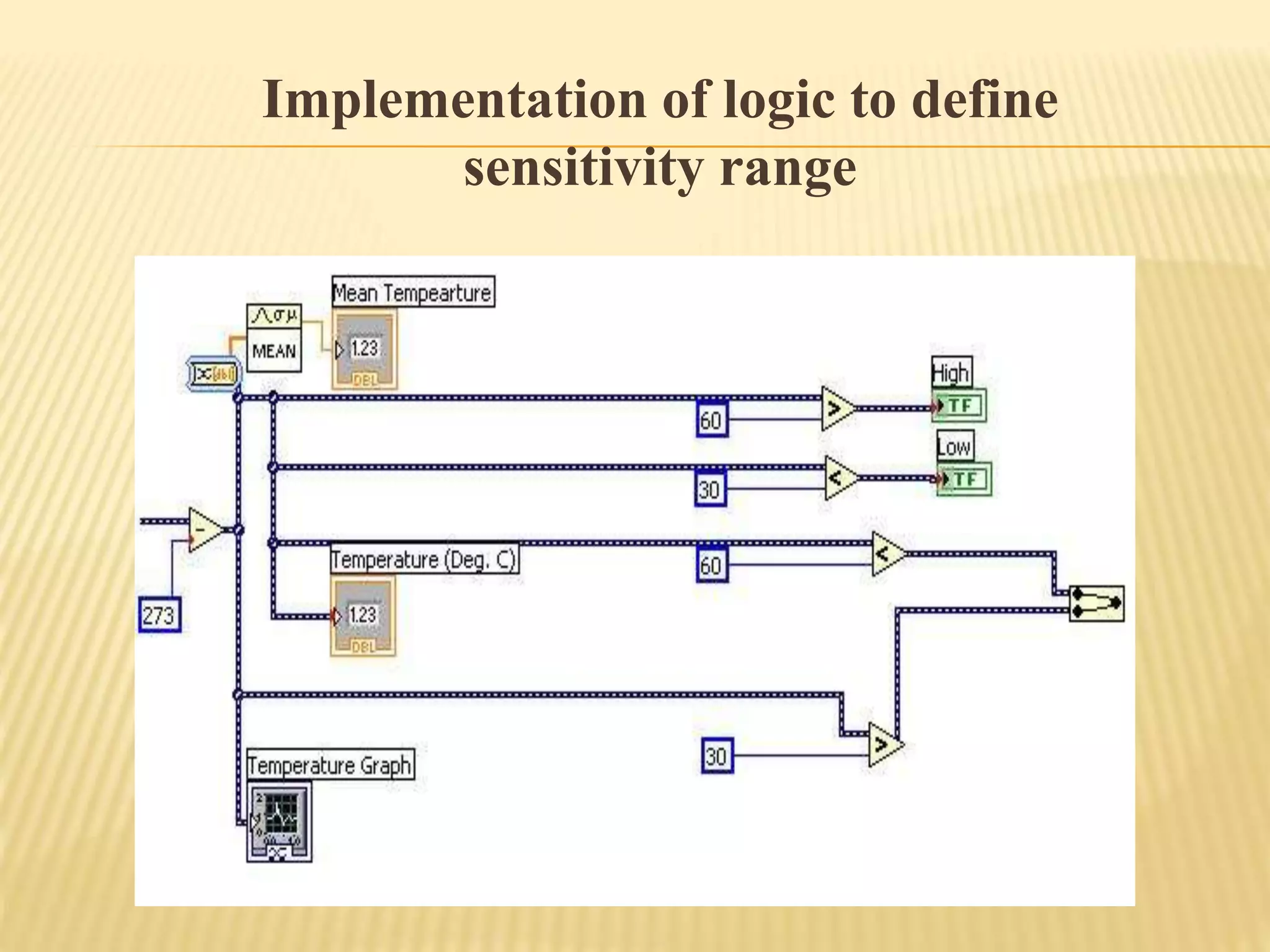
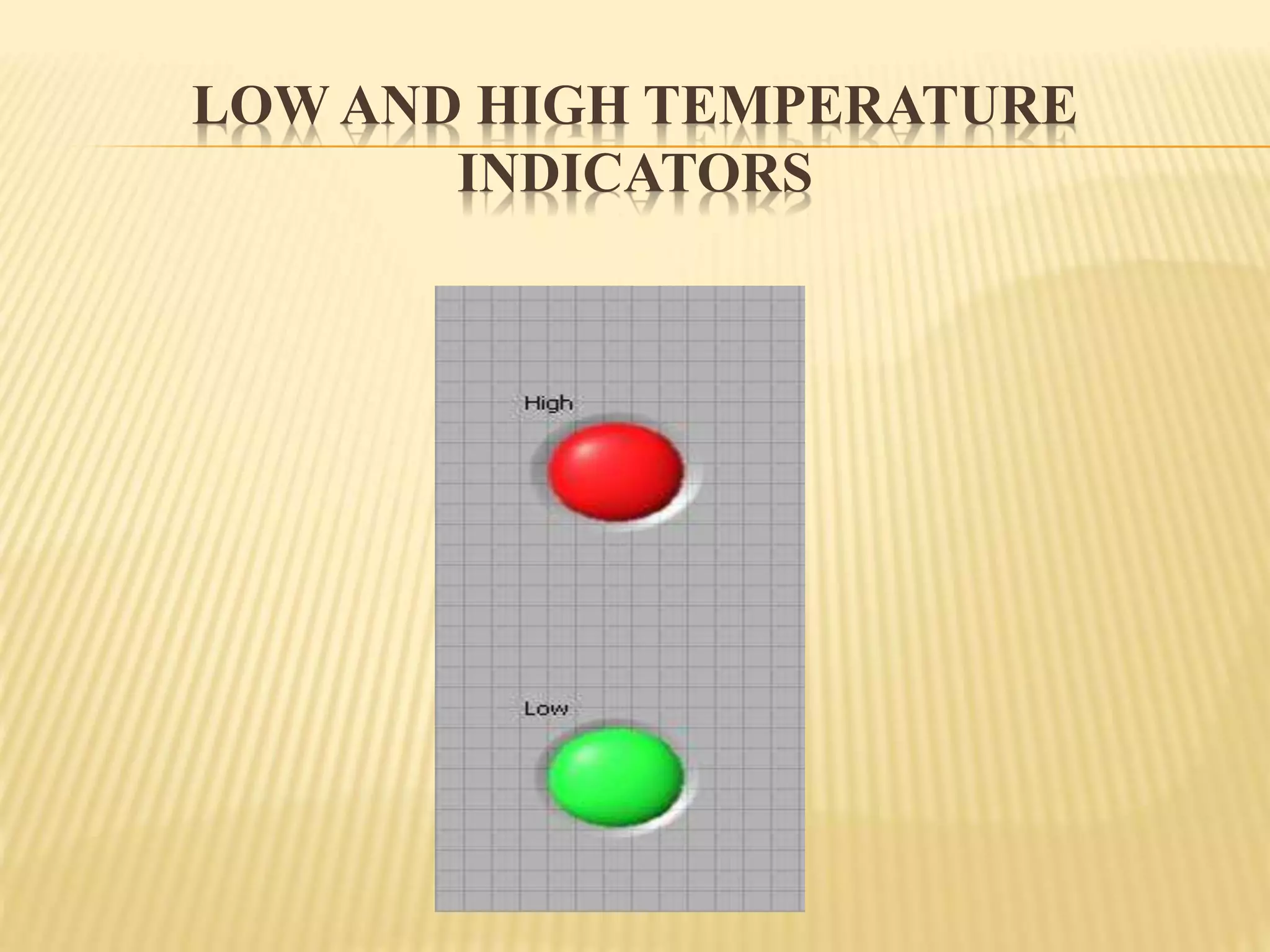
When the temperature value is above the upper boundary (60C)
then violation will be indicated by red indicator and if
temperature value is less than lower boundary (30C) then
violation will be indicated by green indicator as shown in fig.
below.
Implementation of logic to define
sensitivity range
LOW AND HIGH TEMPERATURE
INDICATORS
Condition Monitoring and Self
Maintenance
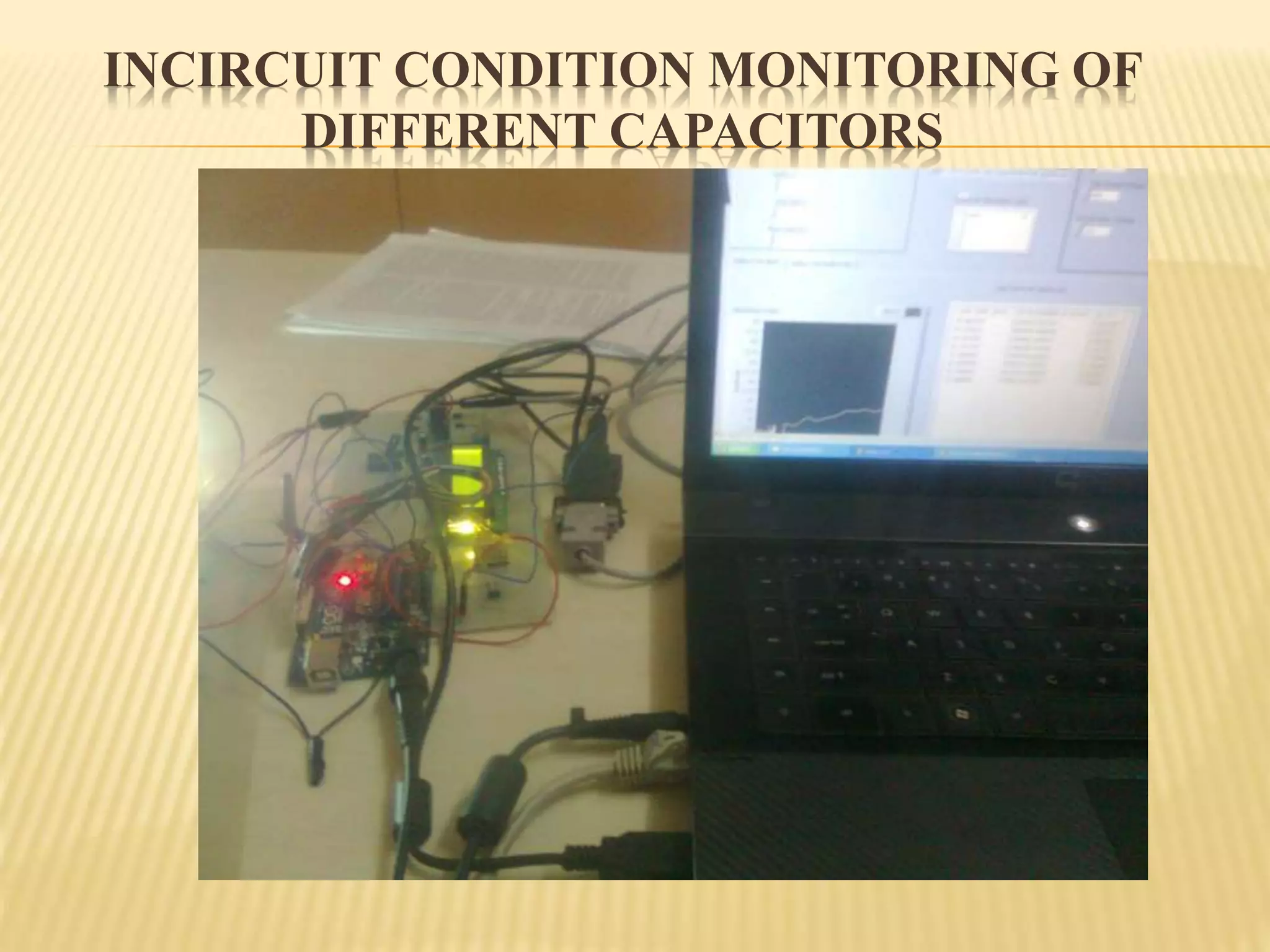
INCIRCUIT CONDITION MONITORING OF
DIFFERENT CAPACITORS
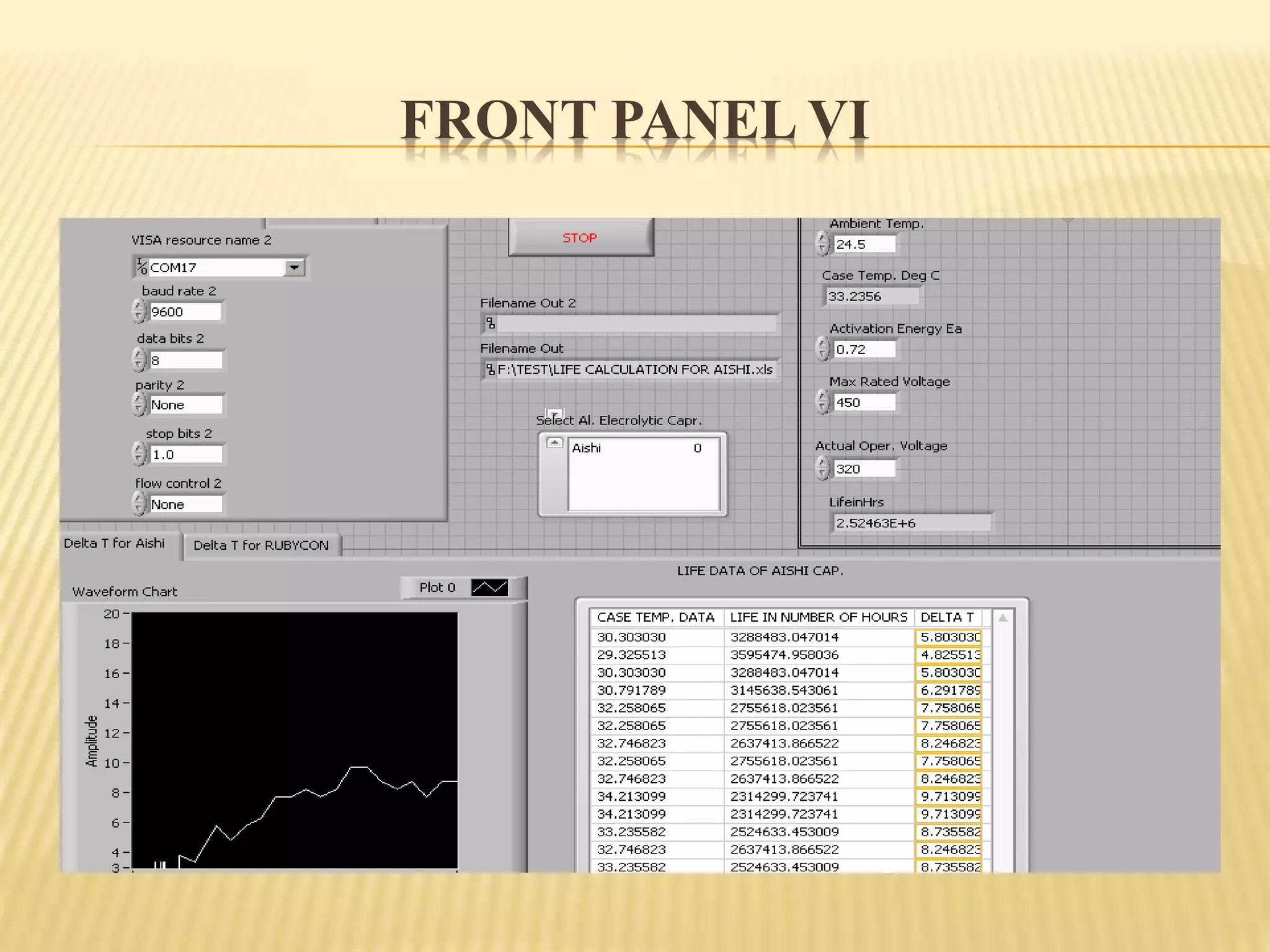
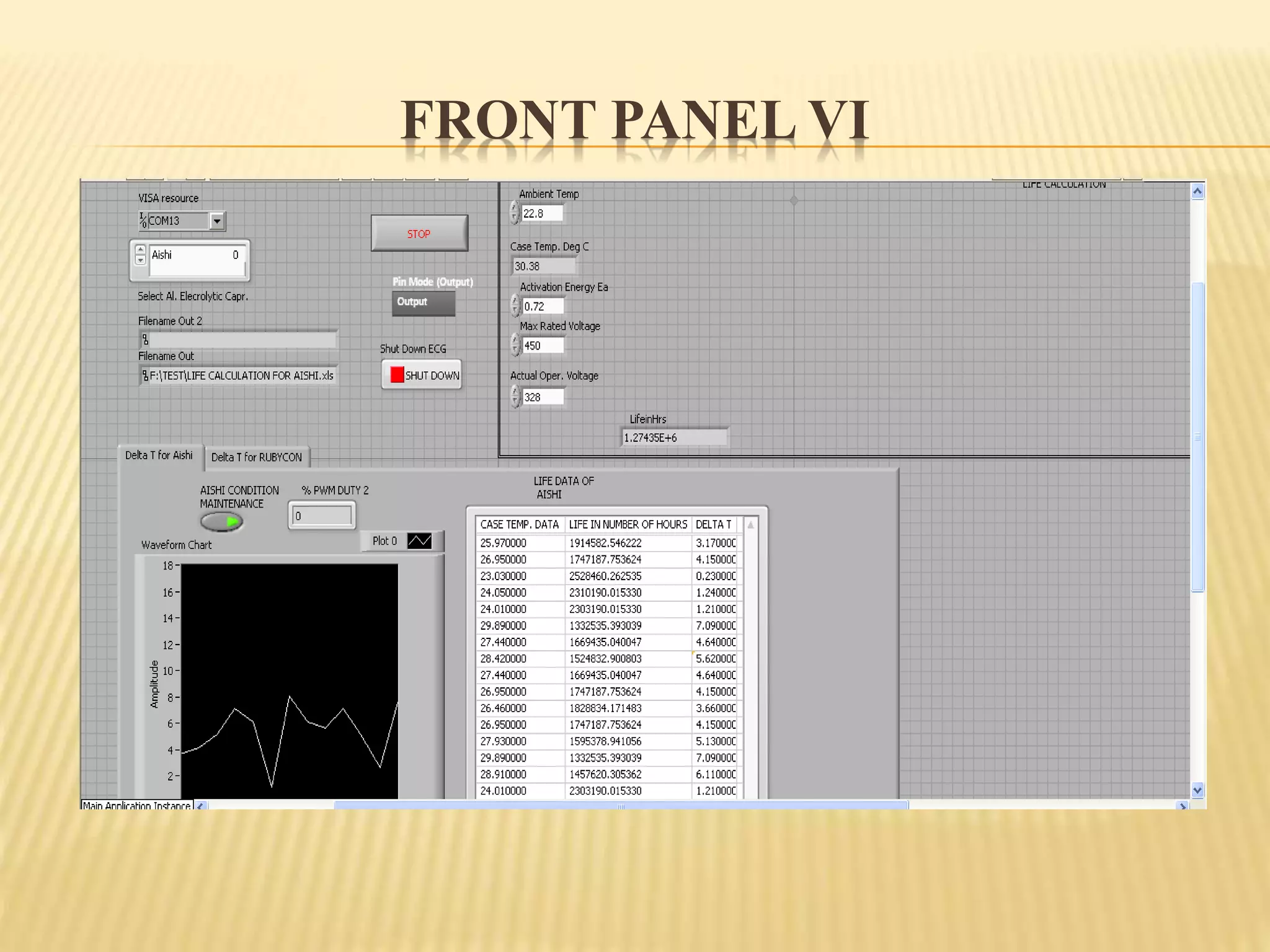
FRONT PANEL VI
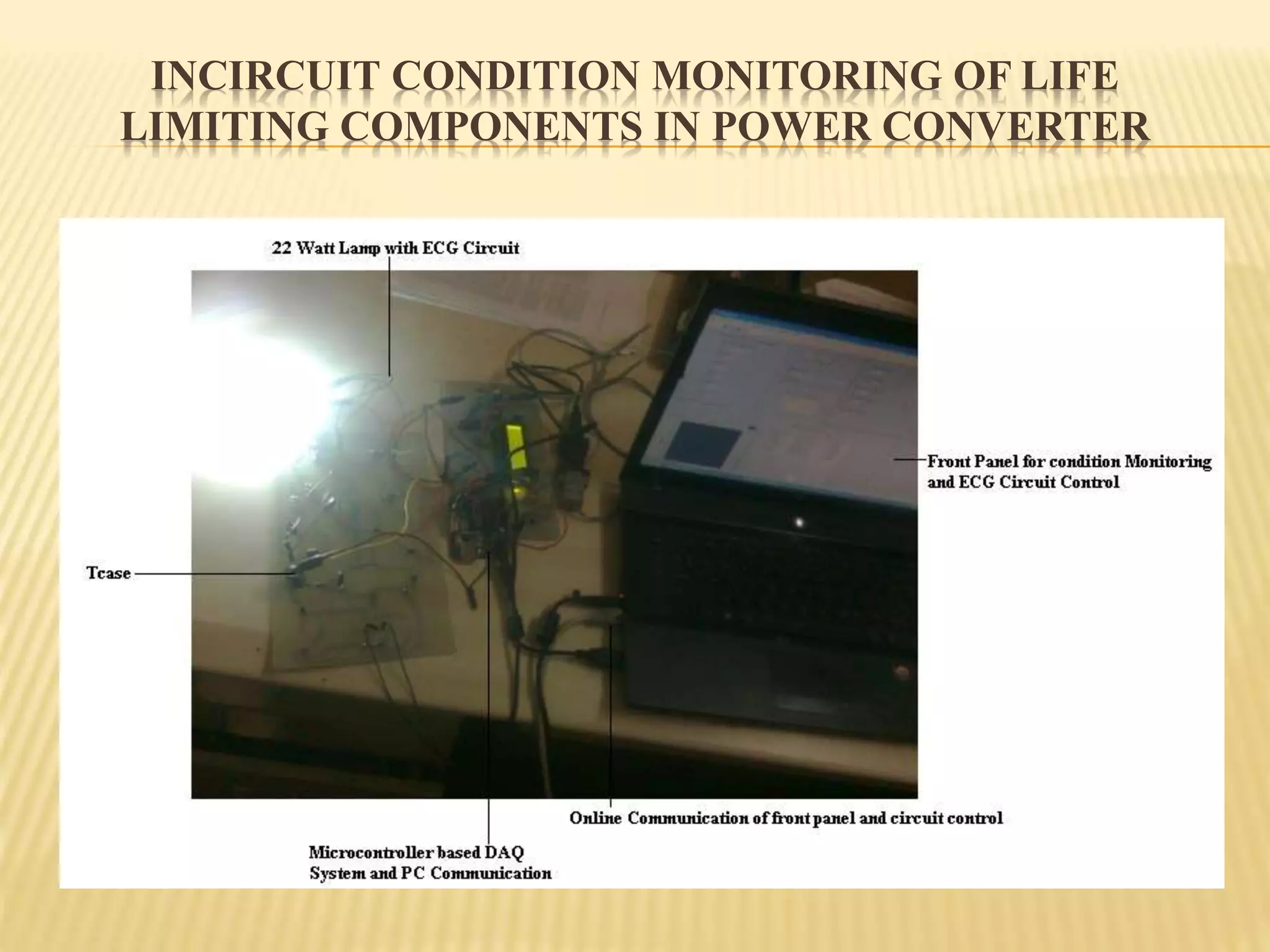
INCIRCUIT CONDITION MONITORING OF LIFE
LIMITING COMPONENTS IN POWER CONVERTER
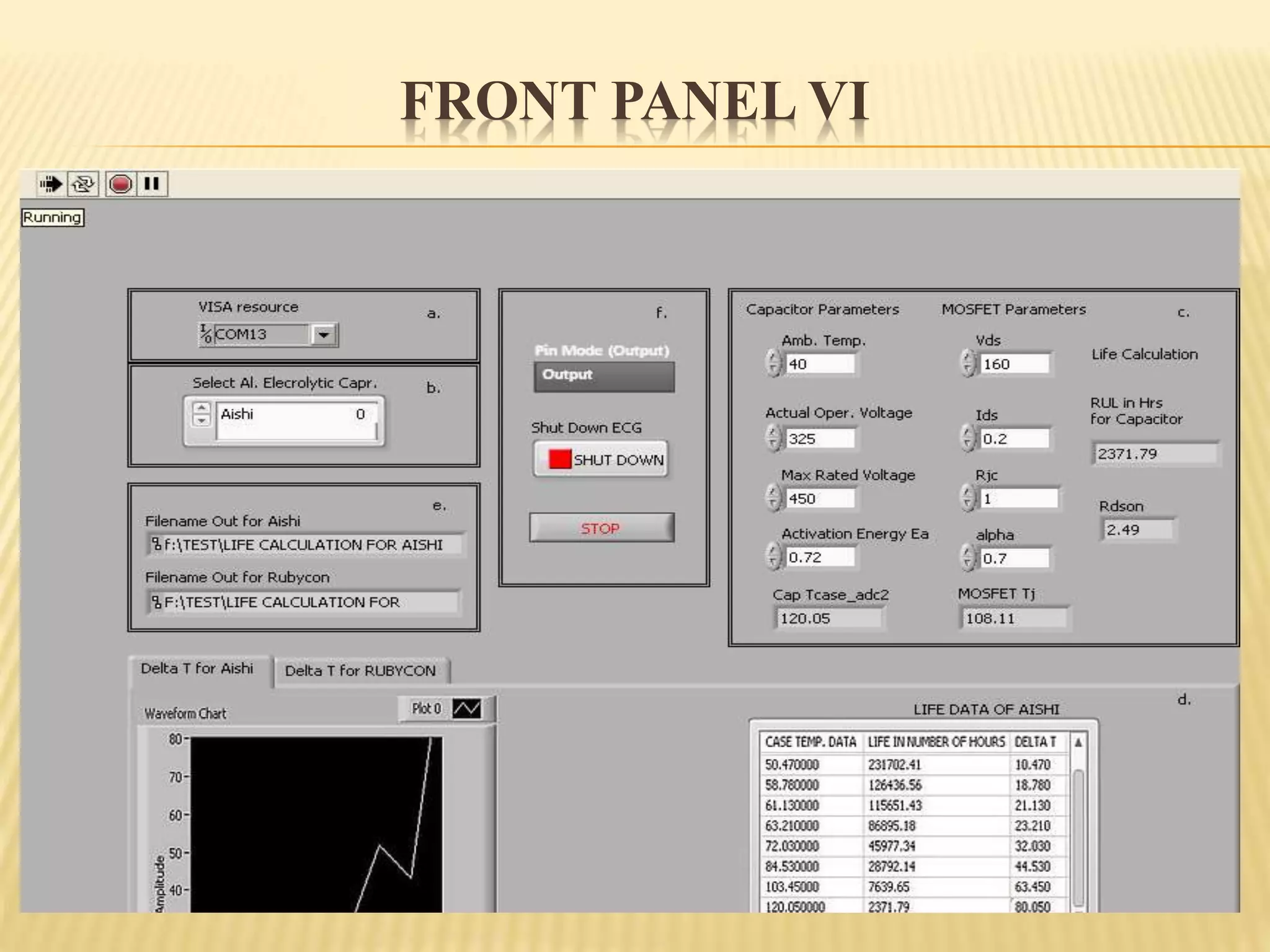
FRONT PANEL VI
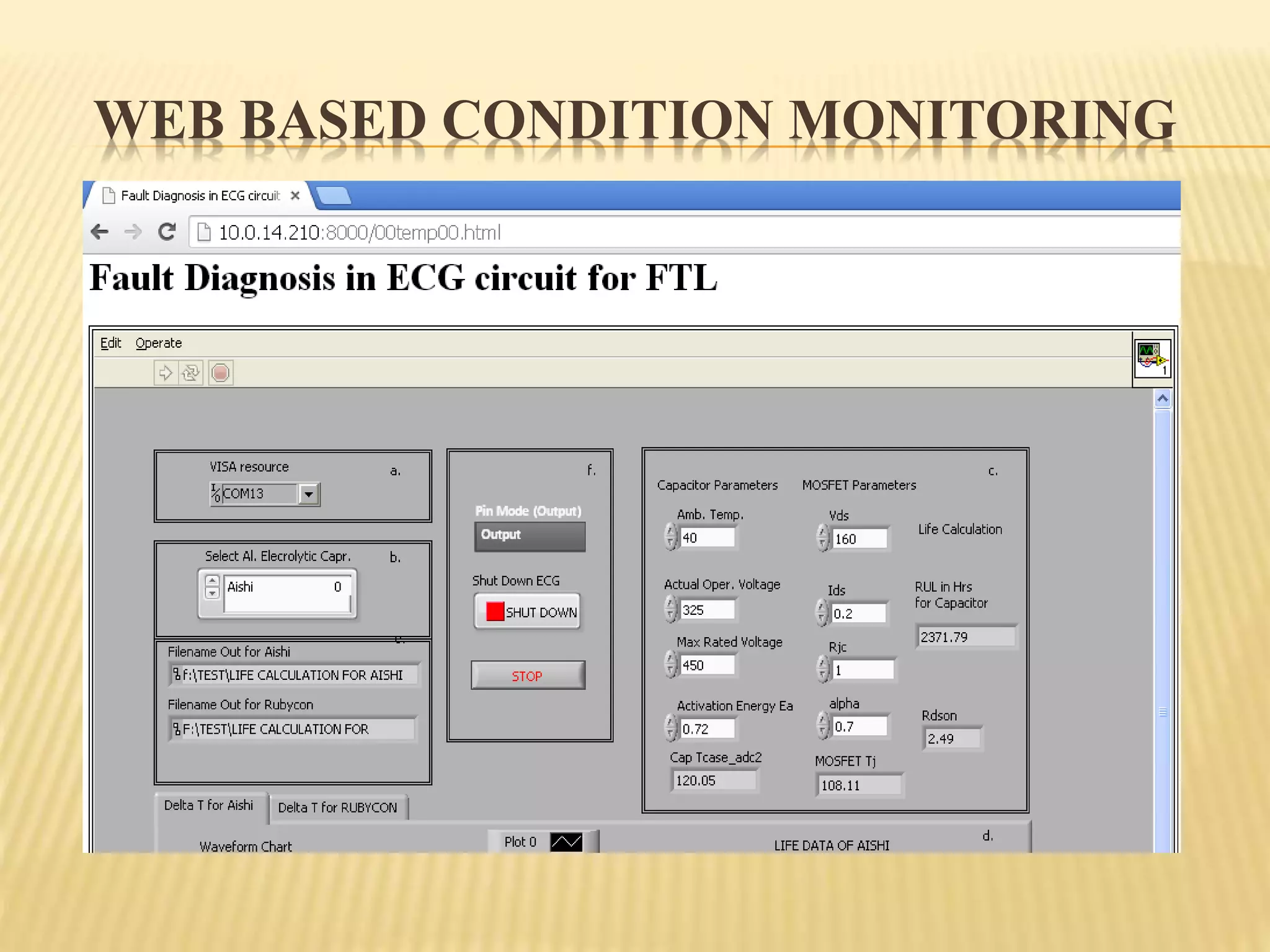
WEB BASED CONDITION MONITORING
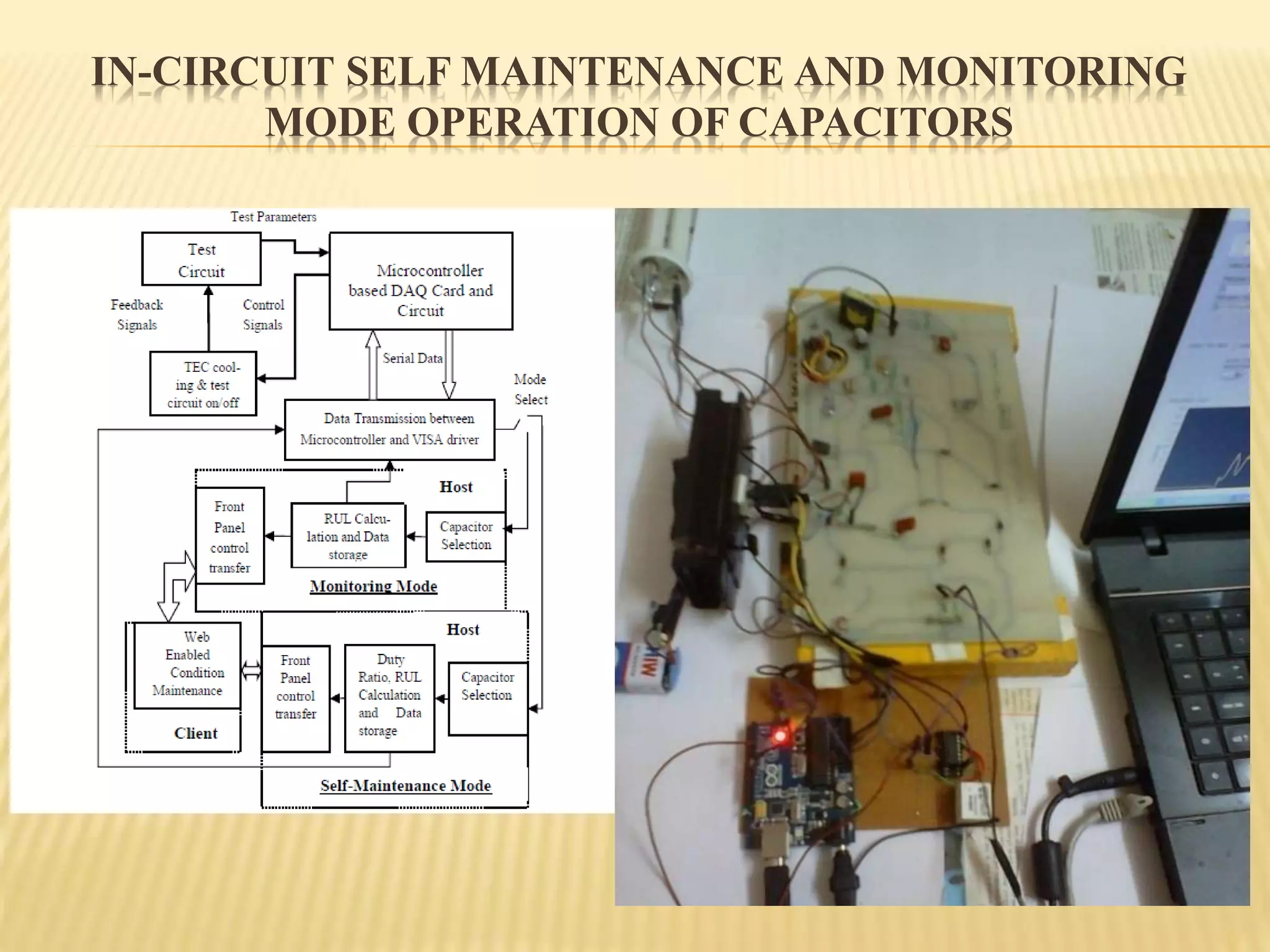
IN-CIRCUIT SELF MAINTENANCE AND MONITORING
MODE OPERATION OF CAPACITORS
FRONT PANEL VI
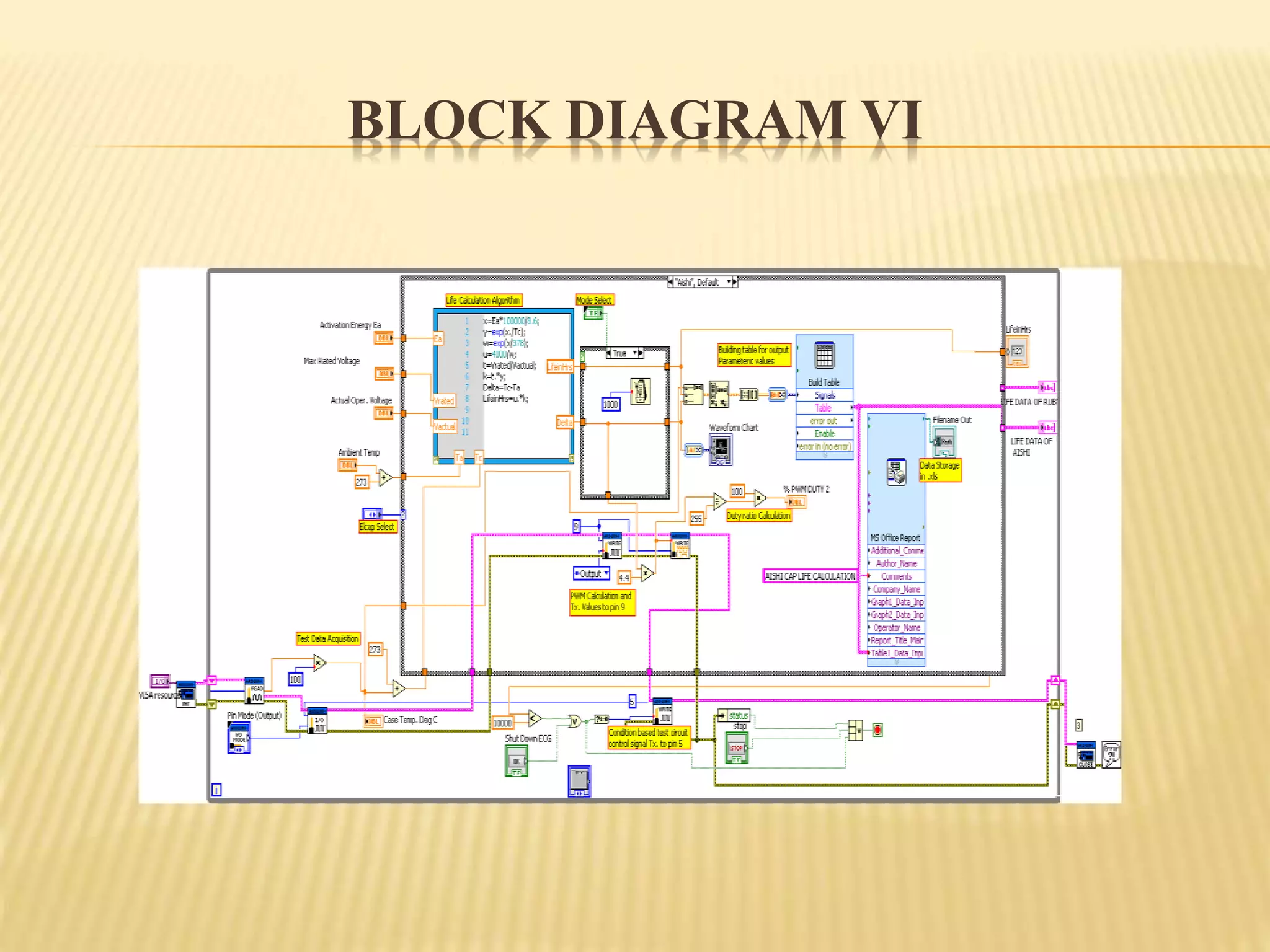
BLOCK DIAGRAM VI
WEB BASED CONDITION MONITORING
[MONITORING MODE]
WEB BASED CONDITION MONITORING [SELF
MAINTENANCE MODE]
59
• Sensor based measurement systems are
discussed.
• Different signal conditioning based issues are
discussed.
• Reported Analog and Digital techniques for
nonlinearity compensation are described.
• ANN based nonlinearity compensation
technique is presented.
• Guidelines are established for selecting order of
model & optimal number of training data points
for different degrees of sensor nonlinearity;
CONCLUSION
• A generalized multilayer ANN based method for sensor
linearization and compensation has been presented.
• Presented real-time implementation of scheme in using
NI PCI-6115 DAQ card and Labview® software.
• Total virtual implementation of temperature
measurement system is presented.
• Implementation of Labview® based in-circuit condition
monitoring of Electrolytic capacitor and MOSFET is
discussed.
• Presented implementation of Labview® based Real-time
condition monitoring and maintenance of Electrolytic
capacitor.
61

Signal conditioning & condition monitoring using LabView by Prof. shakeb ahmad khan

  • 2.
    Presentation Outline • SignalConditioning: An Introduction • Sensor nonlinearity representation • Nonlinearity compensation techniques • Analog & Digital Techniques • ANN based technique •ADALINE based network • MLNN based network • Implementation of trained MLNN for real time application. • Virtual implementation of a measurement system. • Labview based condition monitoring and self maintenance. • Conclusion.
  • 3.
    Sensor Signal Conditioning •Operations performed on sensor signals to compensate the imperfections present and to make them compatible for interface with next stage elements. Important Signal Conditioning Issues: • Signal level & bias adjustment • Linearization • Conversions • Filtering & impedance matching • Loading • Imperfection Compensation
  • 4.
    Significance Of LinearResponse Characteristics  With linear response characteristic, resultant measurement requires minimum no. of calibration data points.  With linear response characteristic resultant measurement system will have single sensitivity value and it will be easier in this case to make the instrument direct reading type.
  • 5.
    End Point Linearity dv %nonlinearity = (dv×100)/Vfs
  • 6.
  • 7.
  • 8.
  • 9.
    DIODE BASED PIECEWISELINEARIZATION CIRCUIT
  • 10.
    Case-1-When the inputvoltage is less than Va + drop across D1 1 1 R Rf A 
  • 11.
    CASE-2-WHEN THE INPUTVOLTAGE BECOMES MORE THAN THE DROP ACROSS RA AND DIODE D1 BUT IS LESS THAN THE DROP ACROSS RA + RB AND DIODE D2 2||1 1 RR Rf A 
  • 12.
    CASE-3-WHEN THE INPUTVOLTAGE BECOMES MORE THAN THE DROP ACROSS RA + RB AND DIODE D2 3||2||1 1 RRR Rf A 
  • 14.
    Linearization By EquationInversion  Consider a transducer, that converts pressure into voltage as: V=K [p]^0.5  V is converted into a binary no. by ADC.  DV varies as [p]^0.5.  Squaring this DV p varies as DV*DV  Thus a program would input a sample DV and multiply it by itself.
  • 15.
  • 16.
    ARTIFICIAL NEURAL NETWORK BASEDNONLINEARITY COMPENSATION
  • 17.
    Artificial Neural Network(ANN) is an information processing paradigm that is inspired by the way biological nervous systems, such as the brain, processes the information. The key element of this paradigm is the novel structure of the information processing system. It is composed of a large number of highly interconnected processing elements (neurons) working to solve specific problems. Artificial Neural Networks
  • 18.
    ADALINE: Adaptive LinearElement   LMS Algorithm b x1 W0 W1 W2 Wn (estimated Input) error Xˆ x2 . . xn
  • 19.
  • 20.
    20 Linearization Scheme Sensor InverseModel Applied measurand Estimated Measurand (X) (Y) (X') Sensor response 1
  • 21.
    Modeling Methodology The inverseresponse of nonlinear measurement system may be represented by power series expansion x = a0 + a1 y + a2 y2 + a3 y3+ … x = ∑ ai yi; i = 1, 2, …, NOr x yNonlinear measurement System N = order of model ai = coefficients that represents the characteristic of model
  • 22.
  • 23.
    Considered Sensor Situations SensorNon-Linearity Ni-RTD 3% Bridge-RTD 11% Bridge-Thermistor 16% Thermistor 51%
  • 24.
    Sensor Percent age Non- linearity Percentage Lowest AsymptoticRMS Error Number of Training Data Points 2nd Order model 3rd Order Model 03 05 07 09 11 03 05 07 09 11 Ni-RTD (0 – 1800C) 3 0.24 0.21 0.19 0.18 0.17 0.24 0.19 0.15 0.12 0.087 RTD-bridge (0 – 1800C) 11 2.9 1.68 1.3 1.03 1.0 0.69 0.51 0.44 0.43 0.41 Thermistor- bridge (0 - 500C) 16 3.94 2.25 2.22 2.02 1.99 3.5 1.71 1.42 0.94 0.88 Thermistor (0-120 0C) 51 22.35 12.37 12.09 10.97 10.6 16.67 11.01 10.41 8.58 8.26
  • 25.
    Limitation Of ADALINEModel  In the case of Thermistor characteristics having 51% nonlinearity, the ADALINE model is not capable of reducing the error below 8.26%.  Proposed solutions; 1. Piecewise linearization 2. Inverse modeling using MLP
  • 26.
    Sensor Percent age Non- linearity Percentage Lowest AsymptoticRMS Error Number of Training Data Points 2nd Order model 3rd Order Model 03 05 07 09 11 03 05 07 09 11 Thermistor (0-30 0C) 16.5 4.01 3.56 1.79 1.69 1.62 3.14 1.76 0.96 0.66 0.52 Thermistor (30-70 0C) 17 4.27 3.68 1.2 1.16 1.12 2.93 1.9 0.96 0.57 0.45 Thermistor (70-120 0C) 17.5 4.12 3.38 1.31 1.16 1.04 3.33 2.00 0.95 0.88 0.85
  • 27.
    Multi Layer Perceptron(MLP) Based Model • Needs powerful and costly device for stand alone implementation for real time applications. • Computer based implementation is proposed for this alternative . • Proposed computer based measurement system comprises two implementation steps; 1. Offline training using MATLAB®. 2. Implementation of trained network in real time using DAQ card and LabVIEW® software.
  • 28.
    Experimental Setup ForOnline Measurement Vi RTH R=1Kohm To DAQ Hardware DAQ Device LabVIE W Vo + - Real Time Data File
  • 29.
    Block Diagram ForThermistor Resistance Measurement VI
  • 30.
    Front Panel ForThermistor Resistance Measurement VI
  • 31.
    Block Diagram ForTesting Of ANN Model
  • 32.
    Front Panel ForTesting Of ANN Model
  • 34.
    Percentage Error BetweenActual And Estimated Temperature Actual temperature Estimated Temperature %age Error 5 5 0 6 6 0 8 7.8334 2.08 10 10.46 4.6 15 14.8765 0.82 20 20.07 0.34 25 25.1136 0.45 30 30.5543 1.8 32 32.698 2.1 35 35.0141 .04 40 40.248 0.62 45 45.2882 0.64 50 50.2 0.4 55 54.67 0.6 60 59.56 .733 65 65.33 .507 68 67.7118 0.42
  • 35.
    Virtual Implementation ofa Measurement System
  • 36.
    Sensor Data SimulatorModule This module represents following part of the circuit, which comprises sensor and signal conditioning circuit. Temperature range: 250C to 650C Corresponding voltage range (Signal Conditioning Circuit Output): 0.45 V to 1.45 V
  • 37.
    Implementation Of SensorData Simulator Module
  • 38.
    Voltage To ThermistorResistance Converter Module In this module following equation is implemented; Rth =((Vi – V0) / V0 ) * Rs Where; Rth – Thermistor Resistance Vi – Input voltage (= 5 V) Rs – Series resistance (= 1 K-ohm) V0 – Voltage across Rs
  • 39.
    Implementation Of VoltageTo Thermistor Resistance Converter Module
  • 40.
    Front Panel OfVoltage To Thermistor Resistance Converter Module
  • 41.
    Calibration And PresentationModule The calibration module implements following expression:- T = /[{ln(Rth/ R0)}+ /T0] Where Rth Thermistor resistance at T (K) T Thermistor temperature (K) R0 Resistance at T0 (K)  Thermistor characteristics constant (K)
  • 42.
  • 43.
  • 44.
    The Front PanelOf The Developed Application
  • 45.
    THE ALARM MODULE Whenthe measured temperature is within the range, the program presents the instantaneous value of temperature and average temperature as well. When the temperature value is above the upper boundary (60C) then violation will be indicated by red indicator and if temperature value is less than lower boundary (30C) then violation will be indicated by green indicator as shown in fig. below.
  • 46.
    Implementation of logicto define sensitivity range
  • 47.
    LOW AND HIGHTEMPERATURE INDICATORS
  • 48.
    Condition Monitoring andSelf Maintenance
  • 49.
    INCIRCUIT CONDITION MONITORINGOF DIFFERENT CAPACITORS
  • 50.
  • 51.
    INCIRCUIT CONDITION MONITORINGOF LIFE LIMITING COMPONENTS IN POWER CONVERTER
  • 52.
  • 53.
  • 54.
    IN-CIRCUIT SELF MAINTENANCEAND MONITORING MODE OPERATION OF CAPACITORS
  • 55.
  • 56.
  • 57.
    WEB BASED CONDITIONMONITORING [MONITORING MODE]
  • 58.
    WEB BASED CONDITIONMONITORING [SELF MAINTENANCE MODE]
  • 59.
    59 • Sensor basedmeasurement systems are discussed. • Different signal conditioning based issues are discussed. • Reported Analog and Digital techniques for nonlinearity compensation are described. • ANN based nonlinearity compensation technique is presented. • Guidelines are established for selecting order of model & optimal number of training data points for different degrees of sensor nonlinearity; CONCLUSION
  • 60.
    • A generalizedmultilayer ANN based method for sensor linearization and compensation has been presented. • Presented real-time implementation of scheme in using NI PCI-6115 DAQ card and Labview® software. • Total virtual implementation of temperature measurement system is presented. • Implementation of Labview® based in-circuit condition monitoring of Electrolytic capacitor and MOSFET is discussed. • Presented implementation of Labview® based Real-time condition monitoring and maintenance of Electrolytic capacitor.
  • 61.