What is Micromeritics?
The Science andTechnology of small particles is known as
Micromeritics.
Micromeritics deals with-
 Particle size and Size Distribution
 Methods of Determining particles size
 Particle shape and surface area
 Pore size
 Angle of repose
Importance of Study of Micromeritics:
Knowledge and control of the size and the size range of particle is of
profound importance in pharmacy.
Size and surface area can be related to the physical, chemical and
pharmacological properties of a drug.
1. Particle size affect its release from dosage forms that are
administered orally, parenterally, rectally and topically
2. Physical stability and pharmacologic response of suspensions,
emulsion and tablets depends on particle size.
3. It is also important in flow properties and proper mixing of
granules and powders in tableting.
4. Both Tablets and capsules are produced using equipments
which controls the mass of drug and other particles by
volumetric filling. Therefore any interference with the
uniformity of fill, volumes may alter the mass of drug
incorporated into the tablet or capsules. Thus reduce the
uniformity of the medicine.
5. Powders with different particle sizes have different flow and
packing properties which alter the volumes of powder during
each encapsulation or tablet compression.
6. The rate of solution depends on the several factors. One factor is
the particle size.Thus particles having small dimensions will tend to
increase the rate of solution.
For example:
a) Griseofulvin has a low solubility after oral administration but is
rapidly distributed following absorption. The solubility of
Griseofulvin can be greatly increased by particle size reduction.
b) Reduction of particles size also increase the rate of absorption of
tetracycline, aspirin and sulphonamides.
c) Reduction of particle size of nitrofurantoin increases the rate of
absorption.Therefore toxic effects results due to rapid absorption.
 Before being used in the preparation of pharmaceuticals, solid
materials are first characterized to determine their chemical and
physical features, including;
morphology, purity, solubility, flow ability, stability,
particle size/ size distribution and compatibility with
any other formulation components .
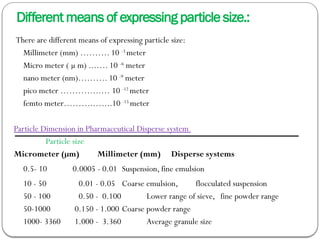
Different means of expressing particle size.:
There are different means of expressing particle size:
Millimeter (mm) ………. 10 -3
meter
Micro meter ( µ m) ...…. 10 -6
meter
nano meter (nm)………. 10 -9 meter
pico meter …………..… 10 -12
meter
femto meter………..…...10 -15
meter
Particle Dimension in Pharmaceutical Disperse system
Particle size
Micrometer (µm) Millimeter (mm) Disperse systems
0.5- 10 0.0005 - 0.01 Suspension, fine emulsion
10 - 50 0.01 - 0.05 Coarse emulsion, flocculated suspension
50 - 100 0.50 - 0.100 Lower range of sieve, fine powder range
50-1000 0.150 - 1.000 Coarse powder range
1000- 3360 1.000 - 3.360 Average granule size
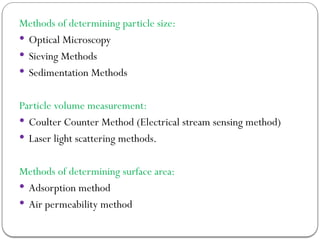
Methods of determining particle size:
 Optical Microscopy
 Sieving Methods
 Sedimentation Methods
Particle volume measurement:
 Coulter Counter Method (Electrical stream sensing method)
 Laser light scattering methods.
Methods of determining surface area:
 Adsorption method
 Air permeability method
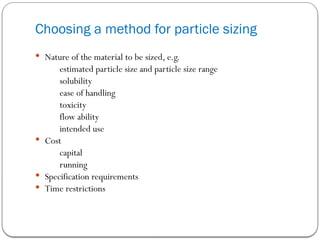
 Nature of the material to be sized, e.g.
estimated particle size and particle size range
solubility
ease of handling
toxicity
flow ability
intended use
 Cost
capital
running
 Specification requirements
 Time restrictions
Choosing a method for particle sizing
Sieving Method:
Sieving method is an ordinary and simple method. It is widely used as a method
for the particle size analysis.
Range of analysis:
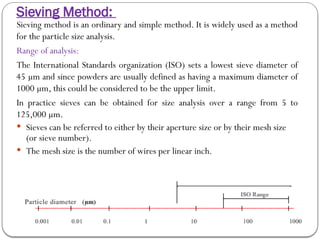
The International Standards organization (ISO) sets a lowest sieve diameter of
45 µm and since powders are usually defined as having a maximum diameter of
1000 µm, this could be considered to be the upper limit.
In practice sieves can be obtained for size analysis over a range from 5 to
125,000 µm.
 Sieves can be referred to either by their aperture size or by their mesh size
(or sieve number).
 The mesh size is the number of wires per linear inch.
 Sieve analysis is usually carried out using dry powders.
 Although, for powders in liquid suspension or which
agglomerate during dry sieving, a process of wet sieving
can be used.
Principle of Measurement:
Sieve analysis utilizes a woven, punched or electroformed mesh
often in brass, bronze or stainless steel with known aperture
(hole) diameters which form a physical barrier to particles.
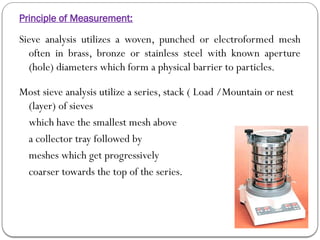
Most sieve analysis utilize a series, stack ( Load /Mountain or nest
(layer) of sieves
which have the smallest mesh above
a collector tray followed by
meshes which get progressively
coarser towards the top of the series.
Powder is loaded on to the coarsest sieve of the assembled stack and the nest is
subjected to mechanical vibration for, say 20 minutes.
After this time, the particles are considered to be retained on the sieve mesh
with an aperture corresponding to the minimum or sieve diameter.
A sieving time of 20 minutes is arbitrary and BS 1796 recommends sieving to
be continued until less than 0.2% material passes a given sieve aperture in any 5
minutes interval
Advantages : 1.This method is very simple.
2. Not expensive
3. Easy to operate
Disadvantages : 1. Not too much precise method.
2 . Not applicable for all disperse systems.
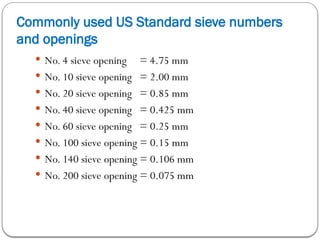
Commonly used US Standard sieve numbers
and openings
 No. 4 sieve opening = 4.75 mm
 No. 10 sieve opening = 2.00 mm
 No. 20 sieve opening = 0.85 mm
 No. 40 sieve opening = 0.425 mm
 No. 60 sieve opening = 0.25 mm
 No. 100 sieve opening = 0.15 mm
 No. 140 sieve opening = 0.106 mm
 No. 200 sieve opening = 0.075 mm
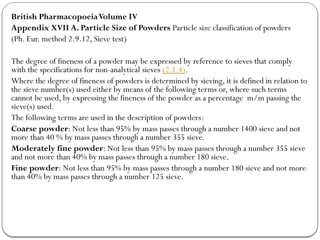
British PharmacopoeiaVolume IV
Appendix XVII A. Particle Size of Powders Particle size classification of powders
(Ph. Eur. method 2.9.12, Sieve test)
The degree of fineness of a powder may be expressed by reference to sieves that comply
with the specifications for non-analytical sieves (2.1.4).
Where the degree of fineness of powders is determined by sieving, it is defined in relation to
the sieve number(s) used either by means of the following terms or, where such terms
cannot be used, by expressing the fineness of the powder as a percentage m/m passing the
sieve(s) used.
The following terms are used in the description of powders:
Coarse powder: Not less than 95% by mass passes through a number 1400 sieve and not
more than 40 % by mass passes through a number 355 sieve.
Moderately fine powder: Not less than 95% by mass passes through a number 355 sieve
and not more than 40% by mass passes through a number 180 sieve.
Fine powder: Not less than 95% by mass passes through a number 180 sieve and not more
than 40% by mass passes through a number 125 sieve.
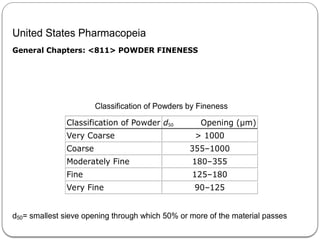
United States Pharmacopeia
General Chapters: <811> POWDER FINENESS
Classification of Powders by Fineness
Classification of Powder d50 Sieve Opening (µm)
Very Coarse > 1000
Coarse 355–1000
Moderately Fine 180–355
Fine 125–180
Very Fine 90–125
d50= smallest sieve opening through which 50% or more of the material passes
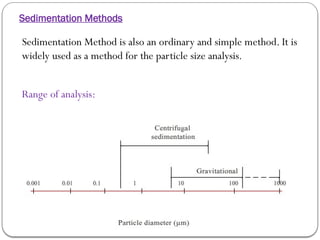
Sedimentation Methods
Sedimentation Method is also an ordinary and simple method. It is
widely used as a method for the particle size analysis.
Range of analysis:
Sample preparation and analysis conditions
In this method particle size can be determined by examining
the powder as it sediments out.
a) In cases where the powder is not uniformly dispersed in a
fluid it can be introduced as a thin layer on the surface of
the liquid.
b) If the powder is lyophobic, e.g. hydrophobic in water , it
may be necessary to add dispersing agent to aid wetting of
the powder.
c) In case where the powder is soluble in water it will be
necessary to use non-aqueous liquids or carry out the
analysis in a gas.
Principle of Measurement
Particle size analysis by sedimentation method can be divided into two
main categories according to the method of measurement used.
 One of the type is based on measurement of particle in a retention
zone.
 Another type uses a non-retention measurement zone.
An example of a non-retention zone measurement is known as the
pipette method.
In this method , known volumes of suspension are drawn off and the
concentration differences are measured with respect to time.
One of the most popular of the pipette methods was that developed by
Andreasen and Lundberg and commonly called the Andreasen pipette.
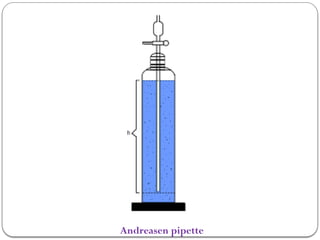
Andreasen pipette
TheAndreasen fixed-position pipette consists of a 200 mm graduate cylinder which can
hold about 500 ml of suspension fluid.
A pipette is located centrally in the cylinder and is held in position by a ground glass
stopper so that its tip coincides with the zero level.
A three way tap allows fluid to be drawn into a 10 ml reservoir which can then be
emptied into a beaker or centrifuge tube.
The amount of powder can be determined by weight following drying or centrifuging.
The weight of each sample residue is therefore called the weight of undersize and the
sum of the successive weight is known as the cumulative weight of undersize. It can
be expressed directly in weight units or percent of the total weight of the final
sediment.
The data of cumulative weight of undersize is used for the determination of particle
weight distribution, number distribution.
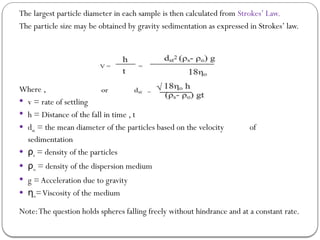
The largest particle diameter in each sample is then calculated from Strokes’ Law.
The particle size may be obtained by gravity sedimentation as expressed in Strokes’ law.
Where ,
 v = rate of settling
 h = Distance of the fall in time , t
 dst = the mean diameter of the particles based on the velocity of
sedimentation
 ρs = density of the particles
 ρo = density of the dispersion medium
 g =Acceleration due to gravity
 ηo=Viscosity of the medium
Note:The question holds spheres falling freely without hindrance and at a constant rate.
Coulter Counter Method (Electrical stream
sensing zone method):
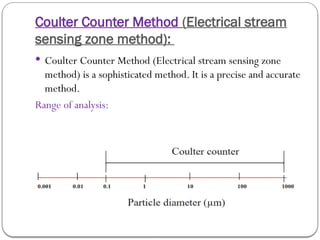
 Coulter Counter Method (Electrical stream sensing zone
method) is a sophisticated method. It is a precise and accurate
method.
Range of analysis:
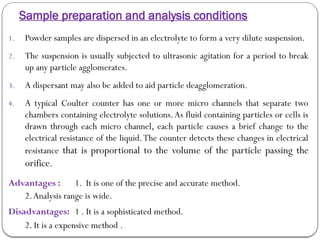
Sample preparation and analysis conditions
1. Powder samples are dispersed in an electrolyte to form a very dilute suspension.
2. The suspension is usually subjected to ultrasonic agitation for a period to break
up any particle agglomerates.
3. A dispersant may also be added to aid particle deagglomeration.
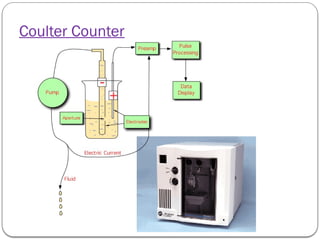
4. A typical Coulter counter has one or more micro channels that separate two
chambers containing electrolyte solutions.As fluid containing particles or cells is
drawn through each micro channel, each particle causes a brief change to the
electrical resistance of the liquid.The counter detects these changes in electrical
resistance that is proportional to the volume of the particle passing the
orifice.
Advantages : 1. It is one of the precise and accurate method.
2.Analysis range is wide.
Disadvantages: 1 . It is a sophisticated method.
2. It is a expensive method .
Coulter Counter
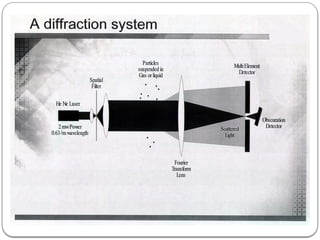
Laser light scattering methods.
Light scattering is measured by two different instruments
 Classical Light Scattering / Static Light Scattering : Here, the
intensity of the scattered light is measured as a function of angle
 Dynamic Light Scattering (DLS): Dynamic light scattering (DLS),
sometimes referred to as Quasi-Elastic Light Scattering (QELS), is a
non-invasive, well-established technique for measuring the size and
size distribution of molecules and particles typically in the submicron
region, and with the latest technology lower than 1nm.
Typical applications of dynamic light scattering are the
characterization of particles, emulsions or molecules, which have
been dispersed or dissolved in a liquid. The Brownian motion of
particles or molecules in suspension causes laser light to be scattered
at different intensities. Analysis of these intensity fluctuations yields
the velocity of the Brownian motion and hence the particle size using
the Stokes-Einstein relationship.
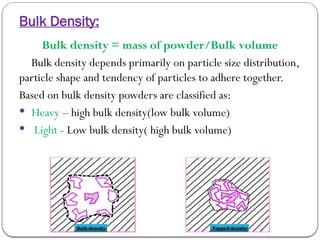
Bulk Density:
Bulk density = mass of powder/Bulk volume
Bulk density depends primarily on particle size distribution,
particle shape and tendency of particles to adhere together.
Based on bulk density powders are classified as:
 Heavy – high bulk density(low bulk volume)
 Light - Low bulk density( high bulk volume)
APPLICATIONS:
 To check the uniformity of bulk chemicals(Quality control
measures)
 Determination of size of capsule for a given dose of
material.(higher the bulk volume ,lower will be bulk density
and bigger the size of capsule)
 It helps in selecting the proper size of a container, packing
material, mixing apparatus in the production of tablets and
capsules.
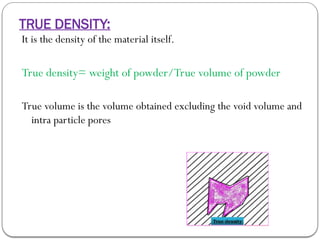
TRUE DENSITY:
It is the density of the material itself.
True density= weight of powder/True volume of powder
True volume is the volume obtained excluding the void volume and
intra particle pores
METHODS:
 GAS DISPLACMENT METHOD(Porous):
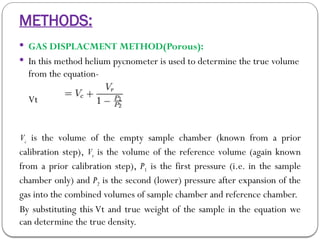
 In this method helium pycnometer is used to determine the true volume
from the equation-
Vt
Vc is the volume of the empty sample chamber (known from a prior
calibration step), Vr is the volume of the reference volume (again known
from a prior calibration step), P1 is the first pressure (i.e. in the sample
chamber only) and P2 is the second (lower) pressure after expansion of the
gas into the combined volumes of sample chamber and reference chamber.
By substituting this Vt and true weight of the sample in the equation we
can determine the true density.
LIQUID DISPLACEMENT METHOD (nonporous):
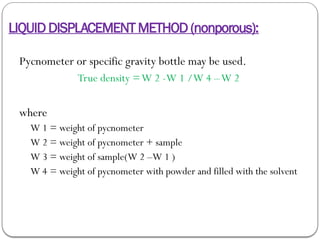
Pycnometer or specific gravity bottle may be used.
True density =W 2 -W 1 /W 4 –W 2
where
W 1 = weight of pycnometer
W 2 = weight of pycnometer + sample
W 3 = weight of sample(W 2 –W 1 )
W 4 = weight of pycnometer with powder and filled with the solvent
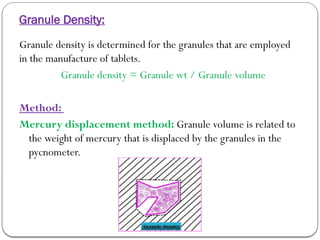
Granule Density:
Granule density is determined for the granules that are employed
in the manufacture of tablets.
Granule density = Granule wt / Granule volume
Method:
Mercury displacement method: Granule volume is related to
the weight of mercury that is displaced by the granules in the
pycnometer.
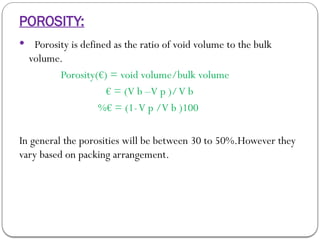
POROSITY:
 Porosity is defined as the ratio of void volume to the bulk
volume.
Porosity(€) = void volume/bulk volume
€ = (V b –V p )/V b
%€ = (1-V p /V b )100
In general the porosities will be between 30 to 50%.However they
vary based on packing arrangement.
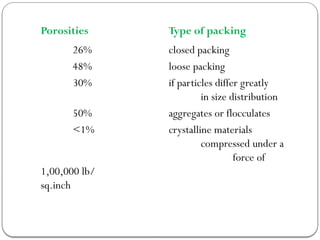
Porosities Type of packing
26% closed packing
48% loose packing
30% if particles differ greatly
in size distribution
50% aggregates or flocculates
<1% crystalline materials
compressed under a
force of
1,00,000 lb/
sq.inch
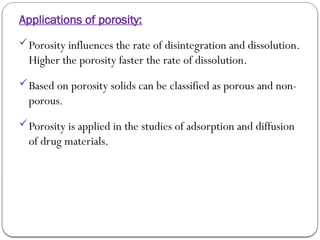
Applications of porosity:
Porosity influences the rate of disintegration and dissolution.
Higher the porosity faster the rate of dissolution.
Based on porosity solids can be classified as porous and non-
porous.
Porosity is applied in the studies of adsorption and diffusion
of drug materials.
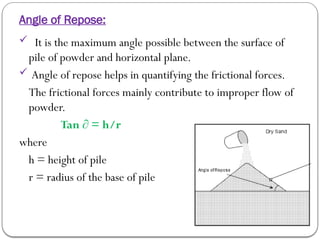
Angle of Repose:
 It is the maximum angle possible between the surface of
pile of powder and horizontal plane.
 Angle of repose helps in quantifying the frictional forces.
The frictional forces mainly contribute to improper flow of
powder.
Tan ∂ = h/r
where
h = height of pile
r = radius of the base of pile
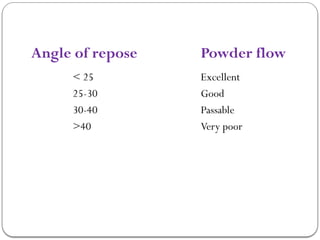
Angle of repose Powder flow
< 25 Excellent
25-30 Good
30-40 Passable
>40 Very poor
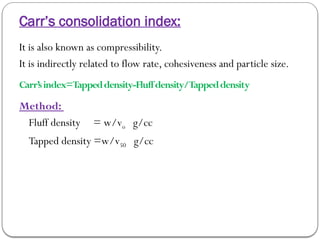
Carr’s consolidation index:
It is also known as compressibility.
It is indirectly related to flow rate, cohesiveness and particle size.
Carr’sindex=Tappeddensity-Fluffdensity/Tappeddensity
Method:
Fluff density = w/vo g/cc
Tapped density =w/v50 g/cc
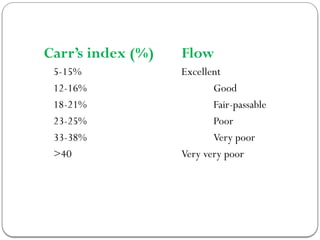
Carr’s index (%) Flow
5-15% Excellent
12-16% Good
18-21% Fair-passable
23-25% Poor
33-38% Very poor
>40 Very very poor
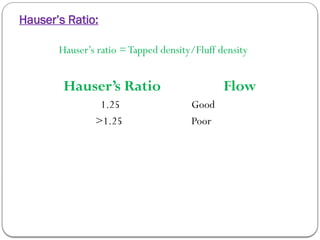
Hauser’s Ratio:
Hauser’s ratio =Tapped density/Fluff density
Hauser’s Ratio Flow
1.25 Good
>1.25 Poor
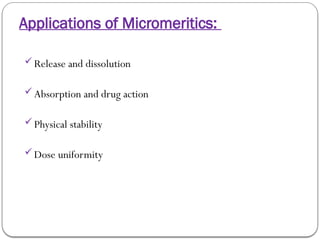
Applications of Micromeritics:
Release and dissolution
Absorption and drug action
Physical stability
Dose uniformity
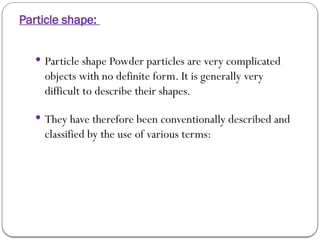
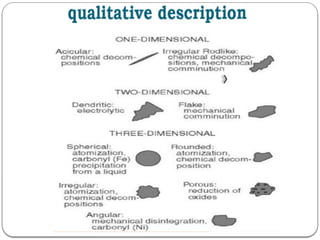
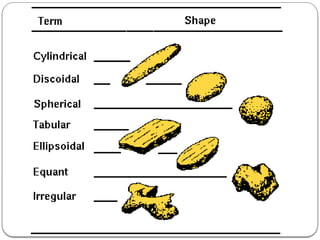
Particle shape:
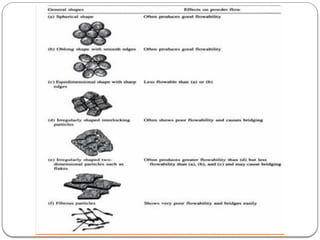
 Particle shape Powder particles are very complicated
objects with no definite form. It is generally very
difficult to describe their shapes.
 They have therefore been conventionally described and
classified by the use of various terms:
Why is studying particle shape so important?
 Particle shape is important because it can influence many
critical powder properties such as:
 the powder flow ability , compatibility, content uniformity,
dissolution, drug release, bioavailabdity, and stability; these
factors ultimately affect the safety and efficacy of a dosage
form .
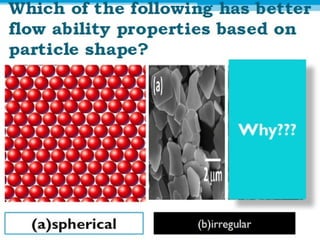
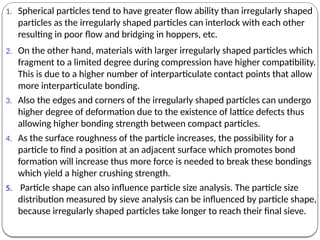
1. Spherical particles tend to have greater flow ability than irregularly shaped
particles as the irregularly shaped particles can interlock with each other
resulting in poor flow and bridging in hoppers, etc.
2. On the other hand, materials with larger irregularly shaped particles which
fragment to a limited degree during compression have higher compatibility.
This is due to a higher number of interparticulate contact points that allow
more interparticulate bonding.
3. Also the edges and corners of the irregularly shaped particles can undergo
higher degree of deformation due to the existence of lattice defects thus
allowing higher bonding strength between compact particles.
4. As the surface roughness of the particle increases, the possibility for a
particle to find a position at an adjacent surface which promotes bond
formation will increase thus more force is needed to break these bondings
which yield a higher crushing strength.
5. Particle shape can also influence particle size analysis. The particle size
distribution measured by sieve analysis can be influenced by particle shape,
because irregularly shaped particles take longer to reach their final sieve.
5.Micromeritics-physical pharmacy 1.pptx

5.Micromeritics-physical pharmacy 1.pptx

  • 2.
    What is Micromeritics? TheScience andTechnology of small particles is known as Micromeritics. Micromeritics deals with-  Particle size and Size Distribution  Methods of Determining particles size  Particle shape and surface area  Pore size  Angle of repose
  • 3.
    Importance of Studyof Micromeritics: Knowledge and control of the size and the size range of particle is of profound importance in pharmacy. Size and surface area can be related to the physical, chemical and pharmacological properties of a drug. 1. Particle size affect its release from dosage forms that are administered orally, parenterally, rectally and topically 2. Physical stability and pharmacologic response of suspensions, emulsion and tablets depends on particle size.
  • 4.
    3. It isalso important in flow properties and proper mixing of granules and powders in tableting. 4. Both Tablets and capsules are produced using equipments which controls the mass of drug and other particles by volumetric filling. Therefore any interference with the uniformity of fill, volumes may alter the mass of drug incorporated into the tablet or capsules. Thus reduce the uniformity of the medicine. 5. Powders with different particle sizes have different flow and packing properties which alter the volumes of powder during each encapsulation or tablet compression.
  • 5.
    6. The rateof solution depends on the several factors. One factor is the particle size.Thus particles having small dimensions will tend to increase the rate of solution. For example: a) Griseofulvin has a low solubility after oral administration but is rapidly distributed following absorption. The solubility of Griseofulvin can be greatly increased by particle size reduction. b) Reduction of particles size also increase the rate of absorption of tetracycline, aspirin and sulphonamides. c) Reduction of particle size of nitrofurantoin increases the rate of absorption.Therefore toxic effects results due to rapid absorption.
  • 6.
     Before beingused in the preparation of pharmaceuticals, solid materials are first characterized to determine their chemical and physical features, including; morphology, purity, solubility, flow ability, stability, particle size/ size distribution and compatibility with any other formulation components .
  • 7.
    Different means ofexpressing particle size.: There are different means of expressing particle size: Millimeter (mm) ………. 10 -3 meter Micro meter ( µ m) ...…. 10 -6 meter nano meter (nm)………. 10 -9 meter pico meter …………..… 10 -12 meter femto meter………..…...10 -15 meter Particle Dimension in Pharmaceutical Disperse system Particle size Micrometer (µm) Millimeter (mm) Disperse systems 0.5- 10 0.0005 - 0.01 Suspension, fine emulsion 10 - 50 0.01 - 0.05 Coarse emulsion, flocculated suspension 50 - 100 0.50 - 0.100 Lower range of sieve, fine powder range 50-1000 0.150 - 1.000 Coarse powder range 1000- 3360 1.000 - 3.360 Average granule size
  • 8.
    Methods of determiningparticle size:  Optical Microscopy  Sieving Methods  Sedimentation Methods Particle volume measurement:  Coulter Counter Method (Electrical stream sensing method)  Laser light scattering methods. Methods of determining surface area:  Adsorption method  Air permeability method
  • 9.
     Nature ofthe material to be sized, e.g. estimated particle size and particle size range solubility ease of handling toxicity flow ability intended use  Cost capital running  Specification requirements  Time restrictions Choosing a method for particle sizing
  • 10.
    Sieving Method: Sieving methodis an ordinary and simple method. It is widely used as a method for the particle size analysis. Range of analysis: The International Standards organization (ISO) sets a lowest sieve diameter of 45 µm and since powders are usually defined as having a maximum diameter of 1000 µm, this could be considered to be the upper limit. In practice sieves can be obtained for size analysis over a range from 5 to 125,000 µm.  Sieves can be referred to either by their aperture size or by their mesh size (or sieve number).  The mesh size is the number of wires per linear inch.
  • 11.
     Sieve analysisis usually carried out using dry powders.  Although, for powders in liquid suspension or which agglomerate during dry sieving, a process of wet sieving can be used.
  • 12.
    Principle of Measurement: Sieveanalysis utilizes a woven, punched or electroformed mesh often in brass, bronze or stainless steel with known aperture (hole) diameters which form a physical barrier to particles. Most sieve analysis utilize a series, stack ( Load /Mountain or nest (layer) of sieves which have the smallest mesh above a collector tray followed by meshes which get progressively coarser towards the top of the series.
  • 13.
    Powder is loadedon to the coarsest sieve of the assembled stack and the nest is subjected to mechanical vibration for, say 20 minutes. After this time, the particles are considered to be retained on the sieve mesh with an aperture corresponding to the minimum or sieve diameter. A sieving time of 20 minutes is arbitrary and BS 1796 recommends sieving to be continued until less than 0.2% material passes a given sieve aperture in any 5 minutes interval Advantages : 1.This method is very simple. 2. Not expensive 3. Easy to operate Disadvantages : 1. Not too much precise method. 2 . Not applicable for all disperse systems.
  • 14.
    Commonly used USStandard sieve numbers and openings  No. 4 sieve opening = 4.75 mm  No. 10 sieve opening = 2.00 mm  No. 20 sieve opening = 0.85 mm  No. 40 sieve opening = 0.425 mm  No. 60 sieve opening = 0.25 mm  No. 100 sieve opening = 0.15 mm  No. 140 sieve opening = 0.106 mm  No. 200 sieve opening = 0.075 mm
  • 15.
    British PharmacopoeiaVolume IV AppendixXVII A. Particle Size of Powders Particle size classification of powders (Ph. Eur. method 2.9.12, Sieve test) The degree of fineness of a powder may be expressed by reference to sieves that comply with the specifications for non-analytical sieves (2.1.4). Where the degree of fineness of powders is determined by sieving, it is defined in relation to the sieve number(s) used either by means of the following terms or, where such terms cannot be used, by expressing the fineness of the powder as a percentage m/m passing the sieve(s) used. The following terms are used in the description of powders: Coarse powder: Not less than 95% by mass passes through a number 1400 sieve and not more than 40 % by mass passes through a number 355 sieve. Moderately fine powder: Not less than 95% by mass passes through a number 355 sieve and not more than 40% by mass passes through a number 180 sieve. Fine powder: Not less than 95% by mass passes through a number 180 sieve and not more than 40% by mass passes through a number 125 sieve.
  • 16.
    United States Pharmacopeia GeneralChapters: <811> POWDER FINENESS Classification of Powders by Fineness Classification of Powder d50 Sieve Opening (µm) Very Coarse > 1000 Coarse 355–1000 Moderately Fine 180–355 Fine 125–180 Very Fine 90–125 d50= smallest sieve opening through which 50% or more of the material passes
  • 17.
    Sedimentation Methods Sedimentation Methodis also an ordinary and simple method. It is widely used as a method for the particle size analysis. Range of analysis:
  • 18.
    Sample preparation andanalysis conditions In this method particle size can be determined by examining the powder as it sediments out. a) In cases where the powder is not uniformly dispersed in a fluid it can be introduced as a thin layer on the surface of the liquid. b) If the powder is lyophobic, e.g. hydrophobic in water , it may be necessary to add dispersing agent to aid wetting of the powder. c) In case where the powder is soluble in water it will be necessary to use non-aqueous liquids or carry out the analysis in a gas.
  • 19.
    Principle of Measurement Particlesize analysis by sedimentation method can be divided into two main categories according to the method of measurement used.  One of the type is based on measurement of particle in a retention zone.  Another type uses a non-retention measurement zone. An example of a non-retention zone measurement is known as the pipette method. In this method , known volumes of suspension are drawn off and the concentration differences are measured with respect to time. One of the most popular of the pipette methods was that developed by Andreasen and Lundberg and commonly called the Andreasen pipette.
  • 20.
  • 21.
    TheAndreasen fixed-position pipetteconsists of a 200 mm graduate cylinder which can hold about 500 ml of suspension fluid. A pipette is located centrally in the cylinder and is held in position by a ground glass stopper so that its tip coincides with the zero level. A three way tap allows fluid to be drawn into a 10 ml reservoir which can then be emptied into a beaker or centrifuge tube. The amount of powder can be determined by weight following drying or centrifuging. The weight of each sample residue is therefore called the weight of undersize and the sum of the successive weight is known as the cumulative weight of undersize. It can be expressed directly in weight units or percent of the total weight of the final sediment. The data of cumulative weight of undersize is used for the determination of particle weight distribution, number distribution.
  • 22.
    The largest particlediameter in each sample is then calculated from Strokes’ Law. The particle size may be obtained by gravity sedimentation as expressed in Strokes’ law. Where ,  v = rate of settling  h = Distance of the fall in time , t  dst = the mean diameter of the particles based on the velocity of sedimentation  ρs = density of the particles  ρo = density of the dispersion medium  g =Acceleration due to gravity  ηo=Viscosity of the medium Note:The question holds spheres falling freely without hindrance and at a constant rate.
  • 23.
    Coulter Counter Method(Electrical stream sensing zone method):  Coulter Counter Method (Electrical stream sensing zone method) is a sophisticated method. It is a precise and accurate method. Range of analysis:
  • 24.
    Sample preparation andanalysis conditions 1. Powder samples are dispersed in an electrolyte to form a very dilute suspension. 2. The suspension is usually subjected to ultrasonic agitation for a period to break up any particle agglomerates. 3. A dispersant may also be added to aid particle deagglomeration. 4. A typical Coulter counter has one or more micro channels that separate two chambers containing electrolyte solutions.As fluid containing particles or cells is drawn through each micro channel, each particle causes a brief change to the electrical resistance of the liquid.The counter detects these changes in electrical resistance that is proportional to the volume of the particle passing the orifice. Advantages : 1. It is one of the precise and accurate method. 2.Analysis range is wide. Disadvantages: 1 . It is a sophisticated method. 2. It is a expensive method .
  • 25.
  • 26.
    Laser light scatteringmethods. Light scattering is measured by two different instruments  Classical Light Scattering / Static Light Scattering : Here, the intensity of the scattered light is measured as a function of angle  Dynamic Light Scattering (DLS): Dynamic light scattering (DLS), sometimes referred to as Quasi-Elastic Light Scattering (QELS), is a non-invasive, well-established technique for measuring the size and size distribution of molecules and particles typically in the submicron region, and with the latest technology lower than 1nm. Typical applications of dynamic light scattering are the characterization of particles, emulsions or molecules, which have been dispersed or dissolved in a liquid. The Brownian motion of particles or molecules in suspension causes laser light to be scattered at different intensities. Analysis of these intensity fluctuations yields the velocity of the Brownian motion and hence the particle size using the Stokes-Einstein relationship.
  • 28.
    Bulk Density: Bulk density= mass of powder/Bulk volume Bulk density depends primarily on particle size distribution, particle shape and tendency of particles to adhere together. Based on bulk density powders are classified as:  Heavy – high bulk density(low bulk volume)  Light - Low bulk density( high bulk volume)
  • 29.
    APPLICATIONS:  To checkthe uniformity of bulk chemicals(Quality control measures)  Determination of size of capsule for a given dose of material.(higher the bulk volume ,lower will be bulk density and bigger the size of capsule)  It helps in selecting the proper size of a container, packing material, mixing apparatus in the production of tablets and capsules.
  • 30.
    TRUE DENSITY: It isthe density of the material itself. True density= weight of powder/True volume of powder True volume is the volume obtained excluding the void volume and intra particle pores
  • 31.
    METHODS:  GAS DISPLACMENTMETHOD(Porous):  In this method helium pycnometer is used to determine the true volume from the equation- Vt Vc is the volume of the empty sample chamber (known from a prior calibration step), Vr is the volume of the reference volume (again known from a prior calibration step), P1 is the first pressure (i.e. in the sample chamber only) and P2 is the second (lower) pressure after expansion of the gas into the combined volumes of sample chamber and reference chamber. By substituting this Vt and true weight of the sample in the equation we can determine the true density.
  • 32.
    LIQUID DISPLACEMENT METHOD(nonporous): Pycnometer or specific gravity bottle may be used. True density =W 2 -W 1 /W 4 –W 2 where W 1 = weight of pycnometer W 2 = weight of pycnometer + sample W 3 = weight of sample(W 2 –W 1 ) W 4 = weight of pycnometer with powder and filled with the solvent
  • 33.
    Granule Density: Granule densityis determined for the granules that are employed in the manufacture of tablets. Granule density = Granule wt / Granule volume Method: Mercury displacement method: Granule volume is related to the weight of mercury that is displaced by the granules in the pycnometer.
  • 34.
    POROSITY:  Porosity isdefined as the ratio of void volume to the bulk volume. Porosity(€) = void volume/bulk volume € = (V b –V p )/V b %€ = (1-V p /V b )100 In general the porosities will be between 30 to 50%.However they vary based on packing arrangement.
  • 35.
    Porosities Type ofpacking 26% closed packing 48% loose packing 30% if particles differ greatly in size distribution 50% aggregates or flocculates <1% crystalline materials compressed under a force of 1,00,000 lb/ sq.inch
  • 36.
    Applications of porosity: Porosityinfluences the rate of disintegration and dissolution. Higher the porosity faster the rate of dissolution. Based on porosity solids can be classified as porous and non- porous. Porosity is applied in the studies of adsorption and diffusion of drug materials.
  • 37.
    Angle of Repose: It is the maximum angle possible between the surface of pile of powder and horizontal plane.  Angle of repose helps in quantifying the frictional forces. The frictional forces mainly contribute to improper flow of powder. Tan ∂ = h/r where h = height of pile r = radius of the base of pile
  • 38.
    Angle of reposePowder flow < 25 Excellent 25-30 Good 30-40 Passable >40 Very poor
  • 39.
    Carr’s consolidation index: Itis also known as compressibility. It is indirectly related to flow rate, cohesiveness and particle size. Carr’sindex=Tappeddensity-Fluffdensity/Tappeddensity Method: Fluff density = w/vo g/cc Tapped density =w/v50 g/cc
  • 40.
    Carr’s index (%)Flow 5-15% Excellent 12-16% Good 18-21% Fair-passable 23-25% Poor 33-38% Very poor >40 Very very poor
  • 41.
    Hauser’s Ratio: Hauser’s ratio=Tapped density/Fluff density Hauser’s Ratio Flow 1.25 Good >1.25 Poor
  • 42.
    Applications of Micromeritics: Releaseand dissolution Absorption and drug action Physical stability Dose uniformity
  • 43.
    Particle shape:  Particleshape Powder particles are very complicated objects with no definite form. It is generally very difficult to describe their shapes.  They have therefore been conventionally described and classified by the use of various terms:
  • 45.
    Why is studyingparticle shape so important?  Particle shape is important because it can influence many critical powder properties such as:  the powder flow ability , compatibility, content uniformity, dissolution, drug release, bioavailabdity, and stability; these factors ultimately affect the safety and efficacy of a dosage form .
  • 47.
    1. Spherical particlestend to have greater flow ability than irregularly shaped particles as the irregularly shaped particles can interlock with each other resulting in poor flow and bridging in hoppers, etc. 2. On the other hand, materials with larger irregularly shaped particles which fragment to a limited degree during compression have higher compatibility. This is due to a higher number of interparticulate contact points that allow more interparticulate bonding. 3. Also the edges and corners of the irregularly shaped particles can undergo higher degree of deformation due to the existence of lattice defects thus allowing higher bonding strength between compact particles. 4. As the surface roughness of the particle increases, the possibility for a particle to find a position at an adjacent surface which promotes bond formation will increase thus more force is needed to break these bondings which yield a higher crushing strength. 5. Particle shape can also influence particle size analysis. The particle size distribution measured by sieve analysis can be influenced by particle shape, because irregularly shaped particles take longer to reach their final sieve.