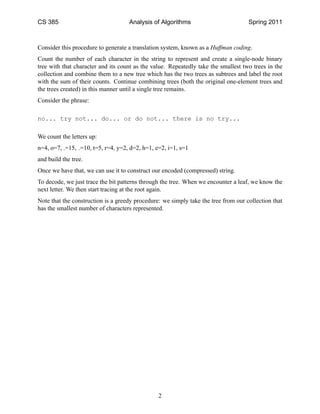
This document provides an overview of Huffman codes, which are a type of variable-length encoding that assigns binary codewords to characters based on their frequency. It explains that Huffman codes are constructed by building a binary tree from the character frequencies, with the most frequent at the top and least at the bottom. The codewords are then generated by tracing a path from the root to each leaf node. This allows more frequent characters to have shorter codewords, compressing the data size. An example of constructing a Huffman code tree from character counts in a sample text is also given.