Rejil Rajan
Wintz was a leader of the
Erlangen school, where it was
believed that fractionated
treatment was decisively inferior,
to be judged a "primitive method"
and "weak irradiation."
single
Popularised by Gosta
Forsell
Stockholm
method
Fractionated treatments becoming more popular than hypofractionated ,
And it was almost abandoned across world as curative treatment
 In the early 1950s, the comeback of hypofractionation started quietly and came
from Stockholm, the city where hypofractionation was first championed by Forsell
50 years previously.
 Lars Leksell. Leksell had-“stereotaxy.”
 Working with a radiation physicist, Borge Larsson, they created the first Gamma
Knife (Elekta AB, Stockholm, Sweden).
 High dose per fraction = High cell kill
 High dose per fraction = Increase late effects
 But always was preferred in palliative setting - because of
logistic reasons
But as we understand radiobiology better, hypofractionation is
back For the tumors with low α/β ratio like Prostate cancer
where it is Seen that prostate cancer cell are sensitive to dose
per fraction.
Interest also because of the newer conformal techniques like
stereotactic treatments, IMRT have emerged where the
chance of irradiating normal tissues with high dose per
fraction is less.
Tumour
control
Late
adverse
effects
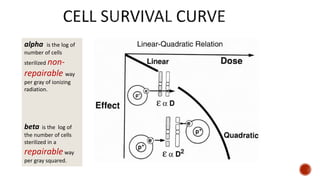
alpha is the log of
number of cells
sterilized non-
repairable way
per gray of ionizing
radiation.
beta is the log of
the number of cells
sterilized in a
repairableway
per gray squared.
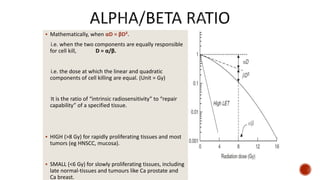
 Mathematically, when αD = βD².
i.e. when the two components are equally responsible
for cell kill, D = α/β.
i.e. the dose at which the linear and quadratic
components of cell killing are equal. (Unit = Gy)
It is the ratio of “intrinsic radiosensitivity” to “repair
capability” of a specified tissue.
 HIGH (>8 Gy) for rapidly proliferating tissues and most
tumors (eg HNSCC, mucosa).
 SMALL (<6 Gy) for slowly proliferating tissues, including
late normal-tissues and tumours like Ca prostate and
Ca breast.
RADIOBIOLOGY
 Assumption of better tumour control.
 Alpha/beta-3-5
LOGISTICS
 Logistic advantages.
 Economic favourability.
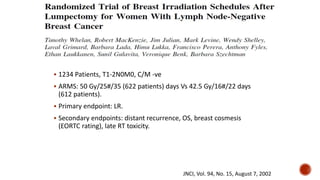
 1234 Patients, T1-2N0M0, C/M -ve
 ARMS: 50 Gy/25#/35 (622 patients) days Vs 42.5 Gy/16#/22 days
(612 patients).
 Primary endpoint: LR.
 Secondary endpoints: distant recurrence, OS, breast cosmesis
(EORTC rating), late RT toxicity.
JNCI, Vol. 94, No. 15, August 7, 2002
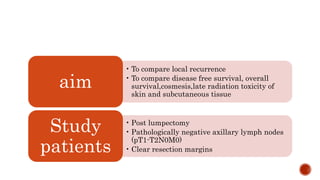
• To compare local recurrence
• To compare disease free survival, overall
survival,cosmesis,late radiation toxicity of
skin and subcutaneous tissue
aim
• Post lumpectomy
• Pathologically negative axillary lymph nodes
(pT1-T2N0M0)
• Clear resection margins
Study
patients
1234 Patients
50Gy/25#/35
days
42.5Gy/16#/22
days
JNCI, Vol. 94, No. 15, August 7, 2002
DFS, p=0.37
DFS, p=0.37 OS, p=0.78
JNCI, Vol. 94, No. 15, August 7, 2002
Excellent to good cosmetic
outcome at 3 yrs and 5yrs
 76.8% (SA) Vs 77.0%(LA)
 76.8% (SA) Vs 77.4%(LA)
JNCI, Vol. 94, No. 15, August 7, 2002
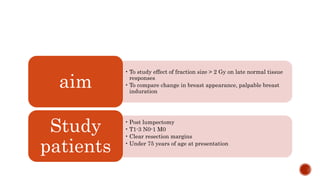
• To study effect of fraction size > 2 Gy on late normal tissue
responses
• To compare change in breast appearance, palpable breast
induration
aim
• Post lumpectomy
• T1-3 N0-1 M0
• Clear resection margins
• Under 75 years of age at presentation
Study
patients
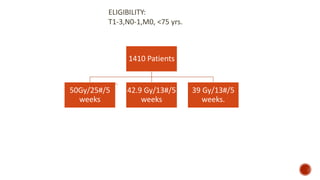
ELIGIBILITY:
T1-3,N0-1,M0, <75 yrs.
1410 Patients
50Gy/25#/5
weeks
42.9 Gy/13#/5
weeks
39 Gy/13#/5
weeks.
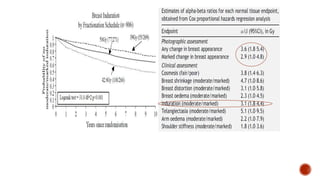
After a minimum 5-year follow up, the risk of scoring any
change in breast appearance after 50 Gy/25 F, 39 Gy/13 F
and 42.9 Gy/13 F was 39.6, 30.3 and 45.7%, from which
an alpha/beta value of 3.6 Gy (95% CI 1.8-5.4) is
estimated.
P=0.01
P=0.05
P=0.01
P=0.18
After a median follow-up of 9.7 years for the 838
(95%) patients who survived, the risk of ipsilateral tumour
relapse after 10 years was 12.1% (95% CI 8.8-15.5) in the
50 Gy group, 14.8% (11.2-18.3) in the 39 Gy group, and
9.6% (6.7-12.6) in the 42.9 Gy group(difference between
39 Gy and 42.9 Gy groups, chi2 test, p=0.027)
Lancet Oncol 2008; 9: 331–41
•To measure the sensitivity of normal and malignant tissues to fraction
size
•To compare loco-regional relapse, distant relapse,disease free survival,
overall survival, late normal tissue effects, quality of life
aim
•Post lumpectomy/post mastectomy
•pT1-3 N0-1 M0
•Clear resection margins
•> 18 years
•No immediate surgical reconstruction
Study
patients
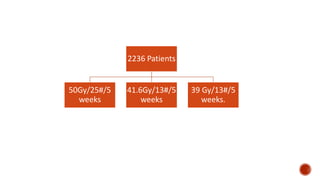
2236 Patients
50Gy/25#/5
weeks
41.6Gy/13#/5
weeks
39 Gy/13#/5
weeks.
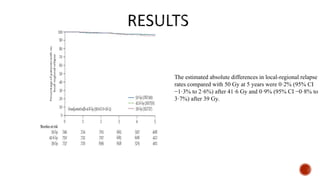
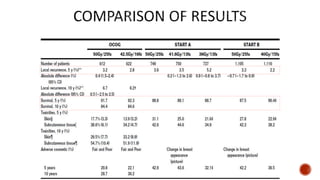
The estimated absolute differences in local-regional relapse
rates compared with 50 Gy at 5 years were 0·2% (95% CI
−1·3% to 2·6%) after 41·6 Gy and 0·9% (95% CI −0·8% to
3·7%) after 39 Gy.
P=0.01
P=0.62
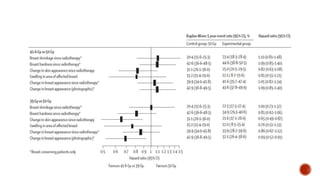
 LRR: estimated maximum 2.1% and 3.2% excess risk with 41.6 Gy and 39 Gy compared with
50 Gy.
 DFS, OS not significantly different.
 Cosmesis: 39 Gy/13# more favourable.
 a/b for LR relapse: 4.8 Gy (CI 0-16.3).
 a/b for change in breast appearance: 3.1 Gy (CI 1.6-4.6).
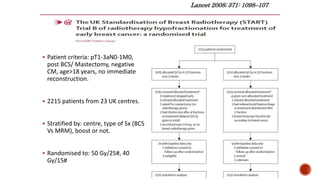
 Patient criteria: pT1-3aN0-1M0,
post BCS/ Mastectomy, negative
CM, age>18 years, no immediate
reconstruction.
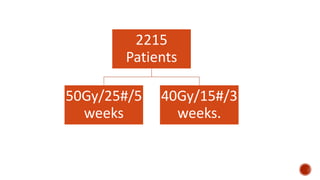
 2215 patients from 23 UK centres.
 Stratified by: centre, type of Sx (BCS
Vs MRM), boost or not.
 Randomised to: 50 Gy/25#, 40
Gy/15#
Lancet 2008; 371: 1098–107
•To compare loco-regional relapse, distant relapse,disease free survival,
overall survival, late normal tissue effects, quality of lifeaim
•Post lumpectomy/post mastectomy
•pT1-3 N0-1 M0
•Clear resection margins
•> 18 years
•No immediate surgical reconstruction
Study
patients
2215
Patients
50Gy/25#/5
weeks
40Gy/15#/3
weeks.
Lancet 2008; 371: 1098–107
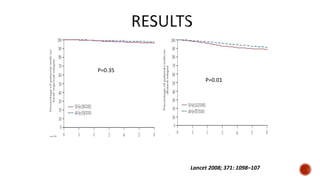
P=0.01
P=0.35
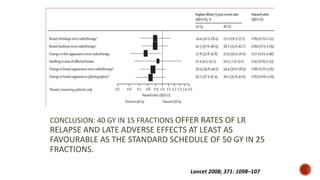
CONCLUSION: 40 GY IN 15 FRACTIONS OFFER RATES OF LR
RELAPSE AND LATE ADVERSE EFFECTS AT LEAST AS
FAVOURABLE AS THE STANDARD SCHEDULE OF 50 GY IN 25
FRACTIONS.
Lancet 2008; 371: 1098–107
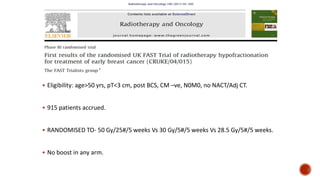
 Eligibility: age>50 yrs, pT<3 cm, post BCS, CM –ve, N0M0, no NACT/Adj CT.
 915 patients accrued.
 RANDOMISED TO- 50 Gy/25#/5 weeks Vs 30 Gy/5#/5 weeks Vs 28.5 Gy/5#/5 weeks.
 No boost in any arm.
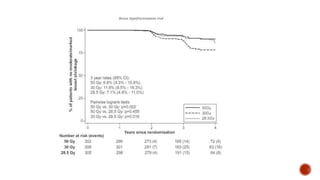
CONCLUSION:
 At 3years median follow-up, 28.5Gy
in 5 fractions is comparable to 50Gy
in 25 fractions, and significantly
milder than 30Gy in 5 fractions, in
terms of adverse effects in the
breast.
Radiotherapy and oncology 2011
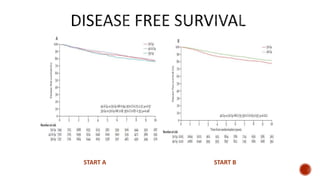
START A START B
START A START B
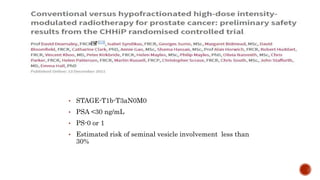
• STAGE-T1b-T3aN0M0
• PSA <30 ng/mL
• PS-0 or 1
• Estimated risk of seminal vesicle involvement less than
30%
450 Patients
74Gy/37#/7.4weeks 60 Gy/20#/4 weeks
57 Gy/19#/3.8
weeks.
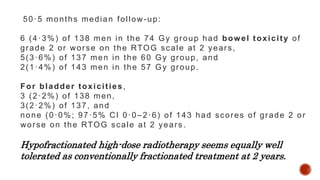
50·5 months median follow-up:
6 (4·3%) of 138 men in the 74 Gy group had bowel toxicity of
grade 2 or worse on the RTOG scale at 2 years,
5(3·6%) of 137 men in the 60 Gy group, and
2(1·4%) of 143 men in the 57 Gy group.
For bladder toxicities,
3 (2·2%) of 138 men,
3(2·2%) of 137, and
none (0·0%; 97·5% CI 0·0–2·6) of 143 had scores of grade 2 or
worse on the RTOG scale at 2 years .
Hypofractionated high-dose radiotherapy seems equally well
tolerated as conventionally fractionated treatment at 2 years.
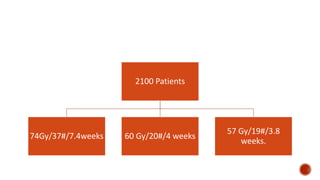
 Same patient characteristics as previous CHHiP TRIAL
2100 Patients
74Gy/37#/7.4weeks 60 Gy/20#/4 weeks
57 Gy/19#/3.8
weeks.
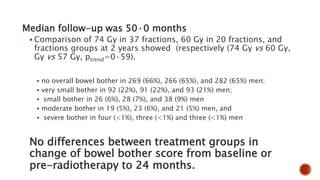
Median follow-up was 50·0 months
 Comparison of 74 Gy in 37 fractions, 60 Gy in 20 fractions, and
fractions groups at 2 years showed (respectively (74 Gy vs 60 Gy,
Gy vs 57 Gy, ptrend=0·59).
 no overall bowel bother in 269 (66%), 266 (65%), and 282 (65%) men;
 very small bother in 92 (22%), 91 (22%), and 93 (21%) men;
 small bother in 26 (6%), 28 (7%), and 38 (9%) men
 moderate bother in 19 (5%), 23 (6%), and 21 (5%) men, and
 severe bother in four (<1%), three (<1%) and three (<1%) men
No differences between treatment groups in
change of bowel bother score from baseline or
pre-radiotherapy to 24 months.
The incidence of patient-reported bowel symptoms was low
and similar between patients in the 74 Gy control group
and the hypofractionated groups up to 24 months after
radiotherapy.
 Intermediate-risk or high-risk patients aged between 44 and 85 years
 Stage T1b–T4 NX-0MX-0
 PSA concentration of 60 ng/mL or lower
 WHO performance status of 0–2
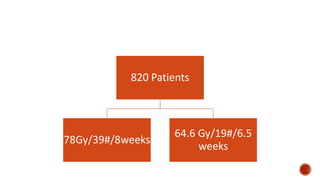
820 Patients
78Gy/39#/8weeks
64.6 Gy/19#/6.5
weeks
median follow-up was 60 months
 The incidence of grade 2 or worse genitourinary toxicity at 3 years was 39·0%
(95% CI 34·2-44·1) in the standard fractionation group and 41·3% (36·6-46·4) in
the hypofractionation group
 The incidence of grade 2 or worse gastrointestinal toxicity at 3 years was 17·7%
(14·1-21·9) in standard fractionation and 21·9% (18·1-26·4) hypofractionation.
 Cumulative grade 3 or worse late genitourinary toxicity was significantly higher
in the hypofractionation group than in the standard fractionation group (19·0%
[95% CI 15·2-23·2] vs 12·9% [9·7-16·7], p=0·021
 no significant difference between cumulative grade 3 or worse late
gastrointestinal toxicity (2·6% [95% CI 1·2-4·7]) in the standard fractionation
group and 3·3% [1·7-5·6] in the hypofractionation group; p=0·55).
HYPOFRACTIONATION IN RADIOTHERAPY

HYPOFRACTIONATION IN RADIOTHERAPY

  • 1.
  • 4.
    Wintz was aleader of the Erlangen school, where it was believed that fractionated treatment was decisively inferior, to be judged a "primitive method" and "weak irradiation." single
  • 5.
  • 6.
    Fractionated treatments becomingmore popular than hypofractionated , And it was almost abandoned across world as curative treatment
  • 8.
     In theearly 1950s, the comeback of hypofractionation started quietly and came from Stockholm, the city where hypofractionation was first championed by Forsell 50 years previously.  Lars Leksell. Leksell had-“stereotaxy.”  Working with a radiation physicist, Borge Larsson, they created the first Gamma Knife (Elekta AB, Stockholm, Sweden).
  • 9.
     High doseper fraction = High cell kill  High dose per fraction = Increase late effects  But always was preferred in palliative setting - because of logistic reasons But as we understand radiobiology better, hypofractionation is back For the tumors with low α/β ratio like Prostate cancer where it is Seen that prostate cancer cell are sensitive to dose per fraction. Interest also because of the newer conformal techniques like stereotactic treatments, IMRT have emerged where the chance of irradiating normal tissues with high dose per fraction is less. Tumour control Late adverse effects
  • 10.
    alpha is thelog of number of cells sterilized non- repairable way per gray of ionizing radiation. beta is the log of the number of cells sterilized in a repairableway per gray squared.
  • 11.
     Mathematically, whenαD = βD². i.e. when the two components are equally responsible for cell kill, D = α/β. i.e. the dose at which the linear and quadratic components of cell killing are equal. (Unit = Gy) It is the ratio of “intrinsic radiosensitivity” to “repair capability” of a specified tissue.  HIGH (>8 Gy) for rapidly proliferating tissues and most tumors (eg HNSCC, mucosa).  SMALL (<6 Gy) for slowly proliferating tissues, including late normal-tissues and tumours like Ca prostate and Ca breast.
  • 13.
    RADIOBIOLOGY  Assumption ofbetter tumour control.  Alpha/beta-3-5 LOGISTICS  Logistic advantages.  Economic favourability.
  • 15.
     1234 Patients,T1-2N0M0, C/M -ve  ARMS: 50 Gy/25#/35 (622 patients) days Vs 42.5 Gy/16#/22 days (612 patients).  Primary endpoint: LR.  Secondary endpoints: distant recurrence, OS, breast cosmesis (EORTC rating), late RT toxicity. JNCI, Vol. 94, No. 15, August 7, 2002
  • 16.
    • To comparelocal recurrence • To compare disease free survival, overall survival,cosmesis,late radiation toxicity of skin and subcutaneous tissue aim • Post lumpectomy • Pathologically negative axillary lymph nodes (pT1-T2N0M0) • Clear resection margins Study patients
  • 17.
  • 18.
    JNCI, Vol. 94,No. 15, August 7, 2002
  • 19.
    DFS, p=0.37 DFS, p=0.37OS, p=0.78 JNCI, Vol. 94, No. 15, August 7, 2002
  • 20.
    Excellent to goodcosmetic outcome at 3 yrs and 5yrs  76.8% (SA) Vs 77.0%(LA)  76.8% (SA) Vs 77.4%(LA) JNCI, Vol. 94, No. 15, August 7, 2002
  • 22.
    • To studyeffect of fraction size > 2 Gy on late normal tissue responses • To compare change in breast appearance, palpable breast induration aim • Post lumpectomy • T1-3 N0-1 M0 • Clear resection margins • Under 75 years of age at presentation Study patients
  • 23.
    ELIGIBILITY: T1-3,N0-1,M0, <75 yrs. 1410Patients 50Gy/25#/5 weeks 42.9 Gy/13#/5 weeks 39 Gy/13#/5 weeks.
  • 24.
    After a minimum5-year follow up, the risk of scoring any change in breast appearance after 50 Gy/25 F, 39 Gy/13 F and 42.9 Gy/13 F was 39.6, 30.3 and 45.7%, from which an alpha/beta value of 3.6 Gy (95% CI 1.8-5.4) is estimated. P=0.01 P=0.05 P=0.01 P=0.18
  • 26.
    After a medianfollow-up of 9.7 years for the 838 (95%) patients who survived, the risk of ipsilateral tumour relapse after 10 years was 12.1% (95% CI 8.8-15.5) in the 50 Gy group, 14.8% (11.2-18.3) in the 39 Gy group, and 9.6% (6.7-12.6) in the 42.9 Gy group(difference between 39 Gy and 42.9 Gy groups, chi2 test, p=0.027)
  • 27.
    Lancet Oncol 2008;9: 331–41
  • 28.
    •To measure thesensitivity of normal and malignant tissues to fraction size •To compare loco-regional relapse, distant relapse,disease free survival, overall survival, late normal tissue effects, quality of life aim •Post lumpectomy/post mastectomy •pT1-3 N0-1 M0 •Clear resection margins •> 18 years •No immediate surgical reconstruction Study patients
  • 29.
  • 30.
    The estimated absolutedifferences in local-regional relapse rates compared with 50 Gy at 5 years were 0·2% (95% CI −1·3% to 2·6%) after 41·6 Gy and 0·9% (95% CI −0·8% to 3·7%) after 39 Gy.
  • 33.
  • 34.
     LRR: estimatedmaximum 2.1% and 3.2% excess risk with 41.6 Gy and 39 Gy compared with 50 Gy.  DFS, OS not significantly different.  Cosmesis: 39 Gy/13# more favourable.  a/b for LR relapse: 4.8 Gy (CI 0-16.3).  a/b for change in breast appearance: 3.1 Gy (CI 1.6-4.6).
  • 35.
     Patient criteria:pT1-3aN0-1M0, post BCS/ Mastectomy, negative CM, age>18 years, no immediate reconstruction.  2215 patients from 23 UK centres.  Stratified by: centre, type of Sx (BCS Vs MRM), boost or not.  Randomised to: 50 Gy/25#, 40 Gy/15# Lancet 2008; 371: 1098–107
  • 36.
    •To compare loco-regionalrelapse, distant relapse,disease free survival, overall survival, late normal tissue effects, quality of lifeaim •Post lumpectomy/post mastectomy •pT1-3 N0-1 M0 •Clear resection margins •> 18 years •No immediate surgical reconstruction Study patients
  • 37.
  • 38.
    Lancet 2008; 371:1098–107 P=0.01 P=0.35
  • 40.
    CONCLUSION: 40 GYIN 15 FRACTIONS OFFER RATES OF LR RELAPSE AND LATE ADVERSE EFFECTS AT LEAST AS FAVOURABLE AS THE STANDARD SCHEDULE OF 50 GY IN 25 FRACTIONS. Lancet 2008; 371: 1098–107
  • 43.
     Eligibility: age>50yrs, pT<3 cm, post BCS, CM –ve, N0M0, no NACT/Adj CT.  915 patients accrued.  RANDOMISED TO- 50 Gy/25#/5 weeks Vs 30 Gy/5#/5 weeks Vs 28.5 Gy/5#/5 weeks.  No boost in any arm.
  • 46.
    CONCLUSION:  At 3yearsmedian follow-up, 28.5Gy in 5 fractions is comparable to 50Gy in 25 fractions, and significantly milder than 30Gy in 5 fractions, in terms of adverse effects in the breast. Radiotherapy and oncology 2011
  • 48.
  • 49.
  • 54.
    • STAGE-T1b-T3aN0M0 • PSA<30 ng/mL • PS-0 or 1 • Estimated risk of seminal vesicle involvement less than 30%
  • 55.
    450 Patients 74Gy/37#/7.4weeks 60Gy/20#/4 weeks 57 Gy/19#/3.8 weeks.
  • 56.
    50·5 months medianfollow-up: 6 (4·3%) of 138 men in the 74 Gy group had bowel toxicity of grade 2 or worse on the RTOG scale at 2 years, 5(3·6%) of 137 men in the 60 Gy group, and 2(1·4%) of 143 men in the 57 Gy group. For bladder toxicities, 3 (2·2%) of 138 men, 3(2·2%) of 137, and none (0·0%; 97·5% CI 0·0–2·6) of 143 had scores of grade 2 or worse on the RTOG scale at 2 years . Hypofractionated high-dose radiotherapy seems equally well tolerated as conventionally fractionated treatment at 2 years.
  • 57.
     Same patientcharacteristics as previous CHHiP TRIAL
  • 58.
    2100 Patients 74Gy/37#/7.4weeks 60Gy/20#/4 weeks 57 Gy/19#/3.8 weeks.
  • 59.
    Median follow-up was50·0 months  Comparison of 74 Gy in 37 fractions, 60 Gy in 20 fractions, and fractions groups at 2 years showed (respectively (74 Gy vs 60 Gy, Gy vs 57 Gy, ptrend=0·59).  no overall bowel bother in 269 (66%), 266 (65%), and 282 (65%) men;  very small bother in 92 (22%), 91 (22%), and 93 (21%) men;  small bother in 26 (6%), 28 (7%), and 38 (9%) men  moderate bother in 19 (5%), 23 (6%), and 21 (5%) men, and  severe bother in four (<1%), three (<1%) and three (<1%) men No differences between treatment groups in change of bowel bother score from baseline or pre-radiotherapy to 24 months.
  • 60.
    The incidence ofpatient-reported bowel symptoms was low and similar between patients in the 74 Gy control group and the hypofractionated groups up to 24 months after radiotherapy.
  • 61.
     Intermediate-risk orhigh-risk patients aged between 44 and 85 years  Stage T1b–T4 NX-0MX-0  PSA concentration of 60 ng/mL or lower  WHO performance status of 0–2
  • 62.
  • 63.
    median follow-up was60 months  The incidence of grade 2 or worse genitourinary toxicity at 3 years was 39·0% (95% CI 34·2-44·1) in the standard fractionation group and 41·3% (36·6-46·4) in the hypofractionation group  The incidence of grade 2 or worse gastrointestinal toxicity at 3 years was 17·7% (14·1-21·9) in standard fractionation and 21·9% (18·1-26·4) hypofractionation.  Cumulative grade 3 or worse late genitourinary toxicity was significantly higher in the hypofractionation group than in the standard fractionation group (19·0% [95% CI 15·2-23·2] vs 12·9% [9·7-16·7], p=0·021  no significant difference between cumulative grade 3 or worse late gastrointestinal toxicity (2·6% [95% CI 1·2-4·7]) in the standard fractionation group and 3·3% [1·7-5·6] in the hypofractionation group; p=0·55).