Radiation Proctitis Dr Darren Tonkin  Colorectal Registrar
Contents Acute radiation proctitis Chronic radiation proctitis Pathology Investigation Management Conclusions
Acute Radiation Proctitis (ARP) ~75% of pts treated with pelvic XRT Occurs during treatment and for several weeks after completion Symptoms usually mild and self limiting Symptomatic treatment only
Clinical Manifestations - ARP Diarrhoea (predominant) Mucous discharge Tenesmus Abdominal & anal pain Rectal bleeding (uncommon)
Chronic Radiation Proctitis (CRP) 2 to 20% of patients Months to yrs following XRT  (median 8 - 13 months) Significant negative effect on quality of life Natural history poorly understood
Clinical Manifestations - CRP Bleeding (70%) Mucous discharge Diarrhoea Pain Urgency Tenesmus Incontinence Fistulae Stricture Obstruction Perforation
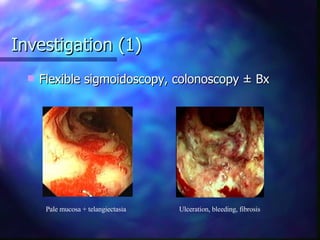
Pathology Mucosal ulceration Eosinophilic crypt abscesses Obliterative endarteritis Submucosal fibrosis Neovascularization (telangiectasia)
Influencing Factors - CRP Radiotherapy regimen Radiation dose (>50Gy) N o.  fields Shielding Delivery method (intracavity > EBRT) Radiosensitizers, chemotherapy Patient Factors Diabetes Previous abdominal surgery Hypertension Age
Investigation (1) Flexible sigmoidoscopy, colonoscopy  ± Bx  Pale mucosa + telangiectasia Ulceration, bleeding, fibrosis
Investigation (2) CT chest, abdomen Contrast enema  Anorectal manometry Transanal ultrasound
Management - Medical Enemas (no proven efficacy) Steroids Sucralfate 5-aminosalicylates Butyrate Hyperbaric O 2 Limited data Expensive Time-consuming (20 - 40 treatments required)
Management - Endoscopic (1) Topical Formalin Adapted from use in radiation cystitis 4% formalin solution applied Contact time 2-3 min 59 – 100% short term response Minimal relapse Protection of perianal skin important GA often required Fissures, ulcers, strictures reported
Management - Endoscopic (2) Diathermy Electrode “sticks” to mucosa Unpredictable depth of coagulation Ineffective in excessive bleeding
Management - Endoscopic (3) Laser (Nd:YAG, Argon) 87% short term response 2 - 3 treatments required 70% relapse after cessation of bleeding Maintenance treatments required at 7 month intervals Disadvantages Expensive Inaccessible Risk of perforation Protective precautions required
Management - Endoscopic (4) Argon Plasma Coagulation Bipolar diathermy current via ionized Argon gas stream Effective in short term 2 - 4 treatments required  Minimal relapse Advantages Reduced perforation risk Easier painting of large areas More affordable/accessible than laser Disadvantages Rectal strictures reported Ineffective with excessive bleeding Overdistension with Argon gas
Management – Surgery (1) Complicated disease Strictures Fistulae Refractory bleeding High complication rate (15 - 79%) Postop fistulae (up to 25%) Anastomotic leaks Wound dehiscence Pelvic sepsis
Management – Surgery (2) Excision - preferred approach Anterior resection + reconstruction APR – perineal wound breakdown in 45% Diversion Prior to definitive surgery for strictures or fistulae Not indicated for bleeding
Conclusions Medical management of little benefit Topical formalin or Argon plasma coagulation most effective Surgery as last resort in complicated cases Poorly investigated in the past Prospective, randomized trials required

Radiation Proctitis

  • 1.
    Radiation Proctitis DrDarren Tonkin Colorectal Registrar
  • 2.
    Contents Acute radiationproctitis Chronic radiation proctitis Pathology Investigation Management Conclusions
  • 3.
    Acute Radiation Proctitis(ARP) ~75% of pts treated with pelvic XRT Occurs during treatment and for several weeks after completion Symptoms usually mild and self limiting Symptomatic treatment only
  • 4.
    Clinical Manifestations -ARP Diarrhoea (predominant) Mucous discharge Tenesmus Abdominal & anal pain Rectal bleeding (uncommon)
  • 5.
    Chronic Radiation Proctitis(CRP) 2 to 20% of patients Months to yrs following XRT (median 8 - 13 months) Significant negative effect on quality of life Natural history poorly understood
  • 6.
    Clinical Manifestations -CRP Bleeding (70%) Mucous discharge Diarrhoea Pain Urgency Tenesmus Incontinence Fistulae Stricture Obstruction Perforation
  • 7.
    Pathology Mucosal ulcerationEosinophilic crypt abscesses Obliterative endarteritis Submucosal fibrosis Neovascularization (telangiectasia)
  • 8.
    Influencing Factors -CRP Radiotherapy regimen Radiation dose (>50Gy) N o. fields Shielding Delivery method (intracavity > EBRT) Radiosensitizers, chemotherapy Patient Factors Diabetes Previous abdominal surgery Hypertension Age
  • 9.
    Investigation (1) Flexiblesigmoidoscopy, colonoscopy ± Bx Pale mucosa + telangiectasia Ulceration, bleeding, fibrosis
  • 10.
    Investigation (2) CTchest, abdomen Contrast enema Anorectal manometry Transanal ultrasound
  • 11.
    Management - MedicalEnemas (no proven efficacy) Steroids Sucralfate 5-aminosalicylates Butyrate Hyperbaric O 2 Limited data Expensive Time-consuming (20 - 40 treatments required)
  • 12.
    Management - Endoscopic(1) Topical Formalin Adapted from use in radiation cystitis 4% formalin solution applied Contact time 2-3 min 59 – 100% short term response Minimal relapse Protection of perianal skin important GA often required Fissures, ulcers, strictures reported
  • 13.
    Management - Endoscopic(2) Diathermy Electrode “sticks” to mucosa Unpredictable depth of coagulation Ineffective in excessive bleeding
  • 14.
    Management - Endoscopic(3) Laser (Nd:YAG, Argon) 87% short term response 2 - 3 treatments required 70% relapse after cessation of bleeding Maintenance treatments required at 7 month intervals Disadvantages Expensive Inaccessible Risk of perforation Protective precautions required
  • 15.
    Management - Endoscopic(4) Argon Plasma Coagulation Bipolar diathermy current via ionized Argon gas stream Effective in short term 2 - 4 treatments required Minimal relapse Advantages Reduced perforation risk Easier painting of large areas More affordable/accessible than laser Disadvantages Rectal strictures reported Ineffective with excessive bleeding Overdistension with Argon gas
  • 16.
    Management – Surgery(1) Complicated disease Strictures Fistulae Refractory bleeding High complication rate (15 - 79%) Postop fistulae (up to 25%) Anastomotic leaks Wound dehiscence Pelvic sepsis
  • 17.
    Management – Surgery(2) Excision - preferred approach Anterior resection + reconstruction APR – perineal wound breakdown in 45% Diversion Prior to definitive surgery for strictures or fistulae Not indicated for bleeding
  • 18.
    Conclusions Medical managementof little benefit Topical formalin or Argon plasma coagulation most effective Surgery as last resort in complicated cases Poorly investigated in the past Prospective, randomized trials required