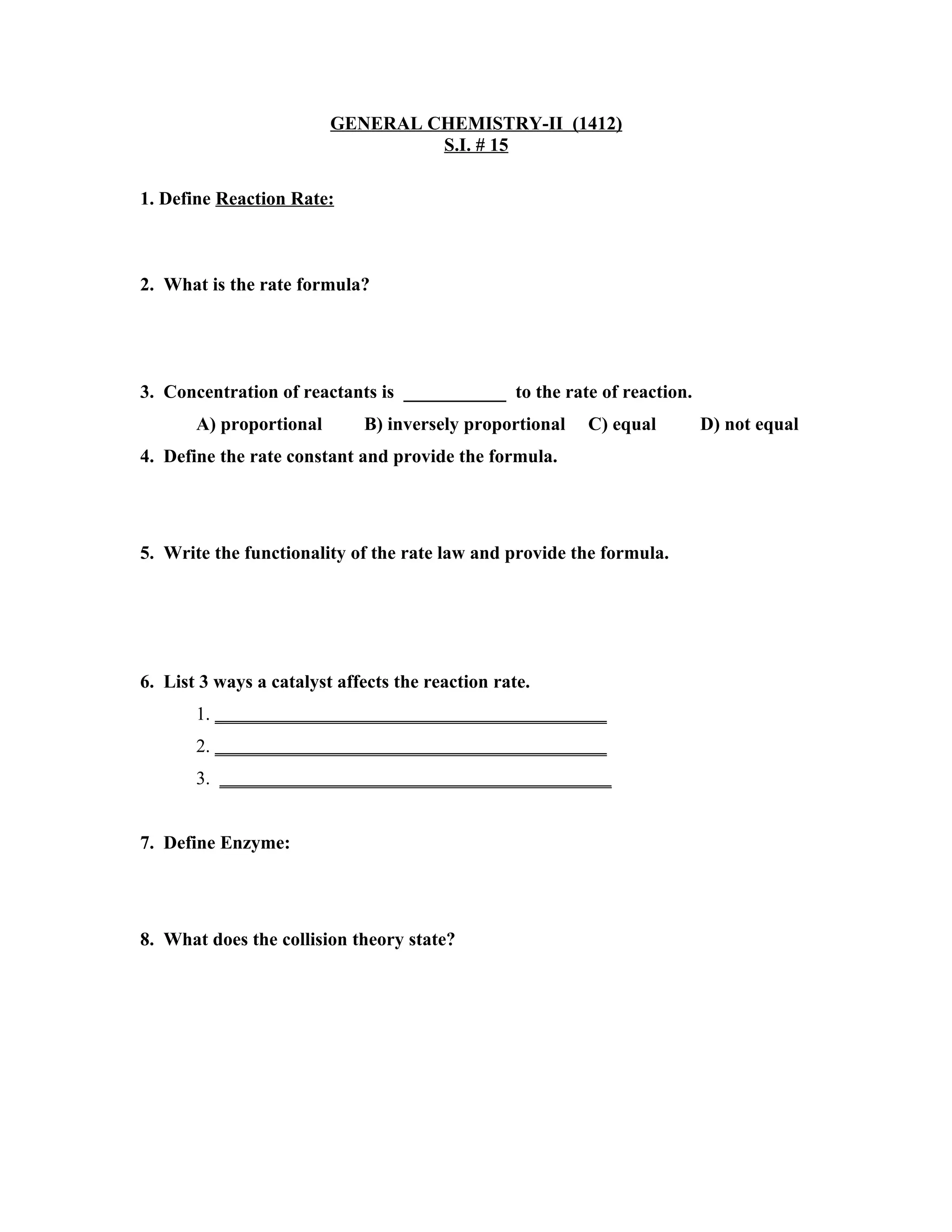
GENERAL CHEMISTRY-II (1412)
                                  S.I. # 15

1. Define Reaction Rate:


2. What is the rate formula?


3. Concentration of reactants is ___________ to the rate of reaction.
       A) proportional       B) inversely proportional   C) equal       D) not equal
4. Define the rate constant and provide the formula.


5. Write the functionality of the rate law and provide the formula.


6. List 3 ways a catalyst affects the reaction rate.
       1. __________________________________________
       2. __________________________________________
       3. __________________________________________


7. Define Enzyme:


8. What does the collision theory state?
9. If we have the reaction A (g)  2B (g) and the number of moles of A is as
follows:
      Time                 0 min                5 min                    10 min
    Moles A                0.100                0.085                     0.070
What is the number of moles of B at 10 minutes?


10. For the reaction 3A (g)  2B (g) the number of moles of A present at 25
minutes is found to be 0.22. If the initial number of moles of A and B were 0.050
mol and 0.00 mol respectively, how much B is present at 25 minutes?


11. Consider the combustion of H2 gas 2 H2 (g) + O2 (g)  2 H2O (g)
If hydrogen is burning at the rate of 4.6 mol s-1, what are the rates of consumption of
oxygen and formation of water vapor?

Si #15

  • 1.
    GENERAL CHEMISTRY-II (1412) S.I. # 15 1. Define Reaction Rate: 2. What is the rate formula? 3. Concentration of reactants is ___________ to the rate of reaction. A) proportional B) inversely proportional C) equal D) not equal 4. Define the rate constant and provide the formula. 5. Write the functionality of the rate law and provide the formula. 6. List 3 ways a catalyst affects the reaction rate. 1. __________________________________________ 2. __________________________________________ 3. __________________________________________ 7. Define Enzyme: 8. What does the collision theory state?
  • 2.
    9. If wehave the reaction A (g)  2B (g) and the number of moles of A is as follows: Time 0 min 5 min 10 min Moles A 0.100 0.085 0.070 What is the number of moles of B at 10 minutes? 10. For the reaction 3A (g)  2B (g) the number of moles of A present at 25 minutes is found to be 0.22. If the initial number of moles of A and B were 0.050 mol and 0.00 mol respectively, how much B is present at 25 minutes? 11. Consider the combustion of H2 gas 2 H2 (g) + O2 (g)  2 H2O (g) If hydrogen is burning at the rate of 4.6 mol s-1, what are the rates of consumption of oxygen and formation of water vapor?