S e c t i o n t h r e e
B y :
Y o u s s ef B e r b ar
 Mole : 6.022 x 10^23 units, the number equal to the
number of carbon atoms in exactly 12 g of pure C 12
 Molar mass : the mass of one mole of a pure
substance.
 Avogadro no : 6.022 x 10^23
How to calculate :
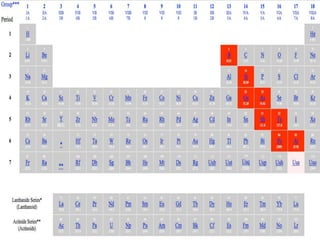
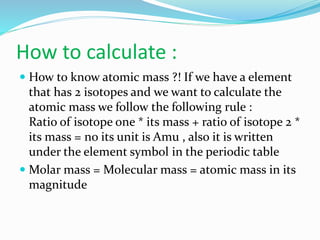
 How to know atomic mass ?! If we have a element
that has 2 isotopes and we want to calculate the
atomic mass we follow the following rule :
Ratio of isotope one * its mass + ratio of isotope 2 *
its mass = no its unit is Amu , also it is written
under the element symbol in the periodic table
 Molar mass = Molecular mass = atomic mass in its
magnitude
What is the difference between molar
, molecular and atomic mass
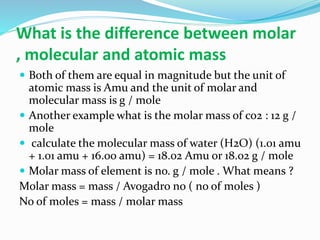
 Both of them are equal in magnitude but the unit of
atomic mass is Amu and the unit of molar and
molecular mass is g / mole
 Another example what is the molar mass of co2 : 12 g /
mole
 calculate the molecular mass of water (H2O) (1.01 amu
+ 1.01 amu + 16.00 amu) = 18.02 Amu or 18.02 g / mole
 Molar mass of element is no. g / mole . What means ?
Molar mass = mass / Avogadro no ( no of moles )
No of moles = mass / molar mass
Some definitions
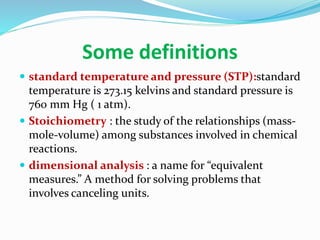
 standard temperature and pressure (STP):standard
temperature is 273.15 kelvins and standard pressure is
760 mm Hg ( 1 atm).
 Stoichiometry : the study of the relationships (mass-
mole-volume) among substances involved in chemical
reactions.
 dimensional analysis : a name for “equivalent
measures.” A method for solving problems that
involves canceling units.
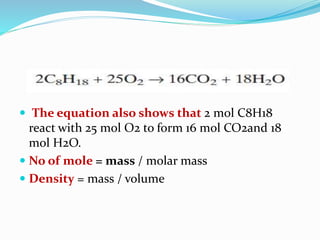
 The equation also shows that 2 mol C8H18
react with 25 mol O2 to form 16 mol CO2and 18
mol H2O.
 No of mole = mass / molar mass
 Density = mass / volume
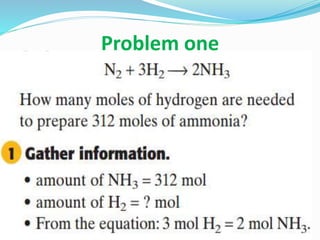
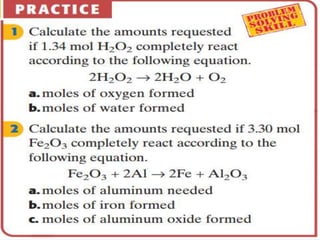
Problem one
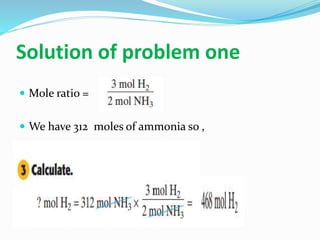
Solution of problem one
 Mole ratio =
 We have 312 moles of ammonia so ,
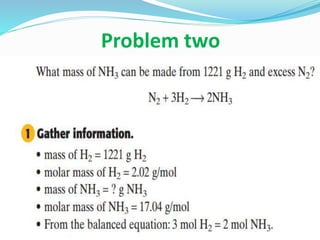
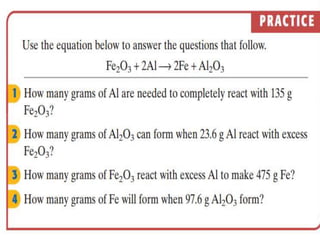
Problem two
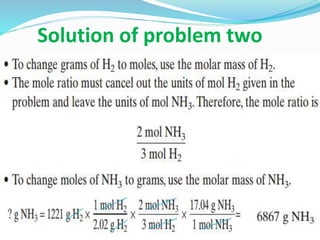
Solution of problem two
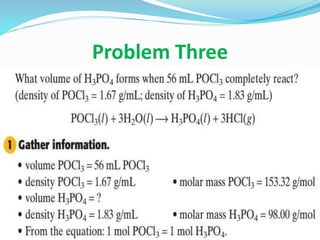
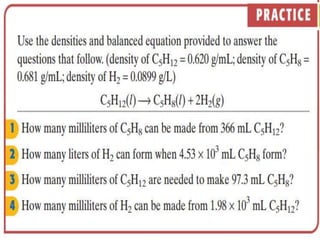
Problem Three
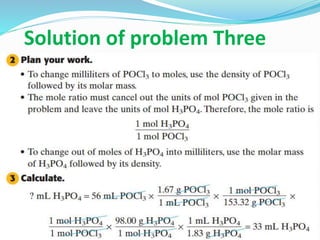
Solution of problem Three
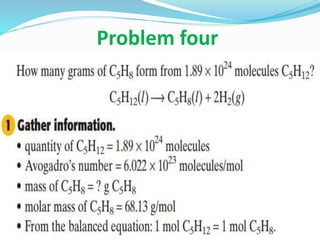
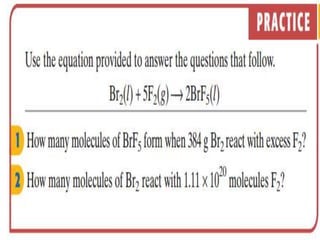
Problem four
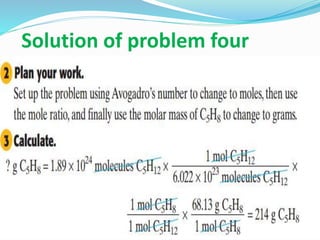
Solution of problem four
Thanks for listening
Youssef Berbar

Chemistry 2 yousef berbar

  • 1.
    S e ct i o n t h r e e B y : Y o u s s ef B e r b ar
  • 3.
     Mole :6.022 x 10^23 units, the number equal to the number of carbon atoms in exactly 12 g of pure C 12  Molar mass : the mass of one mole of a pure substance.  Avogadro no : 6.022 x 10^23
  • 4.
    How to calculate:  How to know atomic mass ?! If we have a element that has 2 isotopes and we want to calculate the atomic mass we follow the following rule : Ratio of isotope one * its mass + ratio of isotope 2 * its mass = no its unit is Amu , also it is written under the element symbol in the periodic table  Molar mass = Molecular mass = atomic mass in its magnitude
  • 5.
    What is thedifference between molar , molecular and atomic mass  Both of them are equal in magnitude but the unit of atomic mass is Amu and the unit of molar and molecular mass is g / mole  Another example what is the molar mass of co2 : 12 g / mole  calculate the molecular mass of water (H2O) (1.01 amu + 1.01 amu + 16.00 amu) = 18.02 Amu or 18.02 g / mole  Molar mass of element is no. g / mole . What means ? Molar mass = mass / Avogadro no ( no of moles ) No of moles = mass / molar mass
  • 6.
    Some definitions  standardtemperature and pressure (STP):standard temperature is 273.15 kelvins and standard pressure is 760 mm Hg ( 1 atm).  Stoichiometry : the study of the relationships (mass- mole-volume) among substances involved in chemical reactions.  dimensional analysis : a name for “equivalent measures.” A method for solving problems that involves canceling units.
  • 7.
     The equationalso shows that 2 mol C8H18 react with 25 mol O2 to form 16 mol CO2and 18 mol H2O.  No of mole = mass / molar mass  Density = mass / volume
  • 8.
  • 9.
    Solution of problemone  Mole ratio =  We have 312 moles of ammonia so ,
  • 10.
  • 11.
  • 12.
  • 13.
  • 14.
  • 15.
  • 20.