KEY


                          GENERAL CHEMISTRY-II (1412)
                                    S.I. # 7

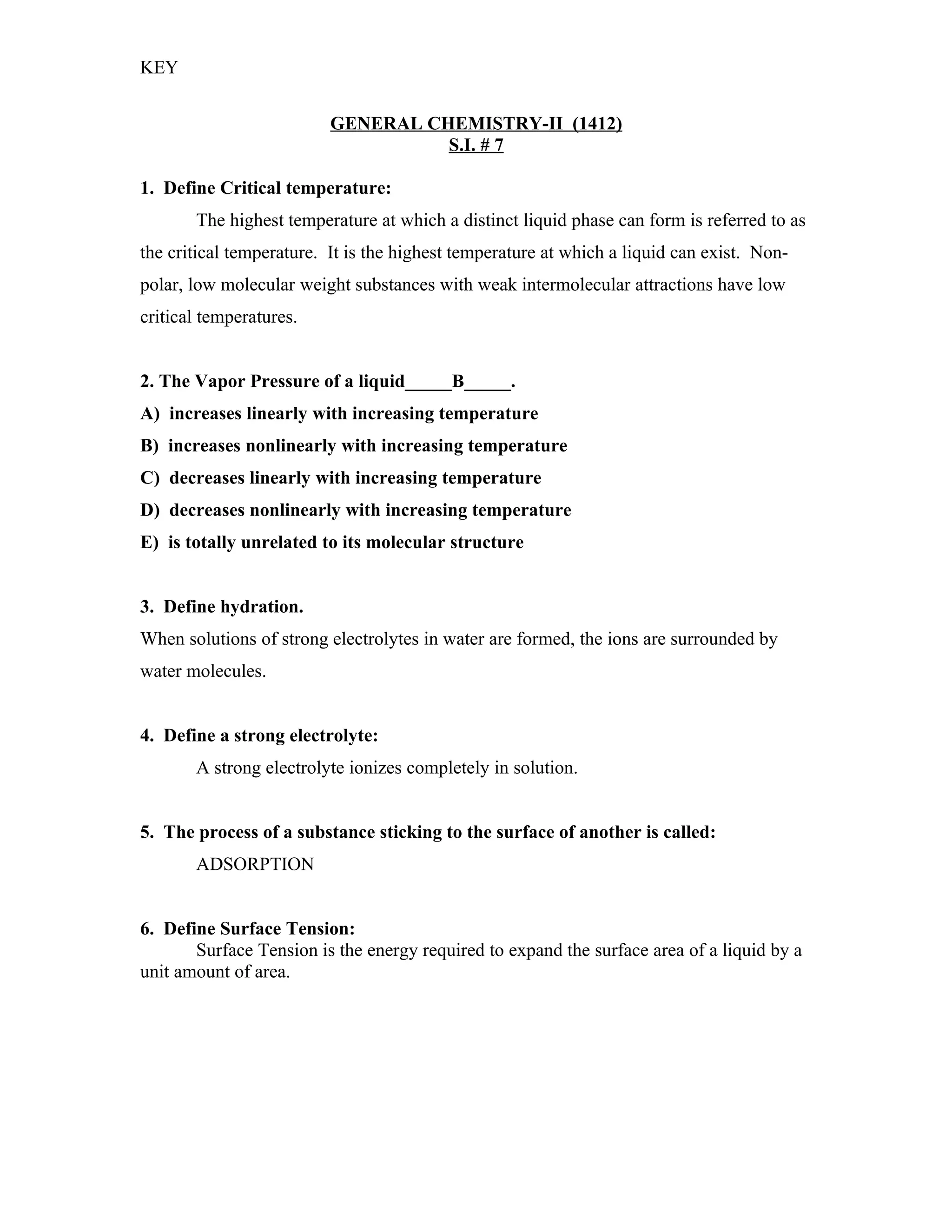
1. Define Critical temperature:
       The highest temperature at which a distinct liquid phase can form is referred to as
the critical temperature. It is the highest temperature at which a liquid can exist. Non-
polar, low molecular weight substances with weak intermolecular attractions have low
critical temperatures.


2. The Vapor Pressure of a liquid_____B_____.
A) increases linearly with increasing temperature
B) increases nonlinearly with increasing temperature
C) decreases linearly with increasing temperature
D) decreases nonlinearly with increasing temperature
E) is totally unrelated to its molecular structure


3. Define hydration.
When solutions of strong electrolytes in water are formed, the ions are surrounded by
water molecules.


4. Define a strong electrolyte:
       A strong electrolyte ionizes completely in solution.


5. The process of a substance sticking to the surface of another is called:
       ADSORPTION


6. Define Surface Tension:
       Surface Tension is the energy required to expand the surface area of a liquid by a
unit amount of area.
KEY


7. How do temperature, molecular weight and intermolecular forces interact with
the viscosity of a molecule?
       Viscosity increases as temperature decreases
       Viscosity increases as molecular weight increases
       Viscosity increases as intermolecular forces increase.


NOMENCLATURE!!!
1. CCl4                        Carbontetrachloride
2. CaH2                        Calcium hydride
3. C6H12O6                     Glucose
4. Ammonium chloride           NH4Cl
5. Methanol                    CH3OH
6. ClO2 (g)                    Chlorine dioxide gas
7. CH3Cl                       Methyl chloride
8. Acetaldehyde                C2H4O
9. Propane                     C3H8
10. CH3I                       Methyl Iodide
11. Hydrazine                          H4N2
12. Methyl Flouride            CH3F
13. H2S                        Hydrogen sulfide
14. PH3                        Phosphine
15. H2O2                       Hydrogen peroxide
16. Acetone                    C3H6O
17. Ethanol                    CH3CH2OH
18. HCl (aq)                   Hydrochloric Acid
19. C3H8O3                     Glycerol
20. CHCl3                      Chloroform

Key SI #7

  • 1.
    KEY GENERAL CHEMISTRY-II (1412) S.I. # 7 1. Define Critical temperature: The highest temperature at which a distinct liquid phase can form is referred to as the critical temperature. It is the highest temperature at which a liquid can exist. Non- polar, low molecular weight substances with weak intermolecular attractions have low critical temperatures. 2. The Vapor Pressure of a liquid_____B_____. A) increases linearly with increasing temperature B) increases nonlinearly with increasing temperature C) decreases linearly with increasing temperature D) decreases nonlinearly with increasing temperature E) is totally unrelated to its molecular structure 3. Define hydration. When solutions of strong electrolytes in water are formed, the ions are surrounded by water molecules. 4. Define a strong electrolyte: A strong electrolyte ionizes completely in solution. 5. The process of a substance sticking to the surface of another is called: ADSORPTION 6. Define Surface Tension: Surface Tension is the energy required to expand the surface area of a liquid by a unit amount of area.
  • 2.
    KEY 7. How dotemperature, molecular weight and intermolecular forces interact with the viscosity of a molecule? Viscosity increases as temperature decreases Viscosity increases as molecular weight increases Viscosity increases as intermolecular forces increase. NOMENCLATURE!!! 1. CCl4 Carbontetrachloride 2. CaH2 Calcium hydride 3. C6H12O6 Glucose 4. Ammonium chloride NH4Cl 5. Methanol CH3OH 6. ClO2 (g) Chlorine dioxide gas 7. CH3Cl Methyl chloride 8. Acetaldehyde C2H4O 9. Propane C3H8 10. CH3I Methyl Iodide 11. Hydrazine H4N2 12. Methyl Flouride CH3F 13. H2S Hydrogen sulfide 14. PH3 Phosphine 15. H2O2 Hydrogen peroxide 16. Acetone C3H6O 17. Ethanol CH3CH2OH 18. HCl (aq) Hydrochloric Acid 19. C3H8O3 Glycerol 20. CHCl3 Chloroform