The document provides 10 questions related to general chemistry concepts including:
1) Defining the common ion effect and buffer capacity
2) Providing the Henderson-Hasselbalch equation
3) Calculating the pH of different buffer solutions
KEY
GENERAL CHEMISTRY-II (1412)
S.I. # 25
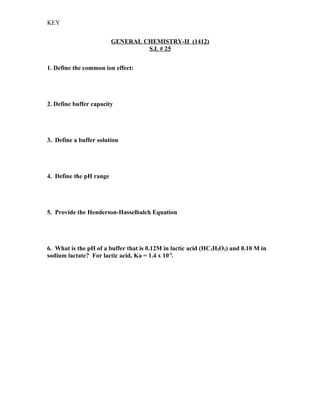
1. Define the common ion effect:
2. Define buffer capacity
3. Define a buffer solution
4. Define the pH range
5. Provide the Henderson-Hasselbalch Equation
6. What is the pH of a buffer that is 0.12M in lactic acid (HC3H5O3) and 0.10 M in
sodium lactate? For lactic acid, Ka = 1.4 x 10⁻⁴.
2.
KEY
7. Calculate themolar concentration of OH- ions in a 1.15 M solution of
hypobromite ion (BrO-); Kb = 4.0 x 10⁻⁶ . What is the pH of this solution?
8. Calculate the pH of a buffer that is 0.120 M in NaHCO3 and 0.105 M Na2CO3.
9. Explain the difference between solubility and solubility-product constant. Write
the expression for ionic compounds: MnCO3, Hg(OH)2 and Cu3(PO4)2.
10. Which of the following salts will be substantially more soluble in acidic solution
than in pure water?
A. ZnCO3
B. ZnS
C. BiI3
D. AgCn
E. Ba3(PO4)2