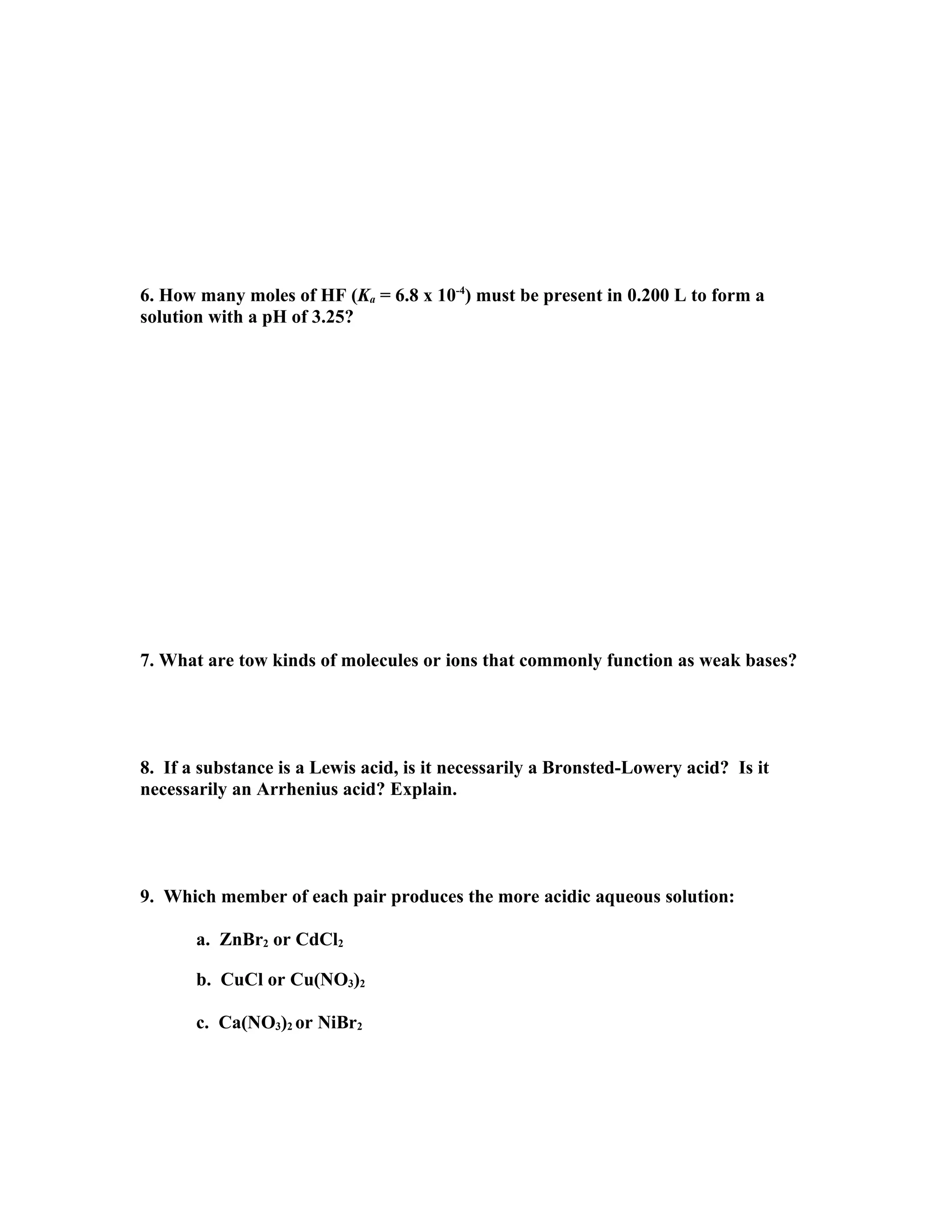
1. The document provides 7 chemistry problems involving calculations of pH, concentrations of products and reactants from acid-base reactions involving strong acids and bases, and identification of types of acids.
2. Problems 1-3 involve calculating the pH of strong acid solutions given molar concentrations.
3. Problems 4-6 require using given volumes, molarities, and extent of ionization to calculate concentrations of products and reactants.
4. Problems 7-9 ask about common weak bases, relationships between types of acids, and identification of more acidic salt solutions.
![GENERAL CHEMISTRY-II (1412)
S.I. # 24
Calculate the pH of each of the following strong acid solutions:
1. 0.00835 M HNO3
2. 0.525 M HClO4
3. 5.00 mL of 1 M HCl diluted to 0.500 L
4. a mixture formed by adding 50.0 mL of 0.020 M HCl to 150 mL of
0.010 M HI.
5. A 0.100 M solution of brmoacetic acid (BrCH2COOH) is 13.2% ionized.
Calculate [H+] , [BrCH2COO-], and [BrCH2COOH].](https://image.slidesharecdn.com/chem-ii-si-24-1272476882-phpapp02/75/24-1-2048.jpg)