“Fun” with Cost Curves
Use the tools at:
http://www.harmon.uconn.edu/GraphTool/GraphTool.html
Create a Powerpoint or Word document to create the following graphical situations. Take screen shots and paste your
graphs into your ppt. Make sure to email you work to yourself and Mr. Klein @ travis.klein@fwusd.org
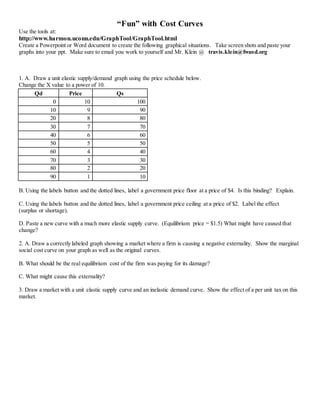
1. A. Draw a unit elastic supply/demand graph using the price schedule below.
Change the X value to a power of 10.
Qd Price Qs
0 10 100
10 9 90
20 8 80
30 7 70
40 6 60
50 5 50
60 4 40
70 3 30
80 2 20
90 1 10
B. Using the labels button and the dotted lines, label a government price floor at a price of $4. Is this binding? Explain.
C. Using the labels button and the dotted lines, label a government price ceiling at a price of $2. Label the effect
(surplus or shortage).
D. Paste a new curve with a much more elastic supply curve. (Equilibrium price = $1.5) What might have caused that
change?
2. A. Draw a correctly labeled graph showing a market where a firm is causing a negative externality. Show the marginal
social cost curve on your graph as well as the original curves.
B. What should be the real equilibrium cost of the firm was paying for its damage?
C. What might cause this externality?
3. Draw a market with a unit elastic supply curve and an inelastic demand curve. Show the effect of a per unit tax on this
market.
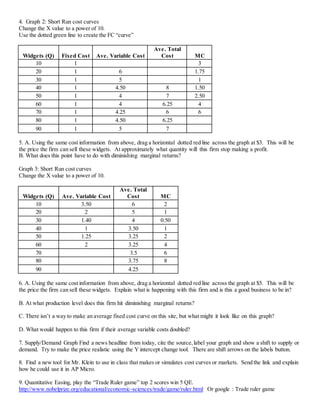
4. Graph 2: Short Run cost curves
Change the X value to a power of 10.
Use the dotted green line to create the FC “curve”
Widgets (Q) Fixed Cost Ave. Variable Cost
Ave. Total
Cost MC
10 1 3
20 1 6 1.75
30 1 5 1
40 1 4.50 8 1.50
50 1 4 7 2.50
60 1 4 6.25 4
70 1 4.25 6 6
80 1 4.50 6.25
90 1 5 7
5. A. Using the same cost information from above, drag a horizontal dotted red line across the graph at $3. This will be
the price the firm can sell these widgets. At approximately what quantity will this firm stop making a profit.
B. What does this point have to do with diminishing marginal returns?
Graph 3: Short Run cost curves
Change the X value to a power of 10.
Widgets (Q) Ave. Variable Cost
Ave. Total
Cost MC
10 3.50 6 2
20 2 5 1
30 1.40 4 0.50
40 1 3.50 1
50 1.25 3.25 2
60 2 3.25 4
70 3.5 6
80 3.75 8
90 4.25
6. A. Using the same cost information from above, drag a horizontal dotted red line across the graph at $5. This will be
the price the firm can sell these widgets. Explain what is happening with this firm and is this a good business to be in?
B. At what production level does this firm hit diminishing marginal returns?
C. There isn’t a way to make an average fixed cost curve on this site, but what might it look like on this graph?
D. What would happen to this firm if their average variable costs doubled?
7. Supply/Demand Graph Find a news headline from today, cite the source,label your graph and show a shift to supply or
demand. Try to make the price realistic using the Y intercept change tool. There are shift arrows on the labels button.
8. Find a new tool for Mr. Klein to use in class that makes or simulates cost curves or markets. Send the link and explain
how he could use it in AP Micro.
9. Quantitative Easing, play the “Trade Ruler game” top 2 scores win 5 QE.
http://www.nobelprize.org/educational/economic-sciences/trade/game/ruler.html Or google : Trade ruler game

Cost curves computer lab

  • 1.
    “Fun” with CostCurves Use the tools at: http://www.harmon.uconn.edu/GraphTool/GraphTool.html Create a Powerpoint or Word document to create the following graphical situations. Take screen shots and paste your graphs into your ppt. Make sure to email you work to yourself and Mr. Klein @ travis.klein@fwusd.org 1. A. Draw a unit elastic supply/demand graph using the price schedule below. Change the X value to a power of 10. Qd Price Qs 0 10 100 10 9 90 20 8 80 30 7 70 40 6 60 50 5 50 60 4 40 70 3 30 80 2 20 90 1 10 B. Using the labels button and the dotted lines, label a government price floor at a price of $4. Is this binding? Explain. C. Using the labels button and the dotted lines, label a government price ceiling at a price of $2. Label the effect (surplus or shortage). D. Paste a new curve with a much more elastic supply curve. (Equilibrium price = $1.5) What might have caused that change? 2. A. Draw a correctly labeled graph showing a market where a firm is causing a negative externality. Show the marginal social cost curve on your graph as well as the original curves. B. What should be the real equilibrium cost of the firm was paying for its damage? C. What might cause this externality? 3. Draw a market with a unit elastic supply curve and an inelastic demand curve. Show the effect of a per unit tax on this market.
  • 2.
    4. Graph 2:Short Run cost curves Change the X value to a power of 10. Use the dotted green line to create the FC “curve” Widgets (Q) Fixed Cost Ave. Variable Cost Ave. Total Cost MC 10 1 3 20 1 6 1.75 30 1 5 1 40 1 4.50 8 1.50 50 1 4 7 2.50 60 1 4 6.25 4 70 1 4.25 6 6 80 1 4.50 6.25 90 1 5 7 5. A. Using the same cost information from above, drag a horizontal dotted red line across the graph at $3. This will be the price the firm can sell these widgets. At approximately what quantity will this firm stop making a profit. B. What does this point have to do with diminishing marginal returns? Graph 3: Short Run cost curves Change the X value to a power of 10. Widgets (Q) Ave. Variable Cost Ave. Total Cost MC 10 3.50 6 2 20 2 5 1 30 1.40 4 0.50 40 1 3.50 1 50 1.25 3.25 2 60 2 3.25 4 70 3.5 6 80 3.75 8 90 4.25 6. A. Using the same cost information from above, drag a horizontal dotted red line across the graph at $5. This will be the price the firm can sell these widgets. Explain what is happening with this firm and is this a good business to be in? B. At what production level does this firm hit diminishing marginal returns? C. There isn’t a way to make an average fixed cost curve on this site, but what might it look like on this graph? D. What would happen to this firm if their average variable costs doubled? 7. Supply/Demand Graph Find a news headline from today, cite the source,label your graph and show a shift to supply or demand. Try to make the price realistic using the Y intercept change tool. There are shift arrows on the labels button. 8. Find a new tool for Mr. Klein to use in class that makes or simulates cost curves or markets. Send the link and explain how he could use it in AP Micro. 9. Quantitative Easing, play the “Trade Ruler game” top 2 scores win 5 QE. http://www.nobelprize.org/educational/economic-sciences/trade/game/ruler.html Or google : Trade ruler game