In this chapter,
Inthis chapter,
look for the answers to these questions:
look for the answers to these questions:
What is a perfectly competitive market?
What is marginal revenue? How is it related to total
and average revenue?
How does a competitive firm determine the quantity
that maximizes profits?
When might a competitive firm shut down in the
short run? Exit the market in the long run?
What does the market supply curve look like in the
short run? In the long run?
2
3.
FIRMS IN COMPETITIVEMARKETS 3
Introduction: A Scenario
Three years after graduating, you run your own
business.
You must decide how much to produce, what price
to charge, how many workers to hire, etc.
What factors should affect these decisions?
Your costs (studied in previous chapter)
How much competition you face
We begin by studying the behavior of firms in
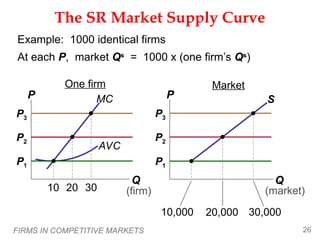
perfectly competitive markets.
4.
FIRMS IN COMPETITIVEMARKETS 4
Characteristics of Perfect Competition
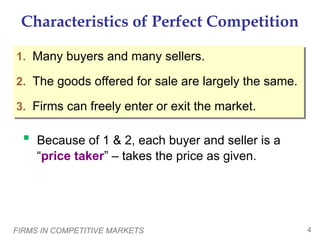
1. Many buyers and many sellers.
2. The goods offered for sale are largely the same.
3. Firms can freely enter or exit the market.
Because of 1 & 2, each buyer and seller is a
“price taker” – takes the price as given.
5.
FIRMS IN COMPETITIVEMARKETS 5
The Revenue of a Competitive Firm
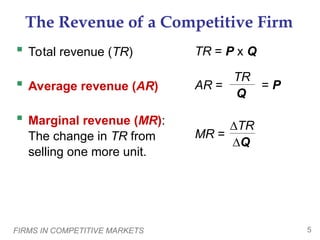
Total revenue (TR)
Average revenue (AR)
Marginal revenue (MR):
The change in TR from
selling one more unit.
∆TR
∆Q
MR =
TR = P x Q
TR
Q
AR = = P
6.
A C TI V E L E A R N I N G
A C T I V E L E A R N I N G 1
1
Calculating
Calculating TR
TR,
, AR
AR,
, MR
MR
6
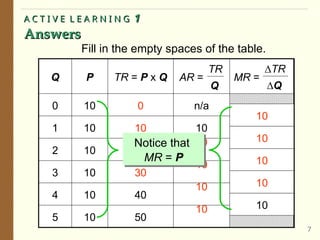
Fill in the empty spaces of the table.
50
10
5
40
10
4
10
3
10
2
10
10
1
n/a
10
0
TR
P
Q MR
AR
10
7.
A C TI V E L E A R N I N G
A C T I V E L E A R N I N G 1
1
Answers
Answers
7
Fill in the empty spaces of the table.
50
10
5
40
10
4
10
3
10
10
10
10
10
2
10
10
1
n/a
30
20
10
0
10
0
TR = P x Q
P
Q
∆TR
∆Q
MR =
TR
Q
AR =
10
10
10
10
10
Notice that
MR = P
8.
FIRMS IN COMPETITIVEMARKETS 8
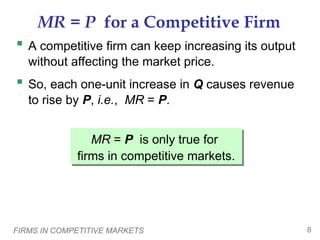
MR = P for a Competitive Firm
A competitive firm can keep increasing its output
without affecting the market price.
So, each one-unit increase in Q causes revenue
to rise by P, i.e., MR = P.
MR = P is only true for
firms in competitive markets.
9.
FIRMS IN COMPETITIVEMARKETS 9
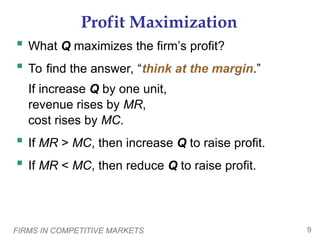
Profit Maximization
What Q maximizes the firm’s profit?
To find the answer, “think at the margin.”
If increase Q by one unit,
revenue rises by MR,
cost rises by MC.
If MR > MC, then increase Q to raise profit.
If MR < MC, then reduce Q to raise profit.
10.
FIRMS IN COMPETITIVEMARKETS 10
Profit Maximization
50
5
40
4
30
3
20
2
10
1
45
33
23
15
9
5
0
0
Profit =
MR – MC
MC
MR
Profit
TC
TR
Q
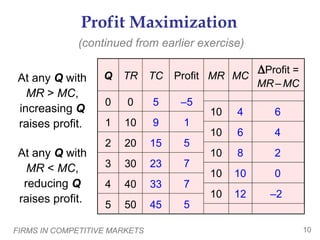
At any Q with
MR > MC,
increasing Q
raises profit.
5
7
7
5
1
–5
10
10
10
10
–2
0
2
4
6
12
10
8
6
4
10
(continued from earlier exercise)
At any Q with
MR < MC,
reducing Q
raises profit.
11.
FIRMS IN COMPETITIVEMARKETS 11
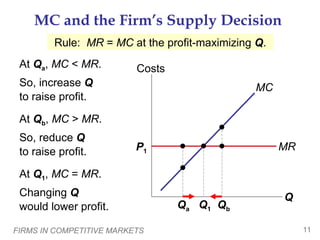
P1 MR
MC and the Firm’s Supply Decision
At Qa, MC < MR.
So, increase Q
to raise profit.
At Qb, MC > MR.
So, reduce Q
to raise profit.
At Q1, MC = MR.
Changing Q
would lower profit.
Q
Costs
MC
Q1
Qa Qb
Rule: MR = MC at the profit-maximizing Q.
12.
FIRMS IN COMPETITIVEMARKETS 12
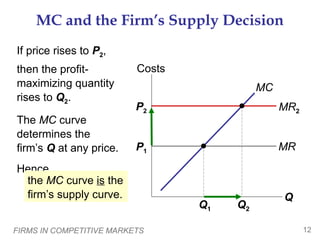
P1 MR
P2 MR2
MC and the Firm’s Supply Decision
If price rises to P2,
then the profit-
maximizing quantity
rises to Q2.
The MC curve
determines the
firm’s Q at any price.
Hence,
Q
Costs
MC
Q1 Q2
the MC curve is the
firm’s supply curve.
13.
FIRMS IN COMPETITIVEMARKETS 13
Shutdown vs. Exit
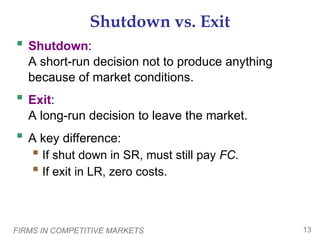
Shutdown:
A short-run decision not to produce anything
because of market conditions.
Exit:
A long-run decision to leave the market.
A key difference:
If shut down in SR, must still pay FC.
If exit in LR, zero costs.
14.
FIRMS IN COMPETITIVEMARKETS 14
A Firm’s Short-run Decision to Shut Down
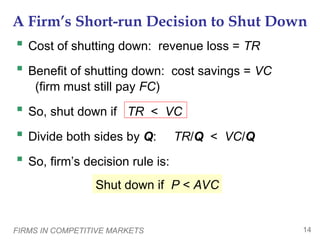
Cost of shutting down: revenue loss = TR
Benefit of shutting down: cost savings = VC
(firm must still pay FC)
So, shut down if TR < VC
Divide both sides by Q: TR/Q < VC/Q
So, firm’s decision rule is:
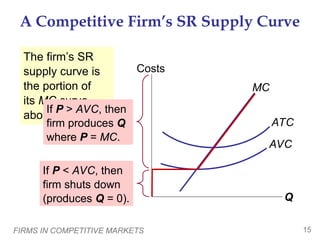
Shut down if P < AVC
15.
FIRMS IN COMPETITIVEMARKETS 15
The firm’s SR
supply curve is
the portion of
its MC curve
above AVC.
Q
Costs
A Competitive Firm’s SR Supply Curve
MC
ATC
AVC
If P > AVC, then
firm produces Q
where P = MC.
If P < AVC, then
firm shuts down
(produces Q = 0).
16.
FIRMS IN COMPETITIVEMARKETS 16
The Irrelevance of Sunk Costs
Sunk cost: a cost that has already been
committed and cannot be recovered
Sunk costs should be irrelevant to decisions;
you must pay them regardless of your choice.
FC is a sunk cost: The firm must pay its fixed
costs whether it produces or shuts down.
So, FC should not matter in the decision to shut
down.
17.
FIRMS IN COMPETITIVEMARKETS 17
A Firm’s Long-Run Decision to Exit 1-9
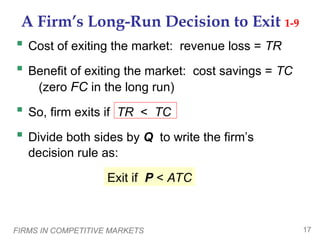
Cost of exiting the market: revenue loss = TR
Benefit of exiting the market: cost savings = TC
(zero FC in the long run)
So, firm exits if TR < TC
Divide both sides by Q to write the firm’s
decision rule as:
Exit if P < ATC
18.
FIRMS IN COMPETITIVEMARKETS 18
A New Firm’s Decision to Enter Market
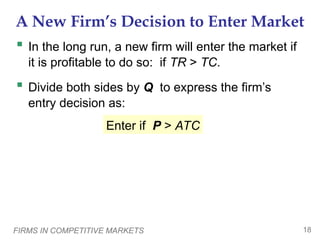
In the long run, a new firm will enter the market if
it is profitable to do so: if TR > TC.
Divide both sides by Q to express the firm’s
entry decision as:
Enter if P > ATC
19.
FIRMS IN COMPETITIVEMARKETS 19
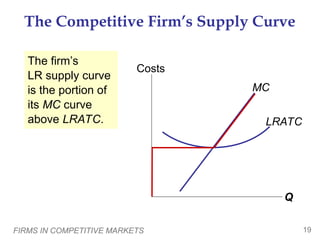
The firm’s
LR supply curve
is the portion of
its MC curve
above LRATC.
Q
Costs
The Competitive Firm’s Supply Curve
MC
LRATC
20.
A C TI V E L E A R N I N G
A C T I V E L E A R N I N G 2
2
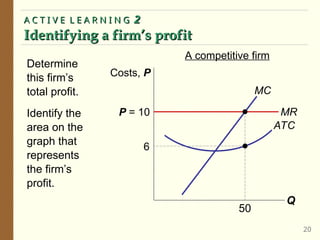
Identifying a firm’s profit
Identifying a firm’s profit
20
Determine
this firm’s
total profit.
Identify the
area on the
graph that
represents
the firm’s
profit.
Q
Costs, P
MC
ATC
P = 10 MR
50
6
A competitive firm
21.
A C TI V E L E A R N I N G
A C T I V E L E A R N I N G 2
2
Answers
Answers
21
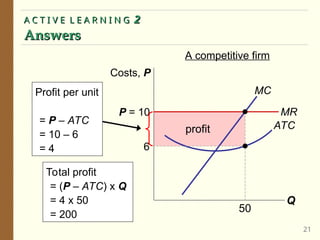
profit
Q
Costs, P
MC
ATC
P = 10 MR
50
6
A competitive firm
Profit per unit
= P – ATC
= 10 – 6
= 4
Total profit
= (P – ATC) x Q
= 4 x 50
= 200
22.
A C TI V E L E A R N I N G
A C T I V E L E A R N I N G 3
3
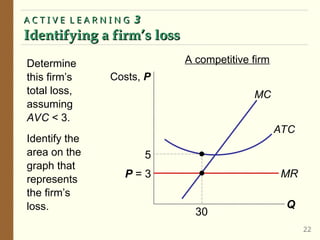
Identifying a firm’s loss
Identifying a firm’s loss
22
Determine
this firm’s
total loss,
assuming
AVC < 3.
Identify the
area on the
graph that
represents
the firm’s
loss. Q
Costs, P
MC
ATC
A competitive firm
5
P = 3 MR
30
23.
A C TI V E L E A R N I N G
A C T I V E L E A R N I N G 3
3
Answers
Answers
23
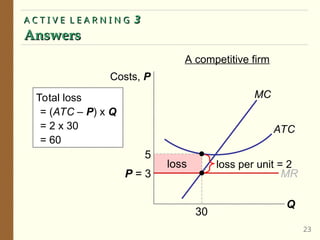
loss
MR
P = 3
Q
Costs, P
MC
ATC
A competitive firm
loss per unit = 2
Total loss
= (ATC – P) x Q
= 2 x 30
= 60
5
30
24.
FIRMS IN COMPETITIVEMARKETS 24
Market Supply: Assumptions
1) All existing firms and potential entrants have
identical costs.
2) Each firm’s costs do not change as other firms
enter or exit the market.
3) The number of firms in the market is
fixed in the short run
(due to fixed costs)
variable in the long run
(due to free entry and exit)
25.
FIRMS IN COMPETITIVEMARKETS 25
The SR Market Supply Curve
As long as P ≥ AVC, each firm will produce its
profit-maximizing quantity, where MR = MC.
At each price, the market quantity supplied is
the sum of quantities supplied by all firms.
26.
FIRMS IN COMPETITIVEMARKETS 26
The SR Market Supply Curve
MC
P2
Market
Q
P
(market)
One firm
Q
P
(firm)
S
P3
Example: 1000 identical firms
At each P, market Qs
= 1000 x (one firm’s Qs
)
AVC
P2
P3
30
P1
20
10
P1
30,000
10,000 20,000
27.
FIRMS IN COMPETITIVEMARKETS 27
Entry & Exit in the Long Run
In the LR, the number of firms can change due to
entry & exit.
If existing firms earn positive economic profit,
new firms enter, SR market supply shifts right.
P falls, reducing profits and slowing entry.
If existing firms incur losses,
some firms exit, SR market supply shifts left.
P rises, reducing remaining firms’ losses.
28.
FIRMS IN COMPETITIVEMARKETS 28
The Zero-Profit Condition
Long-run equilibrium:
The process of entry or exit is complete –
remaining firms earn zero economic profit.
Zero economic profit occurs when P = ATC.
Since firms produce where P = MR = MC,
the zero-profit condition is P = MC = ATC.
Since, that MC intersects ATC at minimum ATC.
Hence, in the long run, P = minimum ATC.
29.
FIRMS IN COMPETITIVEMARKETS 29
Why Do Firms Stay in Business if Profit = 0?
Economic profit is revenue minus all costs –
including implicit costs, like the opportunity cost
of the owner’s time and money.
In the zero-profit equilibrium,
firms earn enough revenue to cover these costs
accounting profit is positive
30.
FIRMS IN COMPETITIVEMARKETS 30
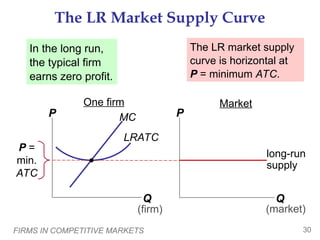
The LR Market Supply Curve
MC
Market
Q
P
(market)
One firm
Q
P
(firm)
In the long run,
the typical firm
earns zero profit.
LRATC
long-run
supply
P =
min.
ATC
The LR market supply
curve is horizontal at
P = minimum ATC.
31.
FIRMS IN COMPETITIVEMARKETS 31
S1
Profit
D1
P1
long-run
supply
D2
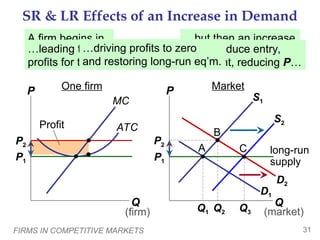
SR & LR Effects of an Increase in Demand
MC
ATC
P1
Market
Q
P
(market)
One firm
Q
P
(firm)
P2
P2
Q1 Q2
S2
Q3
A firm begins in
long-run eq’m…
…but then an increase
in demand raises P,…
…leading to SR
profits for the firm.
Over time, profits induce entry,
shifting S to the right, reducing P…
…driving profits to zero
and restoring long-run eq’m.
A
B
C
32.
FIRMS IN COMPETITIVEMARKETS 32
Why the LR Supply Curve Might Slope Upward
The LR market supply curve is horizontal if
1) all firms have identical costs, and
2) costs do not change as other firms enter or
exit the market.
If either of these assumptions is not true,
then LR supply curve slopes upward.
33.
FIRMS IN COMPETITIVEMARKETS 33
1) Firms Have Different Costs
As P rises, firms with lower costs enter the market
before those with higher costs.
Further increases in P make it worthwhile
for higher-cost firms to enter the market,
which increases market quantity supplied.
Hence, LR market supply curve slopes upward.
At any P,
For the marginal firm,
P = minimum ATC and profit = 0.
For lower-cost firms, profit > 0.
34.
FIRMS IN COMPETITIVEMARKETS 34
2) Costs Rise as Firms Enter the Market
In some industries, the supply of a key input is
limited (e.g., amount of land suitable for farming
is fixed).
The entry of new firms increases demand for this
input, causing its price to rise.
This increases all firms’ costs.
Hence, an increase in P is required to increase
the market quantity supplied, so the supply curve
is upward-sloping.
35.
FIRMS IN COMPETITIVEMARKETS 35
CONCLUSION: The Efficiency of a
Competitive Market
Profit-maximization: MC = MR
Perfect competition: P = MR
So, in the competitive eq’m: P = MC
Recall, MC is cost of producing the marginal unit.
P is value to buyers of the marginal unit.
So, the competitive eq’m is efficient, maximizes
total surplus.
In the next chapter, monopoly: pricing &
production decisions, deadweight loss, regulation.
36.
CHAPTER SUMMARY
CHAPTER SUMMARY
For a firm in a perfectly competitive market,
price = marginal revenue = average revenue.
If P > AVC, a firm maximizes profit by producing
the quantity where MR = MC. If P < AVC, a firm
will shut down in the short run.
If P < ATC, a firm will exit in the long run.
In the short run, entry is not possible, and an
increase in demand increases firms’ profits.
With free entry and exit, profits = 0 in the long run,
and P = minimum ATC.
36
Editor's Notes
#1 Having introduced the cost concepts in the previous chapter, we now begin to use those concepts to see how firms making production and pricing decisions in different market structures. In this chapter, we explore firm behavior under perfect competition. The next chapter covers the other extreme end of the competition spectrum – monopoly. The following two chapters cover the intermediate cases – oligopoly and monopolistic competition, respectively.
#4 “Firms can freely enter or exit the market” means there are no barriers or impediments to entry or exit. E.g., the government does not restrict the number of firms in the market.
#5 These revenue concepts are analogous to the cost concepts (TC, ATC, MC) in the previous chapter.
#6 This easy exercise requires students to apply the definitions from the previous slide.
It also demonstrates that MR = P for a competitive firm.
(The table in this exercise is similar to Table 1 in the chapter.)
#10 (The table on this slide is similar to Table 2 in the textbook.)
For most students, seeing the complete table all at once is too much information. So, the table is animated as follows:
Initially, the only columns displayed are the ones students saw at the end of the exercise in Active Learning 1: Q, TR, and MR.
Then, TC appears, followed by MC. It might be useful to remind students of the relationship between MC and TC.
Then, the Profit column appears. Students should be able to see that, at each value of Q, profit equals TR minus TC.
The last column to appear is the change in profit.
When the table is complete, we use it to show
it is profitable to increase production whenever MR > MC, such as at Q = 0, 1, or 2.
it is profitable to reduce production whenever MC > MR, such as at Q = 5.
#11 This slide is similar to Figure 1 in the chapter. I’ve omitted the AVC and ATC curves (which appear in Figure 1 in the chapter) because they are not needed at this point.
#14 The shutdown rule, in plain English, says:
If the cost of shutting down is less than the benefit, the firm should shut down.
#15 In edit mode, it looks like the text boxes are on top of each other. But in presentation mode, the text boxes display only one at a time.
#17 The decision rule for whether to exit says:
If the cost of exiting is greater than the benefit, the firm should exit.
#18 Similarly, a prospective entrant compares the benefits of entering the market (TR) with the costs (TC), and enters if the benefits exceed the costs.
#20 Rather than tell students that profit equals (P – ATC) x Q, this exercise requires students to figure it out for themselves.
If this exercise is too easy for your students, you can replace it with lecture slides that appear at the end of this file.
#21 The height of the rectangle is P – ATC, profit per unit.
The width of the rectangle is Q, the number of units.
The area of the rectangle
= height x width
= (profit per unit) x (number of units)
= total profit.
#22 Students that didn’t figure out the answer to the previous exercise should be able to get this one.
If this exercise is too easy for your students, you can replace it with lecture slides that appear at the end of this file.
Note that the statement “assuming AVC < $3” is needed to prevent shut-down, i.e. to insure that the firm produces Q=30 instead of Q=0.
#23 The height of the rectangle is ATC – P, loss per unit.
The width of the rectangle is Q, the number of units.
The area of the rectangle
= height x width
= (loss per unit) x (number of units)
= total loss.
#24 In the real world, there are many markets in which assumptions (1) and (2) do not hold. We make them here for simplicity. Later in the chapter, we will see how our results change if we drop either of these assumptions.
Assumption (3) is more reasonable: In the real world, it is much easier for firms to enter or exit in the long run than in the short run.
#26 “Identical” means all firms have the same cost curves.
Note: P1 is minimum AVC. At any price below P1, each firm will shut down, and market quantity supplied will equal zero.
Hence, the market supply curve begins at price = P1 and Q = 10,000.
#29 Students often wonder why firms bother to stay in business if they make zero profit. The textbook gives a nice discussion of this, briefly summarized on this slide.
#30 That the LR market supply curve is horizontal at P = min ATC will become more clear shortly, when students see the SR and LR effects of an increase in demand.
#31 This slide replicates Figure 8 from the textbook. In edit mode, the text boxes in the top part of the slide appear to be on top of each other. But in slide-show mode, the text boxes display one at a time.
If students did not previously understand why the LR market supply curve is horizontal, this slide may help.
#32 Here are two of the assumptions we made previously, when we began the process of deriving the LR market supply curve.
#33 The marginal firm is the firm that would exit the market if the price were any lower.
#34 Another example: There’s a limited amount of beachfront property. An expansion of the beach resort industry will bid up the price of such property, and raises costs in the industry.
#35 Recall from Chapter 7: a competitive market equilibrium is efficient. This chapter has shown why: P = MR under perfect competition, so P = MC in the competitive market equilibrium.
Reviewing these concepts now sets the stage for the next few chapters, where firms with market power set their price above marginal cost, leading to market inefficiencies and a potential role for government intervention.
#37 This slide is “hidden” and will not display in your presentation. I have included it here in case you would like to substitute it for “Active Learning 2A.”
The height of the rectangle is P – ATC, profit per unit.
The width of the rectangle is Q, the number of units.
The area of the rectangle
= height x width
= (profit per unit) x (number of units)
= total profit.
#38 This slide is “hidden” and will not display in your presentation. I have included it here in case you would like to substitute it for “Active Learning 3.”
The height of the rectangle is ATC – P, loss per unit.
The width of the rectangle is Q, the number of units.
The area of the rectangle
= height x width
= (loss per unit) x (number of units)
= total loss.







![[EM-Sofyan] Monopoly and Monopsony Market](https://cdn.slidesharecdn.com/ss_thumbnails/em-sofyanmonopolyandmonopsonymarket-140107174254-phpapp02-thumbnail.jpg?width=640&height=640&fit=bounds)


