BANKING FINANCE 
 KAIVAN KANKARIYA: 000358092 
 SHAILJA BHATT: 000358089 
 ARPIT MALIK: 000357180 
 AMANDEEP SINGH CHEEMA: 000358037 
1
Table Of Content 
 Introduction 
 Key Elements 
 Types Of Bank Financing 
 Short term Bank Financing 
 Medium term Bank Financing 
 Long term Bank Financing 
 Conclusion 
2
What is Banking finance? 
 Banking refers to that process in which a bank which is a 
commercial or government institution offers financial services to their 
customers 
 that includes lending money , industrial loan, project finance, issue 
of currencies ,transaction processing etc. 
 The financial institutions are controlled and supervised by the rules 
and regulations delineated by government authorities. 
3
What do bank look for? 
Banks look for fundamentals at all tags , including: 
• Strong Management the bank finance 
• Valuation is important and key factor for financing 
• Initial Investment of the company 
• Competitive Advantage (Barriers to Entry) 
• Well Defined Use of Proceeds 
4
• Key Elements of a bank finance 
• Clear, concise, quantitative calculation of project 
• Use of requested funds ? all expenditures related to the 
proposed 
investment 
• Historic (3 years back) free cash flow available 
• Projected (3 years forward) free cash flow available 
5
Financial statements, tax returns, 
disclosures 
Demonstrated ability to comply with key 
loan terms 
Track Record 
• Achievable ROI (Profitability) 
• Growth Potential (Scalability) 
• Strong Financial Accounting 
6
The 5 C’s of Credit 
1. Character : refers to the borrowers reputation 
2. Capacity : measures a borrowers ability to repay a loan by comparing income 
against recurring debts 
3.Capital :a lender will consider any capital the borrower puts towards a potential 
investment because a large contribution by the borrower will lessen the chance of 
default 
7
4.Collateral :property or large assets helps to secure the loan 
5.Conditions : interest rate and amount of principle will influence the 
lenders desire to finance 
the borrower 
8
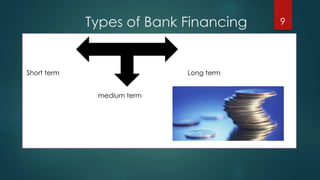
Types of Bank Financing 
Short term Long term 
medium term 
9
Short- Term Financing 
It is that form of financing which embraces borrowings or lending of funds for a 
short period of time. It relates to the finance obtained on short-term basis 
usually for one year or less than one year. It is also known as working capital i.E. 
The excess of current assets over current liabilities. Short- term financing is 
assured for financing the current assets like inventories. 
Most of the enterprises use this tool as a source of financing. Its practice is more 

in developed countries like U.S.A. Even large scale companies makes use of 
short term finance. 
10
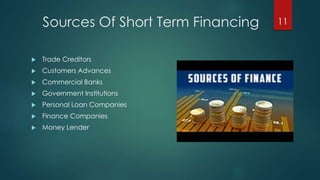
Sources Of Short Term Financing 
 Trade Creditors 
 Customers Advances 
 Commercial Banks 
 Government Institutions 
 Personal Loan Companies 
 Finance Companies 
 Money Lender 
11
Advantages of Short Term 
Financing 
 Easier to obtain 
 Flexibility 
 Convenience 
 Tax savings 
 Extension of credit 
 Lower cost 
 Availability 
12
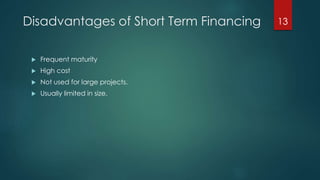
Disadvantages of Short Term Financing 
 Frequent maturity 
 High cost 
 Not used for large projects. 
 Usually limited in size. 
13
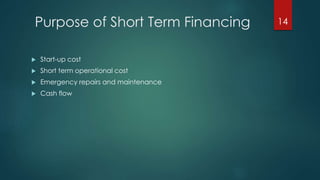
Purpose of Short Term Financing 
 Start-up cost 
 Short term operational cost 
 Emergency repairs and maintenance 
 Cash flow 
14
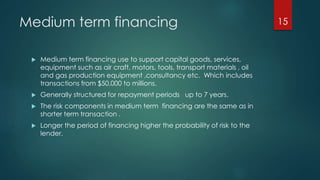
Medium term financing 
 Medium term financing use to support capital goods, services, 
equipment such as air craft, motors, tools, transport materials , oil 
and gas production equipment ,consultancy etc. Which includes 
transactions from $50,000 to millions. 
 Generally structured for repayment periods up to 7 years. 
 The risk components in medium term financing are the same as in 
shorter term transaction . 
 Longer the period of financing higher the probability of risk to the 
lender. 
15
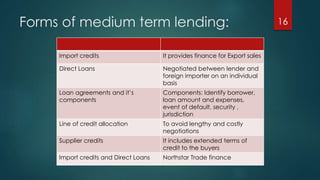
Forms of medium term lending: 
Import credits It provides finance for Export sales 
Direct Loans Negotiated between lender and 
foreign importer on an individual 
basis 
Loan agreements and it’s 
components 
Components: Identify borrower, 
loan amount and expenses, 
event of default, security , 
jurisdiction 
Line of credit allocation To avoid lengthy and costly 
negotiations 
Supplier credits It includes extended terms of 
credit to the buyers 
Import credits and Direct Loans Northstar Trade finance 
16
Forfaiting : 
It is a method of trade finance that allows exporters to obtain cash by 
selling their medium and long – term foreign accounts receivable at a 
discount on a “without resource” basis, that means forfaiter assumes and 
accepts the risk of non payment. 
Debt is usually evidenced by Bills of Exchange, Promissory Notes or a Letter 
of Credit, stand by L/C. 
Interest rates can be agreed on a fixed rate, although it can also be 
arranged on a floating interest-rate bearing basis. 
Used for larger transactions covered by series of promissory notes maturing 
semi annually for 2-5 years , sometimes only one year. 
17
Forfaiting: Pros and Cons 
Advantage: ( to exporter ) 
As the transactions are without resource, fully eliminating political, transfer 
and commercial risk of the importer. 
Gives the ability to the exporter to provide longer payment terms and 
receive the proceeds cash. 
100% financing possibility. 
Protects the exporter from future interest rate increases or exchange rate 
fluctuations. 
Importer receives additional credit through forfaiting from the exporter. 
18
Advantage: ( to bank ) 
Maximum use of credit lines, not directly used credit lines can be utilized in 
the forfaiting market. 
Ease and Simplicity of Documentation; simple and quite uniform 
documentation which eliminates legal costs each time and makes fast 
bookings possible. 
Liquid assets; in case of need the credit lines can be freed in a short term. 
Attractive Yield; trade related assets have better returns than syndicated 
loans 
19
Disadvantage : 
Cost is often higher than commercial lender financing 
Difficult to arrange for medium size business. 
Not readily available to small businesses. 
20
Export Credit Agency : 
They are traditionally viewed as lenders of last resort, though roles and 
mandates are evolving and supporting exporters in their home countries 
that could not obtain financing from other commercial sources 
Currently no single model or approach to lending across ECA 
Some continue to be direct lenders with no private sector involvement 
while others will provide guarantee to banks or other financial institutions 
that provide the actual funding. 
21
International Leasing: 
This form of financing keeps the ownership of the goods with the lender, 
while the use of goods is transferred to the borrower. 
Leases Fall into two classes: 
1. Operating : A true rental agreement where the lessor holds and 
maintains assets for the short term use of lessees. 
2. Financial : It simply acts as a lender, providing up to 100% financing for 
the asset the borrower is acquiring. 
22
Project Financing: 
It is a specialized form of lending and is tailored to unique circumstances. 
It is an arrangement whereby the lenders secure their loan by using the 
cash flow and collateral provided by the project. 
Initial security is combination of undertakings and guarantees by the 
project sponsors, which provide the lenders with a satisfactory credit risk. 
Project financing is generally employed for larger capital projects involving 
substantial risk. 
23
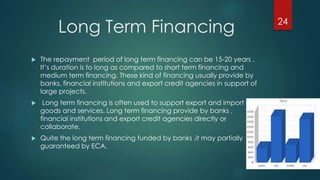
Long Term Financing 
 The repayment period of long term financing can be 15-20 years . 
It’s duration is to long as compared to short term financing and 
medium term financing. These kind of financing usually provide by 
banks, financial institutions and export credit agencies in support of 
large projects. 
 Long term financing is often used to support export and import of 
goods and services. Long term financing provide by banks , 
financial institutions and export credit agencies directly or 
collaborate. 
 Quite the long term financing funded by banks ,it may partially 
guaranteed by ECA. 
24
Long Term Financing 
 Generally ,long term financing used to purchase long term assets 
like machinery, land ,building, transportation and services like 
engineering 
services consulting services and so on. For purchasing such kind of 
assets banks provide fund to the corporations. It is very helpful for 
companies because it is not an easy for any company to invest the 
huge amount in these assets but without these assets the business 
cannot commence. 
25
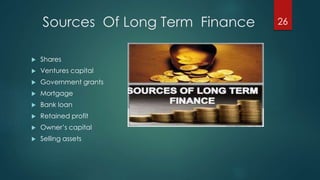
Sources Of Long Term Finance 
 Shares 
 Ventures capital 
 Government grants 
 Mortgage 
 Bank loan 
 Retained profit 
 Owner’s capital 
 Selling assets 
26
Advantage Of Long Term Financing 
 Debt is a least costly source of long term financing. It is least costly 
because.. 
Interest on debt is tax deductible 
 Debt financing provides sufficient flexibility in the financial structure 
of the company 
 Bondholders are the creditors and have no interference in business 
operations because they are not entitled to vote 
 The company can enjoy tax saving on interest on debt 
27
Disadvantage Of Long Term 
Financing 
 Interest on debt is permanent burden on the company. Company 
has to pay fix rate of interest to the creditors whether it is earning 
profit or not. 
 Debt has a fixed maturity date .Therefore ,the financial officer must 
make provision for repayment 
 Debt is the most risky source of finance because company has to 
pay interest and principal on time. 
 Only large scale ,creditworthy whose assets are good for collateral 
can raise long term finance. 
28
Purpose Of Long Term Financing 
 To finance fixed assets 
 To finance the permanent part of working capital 
 Expansion of companies 
 Increasing facilities 
 Construction projects on big scale 
29
Executive Summary 
 Chinese companies face domestic competition and slow growth in 
the developed world. Chinese companies are exploring new 
markets and acquiring advanced technology. There is a great 
increase in Chinese development when Europe outbound 
investment. European companies have been selling non core assets 
as China is always the largest export destination for Brazil , Chile and 
Peru. Energy companies in China has been used as a significant 
investor for bringing financial strength. 
 In a nutshell, we can’t imagine market entry on international level 
without the help of bank financing because it requires lot of 
investment. So, we can say bank financing plays an imperative role 
in every kind of business 
30
Relation With Topic 
 In this article, we find that the funding power of banks aid the 
business activities to a great extent .Chinese development banks 
aid the Chinese corporations to expand their business internationally 
that is why Chinese companies capturing various sectors in the 
distinct countries. 
 If we compare the Chinese investors and brazil’s then we find that 
Chinese invest $28billion in Brazil while brazil invest only $300 in 
China . Bank financing is the back bone for any kind of business, it's 
importance even incline more on international level. 
31
32
33

Banking finance

  • 1.
    BANKING FINANCE KAIVAN KANKARIYA: 000358092  SHAILJA BHATT: 000358089  ARPIT MALIK: 000357180  AMANDEEP SINGH CHEEMA: 000358037 1
  • 2.
    Table Of Content  Introduction  Key Elements  Types Of Bank Financing  Short term Bank Financing  Medium term Bank Financing  Long term Bank Financing  Conclusion 2
  • 3.
    What is Bankingfinance?  Banking refers to that process in which a bank which is a commercial or government institution offers financial services to their customers  that includes lending money , industrial loan, project finance, issue of currencies ,transaction processing etc.  The financial institutions are controlled and supervised by the rules and regulations delineated by government authorities. 3
  • 4.
    What do banklook for? Banks look for fundamentals at all tags , including: • Strong Management the bank finance • Valuation is important and key factor for financing • Initial Investment of the company • Competitive Advantage (Barriers to Entry) • Well Defined Use of Proceeds 4
  • 5.
    • Key Elementsof a bank finance • Clear, concise, quantitative calculation of project • Use of requested funds ? all expenditures related to the proposed investment • Historic (3 years back) free cash flow available • Projected (3 years forward) free cash flow available 5
  • 6.
    Financial statements, taxreturns, disclosures Demonstrated ability to comply with key loan terms Track Record • Achievable ROI (Profitability) • Growth Potential (Scalability) • Strong Financial Accounting 6
  • 7.
    The 5 C’sof Credit 1. Character : refers to the borrowers reputation 2. Capacity : measures a borrowers ability to repay a loan by comparing income against recurring debts 3.Capital :a lender will consider any capital the borrower puts towards a potential investment because a large contribution by the borrower will lessen the chance of default 7
  • 8.
    4.Collateral :property orlarge assets helps to secure the loan 5.Conditions : interest rate and amount of principle will influence the lenders desire to finance the borrower 8
  • 9.
    Types of BankFinancing Short term Long term medium term 9
  • 10.
    Short- Term Financing It is that form of financing which embraces borrowings or lending of funds for a short period of time. It relates to the finance obtained on short-term basis usually for one year or less than one year. It is also known as working capital i.E. The excess of current assets over current liabilities. Short- term financing is assured for financing the current assets like inventories. Most of the enterprises use this tool as a source of financing. Its practice is more in developed countries like U.S.A. Even large scale companies makes use of short term finance. 10
  • 11.
    Sources Of ShortTerm Financing  Trade Creditors  Customers Advances  Commercial Banks  Government Institutions  Personal Loan Companies  Finance Companies  Money Lender 11
  • 12.
    Advantages of ShortTerm Financing  Easier to obtain  Flexibility  Convenience  Tax savings  Extension of credit  Lower cost  Availability 12
  • 13.
    Disadvantages of ShortTerm Financing  Frequent maturity  High cost  Not used for large projects.  Usually limited in size. 13
  • 14.
    Purpose of ShortTerm Financing  Start-up cost  Short term operational cost  Emergency repairs and maintenance  Cash flow 14
  • 15.
    Medium term financing  Medium term financing use to support capital goods, services, equipment such as air craft, motors, tools, transport materials , oil and gas production equipment ,consultancy etc. Which includes transactions from $50,000 to millions.  Generally structured for repayment periods up to 7 years.  The risk components in medium term financing are the same as in shorter term transaction .  Longer the period of financing higher the probability of risk to the lender. 15
  • 16.
    Forms of mediumterm lending: Import credits It provides finance for Export sales Direct Loans Negotiated between lender and foreign importer on an individual basis Loan agreements and it’s components Components: Identify borrower, loan amount and expenses, event of default, security , jurisdiction Line of credit allocation To avoid lengthy and costly negotiations Supplier credits It includes extended terms of credit to the buyers Import credits and Direct Loans Northstar Trade finance 16
  • 17.
    Forfaiting : Itis a method of trade finance that allows exporters to obtain cash by selling their medium and long – term foreign accounts receivable at a discount on a “without resource” basis, that means forfaiter assumes and accepts the risk of non payment. Debt is usually evidenced by Bills of Exchange, Promissory Notes or a Letter of Credit, stand by L/C. Interest rates can be agreed on a fixed rate, although it can also be arranged on a floating interest-rate bearing basis. Used for larger transactions covered by series of promissory notes maturing semi annually for 2-5 years , sometimes only one year. 17
  • 18.
    Forfaiting: Pros andCons Advantage: ( to exporter ) As the transactions are without resource, fully eliminating political, transfer and commercial risk of the importer. Gives the ability to the exporter to provide longer payment terms and receive the proceeds cash. 100% financing possibility. Protects the exporter from future interest rate increases or exchange rate fluctuations. Importer receives additional credit through forfaiting from the exporter. 18
  • 19.
    Advantage: ( tobank ) Maximum use of credit lines, not directly used credit lines can be utilized in the forfaiting market. Ease and Simplicity of Documentation; simple and quite uniform documentation which eliminates legal costs each time and makes fast bookings possible. Liquid assets; in case of need the credit lines can be freed in a short term. Attractive Yield; trade related assets have better returns than syndicated loans 19
  • 20.
    Disadvantage : Costis often higher than commercial lender financing Difficult to arrange for medium size business. Not readily available to small businesses. 20
  • 21.
    Export Credit Agency: They are traditionally viewed as lenders of last resort, though roles and mandates are evolving and supporting exporters in their home countries that could not obtain financing from other commercial sources Currently no single model or approach to lending across ECA Some continue to be direct lenders with no private sector involvement while others will provide guarantee to banks or other financial institutions that provide the actual funding. 21
  • 22.
    International Leasing: Thisform of financing keeps the ownership of the goods with the lender, while the use of goods is transferred to the borrower. Leases Fall into two classes: 1. Operating : A true rental agreement where the lessor holds and maintains assets for the short term use of lessees. 2. Financial : It simply acts as a lender, providing up to 100% financing for the asset the borrower is acquiring. 22
  • 23.
    Project Financing: Itis a specialized form of lending and is tailored to unique circumstances. It is an arrangement whereby the lenders secure their loan by using the cash flow and collateral provided by the project. Initial security is combination of undertakings and guarantees by the project sponsors, which provide the lenders with a satisfactory credit risk. Project financing is generally employed for larger capital projects involving substantial risk. 23
  • 24.
    Long Term Financing  The repayment period of long term financing can be 15-20 years . It’s duration is to long as compared to short term financing and medium term financing. These kind of financing usually provide by banks, financial institutions and export credit agencies in support of large projects.  Long term financing is often used to support export and import of goods and services. Long term financing provide by banks , financial institutions and export credit agencies directly or collaborate.  Quite the long term financing funded by banks ,it may partially guaranteed by ECA. 24
  • 25.
    Long Term Financing  Generally ,long term financing used to purchase long term assets like machinery, land ,building, transportation and services like engineering services consulting services and so on. For purchasing such kind of assets banks provide fund to the corporations. It is very helpful for companies because it is not an easy for any company to invest the huge amount in these assets but without these assets the business cannot commence. 25
  • 26.
    Sources Of LongTerm Finance  Shares  Ventures capital  Government grants  Mortgage  Bank loan  Retained profit  Owner’s capital  Selling assets 26
  • 27.
    Advantage Of LongTerm Financing  Debt is a least costly source of long term financing. It is least costly because.. Interest on debt is tax deductible  Debt financing provides sufficient flexibility in the financial structure of the company  Bondholders are the creditors and have no interference in business operations because they are not entitled to vote  The company can enjoy tax saving on interest on debt 27
  • 28.
    Disadvantage Of LongTerm Financing  Interest on debt is permanent burden on the company. Company has to pay fix rate of interest to the creditors whether it is earning profit or not.  Debt has a fixed maturity date .Therefore ,the financial officer must make provision for repayment  Debt is the most risky source of finance because company has to pay interest and principal on time.  Only large scale ,creditworthy whose assets are good for collateral can raise long term finance. 28
  • 29.
    Purpose Of LongTerm Financing  To finance fixed assets  To finance the permanent part of working capital  Expansion of companies  Increasing facilities  Construction projects on big scale 29
  • 30.
    Executive Summary Chinese companies face domestic competition and slow growth in the developed world. Chinese companies are exploring new markets and acquiring advanced technology. There is a great increase in Chinese development when Europe outbound investment. European companies have been selling non core assets as China is always the largest export destination for Brazil , Chile and Peru. Energy companies in China has been used as a significant investor for bringing financial strength.  In a nutshell, we can’t imagine market entry on international level without the help of bank financing because it requires lot of investment. So, we can say bank financing plays an imperative role in every kind of business 30
  • 31.
    Relation With Topic  In this article, we find that the funding power of banks aid the business activities to a great extent .Chinese development banks aid the Chinese corporations to expand their business internationally that is why Chinese companies capturing various sectors in the distinct countries.  If we compare the Chinese investors and brazil’s then we find that Chinese invest $28billion in Brazil while brazil invest only $300 in China . Bank financing is the back bone for any kind of business, it's importance even incline more on international level. 31
  • 32.
  • 33.