short stature
A diagnostic approach
DR: MH RADI
SENIOR REGISTRAR OF PEDIATRICS
INTRODUCTION
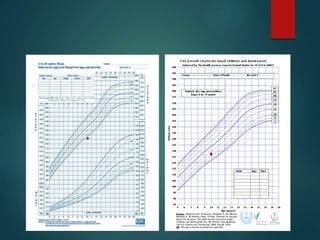
 Short stature is defined as a height that is
2 standard deviations (SD) or more below the
mean height for individuals of the same sex and
chronologic age in a given population.
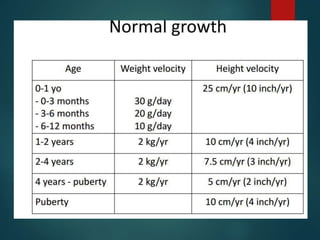
NORMAL GROWTH
 In general, a normal pattern of growth suggests good health.
 Slow growth rate raises the possibility of an underlying pathological
cause of growth failure.
 Statural growth is a continuous but not linear process.
 There are three phases of postnatal growth (infantile, childhood, and
pubertal),
 each of which has a distinctive pattern [5]. The phases are similar for
boys and girls, but the timing and pace of growth differ, particularly
during puberty.
NORMAL
GROWTH
GENETIC
NUTRITINA
L
ENDOCRAINALENVIROMENAL
METABOLIC
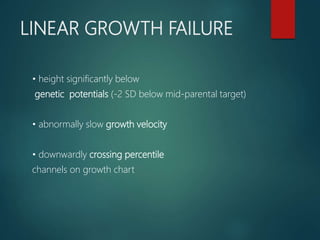
LINEAR GROWTH FAILURE
• height significantly below
genetic potentials (-2 SD below mid-parental target)
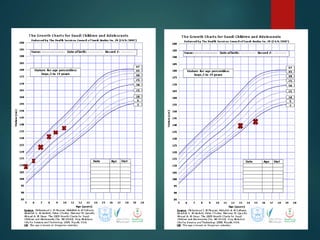
• abnormally slow growth velocity
• downwardly crossing percentile
channels on growth chart
EVALUATION OF GROWTH
 ●How short is the child?
 ●Is the child's height velocity (HV) impaired?
 ●What is the child's likely adult height?
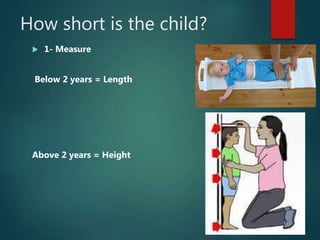
How short is the child?
 1- Measure
Below 2 years = Length
Above 2 years = Height
 Proportionate ?
 Upper segment : Lower segment
** (substract lower segment from total height)
 At birth = 1.7
 At 3 years = 1.3
 At Puberty = 1
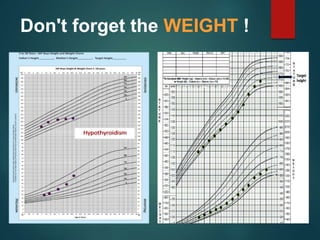
Don't forget the WEIGHT !
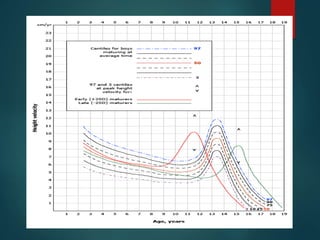
Is the child's height velocity
impaired?
 serial measurements of height, which should be
measured along with weight at each well-child visit can
be considered a "vital sign“
 PATHOLOGIC VS nonpathologic
 HV between the 10th and 25th percentile should raise
concern for possible growth failure, and an HV below
the 10th percentile warrants a thorough evaluation for
growth failure.
What is the child's likely
adult height?
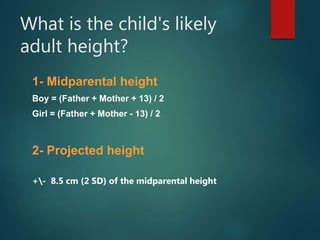
1- Midparental height
Boy = (Father + Mother + 13) / 2
Girl = (Father + Mother - 13) / 2
2- Projected height
+- 8.5 cm (2 SD) of the midparental height
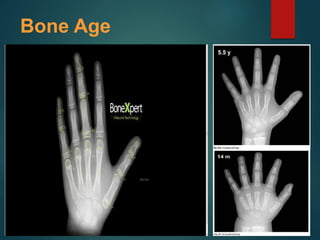
Bone Age
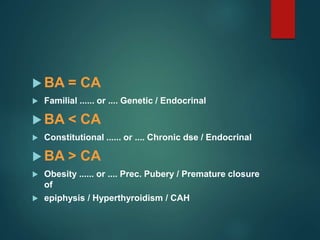
 BA = CA
 Familial ...... or .... Genetic / Endocrinal
 BA < CA
 Constitutional ...... or .... Chronic dse / Endocrinal
 BA > CA
 Obesity ...... or .... Prec. Pubery / Premature closure
of
 epiphysis / Hyperthyroidism / CAH
ADDITIONAL EVALUATION
 In addition to the evaluation of growth outlined
above, a focused history and physical examination
contribute information that helps to categorize the
cause of short stature
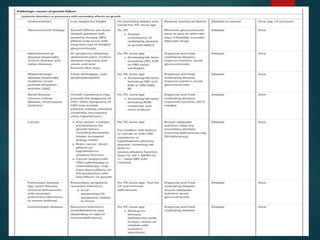
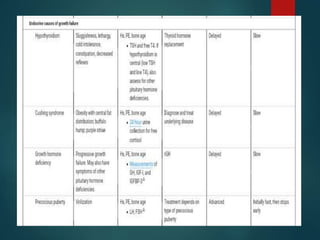
CAUSES
Investigations
 A basic evaluation : bone age determination is
appropriate for children with short stature, normal
growth rate and no other symptoms
 Broader testing: severely short (eg, height ≤-2.5
standard deviations [SD, 0.6th percentile]), has growth
failure
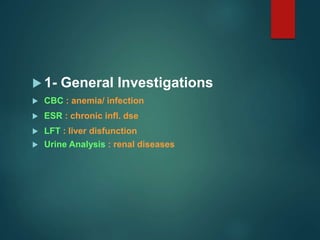
 1- General Investigations
 CBC : anemia/ infection
 ESR : chronic infl. dse
 LFT : liver disfunction
 Urine Analysis : renal diseases
 Celiac serologies (eg, tissue transglutaminase [tTG]
immunoglobulin A [IgA] and total IgA)
 •Thyroid stimulating hormone (TSH), free thyroxine (T4)
 Karyotype (in all girls, to rule out Turner syndrome, and in
boys with associated genital abnormalities)
 , insulin-like growth factor-I (IGF-I), and insulin-like
growth factor binding protein 3 (IGFBP-3). •Karyotype (in
all girls, to rule out Turner syndrome, and in boys with
associated genital abnormalities).
 •Morning luteinizing hormone (LH) and follicle-
stimulating hormone (FSH) in children with signs of sexual
precocity
Management
 • treat underlying cause.
 • psychological support for non-treatable
causes.
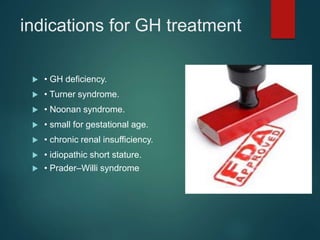
indications for GH treatment
 • GH deficiency.
 • Turner syndrome.
 • Noonan syndrome.
 • small for gestational age.
 • chronic renal insufficiency.
 • idiopathic short stature.
 • Prader–Willi syndrome
GH treatment
 GH dose: 0.18 - 0.3 mg/kg/day (0.5 - 1.0
units/kg/wk) at night.
 GH treatment should start with low
doses and be titrated according to
Clinical
 patients should be monitored at 3-
month intervals
when to stop
 continue treatment till child reaches
near final height.
 a height velocity of < 2cm / year over
at least 9 months .
 bone age >13 years in girls and >14
years in boys.
complications
 • increased intracranial pressure.
 • Impaired GLUCOSE TOLERANCE TEST
 joint pain, muscle pain.
 carpal tunnel syndrome.
 Pancreatitis.
 Scoliosis.
 Increased risk of recurrence of
neoplasim.
Gallery
Genghis Khan
Voltaire
Pablo Picasso
Short stature a Diagnostic approach

Short stature a Diagnostic approach

  • 1.
    short stature A diagnosticapproach DR: MH RADI SENIOR REGISTRAR OF PEDIATRICS
  • 2.
    INTRODUCTION  Short statureis defined as a height that is 2 standard deviations (SD) or more below the mean height for individuals of the same sex and chronologic age in a given population.
  • 4.
    NORMAL GROWTH  Ingeneral, a normal pattern of growth suggests good health.  Slow growth rate raises the possibility of an underlying pathological cause of growth failure.  Statural growth is a continuous but not linear process.  There are three phases of postnatal growth (infantile, childhood, and pubertal),  each of which has a distinctive pattern [5]. The phases are similar for boys and girls, but the timing and pace of growth differ, particularly during puberty.
  • 5.
  • 7.
    LINEAR GROWTH FAILURE •height significantly below genetic potentials (-2 SD below mid-parental target) • abnormally slow growth velocity • downwardly crossing percentile channels on growth chart
  • 10.
    EVALUATION OF GROWTH ●How short is the child?  ●Is the child's height velocity (HV) impaired?  ●What is the child's likely adult height?
  • 11.
    How short isthe child?  1- Measure Below 2 years = Length Above 2 years = Height
  • 12.
     Proportionate ? Upper segment : Lower segment ** (substract lower segment from total height)  At birth = 1.7  At 3 years = 1.3  At Puberty = 1
  • 13.
  • 14.
    Is the child'sheight velocity impaired?  serial measurements of height, which should be measured along with weight at each well-child visit can be considered a "vital sign“  PATHOLOGIC VS nonpathologic  HV between the 10th and 25th percentile should raise concern for possible growth failure, and an HV below the 10th percentile warrants a thorough evaluation for growth failure.
  • 15.
    What is thechild's likely adult height? 1- Midparental height Boy = (Father + Mother + 13) / 2 Girl = (Father + Mother - 13) / 2 2- Projected height +- 8.5 cm (2 SD) of the midparental height
  • 16.
  • 17.
     BA =CA  Familial ...... or .... Genetic / Endocrinal  BA < CA  Constitutional ...... or .... Chronic dse / Endocrinal  BA > CA  Obesity ...... or .... Prec. Pubery / Premature closure of  epiphysis / Hyperthyroidism / CAH
  • 18.
    ADDITIONAL EVALUATION  Inaddition to the evaluation of growth outlined above, a focused history and physical examination contribute information that helps to categorize the cause of short stature
  • 19.
  • 23.
    Investigations  A basicevaluation : bone age determination is appropriate for children with short stature, normal growth rate and no other symptoms  Broader testing: severely short (eg, height ≤-2.5 standard deviations [SD, 0.6th percentile]), has growth failure
  • 24.
     1- GeneralInvestigations  CBC : anemia/ infection  ESR : chronic infl. dse  LFT : liver disfunction  Urine Analysis : renal diseases
  • 25.
     Celiac serologies(eg, tissue transglutaminase [tTG] immunoglobulin A [IgA] and total IgA)  •Thyroid stimulating hormone (TSH), free thyroxine (T4)  Karyotype (in all girls, to rule out Turner syndrome, and in boys with associated genital abnormalities)  , insulin-like growth factor-I (IGF-I), and insulin-like growth factor binding protein 3 (IGFBP-3). •Karyotype (in all girls, to rule out Turner syndrome, and in boys with associated genital abnormalities).  •Morning luteinizing hormone (LH) and follicle- stimulating hormone (FSH) in children with signs of sexual precocity
  • 26.
    Management  • treatunderlying cause.  • psychological support for non-treatable causes.
  • 27.
    indications for GHtreatment  • GH deficiency.  • Turner syndrome.  • Noonan syndrome.  • small for gestational age.  • chronic renal insufficiency.  • idiopathic short stature.  • Prader–Willi syndrome
  • 28.
    GH treatment  GHdose: 0.18 - 0.3 mg/kg/day (0.5 - 1.0 units/kg/wk) at night.  GH treatment should start with low doses and be titrated according to Clinical  patients should be monitored at 3- month intervals
  • 29.
    when to stop continue treatment till child reaches near final height.  a height velocity of < 2cm / year over at least 9 months .  bone age >13 years in girls and >14 years in boys.
  • 30.
    complications  • increasedintracranial pressure.  • Impaired GLUCOSE TOLERANCE TEST  joint pain, muscle pain.  carpal tunnel syndrome.  Pancreatitis.  Scoliosis.  Increased risk of recurrence of neoplasim.
  • 31.
  • 32.