1. NURUL MIZA SHASHEIHA BINTI ABDUL MUTALIB
2. NURUL HUSNA BINTI MURYADI
3. WAN FATHIAH NASUHA BT WAN NUSDRI
4. NURFATIN AFIQAH BT MOHD BADRONDIN
5. ZATEEL FAHADA BT RUSLI
6. NURUL FIRDAUS BT HANAFEE
7. NURUL SAHIIRAH BT AHMAD ROFI
8. WAN FARAH NASUHA BT WAN MUHAMMAD HUSNI
INTRODUCTION
• WHAT IS TERATOGEN ?
• TERATOGENIC DRUG
• FDA PREGNANCY CATEGORIES
• GENERAL MECHANISMS OF ACTION OF
TERATOGENIC DRUGS
• TERATOGENIC MECHANISMS OF MEDICAL
DRUGS
TERATOGEN
• Is an agent that can
disturb the
development of the
embryo or fetus
• Teratogens halt the
pregnancy or
produce a
congenital
malformation
• Include radiation,
maternal infections,
chemicals, and
drugs.
• directly or indirectly,
causes a structural or
functional change in the
fetus or child if it is
administrated to pregnant
mother
• If mother is taking this
drug, It can be either
stopped, switched or
reduced to the lowest
dose possible
• typically during sensitive
periods of fetal
development
• depending on the
particular teratogenic
process and target organ
TERATOGENIC
DRUG
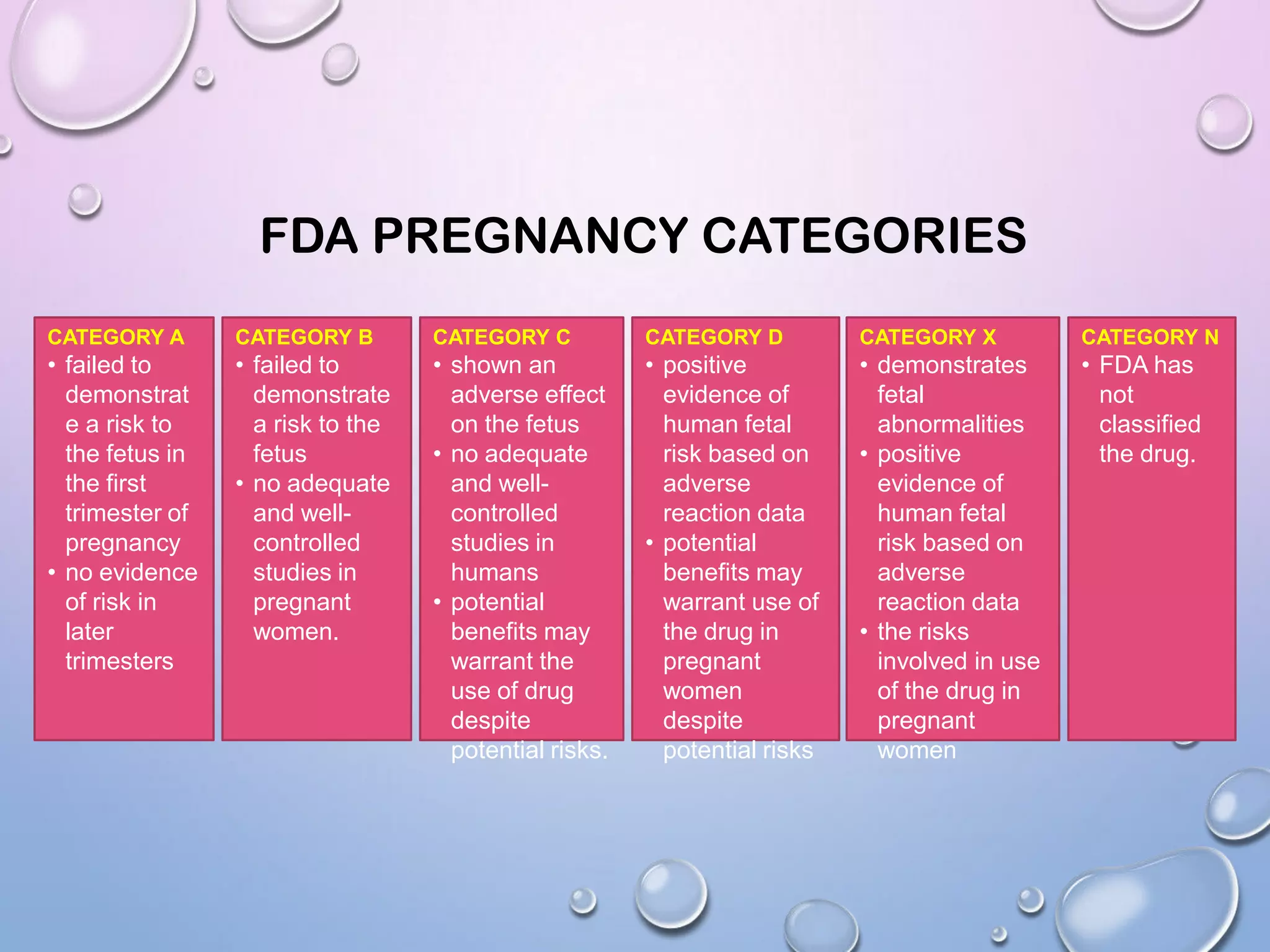
FDA PREGNANCY CATEGORIES
CATEGORY A
• failed to
demonstrat
e a risk to
the fetus in
the first
trimester of
pregnancy
• no evidence
of risk in
later
trimesters
CATEGORY C
• shown an
adverse effect
on the fetus
• no adequate
and well-
controlled
studies in
humans
• potential
benefits may
warrant the
use of drug
despite
potential risks.
CATEGORY D
• positive
evidence of
human fetal
risk based on
adverse
reaction data
• potential
benefits may
warrant use of
the drug in
pregnant
women
despite
potential risks
CATEGORY B
• failed to
demonstrate
a risk to the
fetus
• no adequate
and well-
controlled
studies in
pregnant
women.
CATEGORY X
• demonstrates
fetal
abnormalities
• positive
evidence of
human fetal
risk based on
adverse
reaction data
• the risks
involved in use
of the drug in
pregnant
women
CATEGORY N
• FDA has
not
classified
the drug.
POSSIBLE SITES OF
ACTION OF TERATOGEN
DIRECT
TOXIC
ACTION
• FETUS:
-Direct toxicity.
-Metabolites toxic.
-Indirectly toxic, e.g.
anti-metabolites, anti-
vitamin.
-Pharmacodynamic
actions, e.g. on
cardiovascular system.
-Endocrine balance
altered
• FAETOPLACENTAL
UNIT:
-Umbilical cord, e.g.
spasm.
-Amniotic fluid volume
change.
-Faetal or maternal
placental blood flow.
-Placental transfer of
• MOTHER:
-Nutritional changes,
e.g. vitamin or
mineral deficiencies.
-Biochemical
changes with
secondary effects on
the foetus, e.g.
hyperglycaemia.
-Endocrine balance
• FATHER:
-Sperm changes
INDIRECT
TOXIC
ACTION
• Cause malformation
-interfering with
faetal metabolism
• Drugs:
-folic acid
antagonists
-antiepileptic drugs
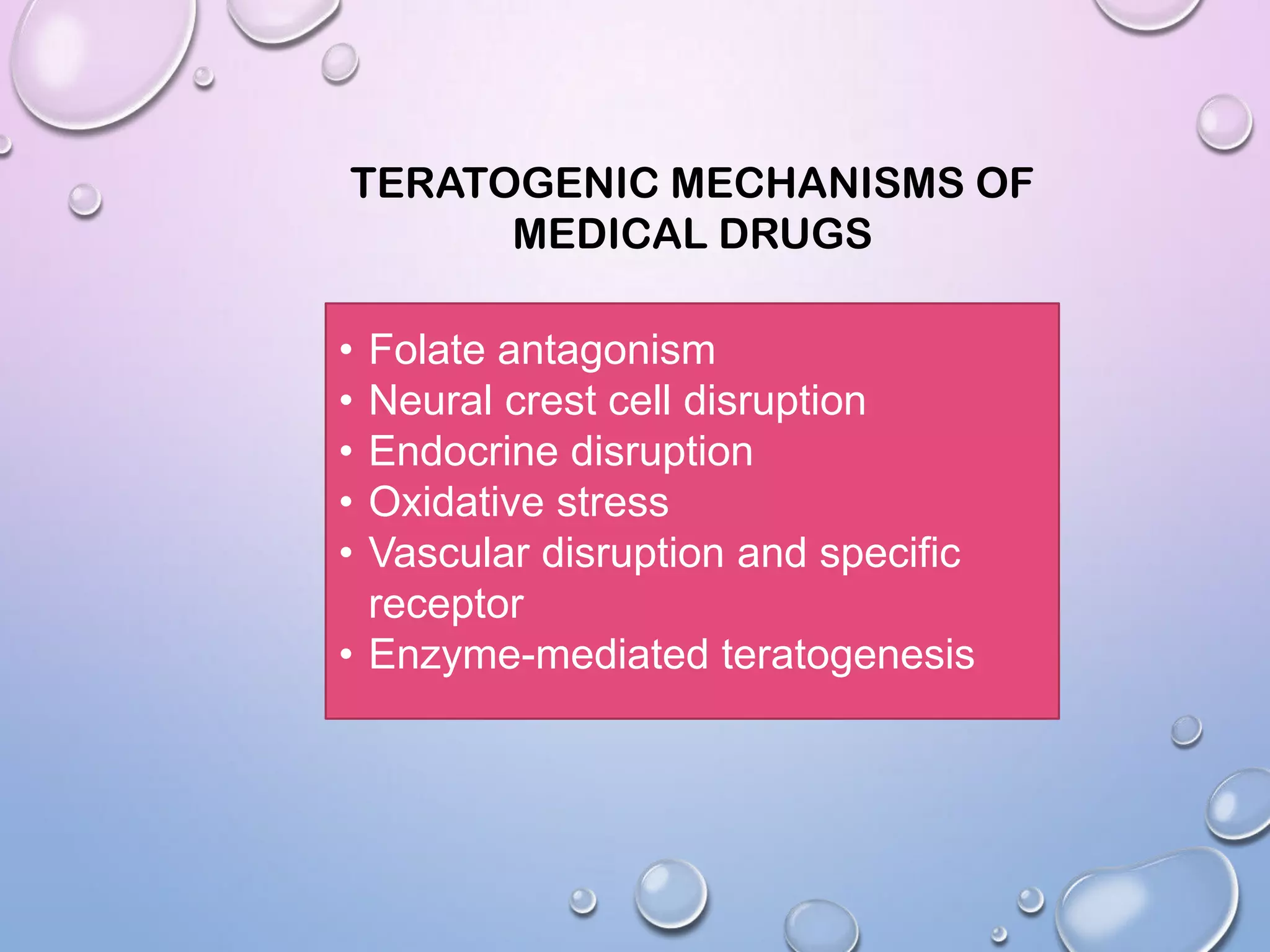
TERATOGENIC MECHANISMS OF
MEDICAL DRUGS
• Folate antagonism
• Neural crest cell disruption
• Endocrine disruption
• Oxidative stress
• Vascular disruption and specific
receptor
• Enzyme-mediated teratogenesis
•Analgesic
•Anticonvulsant
•Anticoagulant
•Antidepressant
•Antithyroid
•Vitamin A
•Metal toxic
•Sedative/ hypnotics
•Aminoglycosides
• Gastroschisis
• Decrease prostaglandin  decrease uterine
contraction delayed onset of labor & prolonged
period of pregnancy
• During delivery severe bleeding because aspirin
decrease platelet aggregation
• Fetal hydantoin syndrome :
 cranio facial malformation:
-Cleft lip and palate
-Broad nasal bridge
-Ocular hypertelorism
-Abnormal ears
 congenital heart disease
 limb malformation
 mental and growth retardation
• Fetal wafarin syndrome:
-Nasal hypoplasia
-Bone stippling
-Bilateral optic atrophy
-Mental retardation
• Respiratory distress syndrome
• Fetal and maternal hemorrhage
• Cleft palate
• Defect in abdomen
• Adrenal hypoplasia
• Cardiovascular defect
• Fetal goiter
• Cranio-facial dysmorphism
• Cleft palate
• Thymic aplasia
• Neural tube defect ( spina bifida cystic )
• Hypotonia
• Cyanosis
• Lethargy
• Poor respiratory
• Cleft lip and palate
• Inguinal hernia
• Congenital heart disease
• Pyloric stenosis
• Breathing difficulties
• Congenital deafness
• Ototoxicity
TERATOGENIC
DRUGS IN SECOND
TRIMESTER OF
PREGNANCY
ACE INHIBITORS
DIAZEPAM
1) ACE INHIBITOR
MECHANISM OF ACTIONS
Produce vasodilatation by
1-inhibitting formation of
angiotensin 11
2- breakdown bradykinin
PHARMACOLOGICAL ACTION
 Mixed vasodilator
 In cases of heart failure, cardiac output is
maintained / even increase
 Increase renal blood flow BUT decrease glomerular
filtration rate decrease glomerular
hypertension
THERAPEUTIC USES
USED IN
 Hypertension
 Heart failure
 Myocardial infarction
SIDE EFFECTS
 IF USED IN 2ND – 3RD TRIMESTER OF PREGNANCY
1- fetal hypotension
2- renal failure
3- oligohydromnios
4- death
3rd tri
2) DIAZEPAM
 Centrally acting spasmolytic drug
 It facilitates action of GABA in CNS
 It acts as GABA synapse and produce sedation at
doses required to reduce muscles tone
PHARMACOKINETICS
 ABSORPTION:
- Delayed and decreased when administered with a
moderate fat meal
 DISTRIBUTION
- Highly bound to plasma protein
- Cross blood brain barrier
- Cross placental barrier
- Found in milk
 METABOLISM
N-demythylated
Diazepam N-desmethyldiazepam
further metabolised
hydroxylated
temazepam oxazepam
 Temazepam and oxazepam are largely eliminated
by glucoronidation
ELIMINATION
 The initial distribution phase is followed by
prolonged elimination phase
SIDE EFFECTS
 RISKS OF…
1) cleft palate
2) cardiac and circulatory defects
1) TETRACYCLINE
 Protein synthesis inhibitor
 Inhibit the binding of aminoacyl-tRNA to the mRNA-
ribosomes complex
Aminoacyl-tRNA mRNA-ribosomes complex
by binding to the 30S ribosomal subunit in mRNA
translation complex
SIDE EFFECTS
 IN PREGNANCY…..
 dental discolouration in chilren
 maternal hepatotoxicity with large parenteral doses
2) ACE INHIBITORS
 AS IN SECOND TRIMESTER
 Ace inhibitors in 2nd trimester
3) CHLORAMPHENICOL
 Bacteriostatic drug that stop bacterial growth by
inhibiting protein synthesis
 Prevent protein chain elongation by inhibiting
peptidyl transferase activity of bacterial chromosome
 Intravenous chloramphenicol use has been associated
with Gray Baby syndrome
 This occur in newborn infants because they liver
enzymes not yet fully developed
chloramphenicol remains
unmetabolised in body
ADVERSE EFFECTS
 Hypotension
 Cyanosis
The condition can be prevented by using the drug at
recommended doses & monitoring blood levels
Gray Baby Syndrome
4) AMINOGLYCOSIDES
 EG: GENTAMICIN, STREPTOMYCIN
 Have several potential antibiotic mechanisms
 They interfere with the proofreading process
increased rate of error in synthesis with
premature termination
 Inhibition of ribosomal translocation
peptidyl tRNA moves from A-site to P-
site
 Disrupt the integrity of the bacterial cell membrane
 Aminoglycosides are in pregnancy category D
 They may cause auditory or vestibular nerve damage
5) SULFAMETHOXAZOLE,
TRIMETHOPRIM
 Sulfonamide bacteriostatic antibiotic
 Structural analogs and competitive antagonist of PABA
 Inhibit normal bacterial utilisation of PABA for the
synthesis of folic acid
 Used as a bacteriostatic antibiotic in prophylaxis and
treatment of urinary tract infections
 Trimethoprim binds to dihydrofolate redustase and
inhibit reduction of DHF to THF
 Sulfamethoxazole inhibit dihydrofolate synthetase
TERATOGENIC EFFECTS
 1) NEONATAL HAEMOLYSIS
 2)METHAEMOGLOBINAEMIA
•BE CAREFUL IN TAKING DRUGS DURING
PREGNANCY
•ALL CLINICIANS INCLUDING PHARMACISTS ARE
RESPONSIBLE TO COUNSEL PATIENTS WITH
COMPLETE , ACCURATE AND CURRENT
INFORMATION ON THE RISKS AND BENEFITS OF
USING MEDICATIONS DURING PREGNANCY
Teratogenic drugs

Teratogenic drugs

  • 1.
    1. NURUL MIZASHASHEIHA BINTI ABDUL MUTALIB 2. NURUL HUSNA BINTI MURYADI 3. WAN FATHIAH NASUHA BT WAN NUSDRI 4. NURFATIN AFIQAH BT MOHD BADRONDIN 5. ZATEEL FAHADA BT RUSLI 6. NURUL FIRDAUS BT HANAFEE 7. NURUL SAHIIRAH BT AHMAD ROFI 8. WAN FARAH NASUHA BT WAN MUHAMMAD HUSNI
  • 2.
    INTRODUCTION • WHAT ISTERATOGEN ? • TERATOGENIC DRUG • FDA PREGNANCY CATEGORIES • GENERAL MECHANISMS OF ACTION OF TERATOGENIC DRUGS • TERATOGENIC MECHANISMS OF MEDICAL DRUGS
  • 3.
    TERATOGEN • Is anagent that can disturb the development of the embryo or fetus • Teratogens halt the pregnancy or produce a congenital malformation • Include radiation, maternal infections, chemicals, and drugs. • directly or indirectly, causes a structural or functional change in the fetus or child if it is administrated to pregnant mother • If mother is taking this drug, It can be either stopped, switched or reduced to the lowest dose possible • typically during sensitive periods of fetal development • depending on the particular teratogenic process and target organ TERATOGENIC DRUG
  • 4.
    FDA PREGNANCY CATEGORIES CATEGORYA • failed to demonstrat e a risk to the fetus in the first trimester of pregnancy • no evidence of risk in later trimesters CATEGORY C • shown an adverse effect on the fetus • no adequate and well- controlled studies in humans • potential benefits may warrant the use of drug despite potential risks. CATEGORY D • positive evidence of human fetal risk based on adverse reaction data • potential benefits may warrant use of the drug in pregnant women despite potential risks CATEGORY B • failed to demonstrate a risk to the fetus • no adequate and well- controlled studies in pregnant women. CATEGORY X • demonstrates fetal abnormalities • positive evidence of human fetal risk based on adverse reaction data • the risks involved in use of the drug in pregnant women CATEGORY N • FDA has not classified the drug.
  • 5.
    POSSIBLE SITES OF ACTIONOF TERATOGEN DIRECT TOXIC ACTION • FETUS: -Direct toxicity. -Metabolites toxic. -Indirectly toxic, e.g. anti-metabolites, anti- vitamin. -Pharmacodynamic actions, e.g. on cardiovascular system. -Endocrine balance altered • FAETOPLACENTAL UNIT: -Umbilical cord, e.g. spasm. -Amniotic fluid volume change. -Faetal or maternal placental blood flow. -Placental transfer of • MOTHER: -Nutritional changes, e.g. vitamin or mineral deficiencies. -Biochemical changes with secondary effects on the foetus, e.g. hyperglycaemia. -Endocrine balance • FATHER: -Sperm changes INDIRECT TOXIC ACTION • Cause malformation -interfering with faetal metabolism • Drugs: -folic acid antagonists -antiepileptic drugs
  • 6.
    TERATOGENIC MECHANISMS OF MEDICALDRUGS • Folate antagonism • Neural crest cell disruption • Endocrine disruption • Oxidative stress • Vascular disruption and specific receptor • Enzyme-mediated teratogenesis
  • 7.
  • 8.
    • Gastroschisis • Decreaseprostaglandin  decrease uterine contraction delayed onset of labor & prolonged period of pregnancy • During delivery severe bleeding because aspirin decrease platelet aggregation
  • 9.
    • Fetal hydantoinsyndrome :  cranio facial malformation: -Cleft lip and palate -Broad nasal bridge -Ocular hypertelorism -Abnormal ears  congenital heart disease  limb malformation  mental and growth retardation
  • 10.
    • Fetal wafarinsyndrome: -Nasal hypoplasia -Bone stippling -Bilateral optic atrophy -Mental retardation • Respiratory distress syndrome • Fetal and maternal hemorrhage
  • 11.
    • Cleft palate •Defect in abdomen • Adrenal hypoplasia • Cardiovascular defect
  • 12.
  • 13.
    • Cranio-facial dysmorphism •Cleft palate • Thymic aplasia • Neural tube defect ( spina bifida cystic )
  • 14.
    • Hypotonia • Cyanosis •Lethargy • Poor respiratory
  • 15.
    • Cleft lipand palate • Inguinal hernia • Congenital heart disease • Pyloric stenosis • Breathing difficulties
  • 16.
  • 17.
  • 18.
  • 19.
    1) ACE INHIBITOR MECHANISMOF ACTIONS Produce vasodilatation by 1-inhibitting formation of angiotensin 11 2- breakdown bradykinin
  • 20.
    PHARMACOLOGICAL ACTION  Mixedvasodilator  In cases of heart failure, cardiac output is maintained / even increase  Increase renal blood flow BUT decrease glomerular filtration rate decrease glomerular hypertension
  • 21.
    THERAPEUTIC USES USED IN Hypertension  Heart failure  Myocardial infarction
  • 22.
    SIDE EFFECTS  IFUSED IN 2ND – 3RD TRIMESTER OF PREGNANCY 1- fetal hypotension 2- renal failure 3- oligohydromnios 4- death 3rd tri
  • 23.
    2) DIAZEPAM  Centrallyacting spasmolytic drug  It facilitates action of GABA in CNS  It acts as GABA synapse and produce sedation at doses required to reduce muscles tone
  • 24.
    PHARMACOKINETICS  ABSORPTION: - Delayedand decreased when administered with a moderate fat meal  DISTRIBUTION - Highly bound to plasma protein - Cross blood brain barrier - Cross placental barrier - Found in milk
  • 25.
     METABOLISM N-demythylated Diazepam N-desmethyldiazepam furthermetabolised hydroxylated temazepam oxazepam  Temazepam and oxazepam are largely eliminated by glucoronidation
  • 26.
    ELIMINATION  The initialdistribution phase is followed by prolonged elimination phase
  • 27.
    SIDE EFFECTS  RISKSOF… 1) cleft palate 2) cardiac and circulatory defects
  • 30.
    1) TETRACYCLINE  Proteinsynthesis inhibitor  Inhibit the binding of aminoacyl-tRNA to the mRNA- ribosomes complex Aminoacyl-tRNA mRNA-ribosomes complex by binding to the 30S ribosomal subunit in mRNA translation complex
  • 31.
    SIDE EFFECTS  INPREGNANCY…..  dental discolouration in chilren  maternal hepatotoxicity with large parenteral doses
  • 32.
    2) ACE INHIBITORS AS IN SECOND TRIMESTER  Ace inhibitors in 2nd trimester
  • 33.
    3) CHLORAMPHENICOL  Bacteriostaticdrug that stop bacterial growth by inhibiting protein synthesis  Prevent protein chain elongation by inhibiting peptidyl transferase activity of bacterial chromosome  Intravenous chloramphenicol use has been associated with Gray Baby syndrome  This occur in newborn infants because they liver enzymes not yet fully developed chloramphenicol remains unmetabolised in body
  • 34.
    ADVERSE EFFECTS  Hypotension Cyanosis The condition can be prevented by using the drug at recommended doses & monitoring blood levels Gray Baby Syndrome
  • 35.
    4) AMINOGLYCOSIDES  EG:GENTAMICIN, STREPTOMYCIN  Have several potential antibiotic mechanisms  They interfere with the proofreading process increased rate of error in synthesis with premature termination  Inhibition of ribosomal translocation peptidyl tRNA moves from A-site to P- site  Disrupt the integrity of the bacterial cell membrane
  • 36.
     Aminoglycosides arein pregnancy category D  They may cause auditory or vestibular nerve damage
  • 37.
    5) SULFAMETHOXAZOLE, TRIMETHOPRIM  Sulfonamidebacteriostatic antibiotic  Structural analogs and competitive antagonist of PABA  Inhibit normal bacterial utilisation of PABA for the synthesis of folic acid  Used as a bacteriostatic antibiotic in prophylaxis and treatment of urinary tract infections
  • 38.
     Trimethoprim bindsto dihydrofolate redustase and inhibit reduction of DHF to THF  Sulfamethoxazole inhibit dihydrofolate synthetase
  • 39.
    TERATOGENIC EFFECTS  1)NEONATAL HAEMOLYSIS  2)METHAEMOGLOBINAEMIA
  • 40.
    •BE CAREFUL INTAKING DRUGS DURING PREGNANCY •ALL CLINICIANS INCLUDING PHARMACISTS ARE RESPONSIBLE TO COUNSEL PATIENTS WITH COMPLETE , ACCURATE AND CURRENT INFORMATION ON THE RISKS AND BENEFITS OF USING MEDICATIONS DURING PREGNANCY