INDEX
1. Introduction
2. Objective and Aims
3. Technology
4. Electrifying Rural in India
5. Features of RE Sources
6. Benefits
7. Drawbacks
8. Policies
9. Conclusion
10.References
Introduction
• Rural electrification is the process of bringing
electrical power to rural and remote areas.
•Electricity is used for lighting and household
purposes also.
•Allows for mechanization of many farming
operations, such as threshing, milking, and
hoisting grain for storage.
•Is of great use in areas of labour shortage.
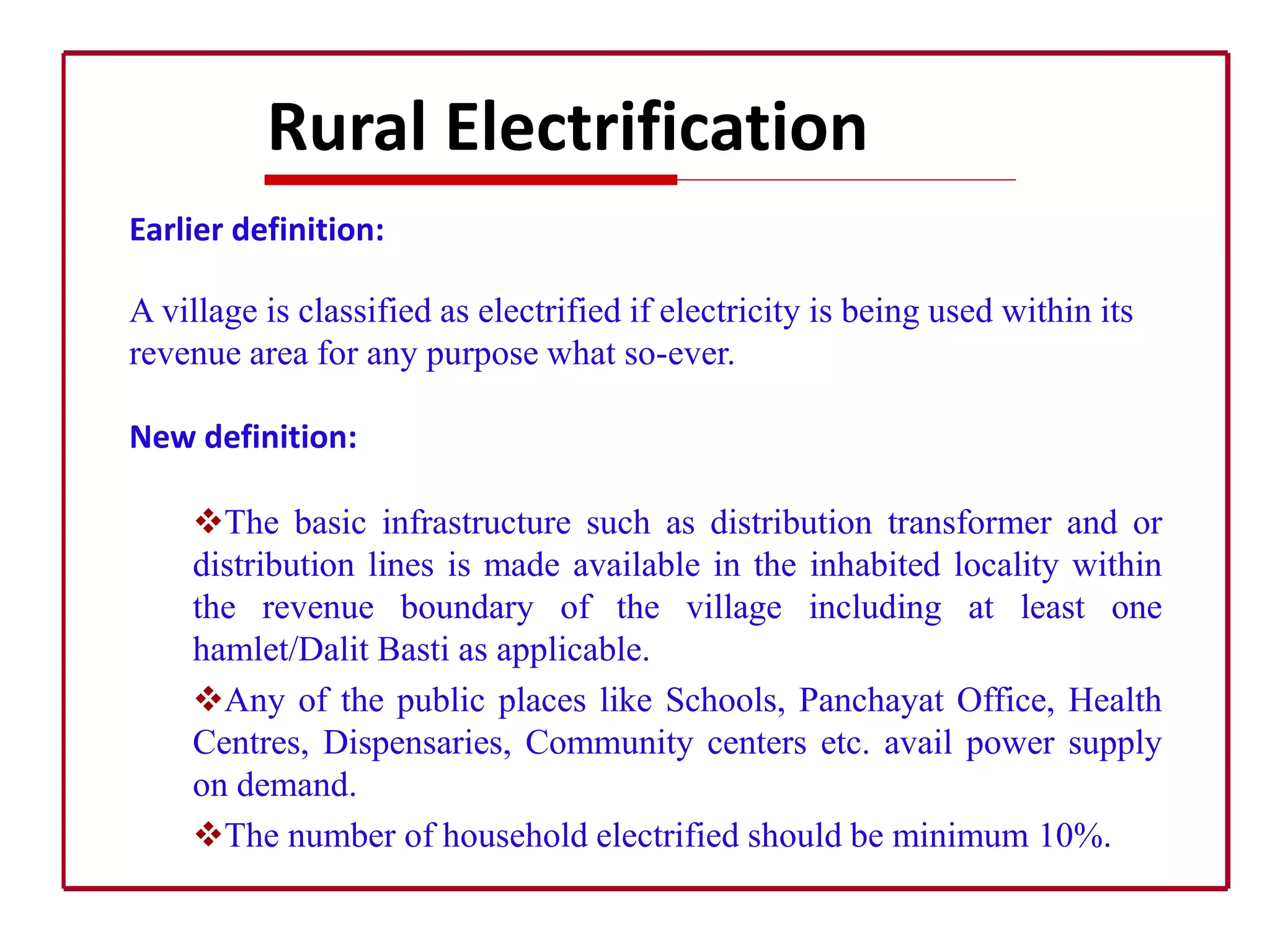
Rural Electrification
Earlier definition:
A village is classified as electrified if electricity is being used within its
revenue area for any purpose what so-ever.
New definition:
The basic infrastructure such as distribution transformer and or
distribution lines is made available in the inhabited locality within
the revenue boundary of the village including at least one
hamlet/Dalit Basti as applicable.
Any of the public places like Schools, Panchayat Office, Health
Centres, Dispensaries, Community centers etc. avail power supply
on demand.
The number of household electrified should be minimum 10%.
Electrification of Households
Overall
electrification in
the country

No.
Households

Percentage

Total no. of
Households

138.27 million

Households electrified

60.18 million

43.5%

Households yet to be
electrified

78.09 million

56.5%
Status of Village Electrification
As on 31.10.2009
700000

593732
497375

600000
500000
400000
300000

96357

200000
100000
0

Total Villages

Electrified
Villages

Unelectrified
Villages
OBJECTIVES
Rural electrification is a big challenge today.
The main objective is to have :• Sustained
• Affordable
• Quality Access to electricity
Through planning of participative programs
and monitoring efforts at the community level.
• 56% of rural households which have not yet been
electrified even though these are willing to pay tariff
for it, should be electrified.
• Ensuring Secured Electricity access to all households
including poor and marginal sections of the society.
• Special attention given to household electrification to
dalitbastis, tribal area and weaker sections.
• Appropriate cooperation among various agencies of
the State and Central Govt. and the community is
needed.
• Education and awareness programmes would be
essential for creating demand for electricity
Technology
• One of the least expensive, most reliable, and
best proven mains electricity distribution systems
for rural electrification is single wire earth return.
• Locally generated renewable energy is an
alternative technology, particularly compared to
electrification with diesel generators.
• In some countries (particularly Bangladesh and
India) hundreds of thousands of Solar Home
Systems have been installed in the last years.
•Most of these systems provide electricity for
lighting and some small appliances (radio, TV).
•Mini-grids (central generation and village
wide distribution network) can be a more
potent alternative to energy home systems
since they can provide capacity for the
productive use of electricity (small
businesses).
•Hybrid mini-grids (renewables combined with
diesel generators) are a widely acknowledged
technology for rural electrification in
developing countries.
Single Wire Earth Return
Use of HDVC System
• Many High-Voltage Direct Current systems using
submarine power cables are single wire earth return
systems.
• To avoid electrochemical corrosion, ground electrodes
of such systems are situated apart from the converter
stations and not near the transmission cable.
• The electrodes can be situated in the sea or on land.
• Bare copper wires can be used for cathodes, and
graphite rods buried in the ground, or titanium grids in
the sea are used for anodes
• Advantage of such schemes is eliminating the cost of a
second conductor, since salt water is an excellent
conductor.
Features of Rural Electrification
Renewable Sources
Source of Energy
Electrifying Rural in India
• 400 million Indians have no access to electricity.
• The problem is not one of distribution, but of
provision. Many people attempt to steal electric
power. The electric company then responds with
punitive "tampering tariffs" that require payment
for all the electricity that the fraudulent
connections and meters might have stolen. These
very high tariffs are unaffordable, resisted by all
but the wealthiest users. The result is that the
underfunded electric power company reduces
service to the amount of electricity it can afford
to produce. The electric companies therefore also
prefer to serve large institutional customers that
pay their bills.
• India's government has proposed legislation to
compel village leaders to operate local generators
run from biomass. Locally-controlled generation
is preferable to distant generation because the
fuel, billing and controls for the generator will
then be controlled by the villagers themselves,
and they are thought more likely to come to an
equitable arrangement among themselves.

• However, there is doubt that villagers can run
such an installation
Genesis of Rural Electrification
• The Rural Electrification Programme in India
initiated in the 1950’s.
• In the 1960’s focus shifted to energisation of
agriculture pump sets to enhance food security in
the country.
• Focus on enhancing access of electricity services
to rural areas with the Minimum Needs
Programme launched(1974).
• Focus on enhancing access to the socially and
economically disadvantaged through the Kutir
Jyoti Programme(1998).
• All programmes since the Minimum Needs
Programme have had the objective of achieving
universal access to electricity services.
• RGGVY intends to do away with the piece meal
approach and target the lowest possible
denominator the rural household.
Benefits
• In impoverished and undeveloped areas, small
amounts of electricity can free large amounts of
human time and labor. In the poorest areas, people
carry water and fuel by hand, their food storage may
be limited, and their activity is limited to daylight
hours.
• Adding electric-powered wells for clean water can
prevent many water-borne diseases, e.g. dysentery.
• Refrigerators increase the time that food can be
stored, potentially reducing hunger, while evening
lighting can lengthen a community's daylight hours.
Drawbacks
• Depending on the source, rural electrification
(and electricity in general) can bring problems as
well as solutions. New power plants may be built,
or existing plant's generation capacity increased
to meet the demands of the new rural electrical
users.
• A government may be inclined to use the
cheapest generation source, which may be highly
pollutive, and locate the power plant next to
vulnerable minorities or rural areas.
• Problems associated with rural electrification.
• Rural electrification in India has been almost
entirely carried out by extending the grid. Rarely
have local resources been utilized for generating
power.
• The distribution networks have grown in a
haphazard fashion. As a result, distribution losses
are very large and often the terminal voltages are
poor.
• Electricity is provided only sporadically(ex : 9-12
hours per day)
• Villagers feel they cannot depend on electricity to
operate pumpsets and other equipment.
Policies
• It should be clear that getting an electricity
connection does not ensure availability of
electricity.
• Power supply to rural areas and poor consumers
is cut-off first when there is shortage.
• Quality of supply and service to rural and tribal
areas is poor, it takes days to restore the power
after an outage.
• Due to wrong billing and other problems many
consumers get permanently disconnected .
Conclusion
•The Rural Electrification schemes could be made attractive
with proper selection of the renewable energy source/hybrid
system
•Grid connected RE based generation scheme could help
improving quality of supply and benefit the locality
•Best Option Study to determine appropriate model/s for
power generation and supply
•Integration/Grouping of such models would enhance bank
ability
•Involvement of local community for the development of the
project
•The encouragement/financial support essential for
sustainability and attracting private
investment in the sector.
References
1.Tazhmoye V. Crawford (December 2009)."Alternate electrification and nonpotable water: A health concern for Jamaicans".North American Journal of
Medical Sciences.Retrieved February 15, 2010.
•Renewables Global Status Report 2006 Update, REN21, published 2006,
accessed 2007-05-16
•Page, Jeremy (August 3, 2009)."India looks to the sun for ambitious surge in
green power". The Times (London). Retrieved May 23, 2010.
•Alliance for Rural Electrification
•Beall, Robert T. (1940). "Rural Electrification."United States Yearbook of
Agriculture. Washington, DC:United States Department of Agriculture. p.
790-809. Retrieved December 30, 2008.
5 electrical india journal 2009
LINKS :•http://mnes.nic.in
•http://powermin.nic.in
•http://www.cwet.tn.nic.in
•http://recindia.nic.in
•http://www.iredaltd.com
•http://www.ruralelec.org
Rural Electrification in India

Rural Electrification in India

  • 2.
    INDEX 1. Introduction 2. Objectiveand Aims 3. Technology 4. Electrifying Rural in India 5. Features of RE Sources 6. Benefits 7. Drawbacks 8. Policies 9. Conclusion 10.References
  • 3.
    Introduction • Rural electrificationis the process of bringing electrical power to rural and remote areas. •Electricity is used for lighting and household purposes also. •Allows for mechanization of many farming operations, such as threshing, milking, and hoisting grain for storage. •Is of great use in areas of labour shortage.
  • 4.
    Rural Electrification Earlier definition: Avillage is classified as electrified if electricity is being used within its revenue area for any purpose what so-ever. New definition: The basic infrastructure such as distribution transformer and or distribution lines is made available in the inhabited locality within the revenue boundary of the village including at least one hamlet/Dalit Basti as applicable. Any of the public places like Schools, Panchayat Office, Health Centres, Dispensaries, Community centers etc. avail power supply on demand. The number of household electrified should be minimum 10%.
  • 5.
    Electrification of Households Overall electrificationin the country No. Households Percentage Total no. of Households 138.27 million Households electrified 60.18 million 43.5% Households yet to be electrified 78.09 million 56.5%
  • 6.
    Status of VillageElectrification As on 31.10.2009 700000 593732 497375 600000 500000 400000 300000 96357 200000 100000 0 Total Villages Electrified Villages Unelectrified Villages
  • 7.
    OBJECTIVES Rural electrification isa big challenge today. The main objective is to have :• Sustained • Affordable • Quality Access to electricity Through planning of participative programs and monitoring efforts at the community level.
  • 8.
    • 56% ofrural households which have not yet been electrified even though these are willing to pay tariff for it, should be electrified. • Ensuring Secured Electricity access to all households including poor and marginal sections of the society. • Special attention given to household electrification to dalitbastis, tribal area and weaker sections. • Appropriate cooperation among various agencies of the State and Central Govt. and the community is needed. • Education and awareness programmes would be essential for creating demand for electricity
  • 9.
    Technology • One ofthe least expensive, most reliable, and best proven mains electricity distribution systems for rural electrification is single wire earth return. • Locally generated renewable energy is an alternative technology, particularly compared to electrification with diesel generators. • In some countries (particularly Bangladesh and India) hundreds of thousands of Solar Home Systems have been installed in the last years.
  • 10.
    •Most of thesesystems provide electricity for lighting and some small appliances (radio, TV). •Mini-grids (central generation and village wide distribution network) can be a more potent alternative to energy home systems since they can provide capacity for the productive use of electricity (small businesses). •Hybrid mini-grids (renewables combined with diesel generators) are a widely acknowledged technology for rural electrification in developing countries.
  • 11.
  • 12.
    Use of HDVCSystem • Many High-Voltage Direct Current systems using submarine power cables are single wire earth return systems. • To avoid electrochemical corrosion, ground electrodes of such systems are situated apart from the converter stations and not near the transmission cable. • The electrodes can be situated in the sea or on land. • Bare copper wires can be used for cathodes, and graphite rods buried in the ground, or titanium grids in the sea are used for anodes • Advantage of such schemes is eliminating the cost of a second conductor, since salt water is an excellent conductor.
  • 13.
    Features of RuralElectrification
  • 14.
  • 15.
  • 16.
    Electrifying Rural inIndia • 400 million Indians have no access to electricity.
  • 17.
    • The problemis not one of distribution, but of provision. Many people attempt to steal electric power. The electric company then responds with punitive "tampering tariffs" that require payment for all the electricity that the fraudulent connections and meters might have stolen. These very high tariffs are unaffordable, resisted by all but the wealthiest users. The result is that the underfunded electric power company reduces service to the amount of electricity it can afford to produce. The electric companies therefore also prefer to serve large institutional customers that pay their bills.
  • 18.
    • India's governmenthas proposed legislation to compel village leaders to operate local generators run from biomass. Locally-controlled generation is preferable to distant generation because the fuel, billing and controls for the generator will then be controlled by the villagers themselves, and they are thought more likely to come to an equitable arrangement among themselves. • However, there is doubt that villagers can run such an installation
  • 19.
    Genesis of RuralElectrification • The Rural Electrification Programme in India initiated in the 1950’s. • In the 1960’s focus shifted to energisation of agriculture pump sets to enhance food security in the country. • Focus on enhancing access of electricity services to rural areas with the Minimum Needs Programme launched(1974). • Focus on enhancing access to the socially and economically disadvantaged through the Kutir Jyoti Programme(1998).
  • 20.
    • All programmessince the Minimum Needs Programme have had the objective of achieving universal access to electricity services. • RGGVY intends to do away with the piece meal approach and target the lowest possible denominator the rural household.
  • 21.
    Benefits • In impoverishedand undeveloped areas, small amounts of electricity can free large amounts of human time and labor. In the poorest areas, people carry water and fuel by hand, their food storage may be limited, and their activity is limited to daylight hours. • Adding electric-powered wells for clean water can prevent many water-borne diseases, e.g. dysentery. • Refrigerators increase the time that food can be stored, potentially reducing hunger, while evening lighting can lengthen a community's daylight hours.
  • 22.
    Drawbacks • Depending onthe source, rural electrification (and electricity in general) can bring problems as well as solutions. New power plants may be built, or existing plant's generation capacity increased to meet the demands of the new rural electrical users. • A government may be inclined to use the cheapest generation source, which may be highly pollutive, and locate the power plant next to vulnerable minorities or rural areas. • Problems associated with rural electrification.
  • 23.
    • Rural electrificationin India has been almost entirely carried out by extending the grid. Rarely have local resources been utilized for generating power. • The distribution networks have grown in a haphazard fashion. As a result, distribution losses are very large and often the terminal voltages are poor. • Electricity is provided only sporadically(ex : 9-12 hours per day) • Villagers feel they cannot depend on electricity to operate pumpsets and other equipment.
  • 24.
    Policies • It shouldbe clear that getting an electricity connection does not ensure availability of electricity. • Power supply to rural areas and poor consumers is cut-off first when there is shortage. • Quality of supply and service to rural and tribal areas is poor, it takes days to restore the power after an outage. • Due to wrong billing and other problems many consumers get permanently disconnected .
  • 25.
    Conclusion •The Rural Electrificationschemes could be made attractive with proper selection of the renewable energy source/hybrid system •Grid connected RE based generation scheme could help improving quality of supply and benefit the locality •Best Option Study to determine appropriate model/s for power generation and supply •Integration/Grouping of such models would enhance bank ability •Involvement of local community for the development of the project •The encouragement/financial support essential for sustainability and attracting private investment in the sector.
  • 26.
    References 1.Tazhmoye V. Crawford(December 2009)."Alternate electrification and nonpotable water: A health concern for Jamaicans".North American Journal of Medical Sciences.Retrieved February 15, 2010. •Renewables Global Status Report 2006 Update, REN21, published 2006, accessed 2007-05-16 •Page, Jeremy (August 3, 2009)."India looks to the sun for ambitious surge in green power". The Times (London). Retrieved May 23, 2010. •Alliance for Rural Electrification •Beall, Robert T. (1940). "Rural Electrification."United States Yearbook of Agriculture. Washington, DC:United States Department of Agriculture. p. 790-809. Retrieved December 30, 2008. 5 electrical india journal 2009 LINKS :•http://mnes.nic.in •http://powermin.nic.in •http://www.cwet.tn.nic.in •http://recindia.nic.in •http://www.iredaltd.com •http://www.ruralelec.org