Shock Management
Shock
Michael Kino
MBBS,NEIGRIHMS
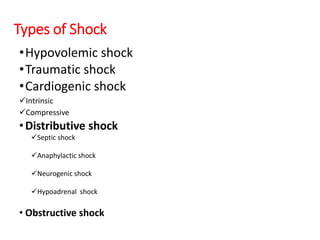
What is Shock?
• Shock is the “physiologic state characterized by significant
reduction of systemic tissue perfusion, resulting in decreased
tissue oxygen delivery.”
• Tissue perfusion is dependent on systemic vascular resistance (SVR)
and cardiac output (COP).
• Imbalance between oxygen delivery and oxygen consumption which
leads to cell death, end organ damage, multi-system organ failure, and
death
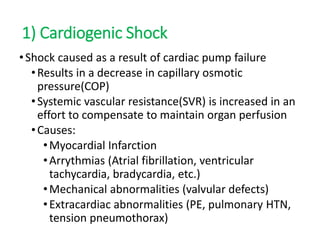
Types of Shock
•Hypovolemic shock
•Traumatic shock
•Cardiogenic shock
Intrinsic
Compressive
•Distributive shock
Septic shock
Anaphylactic shock
Neurogenic shock
Hypoadrenal shock
• Obstructive shock
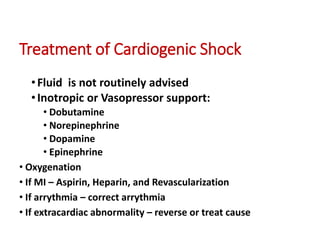
1) Cardiogenic Shock
•Shock caused as a result of cardiac pump failure
•Results in a decrease in capillary osmotic
pressure(COP)
•Systemic vascular resistance(SVR) is increased in an
effort to compensate to maintain organ perfusion
•Causes:
•Myocardial Infarction
•Arrythmias (Atrial fibrillation, ventricular
tachycardia, bradycardia, etc.)
•Mechanical abnormalities (valvular defects)
•Extracardiac abnormalities (PE, pulmonary HTN,
tension pneumothorax)
Pathophysiology of Cardiogenic Shock
Copyright © 2010, 2007, 2004, 2000, Mosby, Inc., an affiliate of Elsevier Inc. All Rights Reserved.
Treatment of Cardiogenic Shock
•Fluid is not routinely advised
•Inotropic or Vasopressor support:
• Dobutamine
• Norepinephrine
• Dopamine
• Epinephrine
• Oxygenation
• If MI – Aspirin, Heparin, and Revascularization
• If arrythmia – correct arrythmia
• If extracardiac abnormality – reverse or treat cause
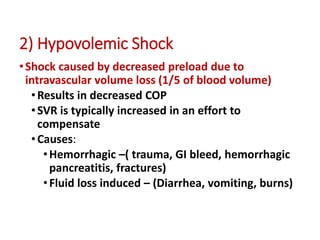
2) Hypovolemic Shock
•Shock caused by decreased preload due to
intravascular volume loss (1/5 of blood volume)
•Results in decreased COP
•SVR is typically increased in an effort to
compensate
•Causes:
•Hemorrhagic –( trauma, GI bleed, hemorrhagic
pancreatitis, fractures)
•Fluid loss induced – (Diarrhea, vomiting, burns)
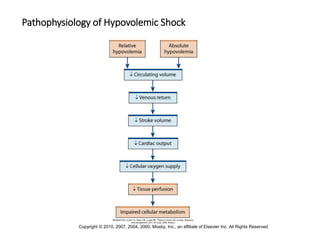
Pathophysiology of Hypovolemic Shock
Copyright © 2010, 2007, 2004, 2000, Mosby, Inc., an affiliate of Elsevier Inc. All Rights Reserved.
#Treatment of Hypovolemic Shock
•Maximize oxygen delivery
•Control further blood loss
•Tourniquets
•Surgical intervention
•Fluid resuscitation
•NS fluid boluses
•Blood product administration
3) Distributive Shock
•Shock as a result of severely diminished SVR
•COP is typically increased in an effort to
maintain perfusion
•Subtypes:
a) Septic – secondary to an overwhelming infection
b) Anaphylactic – secondary to a life-threatening allergic
reaction
c) Neurogenic – secondary to a sudden loss of the
autonomic nervous system function
#Treatment of Septic Shock
•Resuscitate
• 30cc/kg of NS bolus
•Identify Source
• Pan cultures
• CT scan
• Line removal
• Foley removal
• Surgical exploration
•Antibiotics
#Treatment of Anaphylactic Shock
•Remove offending agent
•Establish an airway and return circulation
•Pharmacologic support:
• Epinephrine – reverses peripheral vasodilation, dilates bronchial
airways, increases myocardial contractility, and suppresses histamine/
leukotriene release
• Antihistamine--may help counter histamine-mediated vasodilation
and bronchoconstriction
• Corticosteroids (hydrocortisone) – may help shorten reaction
• Bronchodilators
Neurogenic Shock
•Hemodynamic phenomenon that can occur within
30 minutes of a spinal cord injury at the fifth
thoracic (T5) vertebra or above and can last up to 6
weeks
•Results in massive vasodilation leading to pooling of
blood in vessels
Pathophysiology of Neurogenic Shock
Copyright © 2010, 2007, 2004, 2000, Mosby, Inc., an affiliate of Elsevier Inc. All Rights Reserved.
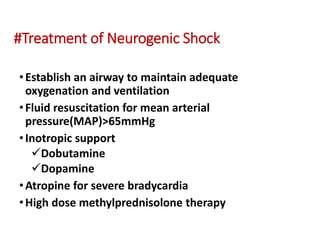
#Treatment of Neurogenic Shock
•Establish an airway to maintain adequate
oxygenation and ventilation
•Fluid resuscitation for mean arterial
pressure(MAP)>65mmHg
•Inotropic support
Dobutamine
Dopamine
•Atropine for severe bradycardia
•High dose methylprednisolone therapy
All three types of shock can occur
at the same time to have a
combined shock picture.
Take the massage
Survival and outcomes improve with early
perfusion, adequate oxygenation, and
identification with appropriate treatment of the
cause of shock.

Shock

  • 1.
  • 2.
    What is Shock? •Shock is the “physiologic state characterized by significant reduction of systemic tissue perfusion, resulting in decreased tissue oxygen delivery.” • Tissue perfusion is dependent on systemic vascular resistance (SVR) and cardiac output (COP). • Imbalance between oxygen delivery and oxygen consumption which leads to cell death, end organ damage, multi-system organ failure, and death
  • 3.
    Types of Shock •Hypovolemicshock •Traumatic shock •Cardiogenic shock Intrinsic Compressive •Distributive shock Septic shock Anaphylactic shock Neurogenic shock Hypoadrenal shock • Obstructive shock
  • 4.
    1) Cardiogenic Shock •Shockcaused as a result of cardiac pump failure •Results in a decrease in capillary osmotic pressure(COP) •Systemic vascular resistance(SVR) is increased in an effort to compensate to maintain organ perfusion •Causes: •Myocardial Infarction •Arrythmias (Atrial fibrillation, ventricular tachycardia, bradycardia, etc.) •Mechanical abnormalities (valvular defects) •Extracardiac abnormalities (PE, pulmonary HTN, tension pneumothorax)
  • 5.
    Pathophysiology of CardiogenicShock Copyright © 2010, 2007, 2004, 2000, Mosby, Inc., an affiliate of Elsevier Inc. All Rights Reserved.
  • 6.
    Treatment of CardiogenicShock •Fluid is not routinely advised •Inotropic or Vasopressor support: • Dobutamine • Norepinephrine • Dopamine • Epinephrine • Oxygenation • If MI – Aspirin, Heparin, and Revascularization • If arrythmia – correct arrythmia • If extracardiac abnormality – reverse or treat cause
  • 7.
    2) Hypovolemic Shock •Shockcaused by decreased preload due to intravascular volume loss (1/5 of blood volume) •Results in decreased COP •SVR is typically increased in an effort to compensate •Causes: •Hemorrhagic –( trauma, GI bleed, hemorrhagic pancreatitis, fractures) •Fluid loss induced – (Diarrhea, vomiting, burns)
  • 8.
    Pathophysiology of HypovolemicShock Copyright © 2010, 2007, 2004, 2000, Mosby, Inc., an affiliate of Elsevier Inc. All Rights Reserved.
  • 9.
    #Treatment of HypovolemicShock •Maximize oxygen delivery •Control further blood loss •Tourniquets •Surgical intervention •Fluid resuscitation •NS fluid boluses •Blood product administration
  • 10.
    3) Distributive Shock •Shockas a result of severely diminished SVR •COP is typically increased in an effort to maintain perfusion •Subtypes: a) Septic – secondary to an overwhelming infection b) Anaphylactic – secondary to a life-threatening allergic reaction c) Neurogenic – secondary to a sudden loss of the autonomic nervous system function
  • 11.
    #Treatment of SepticShock •Resuscitate • 30cc/kg of NS bolus •Identify Source • Pan cultures • CT scan • Line removal • Foley removal • Surgical exploration •Antibiotics
  • 12.
    #Treatment of AnaphylacticShock •Remove offending agent •Establish an airway and return circulation •Pharmacologic support: • Epinephrine – reverses peripheral vasodilation, dilates bronchial airways, increases myocardial contractility, and suppresses histamine/ leukotriene release • Antihistamine--may help counter histamine-mediated vasodilation and bronchoconstriction • Corticosteroids (hydrocortisone) – may help shorten reaction • Bronchodilators
  • 13.
    Neurogenic Shock •Hemodynamic phenomenonthat can occur within 30 minutes of a spinal cord injury at the fifth thoracic (T5) vertebra or above and can last up to 6 weeks •Results in massive vasodilation leading to pooling of blood in vessels
  • 14.
    Pathophysiology of NeurogenicShock Copyright © 2010, 2007, 2004, 2000, Mosby, Inc., an affiliate of Elsevier Inc. All Rights Reserved.
  • 15.
    #Treatment of NeurogenicShock •Establish an airway to maintain adequate oxygenation and ventilation •Fluid resuscitation for mean arterial pressure(MAP)>65mmHg •Inotropic support Dobutamine Dopamine •Atropine for severe bradycardia •High dose methylprednisolone therapy
  • 16.
    All three typesof shock can occur at the same time to have a combined shock picture.
  • 17.
    Take the massage Survivaland outcomes improve with early perfusion, adequate oxygenation, and identification with appropriate treatment of the cause of shock.