INTERNAL JUGULAR VEIN
V.S.RASHMI PRIYEM
ULTRA’S BEST Dental Science
College
IJV - Course
• It begins as the Direct Continuation Of The
Sigmoid Sinus at the base of the skull below
the jugular foramen
• Descends vertically downwards to end behind
the sternal end of the clavicle by joining the
Subclavian Vein to form the
Brachiocephalic Vein
Rashmi Priyem
Saravanan
IJV - Course
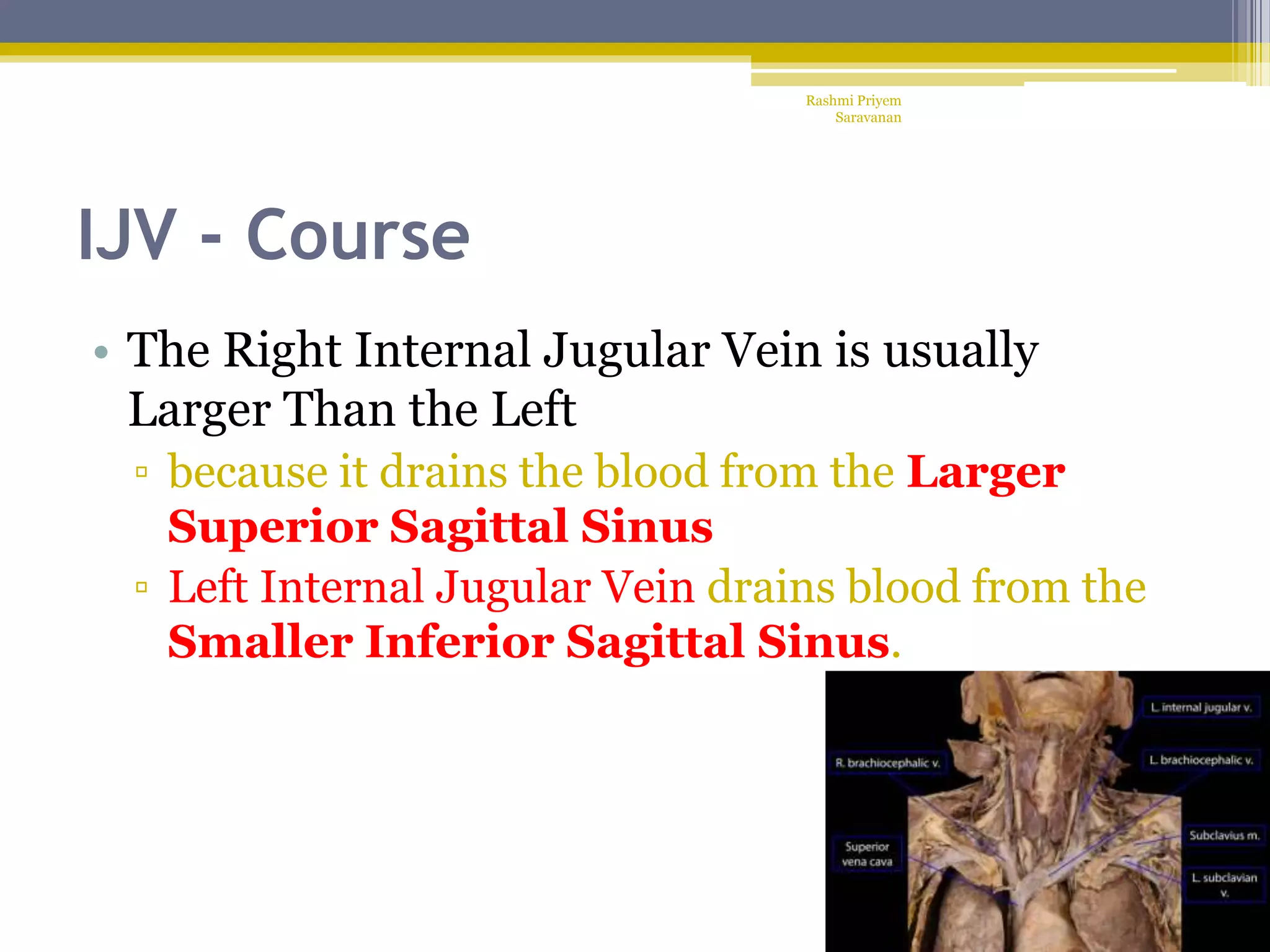
• The Right Internal Jugular Vein is usually
Larger Than the Left
▫ because it drains the blood from the Larger
Superior Sagittal Sinus
▫ Left Internal Jugular Vein drains blood from the
Smaller Inferior Sagittal Sinus.
Rashmi Priyem
Saravanan
Internal Jugular Vein
• The Internal Jugular Vein is usually the Largest
Vein In The Neck
• The Internal Jugular Vein Drains from Brain
and Most of the Tissues of the Head and
Neck.
Rashmi Priyem
Saravanan
Special Features
• 1. It presents Two Dilatations :
▫ First, at its commencement, which Lies In The
Jugular Fossa Of The Temporal Bone.
 It is known as Superior Bulb and is Related to
the Floor of the Middle Ear.
▫ Second, close to its termination, which Lies In
The Lesser Supraclavicular Fossa between
the sternal and clavicular heads of
sternocleidomastoid.
 It is known as Inferior Bulb and is Guarded by
a Pair of Valves.
Rashmi Priyem
Saravanan
Superior And Inferior Bulb
Rashmi Priyem
Saravanan
Special Features
• 2. IJV is Vertically Applied to the lateral side
of the Internal and Common Carotid
Arteries, Enclosed with them and the Vagus
Nerve in the Facial Sheath called Carotid
Sheath
Rashmi Priyem
Saravanan
Special Features
• 3. The Deep Cervical Lymph Nodes Lie
Along Its Entire Course.
Rashmi Priyem
Saravanan
Special Features
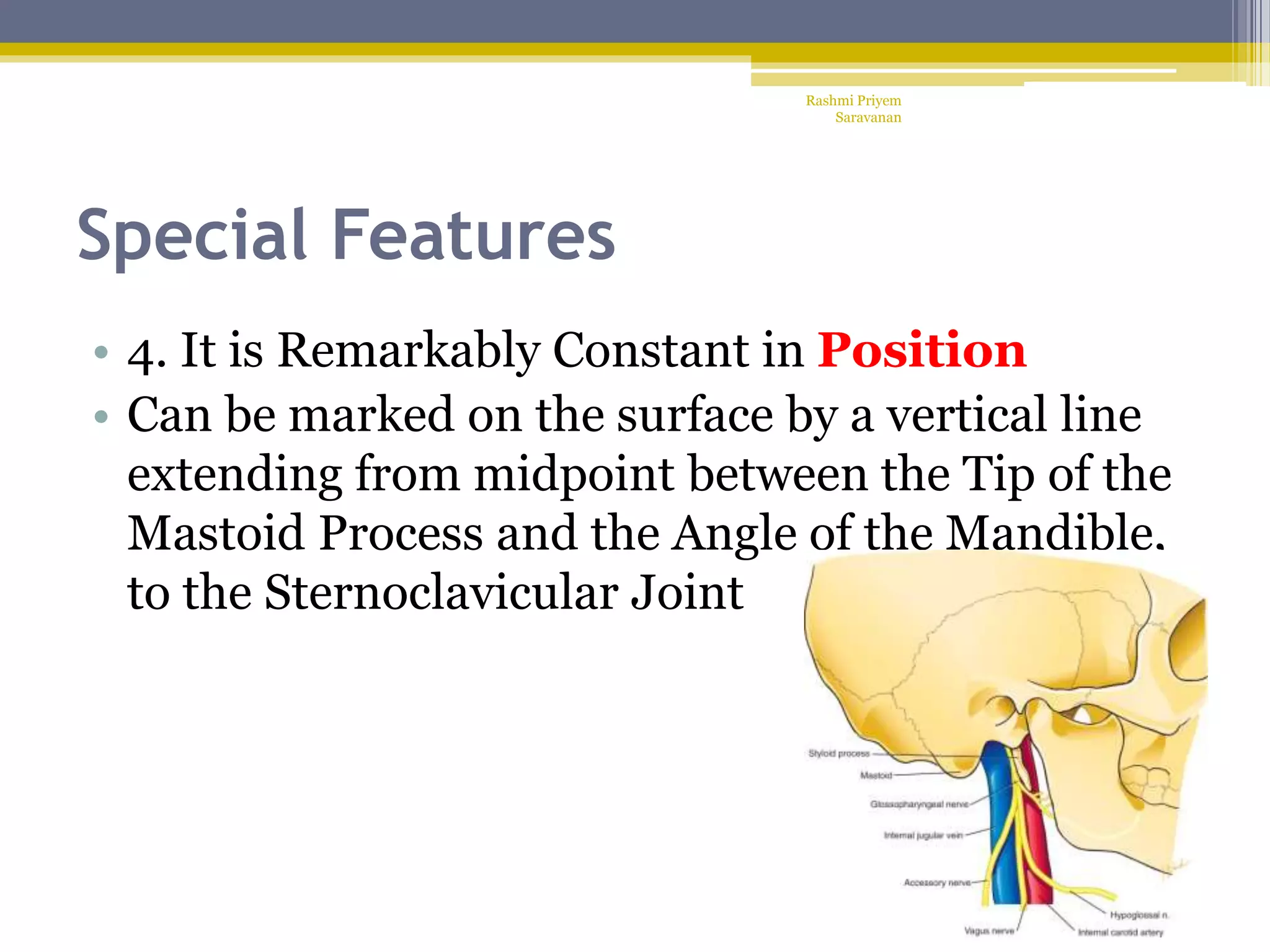
• 4. It is Remarkably Constant in Position
• Can be marked on the surface by a vertical line
extending from midpoint between the Tip of the
Mastoid Process and the Angle of the Mandible,
to the Sternoclavicular Joint
Rashmi Priyem
Saravanan
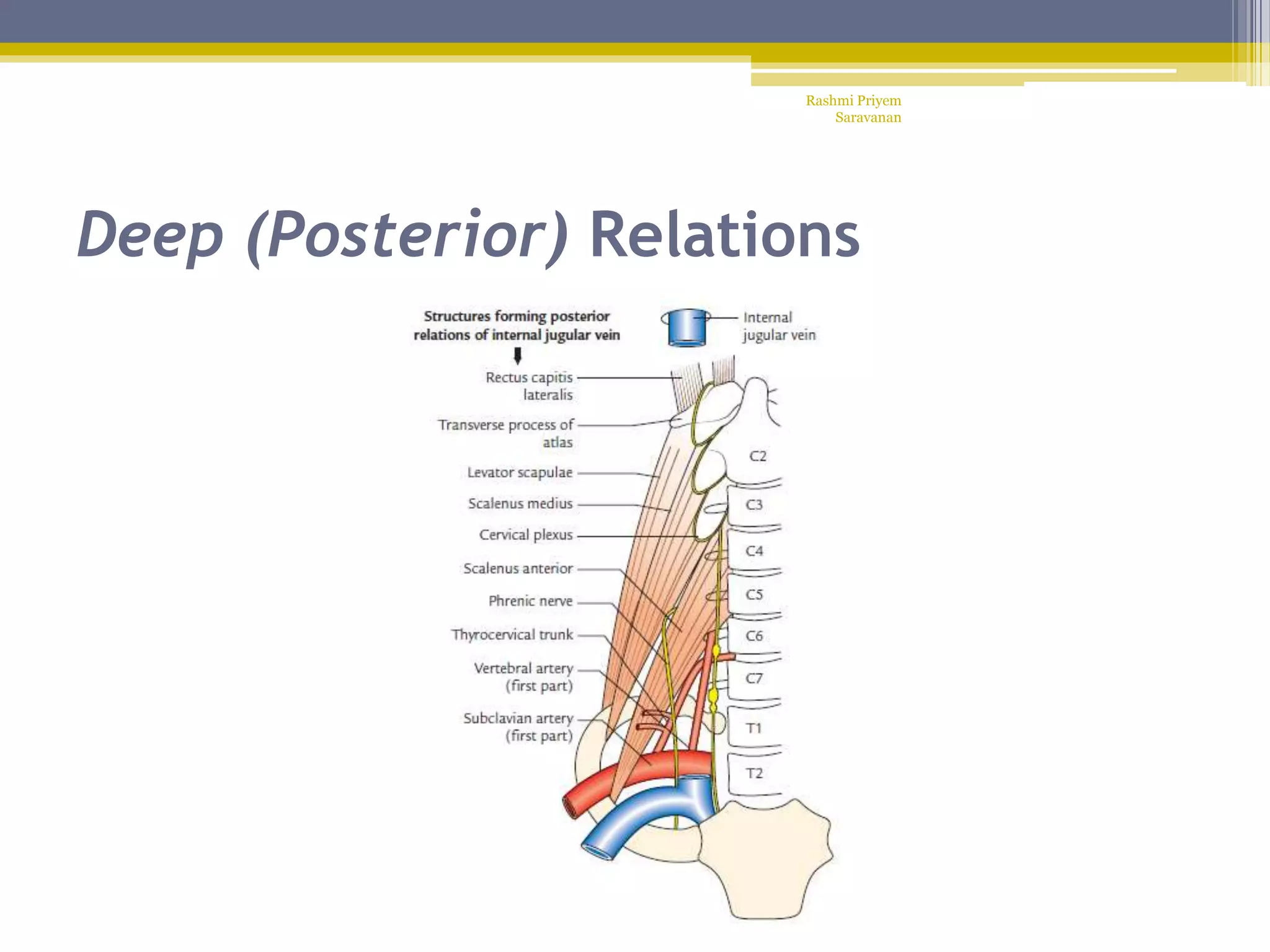
Deep (Posterior) Relations
• 1. Rectus capitis lateralis.
• 2. Transverse process of atlas.
• 3. Levator scapulae.
• 4. Scalenus medius and Cervical plexus.
• 5. Scalenus anterior and Phrenic Nerve.
• 6. Thyrocervical trunk and first part of Vertebral
Artery.
• 7. First part of the Subclavian Artery.
• 8. Thoracic Duct on the left side.
• 9. The Sternocleidomastoid overlaps the upper part
and covers the lower part of the vein.
Rashmi Priyem
Saravanan
Deep (Posterior) Relations
Rashmi Priyem
Saravanan
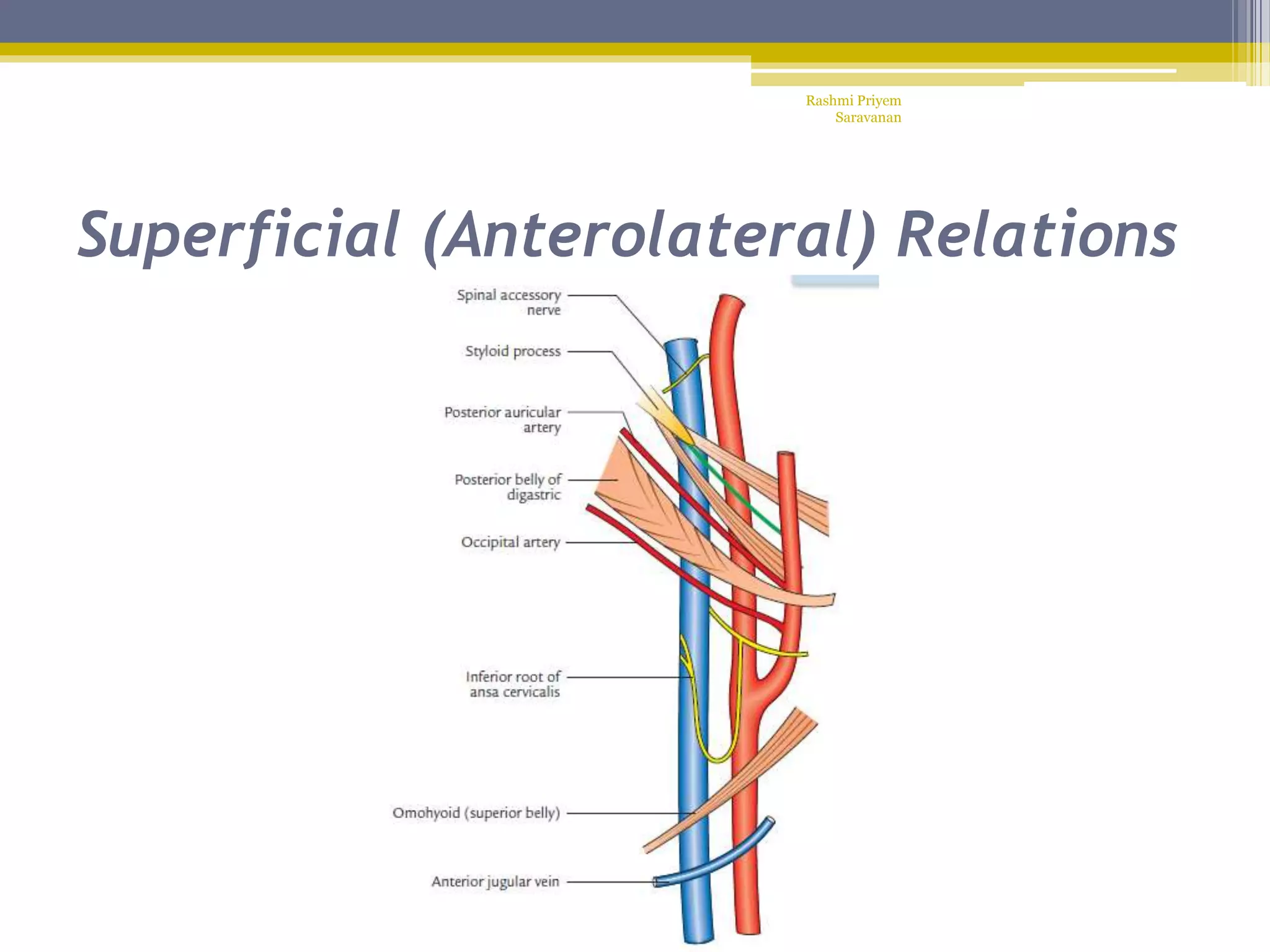
Superficial (Anterolateral) Relations
• 1. Crossed by two muscles
▫ (a) Posterior belly of Digastric Muscle in the upper part.
▫ (b) Inferior belly of Omohyoid in the lower part.
• 2. Crossed by two arteries
▫ (a) Occipital Artery.
▫ (b) Posterior Auricular Artery.
• 3. Crossed by one vein
▫ Anterior Jugular Vein
• 4. Crossed by two nerves
▫ (a) Spinal Accessory Nerve.
▫ (b) Inferior Root of Ansa cervicalis (Descendens cervicalis).
• 5. At the base of skull the internal carotid artery lies in Front of
the Internal Jugular Vein and the Last Four Cranial Nerves
Intervene Between the Vein and the Artery.
Rashmi Priyem
Saravanan
Superficial (Anterolateral) Relations
Rashmi Priyem
Saravanan
Medial Relations
1. Internal Carotid Artery
2. 9th, 10th, 11th, and 12th Cranial Nerves in the
upper part
3. Common Carotid Artery
4. Vagus Nerve in the lower part.
Rashmi Priyem
Saravanan
Tributaries
• 1. Inferior Petrosal Vein—is usually the First
Tributary and joins the Internal Jugular Vein
immediately below the Jugular Foramen.
• 2. Pharyngeal Veins—from Pharyngeal Plexus.
• 3. Common Facial Vein.
• 4. Lingual Vein.
• 5. Superior Thyroid Vein.
• 6. Middle Thyroid Vein.
• 7. Occipital Vein (only sometimes)
Rashmi Priyem
Saravanan
Tributaries
Rashmi Priyem
Saravanan
Clinical Correlation
• The Internal Jugular Vein acts as a Guide for
Surgeons during removal of Deep
Cervical Lymph Nodes.
Rashmi Priyem
Saravanan

Internal Jugular Vein

  • 1.
    INTERNAL JUGULAR VEIN V.S.RASHMIPRIYEM ULTRA’S BEST Dental Science College
  • 2.
    IJV - Course •It begins as the Direct Continuation Of The Sigmoid Sinus at the base of the skull below the jugular foramen • Descends vertically downwards to end behind the sternal end of the clavicle by joining the Subclavian Vein to form the Brachiocephalic Vein Rashmi Priyem Saravanan
  • 3.
    IJV - Course •The Right Internal Jugular Vein is usually Larger Than the Left ▫ because it drains the blood from the Larger Superior Sagittal Sinus ▫ Left Internal Jugular Vein drains blood from the Smaller Inferior Sagittal Sinus. Rashmi Priyem Saravanan
  • 4.
    Internal Jugular Vein •The Internal Jugular Vein is usually the Largest Vein In The Neck • The Internal Jugular Vein Drains from Brain and Most of the Tissues of the Head and Neck. Rashmi Priyem Saravanan
  • 5.
    Special Features • 1.It presents Two Dilatations : ▫ First, at its commencement, which Lies In The Jugular Fossa Of The Temporal Bone.  It is known as Superior Bulb and is Related to the Floor of the Middle Ear. ▫ Second, close to its termination, which Lies In The Lesser Supraclavicular Fossa between the sternal and clavicular heads of sternocleidomastoid.  It is known as Inferior Bulb and is Guarded by a Pair of Valves. Rashmi Priyem Saravanan
  • 6.
    Superior And InferiorBulb Rashmi Priyem Saravanan
  • 7.
    Special Features • 2.IJV is Vertically Applied to the lateral side of the Internal and Common Carotid Arteries, Enclosed with them and the Vagus Nerve in the Facial Sheath called Carotid Sheath Rashmi Priyem Saravanan
  • 8.
    Special Features • 3.The Deep Cervical Lymph Nodes Lie Along Its Entire Course. Rashmi Priyem Saravanan
  • 9.
    Special Features • 4.It is Remarkably Constant in Position • Can be marked on the surface by a vertical line extending from midpoint between the Tip of the Mastoid Process and the Angle of the Mandible, to the Sternoclavicular Joint Rashmi Priyem Saravanan
  • 10.
    Deep (Posterior) Relations •1. Rectus capitis lateralis. • 2. Transverse process of atlas. • 3. Levator scapulae. • 4. Scalenus medius and Cervical plexus. • 5. Scalenus anterior and Phrenic Nerve. • 6. Thyrocervical trunk and first part of Vertebral Artery. • 7. First part of the Subclavian Artery. • 8. Thoracic Duct on the left side. • 9. The Sternocleidomastoid overlaps the upper part and covers the lower part of the vein. Rashmi Priyem Saravanan
  • 11.
  • 12.
    Superficial (Anterolateral) Relations •1. Crossed by two muscles ▫ (a) Posterior belly of Digastric Muscle in the upper part. ▫ (b) Inferior belly of Omohyoid in the lower part. • 2. Crossed by two arteries ▫ (a) Occipital Artery. ▫ (b) Posterior Auricular Artery. • 3. Crossed by one vein ▫ Anterior Jugular Vein • 4. Crossed by two nerves ▫ (a) Spinal Accessory Nerve. ▫ (b) Inferior Root of Ansa cervicalis (Descendens cervicalis). • 5. At the base of skull the internal carotid artery lies in Front of the Internal Jugular Vein and the Last Four Cranial Nerves Intervene Between the Vein and the Artery. Rashmi Priyem Saravanan
  • 13.
  • 14.
    Medial Relations 1. InternalCarotid Artery 2. 9th, 10th, 11th, and 12th Cranial Nerves in the upper part 3. Common Carotid Artery 4. Vagus Nerve in the lower part. Rashmi Priyem Saravanan
  • 15.
    Tributaries • 1. InferiorPetrosal Vein—is usually the First Tributary and joins the Internal Jugular Vein immediately below the Jugular Foramen. • 2. Pharyngeal Veins—from Pharyngeal Plexus. • 3. Common Facial Vein. • 4. Lingual Vein. • 5. Superior Thyroid Vein. • 6. Middle Thyroid Vein. • 7. Occipital Vein (only sometimes) Rashmi Priyem Saravanan
  • 16.
  • 17.
    Clinical Correlation • TheInternal Jugular Vein acts as a Guide for Surgeons during removal of Deep Cervical Lymph Nodes. Rashmi Priyem Saravanan