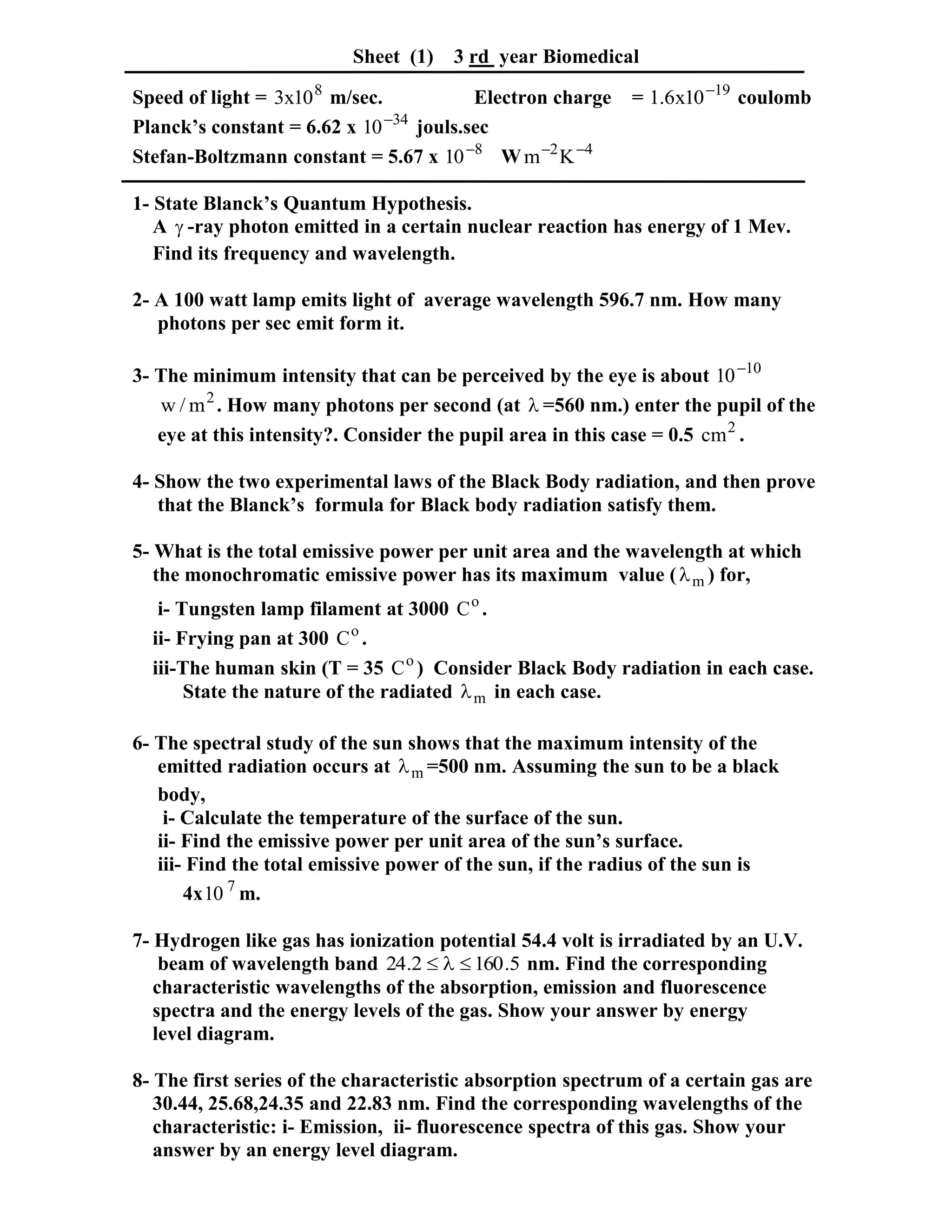
Sheet (1) 3 rd year Biomedical
Speed of light = 8
10x3 m/sec. Electron charge = 19
10x6.1 
coulomb
Planck’s constant = 6.62 x 34
10
jouls.sec
Stefan-Boltzmann constant = 5.67 x 8
10
W 42
Km 
1- State Blanck’s Quantum Hypothesis.
A  -ray photon emitted in a certain nuclear reaction has energy of 1 Mev.
Find its frequency and wavelength.
2- A 100 watt lamp emits light of average wavelength 596.7 nm. How many
photons per sec emit form it.
3- The minimum intensity that can be perceived by the eye is about 10
10
2
m/w . How many photons per second (at  =560 nm.) enter the pupil of the
eye at this intensity?. Consider the pupil area in this case = 0.5 2
cm .
4- Show the two experimental laws of the Black Body radiation, and then prove
that the Blanck’s formula for Black body radiation satisfy them.
5- What is the total emissive power per unit area and the wavelength at which
the monochromatic emissive power has its maximum value ( m ) for,
i- Tungsten lamp filament at 3000 o
C .
ii- Frying pan at 300 o
C .
iii-The human skin (T = 35 o
C ) Consider Black Body radiation in each case.
State the nature of the radiated m in each case.
6- The spectral study of the sun shows that the maximum intensity of the
emitted radiation occurs at m =500 nm. Assuming the sun to be a black
body,
i- Calculate the temperature of the surface of the sun.
ii- Find the emissive power per unit area of the sun’s surface.
iii- Find the total emissive power of the sun, if the radius of the sun is
4x 7
10 m.
7- Hydrogen like gas has ionization potential 54.4 volt is irradiated by an U.V.
beam of wavelength band 5.1602.24  nm. Find the corresponding
characteristic wavelengths of the absorption, emission and fluorescence
spectra and the energy levels of the gas. Show your answer by energy
level diagram.
8- The first series of the characteristic absorption spectrum of a certain gas are
30.44, 25.68,24.35 and 22.83 nm. Find the corresponding wavelengths of the
characteristic: i- Emission, ii- fluorescence spectra of this gas. Show your
answer by an energy level diagram.

Sheet 1 bioanalysis

  • 1.
    Sheet (1) 3rd year Biomedical Speed of light = 8 10x3 m/sec. Electron charge = 19 10x6.1  coulomb Planck’s constant = 6.62 x 34 10 jouls.sec Stefan-Boltzmann constant = 5.67 x 8 10 W 42 Km  1- State Blanck’s Quantum Hypothesis. A  -ray photon emitted in a certain nuclear reaction has energy of 1 Mev. Find its frequency and wavelength. 2- A 100 watt lamp emits light of average wavelength 596.7 nm. How many photons per sec emit form it. 3- The minimum intensity that can be perceived by the eye is about 10 10 2 m/w . How many photons per second (at  =560 nm.) enter the pupil of the eye at this intensity?. Consider the pupil area in this case = 0.5 2 cm . 4- Show the two experimental laws of the Black Body radiation, and then prove that the Blanck’s formula for Black body radiation satisfy them. 5- What is the total emissive power per unit area and the wavelength at which the monochromatic emissive power has its maximum value ( m ) for, i- Tungsten lamp filament at 3000 o C . ii- Frying pan at 300 o C . iii-The human skin (T = 35 o C ) Consider Black Body radiation in each case. State the nature of the radiated m in each case. 6- The spectral study of the sun shows that the maximum intensity of the emitted radiation occurs at m =500 nm. Assuming the sun to be a black body, i- Calculate the temperature of the surface of the sun. ii- Find the emissive power per unit area of the sun’s surface. iii- Find the total emissive power of the sun, if the radius of the sun is 4x 7 10 m. 7- Hydrogen like gas has ionization potential 54.4 volt is irradiated by an U.V. beam of wavelength band 5.1602.24  nm. Find the corresponding characteristic wavelengths of the absorption, emission and fluorescence spectra and the energy levels of the gas. Show your answer by energy level diagram. 8- The first series of the characteristic absorption spectrum of a certain gas are 30.44, 25.68,24.35 and 22.83 nm. Find the corresponding wavelengths of the characteristic: i- Emission, ii- fluorescence spectra of this gas. Show your answer by an energy level diagram.