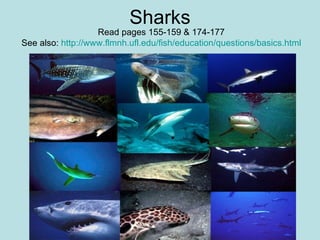
Sharks Read pages 155-159 & 174-177 See also:  http://www.flmnh.ufl.edu/fish/education/questions/basics.html
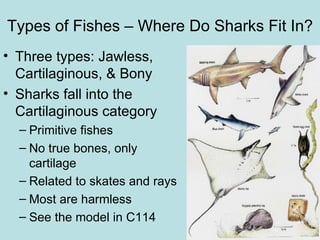
Types of Fishes – Where Do Sharks Fit In? Three types: Jawless, Cartilaginous, & Bony Sharks fall into the Cartilaginous category Primitive fishes No true bones, only cartilage Related to skates and rays Most are harmless See the model in C114
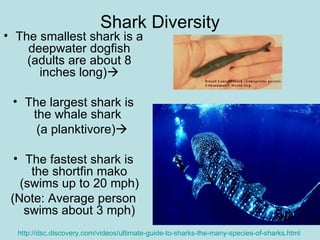
Shark Diversity The smallest shark is a deepwater dogfish (adults are about 8 inches long)  The largest shark is the whale shark  (a planktivore)  The fastest shark is the shortfin mako (swims up to 20 mph) (Note: Average person swims about 3 mph) http://dsc.discovery.com/videos/ultimate-guide-to-sharks-the-many-species-of-sharks.html
Shark Bodies Notice that sharks are  fish  and obtain oxygen from the water through their  gills-usually 5 – 7 gills
Shark Bodies Cont. Lost teeth are replaced in a “conveyor belt” system, with back teeth moving forward to replace lost ones
Shark Bodies Cont. Placoid Scales – sharp-edged scales can injure prey; gives shark skin a sandpaper-like feel Liver – very fatty; helps shark maintain buoyancy Tail-upper lobe is usually longer for better power  & thrust Usually two dorsal fins, paired pectoral fins
Shark Reproduction Fertilization is internal Males use claspers to insert sperm into female’s cloaca
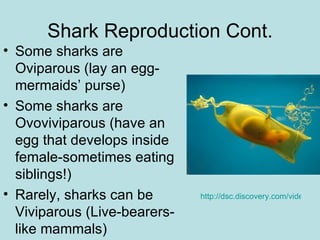
Shark Reproduction Cont. Some sharks are Oviparous (lay an egg-mermaids’ purse) Some sharks are Ovoviviparous (have an egg that develops inside female-sometimes eating siblings!) Rarely, sharks can be Viviparous (Live-bearers-like mammals) http://dsc.discovery.com/videos/ultimate-guide-to-sharks-how-are-sharks-born-take-a-look.html
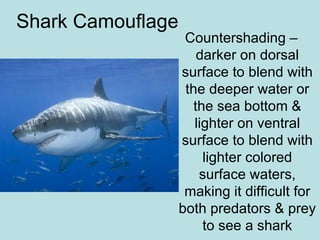
Shark Camouflage Countershading – darker on dorsal surface to blend with the deeper water or the sea bottom & lighter on ventral surface to blend with lighter colored surface waters, making it difficult for both predators & prey to see a shark
Shark Trouble Most sharks need to force water over gills to breathe, and can “drown” when trapped in nets Skin, oil, and fins are overharvested to the point of near extinction for some species PSA aimed at stopping these practices:  http:// www.youtube.com/watch?v =fkxoRPv4ugE&playnext=1&list=PLB4E6B7A755C66293
Additional Shark Links More on the importance of sharks in healthy oceans:  http://www.youtube.com/watch?v=xVKrwsXvC0A&feature=autoplay&list=PLB4E6B7A755C66293&index=5&playnext=2   Clearinghouse of all known Shark links:  http://www.postmodern.com/~fi/sharklinks/links.htm More general shark information:  http:// www.youtube.com/watch?v =xVKrwsXvC0A&feature= autoplay&list =PLB4E6B7A755C66293&index=5&playnext=2

Sharks

  • 1.
    Sharks Read pages155-159 & 174-177 See also: http://www.flmnh.ufl.edu/fish/education/questions/basics.html
  • 2.
    Types of Fishes– Where Do Sharks Fit In? Three types: Jawless, Cartilaginous, & Bony Sharks fall into the Cartilaginous category Primitive fishes No true bones, only cartilage Related to skates and rays Most are harmless See the model in C114
  • 3.
    Shark Diversity Thesmallest shark is a deepwater dogfish (adults are about 8 inches long)  The largest shark is the whale shark (a planktivore)  The fastest shark is the shortfin mako (swims up to 20 mph) (Note: Average person swims about 3 mph) http://dsc.discovery.com/videos/ultimate-guide-to-sharks-the-many-species-of-sharks.html
  • 4.
    Shark Bodies Noticethat sharks are fish and obtain oxygen from the water through their gills-usually 5 – 7 gills
  • 5.
    Shark Bodies Cont.Lost teeth are replaced in a “conveyor belt” system, with back teeth moving forward to replace lost ones
  • 6.
    Shark Bodies Cont.Placoid Scales – sharp-edged scales can injure prey; gives shark skin a sandpaper-like feel Liver – very fatty; helps shark maintain buoyancy Tail-upper lobe is usually longer for better power & thrust Usually two dorsal fins, paired pectoral fins
  • 7.
    Shark Reproduction Fertilizationis internal Males use claspers to insert sperm into female’s cloaca
  • 8.
    Shark Reproduction Cont.Some sharks are Oviparous (lay an egg-mermaids’ purse) Some sharks are Ovoviviparous (have an egg that develops inside female-sometimes eating siblings!) Rarely, sharks can be Viviparous (Live-bearers-like mammals) http://dsc.discovery.com/videos/ultimate-guide-to-sharks-how-are-sharks-born-take-a-look.html
  • 9.
    Shark Camouflage Countershading– darker on dorsal surface to blend with the deeper water or the sea bottom & lighter on ventral surface to blend with lighter colored surface waters, making it difficult for both predators & prey to see a shark
  • 10.
    Shark Trouble Mostsharks need to force water over gills to breathe, and can “drown” when trapped in nets Skin, oil, and fins are overharvested to the point of near extinction for some species PSA aimed at stopping these practices: http:// www.youtube.com/watch?v =fkxoRPv4ugE&playnext=1&list=PLB4E6B7A755C66293
  • 11.
    Additional Shark LinksMore on the importance of sharks in healthy oceans: http://www.youtube.com/watch?v=xVKrwsXvC0A&feature=autoplay&list=PLB4E6B7A755C66293&index=5&playnext=2 Clearinghouse of all known Shark links: http://www.postmodern.com/~fi/sharklinks/links.htm More general shark information: http:// www.youtube.com/watch?v =xVKrwsXvC0A&feature= autoplay&list =PLB4E6B7A755C66293&index=5&playnext=2