Noruza
Presentation
Education About Shark
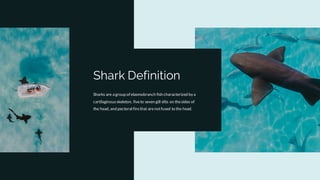
Sharks are a group of elasmobranch fish characterized by a
cartilaginousskeleton, fiveto seven gill slits on thesides of
the head, and pectoral finsthat arenotfused to the head.
Shark Definition
Sharks are notmammals. Rather, they area species of fish. Sharks
havea skeleton that isentirely composed of cartilageand is
equipped with leathery, tough and scale less skin.
What Is A Shark
Mammal Or Fish?
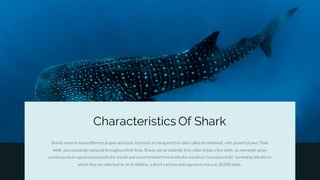
Characteristics Of Shark
Sharks comein many differentshapes and sizes, butmost are long and thin (also called streamlined), with powerful jaws. Their
teeth areconstantly replaced throughouttheir lives. Sharks eat so violently they often breaka few teeth, so new teeth grow
continuously in a groovejustinsidethe mouth and moveforward from insidethe mouth on "conveyor belts" formed by theskin in
which they are attached to. In its lifetime, a shark can loseand regrow as many as 30,000 teeth.
Senses
Of A Shark
Smell
Sight
Sensing Electric Current
Hearing
Lateral Line
01
02
03
04
05
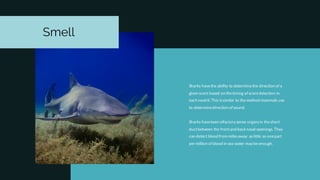
Sharks havethe ability to determinethe direction of a
given scent based on thetiming of scentdetection in
each nostril. This is similar to themethod mammals use
to determinedirection of sound.
Sharks havekeen olfactory sense organs in theshort
ductbetween the frontand backnasal openings. They
can detect blood from milesaway: as little as onepart
per million of blood in sea water may be enough.
Smell
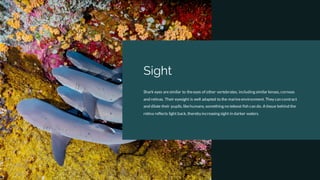
Shark eyes aresimilar to theeyes of other vertebrates, including similar lenses, corneas
and retinas. Their eyesight is well adapted to the marineenvironment. They can contract
and dilate their pupils, likehumans, something no teleost fish can do. A tissue behind the
retina reflects light back, thereby increasing sight in darker waters.
Sight
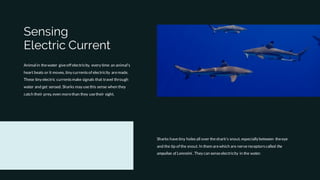
Sharks havetiny holes all over theshark's snout, especially between theeye
and the tip of the snout. In them arewhich are nervereceptors called the
ampullae of Lorenzini . They can senseelectricity in the water.
Sensing
Electric Current
Animal in thewater giveoff electricity, every time an animal's
heart beats or it moves, tiny currentsof electricity aremade.
These tiny electric currentsmake signals that travel through
water and get sensed. Sharks may usethis sense when they
catch their prey, even morethan they usetheir sight.
Hearing
Although it is hard to test sharks' hearing, they may havea sharp
sense of hearing and can possibly hear prey many miles away. A
small opening on each sideof their heads (notthespiracle) leads
directly into the inner ear through a thin channel.
Thelateral linedetects changesin water pressure. It is
open to the environmentby a line of pores. Thisand the

sound-detecting organsare grouped together as the
'acoustic lateralis system', becausethey havea common
origin. In bony fish and tetrapodstheexternal opening
into the inner ear hasbeen lost.
Lateral Line

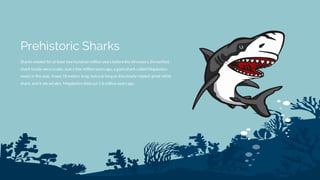
Sharks existed for at least two hundred million yearsbeforethe dinosaurs, theearliest
shark fossils were scales. Just a few million yearsago, a giantshark called Megalodon
swam in the seas. Itwas 18 meters long, twiceas long as theclosely-related great white
shark, and it ate whales. Megalodon died out1.6 million yearsago.
Prehistoric Sharks
Reproduction
Of A Shark
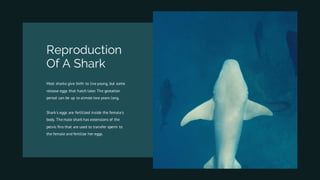
Most sharks give birth to live young, but some
release eggs that hatch later. The gestation
period can be up to almost two years long.
Shark's eggs are fertilized inside the female's
body. The male shark has extensions of the
pelvic fins that are used to transfer sperm to
the female and fertilize her eggs.
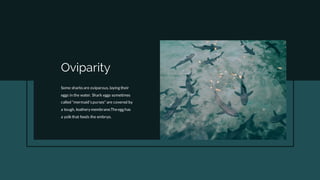
Oviparity
Some sharks are oviparous, laying their
eggs in the water. Shark eggs sometimes
called "mermaid'spurses" are covered by
a tough, leathery membrane.Theegg has
a yolkthat feeds the embryo.
Ovoviviparity
Most sharks areovoviviparous, meaning theeggs
hatch insidethe female's body, with the babies
developing within the mother, butthere is no
placenta to nourish thepups.
Instead theyoung feed on the egg'syolk. The pups
eat any unfertilized eggs and sometimes each other.
Very few pupsin a litter surviveuntil birth dueto
this form of sibling cannibalism.
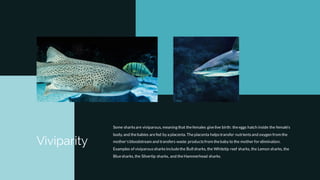
Viviparity
Some sharksare viviparous, meaning that thefemales givelive birth: theeggs hatch inside the female's
body, and thebabies arefed by a placenta. Theplacenta helpstransfer nutrientsand oxygen from the
mother'sbloodstream and transfers waste productsfrom thebaby to the mother for elimination.
Examples of viviparoussharksincludethe Bull sharks, the Whitetip reef sharks, the Lemon sharks, the
Bluesharks, the Silvertip sharks, and theHammerhead sharks.
This Is Break Section
Shark Conservation
Oceanic maritime currentshavedifferentorigins. Tidal currentsarein
phasewith the tide, henceare quasiperiodic; they may form various
knots in certain places, most notably around headlands. Non-periodic
currentshavefor origin the waves, wind and different densities.
Sharks are fascinating and diverse animals, butthere's much moreto them than that. A world without sharks would
haveserious consequencesfor marineand freshwater ecosystems. Diverse sharkpopulationsareimportant for:
Why Are Sharks Important?
Healthy Oceans
Sharks play an integral rolein keeping our oceans healthy. They do this by keeping other
populationsin checkand preying on thesickand old.
The Economy
Shark and ray fisheries providejobs and incomefor communities across theworld. The
rise in ecotourism is also placing a financial value on thepresenceof sharks.
Global Diversity
Sharks are an integral partof our natural world and supportbiodiversity. Wehave
inherited these amazing animalsand we want to pass them on to futuregenerations
WWW.NORUZA.COM
Relationship With Humans
Most species arenotsuitable for homeaquaria, and notevery species sold by pet
stores are appropriate. Somespeciescan flourish in homesaltwater aquaria.
In Captivity
Sharks show little pattern of attacking humansspecifically. Research indicates that
when humansdo becometheobjectof a sharkattack, it is possiblethat the shark has
mistaken the human for speciesthat areits normal prey, such asseals.
Attacks
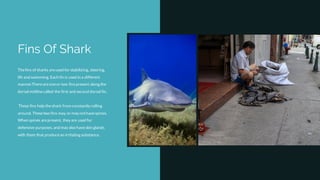
Fins Of Shark
Thefins of sharks areused for stabilizing, steering,
lift and swimming. Each fin is used in a different
manner.Thereareoneor two finspresent along the
dorsal midlinecalled the first and second dorsal fin.
These fins help theshark from constantly rolling
around. Thesetwo fins may, or may nothavespines.
When spines arepresent, they are used for
defensive purposes, and may also haveskin glands
with them that producean irritating substance.
Demand
For
Shark Fins
Thegrowing tradein shark finsoften used to make
an expensiveAsian soup hasbecomea serious
threat to many sharkspecies.
Thelatest research suggests that around 100
million sharks may bekilled annually, often targeted
for their fins. Thispracticeaffects many different
shark species, including whalesharks.
There aremany different ocean temperatures in theopen ocean, both vertically
(from top to bottom) and horizontally. Water coolsand warmsmoreslowly than
land does, so land influenced by theocean haslater and milder seasonsthan land
that is farther away from the ocean.
Overfishing
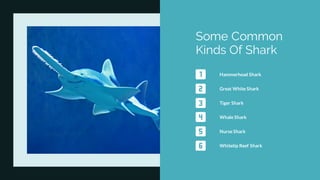
Some Common
Kinds Of Shark
Hammerhead Shark
Great White Shark
Tiger Shark
Whale Shark
Nurse Shark
Whitetip Reef Shark
Theunusual structureof the head makes the head
looklike a hammer, this is why they areknown as
"Hammerhead sharks". Sincethe eyes arepositioned
on theends of thecephalofoil, Hammerheadsareable
to see everything around them, including whatis
under them, and whatis abovethem. This head helps
hammerhead sharks makevery tight turnsin the
water, and it also helps them sense prey.
Hammerhead
Shark
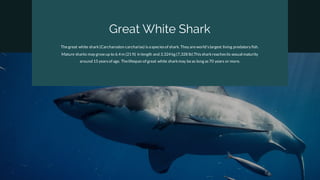
Thegreat white shark(Carcharodon carcharias) isa speciesof shark. They areworld'slargest living predatory fish.
Mature sharks may grow up to 6.4 m (21 ft) in length and 3,324 kg (7,328 lb).Thissharkreachesits sexual maturity
around 15 yearsof age. Thelifespan of great white sharkmay beas long as 70 years or more.
Great White Shark
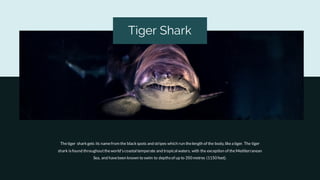
Thetiger sharkgets its namefrom the blackspots and stripes which run thelength of the body, likea tiger. The tiger
shark isfound throughouttheworld'scoastal temperate and tropical waters, with the exception of theMediterranean
Sea, and havebeen known to swim to depths of up to 350 metres (1150 feet).
Tiger Shark
While Shark
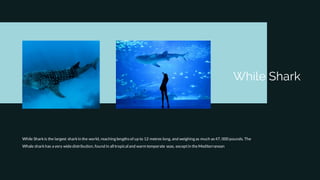
While Sharkis the largest sharkin the world, reaching lengthsof up to 12 metres long, and weighing as much as 47, 000 pounds. The
Whale sharkhas a very widedistribution, found in all tropical and warm temperate seas, exceptin theMediterranean
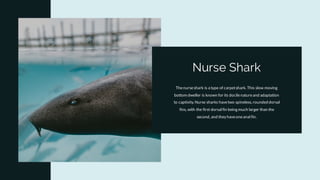
Nurse Shark
Thenurseshark is a type of carpetshark. This slow moving
bottom dweller is known for its docilenatureand adaptation
to captivity. Nurse sharks havetwo spineless, rounded dorsal
fins, with the first dorsal fin being much larger than the
second, and they haveoneanal fin.
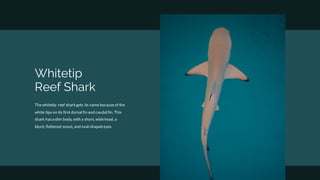
Thewhitetip reef sharkgets its namebecauseof the
white tips on its first dorsal fin and caudal fin. This
shark hasa slim body, with a short, widehead, a
blunt, flattened snout, and oval-shaped eyes.
Whitetip
Reef Shark
Thanks
For
Watching
Noruza Presentation : Dark Color Version

Noruza Presentation : Dark Color Version

  • 1.
  • 2.
    Sharks are agroup of elasmobranch fish characterized by a cartilaginousskeleton, fiveto seven gill slits on thesides of the head, and pectoral finsthat arenotfused to the head. Shark Definition
  • 3.
    Sharks are notmammals.Rather, they area species of fish. Sharks havea skeleton that isentirely composed of cartilageand is equipped with leathery, tough and scale less skin. What Is A Shark Mammal Or Fish?
  • 4.
    Characteristics Of Shark Sharkscomein many differentshapes and sizes, butmost are long and thin (also called streamlined), with powerful jaws. Their teeth areconstantly replaced throughouttheir lives. Sharks eat so violently they often breaka few teeth, so new teeth grow continuously in a groovejustinsidethe mouth and moveforward from insidethe mouth on "conveyor belts" formed by theskin in which they are attached to. In its lifetime, a shark can loseand regrow as many as 30,000 teeth.
  • 5.
    Senses Of A Shark Smell Sight SensingElectric Current Hearing Lateral Line 01 02 03 04 05

  • 6.
    Sharks havethe abilityto determinethe direction of a given scent based on thetiming of scentdetection in each nostril. This is similar to themethod mammals use to determinedirection of sound. Sharks havekeen olfactory sense organs in theshort ductbetween the frontand backnasal openings. They can detect blood from milesaway: as little as onepart per million of blood in sea water may be enough. Smell

  • 7.
    Shark eyes aresimilarto theeyes of other vertebrates, including similar lenses, corneas and retinas. Their eyesight is well adapted to the marineenvironment. They can contract and dilate their pupils, likehumans, something no teleost fish can do. A tissue behind the retina reflects light back, thereby increasing sight in darker waters. Sight
  • 8.
    Sharks havetiny holesall over theshark's snout, especially between theeye and the tip of the snout. In them arewhich are nervereceptors called the ampullae of Lorenzini . They can senseelectricity in the water. Sensing Electric Current Animal in thewater giveoff electricity, every time an animal's heart beats or it moves, tiny currentsof electricity aremade. These tiny electric currentsmake signals that travel through water and get sensed. Sharks may usethis sense when they catch their prey, even morethan they usetheir sight.
  • 9.
    Hearing Although it ishard to test sharks' hearing, they may havea sharp sense of hearing and can possibly hear prey many miles away. A small opening on each sideof their heads (notthespiracle) leads directly into the inner ear through a thin channel.
  • 10.
    Thelateral linedetects changesinwater pressure. It is open to the environmentby a line of pores. Thisand the sound-detecting organsare grouped together as the 'acoustic lateralis system', becausethey havea common origin. In bony fish and tetrapodstheexternal opening into the inner ear hasbeen lost. Lateral Line
  • 11.
    Sharks existed forat least two hundred million yearsbeforethe dinosaurs, theearliest shark fossils were scales. Just a few million yearsago, a giantshark called Megalodon swam in the seas. Itwas 18 meters long, twiceas long as theclosely-related great white shark, and it ate whales. Megalodon died out1.6 million yearsago. Prehistoric Sharks
  • 12.
    Reproduction Of A Shark Mostsharks give birth to live young, but some release eggs that hatch later. The gestation period can be up to almost two years long. Shark's eggs are fertilized inside the female's body. The male shark has extensions of the pelvic fins that are used to transfer sperm to the female and fertilize her eggs.
  • 13.
    Oviparity Some sharks areoviparous, laying their eggs in the water. Shark eggs sometimes called "mermaid'spurses" are covered by a tough, leathery membrane.Theegg has a yolkthat feeds the embryo.
  • 14.
    Ovoviviparity Most sharks areovoviviparous,meaning theeggs hatch insidethe female's body, with the babies developing within the mother, butthere is no placenta to nourish thepups. Instead theyoung feed on the egg'syolk. The pups eat any unfertilized eggs and sometimes each other. Very few pupsin a litter surviveuntil birth dueto this form of sibling cannibalism.
  • 15.
    Viviparity Some sharksare viviparous,meaning that thefemales givelive birth: theeggs hatch inside the female's body, and thebabies arefed by a placenta. Theplacenta helpstransfer nutrientsand oxygen from the mother'sbloodstream and transfers waste productsfrom thebaby to the mother for elimination. Examples of viviparoussharksincludethe Bull sharks, the Whitetip reef sharks, the Lemon sharks, the Bluesharks, the Silvertip sharks, and theHammerhead sharks.
  • 16.
  • 17.
    Shark Conservation Oceanic maritimecurrentshavedifferentorigins. Tidal currentsarein phasewith the tide, henceare quasiperiodic; they may form various knots in certain places, most notably around headlands. Non-periodic currentshavefor origin the waves, wind and different densities.
  • 18.
    Sharks are fascinatingand diverse animals, butthere's much moreto them than that. A world without sharks would haveserious consequencesfor marineand freshwater ecosystems. Diverse sharkpopulationsareimportant for: Why Are Sharks Important? Healthy Oceans Sharks play an integral rolein keeping our oceans healthy. They do this by keeping other populationsin checkand preying on thesickand old. The Economy Shark and ray fisheries providejobs and incomefor communities across theworld. The rise in ecotourism is also placing a financial value on thepresenceof sharks. Global Diversity Sharks are an integral partof our natural world and supportbiodiversity. Wehave inherited these amazing animalsand we want to pass them on to futuregenerations WWW.NORUZA.COM
  • 19.
    Relationship With Humans Mostspecies arenotsuitable for homeaquaria, and notevery species sold by pet stores are appropriate. Somespeciescan flourish in homesaltwater aquaria. In Captivity Sharks show little pattern of attacking humansspecifically. Research indicates that when humansdo becometheobjectof a sharkattack, it is possiblethat the shark has mistaken the human for speciesthat areits normal prey, such asseals. Attacks
  • 20.
    Fins Of Shark Thefinsof sharks areused for stabilizing, steering, lift and swimming. Each fin is used in a different manner.Thereareoneor two finspresent along the dorsal midlinecalled the first and second dorsal fin. These fins help theshark from constantly rolling around. Thesetwo fins may, or may nothavespines. When spines arepresent, they are used for defensive purposes, and may also haveskin glands with them that producean irritating substance.
  • 21.
    Demand For Shark Fins Thegrowing tradeinshark finsoften used to make an expensiveAsian soup hasbecomea serious threat to many sharkspecies. Thelatest research suggests that around 100 million sharks may bekilled annually, often targeted for their fins. Thispracticeaffects many different shark species, including whalesharks.
  • 22.
    There aremany differentocean temperatures in theopen ocean, both vertically (from top to bottom) and horizontally. Water coolsand warmsmoreslowly than land does, so land influenced by theocean haslater and milder seasonsthan land that is farther away from the ocean. Overfishing
  • 23.
    Some Common Kinds OfShark Hammerhead Shark Great White Shark Tiger Shark Whale Shark Nurse Shark Whitetip Reef Shark
  • 24.
    Theunusual structureof thehead makes the head looklike a hammer, this is why they areknown as "Hammerhead sharks". Sincethe eyes arepositioned on theends of thecephalofoil, Hammerheadsareable to see everything around them, including whatis under them, and whatis abovethem. This head helps hammerhead sharks makevery tight turnsin the water, and it also helps them sense prey. Hammerhead Shark
  • 25.
    Thegreat white shark(Carcharodoncarcharias) isa speciesof shark. They areworld'slargest living predatory fish. Mature sharks may grow up to 6.4 m (21 ft) in length and 3,324 kg (7,328 lb).Thissharkreachesits sexual maturity around 15 yearsof age. Thelifespan of great white sharkmay beas long as 70 years or more. Great White Shark
  • 26.
    Thetiger sharkgets itsnamefrom the blackspots and stripes which run thelength of the body, likea tiger. The tiger shark isfound throughouttheworld'scoastal temperate and tropical waters, with the exception of theMediterranean Sea, and havebeen known to swim to depths of up to 350 metres (1150 feet). Tiger Shark
  • 27.
    While Shark While Sharkisthe largest sharkin the world, reaching lengthsof up to 12 metres long, and weighing as much as 47, 000 pounds. The Whale sharkhas a very widedistribution, found in all tropical and warm temperate seas, exceptin theMediterranean
  • 28.
    Nurse Shark Thenurseshark isa type of carpetshark. This slow moving bottom dweller is known for its docilenatureand adaptation to captivity. Nurse sharks havetwo spineless, rounded dorsal fins, with the first dorsal fin being much larger than the second, and they haveoneanal fin.
  • 29.
    Thewhitetip reef sharkgetsits namebecauseof the white tips on its first dorsal fin and caudal fin. This shark hasa slim body, with a short, widehead, a blunt, flattened snout, and oval-shaped eyes. Whitetip Reef Shark
  • 30.