Presentation on
Organisation Study at Shahi Exports Pvt. Ltd.
                  Bangalore


        By:
Sandeep Kumar S
111gcma112
Industry profile:
                                          (Apparel Manufacturing)


• Apparel is one of the basic necessities .
• The Apparel and Textile industry is India’s second largest industry
• India and China have a comparative advantage in this industry.
• apparel goods had been reserved for SSI till 1997.
• garments made depends on various factors.
• In past two decade The apparel market has grown 15.5% to INR
   1,224 billion.
• India accounts for about 12% of the world’s production of apparel.
• Industry has around 1, 25, 000 knitted and woven
   Garment units

• Production capacity is 8,390 million pieces, in which
   1,930 million pieces are exported.

• Over 36.5 lakhs workers

• US and EURO are the main import hubs.

• Major Players:
    – Aditya Birla Nuvo

    – Raymond

    – Koutons

    – Arvind Mills

    – Wills Lifestyle.
Company profile:
                                    (Shahi Exports Pvt. Ltd.)

• Started in 1974 at Faridabad, in Delhi
• Bangalore operations began on 1st November 1988 with 250
  associates and 104 machines.
• Expanded over 200 times from last 30 years
• Manufactures 3 million pieces of high quality wovens & knits
  per month
• In-house product development and design studio
• Uses 3 software platforms such as MOVEX, COGNOS and
  OPTITEX.
• Major business operations are Textile Mills and Apparel
  Manufacturing.
• Future plans: set up 3 more units in Karnataka, plants in
  Bangladesh and Pakistan.
• Competitors: Madura Garments, Gokuldas Exports and
  VK Exports.
• Key personnel:
   – MRS. SARALA AHUJA               - Chairperson(founder)
   – MR. HARISH AHUJA                - Managing Director
   – MR. GIRISH AHUJA                - Director
   – MR. SUBHASH TIWARI              - Director
   – MR. RAMALINGAM                  - CEO
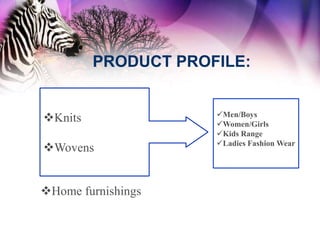
PRODUCT PROFILE:


                     Men/Boys
Knits               Women/Girls
                     Kids Range
                     Ladies Fashion Wear
Wovens


Home furnishings
• VISION:
       “Be the global best in bringing delight to human life by weaving
       dreams of fashion & feelings of comfort”.
• MISSION:
   – Be the most preferred competitive global supplier of apparel.
   – Be the most preferred employer in the industry.
   – Be a learning organization to improve & excel.
• VALUES:
   –   Customer delight.
   –   Integrity & ethics.
   –   Respect for human values.
   –   Nurturing human talent.
   –   Continues improvement
Organisation Structure:
Departmental study:
1. MARKETING/MERCHANDISING
  It includes directing and overseeing the development of
  product line from start to finish.
• Type of merchandising
   – Marketing merchandising.
   – Product merchandising.


2. SAMPLING:
   Sampling is done to see how the product will look like
   when produced in bulk.
3. PURCHSING:
      Divided into two sub department
      •   fabric sourcing
      •   Trims sourcing.


4. PRODUCTION DEPARTMENT:
   This Department Includes Various Sections As Follows:
   Cutting Section
   Embroidery Section
   Sewing Section
   Washing Section
   Finishing Section
5.    HUMAN RESOURCE DEPARTMENT:
      HR department is divided into two sections for the better control of
      manpower
      Corporate HR
      Factory HR.

6.    FINANCE AND ACCOUNTING DEPARTMENT:
      The company uses its own funds for long term sources. For short
      term sources the company avails over draft facilities from banks
      like Canara Bank and Axis Bank”.
      key functions includes:
         Capital budgeting
         Bills Receivable and processing
         Salary and wage administration
Other departments:
• Planning Department

• Industrial Engineering Department

• Fabric Audit Department

• Fabric Stores

• Accessory Stores

• Maintenance

• Systems

• Documentation Department
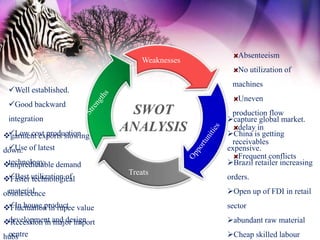
Absenteeism
                                   Weaknesses
                                                   No utilization of
                                                 machines
 Well established.
                                                   Uneven
 Good backward
                               SWOT              production flow
 integration                                    capture global market.
 Low cost production
garment exports slowing
                              ANALYSIS             delay in
                                                China is getting
                                                 receivables
 Use
down. of latest                                 expensive.
                                                   Frequent conflicts
 technology.
unpredictable demand                           Brazil retailer increasing
                               Treats
 Best technological
Faster utilization of                          orders.
 material.
obsolescence                                    Open up of FDI in retail
 In house product
Fluctuation in rupee value                     sector

Recession in and design
 development major import                       abundant raw material
 centre
hubs                                            Cheap skilled labour
Findings: Suggestions & Conclusion
           Findings,
• Expanded over 200 times in past 30 years.

• Production capacity of the unit is 8000 to 10000 garments per day.

• Efficiency of the company is ranging from 50% to 75%.

• The company’s customers are situated in foreign

• Own product design centers

• Exports its products through its sister company.

• Company uses its own funds for long term operations

• Company is following manual KANBON system
Suggestions:
• Use the electronic KANBON system

• Company can go for six sigma

• Company is facing 8% to 10% absenteeism          can reduced by
  creating friendly work environment.

• frequent conflicts because of over burden    can minimized by
  recruiting additional operators.

• Company is not taking many good investment opportunities
  mainly depending on internally generated funds      consider
  outside sources
Conclusion:
• “Shahi Exports Pvt. Ltd”, developed itself as a leading
  manufacturer of ready to wear garments in India.

• Company’s strength lies in good product design team, well
  trained employees, quality concern and price leadership.

• Finally, Shahi is growing at good rate even though it has many
  internal and external problems and the customers are satisfied
  with “Shahi Exports Pvt. Ltd”, and have a positive attitude
  towards the organization.
Shahi Exports Pvt. Ltd

Shahi Exports Pvt. Ltd

  • 1.
    Presentation on Organisation Studyat Shahi Exports Pvt. Ltd. Bangalore By: Sandeep Kumar S 111gcma112
  • 2.
    Industry profile: (Apparel Manufacturing) • Apparel is one of the basic necessities . • The Apparel and Textile industry is India’s second largest industry • India and China have a comparative advantage in this industry. • apparel goods had been reserved for SSI till 1997. • garments made depends on various factors. • In past two decade The apparel market has grown 15.5% to INR 1,224 billion. • India accounts for about 12% of the world’s production of apparel.
  • 3.
    • Industry hasaround 1, 25, 000 knitted and woven Garment units • Production capacity is 8,390 million pieces, in which 1,930 million pieces are exported. • Over 36.5 lakhs workers • US and EURO are the main import hubs. • Major Players: – Aditya Birla Nuvo – Raymond – Koutons – Arvind Mills – Wills Lifestyle.
  • 4.
    Company profile: (Shahi Exports Pvt. Ltd.) • Started in 1974 at Faridabad, in Delhi • Bangalore operations began on 1st November 1988 with 250 associates and 104 machines. • Expanded over 200 times from last 30 years • Manufactures 3 million pieces of high quality wovens & knits per month • In-house product development and design studio • Uses 3 software platforms such as MOVEX, COGNOS and OPTITEX. • Major business operations are Textile Mills and Apparel Manufacturing.
  • 5.
    • Future plans:set up 3 more units in Karnataka, plants in Bangladesh and Pakistan. • Competitors: Madura Garments, Gokuldas Exports and VK Exports. • Key personnel: – MRS. SARALA AHUJA - Chairperson(founder) – MR. HARISH AHUJA - Managing Director – MR. GIRISH AHUJA - Director – MR. SUBHASH TIWARI - Director – MR. RAMALINGAM - CEO
  • 6.
    PRODUCT PROFILE: Men/Boys Knits Women/Girls Kids Range Ladies Fashion Wear Wovens Home furnishings
  • 7.
    • VISION: “Be the global best in bringing delight to human life by weaving dreams of fashion & feelings of comfort”. • MISSION: – Be the most preferred competitive global supplier of apparel. – Be the most preferred employer in the industry. – Be a learning organization to improve & excel. • VALUES: – Customer delight. – Integrity & ethics. – Respect for human values. – Nurturing human talent. – Continues improvement
  • 8.
  • 9.
    Departmental study: 1. MARKETING/MERCHANDISING It includes directing and overseeing the development of product line from start to finish. • Type of merchandising – Marketing merchandising. – Product merchandising. 2. SAMPLING: Sampling is done to see how the product will look like when produced in bulk.
  • 10.
    3. PURCHSING: Divided into two sub department • fabric sourcing • Trims sourcing. 4. PRODUCTION DEPARTMENT: This Department Includes Various Sections As Follows:  Cutting Section  Embroidery Section  Sewing Section  Washing Section  Finishing Section
  • 11.
    5. HUMAN RESOURCE DEPARTMENT: HR department is divided into two sections for the better control of manpower  Corporate HR  Factory HR. 6. FINANCE AND ACCOUNTING DEPARTMENT: The company uses its own funds for long term sources. For short term sources the company avails over draft facilities from banks like Canara Bank and Axis Bank”. key functions includes:  Capital budgeting  Bills Receivable and processing  Salary and wage administration
  • 12.
    Other departments: • PlanningDepartment • Industrial Engineering Department • Fabric Audit Department • Fabric Stores • Accessory Stores • Maintenance • Systems • Documentation Department
  • 13.
    Absenteeism Weaknesses No utilization of machines Well established. Uneven Good backward SWOT production flow integration capture global market. Low cost production garment exports slowing ANALYSIS delay in China is getting receivables Use down. of latest expensive. Frequent conflicts technology. unpredictable demand Brazil retailer increasing Treats Best technological Faster utilization of orders. material. obsolescence Open up of FDI in retail In house product Fluctuation in rupee value sector Recession in and design development major import abundant raw material centre hubs Cheap skilled labour
  • 14.
    Findings: Suggestions &Conclusion Findings, • Expanded over 200 times in past 30 years. • Production capacity of the unit is 8000 to 10000 garments per day. • Efficiency of the company is ranging from 50% to 75%. • The company’s customers are situated in foreign • Own product design centers • Exports its products through its sister company. • Company uses its own funds for long term operations • Company is following manual KANBON system
  • 15.
    Suggestions: • Use theelectronic KANBON system • Company can go for six sigma • Company is facing 8% to 10% absenteeism can reduced by creating friendly work environment. • frequent conflicts because of over burden can minimized by recruiting additional operators. • Company is not taking many good investment opportunities mainly depending on internally generated funds consider outside sources
  • 16.
    Conclusion: • “Shahi ExportsPvt. Ltd”, developed itself as a leading manufacturer of ready to wear garments in India. • Company’s strength lies in good product design team, well trained employees, quality concern and price leadership. • Finally, Shahi is growing at good rate even though it has many internal and external problems and the customers are satisfied with “Shahi Exports Pvt. Ltd”, and have a positive attitude towards the organization.