SPECIAL ECONOMIC
ZONE’S IN INDIAPresentation by
Jafar Nadaf(11)
Guided by: Prof: P K Gupta
WHAT IS A SEZ ?
 The SEZs are expected to be engines for economic
growth.
 Special Economic Zone (SEZ) is designated area in
countries that possess special economic regulation
that are different from other areas in the same
country. Moreover these regulations tend to contain
measures that are conducive business in a SEZ
usually means that a company will receive tax reliefs
and the opportunity to pay lower tax.
It covers a broad range of more
specific zones including :-
• Free Trade Zones (FTZ)
• Export Processing Zones (EPZ)
• Free Zones (FZ)
• Industrial Estates (IE)
• Free Ports (FP)
• Urban Enterprise Zones
Free Trade Zones (FTZ)
• FTZ is specific class of special economy zone.
They are geographic area where goods may be
landed, handled or re-configured, and re-
exported without the intervention of customs
authorities.
Export Processing Zones (EPZ)
• An Export Processing Zone is a specific type of
FTZ, set up generally in developing countries
by their governments to promote and
commercial exports.
Free Zones (FZ)
• Free zone designated area in which companies
are taxed very lightly or not at all in order to
encourage economic activities.
Industrial Estates (IE)
• An industrial estate is a place where the
required facilities and factory accommodation
are provided by government to the
entrepreneurs to establish their industries .
• Industrial estates are also known by different
names, e.g. Industrial region, industrial park,
industrial area, industrial zone, etc.
Free Ports (FP)
• A port or area of a port in which imported goods
can be held or processed free of customs duties
before re-export.
Urban Enterprises Zone
• An urban enterprises zone is an area in which
policies to encourage economic growth and
development and implemented.
• UEZ policies generally offer tax concession,
infrastructure incentives and reduced regulations
to attract investment and private companies.
History of Free Trade Zones
• First Free Trade Zone in the world had started on 1st
January 1965 at Kandla Port , Kutch, India.
• By 1978 India had another four free trade zones at
Mumbai , Chennai , Noida and Falta.
• In 1980 China had gone through major economic
make over and they had realized power in concept of
Free Trade Zone’s.
Cont..
• First Chinese Free Trade Zone became operational in
1984 – Shenzhen
• In year 2000 one zone of Shenzhen was Exporting
thrice of India.
• As on today there are about 2700 operation free
trade zones spread over 150 countries in world,
• Providing employment for approximately 63 million
people.
Cont..
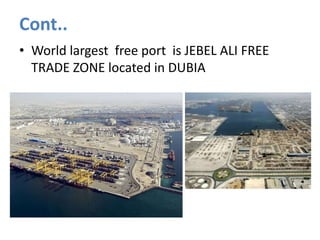
• World largest free port is JEBEL ALI FREE
TRADE ZONE located in DUBIA
ROLE OF SEZ IN INDIAN ECONOMY
• To provide internationally competitive
environment
• To encourage FDI and enhance GDP
• To increase share in global exports
 SEZ exports accounting for 38% of India’s total
export in 2014.
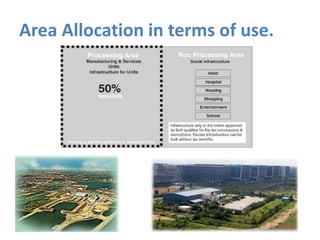
Area Allocation in terms of use.
ADVANTAGES OF SEZ
• Growth and development
• Attracts Foreign Direct Investment
• Exposure to technology and global market
• Increasing GDP and Economic Model
• Employment opportunities are created
DISADVANTAGES OF SEZ
• Land acquisition at very low prices
• Farmers loose their livelihood
• Tax holidays affect GDP
SEZ Policy of 2000
 New Policy in April 2000. SEZs permitted to be set
up in the public, private, joint sector or by the State
Governments
 Minimum size of 1000 hectares (4 sq. miles)
 Simplified procedures and more incentives
 Main measures were:
 Conditions for automatic approval relaxed
considerably
 Customs procedures simplified
 Units could produce items reserved for SSI units in
domestic market
 100% FDI investment for manufacturing
 Profits could be repatriated fully
 Freedom for sub-contracting
 100% I.T. exemption for five years
 Exemption from Central Excise Duty on capital
goods, raw materials, consumable spares from
domestic market
 Reimbursement of CST paid on domestic
purchases
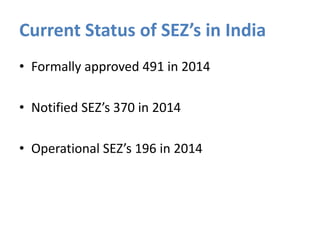
Current Status of SEZ’s in India
• Formally approved 491 in 2014
• Notified SEZ’s 370 in 2014
• Operational SEZ’s 196 in 2014
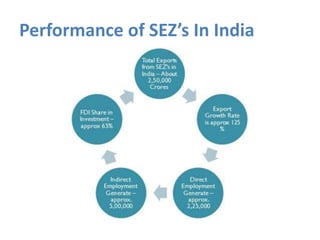
Performance of SEZ’s In India
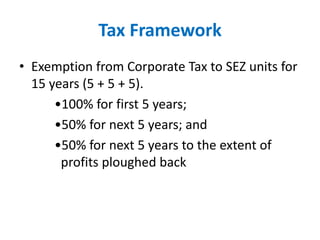
Tax Framework
• Exemption from Corporate Tax to SEZ units for
15 years (5 + 5 + 5).
•100% for first 5 years;
•50% for next 5 years; and
•50% for next 5 years to the extent of
profits ploughed back
Thank you

sezindia-131119110742-phpapp02

  • 1.
    SPECIAL ECONOMIC ZONE’S ININDIAPresentation by Jafar Nadaf(11) Guided by: Prof: P K Gupta
  • 2.
    WHAT IS ASEZ ?  The SEZs are expected to be engines for economic growth.  Special Economic Zone (SEZ) is designated area in countries that possess special economic regulation that are different from other areas in the same country. Moreover these regulations tend to contain measures that are conducive business in a SEZ usually means that a company will receive tax reliefs and the opportunity to pay lower tax.
  • 3.
    It covers abroad range of more specific zones including :- • Free Trade Zones (FTZ) • Export Processing Zones (EPZ) • Free Zones (FZ) • Industrial Estates (IE) • Free Ports (FP) • Urban Enterprise Zones
  • 4.
    Free Trade Zones(FTZ) • FTZ is specific class of special economy zone. They are geographic area where goods may be landed, handled or re-configured, and re- exported without the intervention of customs authorities.
  • 5.
    Export Processing Zones(EPZ) • An Export Processing Zone is a specific type of FTZ, set up generally in developing countries by their governments to promote and commercial exports. Free Zones (FZ) • Free zone designated area in which companies are taxed very lightly or not at all in order to encourage economic activities.
  • 6.
    Industrial Estates (IE) •An industrial estate is a place where the required facilities and factory accommodation are provided by government to the entrepreneurs to establish their industries . • Industrial estates are also known by different names, e.g. Industrial region, industrial park, industrial area, industrial zone, etc.
  • 7.
    Free Ports (FP) •A port or area of a port in which imported goods can be held or processed free of customs duties before re-export. Urban Enterprises Zone • An urban enterprises zone is an area in which policies to encourage economic growth and development and implemented. • UEZ policies generally offer tax concession, infrastructure incentives and reduced regulations to attract investment and private companies.
  • 8.
    History of FreeTrade Zones • First Free Trade Zone in the world had started on 1st January 1965 at Kandla Port , Kutch, India. • By 1978 India had another four free trade zones at Mumbai , Chennai , Noida and Falta. • In 1980 China had gone through major economic make over and they had realized power in concept of Free Trade Zone’s.
  • 9.
    Cont.. • First ChineseFree Trade Zone became operational in 1984 – Shenzhen • In year 2000 one zone of Shenzhen was Exporting thrice of India. • As on today there are about 2700 operation free trade zones spread over 150 countries in world, • Providing employment for approximately 63 million people.
  • 10.
    Cont.. • World largestfree port is JEBEL ALI FREE TRADE ZONE located in DUBIA
  • 11.
    ROLE OF SEZIN INDIAN ECONOMY • To provide internationally competitive environment • To encourage FDI and enhance GDP • To increase share in global exports  SEZ exports accounting for 38% of India’s total export in 2014.
  • 12.
    Area Allocation interms of use.
  • 13.
    ADVANTAGES OF SEZ •Growth and development • Attracts Foreign Direct Investment • Exposure to technology and global market • Increasing GDP and Economic Model • Employment opportunities are created
  • 14.
    DISADVANTAGES OF SEZ •Land acquisition at very low prices • Farmers loose their livelihood • Tax holidays affect GDP
  • 15.
    SEZ Policy of2000  New Policy in April 2000. SEZs permitted to be set up in the public, private, joint sector or by the State Governments  Minimum size of 1000 hectares (4 sq. miles)  Simplified procedures and more incentives
  • 16.
     Main measureswere:  Conditions for automatic approval relaxed considerably  Customs procedures simplified  Units could produce items reserved for SSI units in domestic market  100% FDI investment for manufacturing  Profits could be repatriated fully  Freedom for sub-contracting  100% I.T. exemption for five years  Exemption from Central Excise Duty on capital goods, raw materials, consumable spares from domestic market  Reimbursement of CST paid on domestic purchases
  • 17.
    Current Status ofSEZ’s in India • Formally approved 491 in 2014 • Notified SEZ’s 370 in 2014 • Operational SEZ’s 196 in 2014
  • 18.
  • 19.
    Tax Framework • Exemptionfrom Corporate Tax to SEZ units for 15 years (5 + 5 + 5). •100% for first 5 years; •50% for next 5 years; and •50% for next 5 years to the extent of profits ploughed back
  • 20.