DISINVESTMENT BY 
GOVERNMENT IN PSUs 
Presentation By:- 
• Swaraj Mishra
REDEFINING DISINVESTMENT 
• Investment refers to the conversion of money or cash 
into securities, debentures, bonds or any other claims 
on money. As follows, disinvestment involves the 
conversion of money claims or securities into money or 
cash. 
• Disinvestment can be simply defined as the action of 
the organization’s (Or Government’s) Selling or 
Liquidating an Asset or Subsidiary. 
• It is commonly referred to as Divestment or Divestiture 
• Government organization will typically disinvest an 
Asset either as a strategic move for the company or for 
raising resources to meet general / specific needs.
METHODS FOR DISINVESTMENT 
• STRATEGIC SALE: Government sells a major portion of its stake to the 
strategic buyer and also gives over management control. 
• CAPITAL MARKET: Offering shares at a fixed price through a general 
prospectus, the offer is made to the general public through the medium of 
recognized market intermediaries. 
• AUCTION: 
• SALES TO EMPLOYEES:
IMPORTANCE OF DISINVESTMENT 
1. It will generate money to reduce fiscal deficit. 
2. Govt. Can utilizes these funds for welfare of public. 
3. It will improve efficiency and abilities of organisation. 
4. Lose making PSU's will make profit. 
5. Private sector have huge money to invest so it will improve 
infrastructure, technical efficiency. 
6. It will change the attitude of lazy employees and will improve their 
efficiency.
RECENT DISINVESTMENTS 
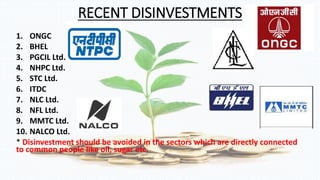
1. ONGC 
2. BHEL 
3. PGCIL Ltd. 
4. NHPC Ltd. 
5. STC Ltd. 
6. ITDC 
7. NLC Ltd. 
8. NFL Ltd. 
9. MMTC Ltd. 
10. NALCO Ltd. 
* Disinvestment should be avoided in the sectors which are directly connected 
to common people like oil, sugar etc.
CURRENT DISINVESTMENT FIGURES 
1. The process for disinvestment in ONGC and NHPC has already 
been started. 
2. Also, the Government is looking to sell 5% stake in SAIL and 10% 
each in RINL and HAL in the current Fiscal Year. 
3. Disinvestment of 10% through an IPO in RINL is tentatively 
scheduled for completion in the current financial year. 
4. Of the disinvestment targets of Rs. 40,000 Crore in 2013-14, the 
Government had mobilized Rs. 15,820 Crore. 
5. In 2012-13 of 30,000 Crore target, 23,957 Crore was raised.
MERITS OF DISINVESTMENT 
1. In private sector the decision making process is quick. 
2. Decisions are linked with the competitive market changes. 
3. Better corporate governance. 
4. Transparency 
5. The market participation in capital of PSUs through stock 
exchanges would enable the market to discover the latent worth 
of PSUs
DEMERITS OF DISINVESTMENT 
1. Loss of public interest 
2. There would be chances of Assets striping by the strategic partner. 
3. The Government’s policy on Disinvestment includes the disposal 
of both Profit making, as well as Potentially viable PSUs. 
4. Private monopolies : VSNL to TATA 
5. Loss of regular source of income to the government
POLITICS AND DISINVESTMENT 
1. The main challenge in Disinvestment is the pricing strategy, as the 
IPO market plays a critical role to decide the funds generated 
through Disinvestment 
2. Since last few years the IPO market has not picked up well, the 
change in government is expected to trigger the market 
sentiments on Disinvestments.
http://www.divest.nic.in/ 
http://www.bsepsu.com/ 
http://www.worldbank.org/ 
http://www.investopedia.com/ 
http://www.business.mapsofindia.com/ 
http://www.economictimes.indiatimes.com/
Short Presentation For Disinvestment By Government Of India In PSUs

Short Presentation For Disinvestment By Government Of India In PSUs

  • 1.
    DISINVESTMENT BY GOVERNMENTIN PSUs Presentation By:- • Swaraj Mishra
  • 2.
    REDEFINING DISINVESTMENT •Investment refers to the conversion of money or cash into securities, debentures, bonds or any other claims on money. As follows, disinvestment involves the conversion of money claims or securities into money or cash. • Disinvestment can be simply defined as the action of the organization’s (Or Government’s) Selling or Liquidating an Asset or Subsidiary. • It is commonly referred to as Divestment or Divestiture • Government organization will typically disinvest an Asset either as a strategic move for the company or for raising resources to meet general / specific needs.
  • 3.
    METHODS FOR DISINVESTMENT • STRATEGIC SALE: Government sells a major portion of its stake to the strategic buyer and also gives over management control. • CAPITAL MARKET: Offering shares at a fixed price through a general prospectus, the offer is made to the general public through the medium of recognized market intermediaries. • AUCTION: • SALES TO EMPLOYEES:
  • 4.
    IMPORTANCE OF DISINVESTMENT 1. It will generate money to reduce fiscal deficit. 2. Govt. Can utilizes these funds for welfare of public. 3. It will improve efficiency and abilities of organisation. 4. Lose making PSU's will make profit. 5. Private sector have huge money to invest so it will improve infrastructure, technical efficiency. 6. It will change the attitude of lazy employees and will improve their efficiency.
  • 5.
    RECENT DISINVESTMENTS 1.ONGC 2. BHEL 3. PGCIL Ltd. 4. NHPC Ltd. 5. STC Ltd. 6. ITDC 7. NLC Ltd. 8. NFL Ltd. 9. MMTC Ltd. 10. NALCO Ltd. * Disinvestment should be avoided in the sectors which are directly connected to common people like oil, sugar etc.
  • 6.
    CURRENT DISINVESTMENT FIGURES 1. The process for disinvestment in ONGC and NHPC has already been started. 2. Also, the Government is looking to sell 5% stake in SAIL and 10% each in RINL and HAL in the current Fiscal Year. 3. Disinvestment of 10% through an IPO in RINL is tentatively scheduled for completion in the current financial year. 4. Of the disinvestment targets of Rs. 40,000 Crore in 2013-14, the Government had mobilized Rs. 15,820 Crore. 5. In 2012-13 of 30,000 Crore target, 23,957 Crore was raised.
  • 7.
    MERITS OF DISINVESTMENT 1. In private sector the decision making process is quick. 2. Decisions are linked with the competitive market changes. 3. Better corporate governance. 4. Transparency 5. The market participation in capital of PSUs through stock exchanges would enable the market to discover the latent worth of PSUs
  • 8.
    DEMERITS OF DISINVESTMENT 1. Loss of public interest 2. There would be chances of Assets striping by the strategic partner. 3. The Government’s policy on Disinvestment includes the disposal of both Profit making, as well as Potentially viable PSUs. 4. Private monopolies : VSNL to TATA 5. Loss of regular source of income to the government
  • 9.
    POLITICS AND DISINVESTMENT 1. The main challenge in Disinvestment is the pricing strategy, as the IPO market plays a critical role to decide the funds generated through Disinvestment 2. Since last few years the IPO market has not picked up well, the change in government is expected to trigger the market sentiments on Disinvestments.
  • 10.
    http://www.divest.nic.in/ http://www.bsepsu.com/ http://www.worldbank.org/ http://www.investopedia.com/ http://www.business.mapsofindia.com/ http://www.economictimes.indiatimes.com/