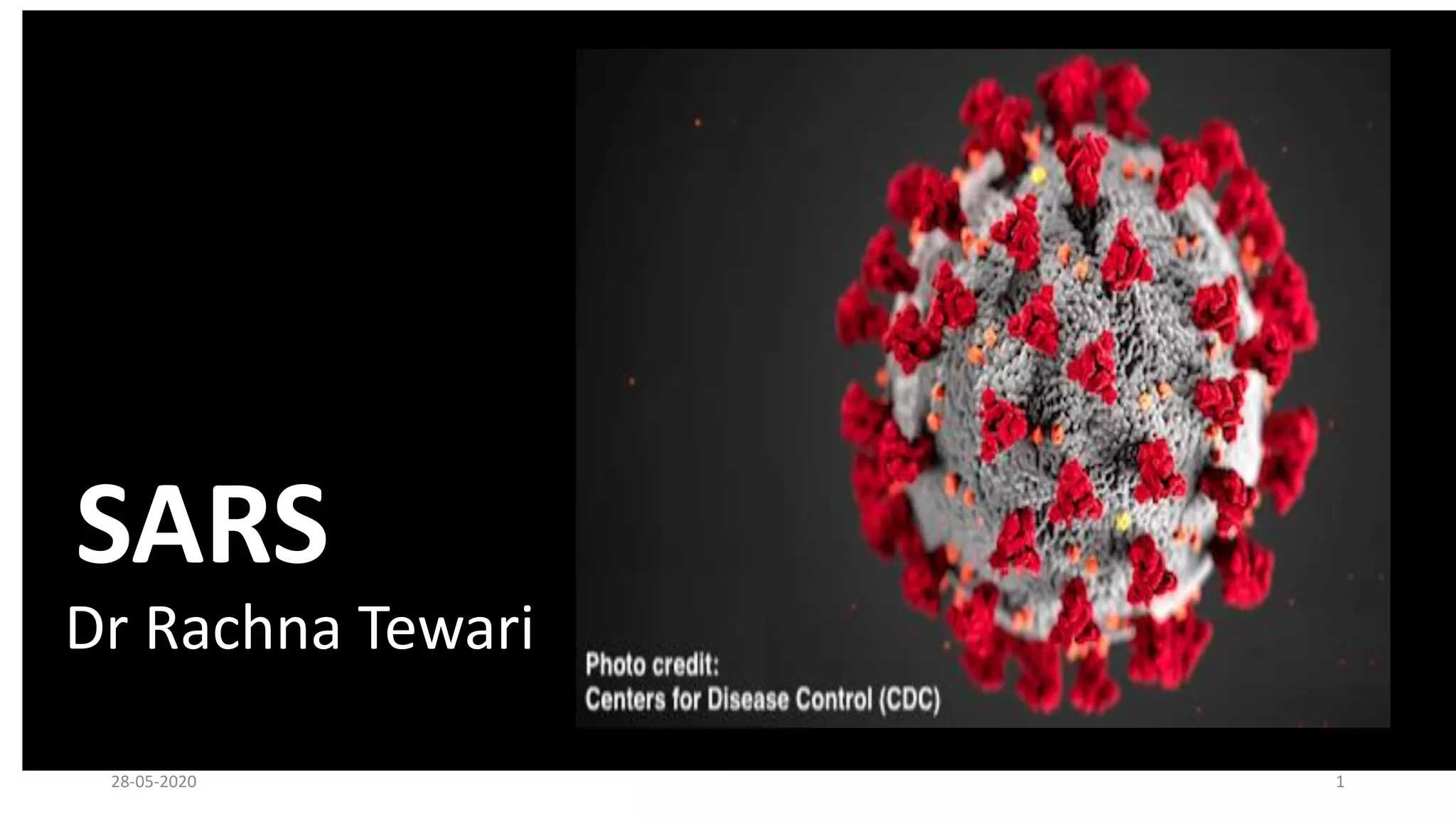
SARS
Dr Rachna Tewari
28-05-2020 1
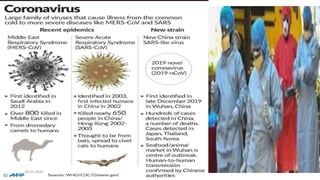
SARS (Severe Acute Respiratory Syndrome)
Cause
SARS virus.
Virus identified in 2003 in China.
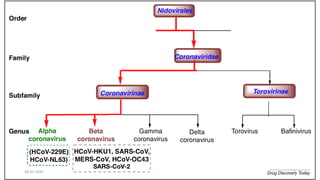
Coronavirus .
SARS-CoV.
28-05-2020 2
28-05-2020 3
Morphology
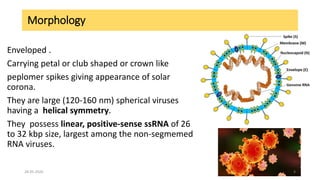
Enveloped .
Carrying petal or club shaped or crown like
peplomer spikes giving appearance of solar
corona.
They are large (120-160 nm) spherical viruses
having a helical symmetry.
They possess linear, positive-sense ssRNA of 26
to 32 kbp size, largest among the non-segmemed
RNA viruses.
28-05-2020 4
28-05-2020 5
SAR S-Co V (severe acute respiratory
syndrome corona virus)
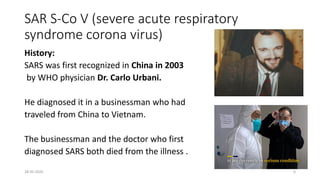
History:
SARS was first recognized in China in 2003
by WHO physician Dr. Carlo Urbani.
He diagnosed it in a businessman who had
traveled from China to Vietnam.
The businessman and the doctor who first
diagnosed SARS both died from the illness .
28-05-2020 6
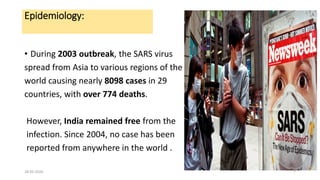
Epidemiology:
• During 2003 outbreak, the SARS virus
spread from Asia to various regions of the
world causing nearly 8098 cases in 29
countries, with over 774 deaths.
However, India remained free from the
infection. Since 2004, no case has been
reported from anywhere in the world .
28-05-2020 7
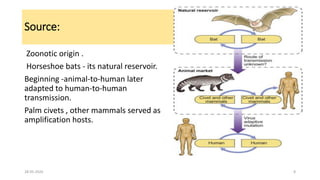
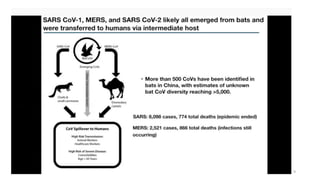
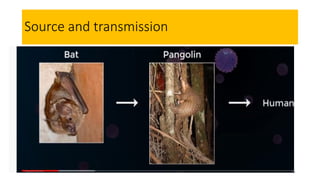
Source:
Zoonotic origin .
Horseshoe bats - its natural reservoir.
Beginning -animal-to-human later
adapted to human-to-human
transmission.
Palm civets , other mammals served as
amplification hosts.
28-05-2020 8
28-05-2020 9
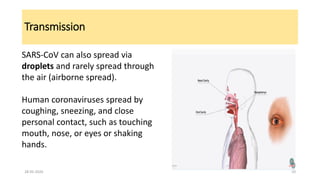
Transmission
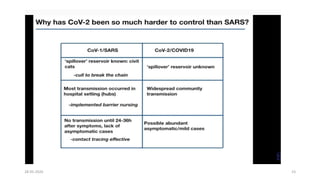
SARS-CoV can also spread via
droplets and rarely spread through
the air (airborne spread).
Human coronaviruses spread by
coughing, sneezing, and close
personal contact, such as touching
mouth, nose, or eyes or shaking
hands.
28-05-2020 10
Clinical manifestation
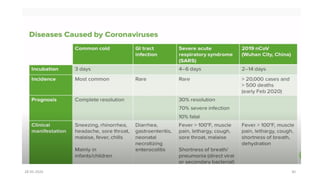
Severe lower respiratory tract infection .
Characterized by muscle pain .
Headache, sore throat and fever.
Followed by the onset of respiratory symptoms
Cough
Dyspnoea
Severe pneumonia
28-05-2020 11
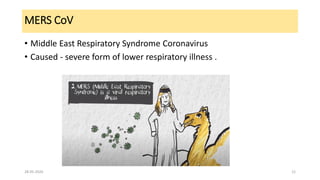
MERS CoV
• Middle East Respiratory Syndrome Coronavirus
• Caused - severe form of lower respiratory illness .
28-05-2020 12
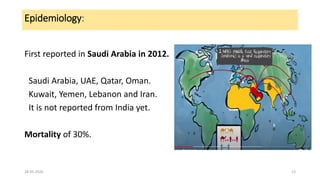
Epidemiology:
First reported in Saudi Arabia in 2012.
Saudi Arabia, UAE, Qatar, Oman.
Kuwait, Yemen, Lebanon and Iran.
It is not reported from India yet.
Mortality of 30%.
28-05-2020 13
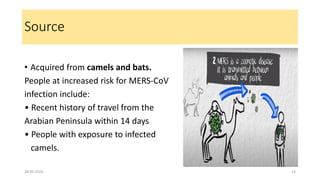
Source
• Acquired from camels and bats.
People at increased risk for MERS-CoV
infection include:
• Recent history of travel from the
Arabian Peninsula within 14 days
• People with exposure to infected
camels.
28-05-2020 14
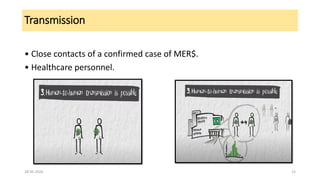
Transmission
• Close contacts of a confirmed case of MER$.
• Healthcare personnel.
28-05-2020 15
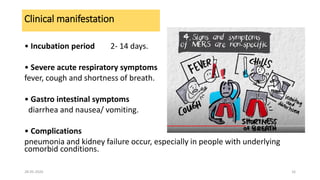
Clinical manifestation
• Incubation period 2- 14 days.
• Severe acute respiratory symptoms
fever, cough and shortness of breath.
• Gastro intestinal symptoms
diarrhea and nausea/ vomiting.
• Complications
pneumonia and kidney failure occur, especially in people with underlying
comorbid conditions.
28-05-2020 16
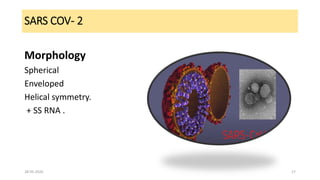
SARS COV- 2
Morphology
Spherical
Enveloped
Helical symmetry.
+ SS RNA .
28-05-2020 17
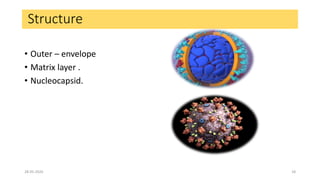
Structure
• Outer – envelope
• Matrix layer .
• Nucleocapsid.
28-05-2020 18
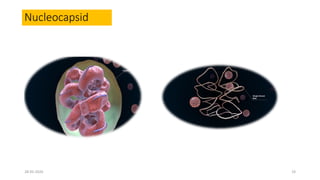
Nucleocapsid
28-05-2020 19
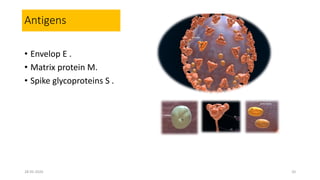
Antigens
• Envelop E .
• Matrix protein M.
• Spike glycoproteins S .
28-05-2020 20
Source and transmission
28-05-2020 21
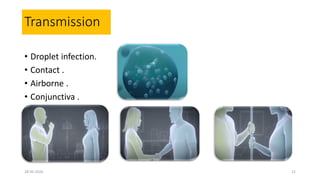
Transmission
• Droplet infection.
• Contact .
• Airborne .
• Conjunctiva .
28-05-2020 22
28-05-2020 23
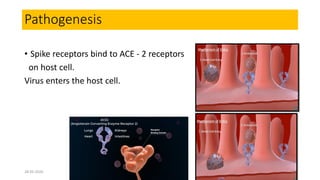
Pathogenesis
• Spike receptors bind to ACE - 2 receptors
on host cell.
Virus enters the host cell.
28-05-2020 24
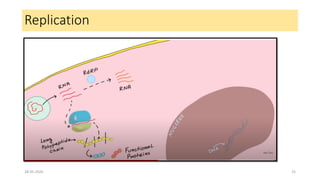
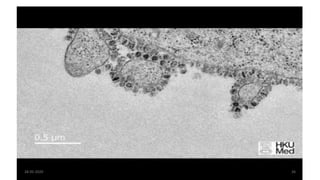
Replication
28-05-2020 25
28-05-2020 26
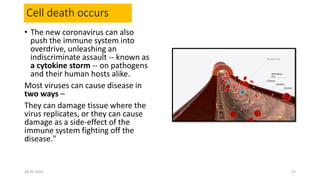
Cell death occurs
• The new coronavirus can also
push the immune system into
overdrive, unleashing an
indiscriminate assault -- known as
a cytokine storm -- on pathogens
and their human hosts alike.
Most viruses can cause disease in
two ways –
They can damage tissue where the
virus replicates, or they can cause
damage as a side-effect of the
immune system fighting off the
disease."
28-05-2020 27
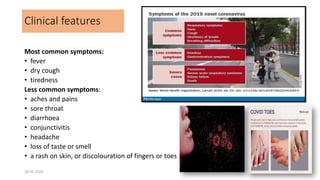
Clinical features
Most common symptoms:
• fever
• dry cough
• tiredness
Less common symptoms:
• aches and pains
• sore throat
• diarrhoea
• conjunctivitis
• headache
• loss of taste or smell
• a rash on skin, or discolouration of fingers or toes
28-05-2020 28
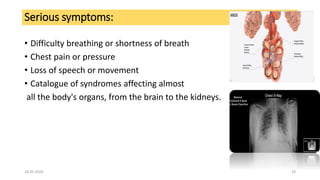
Serious symptoms:
• Difficulty breathing or shortness of breath
• Chest pain or pressure
• Loss of speech or movement
• Catalogue of syndromes affecting almost
all the body's organs, from the brain to the kidneys.
28-05-2020 29
28-05-2020 30
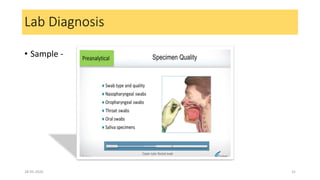
Lab Diagnosis
• Sample -
28-05-2020 31
Laboratory Diagnosis
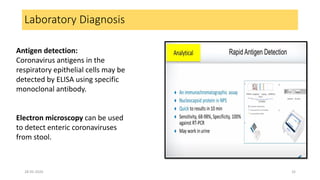
Antigen detection:
Coronavirus antigens in the
respiratory epithelial cells may be
detected by ELISA using specific
monoclonal antibody.
Electron microscopy can be used
to detect enteric coronaviruses
from stool.
28-05-2020 32
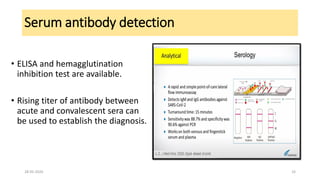
Serum antibody detection
• ELISA and hemagglutination
inhibition test are available.
• Rising titer of antibody between
acute and convalescent sera can
be used to establish the diagnosis.
28-05-2020 33
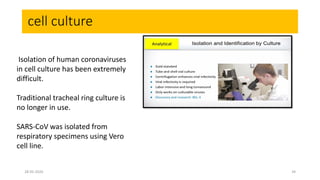
cell culture
Isolation of human coronaviruses
in cell culture has been extremely
difficult.
Traditional tracheal ring culture is
no longer in use.
SARS-CoV was isolated from
respiratory specimens using Vero
cell line.
28-05-2020 34
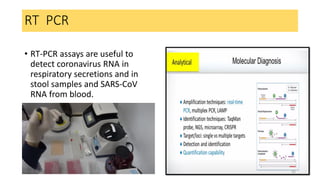
RT PCR
• RT-PCR assays are useful to
detect coronavirus RNA in
respiratory secretions and in
stool samples and SARS-CoV
RNA from blood.
28-05-2020 35
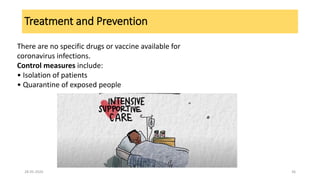
Treatment and Prevention
There are no specific drugs or vaccine available for
coronavirus infections.
Control measures include:
• Isolation of patients
• Quarantine of exposed people
28-05-2020 36
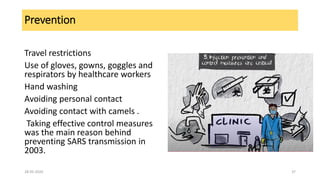
Prevention
Travel restrictions
Use of gloves, gowns, goggles and
respirators by healthcare workers
Hand washing
Avoiding personal contact
Avoiding contact with camels .
Taking effective control measures
was the main reason behind
preventing SARS transmission in
2003.
28-05-2020 37
TREATMENT
• HYDROXYCHLOROQUINE
• REMDISIVIR
• IVERMECTIN
• AZITHROMYCIN
• PARACETAMOL
• VENTILATOR
• CONVALESCENT PLASMA.
28-05-2020 38
Vaccines
• Under trial .
28-05-2020 39
Questions ???
28-05-2020 40

Sars corona virus .

  • 1.
  • 2.
    SARS (Severe AcuteRespiratory Syndrome) Cause SARS virus. Virus identified in 2003 in China. Coronavirus . SARS-CoV. 28-05-2020 2
  • 3.
  • 4.
    Morphology Enveloped . Carrying petalor club shaped or crown like peplomer spikes giving appearance of solar corona. They are large (120-160 nm) spherical viruses having a helical symmetry. They possess linear, positive-sense ssRNA of 26 to 32 kbp size, largest among the non-segmemed RNA viruses. 28-05-2020 4
  • 5.
  • 6.
    SAR S-Co V(severe acute respiratory syndrome corona virus) History: SARS was first recognized in China in 2003 by WHO physician Dr. Carlo Urbani. He diagnosed it in a businessman who had traveled from China to Vietnam. The businessman and the doctor who first diagnosed SARS both died from the illness . 28-05-2020 6
  • 7.
    Epidemiology: • During 2003outbreak, the SARS virus spread from Asia to various regions of the world causing nearly 8098 cases in 29 countries, with over 774 deaths. However, India remained free from the infection. Since 2004, no case has been reported from anywhere in the world . 28-05-2020 7
  • 8.
    Source: Zoonotic origin . Horseshoebats - its natural reservoir. Beginning -animal-to-human later adapted to human-to-human transmission. Palm civets , other mammals served as amplification hosts. 28-05-2020 8
  • 9.
  • 10.
    Transmission SARS-CoV can alsospread via droplets and rarely spread through the air (airborne spread). Human coronaviruses spread by coughing, sneezing, and close personal contact, such as touching mouth, nose, or eyes or shaking hands. 28-05-2020 10
  • 11.
    Clinical manifestation Severe lowerrespiratory tract infection . Characterized by muscle pain . Headache, sore throat and fever. Followed by the onset of respiratory symptoms Cough Dyspnoea Severe pneumonia 28-05-2020 11
  • 12.
    MERS CoV • MiddleEast Respiratory Syndrome Coronavirus • Caused - severe form of lower respiratory illness . 28-05-2020 12
  • 13.
    Epidemiology: First reported inSaudi Arabia in 2012. Saudi Arabia, UAE, Qatar, Oman. Kuwait, Yemen, Lebanon and Iran. It is not reported from India yet. Mortality of 30%. 28-05-2020 13
  • 14.
    Source • Acquired fromcamels and bats. People at increased risk for MERS-CoV infection include: • Recent history of travel from the Arabian Peninsula within 14 days • People with exposure to infected camels. 28-05-2020 14
  • 15.
    Transmission • Close contactsof a confirmed case of MER$. • Healthcare personnel. 28-05-2020 15
  • 16.
    Clinical manifestation • Incubationperiod 2- 14 days. • Severe acute respiratory symptoms fever, cough and shortness of breath. • Gastro intestinal symptoms diarrhea and nausea/ vomiting. • Complications pneumonia and kidney failure occur, especially in people with underlying comorbid conditions. 28-05-2020 16
  • 17.
    SARS COV- 2 Morphology Spherical Enveloped Helicalsymmetry. + SS RNA . 28-05-2020 17
  • 18.
    Structure • Outer –envelope • Matrix layer . • Nucleocapsid. 28-05-2020 18
  • 19.
  • 20.
    Antigens • Envelop E. • Matrix protein M. • Spike glycoproteins S . 28-05-2020 20
  • 21.
  • 22.
    Transmission • Droplet infection. •Contact . • Airborne . • Conjunctiva . 28-05-2020 22
  • 23.
  • 24.
    Pathogenesis • Spike receptorsbind to ACE - 2 receptors on host cell. Virus enters the host cell. 28-05-2020 24
  • 25.
  • 26.
  • 27.
    Cell death occurs •The new coronavirus can also push the immune system into overdrive, unleashing an indiscriminate assault -- known as a cytokine storm -- on pathogens and their human hosts alike. Most viruses can cause disease in two ways – They can damage tissue where the virus replicates, or they can cause damage as a side-effect of the immune system fighting off the disease." 28-05-2020 27
  • 28.
    Clinical features Most commonsymptoms: • fever • dry cough • tiredness Less common symptoms: • aches and pains • sore throat • diarrhoea • conjunctivitis • headache • loss of taste or smell • a rash on skin, or discolouration of fingers or toes 28-05-2020 28
  • 29.
    Serious symptoms: • Difficultybreathing or shortness of breath • Chest pain or pressure • Loss of speech or movement • Catalogue of syndromes affecting almost all the body's organs, from the brain to the kidneys. 28-05-2020 29
  • 30.
  • 31.
    Lab Diagnosis • Sample- 28-05-2020 31
  • 32.
    Laboratory Diagnosis Antigen detection: Coronavirusantigens in the respiratory epithelial cells may be detected by ELISA using specific monoclonal antibody. Electron microscopy can be used to detect enteric coronaviruses from stool. 28-05-2020 32
  • 33.
    Serum antibody detection •ELISA and hemagglutination inhibition test are available. • Rising titer of antibody between acute and convalescent sera can be used to establish the diagnosis. 28-05-2020 33
  • 34.
    cell culture Isolation ofhuman coronaviruses in cell culture has been extremely difficult. Traditional tracheal ring culture is no longer in use. SARS-CoV was isolated from respiratory specimens using Vero cell line. 28-05-2020 34
  • 35.
    RT PCR • RT-PCRassays are useful to detect coronavirus RNA in respiratory secretions and in stool samples and SARS-CoV RNA from blood. 28-05-2020 35
  • 36.
    Treatment and Prevention Thereare no specific drugs or vaccine available for coronavirus infections. Control measures include: • Isolation of patients • Quarantine of exposed people 28-05-2020 36
  • 37.
    Prevention Travel restrictions Use ofgloves, gowns, goggles and respirators by healthcare workers Hand washing Avoiding personal contact Avoiding contact with camels . Taking effective control measures was the main reason behind preventing SARS transmission in 2003. 28-05-2020 37
  • 38.
    TREATMENT • HYDROXYCHLOROQUINE • REMDISIVIR •IVERMECTIN • AZITHROMYCIN • PARACETAMOL • VENTILATOR • CONVALESCENT PLASMA. 28-05-2020 38
  • 39.
    Vaccines • Under trial. 28-05-2020 39
  • 40.