

Seven Basic Steps to
Build Realistic Schedule
    in Project 2010

         B Sai Prasad
  PMP, PMI-SP, MCTS Project 2007,
        MCTS Project 2010
        www.sainivas.com
“Microsoft Project is the enhanced
   version of Microsoft Excel”
               Anonymous


          Seven Steps To Success - Microsoft Project   2
Takeaways
• Forecast scheduling with Project 2010
  1. Realistic
  2. Dynamic
  3. Presentable


                   Seven Steps To Success - Microsoft Project   3
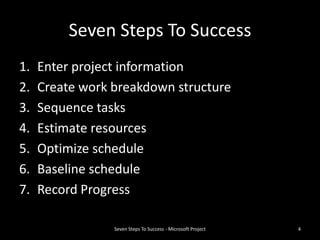
Seven Steps To Success
1.   Enter project information
2.   Create work breakdown structure
3.   Sequence tasks
4.   Estimate resources
5.   Optimize schedule
6.   Baseline schedule
7.   Record Progress

                 Seven Steps To Success - Microsoft Project   4
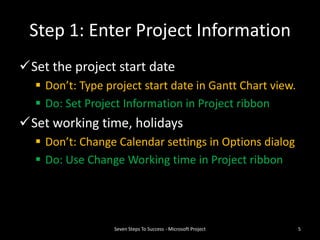
Step 1: Enter Project Information
Set the project start date
   Don’t: Type project start date in Gantt Chart view.
   Do: Set Project Information in Project ribbon
Set working time, holidays
   Don’t: Change Calendar settings in Options dialog
   Do: Use Change Working time in Project ribbon


                  Seven Steps To Success - Microsoft Project   5
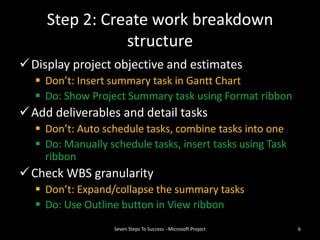
Step 2: Create work breakdown
                structure
 Display project objective and estimates
   Don’t: Insert summary task in Gantt Chart
   Do: Show Project Summary task using Format ribbon
 Add deliverables and detail tasks
   Don’t: Auto schedule tasks, combine tasks into one
   Do: Manually schedule tasks, insert tasks using Task
    ribbon
 Check WBS granularity
   Don’t: Expand/collapse the summary tasks
   Do: Use Outline button in View ribbon
                  Seven Steps To Success - Microsoft Project   6
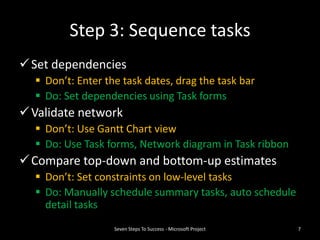
Step 3: Sequence tasks
 Set dependencies
   Don’t: Enter the task dates, drag the task bar
   Do: Set dependencies using Task forms
 Validate network
   Don’t: Use Gantt Chart view
   Do: Use Task forms, Network diagram in Task ribbon
 Compare top-down and bottom-up estimates
   Don’t: Set constraints on low-level tasks
   Do: Manually schedule summary tasks, auto schedule
    detail tasks
                   Seven Steps To Success - Microsoft Project   7
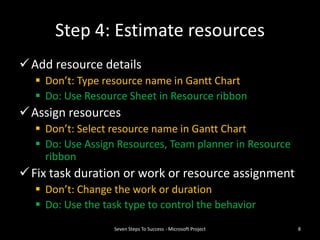
Step 4: Estimate resources
 Add resource details
   Don’t: Type resource name in Gantt Chart
   Do: Use Resource Sheet in Resource ribbon
 Assign resources
   Don’t: Select resource name in Gantt Chart
   Do: Use Assign Resources, Team planner in Resource
    ribbon
 Fix task duration or work or resource assignment
   Don’t: Change the work or duration
   Do: Use the task type to control the behavior
                  Seven Steps To Success - Microsoft Project   8
Step 5: Optimize schedule
Identify critical path
   Don’t: Have broken critical path
   Do: Check slack, critical path using Format ribbon
Level resources
   Don’t: Use Gantt chart view
   Do: Use Resource Usage, Team planner in
    Resource ribbon


                 Seven Steps To Success - Microsoft Project   9
Step 6: Baseline schedule
Set baseline
   Don’t: Copy the file (or) fields to custom fields
   Do: Set Baseline using Project ribbon
View baseline
   Don’t: Insert columns in view
   Do: Use Baseline table, Show baseline bar using
    Format ribbon


                  Seven Steps To Success - Microsoft Project   10
Step 7: Record progress
 Record actual
   Don’t: Use the Entry table for recording actual
   Do: Use the Tracking table with % complete in Task
    ribbon
 Slippage
   Don’t: Write formula to calculate variance
   Do: Use Slippage of Format ribbon, Variance table
 Report progress
   Don’t: Use the standard reports, copy picture
   Do: Print views, copy timeline view
                  Seven Steps To Success - Microsoft Project   11
Seven Steps To Success
1.   Enter Project Information
2.   Create Work breakdown structure
3.   Sequence tasks
4.   Estimate resources
5.   Optimize schedule
6.   Baseline schedule
7.   Record Progress

                 Seven Steps To Success - Microsoft Project   12
Thank you

Email: sai@sainivas.com
Web: www.sainivas.com


    Seven Steps To Success - Microsoft Project   13

Seven Basic Steps to Build Realistic Schedule in Project 2010

  • 1.
    Seven Basic Stepsto Build Realistic Schedule in Project 2010 B Sai Prasad PMP, PMI-SP, MCTS Project 2007, MCTS Project 2010 www.sainivas.com
  • 2.
    “Microsoft Project isthe enhanced version of Microsoft Excel” Anonymous Seven Steps To Success - Microsoft Project 2
  • 3.
    Takeaways • Forecast schedulingwith Project 2010 1. Realistic 2. Dynamic 3. Presentable Seven Steps To Success - Microsoft Project 3
  • 4.
    Seven Steps ToSuccess 1. Enter project information 2. Create work breakdown structure 3. Sequence tasks 4. Estimate resources 5. Optimize schedule 6. Baseline schedule 7. Record Progress Seven Steps To Success - Microsoft Project 4
  • 5.
    Step 1: EnterProject Information Set the project start date  Don’t: Type project start date in Gantt Chart view.  Do: Set Project Information in Project ribbon Set working time, holidays  Don’t: Change Calendar settings in Options dialog  Do: Use Change Working time in Project ribbon Seven Steps To Success - Microsoft Project 5
  • 6.
    Step 2: Creatework breakdown structure  Display project objective and estimates  Don’t: Insert summary task in Gantt Chart  Do: Show Project Summary task using Format ribbon  Add deliverables and detail tasks  Don’t: Auto schedule tasks, combine tasks into one  Do: Manually schedule tasks, insert tasks using Task ribbon  Check WBS granularity  Don’t: Expand/collapse the summary tasks  Do: Use Outline button in View ribbon Seven Steps To Success - Microsoft Project 6
  • 7.
    Step 3: Sequencetasks  Set dependencies  Don’t: Enter the task dates, drag the task bar  Do: Set dependencies using Task forms  Validate network  Don’t: Use Gantt Chart view  Do: Use Task forms, Network diagram in Task ribbon  Compare top-down and bottom-up estimates  Don’t: Set constraints on low-level tasks  Do: Manually schedule summary tasks, auto schedule detail tasks Seven Steps To Success - Microsoft Project 7
  • 8.
    Step 4: Estimateresources  Add resource details  Don’t: Type resource name in Gantt Chart  Do: Use Resource Sheet in Resource ribbon  Assign resources  Don’t: Select resource name in Gantt Chart  Do: Use Assign Resources, Team planner in Resource ribbon  Fix task duration or work or resource assignment  Don’t: Change the work or duration  Do: Use the task type to control the behavior Seven Steps To Success - Microsoft Project 8
  • 9.
    Step 5: Optimizeschedule Identify critical path  Don’t: Have broken critical path  Do: Check slack, critical path using Format ribbon Level resources  Don’t: Use Gantt chart view  Do: Use Resource Usage, Team planner in Resource ribbon Seven Steps To Success - Microsoft Project 9
  • 10.
    Step 6: Baselineschedule Set baseline  Don’t: Copy the file (or) fields to custom fields  Do: Set Baseline using Project ribbon View baseline  Don’t: Insert columns in view  Do: Use Baseline table, Show baseline bar using Format ribbon Seven Steps To Success - Microsoft Project 10
  • 11.
    Step 7: Recordprogress  Record actual  Don’t: Use the Entry table for recording actual  Do: Use the Tracking table with % complete in Task ribbon  Slippage  Don’t: Write formula to calculate variance  Do: Use Slippage of Format ribbon, Variance table  Report progress  Don’t: Use the standard reports, copy picture  Do: Print views, copy timeline view Seven Steps To Success - Microsoft Project 11
  • 12.
    Seven Steps ToSuccess 1. Enter Project Information 2. Create Work breakdown structure 3. Sequence tasks 4. Estimate resources 5. Optimize schedule 6. Baseline schedule 7. Record Progress Seven Steps To Success - Microsoft Project 12
  • 13.
    Thank you Email: sai@sainivas.com Web:www.sainivas.com Seven Steps To Success - Microsoft Project 13