SET IDENTITIES
Lecture # 09
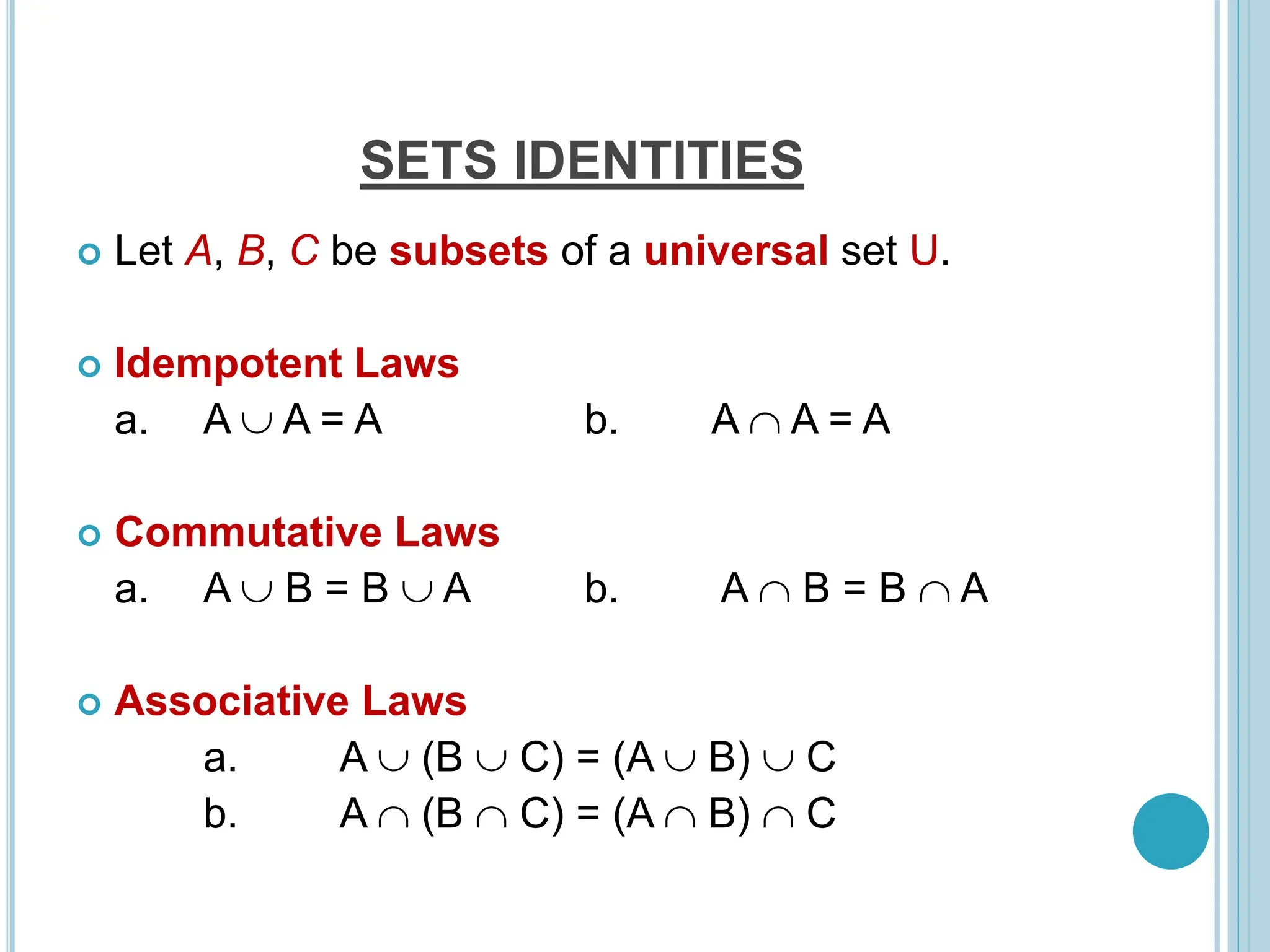
 Let A, B, C be subsets of a universal set U.
 Idempotent Laws
a. A  A = A b. A  A = A
 Commutative Laws
a. A  B = B  A b. A  B = B  A
 Associative Laws
a. A  (B  C) = (A  B)  C
b. A  (B  C) = (A  B)  C
SETS IDENTITIES
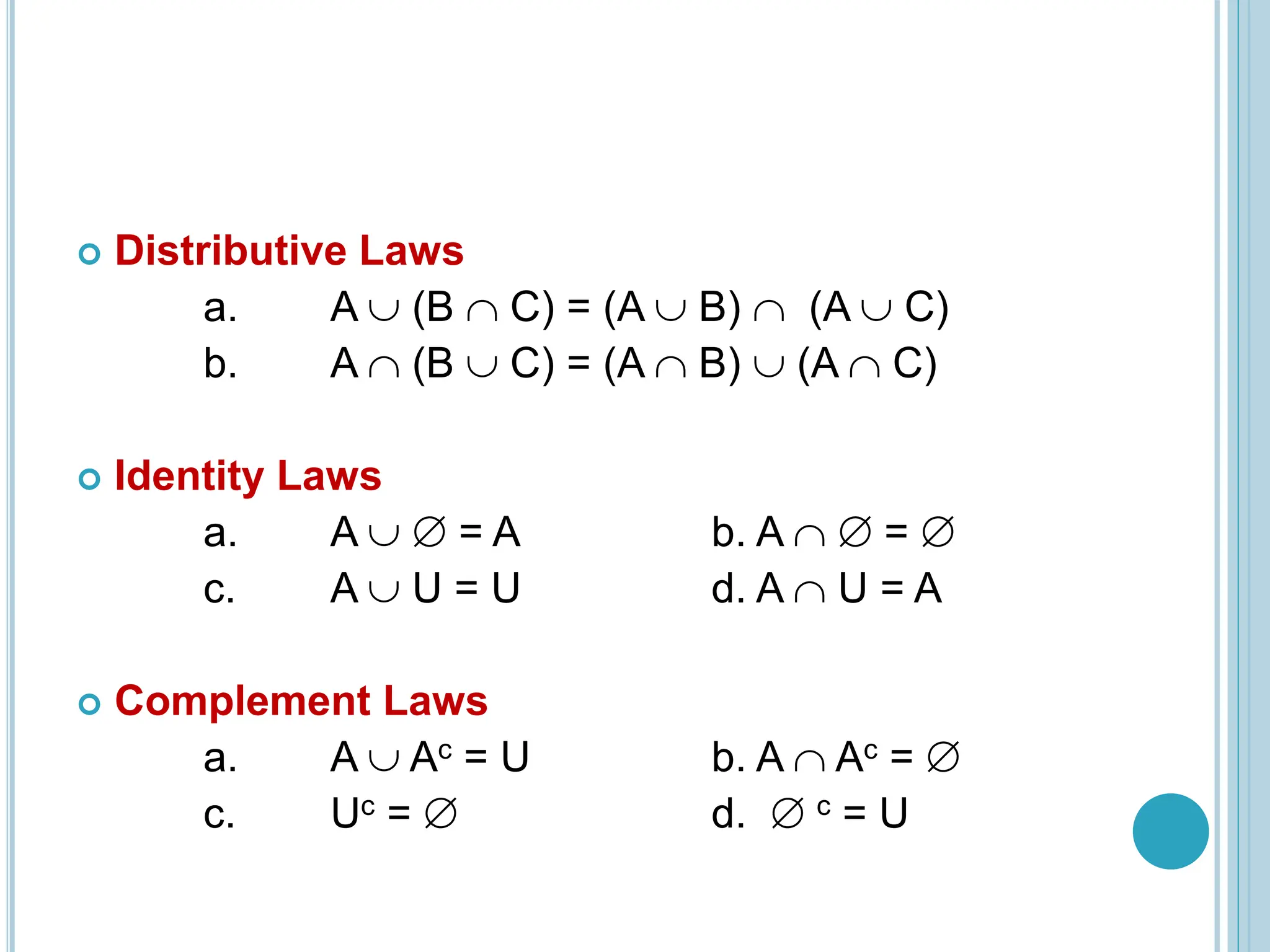
 Distributive Laws
a. A  (B  C) = (A  B)  (A  C)
b. A  (B  C) = (A  B)  (A  C)
 Identity Laws
a. A   = A b. A   = 
c. A  U = U d. A  U = A
 Complement Laws
a. A  Ac = U b. A  Ac = 
c. Uc =  d.  c = U
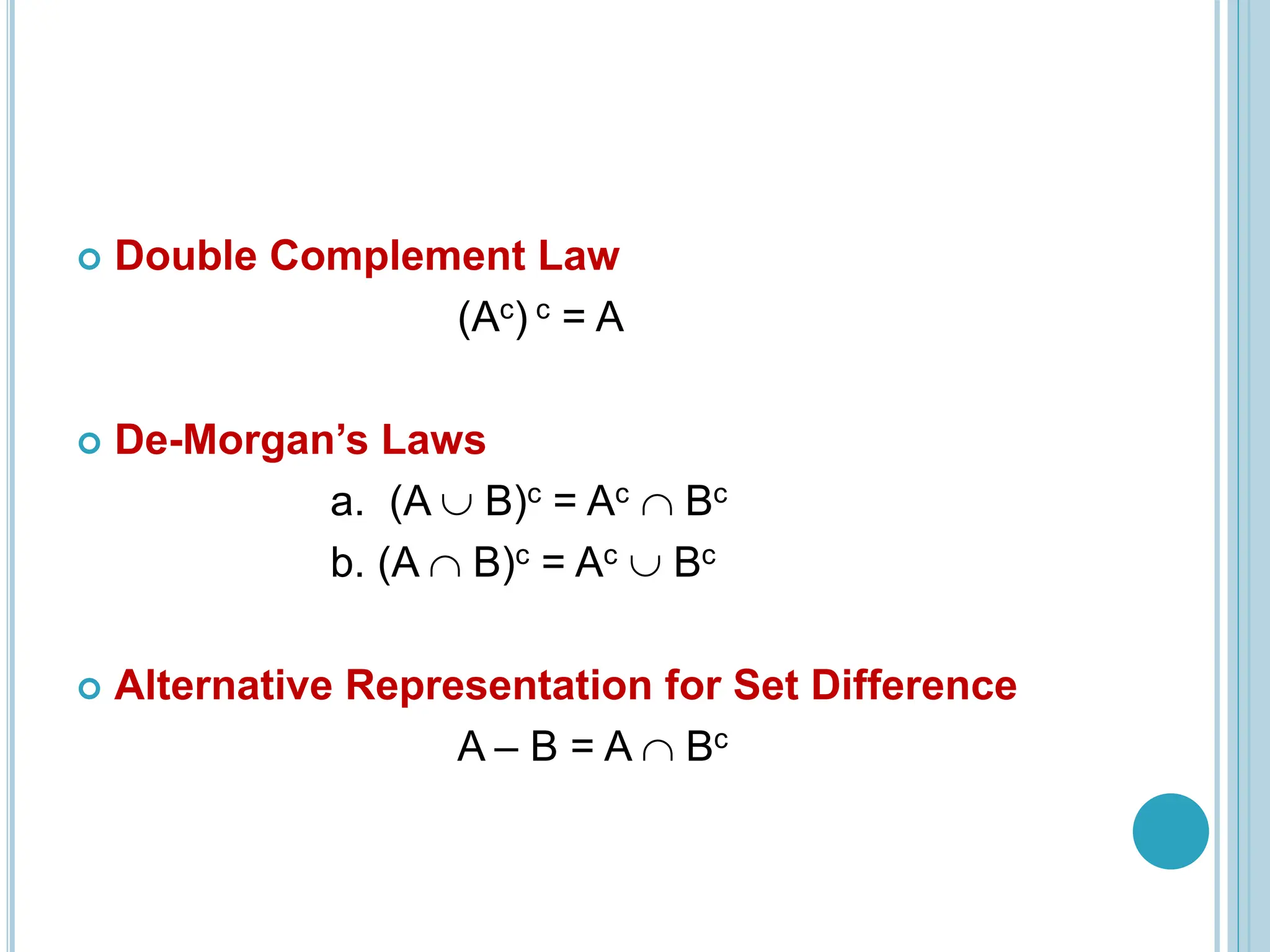
 Double Complement Law
(Ac) c = A
 De-Morgan’s Laws
a. (A  B)c = Ac  Bc
b. (A  B)c = Ac  Bc
 Alternative Representation for Set Difference
A – B = A  Bc
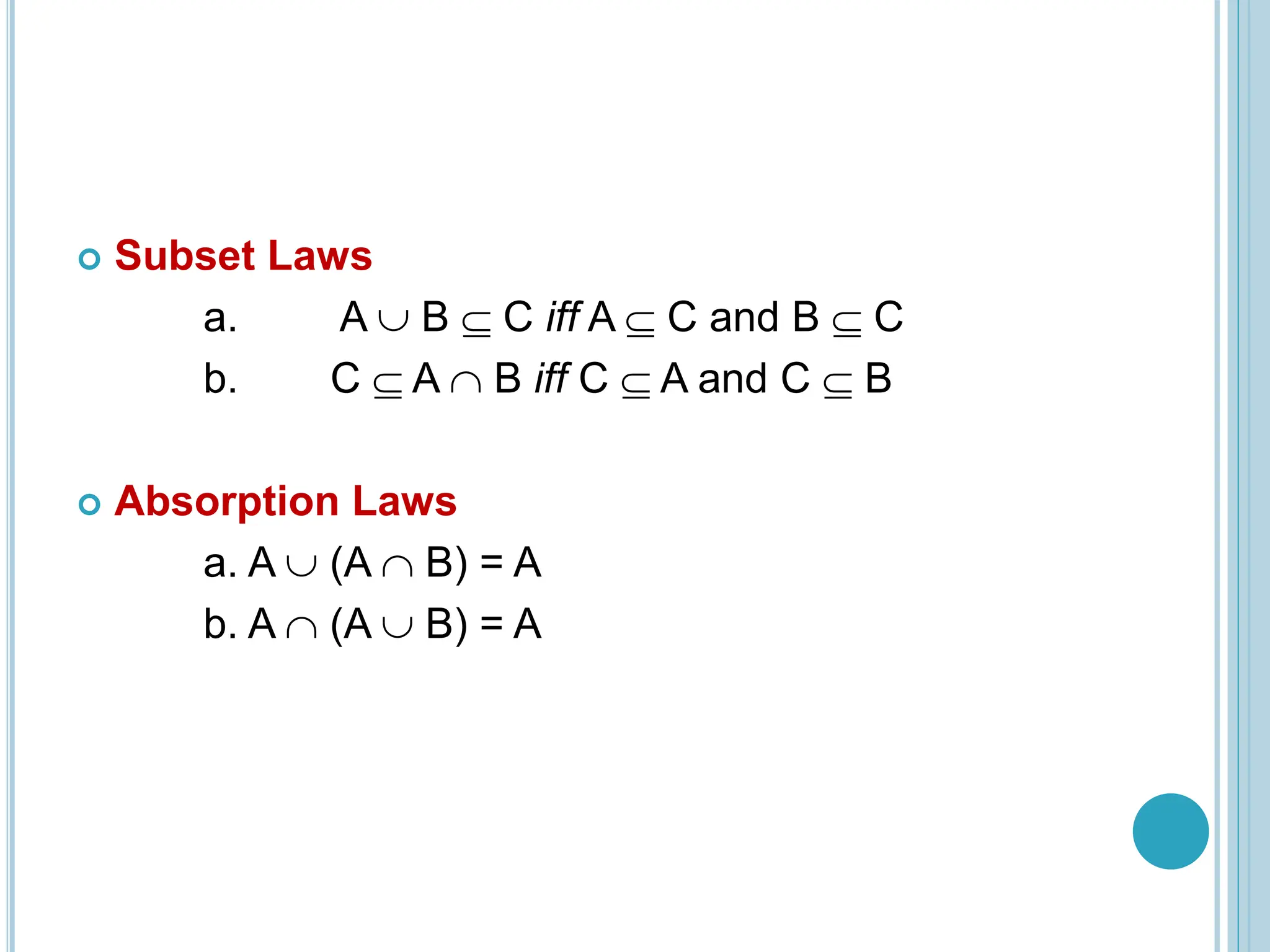
 Subset Laws
a. A  B  C iff A  C and B  C
b. C  A  B iff C  A and C  B
 Absorption Laws
a. A  (A  B) = A
b. A  (A  B) = A
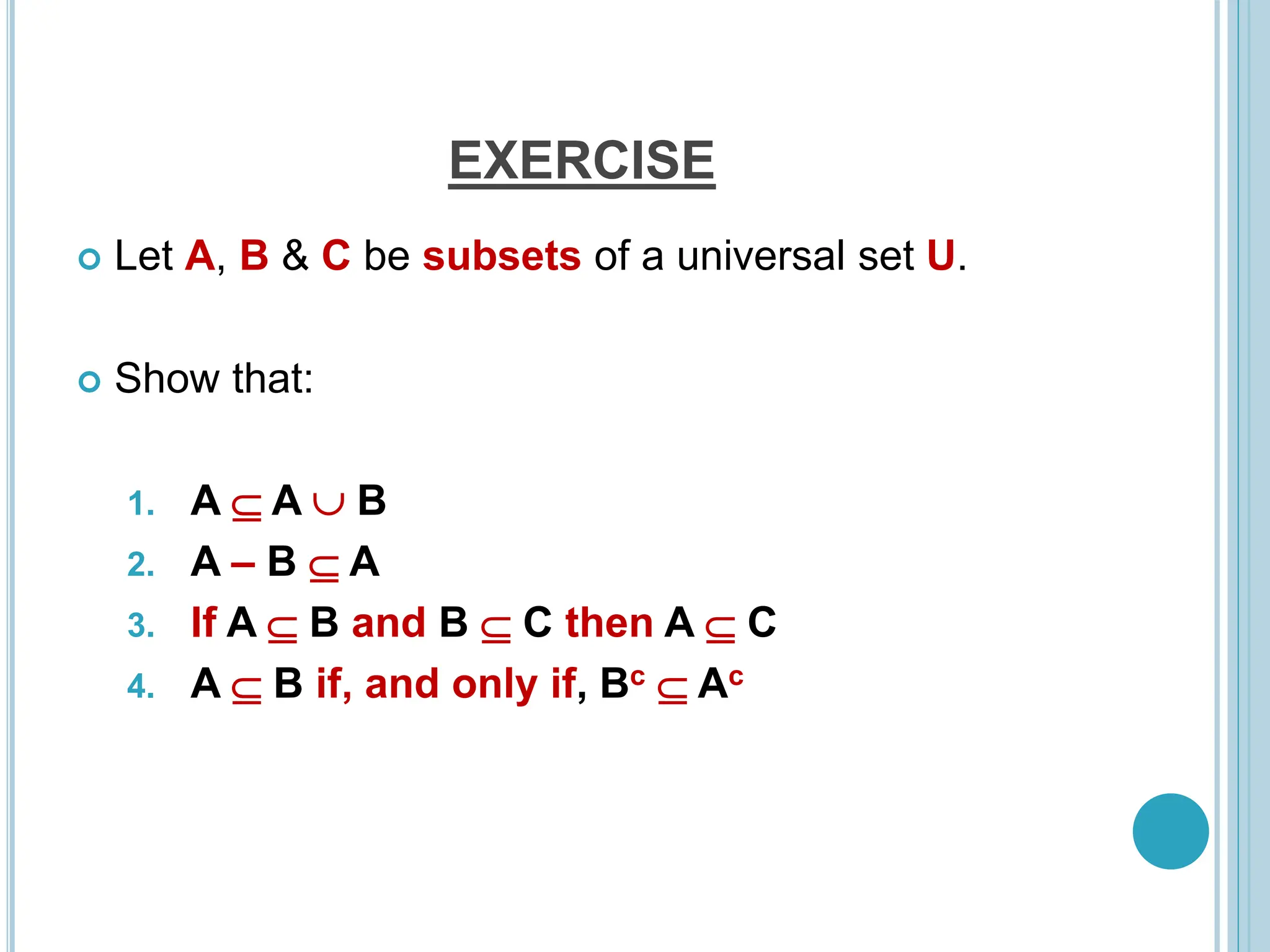
EXERCISE
 Let A, B & C be subsets of a universal set U.
 Show that:
1. A  A  B
2. A – B  A
3. If A  B and B  C then A  C
4. A  B if, and only if, Bc  Ac
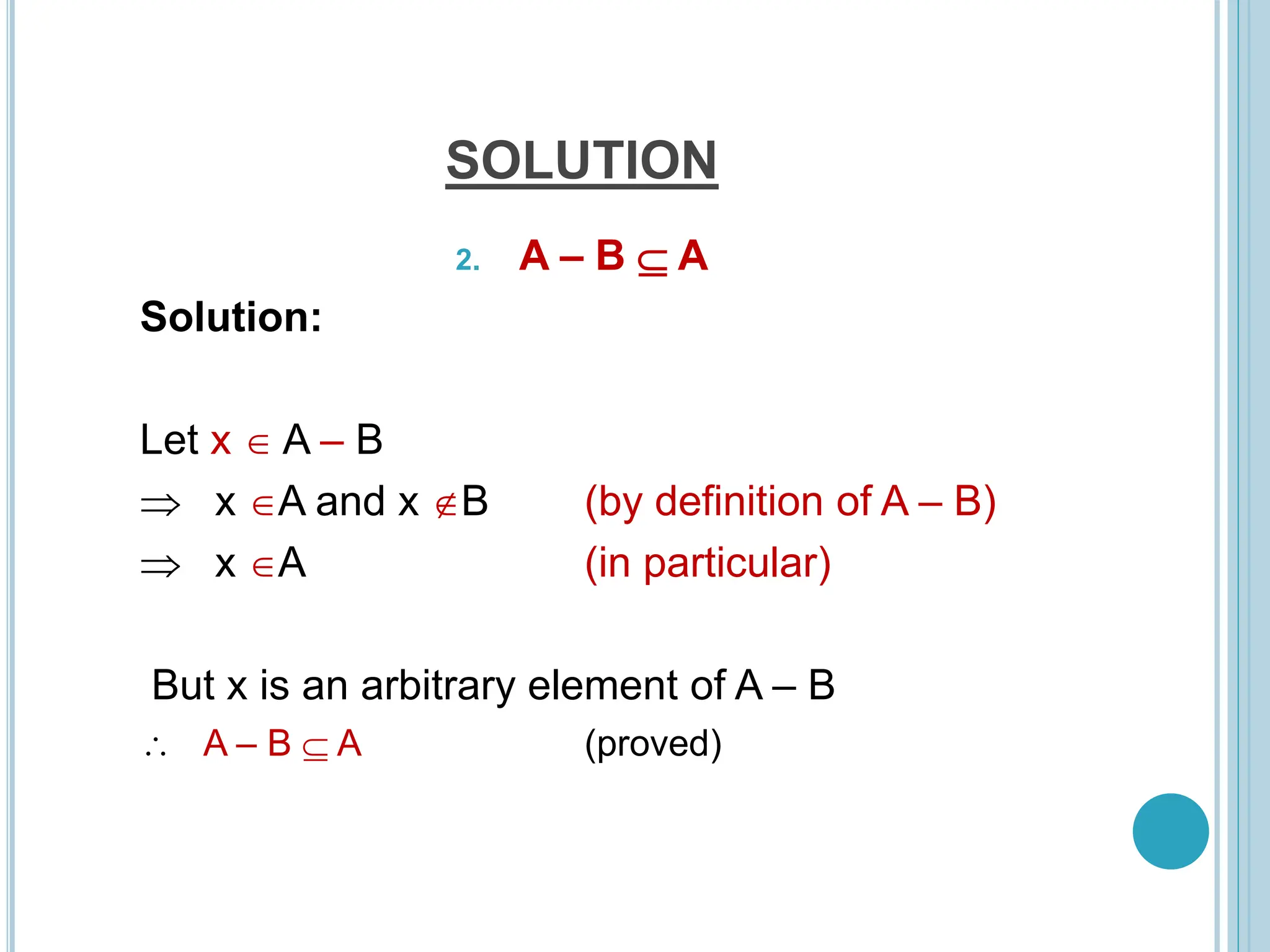
SOLUTION
2. A – B  A
Solution:
Let x  A – B
 x A and x B (by definition of A – B)
 x A (in particular)
But x is an arbitrary element of A – B
 A – B  A (proved)
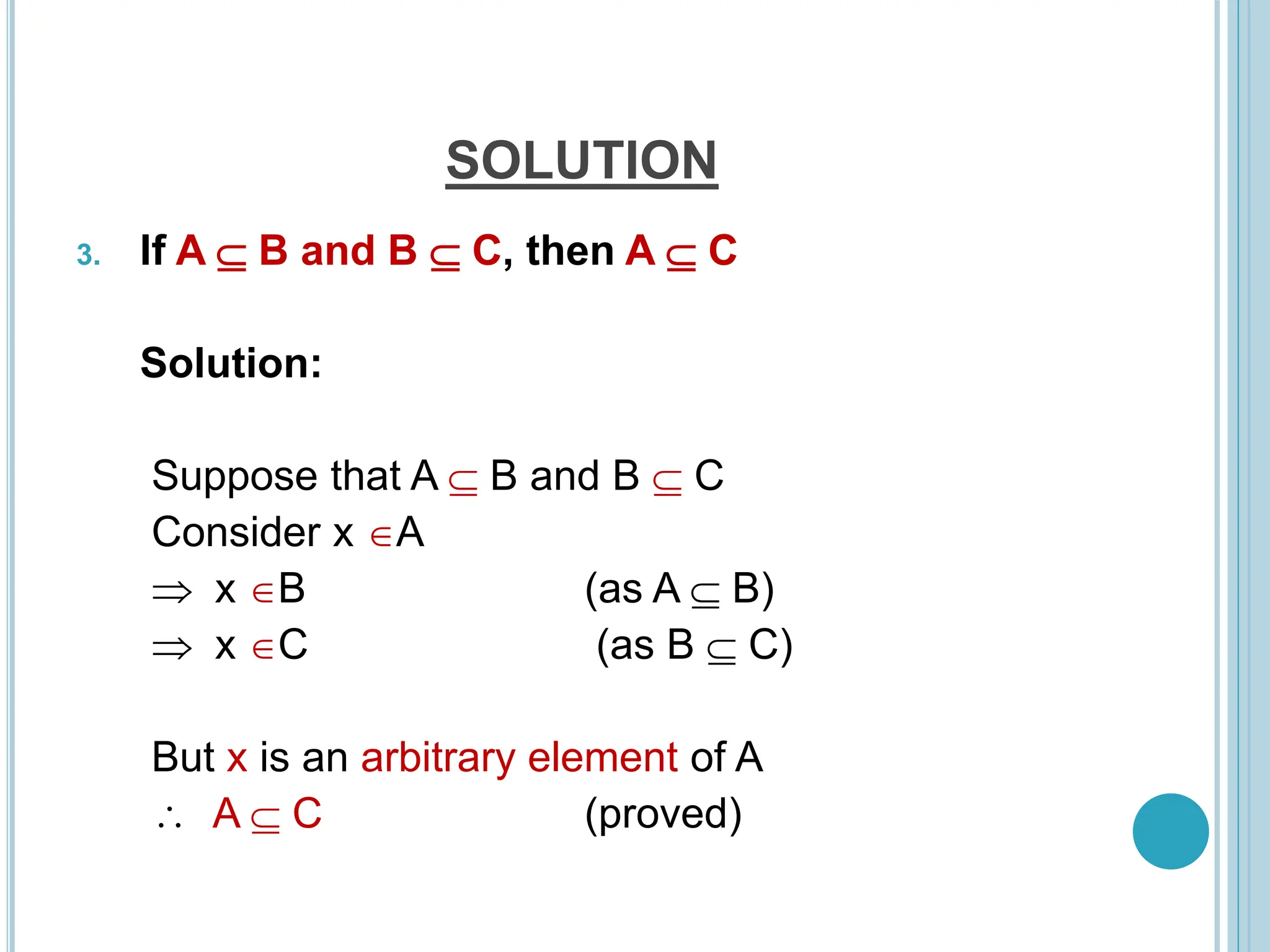
SOLUTION
3. If A  B and B  C, then A  C
Solution:
Suppose that A  B and B  C
Consider x A
 x B (as A  B)
 x C (as B  C)
But x is an arbitrary element of A
 A  C (proved)
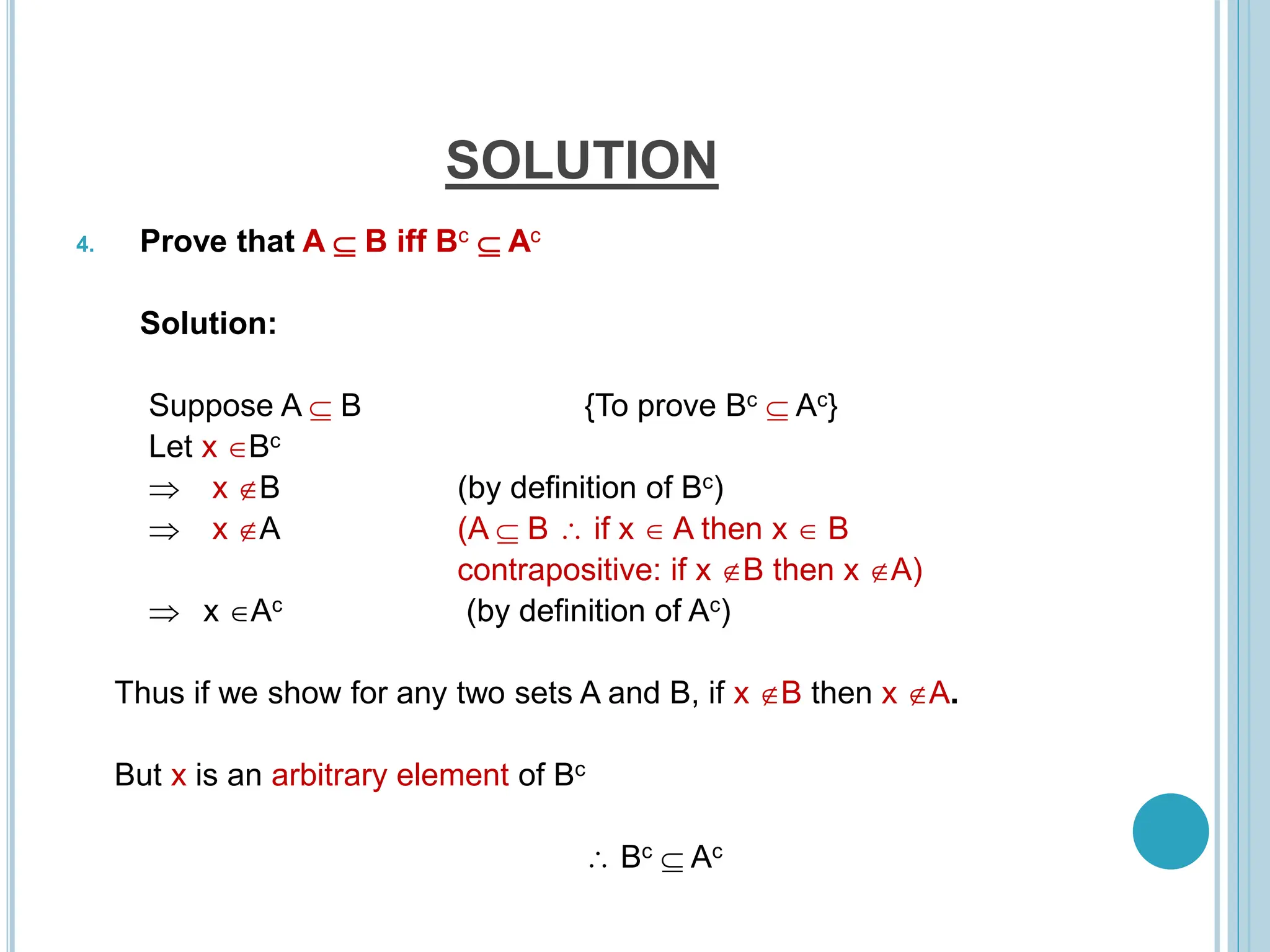
SOLUTION
4. Prove that A  B iff Bc  Ac
Solution:
Suppose A  B {To prove Bc  Ac}
Let x Bc
 x B (by definition of Bc)
 x A (A  B  if x  A then x  B
contrapositive: if x B then x A)
 x Ac (by definition of Ac)
Thus if we show for any two sets A and B, if x B then x A.
But x is an arbitrary element of Bc
 Bc  Ac
CONT…
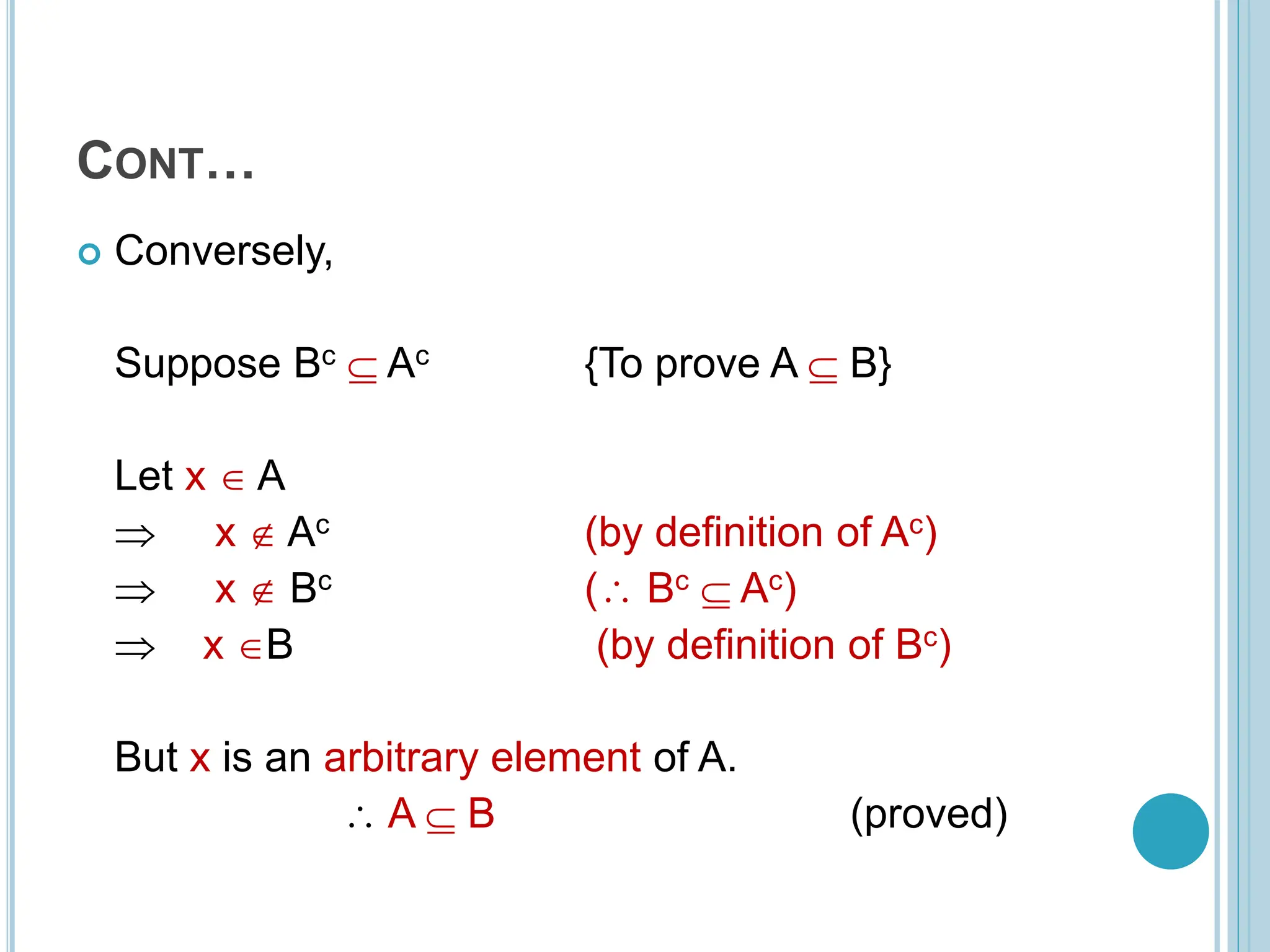
 Conversely,
Suppose Bc  Ac {To prove A  B}
Let x  A
 x  Ac (by definition of Ac)
 x  Bc ( Bc  Ac)
 x B (by definition of Bc)
But x is an arbitrary element of A.
 A  B (proved)
SOLUTION
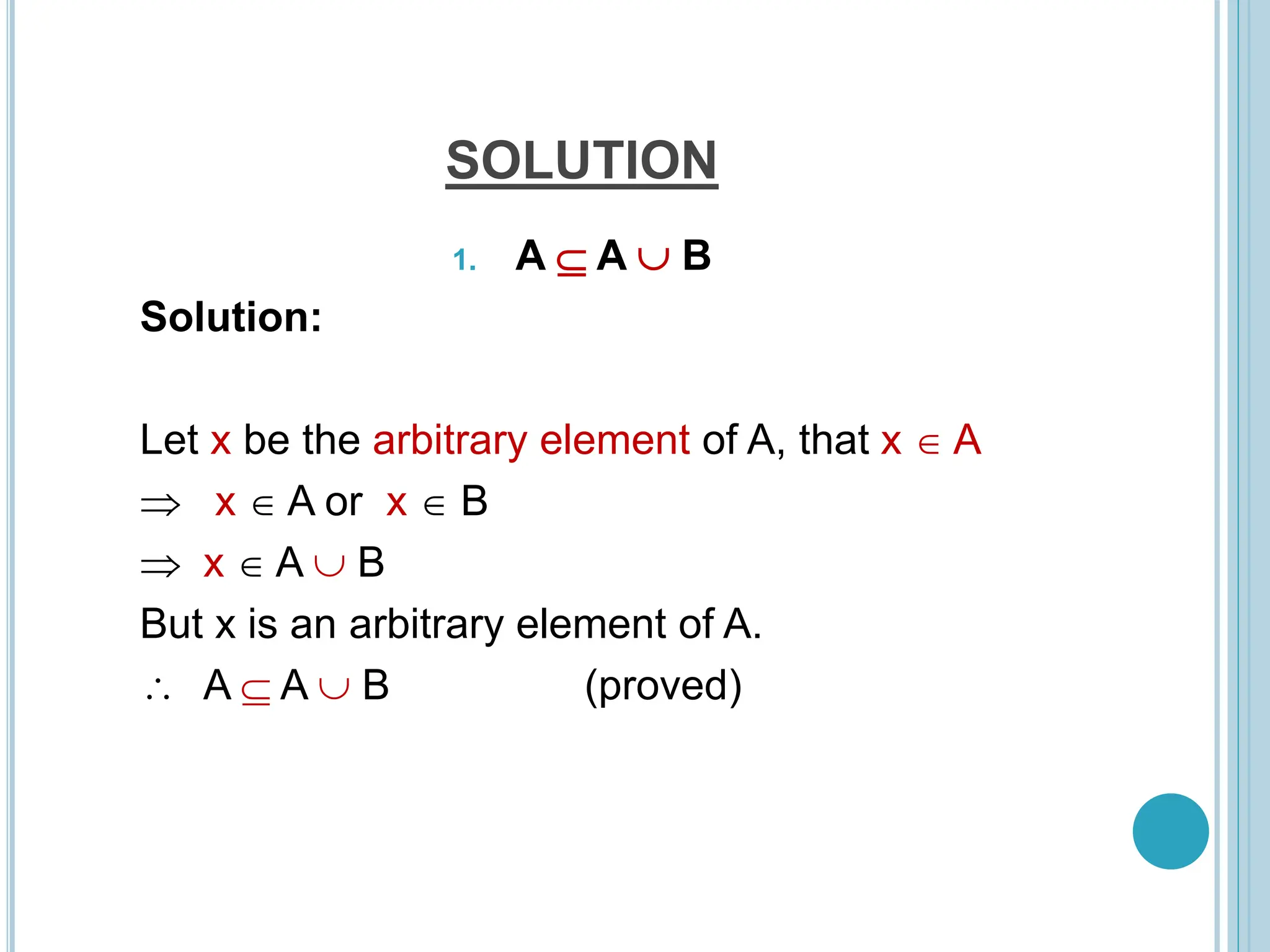
1. A  A  B
Solution:
Let x be the arbitrary element of A, that x  A
 x  A or x  B
 x  A  B
But x is an arbitrary element of A.
 A  A  B (proved)
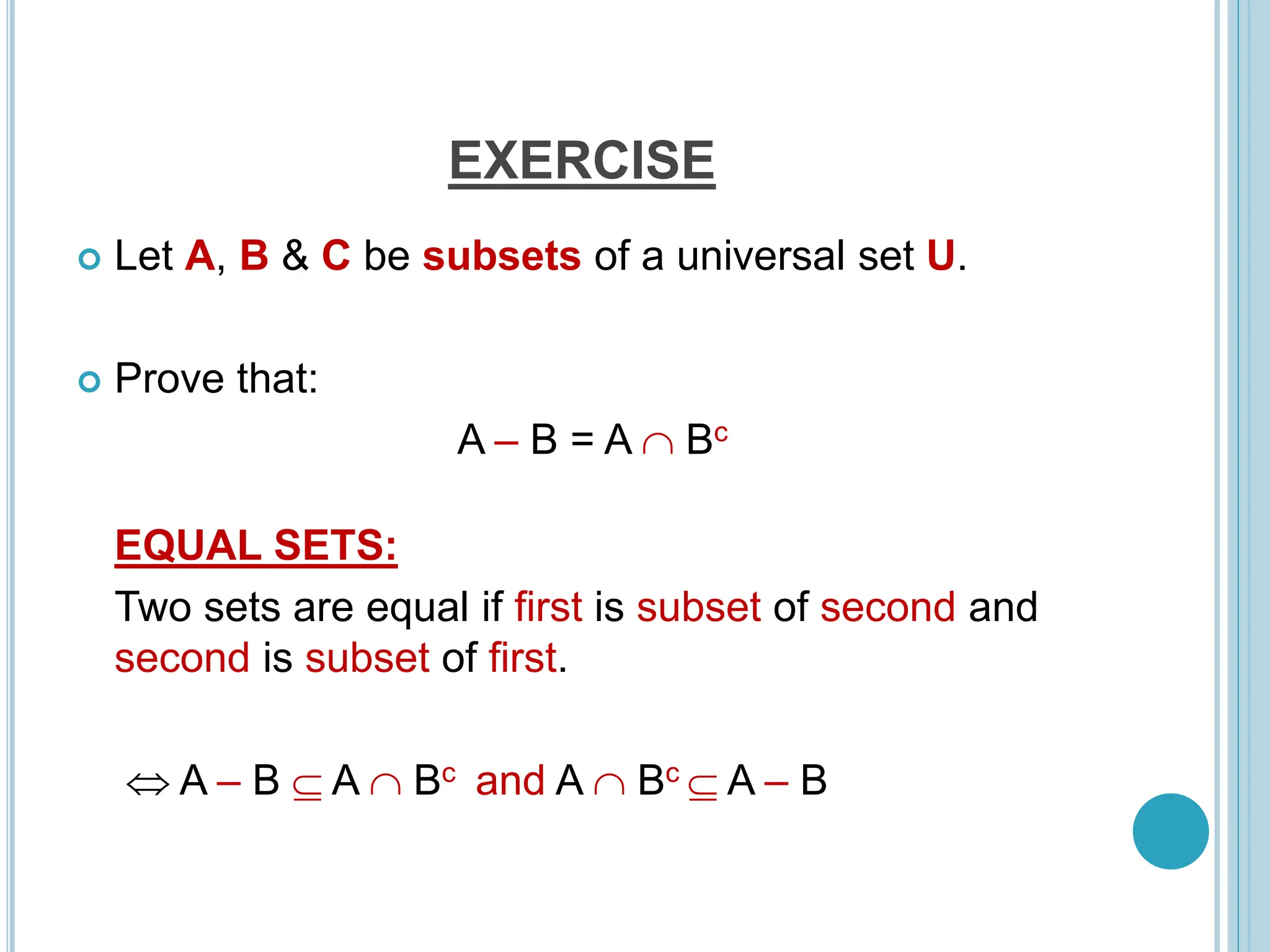
EXERCISE
 Let A, B & C be subsets of a universal set U.
 Prove that:
A – B = A  Bc
EQUAL SETS:
Two sets are equal if first is subset of second and
second is subset of first.
 A – B  A  Bc and A  Bc  A – B
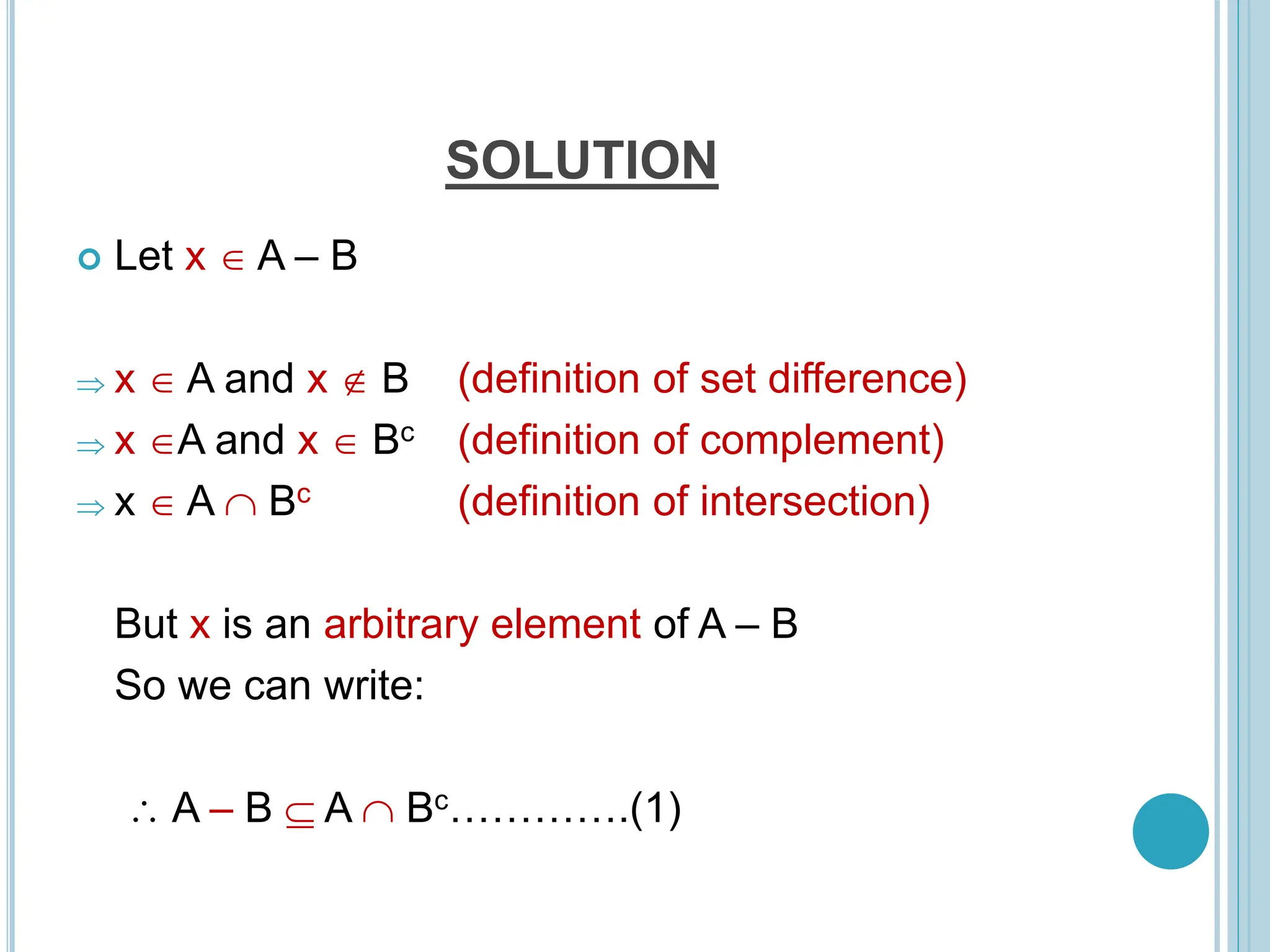
SOLUTION
 Let x  A – B
 x  A and x  B (definition of set difference)
 x A and x  Bc (definition of complement)
 x  A  Bc (definition of intersection)
But x is an arbitrary element of A – B
So we can write:
 A – B  A  Bc………….(1)
CONT…
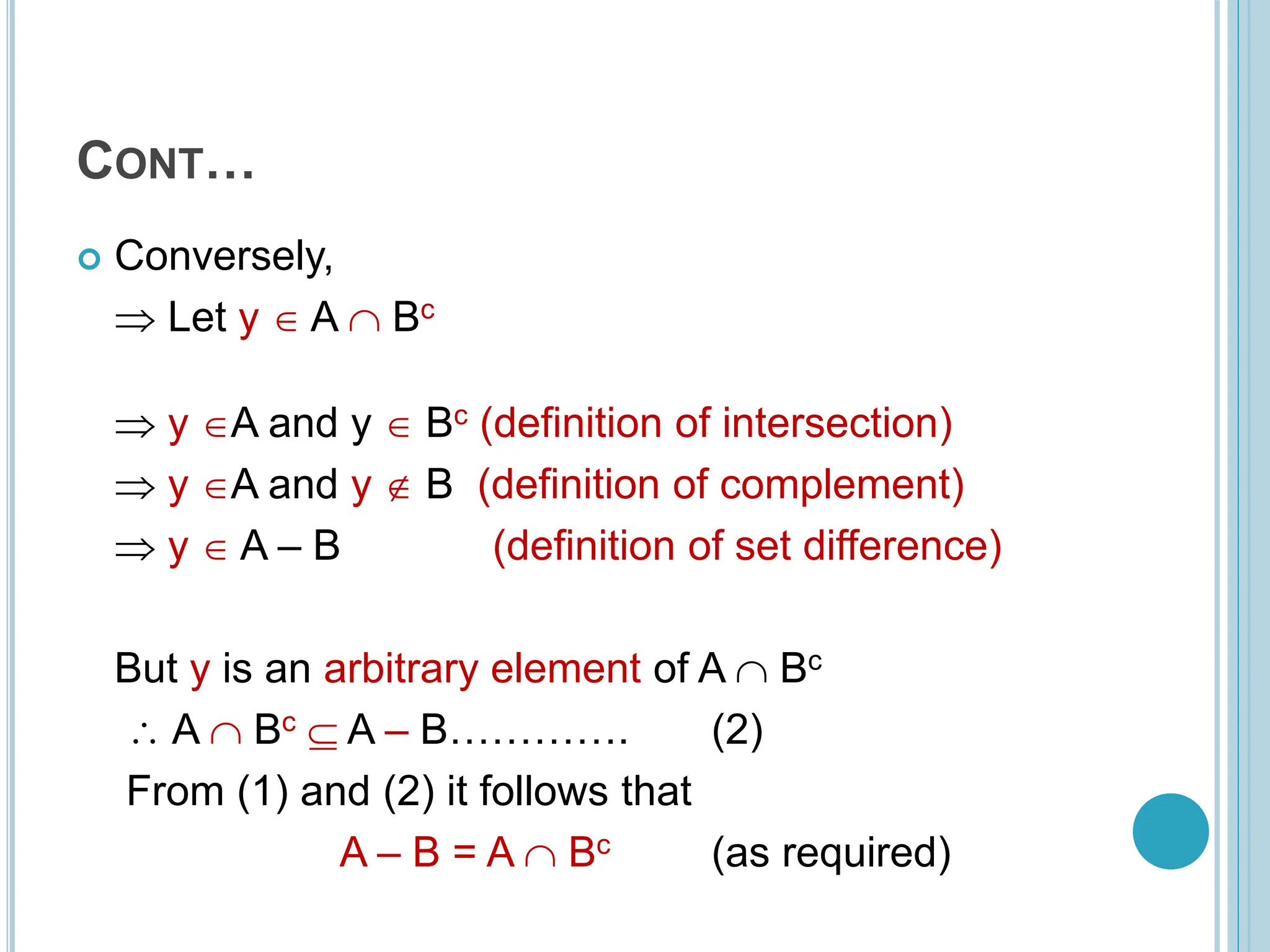
 Conversely,
 Let y  A  Bc
 y A and y  Bc (definition of intersection)
 y A and y  B (definition of complement)
 y  A – B (definition of set difference)
But y is an arbitrary element of A  Bc
 A  Bc  A – B…………. (2)
From (1) and (2) it follows that
A – B = A  Bc (as required)
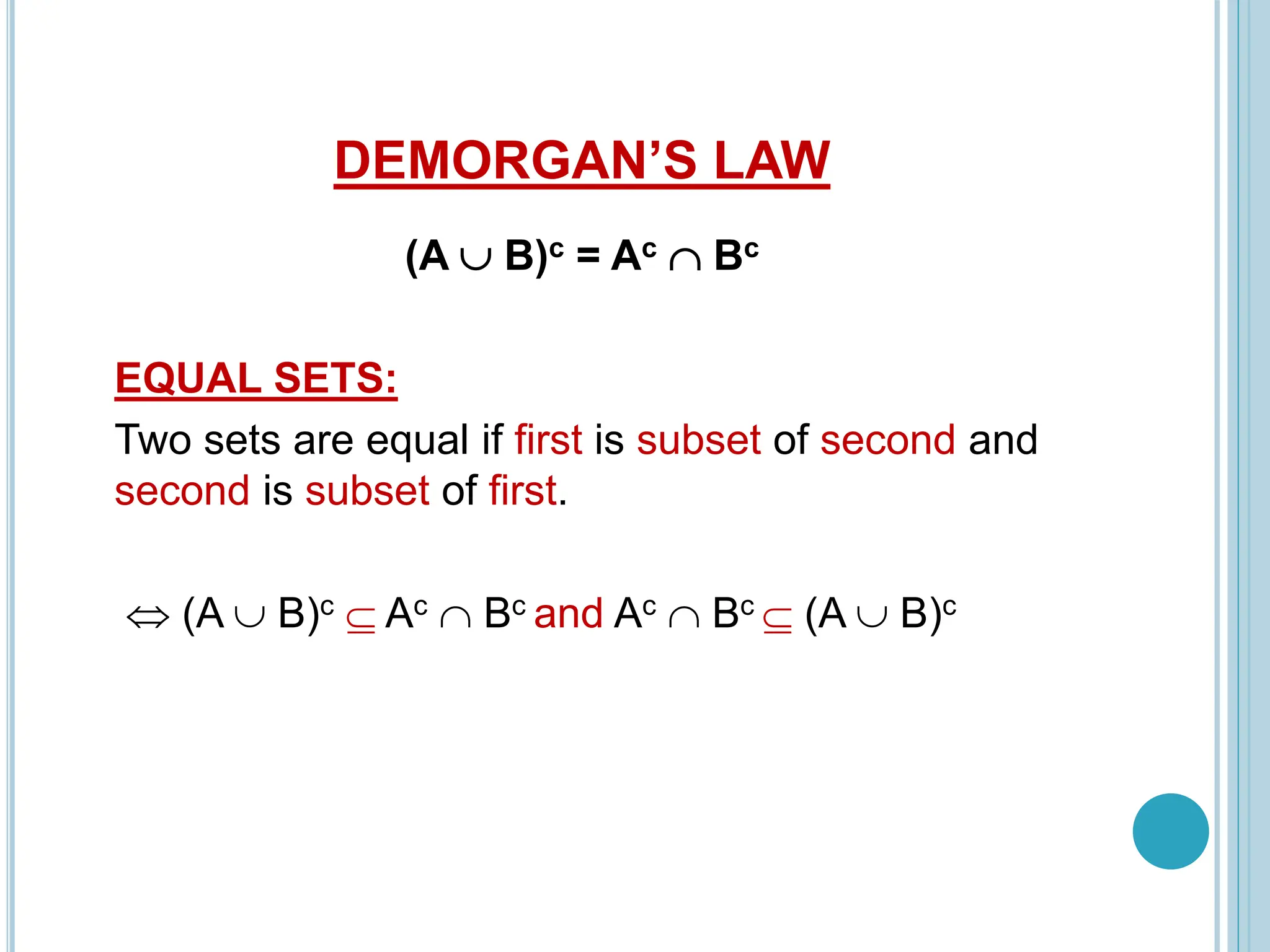
DEMORGAN’S LAW
(A  B)c = Ac  Bc
EQUAL SETS:
Two sets are equal if first is subset of second and
second is subset of first.
 (A  B)c  Ac  Bc and Ac  Bc  (A  B)c
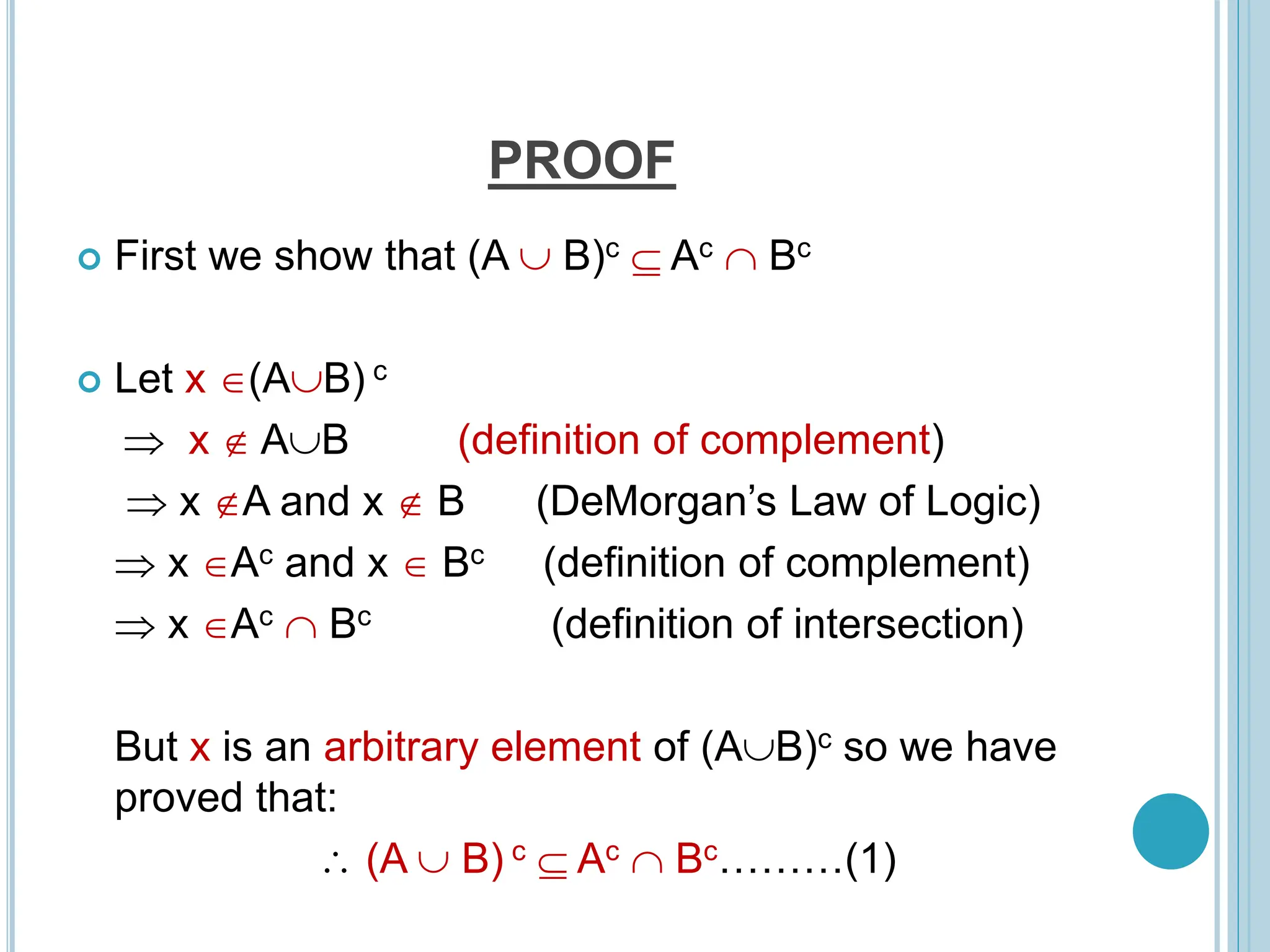
PROOF
 First we show that (A  B)c  Ac  Bc
 Let x (AB) c
 x  AB (definition of complement)
 x A and x  B (DeMorgan’s Law of Logic)
 x Ac and x  Bc (definition of complement)
 x Ac  Bc (definition of intersection)
But x is an arbitrary element of (AB)c so we have
proved that:
 (A  B) c  Ac  Bc………(1)
CONT…
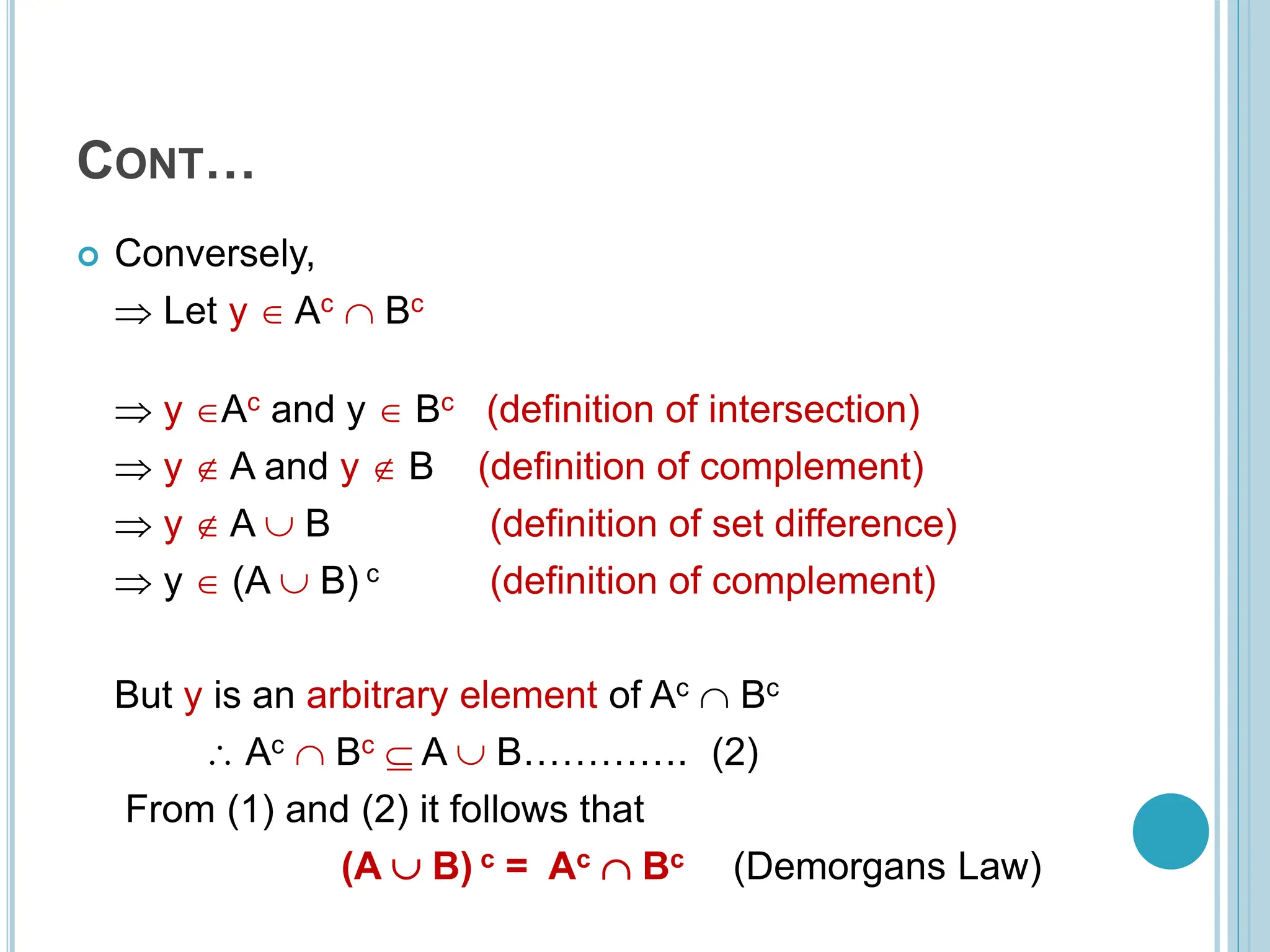
 Conversely,
 Let y  Ac  Bc
 y Ac and y  Bc (definition of intersection)
 y  A and y  B (definition of complement)
 y  A  B (definition of set difference)
 y  (A  B) c (definition of complement)
But y is an arbitrary element of Ac  Bc
 Ac  Bc  A  B…………. (2)
From (1) and (2) it follows that
(A  B) c = Ac  Bc (Demorgans Law)
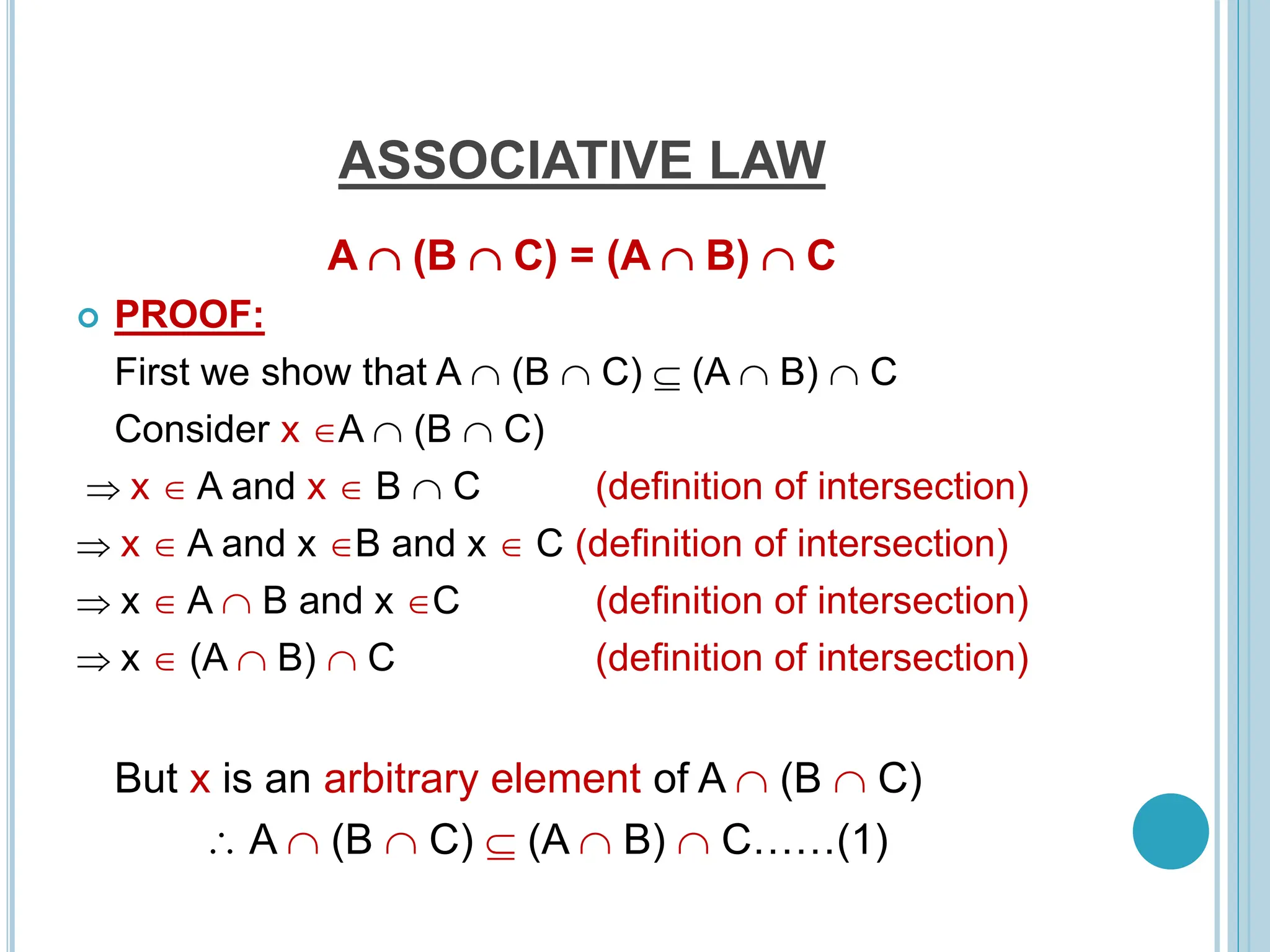
ASSOCIATIVE LAW
A  (B  C) = (A  B)  C
 PROOF:
First we show that A  (B  C)  (A  B)  C
Consider x A  (B  C)
 x  A and x  B  C (definition of intersection)
 x  A and x B and x  C (definition of intersection)
 x  A  B and x C (definition of intersection)
 x  (A  B)  C (definition of intersection)
But x is an arbitrary element of A  (B  C)
 A  (B  C)  (A  B)  C……(1)
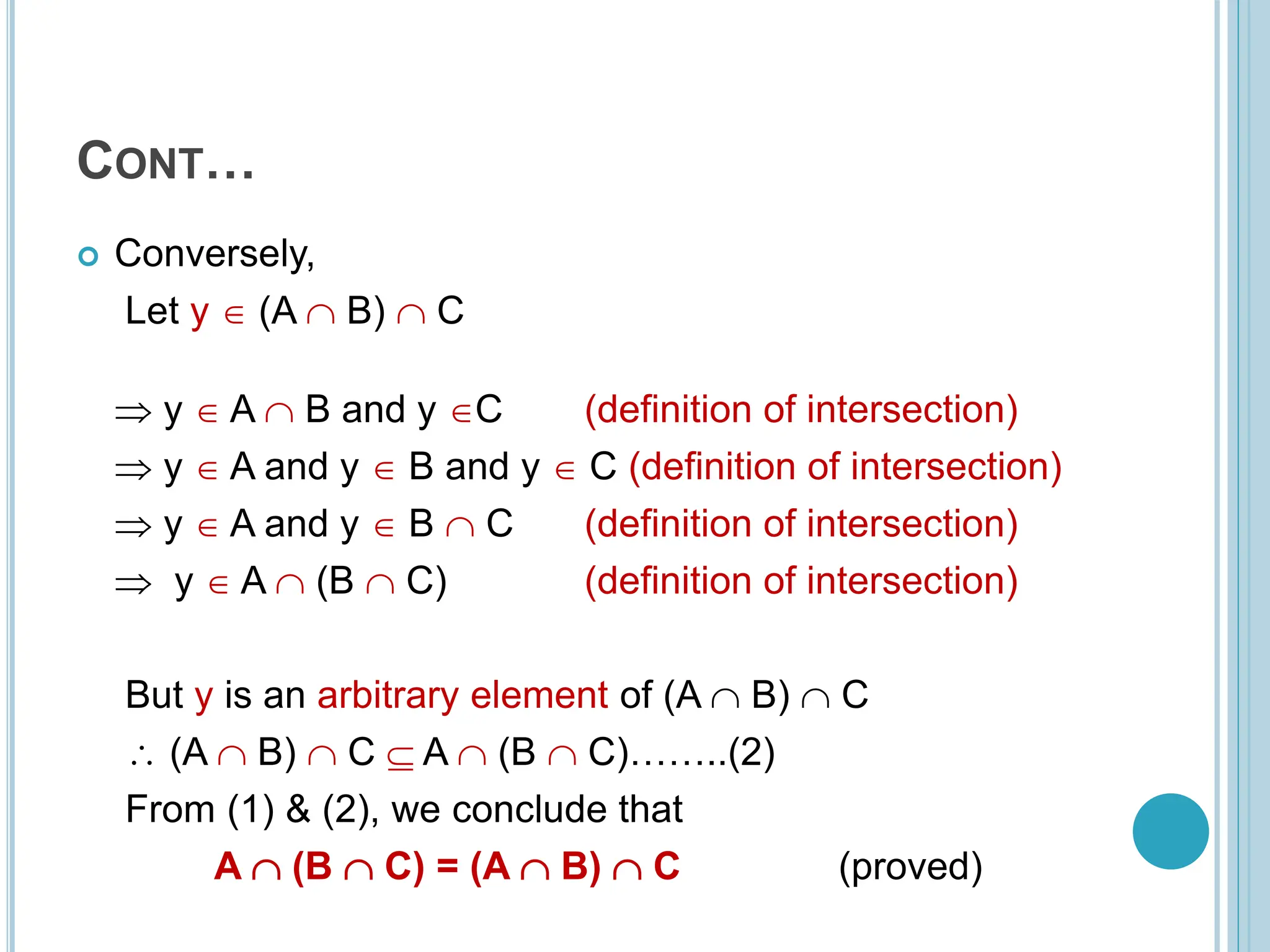
CONT…
 Conversely,
Let y  (A  B)  C
 y  A  B and y C (definition of intersection)
 y  A and y  B and y  C (definition of intersection)
 y  A and y  B  C (definition of intersection)
 y  A  (B  C) (definition of intersection)
But y is an arbitrary element of (A  B)  C
 (A  B)  C  A  (B  C)……..(2)
From (1) & (2), we conclude that
A  (B  C) = (A  B)  C (proved)
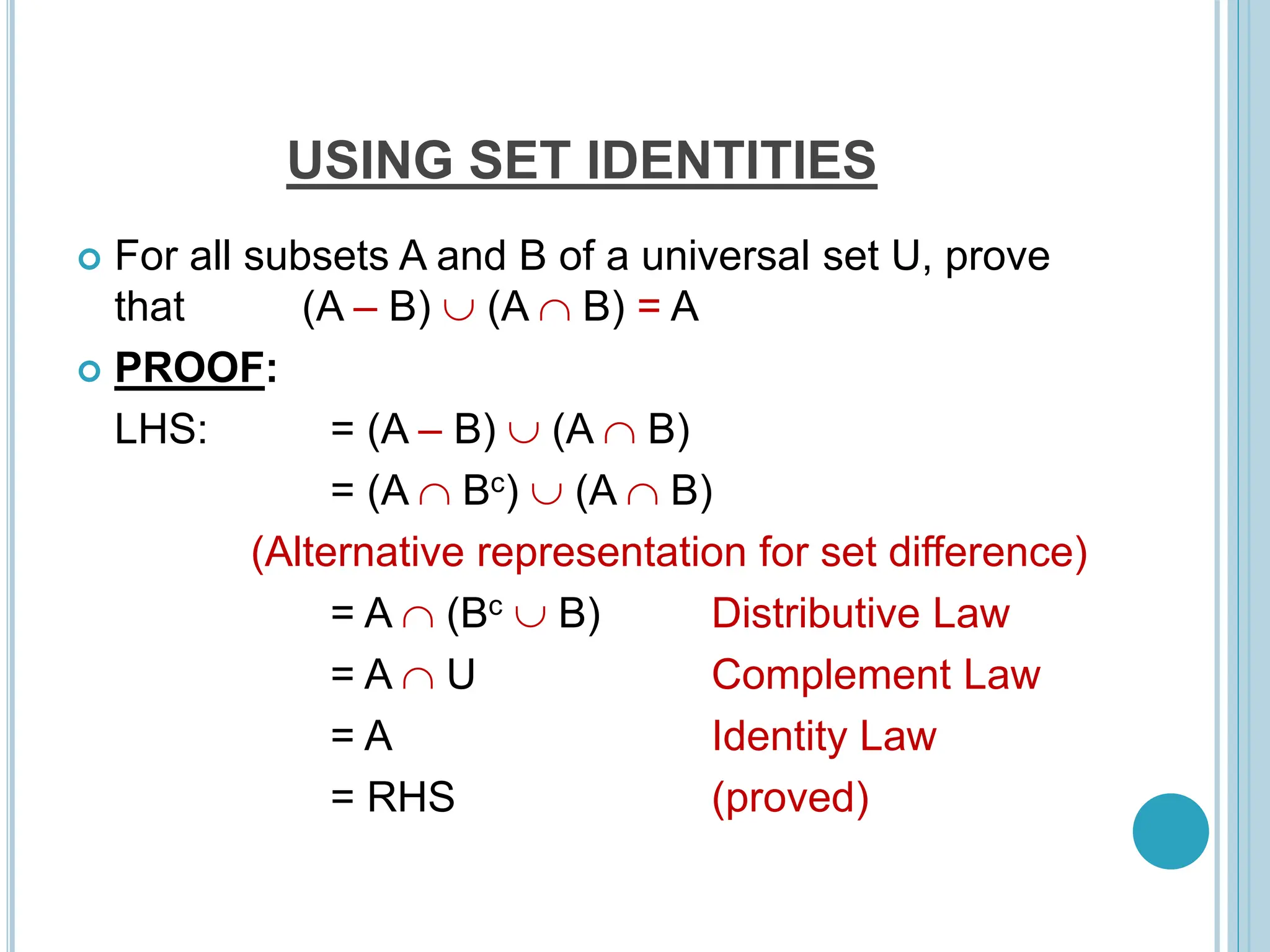
USING SET IDENTITIES
 For all subsets A and B of a universal set U, prove
that (A – B)  (A  B) = A
 PROOF:
LHS: = (A – B)  (A  B)
= (A  Bc)  (A  B)
(Alternative representation for set difference)
= A  (Bc  B) Distributive Law
= A  U Complement Law
= A Identity Law
= RHS (proved)
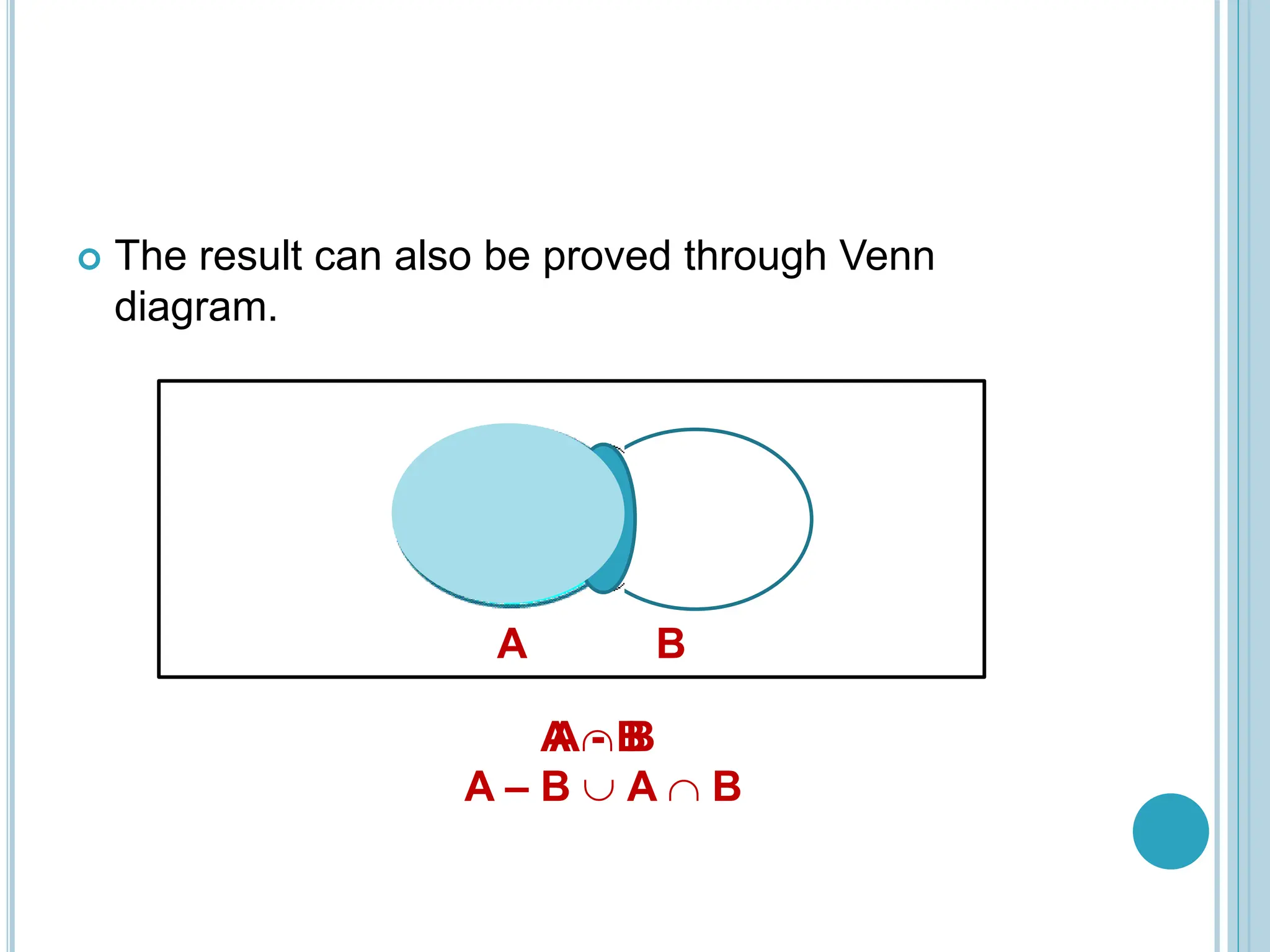
 The result can also be proved through Venn
diagram.
A B
A - B
A  B
A – B  A  B
EXERCISE
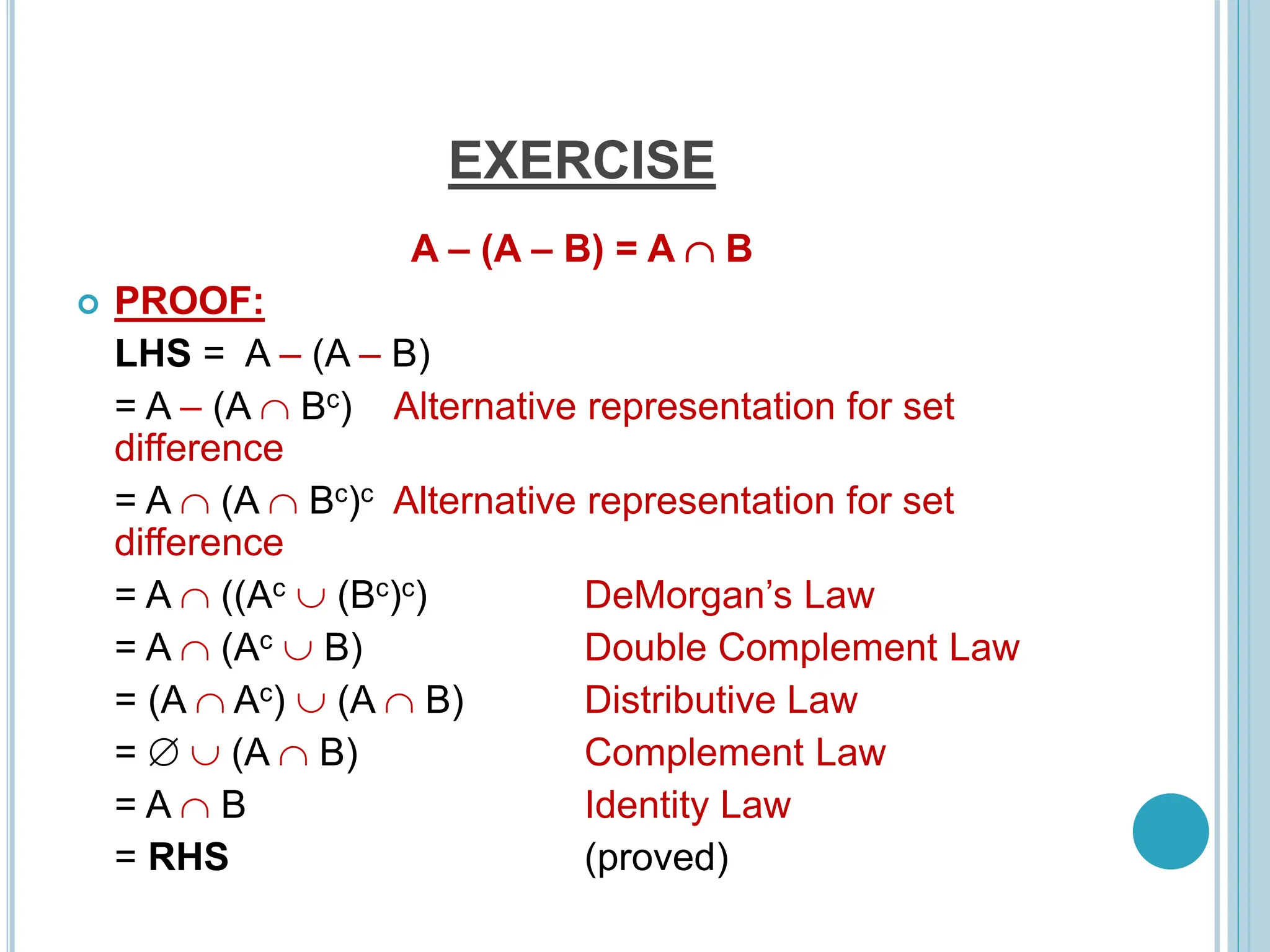
A – (A – B) = A  B
 PROOF:
LHS = A – (A – B)
= A – (A  Bc) Alternative representation for set
difference
= A  (A  Bc)c Alternative representation for set
difference
= A  ((Ac  (Bc)c) DeMorgan’s Law
= A  (Ac  B) Double Complement Law
= (A  Ac)  (A  B) Distributive Law
=   (A  B) Complement Law
= A  B Identity Law
= RHS (proved)
EXERCISE
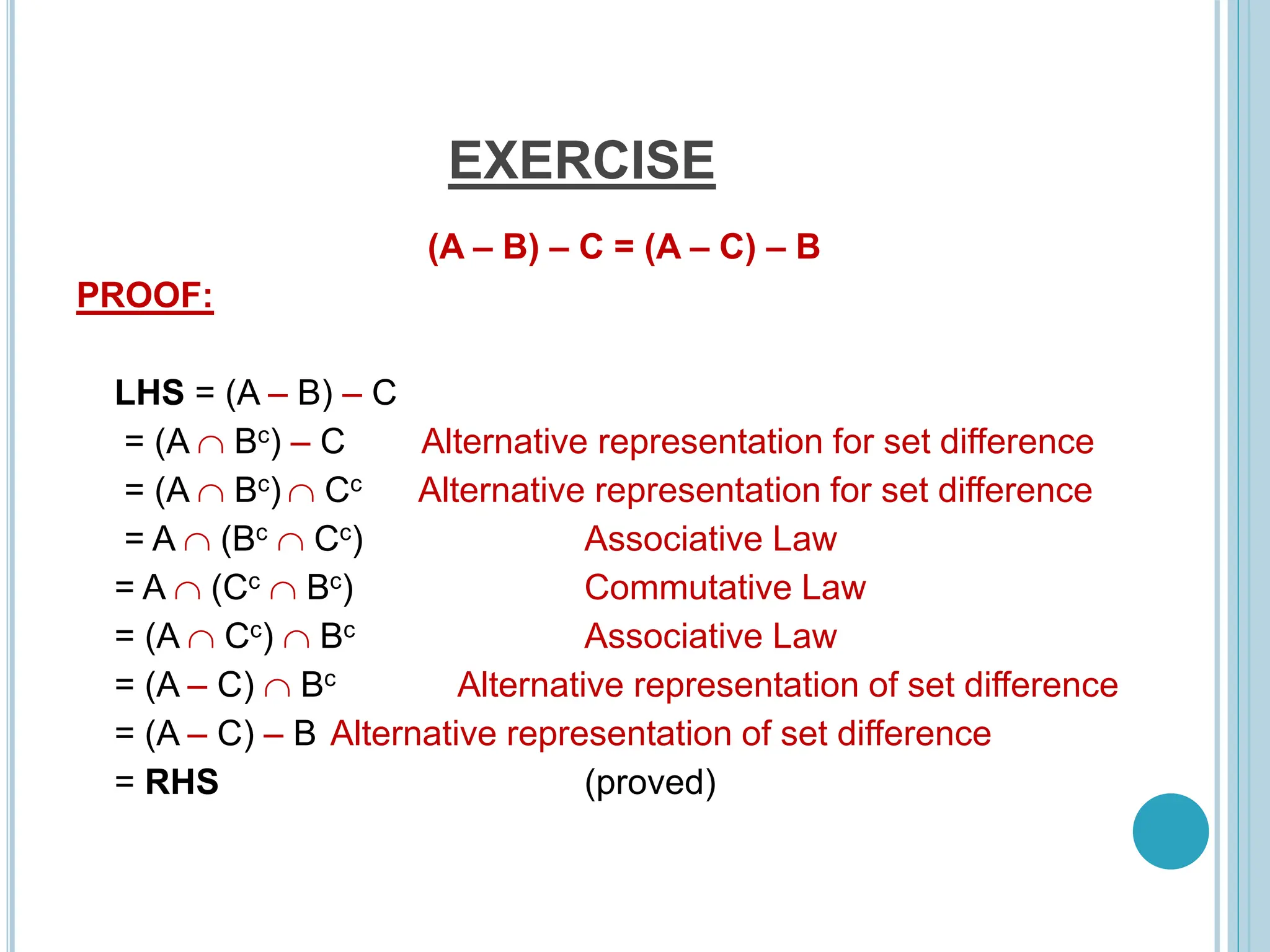
(A – B) – C = (A – C) – B
PROOF:
LHS = (A – B) – C
= (A  Bc) – C Alternative representation for set difference
= (A  Bc)  Cc Alternative representation for set difference
= A  (Bc  Cc) Associative Law
= A  (Cc  Bc) Commutative Law
= (A  Cc)  Bc Associative Law
= (A – C)  Bc Alternative representation of set difference
= (A – C) – B Alternative representation of set difference
= RHS (proved)
EXERCISE
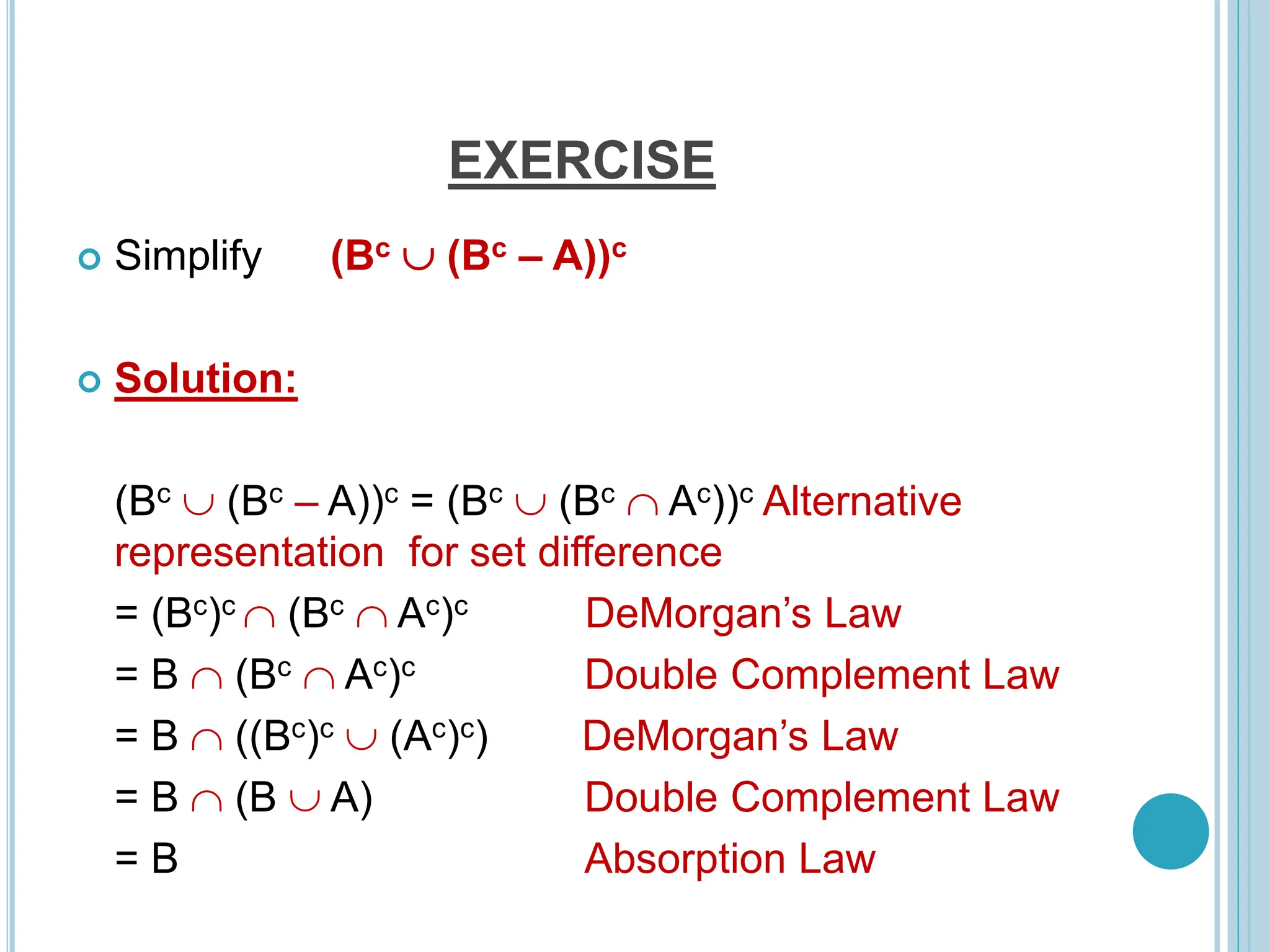
 Simplify (Bc  (Bc – A))c
 Solution:
(Bc  (Bc – A))c = (Bc  (Bc  Ac))c Alternative
representation for set difference
= (Bc)c  (Bc  Ac)c DeMorgan’s Law
= B  (Bc  Ac)c Double Complement Law
= B  ((Bc)c  (Ac)c) DeMorgan’s Law
= B  (B  A) Double Complement Law
= B Absorption Law
PROVING SET IDENTITIES BY
MEMBERSHIP TABLE
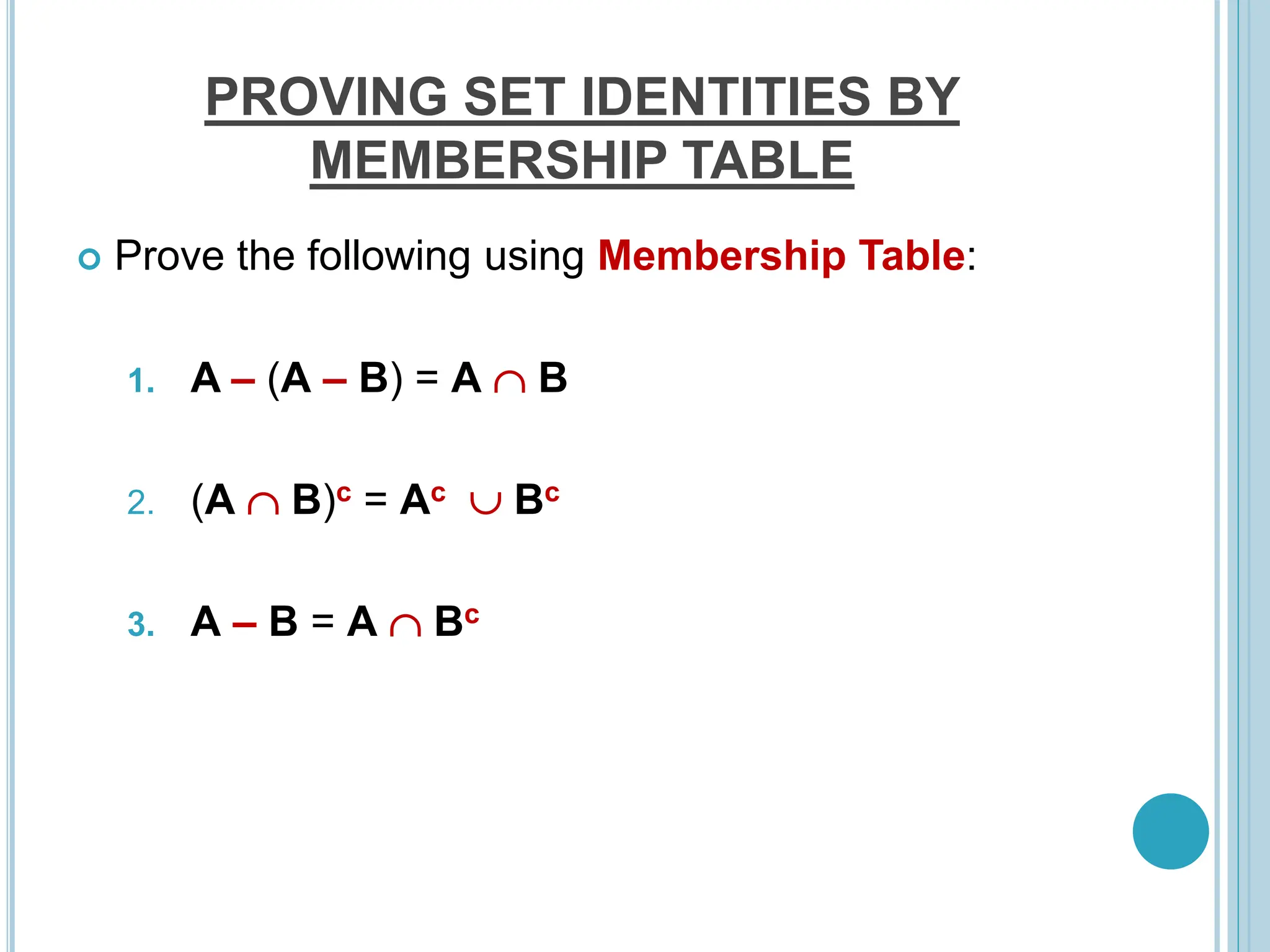
 Prove the following using Membership Table:
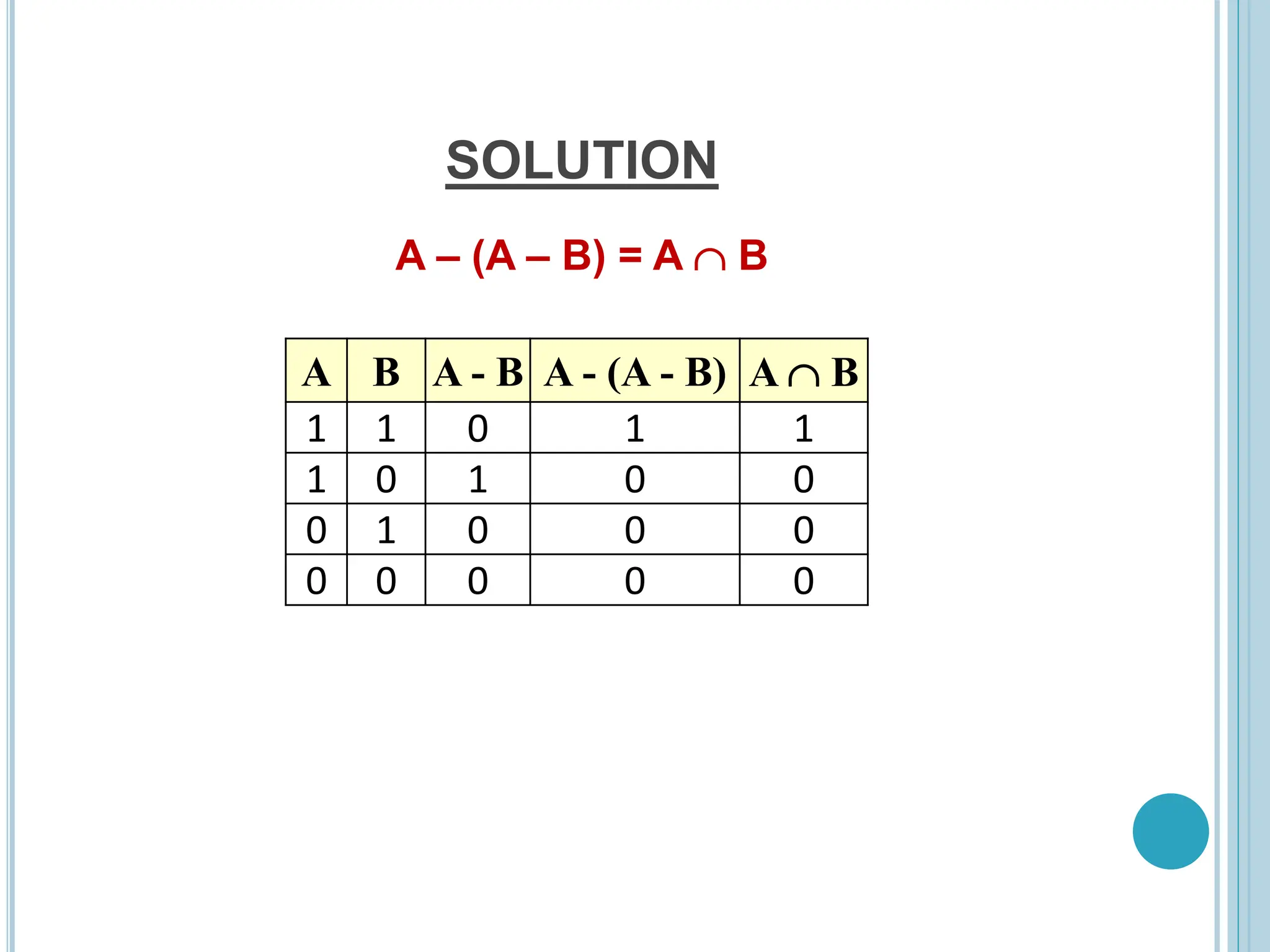
1. A – (A – B) = A  B
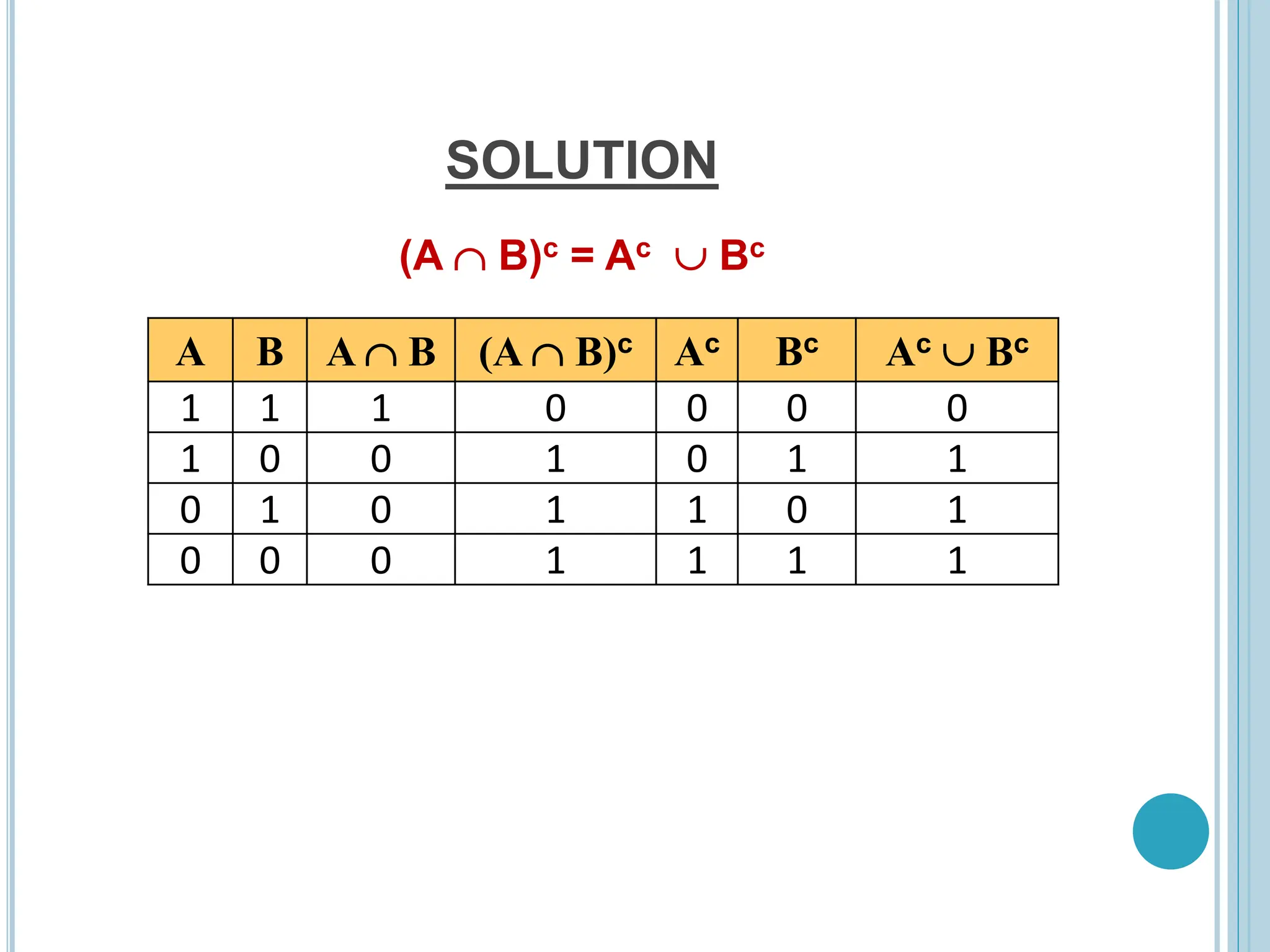
2. (A  B)c = Ac  Bc
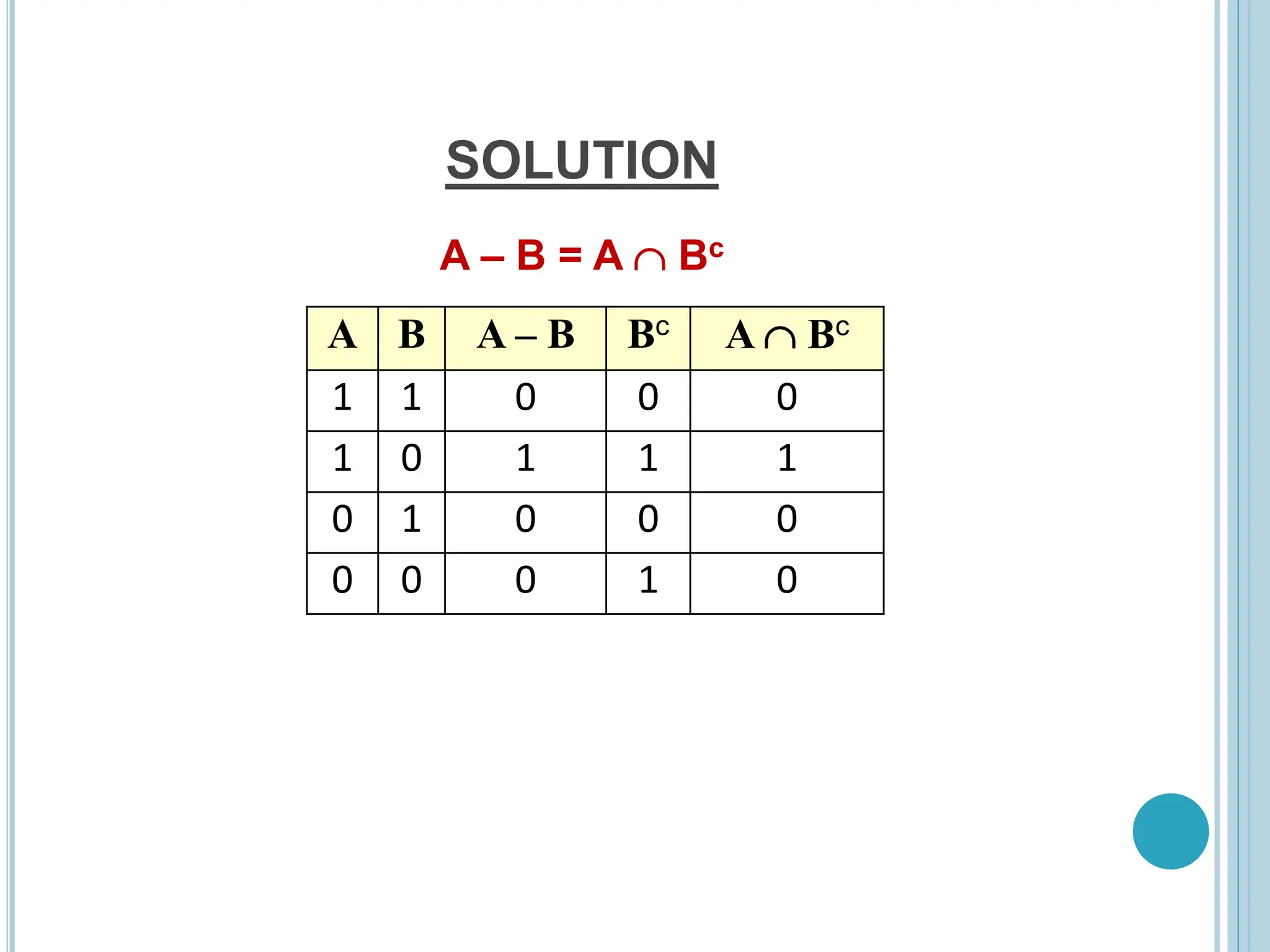
3. A – B = A  Bc
SOLUTION
A – (A – B) = A  B
A B A - B A - (A - B) A  B
1 1 0 1 1
1 0 1 0 0
0 1 0 0 0
0 0 0 0 0
SOLUTION
(A  B)c = Ac  Bc
A B A  B (A  B)c Ac Bc Ac  Bc
1 1 1 0 0 0 0
1 0 0 1 0 1 1
0 1 0 1 1 0 1
0 0 0 1 1 1 1
SOLUTION
A – B = A  Bc
A B A – B Bc A  Bc
1 1 0 0 0
1 0 1 1 1
0 1 0 0 0
0 0 0 1 0
set identities and their examples outlined.pptx

  • 1.
  • 2.
     Let A,B, C be subsets of a universal set U.  Idempotent Laws a. A  A = A b. A  A = A  Commutative Laws a. A  B = B  A b. A  B = B  A  Associative Laws a. A  (B  C) = (A  B)  C b. A  (B  C) = (A  B)  C SETS IDENTITIES
  • 3.
     Distributive Laws a.A  (B  C) = (A  B)  (A  C) b. A  (B  C) = (A  B)  (A  C)  Identity Laws a. A   = A b. A   =  c. A  U = U d. A  U = A  Complement Laws a. A  Ac = U b. A  Ac =  c. Uc =  d.  c = U
  • 4.
     Double ComplementLaw (Ac) c = A  De-Morgan’s Laws a. (A  B)c = Ac  Bc b. (A  B)c = Ac  Bc  Alternative Representation for Set Difference A – B = A  Bc
  • 5.
     Subset Laws a.A  B  C iff A  C and B  C b. C  A  B iff C  A and C  B  Absorption Laws a. A  (A  B) = A b. A  (A  B) = A
  • 6.
    EXERCISE  Let A,B & C be subsets of a universal set U.  Show that: 1. A  A  B 2. A – B  A 3. If A  B and B  C then A  C 4. A  B if, and only if, Bc  Ac
  • 7.
    SOLUTION 2. A –B  A Solution: Let x  A – B  x A and x B (by definition of A – B)  x A (in particular) But x is an arbitrary element of A – B  A – B  A (proved)
  • 8.
    SOLUTION 3. If A B and B  C, then A  C Solution: Suppose that A  B and B  C Consider x A  x B (as A  B)  x C (as B  C) But x is an arbitrary element of A  A  C (proved)
  • 9.
    SOLUTION 4. Prove thatA  B iff Bc  Ac Solution: Suppose A  B {To prove Bc  Ac} Let x Bc  x B (by definition of Bc)  x A (A  B  if x  A then x  B contrapositive: if x B then x A)  x Ac (by definition of Ac) Thus if we show for any two sets A and B, if x B then x A. But x is an arbitrary element of Bc  Bc  Ac
  • 10.
    CONT…  Conversely, Suppose Bc Ac {To prove A  B} Let x  A  x  Ac (by definition of Ac)  x  Bc ( Bc  Ac)  x B (by definition of Bc) But x is an arbitrary element of A.  A  B (proved)
  • 11.
    SOLUTION 1. A A  B Solution: Let x be the arbitrary element of A, that x  A  x  A or x  B  x  A  B But x is an arbitrary element of A.  A  A  B (proved)
  • 12.
    EXERCISE  Let A,B & C be subsets of a universal set U.  Prove that: A – B = A  Bc EQUAL SETS: Two sets are equal if first is subset of second and second is subset of first.  A – B  A  Bc and A  Bc  A – B
  • 13.
    SOLUTION  Let x A – B  x  A and x  B (definition of set difference)  x A and x  Bc (definition of complement)  x  A  Bc (definition of intersection) But x is an arbitrary element of A – B So we can write:  A – B  A  Bc………….(1)
  • 14.
    CONT…  Conversely,  Lety  A  Bc  y A and y  Bc (definition of intersection)  y A and y  B (definition of complement)  y  A – B (definition of set difference) But y is an arbitrary element of A  Bc  A  Bc  A – B…………. (2) From (1) and (2) it follows that A – B = A  Bc (as required)
  • 15.
    DEMORGAN’S LAW (A B)c = Ac  Bc EQUAL SETS: Two sets are equal if first is subset of second and second is subset of first.  (A  B)c  Ac  Bc and Ac  Bc  (A  B)c
  • 16.
    PROOF  First weshow that (A  B)c  Ac  Bc  Let x (AB) c  x  AB (definition of complement)  x A and x  B (DeMorgan’s Law of Logic)  x Ac and x  Bc (definition of complement)  x Ac  Bc (definition of intersection) But x is an arbitrary element of (AB)c so we have proved that:  (A  B) c  Ac  Bc………(1)
  • 17.
    CONT…  Conversely,  Lety  Ac  Bc  y Ac and y  Bc (definition of intersection)  y  A and y  B (definition of complement)  y  A  B (definition of set difference)  y  (A  B) c (definition of complement) But y is an arbitrary element of Ac  Bc  Ac  Bc  A  B…………. (2) From (1) and (2) it follows that (A  B) c = Ac  Bc (Demorgans Law)
  • 18.
    ASSOCIATIVE LAW A (B  C) = (A  B)  C  PROOF: First we show that A  (B  C)  (A  B)  C Consider x A  (B  C)  x  A and x  B  C (definition of intersection)  x  A and x B and x  C (definition of intersection)  x  A  B and x C (definition of intersection)  x  (A  B)  C (definition of intersection) But x is an arbitrary element of A  (B  C)  A  (B  C)  (A  B)  C……(1)
  • 19.
    CONT…  Conversely, Let y (A  B)  C  y  A  B and y C (definition of intersection)  y  A and y  B and y  C (definition of intersection)  y  A and y  B  C (definition of intersection)  y  A  (B  C) (definition of intersection) But y is an arbitrary element of (A  B)  C  (A  B)  C  A  (B  C)……..(2) From (1) & (2), we conclude that A  (B  C) = (A  B)  C (proved)
  • 20.
    USING SET IDENTITIES For all subsets A and B of a universal set U, prove that (A – B)  (A  B) = A  PROOF: LHS: = (A – B)  (A  B) = (A  Bc)  (A  B) (Alternative representation for set difference) = A  (Bc  B) Distributive Law = A  U Complement Law = A Identity Law = RHS (proved)
  • 21.
     The resultcan also be proved through Venn diagram. A B A - B A  B A – B  A  B
  • 22.
    EXERCISE A – (A– B) = A  B  PROOF: LHS = A – (A – B) = A – (A  Bc) Alternative representation for set difference = A  (A  Bc)c Alternative representation for set difference = A  ((Ac  (Bc)c) DeMorgan’s Law = A  (Ac  B) Double Complement Law = (A  Ac)  (A  B) Distributive Law =   (A  B) Complement Law = A  B Identity Law = RHS (proved)
  • 23.
    EXERCISE (A – B)– C = (A – C) – B PROOF: LHS = (A – B) – C = (A  Bc) – C Alternative representation for set difference = (A  Bc)  Cc Alternative representation for set difference = A  (Bc  Cc) Associative Law = A  (Cc  Bc) Commutative Law = (A  Cc)  Bc Associative Law = (A – C)  Bc Alternative representation of set difference = (A – C) – B Alternative representation of set difference = RHS (proved)
  • 24.
    EXERCISE  Simplify (Bc (Bc – A))c  Solution: (Bc  (Bc – A))c = (Bc  (Bc  Ac))c Alternative representation for set difference = (Bc)c  (Bc  Ac)c DeMorgan’s Law = B  (Bc  Ac)c Double Complement Law = B  ((Bc)c  (Ac)c) DeMorgan’s Law = B  (B  A) Double Complement Law = B Absorption Law
  • 25.
    PROVING SET IDENTITIESBY MEMBERSHIP TABLE  Prove the following using Membership Table: 1. A – (A – B) = A  B 2. (A  B)c = Ac  Bc 3. A – B = A  Bc
  • 26.
    SOLUTION A – (A– B) = A  B A B A - B A - (A - B) A  B 1 1 0 1 1 1 0 1 0 0 0 1 0 0 0 0 0 0 0 0
  • 27.
    SOLUTION (A  B)c= Ac  Bc A B A  B (A  B)c Ac Bc Ac  Bc 1 1 1 0 0 0 0 1 0 0 1 0 1 1 0 1 0 1 1 0 1 0 0 0 1 1 1 1
  • 28.
    SOLUTION A – B= A  Bc A B A – B Bc A  Bc 1 1 0 0 0 1 0 1 1 1 0 1 0 0 0 0 0 0 1 0