ARGUMENTS
Lecture # 05
In Today’s Lecture
 Logic:
Logic rules and principles is to distinguish an
argument is valid or invalid.
 Examples of Arguments:
 You have a intuitive idea about argument. When you are
talking with your friend you give argument.
 Sometimes you say to your friend “what are you saying
has no logic” it means you are saying that your argument
is not valid.
 Lawyer in court during the trail to defend client, give
argument. Judge decision is also based on lawyer
argument if its argument is valid then decision will be in
his favor.
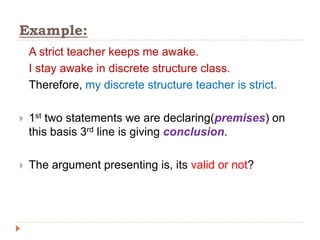
Example:
A strict teacher keeps me awake.
I stay awake in discrete structure class.
Therefore, my discrete structure teacher is strict.
 1st two statements we are declaring(premises) on
this basis 3rd line is giving conclusion.
 The argument presenting is, its valid or not?
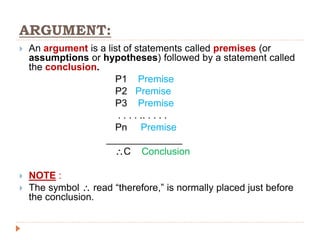
ARGUMENT:
 An argument is a list of statements called premises (or
assumptions or hypotheses) followed by a statement called
the conclusion.
P1 Premise
P2 Premise
P3 Premise
. . . . .. . . . .
Pn Premise
______________
C Conclusion
 NOTE :
 The symbol  read “therefore,” is normally placed just before
the conclusion.
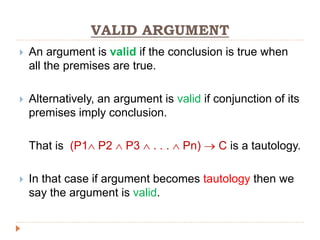
VALID ARGUMENT
 An argument is valid if the conclusion is true when
all the premises are true.
 Alternatively, an argument is valid if conjunction of its
premises imply conclusion.
That is (P1 P2  P3  . . .  Pn)  C is a tautology.
 In that case if argument becomes tautology then we
say the argument is valid.
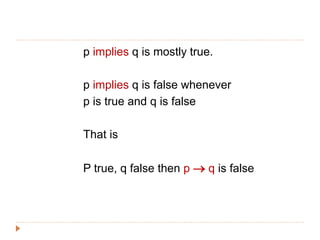
p implies q is mostly true.
p implies q is false whenever
p is true and q is false
That is
P true, q false then p  q is false
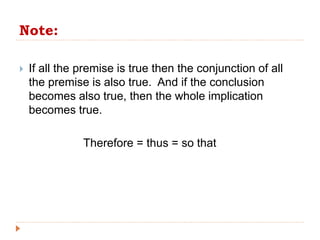
Note:
 If all the premise is true then the conjunction of all
the premise is also true. And if the conclusion
becomes also true, then the whole implication
becomes true.
Therefore = thus = so that
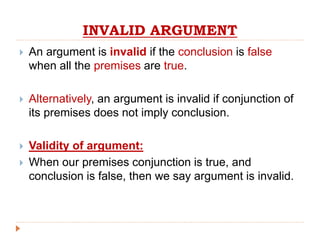
INVALID ARGUMENT
 An argument is invalid if the conclusion is false
when all the premises are true.
 Alternatively, an argument is invalid if conjunction of
its premises does not imply conclusion.
 Validity of argument:
 When our premises conjunction is true, and
conclusion is false, then we say argument is invalid.
9
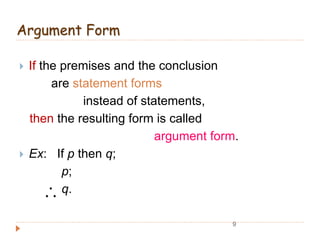
Argument Form
 If the premises and the conclusion
are statement forms
instead of statements,
then the resulting form is called
argument form.
 Ex: If p then q;
p;
q.

10
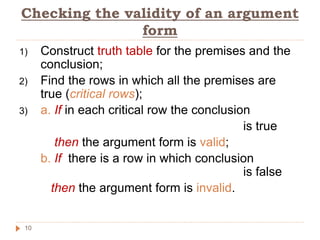
Checking the validity of an argument
form
1) Construct truth table for the premises and the
conclusion;
2) Find the rows in which all the premises are
true (critical rows);
3) a. If in each critical row the conclusion
is true
then the argument form is valid;
b. If there is a row in which conclusion
is false
then the argument form is invalid.
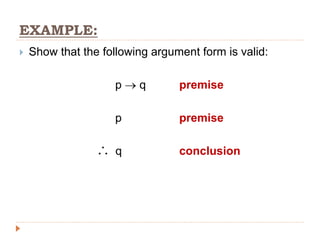
EXAMPLE:
 Show that the following argument form is valid:
p  q premise
p premise
q conclusion

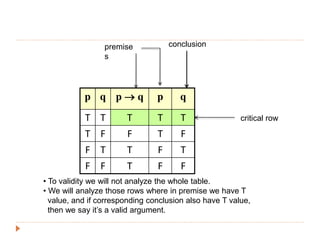
p q p  q p q
T T T T T
T F F T F
F T T F T
F F T F F
premise
s
conclusion
• To validity we will not analyze the whole table.
• We will analyze those rows where in premise we have T
value, and if corresponding conclusion also have T value,
then we say it’s a valid argument.
critical row
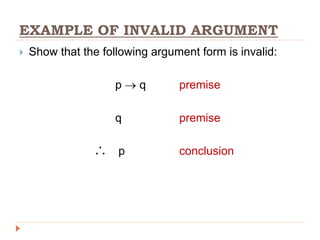
EXAMPLE OF INVALID ARGUMENT
 Show that the following argument form is invalid:
p  q premise
q premise
p conclusion

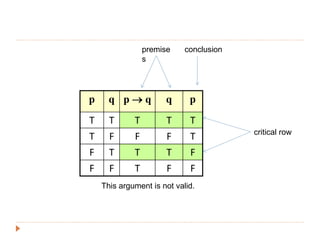
p q p  q q p
T T T T T
T F F F T
F T T T F
F F T F F
premise
s
conclusion
critical row
This argument is not valid.
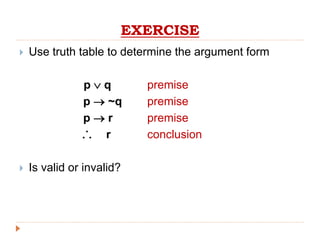
EXERCISE
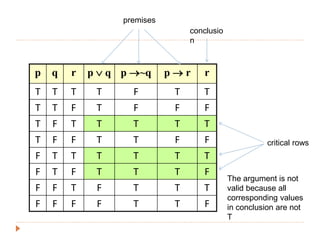
 Use truth table to determine the argument form
p  q premise
p  ~q premise
p  r premise
r conclusion
 Is valid or invalid?

p q r p  q p ~q p  r r
T T T T F T T
T T F T F F F
T F T T T T T
T F F T T F F
F T T T T T T
F T F T T T F
F F T F T T T
F F F F T T F
premises
conclusio
n
critical rows
The argument is not
valid because all
corresponding values
in conclusion are not
T
WORD PROBLEM
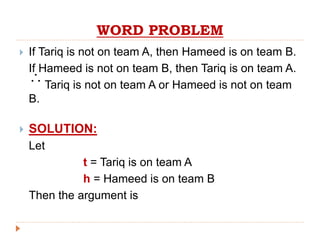
 If Tariq is not on team A, then Hameed is on team B.
If Hameed is not on team B, then Tariq is on team A.
Tariq is not on team A or Hameed is not on team
B.
 SOLUTION:
Let
t = Tariq is on team A
h = Hameed is on team B
Then the argument is

WORD PROBLEM
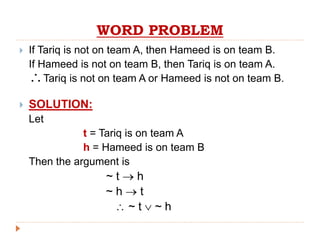
 If Tariq is not on team A, then Hameed is on team B.
If Hameed is not on team B, then Tariq is on team A.
Tariq is not on team A or Hameed is not on team B.
 SOLUTION:
Let
t = Tariq is on team A
h = Hameed is on team B
Then the argument is
~ t  h
~ h  t
 ~ t  ~ h

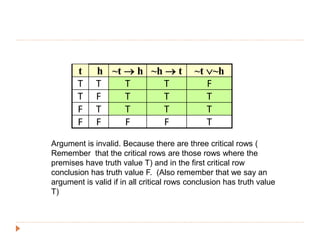
t h ~t  h ~h  t ~t ~h
T T T T F
T F T T T
F T T T T
F F F F T
Argument is invalid. Because there are three critical rows (
Remember that the critical rows are those rows where the
premises have truth value T) and in the first critical row
conclusion has truth value F. (Also remember that we say an
argument is valid if in all critical rows conclusion has truth value
T)
EXERCISE
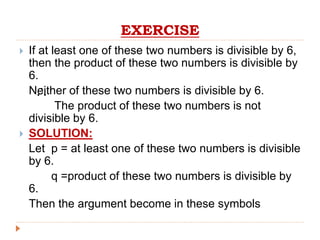
 If at least one of these two numbers is divisible by 6,
then the product of these two numbers is divisible by
6.
Neither of these two numbers is divisible by 6.
The product of these two numbers is not
divisible by 6.
 SOLUTION:
Let p = at least one of these two numbers is divisible
by 6.
q =product of these two numbers is divisible by
6.
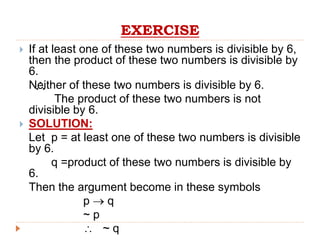
Then the argument become in these symbols

EXERCISE
 If at least one of these two numbers is divisible by 6,
then the product of these two numbers is divisible by
6.
Neither of these two numbers is divisible by 6.
The product of these two numbers is not
divisible by 6.
 SOLUTION:
Let p = at least one of these two numbers is divisible
by 6.
q =product of these two numbers is divisible by
6.
Then the argument become in these symbols
p  q
~ p
 ~ q

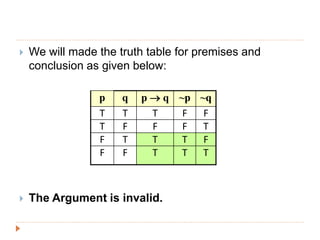
 We will made the truth table for premises and
conclusion as given below:
 The Argument is invalid.
p q p  q ~p ~q
T T T F F
T F F F T
F T T T F
F F T T T
EXERCISE
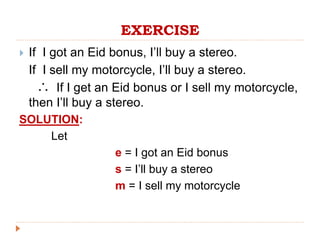
 If I got an Eid bonus, I’ll buy a stereo.
If I sell my motorcycle, I’ll buy a stereo.
If I get an Eid bonus or I sell my motorcycle,
then I’ll buy a stereo.
SOLUTION:
Let
e = I got an Eid bonus
s = I’ll buy a stereo
m = I sell my motorcycle

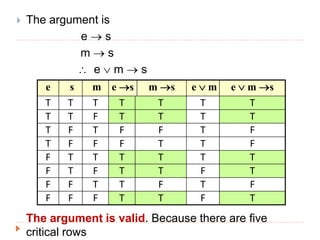
 The argument is
e  s
m  s
 e  m  s
The argument is valid. Because there are five
critical rows
e s m e s m s e  m e  m s
T T T T T T T
T T F T T T T
T F T F F T F
T F F F T T F
F T T T T T T
F T F T T F T
F F T T F T F
F F F T T F T
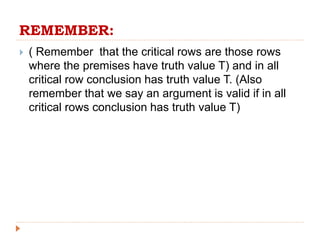
REMEMBER:
 ( Remember that the critical rows are those rows
where the premises have truth value T) and in all
critical row conclusion has truth value T. (Also
remember that we say an argument is valid if in all
critical rows conclusion has truth value T)
EXERCISE
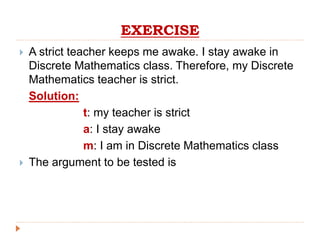
 A strict teacher keeps me awake. I stay awake in
Discrete Mathematics class. Therefore, my Discrete
Mathematics teacher is strict.
Solution:
t: my teacher is strict
a: I stay awake
m: I am in Discrete Mathematics class
 The argument to be tested is
EXERCISE
 A strict teacher keeps me awake. I stay awake in
Discrete Mathematics class. Therefore, my Discrete
Mathematics teacher is strict.
Solution:
t: my teacher is strict
a: I stay awake
m: I am in Discrete Mathematics class
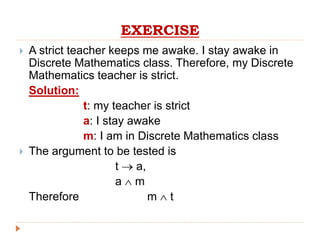
 The argument to be tested is
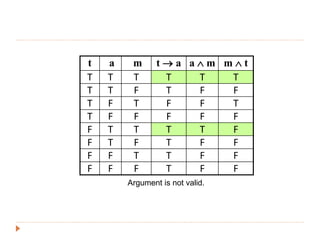
t  a,
a  m
Therefore m  t
t a m t  a a  m m  t
T T T T T T
T T F T F F
T F T F F T
T F F F F F
F T T T T F
F T F T F F
F F T T F F
F F F T F F
Argument is not valid.

Arguments in discreate structures and stuff

  • 1.
  • 2.
    In Today’s Lecture Logic: Logic rules and principles is to distinguish an argument is valid or invalid.  Examples of Arguments:  You have a intuitive idea about argument. When you are talking with your friend you give argument.  Sometimes you say to your friend “what are you saying has no logic” it means you are saying that your argument is not valid.  Lawyer in court during the trail to defend client, give argument. Judge decision is also based on lawyer argument if its argument is valid then decision will be in his favor.
  • 3.
    Example: A strict teacherkeeps me awake. I stay awake in discrete structure class. Therefore, my discrete structure teacher is strict.  1st two statements we are declaring(premises) on this basis 3rd line is giving conclusion.  The argument presenting is, its valid or not?
  • 4.
    ARGUMENT:  An argumentis a list of statements called premises (or assumptions or hypotheses) followed by a statement called the conclusion. P1 Premise P2 Premise P3 Premise . . . . .. . . . . Pn Premise ______________ C Conclusion  NOTE :  The symbol  read “therefore,” is normally placed just before the conclusion.
  • 5.
    VALID ARGUMENT  Anargument is valid if the conclusion is true when all the premises are true.  Alternatively, an argument is valid if conjunction of its premises imply conclusion. That is (P1 P2  P3  . . .  Pn)  C is a tautology.  In that case if argument becomes tautology then we say the argument is valid.
  • 6.
    p implies qis mostly true. p implies q is false whenever p is true and q is false That is P true, q false then p  q is false
  • 7.
    Note:  If allthe premise is true then the conjunction of all the premise is also true. And if the conclusion becomes also true, then the whole implication becomes true. Therefore = thus = so that
  • 8.
    INVALID ARGUMENT  Anargument is invalid if the conclusion is false when all the premises are true.  Alternatively, an argument is invalid if conjunction of its premises does not imply conclusion.  Validity of argument:  When our premises conjunction is true, and conclusion is false, then we say argument is invalid.
  • 9.
    9 Argument Form  Ifthe premises and the conclusion are statement forms instead of statements, then the resulting form is called argument form.  Ex: If p then q; p; q. 
  • 10.
    10 Checking the validityof an argument form 1) Construct truth table for the premises and the conclusion; 2) Find the rows in which all the premises are true (critical rows); 3) a. If in each critical row the conclusion is true then the argument form is valid; b. If there is a row in which conclusion is false then the argument form is invalid.
  • 11.
    EXAMPLE:  Show thatthe following argument form is valid: p  q premise p premise q conclusion 
  • 12.
    p q p q p q T T T T T T F F T F F T T F T F F T F F premise s conclusion • To validity we will not analyze the whole table. • We will analyze those rows where in premise we have T value, and if corresponding conclusion also have T value, then we say it’s a valid argument. critical row
  • 13.
    EXAMPLE OF INVALIDARGUMENT  Show that the following argument form is invalid: p  q premise q premise p conclusion 
  • 14.
    p q p q q p T T T T T T F F F T F T T T F F F T F F premise s conclusion critical row This argument is not valid.
  • 15.
    EXERCISE  Use truthtable to determine the argument form p  q premise p  ~q premise p  r premise r conclusion  Is valid or invalid? 
  • 16.
    p q rp  q p ~q p  r r T T T T F T T T T F T F F F T F T T T T T T F F T T F F F T T T T T T F T F T T T F F F T F T T T F F F F T T F premises conclusio n critical rows The argument is not valid because all corresponding values in conclusion are not T
  • 17.
    WORD PROBLEM  IfTariq is not on team A, then Hameed is on team B. If Hameed is not on team B, then Tariq is on team A. Tariq is not on team A or Hameed is not on team B.  SOLUTION: Let t = Tariq is on team A h = Hameed is on team B Then the argument is 
  • 18.
    WORD PROBLEM  IfTariq is not on team A, then Hameed is on team B. If Hameed is not on team B, then Tariq is on team A. Tariq is not on team A or Hameed is not on team B.  SOLUTION: Let t = Tariq is on team A h = Hameed is on team B Then the argument is ~ t  h ~ h  t  ~ t  ~ h 
  • 19.
    t h ~t h ~h  t ~t ~h T T T T F T F T T T F T T T T F F F F T Argument is invalid. Because there are three critical rows ( Remember that the critical rows are those rows where the premises have truth value T) and in the first critical row conclusion has truth value F. (Also remember that we say an argument is valid if in all critical rows conclusion has truth value T)
  • 20.
    EXERCISE  If atleast one of these two numbers is divisible by 6, then the product of these two numbers is divisible by 6. Neither of these two numbers is divisible by 6. The product of these two numbers is not divisible by 6.  SOLUTION: Let p = at least one of these two numbers is divisible by 6. q =product of these two numbers is divisible by 6. Then the argument become in these symbols 
  • 21.
    EXERCISE  If atleast one of these two numbers is divisible by 6, then the product of these two numbers is divisible by 6. Neither of these two numbers is divisible by 6. The product of these two numbers is not divisible by 6.  SOLUTION: Let p = at least one of these two numbers is divisible by 6. q =product of these two numbers is divisible by 6. Then the argument become in these symbols p  q ~ p  ~ q 
  • 22.
     We willmade the truth table for premises and conclusion as given below:  The Argument is invalid. p q p  q ~p ~q T T T F F T F F F T F T T T F F F T T T
  • 23.
    EXERCISE  If Igot an Eid bonus, I’ll buy a stereo. If I sell my motorcycle, I’ll buy a stereo. If I get an Eid bonus or I sell my motorcycle, then I’ll buy a stereo. SOLUTION: Let e = I got an Eid bonus s = I’ll buy a stereo m = I sell my motorcycle 
  • 24.
     The argumentis e  s m  s  e  m  s The argument is valid. Because there are five critical rows e s m e s m s e  m e  m s T T T T T T T T T F T T T T T F T F F T F T F F F T T F F T T T T T T F T F T T F T F F T T F T F F F F T T F T
  • 25.
    REMEMBER:  ( Rememberthat the critical rows are those rows where the premises have truth value T) and in all critical row conclusion has truth value T. (Also remember that we say an argument is valid if in all critical rows conclusion has truth value T)
  • 26.
    EXERCISE  A strictteacher keeps me awake. I stay awake in Discrete Mathematics class. Therefore, my Discrete Mathematics teacher is strict. Solution: t: my teacher is strict a: I stay awake m: I am in Discrete Mathematics class  The argument to be tested is
  • 27.
    EXERCISE  A strictteacher keeps me awake. I stay awake in Discrete Mathematics class. Therefore, my Discrete Mathematics teacher is strict. Solution: t: my teacher is strict a: I stay awake m: I am in Discrete Mathematics class  The argument to be tested is t  a, a  m Therefore m  t
  • 28.
    t a mt  a a  m m  t T T T T T T T T F T F F T F T F F T T F F F F F F T T T T F F T F T F F F F T T F F F F F T F F Argument is not valid.