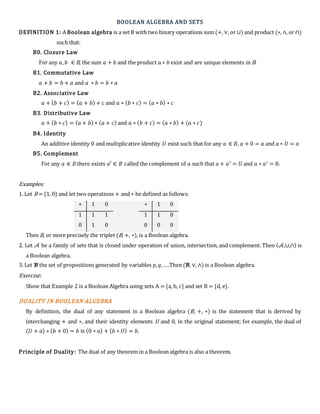
BOOLEAN ALGEBRA AND SETS
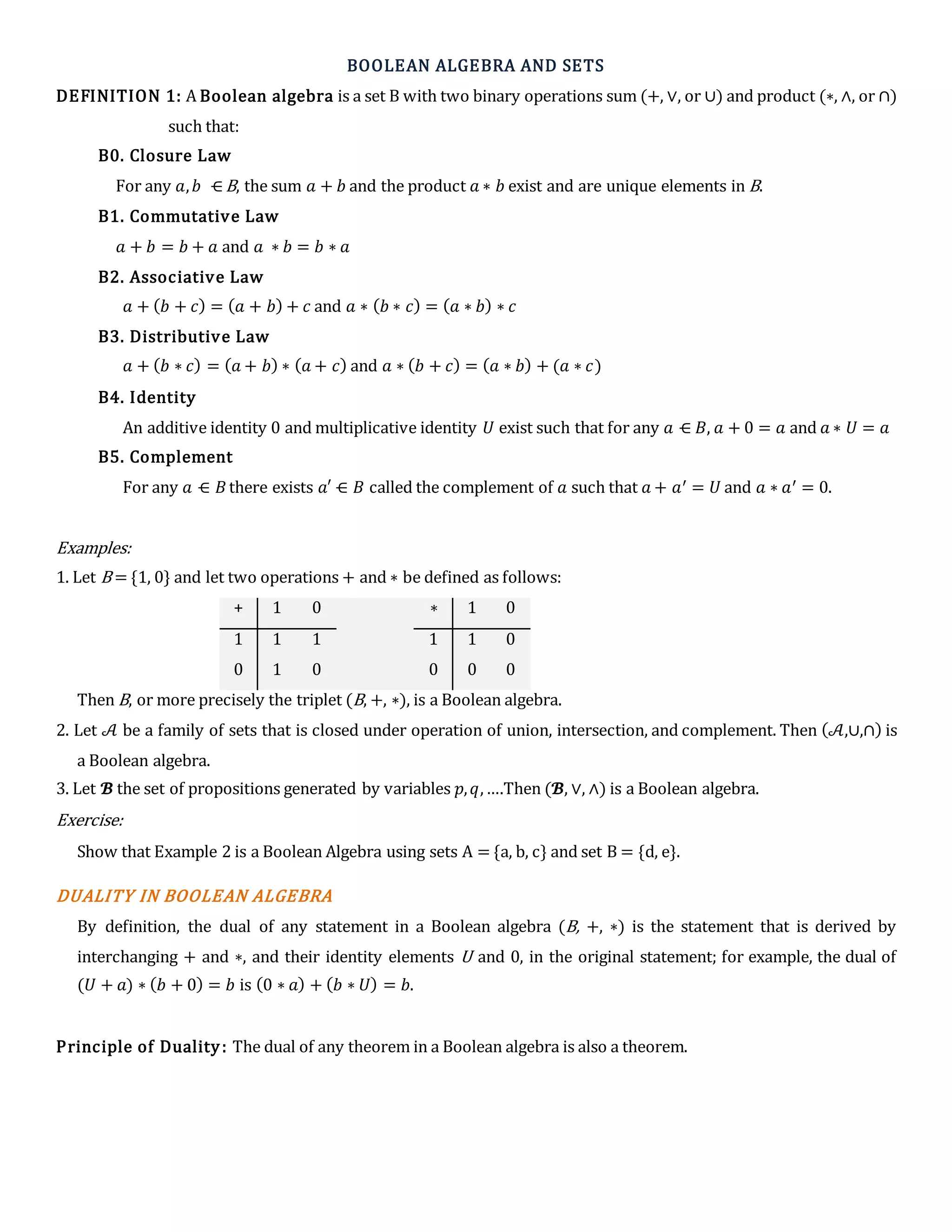
DEFINITION 1: A Boolean algebra is a set B with two binary operations sum (+, ∨, or ∪) and product (∗, ∧, or ∩)
such that:
B0. Closure Law
For any 𝑎, 𝑏 ⋲B, the sum 𝑎 + 𝑏 and the product 𝑎 ∗ 𝑏 exist and are unique elements in B.
B1. Commutative Law
𝑎 + 𝑏 = 𝑏 + 𝑎 and 𝑎 ∗ 𝑏 = 𝑏 ∗ 𝑎
B2. Associative Law
𝑎 + ( 𝑏 + 𝑐) = ( 𝑎 + 𝑏) + 𝑐 and 𝑎 ∗ ( 𝑏 ∗ 𝑐) = ( 𝑎 ∗ 𝑏) ∗ 𝑐
B3. Distributive Law
𝑎 + ( 𝑏 ∗ 𝑐) = ( 𝑎 + 𝑏) ∗ ( 𝑎 + 𝑐) and 𝑎 ∗ ( 𝑏 + 𝑐) = ( 𝑎 ∗ 𝑏) + (𝑎 ∗ 𝑐)
B4. Identity
An additive identity 0 and multiplicative identity 𝑈 exist such that for any 𝑎 ⋲ 𝐵, 𝑎 + 0 = 𝑎 and 𝑎 ∗ 𝑈 = 𝑎
B5. Complement
For any 𝑎 ⋲ 𝐵there exists 𝑎′ ⋲ 𝐵 called the complement of 𝑎 such that 𝑎 + 𝑎′ = 𝑈 and 𝑎 ∗ 𝑎′ = 0.
Examples:
1. Let B = {1, 0} and let two operations + and ∗ be defined as follows:
+ 1 0 ∗ 1 0
1 1 1 1 1 0
0 1 0 0 0 0
Then B, or more precisely the triplet (B, +, ∗), is a Boolean algebra.
2. Let 𝒜 be a family of sets that is closed under operation of union, intersection, and complement. Then ( 𝒜,∪,∩) is
a Boolean algebra.
3. Let 𝓑 the set of propositions generated by variables 𝑝, 𝑞,….Then (𝓑, ∨, ∧) is a Boolean algebra.
Exercise:
Show that Example 2 is a Boolean Algebra using sets A = {a, b, c} and set B = {d, e}.
DUALITY IN BOOLEAN ALGEBRA
By definition, the dual of any statement in a Boolean algebra (B, +, ∗) is the statement that is derived by
interchanging + and ∗, and their identity elements U and 0, in the original statement; for example, the dual of
(𝑈 + 𝑎) ∗ ( 𝑏 + 0) = 𝑏 is (0 ∗ 𝑎) + ( 𝑏 ∗ 𝑈) = 𝑏.
Principle of Duality: The dual of any theorem in a Boolean algebra is also a theorem.
BASIC THEOREMS
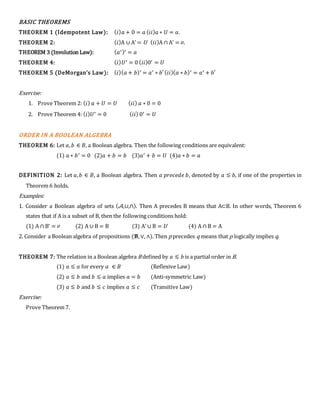
THEOREM 1 (Idempotent Law): (𝑖) 𝑎 + 0 = 𝑎 (𝑖𝑖) 𝑎 ∗ 𝑈 = 𝑎.
THEOREM 2: (𝑖)A ∪ A’ = U (𝑖𝑖)A ∩ A’ = ⌀.
THEOREM 3 (Involution Law): ( 𝑎′)′ = 𝑎
THEOREM 4: (𝑖) 𝑈′ = 0 (𝑖𝑖)0′ = 𝑈
THEOREM 5 (DeMorgan’s Law): (𝑖)( 𝑎 + 𝑏)′ = 𝑎′ ∗ 𝑏′(𝑖𝑖)( 𝑎 ∗ 𝑏)′ = 𝑎′ + 𝑏′
Exercise:
1. Prove Theorem 2: (𝑖) 𝑎 + 𝑈 = 𝑈 (𝑖𝑖) 𝑎 ∗ 0 = 0
2. Prove Theorem 4: (𝑖) 𝑈′ = 0 (𝑖𝑖) 0′ = 𝑈
ORDER IN A BOOLEAN ALGEBRA
THEOREM 6: Let 𝑎, 𝑏 ⋲ 𝐵, a Boolean algebra. Then the following conditions are equivalent:
(1) 𝑎 ∗ 𝑏′ = 0 (2)𝑎 + 𝑏 = 𝑏 (3)𝑎′ + 𝑏 = 𝑈 (4)𝑎 ∗ 𝑏 = 𝑎
DEFINITION 2: Let 𝑎, 𝑏 ⋲ 𝐵, a Boolean algebra. Then 𝑎 𝑝𝑟𝑒𝑐𝑒𝑑𝑒 𝑏, denoted by 𝑎 ≲ 𝑏, if one of the properties in
Theorem 6 holds.
Examples:
1. Consider a Boolean algebra of sets ( 𝒜,∪,∩). Then A precedes B means that A⊂B. In other words, Theorem 6
states that if A is a subset of B, then the following conditions hold:
(1) A ∩ B’ = ⌀ (2) A ∪ B = B (3) A’ ∪ B = U (4) A ∩ B = A
2. Consider a Boolean algebra of propositions (𝓑, ∨, ∧). Then p precedes q means that p logically implies q.
THEOREM 7: The relation in a Boolean algebra B defined by 𝑎 ≲ 𝑏 is a partial order in B.
(1) 𝑎 ≲ 𝑎 for every 𝑎 ⋲ 𝐵 (Reflexive Law)
(2) 𝑎 ≲ 𝑏 and 𝑏 ≲ 𝑎 implies 𝑎 = 𝑏 (Anti-symmetric Law)
(3) 𝑎 ≲ 𝑏 and 𝑏 ≲ 𝑐 implies 𝑎 ≲ 𝑐 (Transitive Law)
Exercise:
Prove Theorem 7.
SWITCHING CIRCUITS DESIGNS
Let A, B, … denote electrical switches, and let A and A’ denote switches with the property that if one is on then
the other is off, and vice versa. Two switches, say A and B, can be connected by wire in a series or parallel
combination as follows:
Series combination, A ∧ B Parallel combination, A ∨ B
A Boolean switching circuit design means an arrangement of wires and switches that can be constructed by
repeated use of series and parallel combinations; hence it can be described by the use of connectives ∧ and ∨.
Circuit (1) A ∧ (B ∨ A’) Circuit (2) (A ∧ B’) ∨ [(A ∨ C) ∧ B]
Now let 1 and 0 denote respectively, that a switch or a circuit is on and that a switch or circuit is off.
*The tables describe the behavior of a series circuit A ∧ B, parallel circuit A ∨ B, and the relationship between
switch A and switch A’.
THEOREM 8: The algebra of Boolean switching circuits is a Boolean algebra.
Exercise:
1. Using circuit (1) in the example, when will the circuit be on and when will the circuit be off?
2. Construct s circuit for (A ∨ B) ∧ C ∧ (A’ ∨ B’ ∨ C’)
Reference:
Lipschuts, S. (2005). Schaums outline of theory and problem of set theory and related topics. New York: McGraw-
Hill Publishing Inc.
Raymund T. de la Cruz
MAEd – Mathematics
A B A ∧ B A B A ∨ B A A'
1 1 1 1 1 1 1 0
1 0 0 1 0 1 0 1
0 1 0 0 1 1
0 0 0 0 0 0
A B
A
B
A
B
A’
C
A
B
A’
B’

Report on set theory

  • 1.
    BOOLEAN ALGEBRA ANDSETS DEFINITION 1: A Boolean algebra is a set B with two binary operations sum (+, ∨, or ∪) and product (∗, ∧, or ∩) such that: B0. Closure Law For any 𝑎, 𝑏 ⋲B, the sum 𝑎 + 𝑏 and the product 𝑎 ∗ 𝑏 exist and are unique elements in B. B1. Commutative Law 𝑎 + 𝑏 = 𝑏 + 𝑎 and 𝑎 ∗ 𝑏 = 𝑏 ∗ 𝑎 B2. Associative Law 𝑎 + ( 𝑏 + 𝑐) = ( 𝑎 + 𝑏) + 𝑐 and 𝑎 ∗ ( 𝑏 ∗ 𝑐) = ( 𝑎 ∗ 𝑏) ∗ 𝑐 B3. Distributive Law 𝑎 + ( 𝑏 ∗ 𝑐) = ( 𝑎 + 𝑏) ∗ ( 𝑎 + 𝑐) and 𝑎 ∗ ( 𝑏 + 𝑐) = ( 𝑎 ∗ 𝑏) + (𝑎 ∗ 𝑐) B4. Identity An additive identity 0 and multiplicative identity 𝑈 exist such that for any 𝑎 ⋲ 𝐵, 𝑎 + 0 = 𝑎 and 𝑎 ∗ 𝑈 = 𝑎 B5. Complement For any 𝑎 ⋲ 𝐵there exists 𝑎′ ⋲ 𝐵 called the complement of 𝑎 such that 𝑎 + 𝑎′ = 𝑈 and 𝑎 ∗ 𝑎′ = 0. Examples: 1. Let B = {1, 0} and let two operations + and ∗ be defined as follows: + 1 0 ∗ 1 0 1 1 1 1 1 0 0 1 0 0 0 0 Then B, or more precisely the triplet (B, +, ∗), is a Boolean algebra. 2. Let 𝒜 be a family of sets that is closed under operation of union, intersection, and complement. Then ( 𝒜,∪,∩) is a Boolean algebra. 3. Let 𝓑 the set of propositions generated by variables 𝑝, 𝑞,….Then (𝓑, ∨, ∧) is a Boolean algebra. Exercise: Show that Example 2 is a Boolean Algebra using sets A = {a, b, c} and set B = {d, e}. DUALITY IN BOOLEAN ALGEBRA By definition, the dual of any statement in a Boolean algebra (B, +, ∗) is the statement that is derived by interchanging + and ∗, and their identity elements U and 0, in the original statement; for example, the dual of (𝑈 + 𝑎) ∗ ( 𝑏 + 0) = 𝑏 is (0 ∗ 𝑎) + ( 𝑏 ∗ 𝑈) = 𝑏. Principle of Duality: The dual of any theorem in a Boolean algebra is also a theorem.
  • 2.
    BASIC THEOREMS THEOREM 1(Idempotent Law): (𝑖) 𝑎 + 0 = 𝑎 (𝑖𝑖) 𝑎 ∗ 𝑈 = 𝑎. THEOREM 2: (𝑖)A ∪ A’ = U (𝑖𝑖)A ∩ A’ = ⌀. THEOREM 3 (Involution Law): ( 𝑎′)′ = 𝑎 THEOREM 4: (𝑖) 𝑈′ = 0 (𝑖𝑖)0′ = 𝑈 THEOREM 5 (DeMorgan’s Law): (𝑖)( 𝑎 + 𝑏)′ = 𝑎′ ∗ 𝑏′(𝑖𝑖)( 𝑎 ∗ 𝑏)′ = 𝑎′ + 𝑏′ Exercise: 1. Prove Theorem 2: (𝑖) 𝑎 + 𝑈 = 𝑈 (𝑖𝑖) 𝑎 ∗ 0 = 0 2. Prove Theorem 4: (𝑖) 𝑈′ = 0 (𝑖𝑖) 0′ = 𝑈 ORDER IN A BOOLEAN ALGEBRA THEOREM 6: Let 𝑎, 𝑏 ⋲ 𝐵, a Boolean algebra. Then the following conditions are equivalent: (1) 𝑎 ∗ 𝑏′ = 0 (2)𝑎 + 𝑏 = 𝑏 (3)𝑎′ + 𝑏 = 𝑈 (4)𝑎 ∗ 𝑏 = 𝑎 DEFINITION 2: Let 𝑎, 𝑏 ⋲ 𝐵, a Boolean algebra. Then 𝑎 𝑝𝑟𝑒𝑐𝑒𝑑𝑒 𝑏, denoted by 𝑎 ≲ 𝑏, if one of the properties in Theorem 6 holds. Examples: 1. Consider a Boolean algebra of sets ( 𝒜,∪,∩). Then A precedes B means that A⊂B. In other words, Theorem 6 states that if A is a subset of B, then the following conditions hold: (1) A ∩ B’ = ⌀ (2) A ∪ B = B (3) A’ ∪ B = U (4) A ∩ B = A 2. Consider a Boolean algebra of propositions (𝓑, ∨, ∧). Then p precedes q means that p logically implies q. THEOREM 7: The relation in a Boolean algebra B defined by 𝑎 ≲ 𝑏 is a partial order in B. (1) 𝑎 ≲ 𝑎 for every 𝑎 ⋲ 𝐵 (Reflexive Law) (2) 𝑎 ≲ 𝑏 and 𝑏 ≲ 𝑎 implies 𝑎 = 𝑏 (Anti-symmetric Law) (3) 𝑎 ≲ 𝑏 and 𝑏 ≲ 𝑐 implies 𝑎 ≲ 𝑐 (Transitive Law) Exercise: Prove Theorem 7.
  • 3.
    SWITCHING CIRCUITS DESIGNS LetA, B, … denote electrical switches, and let A and A’ denote switches with the property that if one is on then the other is off, and vice versa. Two switches, say A and B, can be connected by wire in a series or parallel combination as follows: Series combination, A ∧ B Parallel combination, A ∨ B A Boolean switching circuit design means an arrangement of wires and switches that can be constructed by repeated use of series and parallel combinations; hence it can be described by the use of connectives ∧ and ∨. Circuit (1) A ∧ (B ∨ A’) Circuit (2) (A ∧ B’) ∨ [(A ∨ C) ∧ B] Now let 1 and 0 denote respectively, that a switch or a circuit is on and that a switch or circuit is off. *The tables describe the behavior of a series circuit A ∧ B, parallel circuit A ∨ B, and the relationship between switch A and switch A’. THEOREM 8: The algebra of Boolean switching circuits is a Boolean algebra. Exercise: 1. Using circuit (1) in the example, when will the circuit be on and when will the circuit be off? 2. Construct s circuit for (A ∨ B) ∧ C ∧ (A’ ∨ B’ ∨ C’) Reference: Lipschuts, S. (2005). Schaums outline of theory and problem of set theory and related topics. New York: McGraw- Hill Publishing Inc. Raymund T. de la Cruz MAEd – Mathematics A B A ∧ B A B A ∨ B A A' 1 1 1 1 1 1 1 0 1 0 0 1 0 1 0 1 0 1 0 0 1 1 0 0 0 0 0 0 A B A B A B A’ C A B A’ B’