Copyright © 2012 Pearson Education,
Inc. Publishing as Prentice Hall
Copyright © 2014 Pearson Education, Inc. publishing as Prentice Hall 8-1
Foundations of
Planning
8
Copyright © 2012 Pearson Education,
Inc. Publishing as Prentice Hall
Copyright © 2014 Pearson Education, Inc. publishing as Prentice Hall 8-2
What Is Planning?
• Planning - defining the organization’s
goals, establishing strategies for achieving
those goals, and developing plans to
integrate and coordinate work activities.
• Formal planning
– Specific goals covering a specific time period
– Written and shared with organizational
members
Copyright © 2012 Pearson Education,
Inc. Publishing as Prentice Hall
Copyright © 2014 Pearson Education, Inc. publishing as Prentice Hall 8-3
Why Do Managers Plan?
• Four reasons for planning
– Provides direction
– Reduces uncertainty
– Minimizes waste and redundancy
– Sets the standards for controlling
Copyright © 2012 Pearson Education,
Inc. Publishing as Prentice Hall
Copyright © 2014 Pearson Education, Inc. publishing as Prentice Hall 8-4
Planning and Performance
• Formal planning is associated with:
– Positive financial results - higher profits,
higher return on assets, and so forth
– The quality of planning and implementation
affects performance more than the extent of
planning
– The external environment can reduce the
impact of planning on performance
– The planning-performance relationship seems
to be influenced by the planning time frame
Copyright © 2012 Pearson Education,
Inc. Publishing as Prentice Hall
Copyright © 2014 Pearson Education, Inc. publishing as Prentice Hall 8-5
Goals and Plans
• Goals (objectives) - desired
outcomes or targets
• Plans - documents that outline how
goals are going to be met
Copyright © 2012 Pearson Education,
Inc. Publishing as Prentice Hall
Copyright © 2014 Pearson Education, Inc. publishing as Prentice Hall 8-6
Types of Goals
• Financial Goals - related to the expected
internal financial performance of the
organization.
• Strategic Goals - related to the performance of
the firm relative to factors in its external
environment (e.g., competitors).
Copyright © 2012 Pearson Education,
Inc. Publishing as Prentice Hall
Copyright © 2014 Pearson Education, Inc. publishing as Prentice Hall 8-7
Types of Goals (cont.)
• Stated goals - official statements of what an
organization says, and what it wants its various
stakeholders to believe, its goals are
• Real goals - goals that an organization actually
pursues, as defined by the actions of its
members
Exhibit 7–2 Types of Plans
Copyright © 2012 Pearson Education,
Inc. Publishing as Prentice Hall
Copyright © 2014 Pearson Education, Inc. publishing as Prentice Hall 8-9
Types of Plans
• Strategic plans - plans that apply to the
entire organization and establish the
organization’s overall goals
• Operational plans - plans that
encompass a particular operational area of
the organization
Copyright © 2012 Pearson Education,
Inc. Publishing as Prentice Hall
Copyright © 2014 Pearson Education, Inc. publishing as Prentice Hall 8-10
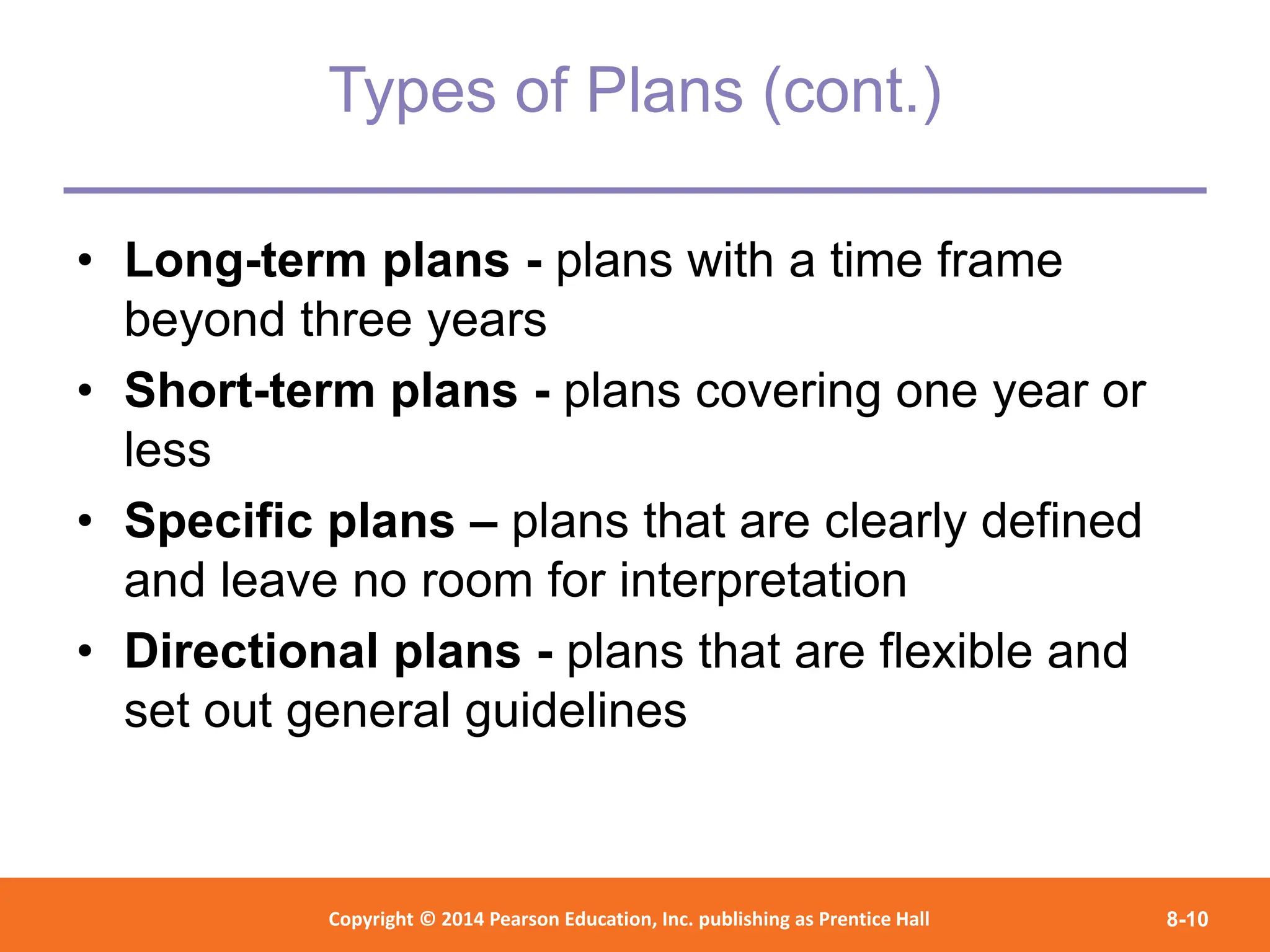
Types of Plans (cont.)
• Long-term plans - plans with a time frame
beyond three years
• Short-term plans - plans covering one year or
less
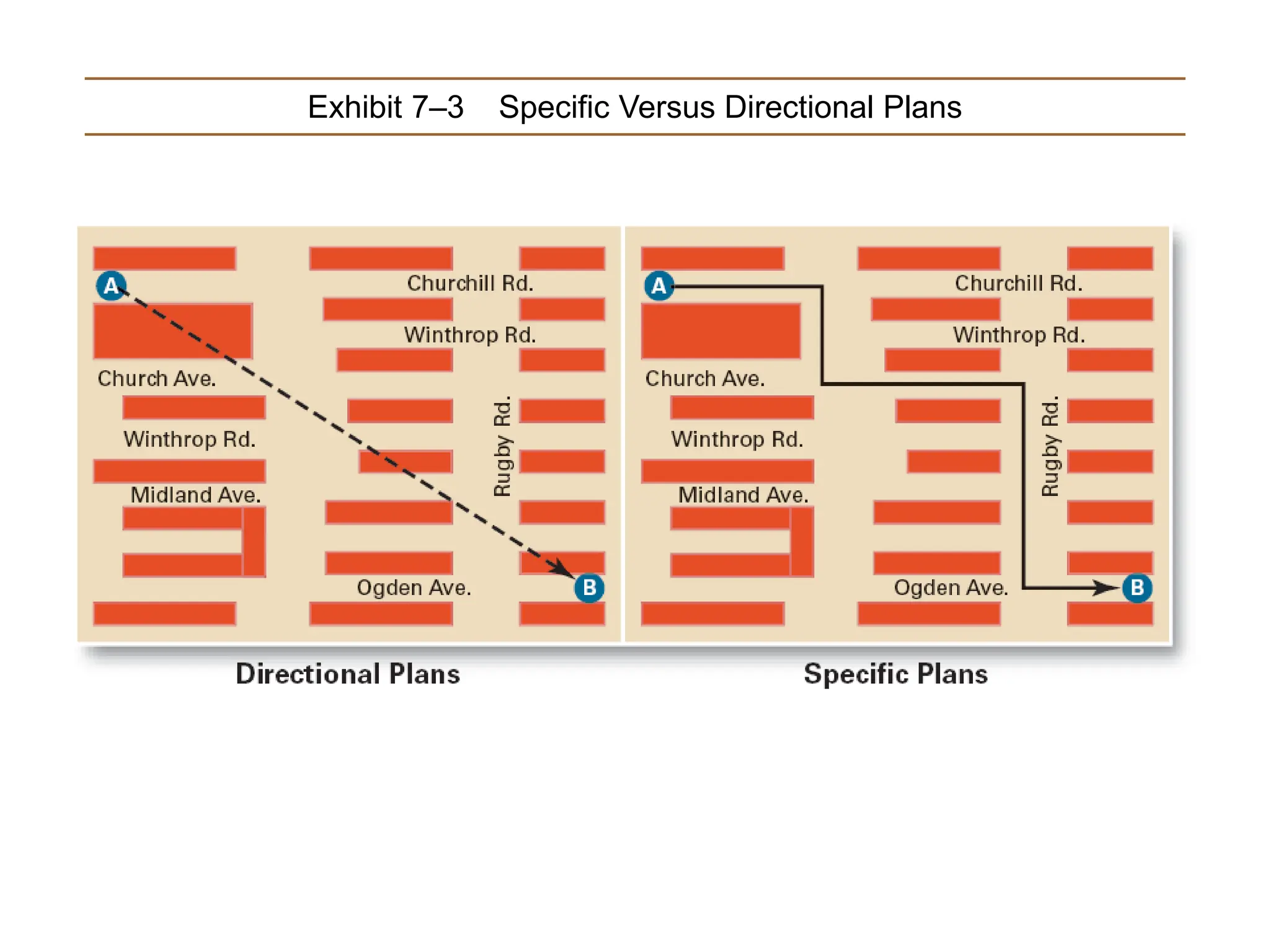
• Specific plans – plans that are clearly defined
and leave no room for interpretation
• Directional plans - plans that are flexible and
set out general guidelines
Exhibit 7–3 Specific Versus Directional Plans
Copyright © 2012 Pearson Education,
Inc. Publishing as Prentice Hall
Copyright © 2014 Pearson Education, Inc. publishing as Prentice Hall 8-12
Types of Plans (cont.)
• Single-use plan - a one-time plan
specifically designed to meet the needs of
a unique situation
• Standing plans ongoing plans that
provide guidance for activities performed
repeatedly
Copyright © 2012 Pearson Education,
Inc. Publishing as Prentice Hall
Copyright © 2014 Pearson Education, Inc. publishing as Prentice Hall 8-13
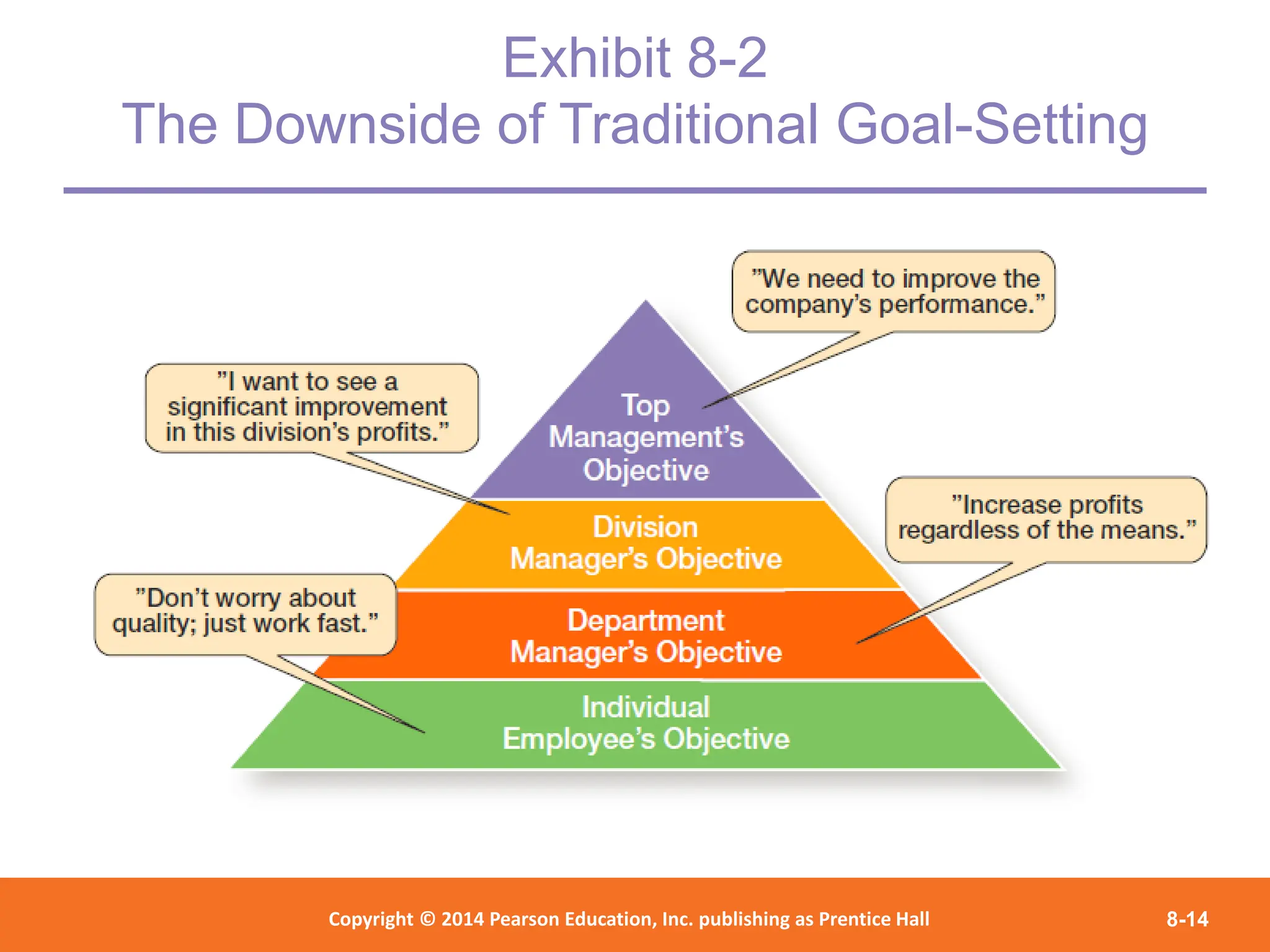
Approaches to Setting Goals
• Traditional goal-setting - an approach to
setting goals in which top managers set goals
that then flow down through the organization
and become subgoals for each organizational
area
• Means-ends chain - an integrated network of
goals in which the accomplishment of goals at
one level serves as the means for achieving the
goals, or ends, at the next level
Copyright © 2012 Pearson Education,
Inc. Publishing as Prentice Hall
Copyright © 2014 Pearson Education, Inc. publishing as Prentice Hall 8-14
Exhibit 8-2
The Downside of Traditional Goal-Setting
Establishing Goals and
Developing Plans (cont’d)
• Management By Objectives (MBO)
– Specific performance goals are jointly
determined by employees and managers.
– Progress toward accomplishing goals is
periodically reviewed.
– Rewards are allocated on the basis of
progress towards the goals.
– Key elements of MBO:
• Goal specificity, participative decision making, an
explicit performance/evaluation period, feedback
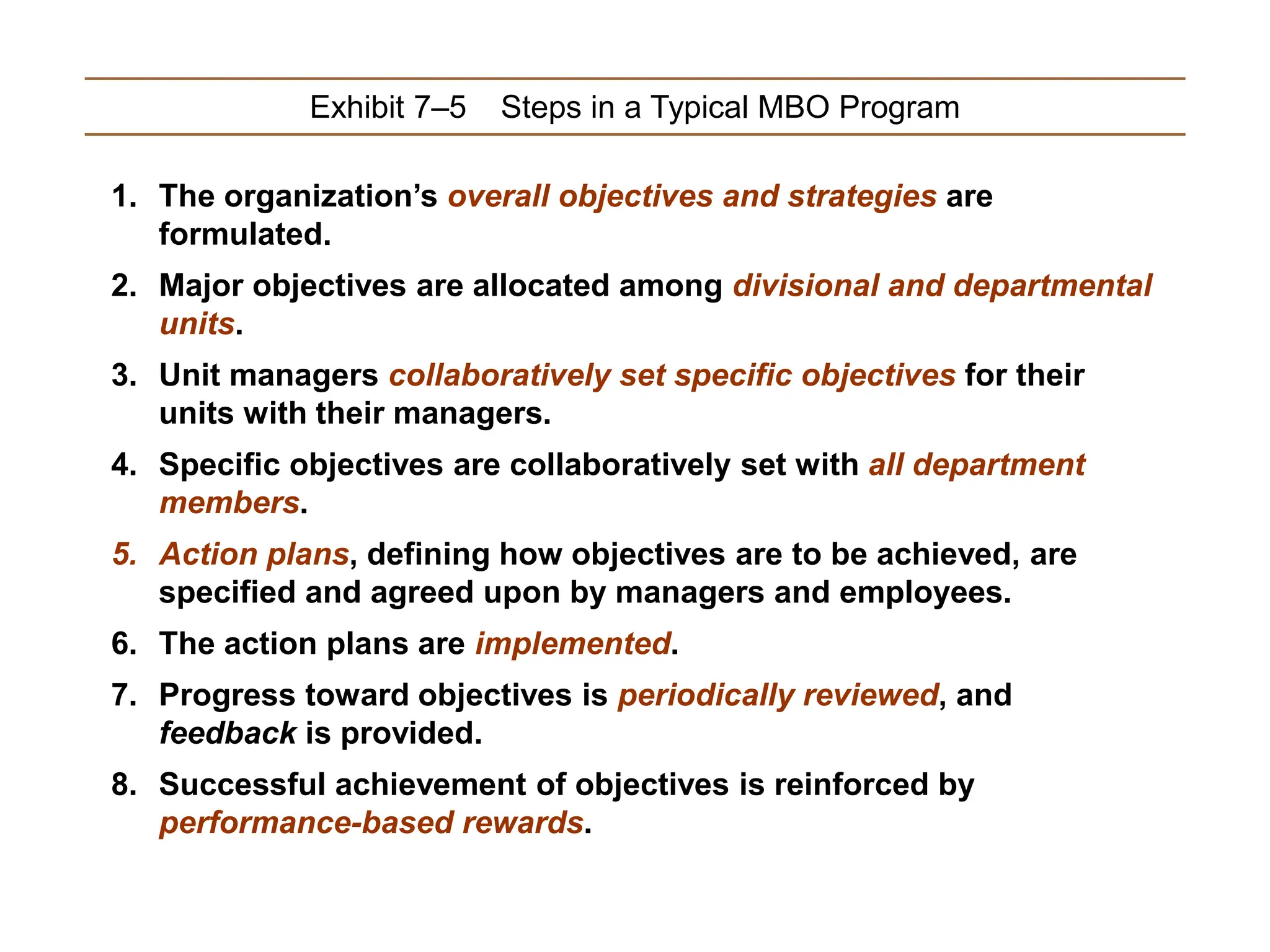
Exhibit 7–5 Steps in a Typical MBO Program
1. The organization’s overall objectives and strategies are
formulated.
2. Major objectives are allocated among divisional and departmental
units.
3. Unit managers collaboratively set specific objectives for their
units with their managers.
4. Specific objectives are collaboratively set with all department
members.
5. Action plans, defining how objectives are to be achieved, are
specified and agreed upon by managers and employees.
6. The action plans are implemented.
7. Progress toward objectives is periodically reviewed, and
feedback is provided.
8. Successful achievement of objectives is reinforced by
performance-based rewards.
Does MBO Work?
• Reason for MBO Success
– Top management commitment and involvement
• Potential Problems with MBO Programs
– Not as effective in dynamic environments that require
constant resetting of goals.
– Overemphasis on individual accomplishment may
create problems with teamwork.
– Allowing the MBO program to become an annual
paperwork shuffle.
Copyright © 2012 Pearson Education,
Inc. Publishing as Prentice Hall
Copyright © 2014 Pearson Education, Inc. publishing as Prentice Hall 8-18
Steps in Goal-Setting
1. Review the organization’s mission, or purpose.
2. Evaluate available resources
3. Determine the goals individually or with input
from others
4. Write down the goals and communicate them to
all who need to know
5. Review results and whether goals are being
met.
Copyright © 2012 Pearson Education,
Inc. Publishing as Prentice Hall
Copyright © 2014 Pearson Education, Inc. publishing as Prentice Hall 8-19
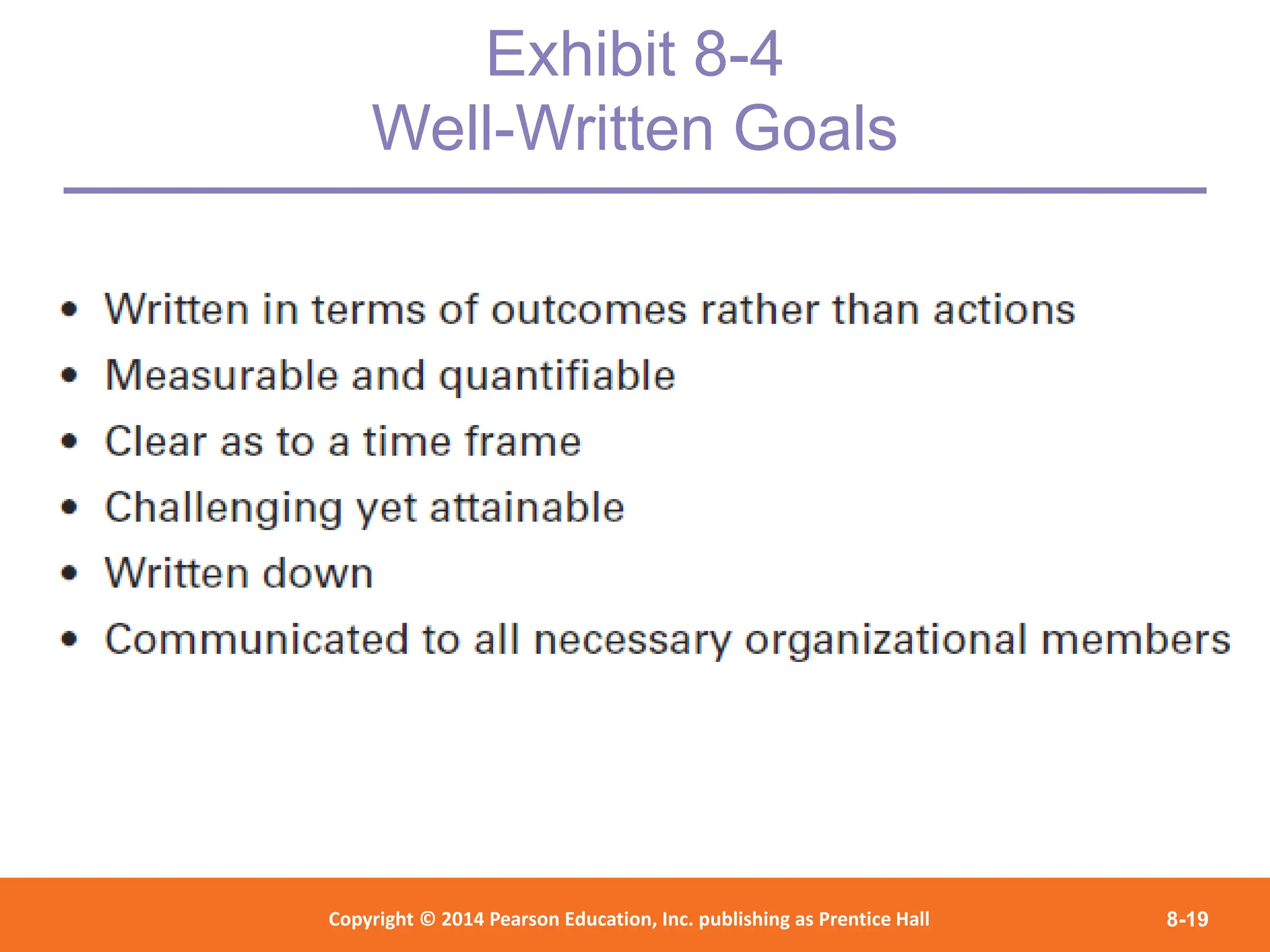
Exhibit 8-4
Well-Written Goals
Copyright © 2012 Pearson Education,
Inc. Publishing as Prentice Hall
Copyright © 2014 Pearson Education, Inc. publishing as Prentice Hall 8-20
Contingency Factors in Planning
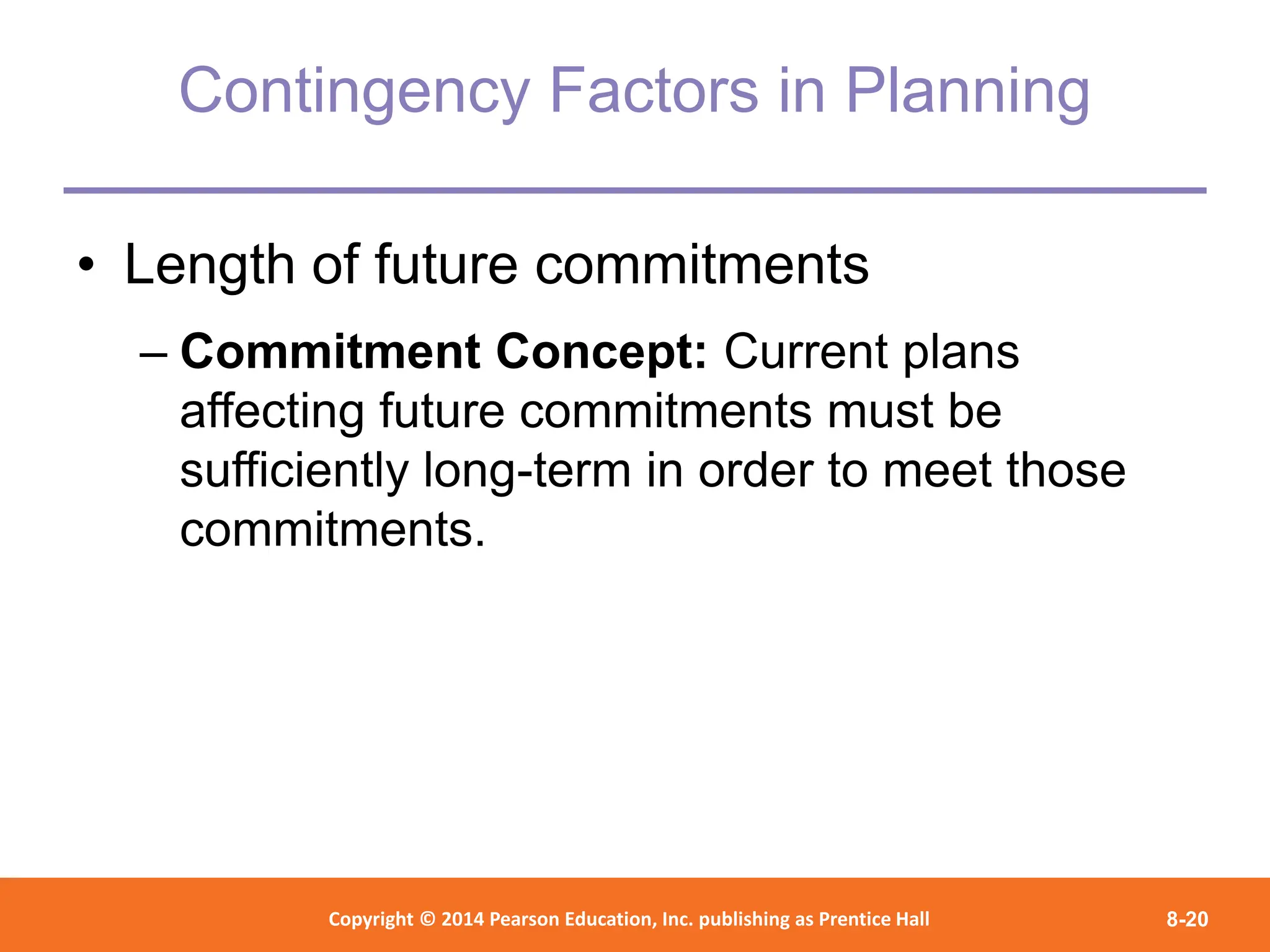
• Length of future commitments
– Commitment Concept: Current plans
affecting future commitments must be
sufficiently long-term in order to meet those
commitments.
Copyright © 2012 Pearson Education,
Inc. Publishing as Prentice Hall
Copyright © 2014 Pearson Education, Inc. publishing as Prentice Hall 8-21
Exhibit 8-5
Planning and Organizational Level
Copyright © 2012 Pearson Education,
Inc. Publishing as Prentice Hall
Copyright © 2014 Pearson Education, Inc. publishing as Prentice Hall 8-22
Contingency Factors in Planning (cont.)
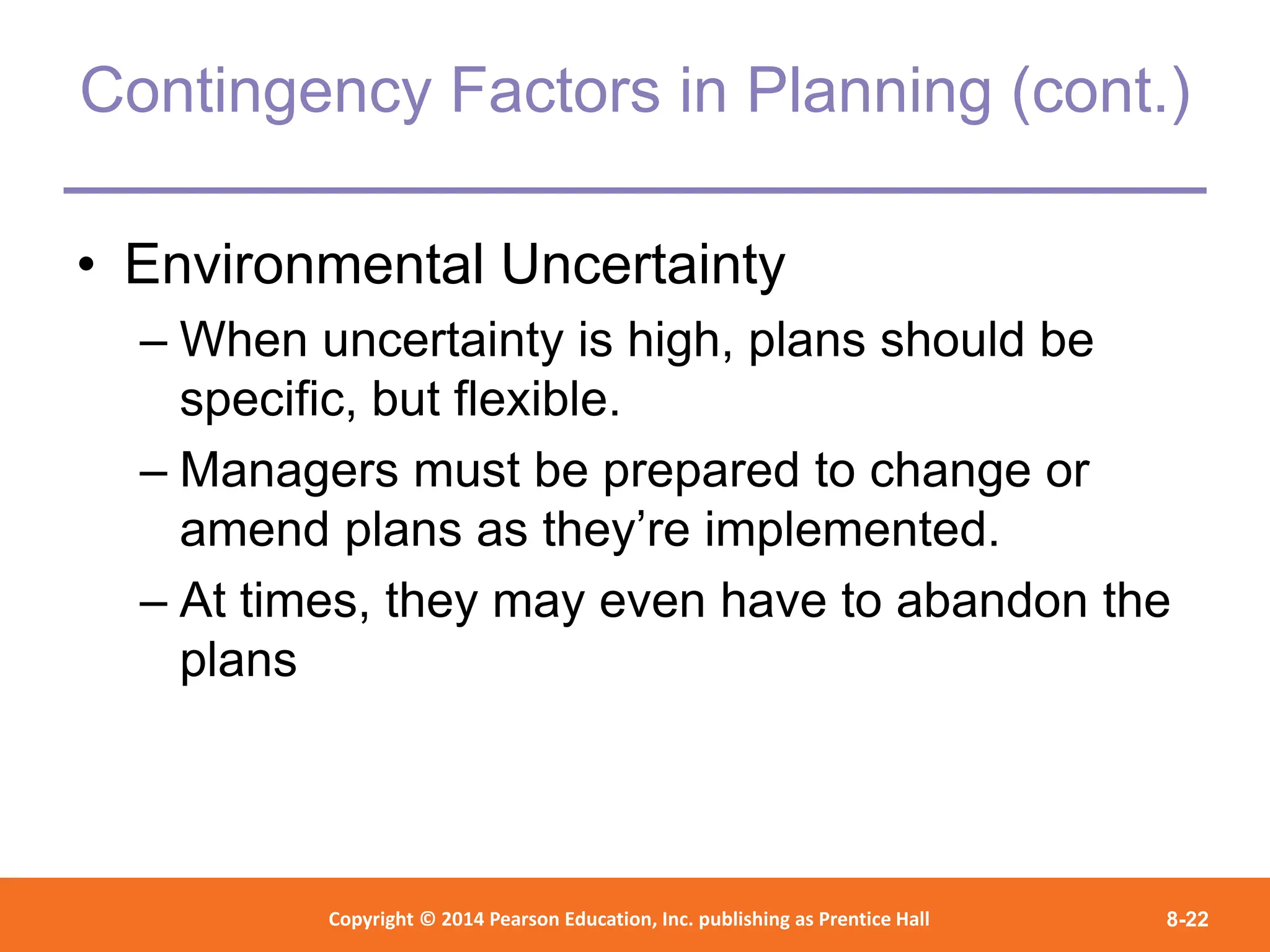
• Environmental Uncertainty
– When uncertainty is high, plans should be
specific, but flexible.
– Managers must be prepared to change or
amend plans as they’re implemented.
– At times, they may even have to abandon the
plans
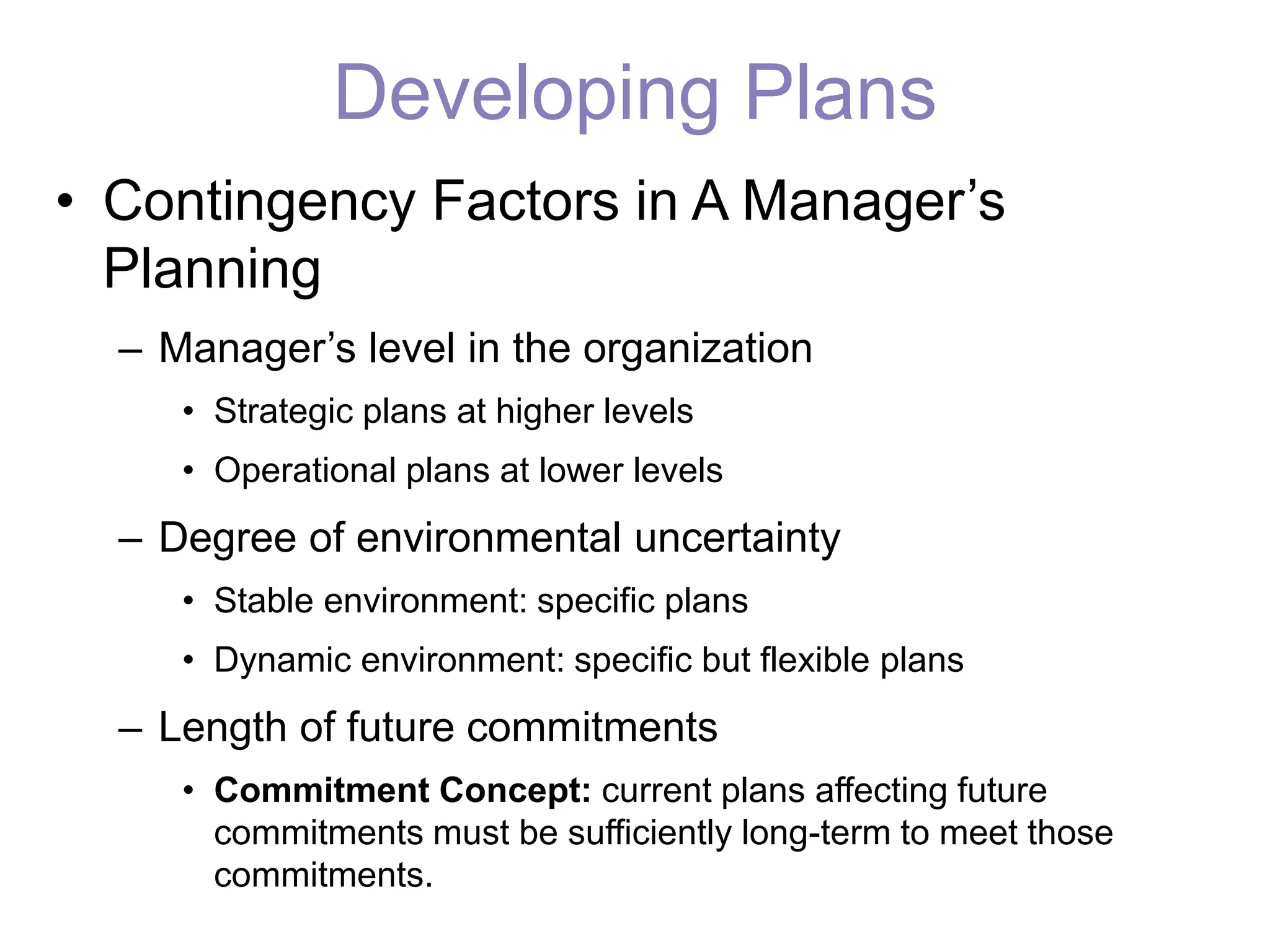
Developing Plans
• Contingency Factors in A Manager’s
Planning
– Manager’s level in the organization
• Strategic plans at higher levels
• Operational plans at lower levels
– Degree of environmental uncertainty
• Stable environment: specific plans
• Dynamic environment: specific but flexible plans
– Length of future commitments
• Commitment Concept: current plans affecting future
commitments must be sufficiently long-term to meet those
commitments.
Approaches to Planning
• Establishing a formal planning department
– A group of planning specialists who help managers
write organizational plans.
– Planning is a function of management; it should never
become the sole responsibility of planners.
• Involving organizational members in the process
– Plans are developed by members of organizational
units at various levels and then coordinated with other
units across the organization.
Copyright © 2012 Pearson Education,
Inc. Publishing as Prentice Hall
Copyright © 2014 Pearson Education, Inc. publishing as Prentice Hall 8-25
Approaches to Planning
• In the traditional approach, planning is done
entirely by top-level managers often are assisted
by a formal planning department
• Formal planning department - a group of
planning specialists whose sole responsibility is
helping to write organizational plans
Copyright © 2012 Pearson Education,
Inc. Publishing as Prentice Hall
Copyright © 2014 Pearson Education, Inc. publishing as Prentice Hall 8-26
Criticism of Planning
• Planning may create rigidity
• Plans Can’t be developed for a dynamic environment
• Formal plans can’t replace intuition and creativity
• Planning focuses manager’s attention on today’s
competition, not on tomorrow’s survival
• Formal planning reinforces success, which may lead
to failure
• Just planning isn’t enough

Planning Work Activities and their benefits.pdf

  • 1.
    Copyright © 2012Pearson Education, Inc. Publishing as Prentice Hall Copyright © 2014 Pearson Education, Inc. publishing as Prentice Hall 8-1 Foundations of Planning 8
  • 2.
    Copyright © 2012Pearson Education, Inc. Publishing as Prentice Hall Copyright © 2014 Pearson Education, Inc. publishing as Prentice Hall 8-2 What Is Planning? • Planning - defining the organization’s goals, establishing strategies for achieving those goals, and developing plans to integrate and coordinate work activities. • Formal planning – Specific goals covering a specific time period – Written and shared with organizational members
  • 3.
    Copyright © 2012Pearson Education, Inc. Publishing as Prentice Hall Copyright © 2014 Pearson Education, Inc. publishing as Prentice Hall 8-3 Why Do Managers Plan? • Four reasons for planning – Provides direction – Reduces uncertainty – Minimizes waste and redundancy – Sets the standards for controlling
  • 4.
    Copyright © 2012Pearson Education, Inc. Publishing as Prentice Hall Copyright © 2014 Pearson Education, Inc. publishing as Prentice Hall 8-4 Planning and Performance • Formal planning is associated with: – Positive financial results - higher profits, higher return on assets, and so forth – The quality of planning and implementation affects performance more than the extent of planning – The external environment can reduce the impact of planning on performance – The planning-performance relationship seems to be influenced by the planning time frame
  • 5.
    Copyright © 2012Pearson Education, Inc. Publishing as Prentice Hall Copyright © 2014 Pearson Education, Inc. publishing as Prentice Hall 8-5 Goals and Plans • Goals (objectives) - desired outcomes or targets • Plans - documents that outline how goals are going to be met
  • 6.
    Copyright © 2012Pearson Education, Inc. Publishing as Prentice Hall Copyright © 2014 Pearson Education, Inc. publishing as Prentice Hall 8-6 Types of Goals • Financial Goals - related to the expected internal financial performance of the organization. • Strategic Goals - related to the performance of the firm relative to factors in its external environment (e.g., competitors).
  • 7.
    Copyright © 2012Pearson Education, Inc. Publishing as Prentice Hall Copyright © 2014 Pearson Education, Inc. publishing as Prentice Hall 8-7 Types of Goals (cont.) • Stated goals - official statements of what an organization says, and what it wants its various stakeholders to believe, its goals are • Real goals - goals that an organization actually pursues, as defined by the actions of its members
  • 8.
  • 9.
    Copyright © 2012Pearson Education, Inc. Publishing as Prentice Hall Copyright © 2014 Pearson Education, Inc. publishing as Prentice Hall 8-9 Types of Plans • Strategic plans - plans that apply to the entire organization and establish the organization’s overall goals • Operational plans - plans that encompass a particular operational area of the organization
  • 10.
    Copyright © 2012Pearson Education, Inc. Publishing as Prentice Hall Copyright © 2014 Pearson Education, Inc. publishing as Prentice Hall 8-10 Types of Plans (cont.) • Long-term plans - plans with a time frame beyond three years • Short-term plans - plans covering one year or less • Specific plans – plans that are clearly defined and leave no room for interpretation • Directional plans - plans that are flexible and set out general guidelines
  • 11.
    Exhibit 7–3 SpecificVersus Directional Plans
  • 12.
    Copyright © 2012Pearson Education, Inc. Publishing as Prentice Hall Copyright © 2014 Pearson Education, Inc. publishing as Prentice Hall 8-12 Types of Plans (cont.) • Single-use plan - a one-time plan specifically designed to meet the needs of a unique situation • Standing plans ongoing plans that provide guidance for activities performed repeatedly
  • 13.
    Copyright © 2012Pearson Education, Inc. Publishing as Prentice Hall Copyright © 2014 Pearson Education, Inc. publishing as Prentice Hall 8-13 Approaches to Setting Goals • Traditional goal-setting - an approach to setting goals in which top managers set goals that then flow down through the organization and become subgoals for each organizational area • Means-ends chain - an integrated network of goals in which the accomplishment of goals at one level serves as the means for achieving the goals, or ends, at the next level
  • 14.
    Copyright © 2012Pearson Education, Inc. Publishing as Prentice Hall Copyright © 2014 Pearson Education, Inc. publishing as Prentice Hall 8-14 Exhibit 8-2 The Downside of Traditional Goal-Setting
  • 15.
    Establishing Goals and DevelopingPlans (cont’d) • Management By Objectives (MBO) – Specific performance goals are jointly determined by employees and managers. – Progress toward accomplishing goals is periodically reviewed. – Rewards are allocated on the basis of progress towards the goals. – Key elements of MBO: • Goal specificity, participative decision making, an explicit performance/evaluation period, feedback
  • 16.
    Exhibit 7–5 Stepsin a Typical MBO Program 1. The organization’s overall objectives and strategies are formulated. 2. Major objectives are allocated among divisional and departmental units. 3. Unit managers collaboratively set specific objectives for their units with their managers. 4. Specific objectives are collaboratively set with all department members. 5. Action plans, defining how objectives are to be achieved, are specified and agreed upon by managers and employees. 6. The action plans are implemented. 7. Progress toward objectives is periodically reviewed, and feedback is provided. 8. Successful achievement of objectives is reinforced by performance-based rewards.
  • 17.
    Does MBO Work? •Reason for MBO Success – Top management commitment and involvement • Potential Problems with MBO Programs – Not as effective in dynamic environments that require constant resetting of goals. – Overemphasis on individual accomplishment may create problems with teamwork. – Allowing the MBO program to become an annual paperwork shuffle.
  • 18.
    Copyright © 2012Pearson Education, Inc. Publishing as Prentice Hall Copyright © 2014 Pearson Education, Inc. publishing as Prentice Hall 8-18 Steps in Goal-Setting 1. Review the organization’s mission, or purpose. 2. Evaluate available resources 3. Determine the goals individually or with input from others 4. Write down the goals and communicate them to all who need to know 5. Review results and whether goals are being met.
  • 19.
    Copyright © 2012Pearson Education, Inc. Publishing as Prentice Hall Copyright © 2014 Pearson Education, Inc. publishing as Prentice Hall 8-19 Exhibit 8-4 Well-Written Goals
  • 20.
    Copyright © 2012Pearson Education, Inc. Publishing as Prentice Hall Copyright © 2014 Pearson Education, Inc. publishing as Prentice Hall 8-20 Contingency Factors in Planning • Length of future commitments – Commitment Concept: Current plans affecting future commitments must be sufficiently long-term in order to meet those commitments.
  • 21.
    Copyright © 2012Pearson Education, Inc. Publishing as Prentice Hall Copyright © 2014 Pearson Education, Inc. publishing as Prentice Hall 8-21 Exhibit 8-5 Planning and Organizational Level
  • 22.
    Copyright © 2012Pearson Education, Inc. Publishing as Prentice Hall Copyright © 2014 Pearson Education, Inc. publishing as Prentice Hall 8-22 Contingency Factors in Planning (cont.) • Environmental Uncertainty – When uncertainty is high, plans should be specific, but flexible. – Managers must be prepared to change or amend plans as they’re implemented. – At times, they may even have to abandon the plans
  • 23.
    Developing Plans • ContingencyFactors in A Manager’s Planning – Manager’s level in the organization • Strategic plans at higher levels • Operational plans at lower levels – Degree of environmental uncertainty • Stable environment: specific plans • Dynamic environment: specific but flexible plans – Length of future commitments • Commitment Concept: current plans affecting future commitments must be sufficiently long-term to meet those commitments.
  • 24.
    Approaches to Planning •Establishing a formal planning department – A group of planning specialists who help managers write organizational plans. – Planning is a function of management; it should never become the sole responsibility of planners. • Involving organizational members in the process – Plans are developed by members of organizational units at various levels and then coordinated with other units across the organization.
  • 25.
    Copyright © 2012Pearson Education, Inc. Publishing as Prentice Hall Copyright © 2014 Pearson Education, Inc. publishing as Prentice Hall 8-25 Approaches to Planning • In the traditional approach, planning is done entirely by top-level managers often are assisted by a formal planning department • Formal planning department - a group of planning specialists whose sole responsibility is helping to write organizational plans
  • 26.
    Copyright © 2012Pearson Education, Inc. Publishing as Prentice Hall Copyright © 2014 Pearson Education, Inc. publishing as Prentice Hall 8-26 Criticism of Planning • Planning may create rigidity • Plans Can’t be developed for a dynamic environment • Formal plans can’t replace intuition and creativity • Planning focuses manager’s attention on today’s competition, not on tomorrow’s survival • Formal planning reinforces success, which may lead to failure • Just planning isn’t enough