CSC102 - Discrete Structures
(Discrete Mathematics)
Set Operations
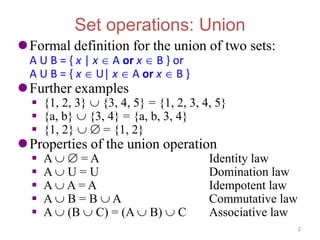
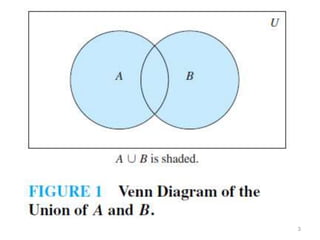
Set operations: Union
Formal definition for the union of two sets:
A U B = { x | x  A or x  B } or
A U B = { x  U| x  A or x  B }
Further examples
 {1, 2, 3}  {3, 4, 5} = {1, 2, 3, 4, 5}
 {a, b}  {3, 4} = {a, b, 3, 4}
 {1, 2}   = {1, 2}
Properties of the union operation
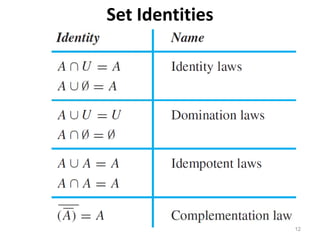
 A   = A Identity law
 A  U = U Domination law
 A  A = A Idempotent law
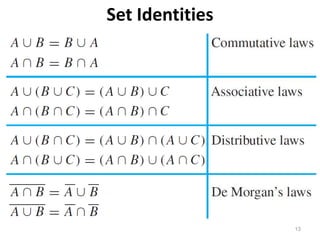
 A  B = B  A Commutative law
 A  (B  C) = (A  B)  C Associative law
2
3
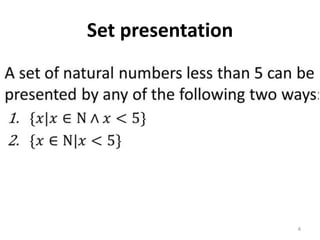
Set presentation
4
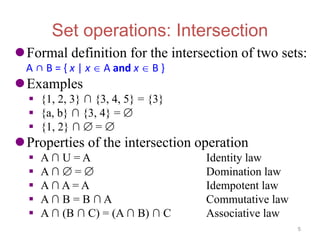
Set operations: Intersection
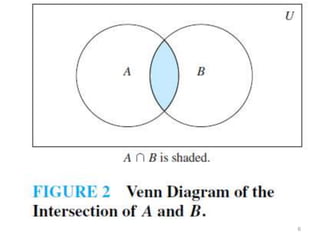
Formal definition for the intersection of two sets:
A ∩ B = { x | x  A and x  B }
Examples
 {1, 2, 3} ∩ {3, 4, 5} = {3}
 {a, b} ∩ {3, 4} = 
 {1, 2} ∩  = 
Properties of the intersection operation
 A ∩ U = A Identity law
 A ∩  =  Domination law
 A ∩ A = A Idempotent law
 A ∩ B = B ∩ A Commutative law
 A ∩ (B ∩ C) = (A ∩ B) ∩ C Associative law
5
6
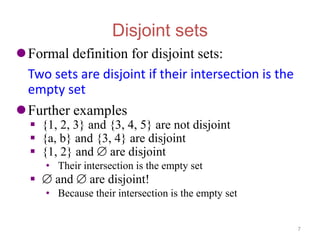
Disjoint sets
Formal definition for disjoint sets:
Two sets are disjoint if their intersection is the
empty set
Further examples
 {1, 2, 3} and {3, 4, 5} are not disjoint
 {a, b} and {3, 4} are disjoint
 {1, 2} and  are disjoint
• Their intersection is the empty set
  and  are disjoint!
• Because their intersection is the empty set
7
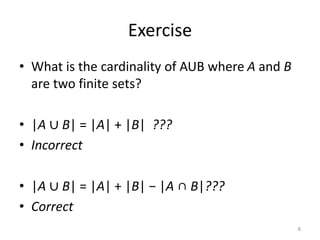
Exercise
• What is the cardinality of AUB where A and B
are two finite sets?
• |A ∪ B| = |A| + |B| ???
• Incorrect
• |A ∪ B| = |A| + |B| − |A ∩ B|???
• Correct
8
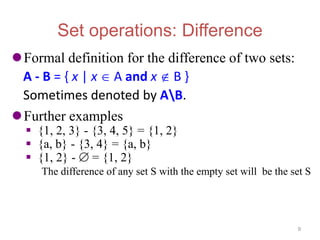
Set operations: Difference
Formal definition for the difference of two sets:
A - B = { x | x  A and x  B }
Sometimes denoted by AB.
Further examples
 {1, 2, 3} - {3, 4, 5} = {1, 2}
 {a, b} - {3, 4} = {a, b}
 {1, 2} -  = {1, 2}
The difference of any set S with the empty set will be the set S
9
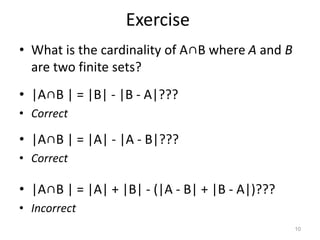
Exercise
• What is the cardinality of A∩B where A and B
are two finite sets?
• |A∩B | = |B| - |B - A|???
• Correct
• |A∩B | = |A| - |A - B|???
• Correct
• |A∩B | = |A| + |B| - (|A - B| + |B - A|)???
• Incorrect
10
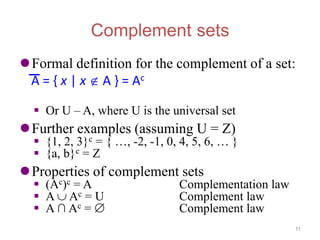
Complement sets
Formal definition for the complement of a set:
A = { x | x  A } = Ac
 Or U – A, where U is the universal set
Further examples (assuming U = Z)
 {1, 2, 3}c = { …, -2, -1, 0, 4, 5, 6, … }
 {a, b}c = Z
Properties of complement sets
 (Ac)c = A Complementation law
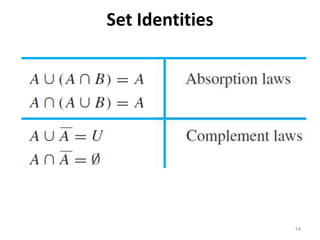
 A  Ac = U Complement law
 A ∩ Ac =  Complement law
11
Set Identities
12
Set Identities
13
Set Identities
14
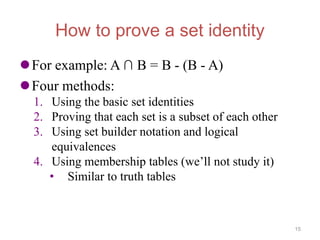
How to prove a set identity
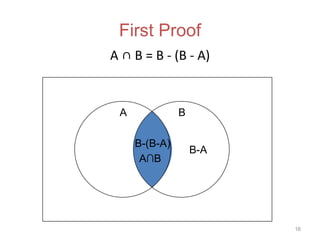
For example: A ∩ B = B - (B - A)
Four methods:
1. Using the basic set identities
2. Proving that each set is a subset of each other
3. Using set builder notation and logical
equivalences
4. Using membership tables (we’ll not study it)
• Similar to truth tables
15
First Proof
A ∩ B = B - (B - A)
A B
A∩B
B-A
B-(B-A)
16
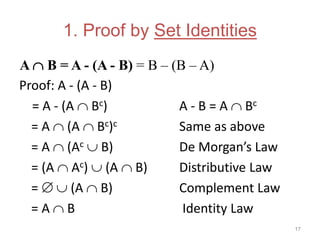
1. Proof by Set Identities
A  B = A - (A - B) = B – (B – A)
Proof: A - (A - B)
= A - (A  Bc) A - B = A  Bc
= A  (A  Bc)c Same as above
= A  (Ac  B) De Morgan’s Law
= (A  Ac)  (A  B) Distributive Law
=   (A  B) Complement Law
= A  B Identity Law
17
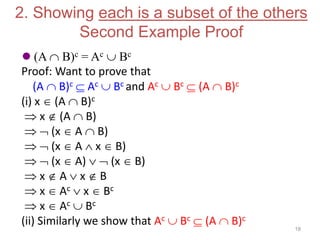
2. Showing each is a subset of the others
Second Example Proof
 (A  B)c = Ac  Bc
Proof: Want to prove that
(A  B)c  Ac  Bc and Ac  Bc  (A  B)c
(i) x  (A  B)c
 x  (A  B)
  (x  A  B)
  (x  A  x  B)
  (x  A)   (x  B)
 x  A  x  B
 x  Ac  x  Bc
 x  Ac  Bc
(ii) Similarly we show that Ac  Bc  (A  B)c
18
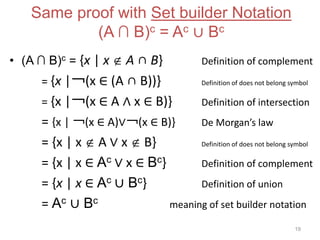
Same proof with Set builder Notation
(A ∩ B)c = Ac ∪ Bc
• (A ∩ B)c = {x | x  A ∩ B} Definition of complement
= {x |¬(x ∈ (A ∩ B))} Definition of does not belong symbol
= {x |¬(x ∈ A ∧ x ∈ B)} Definition of intersection
= {x | ¬(x ∈ A)∨¬(x ∈ B)} De Morgan’s law
= {x | x  A ∨ x  B} Definition of does not belong symbol
= {x | x ∈ Ac ∨ x ∈ Bc} Definition of complement
= {x | x ∈ Ac ∪ Bc} Definition of union
= Ac ∪ Bc meaning of set builder notation
19
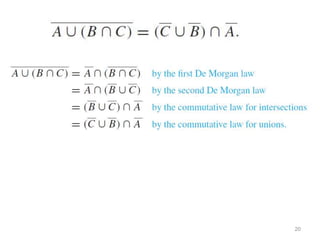
20
END
21

8-Sets-2.ppt

  • 1.
    CSC102 - DiscreteStructures (Discrete Mathematics) Set Operations
  • 2.
    Set operations: Union Formaldefinition for the union of two sets: A U B = { x | x  A or x  B } or A U B = { x  U| x  A or x  B } Further examples  {1, 2, 3}  {3, 4, 5} = {1, 2, 3, 4, 5}  {a, b}  {3, 4} = {a, b, 3, 4}  {1, 2}   = {1, 2} Properties of the union operation  A   = A Identity law  A  U = U Domination law  A  A = A Idempotent law  A  B = B  A Commutative law  A  (B  C) = (A  B)  C Associative law 2
  • 3.
  • 4.
  • 5.
    Set operations: Intersection Formaldefinition for the intersection of two sets: A ∩ B = { x | x  A and x  B } Examples  {1, 2, 3} ∩ {3, 4, 5} = {3}  {a, b} ∩ {3, 4} =   {1, 2} ∩  =  Properties of the intersection operation  A ∩ U = A Identity law  A ∩  =  Domination law  A ∩ A = A Idempotent law  A ∩ B = B ∩ A Commutative law  A ∩ (B ∩ C) = (A ∩ B) ∩ C Associative law 5
  • 6.
  • 7.
    Disjoint sets Formal definitionfor disjoint sets: Two sets are disjoint if their intersection is the empty set Further examples  {1, 2, 3} and {3, 4, 5} are not disjoint  {a, b} and {3, 4} are disjoint  {1, 2} and  are disjoint • Their intersection is the empty set   and  are disjoint! • Because their intersection is the empty set 7
  • 8.
    Exercise • What isthe cardinality of AUB where A and B are two finite sets? • |A ∪ B| = |A| + |B| ??? • Incorrect • |A ∪ B| = |A| + |B| − |A ∩ B|??? • Correct 8
  • 9.
    Set operations: Difference Formaldefinition for the difference of two sets: A - B = { x | x  A and x  B } Sometimes denoted by AB. Further examples  {1, 2, 3} - {3, 4, 5} = {1, 2}  {a, b} - {3, 4} = {a, b}  {1, 2} -  = {1, 2} The difference of any set S with the empty set will be the set S 9
  • 10.
    Exercise • What isthe cardinality of A∩B where A and B are two finite sets? • |A∩B | = |B| - |B - A|??? • Correct • |A∩B | = |A| - |A - B|??? • Correct • |A∩B | = |A| + |B| - (|A - B| + |B - A|)??? • Incorrect 10
  • 11.
    Complement sets Formal definitionfor the complement of a set: A = { x | x  A } = Ac  Or U – A, where U is the universal set Further examples (assuming U = Z)  {1, 2, 3}c = { …, -2, -1, 0, 4, 5, 6, … }  {a, b}c = Z Properties of complement sets  (Ac)c = A Complementation law  A  Ac = U Complement law  A ∩ Ac =  Complement law 11
  • 12.
  • 13.
  • 14.
  • 15.
    How to provea set identity For example: A ∩ B = B - (B - A) Four methods: 1. Using the basic set identities 2. Proving that each set is a subset of each other 3. Using set builder notation and logical equivalences 4. Using membership tables (we’ll not study it) • Similar to truth tables 15
  • 16.
    First Proof A ∩B = B - (B - A) A B A∩B B-A B-(B-A) 16
  • 17.
    1. Proof bySet Identities A  B = A - (A - B) = B – (B – A) Proof: A - (A - B) = A - (A  Bc) A - B = A  Bc = A  (A  Bc)c Same as above = A  (Ac  B) De Morgan’s Law = (A  Ac)  (A  B) Distributive Law =   (A  B) Complement Law = A  B Identity Law 17
  • 18.
    2. Showing eachis a subset of the others Second Example Proof  (A  B)c = Ac  Bc Proof: Want to prove that (A  B)c  Ac  Bc and Ac  Bc  (A  B)c (i) x  (A  B)c  x  (A  B)   (x  A  B)   (x  A  x  B)   (x  A)   (x  B)  x  A  x  B  x  Ac  x  Bc  x  Ac  Bc (ii) Similarly we show that Ac  Bc  (A  B)c 18
  • 19.
    Same proof withSet builder Notation (A ∩ B)c = Ac ∪ Bc • (A ∩ B)c = {x | x  A ∩ B} Definition of complement = {x |¬(x ∈ (A ∩ B))} Definition of does not belong symbol = {x |¬(x ∈ A ∧ x ∈ B)} Definition of intersection = {x | ¬(x ∈ A)∨¬(x ∈ B)} De Morgan’s law = {x | x  A ∨ x  B} Definition of does not belong symbol = {x | x ∈ Ac ∨ x ∈ Bc} Definition of complement = {x | x ∈ Ac ∪ Bc} Definition of union = Ac ∪ Bc meaning of set builder notation 19
  • 20.
  • 21.