MATHEMATICAL INDUCTION
Lecture # 19
1
INTRODUCTION
2
 Suppose we have an infinite ladder, and we want to
know whether we can reach every step on this
ladder. We know two things:
 We can reach first rung of the ladder.
 If we can reach a particular rung of the ladder, then
we can reach the next rung.
3
4
 Many theorems state that P(n) is true for all positive
integers ‘n’. Where P(n) is a propositional function.
 Example:
1 + 2 + 3 + ….. + n = n(n + 1)/2
or
n ≤ 2n
5
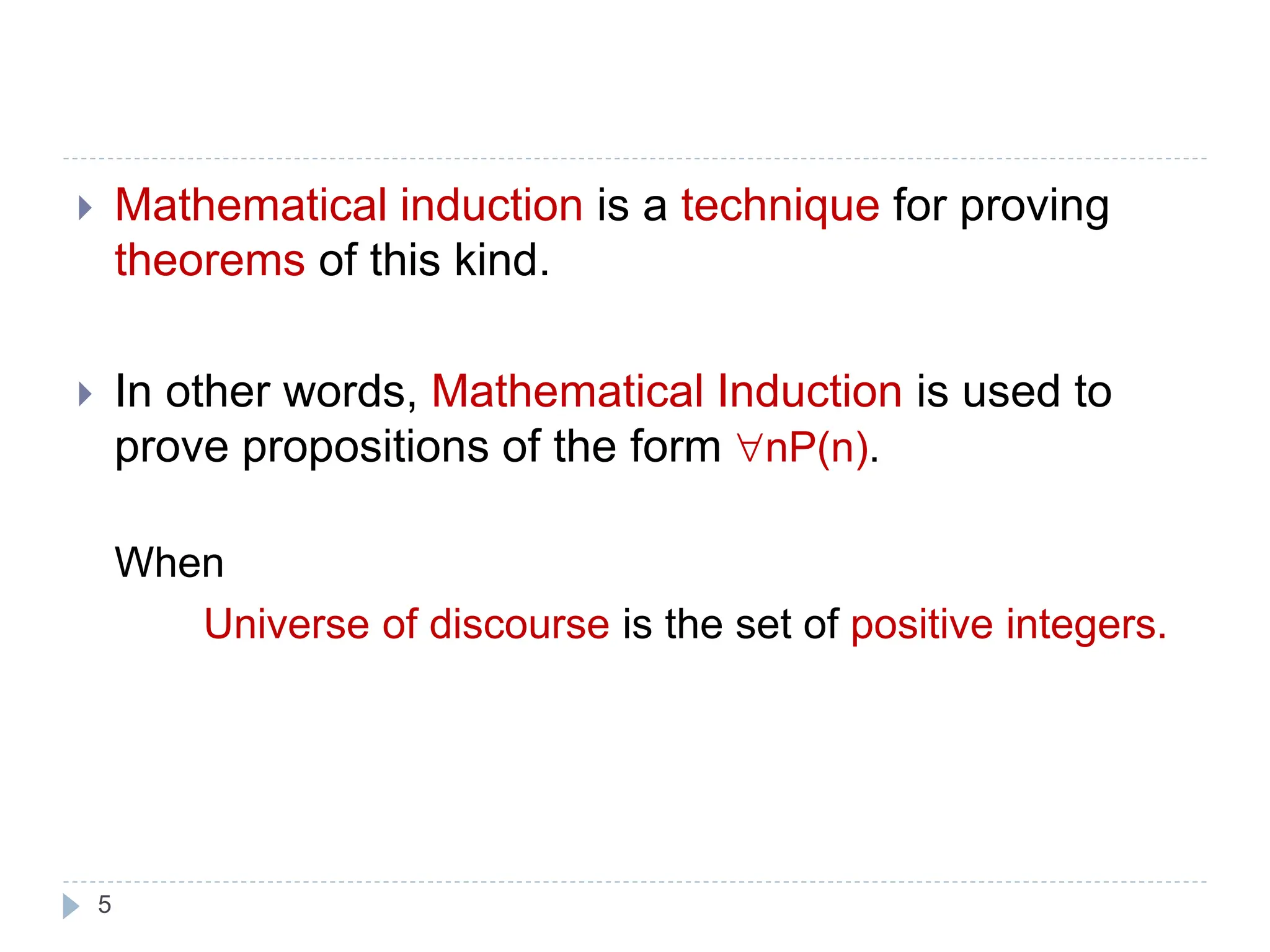
 Mathematical induction is a technique for proving
theorems of this kind.
 In other words, Mathematical Induction is used to
prove propositions of the form nP(n).
When
Universe of discourse is the set of positive integers.
PRINCIPLE OF MATHEMATICAL
INDUCTION
6
 Let P(n) be a propositional function defined for all
positive integers n. P(n) is true for every positive
integer n if:
 Basis Step:
The proposition P(1) is true.
 Inductive Step:
If P(k) is true then P(k + 1) is true for all integers k 
1.
i.e. k P(k)  P(k + 1)
EXAMPLE
7
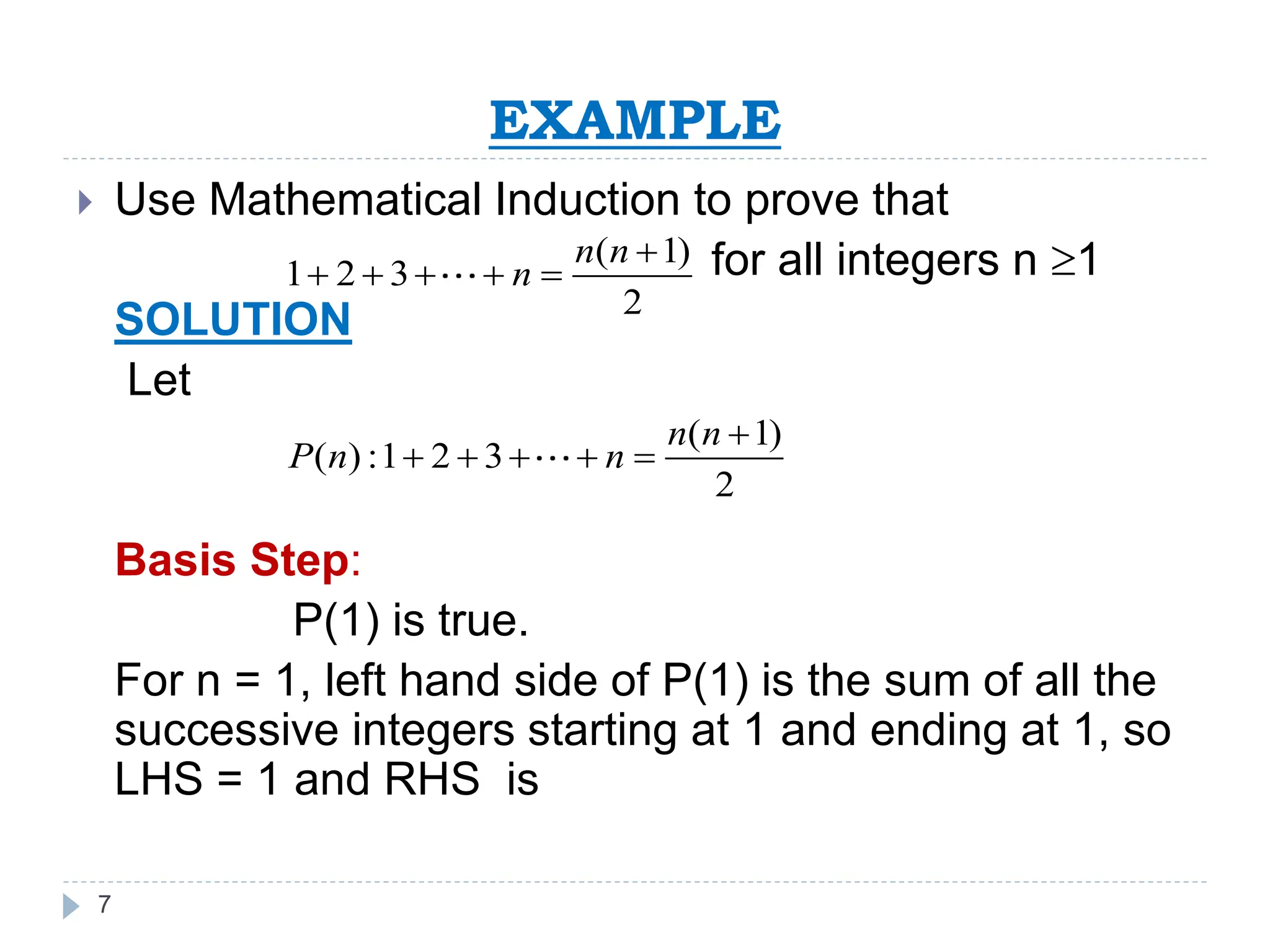
 Use Mathematical Induction to prove that
for all integers n 1
SOLUTION
Let
Basis Step:
P(1) is true.
For n = 1, left hand side of P(1) is the sum of all the
successive integers starting at 1 and ending at 1, so
LHS = 1 and RHS is
( 1)
1 2 3
2
n n
n

    
( 1)
( ) :1 2 3
2
n n
P n n

    
8
and RHS is
so the proposition is true for n = 1.
Inductive Step: Suppose P(k) is true for, some
integers k  1.
(1)
To prove P(k + 1) is true. That is,
(2)
1(1 1) 2
. . 1
2 2
R H S

  
( 1)
1 2 3
2
k k
k

    
( 1)( 2)
1 2 3 ( 1)
2
k k
k
 
     
9
 Consider L.H.S. of (2)
 Hence by principle of Mathematical Induction the given
result true for all integers greater or equal to 1.
1 2 3 ( 1) 1 2 3 ( 1)
( 1)
( 1) using (1)
2
( 1) 1
2
2
( 1)
2
( 1)( 2)
RHS of (2)
2
k k k
k k
k
k
k
k
k
k k
           

  
 
  
 
 

 
   
 
 
 
EXERCISE
10
 Use mathematical induction to prove that
1+3+5+…+(2n -1) = n2 for all integers n 1.
 SOLUTION:
EXERCISE
11
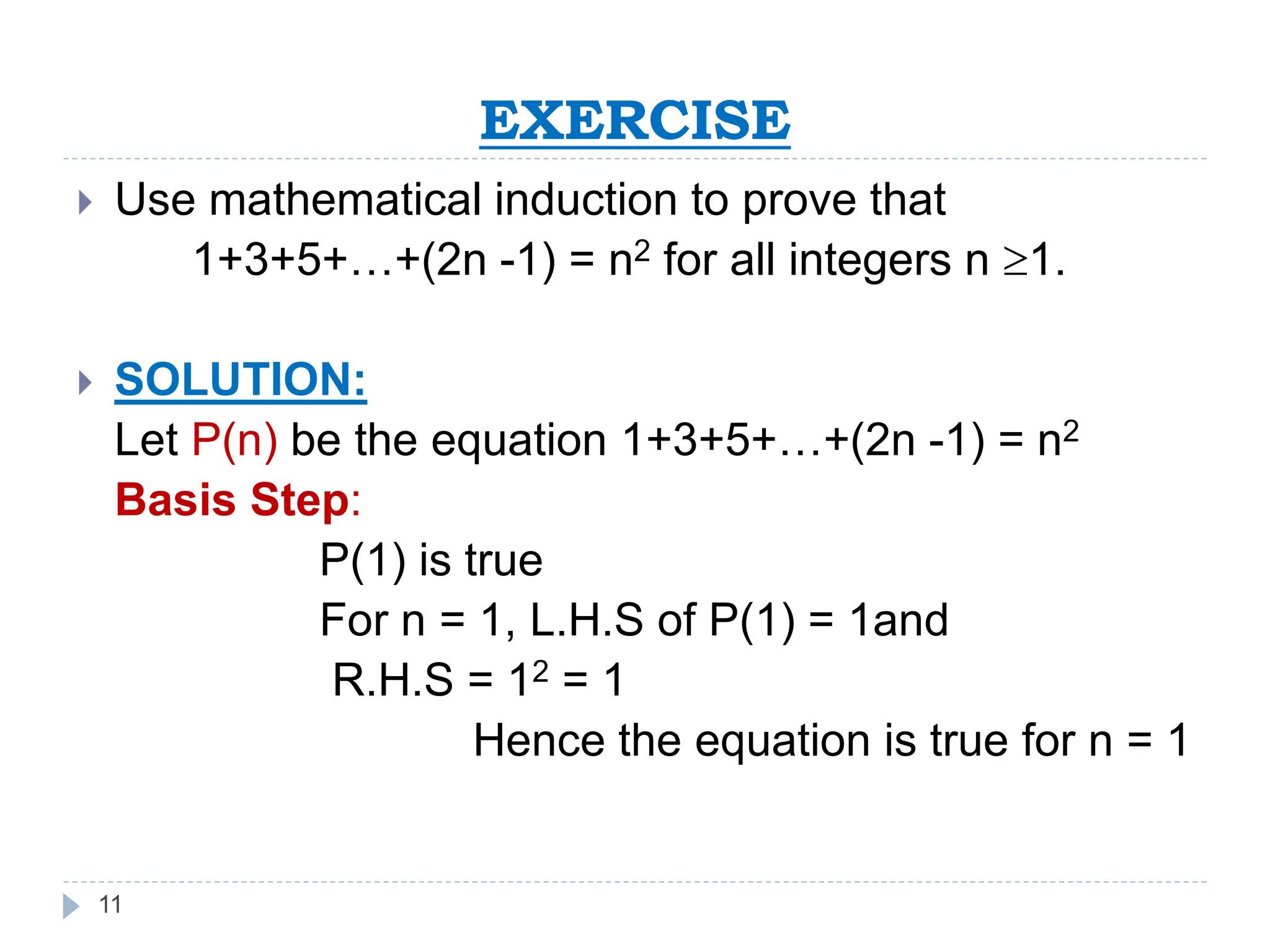
 Use mathematical induction to prove that
1+3+5+…+(2n -1) = n2 for all integers n 1.
 SOLUTION:
Let P(n) be the equation 1+3+5+…+(2n -1) = n2
Basis Step:
P(1) is true
For n = 1, L.H.S of P(1) = 1and
R.H.S = 12 = 1
Hence the equation is true for n = 1
12
Inductive Step:
Suppose P(k) is true for some integer k  1. That is,
1 + 3 + 5 + … + (2k - 1) = k2 …………………(1)
To prove P(k+1) is true; i.e.,
1 + 3 + 5 + … +[2(k+1)-1] = (k+1) 2 …….…(2)
13
 Consider L.H.S. of (2)
 Thus P(k+1) is also true. Hence by mathematical
induction, the given equation is true for all integers
n1.
2
2
1 3 5 [2( 1) 1] 1 3 5 (2 1)
1 3 5 (2 1) (2 1)
(2 1) using (1)
( 1)
R.H.S. of (2)
k k
k k
k k
k
           
       
  
 

EXERCISE
14
 Use mathematical induction to prove that
1+2+22 + … + 2n = 2n+1 – 1 for all integers n 0
 SOLUTION:
EXERCISE
15
 Use mathematical induction to prove that
1+2+22 + … + 2n = 2n+1 - 1 for all integers n
0
 SOLUTION:
Let
P(n): 1 + 2 + 22 + … + 2n = 2n+1 – 1
Basis Step:
P(0) is true.
For n = 0
L.H.S of P(0) = 1
R.H.S of P(0) = 20+1 - 1 = 2 - 1 = 1
Hence P(0) is true.
16
Inductive Step:
Suppose P(k) is true for some integer k  0; i.e.,
1+2+22+…+2k = 2k+1 – 1……………………(1)
To prove P(k+1) is true, i.e.,
1+2+22+…+2k+1 = 2k+1+1 – 1……………..…(2)
17
 Consider LHS of equation (2)
1+2+22+…+2k+1= (1+2+22+…+2k) + 2k+1
= (2k+1 – 1) +2k+1
= 2·2k+1 – 1
= 2k+1+1 – 1
= R.H.S of (2)
 Hence P(k+1) is true and consequently by
mathematical induction the given propositional
function is true for all integers n0.
EXERCISE
18
 Prove by mathematical induction
for all integers n 1.
2 2 2 2 ( 1)(2 1)
1 2 3
6
n n n
n
 
    
EXERCISE
19
 Prove by mathematical induction
 PROOF: for all integers n 1.
Let P(n) denotes the given equation
Basis step:
P(1) is true
For n = 1
L.H.S of P(1) = 12 = 1
R.H.S of P(1)
So L.H.S = R.H.S of P(1).Hence P(1) is true
2 2 2 2 ( 1)(2 1)
1 2 3
6
n n n
n
 
    
1(1 1)(2(1) 1)
6
(1)(2)(3) 6
1
6 6
 

  
20
Inductive Step:
Suppose P(k) is true for some integer k 1;
………(1)
To prove P(k+1) is true; i.e.;
………(2)
Consider LHS of above equation (2)
2 2 2 2 ( 1)(2 1)
1 2 3
6
k k k
k
 
    
2 2 2 2 ( 1)( 1 1)(2( 1) 1)
1 2 3 ( 1)
6
k k k
k
    
     
2 2 2 2 2 2 2 2 2
2
1 2 3 ( 1) 1 2 3 ( 1)
( 1)(2 1)
( 1)
6
k k k
k k k
k
           
 
  
21
2
2
2
(2 1) 6( 1)
( 1)
6
2 6 6
( 1)
6
( 1)(2 7 6)
6
( 1)( 2)(2 3)
6
( 1)( 1 1)(2( 1) 1)
6
2 6 6
( 1)
6
k k k
k
k k k
k
k k k
k k k
k k k
k k k
k
  
 
   
 
 
  
   
 
  

  

    

 
  
   
 
EXERCISE
22
 Prove by mathematical induction
for all integers
n1
 PROOF:
1 1 1
1 2 2 3 ( 1) 1
n
n n n
   
   
EXERCISE
23
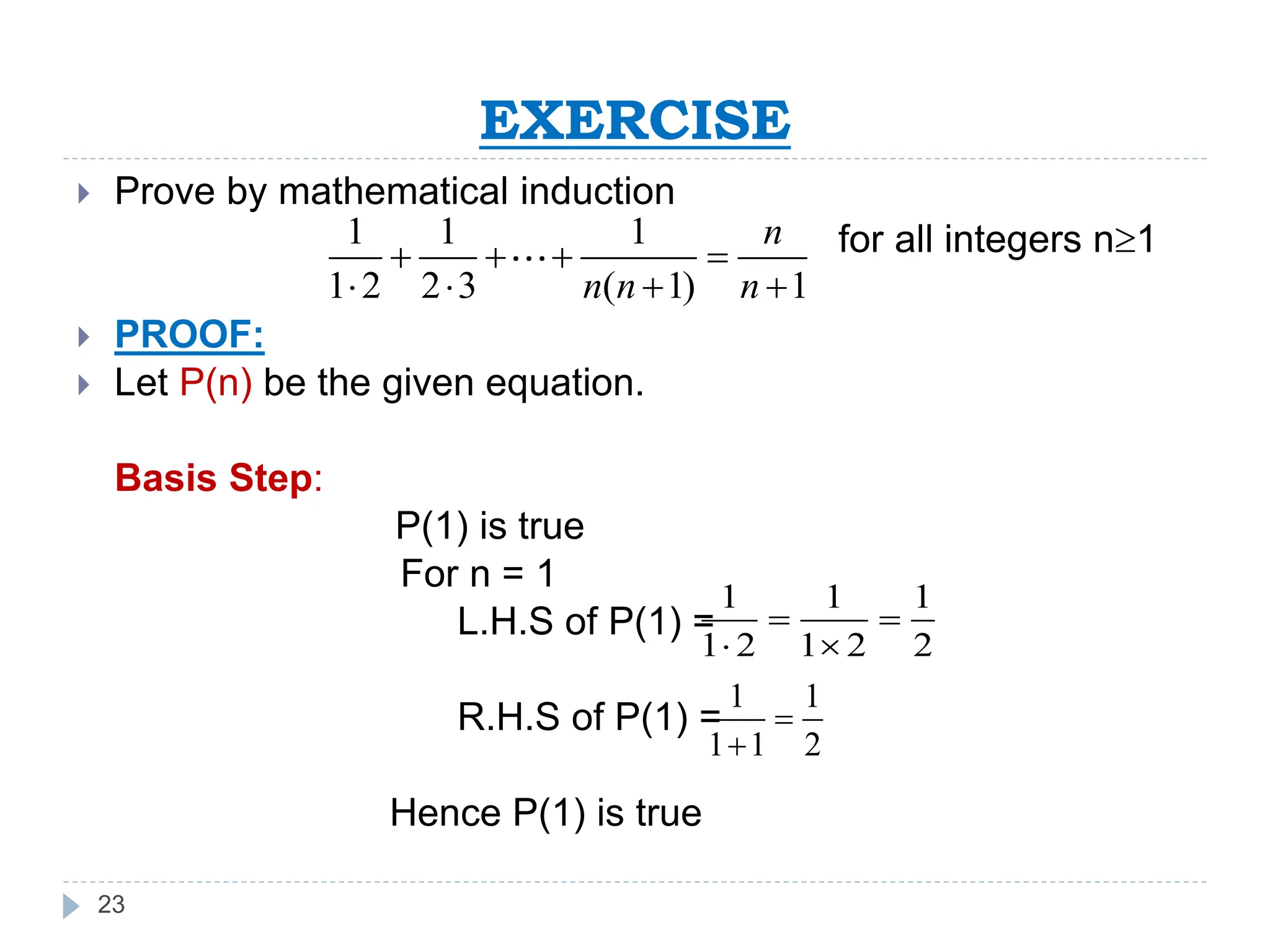
 Prove by mathematical induction
for all integers n1
 PROOF:
 Let P(n) be the given equation.
Basis Step:
P(1) is true
For n = 1
L.H.S of P(1) =
R.H.S of P(1) =
Hence P(1) is true
1 1 1
1 2 2 3 ( 1) 1
n
n n n
   
   
1 1 1
1 2 1 2 2
 
 
1 1
1 1 2


24
Inductive Step:
Suppose P(k) is true, for some integer k1.
That is
To prove P(k+1) is true. That is
Now we will consider the L.H.S of the equation (2)
and will try to get the R.H.S by using equation ( 1)
and some simple computation.
1 1 1
1 2 2 3 ( 1) 1
k
k k k
   
   
1 1 1 1
1 2 2 3 ( 1)( 1 1) ( 1) 1
k
k k k

   
      
Consider LHS of (2)
25
1 1 1
1 2 2 3 ( 1)( 2)
1 1 1 1
1 2 2 3 ( 1) ( 1)( 2)
1
1 ( 1)( 2)
k k
k k k k
k
k k k
  
   
    
    
 
  
2
2
( 2) 1
( 1)( 2)
2 1
( 1)( 2)
( 1)
( 1)( 2)
1
( 2)
RHS of (2)
k k
k k
k k
k k
k
k k
k
k
 

 
 

 


 




26
 Hence P(k+1) is also true and so by Mathematical
induction the given equation is true for all integers n
1.
EXERCISE
27
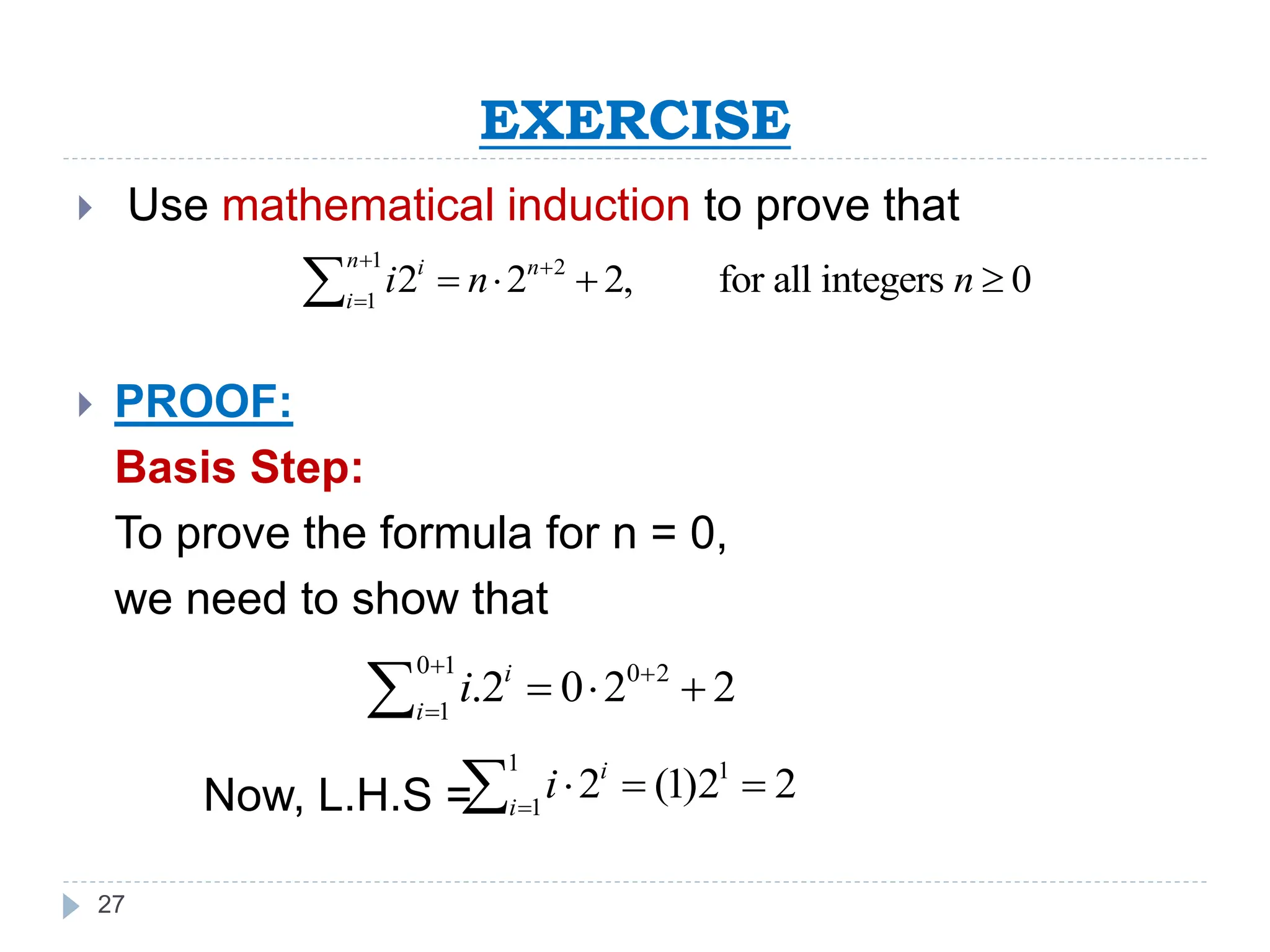
 Use mathematical induction to prove that
 PROOF:
Basis Step:
To prove the formula for n = 0,
we need to show that
Now, L.H.S =
1 2
1
2 2 2, for all integers 0
n i n
i
i n n
 

   

0 1 0 2
1
.2 0 2 2
i
i
i
 

  

1 1
1
2 (1)2 2
i
i
i

  

28
R.H.S = 0·22 + 2 = 0 + 2 = 2
Hence the formula is true for n = 0
Inductive Step:
Suppose for some integer n=k 0
………(1)
We must show that
1 2
1
2 2 2
k i k
i
i k
 

   

2 1 2
1
2 ( 1) 2 2 ................(2)
i
k k
i
i k
  

    

29
 Consider LHS of (2)
 Hence the inductive step is proved as well. Accordingly
by mathematical induction the given formula is true for all
integers n0.
2 1 2
1 1
2 2
2
2
2
1 2
2 2 ( 2) 2
( 2 2) ( 2) 2
( 2)2 2
(2 2) 2 2
( 1)2 2 2
( 1) 2 2
RHS of equation (2)
i i
k k k
i i
k k
k
k
k
k
i i k
k k
k k
k
k
k
  
 
 



 
     
     
   
   
   
   

 
2 1 2
1
2 ( 1) 2 2 ................(2)
i
k k
i
i k
  

    

EXERCISE
30
 Use mathematical induction to prove that
for all integers n 2
 PROOF:
2 2 2
1 1 1 1
1 1 1
2 3 2
n
n n

     
    
     
     
EXERCISE
31
 Use mathematical induction to prove that
for all integers n 2
 PROOF:
Basis Step:
For n = 2
L.H.S
R.H.S
Hence the given formula is true for n = 2
2 2 2
1 1 1 1
1 1 1
2 3 2
n
n n

     
    
     
     
2
1 1 3
1 1
2 4 4
    
2 1 3
2(2) 4

 
32
 Inductive Step:
Suppose for some integer k 2
………….(1)
We must show that
…..(2)
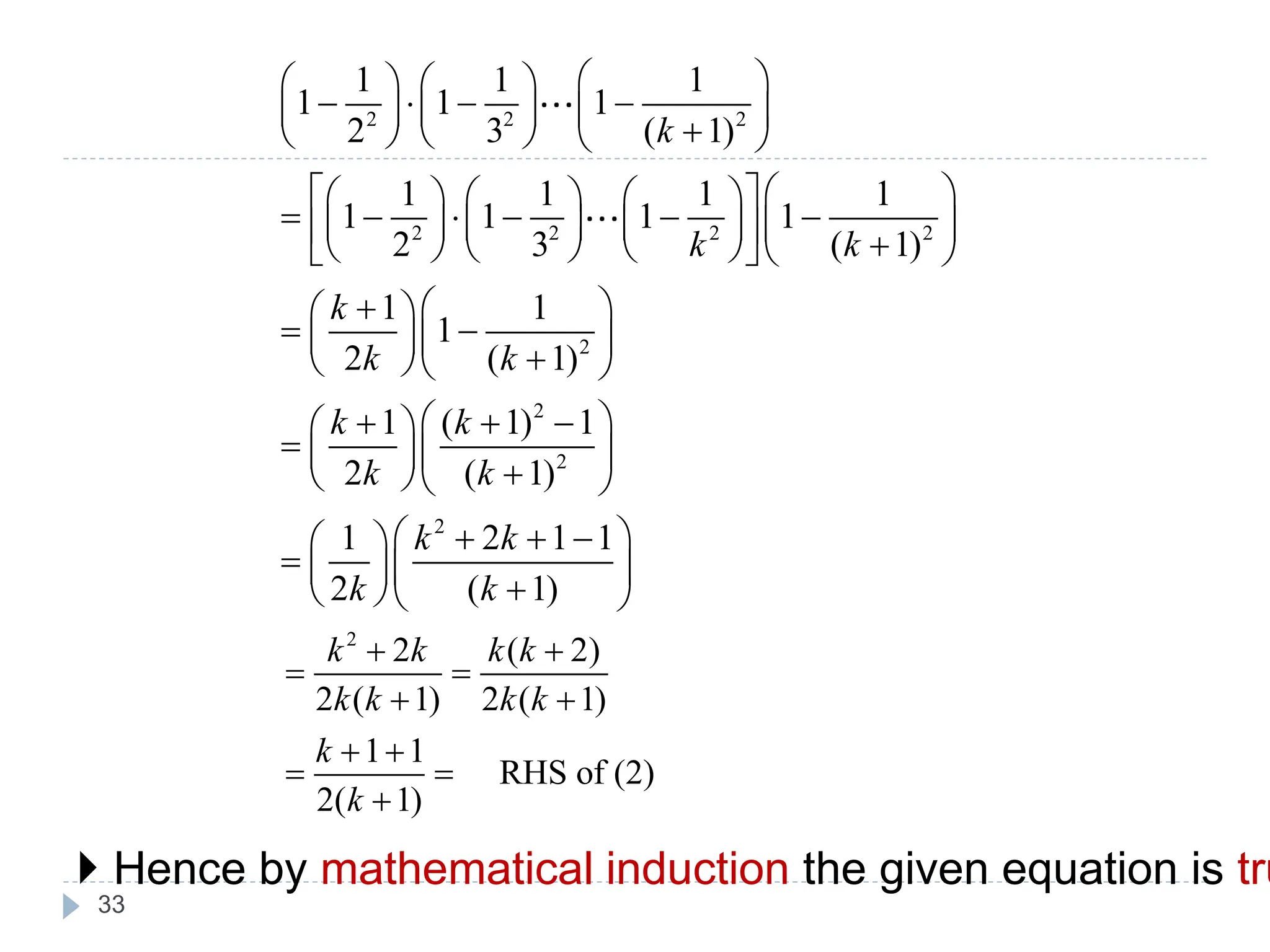
 Consider L.H.S of (2)
2 2 2
1 1 1 1
1 1 1
2 3 2
k
k k

     
    
     
     
2 2 2
1 1 1 ( 1) 1
1 1 1
2 3 ( 1) 2( 1)
k
k k
   
   
    
     
 
     
33
2 2 2
2 2 2 2
2
2
2
2
1 1 1
1 1 1
2 3 ( 1)
1 1 1 1
1 1 1 1
2 3 ( 1)
1 1
1
2 ( 1)
1 ( 1) 1
2 ( 1)
1 2 1 1
2 ( 1)
k
k k
k
k k
k k
k k
k k
k k
 
   
   
     

     
 
 
     
     
       
  
     
  
 

 
 
  

  
 
  
 
   

  
 
  
 
   

  
2
2 ( 2)
2 ( 1) 2 ( 1)
1 1
RHS of (2)
2( 1)
k k k k
k k k k
k
k
 
 
 
 
 

 Hence by mathematical induction the given equation is tru
EXERCISE
34
 Prove by mathematical induction
for all integers n1
 PROOF:
Basis step:
For n = 1
L.H.S
R.H.S = (1+1)! - 1 = 2! - 1
= 2 -1 = 1
Hence
which proves the basis step.
1
( !) ( 1)! 1
n
i
i i n

  

1
( !) (1)(1!) 1
n
i
i i

  

1
1
( !) (1 1)! 1
i
i i

  

35
Inductive Step:
Suppose for any integer k 1
………..(1)
We need to prove that
..………(2)
Consider LHS of (2)
1
( !) ( 1)! 1
k
i
i i k

  

1
1
( !) ( 1 1)! 1
k
i
i i k


   

36
 Hence the inductive step is also true.
 Accordingly, by mathematical induction, the given
formula is true for all integers n 1.
1
1 1
( !) ( !) ( 1)( 1)!
( 1)! 1 ( 1)( 1)!
( 1)! ( 1)( 1)! 1
[1 ( 1)]( 1)! 1
( 2)( 1)! 1
( 2)! 1
RHS of (2)
k k
i i
i i i i k k
k k k
k k k
k k
k k
k

 
   
     
     
    
   
  

 

mathematical induction and stuff Induction.pptx

  • 1.
  • 2.
    INTRODUCTION 2  Suppose wehave an infinite ladder, and we want to know whether we can reach every step on this ladder. We know two things:  We can reach first rung of the ladder.  If we can reach a particular rung of the ladder, then we can reach the next rung.
  • 3.
  • 4.
    4  Many theoremsstate that P(n) is true for all positive integers ‘n’. Where P(n) is a propositional function.  Example: 1 + 2 + 3 + ….. + n = n(n + 1)/2 or n ≤ 2n
  • 5.
    5  Mathematical inductionis a technique for proving theorems of this kind.  In other words, Mathematical Induction is used to prove propositions of the form nP(n). When Universe of discourse is the set of positive integers.
  • 6.
    PRINCIPLE OF MATHEMATICAL INDUCTION 6 Let P(n) be a propositional function defined for all positive integers n. P(n) is true for every positive integer n if:  Basis Step: The proposition P(1) is true.  Inductive Step: If P(k) is true then P(k + 1) is true for all integers k  1. i.e. k P(k)  P(k + 1)
  • 7.
    EXAMPLE 7  Use MathematicalInduction to prove that for all integers n 1 SOLUTION Let Basis Step: P(1) is true. For n = 1, left hand side of P(1) is the sum of all the successive integers starting at 1 and ending at 1, so LHS = 1 and RHS is ( 1) 1 2 3 2 n n n       ( 1) ( ) :1 2 3 2 n n P n n      
  • 8.
    8 and RHS is sothe proposition is true for n = 1. Inductive Step: Suppose P(k) is true for, some integers k  1. (1) To prove P(k + 1) is true. That is, (2) 1(1 1) 2 . . 1 2 2 R H S     ( 1) 1 2 3 2 k k k       ( 1)( 2) 1 2 3 ( 1) 2 k k k        
  • 9.
    9  Consider L.H.S.of (2)  Hence by principle of Mathematical Induction the given result true for all integers greater or equal to 1. 1 2 3 ( 1) 1 2 3 ( 1) ( 1) ( 1) using (1) 2 ( 1) 1 2 2 ( 1) 2 ( 1)( 2) RHS of (2) 2 k k k k k k k k k k k k                                      
  • 10.
    EXERCISE 10  Use mathematicalinduction to prove that 1+3+5+…+(2n -1) = n2 for all integers n 1.  SOLUTION:
  • 11.
    EXERCISE 11  Use mathematicalinduction to prove that 1+3+5+…+(2n -1) = n2 for all integers n 1.  SOLUTION: Let P(n) be the equation 1+3+5+…+(2n -1) = n2 Basis Step: P(1) is true For n = 1, L.H.S of P(1) = 1and R.H.S = 12 = 1 Hence the equation is true for n = 1
  • 12.
    12 Inductive Step: Suppose P(k)is true for some integer k  1. That is, 1 + 3 + 5 + … + (2k - 1) = k2 …………………(1) To prove P(k+1) is true; i.e., 1 + 3 + 5 + … +[2(k+1)-1] = (k+1) 2 …….…(2)
  • 13.
    13  Consider L.H.S.of (2)  Thus P(k+1) is also true. Hence by mathematical induction, the given equation is true for all integers n1. 2 2 1 3 5 [2( 1) 1] 1 3 5 (2 1) 1 3 5 (2 1) (2 1) (2 1) using (1) ( 1) R.H.S. of (2) k k k k k k k                          
  • 14.
    EXERCISE 14  Use mathematicalinduction to prove that 1+2+22 + … + 2n = 2n+1 – 1 for all integers n 0  SOLUTION:
  • 15.
    EXERCISE 15  Use mathematicalinduction to prove that 1+2+22 + … + 2n = 2n+1 - 1 for all integers n 0  SOLUTION: Let P(n): 1 + 2 + 22 + … + 2n = 2n+1 – 1 Basis Step: P(0) is true. For n = 0 L.H.S of P(0) = 1 R.H.S of P(0) = 20+1 - 1 = 2 - 1 = 1 Hence P(0) is true.
  • 16.
    16 Inductive Step: Suppose P(k)is true for some integer k  0; i.e., 1+2+22+…+2k = 2k+1 – 1……………………(1) To prove P(k+1) is true, i.e., 1+2+22+…+2k+1 = 2k+1+1 – 1……………..…(2)
  • 17.
    17  Consider LHSof equation (2) 1+2+22+…+2k+1= (1+2+22+…+2k) + 2k+1 = (2k+1 – 1) +2k+1 = 2·2k+1 – 1 = 2k+1+1 – 1 = R.H.S of (2)  Hence P(k+1) is true and consequently by mathematical induction the given propositional function is true for all integers n0.
  • 18.
    EXERCISE 18  Prove bymathematical induction for all integers n 1. 2 2 2 2 ( 1)(2 1) 1 2 3 6 n n n n       
  • 19.
    EXERCISE 19  Prove bymathematical induction  PROOF: for all integers n 1. Let P(n) denotes the given equation Basis step: P(1) is true For n = 1 L.H.S of P(1) = 12 = 1 R.H.S of P(1) So L.H.S = R.H.S of P(1).Hence P(1) is true 2 2 2 2 ( 1)(2 1) 1 2 3 6 n n n n        1(1 1)(2(1) 1) 6 (1)(2)(3) 6 1 6 6      
  • 20.
    20 Inductive Step: Suppose P(k)is true for some integer k 1; ………(1) To prove P(k+1) is true; i.e.; ………(2) Consider LHS of above equation (2) 2 2 2 2 ( 1)(2 1) 1 2 3 6 k k k k        2 2 2 2 ( 1)( 1 1)(2( 1) 1) 1 2 3 ( 1) 6 k k k k            2 2 2 2 2 2 2 2 2 2 1 2 3 ( 1) 1 2 3 ( 1) ( 1)(2 1) ( 1) 6 k k k k k k k                 
  • 21.
    21 2 2 2 (2 1) 6(1) ( 1) 6 2 6 6 ( 1) 6 ( 1)(2 7 6) 6 ( 1)( 2)(2 3) 6 ( 1)( 1 1)(2( 1) 1) 6 2 6 6 ( 1) 6 k k k k k k k k k k k k k k k k k k k k k                                               
  • 22.
    EXERCISE 22  Prove bymathematical induction for all integers n1  PROOF: 1 1 1 1 2 2 3 ( 1) 1 n n n n        
  • 23.
    EXERCISE 23  Prove bymathematical induction for all integers n1  PROOF:  Let P(n) be the given equation. Basis Step: P(1) is true For n = 1 L.H.S of P(1) = R.H.S of P(1) = Hence P(1) is true 1 1 1 1 2 2 3 ( 1) 1 n n n n         1 1 1 1 2 1 2 2     1 1 1 1 2  
  • 24.
    24 Inductive Step: Suppose P(k)is true, for some integer k1. That is To prove P(k+1) is true. That is Now we will consider the L.H.S of the equation (2) and will try to get the R.H.S by using equation ( 1) and some simple computation. 1 1 1 1 2 2 3 ( 1) 1 k k k k         1 1 1 1 1 2 2 3 ( 1)( 1 1) ( 1) 1 k k k k            
  • 25.
    Consider LHS of(2) 25 1 1 1 1 2 2 3 ( 1)( 2) 1 1 1 1 1 2 2 3 ( 1) ( 1)( 2) 1 1 ( 1)( 2) k k k k k k k k k k                       2 2 ( 2) 1 ( 1)( 2) 2 1 ( 1)( 2) ( 1) ( 1)( 2) 1 ( 2) RHS of (2) k k k k k k k k k k k k k                  
  • 26.
    26  Hence P(k+1)is also true and so by Mathematical induction the given equation is true for all integers n 1.
  • 27.
    EXERCISE 27  Use mathematicalinduction to prove that  PROOF: Basis Step: To prove the formula for n = 0, we need to show that Now, L.H.S = 1 2 1 2 2 2, for all integers 0 n i n i i n n         0 1 0 2 1 .2 0 2 2 i i i        1 1 1 2 (1)2 2 i i i     
  • 28.
    28 R.H.S = 0·22+ 2 = 0 + 2 = 2 Hence the formula is true for n = 0 Inductive Step: Suppose for some integer n=k 0 ………(1) We must show that 1 2 1 2 2 2 k i k i i k         2 1 2 1 2 ( 1) 2 2 ................(2) i k k i i k          
  • 29.
    29  Consider LHSof (2)  Hence the inductive step is proved as well. Accordingly by mathematical induction the given formula is true for all integers n0. 2 1 2 1 1 2 2 2 2 2 1 2 2 2 ( 2) 2 ( 2 2) ( 2) 2 ( 2)2 2 (2 2) 2 2 ( 1)2 2 2 ( 1) 2 2 RHS of equation (2) i i k k k i i k k k k k k i i k k k k k k k k                                            2 1 2 1 2 ( 1) 2 2 ................(2) i k k i i k          
  • 30.
    EXERCISE 30  Use mathematicalinduction to prove that for all integers n 2  PROOF: 2 2 2 1 1 1 1 1 1 1 2 3 2 n n n                        
  • 31.
    EXERCISE 31  Use mathematicalinduction to prove that for all integers n 2  PROOF: Basis Step: For n = 2 L.H.S R.H.S Hence the given formula is true for n = 2 2 2 2 1 1 1 1 1 1 1 2 3 2 n n n                         2 1 1 3 1 1 2 4 4      2 1 3 2(2) 4   
  • 32.
    32  Inductive Step: Supposefor some integer k 2 ………….(1) We must show that …..(2)  Consider L.H.S of (2) 2 2 2 1 1 1 1 1 1 1 2 3 2 k k k                         2 2 2 1 1 1 ( 1) 1 1 1 1 2 3 ( 1) 2( 1) k k k                           
  • 33.
    33 2 2 2 22 2 2 2 2 2 2 1 1 1 1 1 1 2 3 ( 1) 1 1 1 1 1 1 1 1 2 3 ( 1) 1 1 1 2 ( 1) 1 ( 1) 1 2 ( 1) 1 2 1 1 2 ( 1) k k k k k k k k k k k k k k                                                                                                        2 2 ( 2) 2 ( 1) 2 ( 1) 1 1 RHS of (2) 2( 1) k k k k k k k k k k             Hence by mathematical induction the given equation is tru
  • 34.
    EXERCISE 34  Prove bymathematical induction for all integers n1  PROOF: Basis step: For n = 1 L.H.S R.H.S = (1+1)! - 1 = 2! - 1 = 2 -1 = 1 Hence which proves the basis step. 1 ( !) ( 1)! 1 n i i i n      1 ( !) (1)(1!) 1 n i i i      1 1 ( !) (1 1)! 1 i i i     
  • 35.
    35 Inductive Step: Suppose forany integer k 1 ………..(1) We need to prove that ..………(2) Consider LHS of (2) 1 ( !) ( 1)! 1 k i i i k      1 1 ( !) ( 1 1)! 1 k i i i k       
  • 36.
    36  Hence theinductive step is also true.  Accordingly, by mathematical induction, the given formula is true for all integers n 1. 1 1 1 ( !) ( !) ( 1)( 1)! ( 1)! 1 ( 1)( 1)! ( 1)! ( 1)( 1)! 1 [1 ( 1)]( 1)! 1 ( 2)( 1)! 1 ( 2)! 1 RHS of (2) k k i i i i i i k k k k k k k k k k k k k                                  