

Muhamad Yusuf
m.yusuf.edu@gmail.com
Instructional Learning Objectives
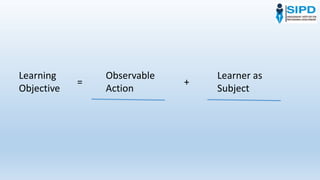
Learning
Objective
= +
Observable
Action
Learner as
Subject
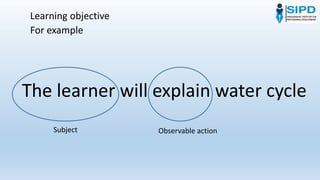
For example
The learner will explain water cycle
Observable actionSubject
Learning objective
A learning objective is a promise of what
will be obtained
A brief statement describing what the learner
will able to perform by the end of the
lesson/unit/course, to what degree and under
what conditions.
A brief definition of a learning objective
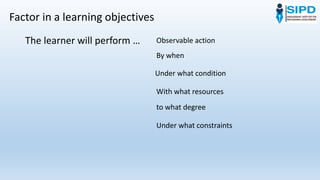
Factor in a learning objectives
The learner will perform … Observable action
By when
Under what condition
With what resources
to what degree
Under what constraints
By the end of the lesson, students should be able
to explain water cycle with help of a poster in three
minutes.
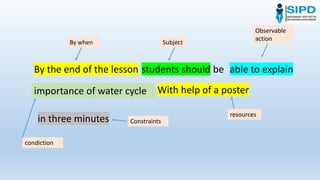
By the end of the lesson students should be able to explain
importance of water cycle With help of a poster
in three minutes
SubjectBy when
Observable
action
resources
Constraints
condiction
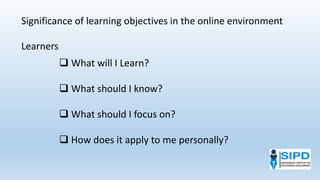
Significance of learning objectives in the online environment
 What will I Learn?
 What should I know?
 What should I focus on?
 How does it apply to me personally?
Learners
Without Learning Objectives
 What am I learning?
 Why am I learning this?
Teachers
Reassure the learners by giving them a
mental road map
Stay focused on the learning path
Align instruction to the stated goals
Give teachers and students the foundation
for assessment
For both teacher and students
Learning Objectives
Make it clear what learners will get out of
the lesson/course.
Let us write Clear Learning Objective
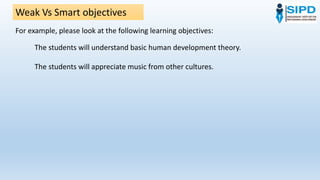
Weak Vs Smart objectives
For example, please look at the following learning objectives:
The students will understand basic human development theory.
The students will appreciate music from other cultures.
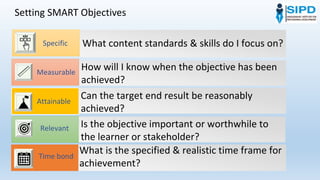
Setting SMART Objectives
Specific
Measurable
Attainable
What content standards & skills do I focus on?
How will I know when the objective has been
achieved?
What is the specified & realistic time frame for
achievement?
Is the objective important or worthwhile to
the learner or stakeholder?
Relevant
Time bond
Can the target end result be reasonably
achieved?
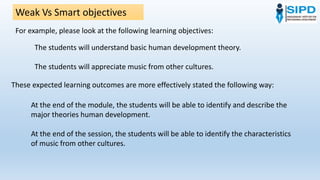
Weak Vs Smart objectives
For example, please look at the following learning objectives:
The students will understand basic human development theory.
The students will appreciate music from other cultures.
These expected learning outcomes are more effectively stated the following way:
At the end of the module, the students will be able to identify and describe the
major theories human development.
At the end of the session, the students will be able to identify the characteristics
of music from other cultures.
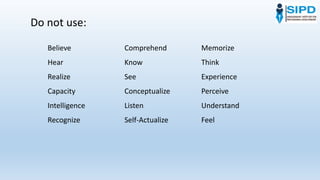
Believe
Hear
Realize
Capacity
Intelligence
Recognize
Comprehend
Know
See
Conceptualize
Listen
Self-Actualize
Memorize
Think
Experience
Perceive
Understand
Feel
Do not use:
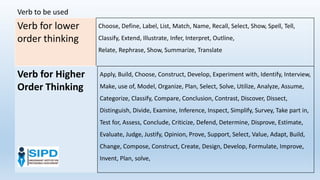
Verb for lower
order thinking
Choose, Define, Label, List, Match, Name, Recall, Select, Show, Spell, Tell,
Classify, Extend, Illustrate, Infer, Interpret, Outline,
Relate, Rephrase, Show, Summarize, Translate
Verb for Higher
Order Thinking
Apply, Build, Choose, Construct, Develop, Experiment with, Identify, Interview,
Make, use of, Model, Organize, Plan, Select, Solve, Utilize, Analyze, Assume,
Categorize, Classify, Compare, Conclusion, Contrast, Discover, Dissect,
Distinguish, Divide, Examine, Inference, Inspect, Simplify, Survey, Take part in,
Test for, Assess, Conclude, Criticize, Defend, Determine, Disprove, Estimate,
Evaluate, Judge, Justify, Opinion, Prove, Support, Select, Value, Adapt, Build,
Change, Compose, Construct, Create, Design, Develop, Formulate, Improve,
Invent, Plan, solve,
Verb to be used
Begin with the end in Mind
Covey, 1989

Set Clear Learning Objectives

  • 1.
  • 2.
  • 3.
    For example The learnerwill explain water cycle Observable actionSubject Learning objective
  • 4.
    A learning objectiveis a promise of what will be obtained
  • 5.
    A brief statementdescribing what the learner will able to perform by the end of the lesson/unit/course, to what degree and under what conditions. A brief definition of a learning objective
  • 6.
    Factor in alearning objectives The learner will perform … Observable action By when Under what condition With what resources to what degree Under what constraints
  • 7.
    By the endof the lesson, students should be able to explain water cycle with help of a poster in three minutes.
  • 8.
    By the endof the lesson students should be able to explain importance of water cycle With help of a poster in three minutes SubjectBy when Observable action resources Constraints condiction
  • 9.
    Significance of learningobjectives in the online environment  What will I Learn?  What should I know?  What should I focus on?  How does it apply to me personally? Learners
  • 10.
    Without Learning Objectives What am I learning?  Why am I learning this?
  • 11.
    Teachers Reassure the learnersby giving them a mental road map Stay focused on the learning path Align instruction to the stated goals
  • 12.
    Give teachers andstudents the foundation for assessment For both teacher and students
  • 13.
    Learning Objectives Make itclear what learners will get out of the lesson/course.
  • 14.
    Let us writeClear Learning Objective
  • 15.
    Weak Vs Smartobjectives For example, please look at the following learning objectives: The students will understand basic human development theory. The students will appreciate music from other cultures.
  • 16.
    Setting SMART Objectives Specific Measurable Attainable Whatcontent standards & skills do I focus on? How will I know when the objective has been achieved? What is the specified & realistic time frame for achievement? Is the objective important or worthwhile to the learner or stakeholder? Relevant Time bond Can the target end result be reasonably achieved?
  • 17.
    Weak Vs Smartobjectives For example, please look at the following learning objectives: The students will understand basic human development theory. The students will appreciate music from other cultures. These expected learning outcomes are more effectively stated the following way: At the end of the module, the students will be able to identify and describe the major theories human development. At the end of the session, the students will be able to identify the characteristics of music from other cultures.
  • 18.
  • 19.
    Verb for lower orderthinking Choose, Define, Label, List, Match, Name, Recall, Select, Show, Spell, Tell, Classify, Extend, Illustrate, Infer, Interpret, Outline, Relate, Rephrase, Show, Summarize, Translate Verb for Higher Order Thinking Apply, Build, Choose, Construct, Develop, Experiment with, Identify, Interview, Make, use of, Model, Organize, Plan, Select, Solve, Utilize, Analyze, Assume, Categorize, Classify, Compare, Conclusion, Contrast, Discover, Dissect, Distinguish, Divide, Examine, Inference, Inspect, Simplify, Survey, Take part in, Test for, Assess, Conclude, Criticize, Defend, Determine, Disprove, Estimate, Evaluate, Judge, Justify, Opinion, Prove, Support, Select, Value, Adapt, Build, Change, Compose, Construct, Create, Design, Develop, Formulate, Improve, Invent, Plan, solve, Verb to be used
  • 20.
    Begin with theend in Mind Covey, 1989