SMS Course for Senior Management 90 / 142
Development and Course Improvement
Session No. 4
ICAO SMS FRAMEWORK
SMS Course for Senior Management 91 / 142
Development and Course Improvement
End of Session Objective
• At the end of this Session participants will
be able to describe the basic components of
a Safety Management System.
SMS Course for Senior Management 92 / 142
Development and Course Improvement
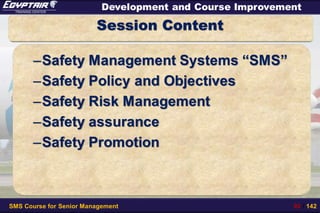
Session Content
–Safety Management Systems “SMS”
–Safety Policy and Objectives
–Safety Risk Management
–Safety assurance
–Safety Promotion
SMS Course for Senior Management 93 / 142
Development and Course Improvement
Terminal Objectives
• List the components and elements of a
safety management system.
• Explain the components and elements of a
safety management system.
SMS Course for Senior Management 94 / 142
Development and Course Improvement
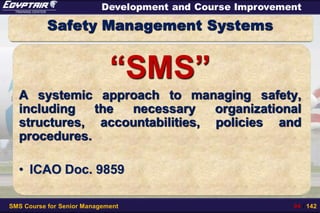
“SMS”
A systemic approach to managing safety,
including the necessary organizational
structures, accountabilities, policies and
procedures.
• ICAO Doc. 9859
Safety Management Systems
SMS Course for Senior Management 95 / 142
Development and Course Improvement
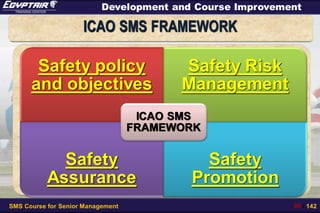
ICAO SMS FRAMEWORK
Safety policy
and objectives
Safety Risk
Management
Safety
Assurance
Safety
Promotion
ICAO SMS
FRAMEWORK
SMS Course for Senior Management 96 / 142
Development and Course Improvement
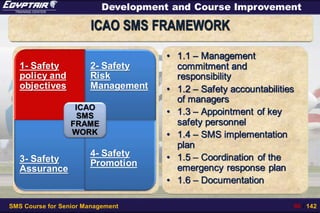
ICAO SMS FRAMEWORK
• 1.1 – Management
commitment and
responsibility
• 1.2 – Safety accountabilities
of managers
• 1.3 – Appointment of key
safety personnel
• 1.4 – SMS implementation
plan
• 1.5 – Coordination of the
emergency response plan
• 1.6 – Documentation
1- Safety
policy and
objectives
2- Safety
Risk
Management
3- Safety
Assurance
4- Safety
Promotion
ICAO
SMS
FRAME
WORK
SMS Course for Senior Management 97 / 142
Development and Course Improvement
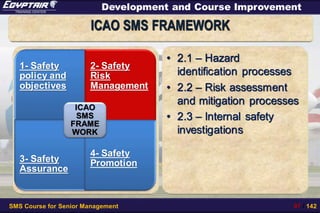
ICAO SMS FRAMEWORK
• 2.1 – Hazard
identification processes
• 2.2 – Risk assessment
and mitigation processes
• 2.3 – Internal safety
investigations
1- Safety
policy and
objectives
2- Safety
Risk
Management
3- Safety
Assurance
4- Safety
Promotion
ICAO
SMS
FRAME
WORK
SMS Course for Senior Management 98 / 142
Development and Course Improvement
ICAO SMS FRAMEWORK
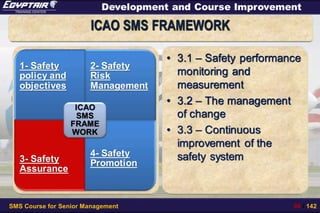
• 3.1 – Safety performance
monitoring and
measurement
• 3.2 – The management
of change
• 3.3 – Continuous
improvement of the
safety system
1- Safety
policy and
objectives
2- Safety
Risk
Management
3- Safety
Assurance
4- Safety
Promotion
ICAO
SMS
FRAME
WORK
SMS Course for Senior Management 99 / 142
Development and Course Improvement
ICAO SMS FRAMEWORK
1- Safety
policy and
objectives
2- Safety
Risk
Management
3- Safety
Assurance
4- Safety
Promotion
ICAO
SMS
FRAME
WORK
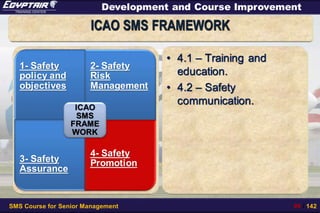
• 4.1 – Training and
education.
• 4.2 – Safety
communication.
SMS Course for Senior Management 100 / 142
Development and Course Improvement
Safety Policy and Objectives
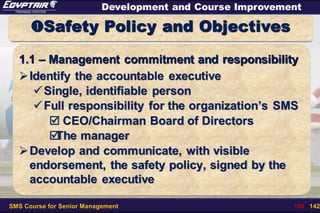
1.1 – Management commitment and responsibility
Identify the accountable executive
Single, identifiable person
Full responsibility for the organization’s SMS
 CEO/Chairman Board of Directors
The manager
Develop and communicate, with visible
endorsement, the safety policy, signed by the
accountable executive
SMS Course for Senior Management 101 / 142
Development and Course Improvement
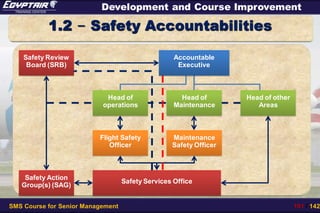
1.2 – Safety Accountabilities
Safety Review
Board (SRB)
Safety Action
Group(s) (SAG)
Accountable
Executive
Head of
operations
Flight Safety
Officer
Safety Services Office
Head of
Maintenance
Maintenance
Safety Officer
Head of other
Areas
SMS Course for Senior Management 102 / 142
Development and Course Improvement
Safety Policy and Objectives
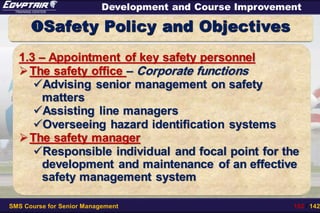
1.3 – Appointment of key safety personnel
The safety office – Corporate functions
Advising senior management on safety
matters
Assisting line managers
Overseeing hazard identification systems
The safety manager
Responsible individual and focal point for the
development and maintenance of an effective
safety management system
SMS Course for Senior Management 103 / 142
Development and Course Improvement
Safety Policy and Objectives
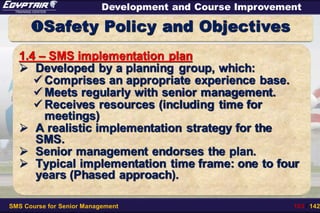
1.4 – SMS implementation plan
 Developed by a planning group, which:
 Comprises an appropriate experience base.
 Meets regularly with senior management.
 Receives resources (including time for
meetings)
 A realistic implementation strategy for the
SMS.
 Senior management endorses the plan.
 Typical implementation time frame: one to four
years (Phased approach).
SMS Course for Senior Management 104 / 142
Development and Course Improvement
Safety Policy and Objectives
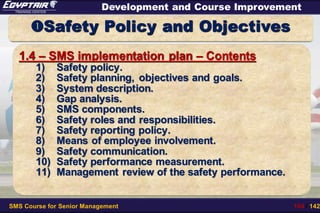
1.4 – SMS implementation plan – Contents
1) Safety policy.
2) Safety planning, objectives and goals.
3) System description.
4) Gap analysis.
5) SMS components.
6) Safety roles and responsibilities.
7) Safety reporting policy.
8) Means of employee involvement.
9) Safety communication.
10) Safety performance measurement.
11) Management review of the safety performance.
SMS Course for Senior Management 105 / 142
Development and Course Improvement
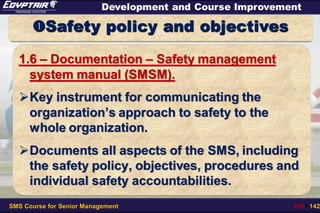
Safety policy and objectives
1.6 – Documentation – Safety management
system manual (SMSM).
Key instrument for communicating the
organization’s approach to safety to the
whole organization.
Documents all aspects of the SMS, including
the safety policy, objectives, procedures and
individual safety accountabilities.
SMS Course for Senior Management 106 / 142
Development and Course Improvement
Safety policy and objectives
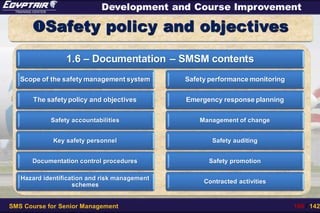
1.6 – Documentation – SMSM contents
Scope of the safety management system
The safetypolicy and objectives
Safety accountabilities
Key safety personnel
Documentation control procedures
Hazard identification and risk management
schemes
Safety performance monitoring
Emergency response planning
Management of change
Safety auditing
Safety promotion
Contracted activities
SMS Course for Senior Management 107 / 142
Development and Course Improvement
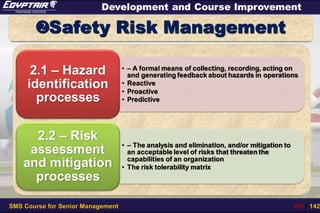
Safety Risk Management
• – A formal means of collecting, recording, acting on
and generating feedback about hazards in operations
• Reactive
• Proactive
• Predictive
2.1 – Hazard
identification
processes
• – The analysis and elimination, and/or mitigation to
an acceptable level of risks that threaten the
capabilities of an organization
• The risk tolerability matrix
2.2 – Risk
assessment
and mitigation
processes
SMS Course for Senior Management 108 / 142
Development and Course Improvement
Safety assurance
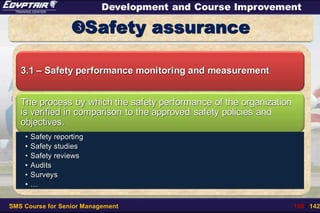
3.1 – Safety performance monitoring and measurement
The process by which the safety performance of the organization
is verified in comparison to the approved safety policies and
objectives.
• Safety reporting
• Safety studies
• Safety reviews
• Audits
• Surveys
• …
SMS Course for Senior Management 109 / 142
Development and Course Improvement
Safety assurance
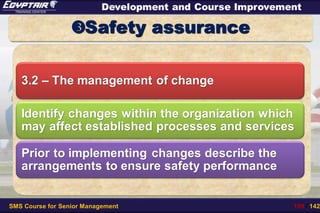
3.2 – The management of change
Identify changes within the organization which
may affect established processes and services
Prior to implementing changes describe the
arrangements to ensure safety performance
SMS Course for Senior Management 110 / 142
Development and Course Improvement
Safety assurance
3.3 – Continuous improvement of the safety system
Determining causes of below standard performance
and their implications in the operation of the SMS
Rectifying situations involving below standard
performance identified through safety assurance
activities
SMS Course for Senior Management 111 / 142
Development and Course Improvement
Safety Promotion
4.1 – Training and education – To ensure that personnel are
trained and competent to perform the SMS duties
Who?
• Operational personnel
• Managers and supervisors
• Senior managers
• Accountable executive
How much?
• Appropriate to the individual’s involvement in the SMS
SMS Course for Senior Management 112 / 142
Development and Course Improvement
Safety Promotion
4.2 – Safety communication
An essential foundation for the development and
maintenance of a positive culture
The means to communicate may include
• Safety policies and procedures
• News letters
• Bulletins
• Website
SMS Course for Senior Management 113 / 142
Development and Course Improvement
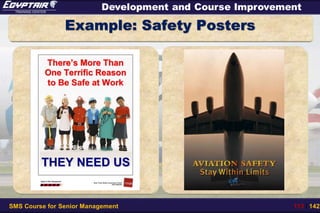
Example: Safety Posters
SMS Course for Senior Management 114 / 142
Development and Course Improvement
In this Session we will look at some other abnormal situations of
the Pressurization System.
This is an example of an abnormal procedure.
The aircraft is in cruise and all systems are working normally.
SMS Part 2 WHY IS SMS Important

Session no. 4 icao sms framework

  • 1.
    SMS Course forSenior Management 90 / 142 Development and Course Improvement Session No. 4 ICAO SMS FRAMEWORK
  • 2.
    SMS Course forSenior Management 91 / 142 Development and Course Improvement End of Session Objective • At the end of this Session participants will be able to describe the basic components of a Safety Management System.
  • 3.
    SMS Course forSenior Management 92 / 142 Development and Course Improvement Session Content –Safety Management Systems “SMS” –Safety Policy and Objectives –Safety Risk Management –Safety assurance –Safety Promotion
  • 4.
    SMS Course forSenior Management 93 / 142 Development and Course Improvement Terminal Objectives • List the components and elements of a safety management system. • Explain the components and elements of a safety management system.
  • 5.
    SMS Course forSenior Management 94 / 142 Development and Course Improvement “SMS” A systemic approach to managing safety, including the necessary organizational structures, accountabilities, policies and procedures. • ICAO Doc. 9859 Safety Management Systems
  • 6.
    SMS Course forSenior Management 95 / 142 Development and Course Improvement ICAO SMS FRAMEWORK Safety policy and objectives Safety Risk Management Safety Assurance Safety Promotion ICAO SMS FRAMEWORK
  • 7.
    SMS Course forSenior Management 96 / 142 Development and Course Improvement ICAO SMS FRAMEWORK • 1.1 – Management commitment and responsibility • 1.2 – Safety accountabilities of managers • 1.3 – Appointment of key safety personnel • 1.4 – SMS implementation plan • 1.5 – Coordination of the emergency response plan • 1.6 – Documentation 1- Safety policy and objectives 2- Safety Risk Management 3- Safety Assurance 4- Safety Promotion ICAO SMS FRAME WORK
  • 8.
    SMS Course forSenior Management 97 / 142 Development and Course Improvement ICAO SMS FRAMEWORK • 2.1 – Hazard identification processes • 2.2 – Risk assessment and mitigation processes • 2.3 – Internal safety investigations 1- Safety policy and objectives 2- Safety Risk Management 3- Safety Assurance 4- Safety Promotion ICAO SMS FRAME WORK
  • 9.
    SMS Course forSenior Management 98 / 142 Development and Course Improvement ICAO SMS FRAMEWORK • 3.1 – Safety performance monitoring and measurement • 3.2 – The management of change • 3.3 – Continuous improvement of the safety system 1- Safety policy and objectives 2- Safety Risk Management 3- Safety Assurance 4- Safety Promotion ICAO SMS FRAME WORK
  • 10.
    SMS Course forSenior Management 99 / 142 Development and Course Improvement ICAO SMS FRAMEWORK 1- Safety policy and objectives 2- Safety Risk Management 3- Safety Assurance 4- Safety Promotion ICAO SMS FRAME WORK • 4.1 – Training and education. • 4.2 – Safety communication.
  • 11.
    SMS Course forSenior Management 100 / 142 Development and Course Improvement Safety Policy and Objectives 1.1 – Management commitment and responsibility Identify the accountable executive Single, identifiable person Full responsibility for the organization’s SMS  CEO/Chairman Board of Directors The manager Develop and communicate, with visible endorsement, the safety policy, signed by the accountable executive
  • 12.
    SMS Course forSenior Management 101 / 142 Development and Course Improvement 1.2 – Safety Accountabilities Safety Review Board (SRB) Safety Action Group(s) (SAG) Accountable Executive Head of operations Flight Safety Officer Safety Services Office Head of Maintenance Maintenance Safety Officer Head of other Areas
  • 13.
    SMS Course forSenior Management 102 / 142 Development and Course Improvement Safety Policy and Objectives 1.3 – Appointment of key safety personnel The safety office – Corporate functions Advising senior management on safety matters Assisting line managers Overseeing hazard identification systems The safety manager Responsible individual and focal point for the development and maintenance of an effective safety management system
  • 14.
    SMS Course forSenior Management 103 / 142 Development and Course Improvement Safety Policy and Objectives 1.4 – SMS implementation plan  Developed by a planning group, which:  Comprises an appropriate experience base.  Meets regularly with senior management.  Receives resources (including time for meetings)  A realistic implementation strategy for the SMS.  Senior management endorses the plan.  Typical implementation time frame: one to four years (Phased approach).
  • 15.
    SMS Course forSenior Management 104 / 142 Development and Course Improvement Safety Policy and Objectives 1.4 – SMS implementation plan – Contents 1) Safety policy. 2) Safety planning, objectives and goals. 3) System description. 4) Gap analysis. 5) SMS components. 6) Safety roles and responsibilities. 7) Safety reporting policy. 8) Means of employee involvement. 9) Safety communication. 10) Safety performance measurement. 11) Management review of the safety performance.
  • 16.
    SMS Course forSenior Management 105 / 142 Development and Course Improvement Safety policy and objectives 1.6 – Documentation – Safety management system manual (SMSM). Key instrument for communicating the organization’s approach to safety to the whole organization. Documents all aspects of the SMS, including the safety policy, objectives, procedures and individual safety accountabilities.
  • 17.
    SMS Course forSenior Management 106 / 142 Development and Course Improvement Safety policy and objectives 1.6 – Documentation – SMSM contents Scope of the safety management system The safetypolicy and objectives Safety accountabilities Key safety personnel Documentation control procedures Hazard identification and risk management schemes Safety performance monitoring Emergency response planning Management of change Safety auditing Safety promotion Contracted activities
  • 18.
    SMS Course forSenior Management 107 / 142 Development and Course Improvement Safety Risk Management • – A formal means of collecting, recording, acting on and generating feedback about hazards in operations • Reactive • Proactive • Predictive 2.1 – Hazard identification processes • – The analysis and elimination, and/or mitigation to an acceptable level of risks that threaten the capabilities of an organization • The risk tolerability matrix 2.2 – Risk assessment and mitigation processes
  • 19.
    SMS Course forSenior Management 108 / 142 Development and Course Improvement Safety assurance 3.1 – Safety performance monitoring and measurement The process by which the safety performance of the organization is verified in comparison to the approved safety policies and objectives. • Safety reporting • Safety studies • Safety reviews • Audits • Surveys • …
  • 20.
    SMS Course forSenior Management 109 / 142 Development and Course Improvement Safety assurance 3.2 – The management of change Identify changes within the organization which may affect established processes and services Prior to implementing changes describe the arrangements to ensure safety performance
  • 21.
    SMS Course forSenior Management 110 / 142 Development and Course Improvement Safety assurance 3.3 – Continuous improvement of the safety system Determining causes of below standard performance and their implications in the operation of the SMS Rectifying situations involving below standard performance identified through safety assurance activities
  • 22.
    SMS Course forSenior Management 111 / 142 Development and Course Improvement Safety Promotion 4.1 – Training and education – To ensure that personnel are trained and competent to perform the SMS duties Who? • Operational personnel • Managers and supervisors • Senior managers • Accountable executive How much? • Appropriate to the individual’s involvement in the SMS
  • 23.
    SMS Course forSenior Management 112 / 142 Development and Course Improvement Safety Promotion 4.2 – Safety communication An essential foundation for the development and maintenance of a positive culture The means to communicate may include • Safety policies and procedures • News letters • Bulletins • Website
  • 24.
    SMS Course forSenior Management 113 / 142 Development and Course Improvement Example: Safety Posters
  • 25.
    SMS Course forSenior Management 114 / 142 Development and Course Improvement In this Session we will look at some other abnormal situations of the Pressurization System. This is an example of an abnormal procedure. The aircraft is in cruise and all systems are working normally. SMS Part 2 WHY IS SMS Important