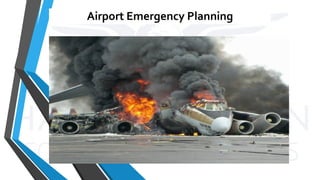
Airport Emergency Planning
ModuleThree;
Airport Emergency Planning
Objective
At the end of the session participants should be able to;
Demonstrate knowledge in airport emergency planning.
• Describe airport emergency plans
• Identify and appreciate the role of assisting agencies in AEP
• Communication and Coordination activities of the emergency response
structures.
Outline
• Airport Emergency Planning
• Types of Emergencies
• Emergency Organizations (Agencies)
• Airport Emergency Plan
• MutualAid Agreements
What is Airport Emergency
Planning?
Aerodrome emergency planning is the process of preparing an
aerodrome to cope with an emergency occurring at the aerodrome or in
its vicinity.
Objective of Airport Emergency
Planning
The objective of aerodrome emergency planning is to minimize the effects of an
emergency, particularly in respect of saving lives and maintaining aircraft
operations.
• Reduce
Loss of life and injuries
Material damage
Environmental damage
• Maintain safe airport operations
Airport Emergency Planning
Purpose
The aerodrome emergency planning sets forth:
• the procedures for coordinating the response of different aerodrome
agencies (or services) and
• those agencies in the surrounding community that could be of assistance in
responding to the emergency.
Types of Emergencies
Different types of emergencies which can be anticipated
are:
a) Emergencies involving aircraft,
b) Emergencies not involving aircraft
c) Compound emergencies
Types of Emergencies
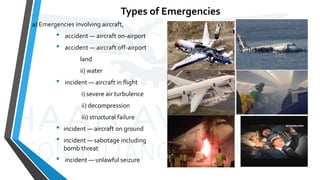
a) Emergencies involving aircraft,
• accident — aircraft on-airport
• accident — aircraft off-airport
land
ii) water
• incident — aircraft in flight
i) severe air turbulence
ii) decompression
iii) structural failure
• incident — aircraft on ground
• incident — sabotage including
bomb threat
• incident — unlawful seizure
Types of Emergencies
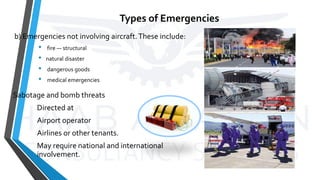
b) Emergencies not involving aircraft.These include:
• fire — structural
• natural disaster
• dangerous goods
• medical emergencies
Sabotage and bomb threats
Directed at
Airport operator
Airlines or other tenants.
May require national and international
involvement.
Types of Emergencies
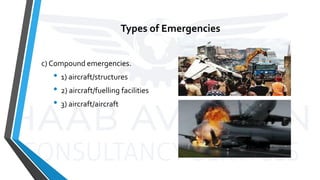
c) Compound emergencies.
• 1) aircraft/structures
• 2) aircraft/fuelling facilities
• 3) aircraft/aircraft
Emergencies NOT involving aircraft (Cont.)
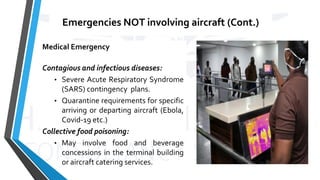
Medical Emergency
Contagious and infectious diseases:
• Severe Acute Respiratory Syndrome
(SARS) contingency plans.
• Quarantine requirements for specific
arriving or departing aircraft (Ebola,
Covid-19 etc.)
Collective food poisoning:
• May involve food and beverage
concessions in the terminal building
or aircraft catering services.
Emergencies NOT involving aircraft (Cont.)
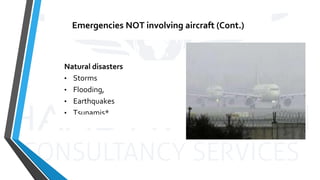
Natural disasters
• Storms
• Flooding,
• Earthquakes
• Tsunamis*
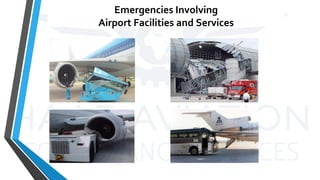
Emergencies Involving
Airport Facilities and Services
Emergencies involving aircraft (Cont.)
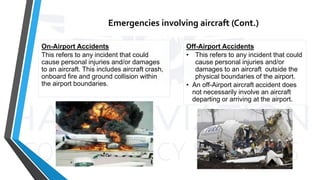
On-Airport Accidents
This refers to any incident that could
cause personal injuries and/or damages
to an aircraft. This includes aircraft crash,
onboard fire and ground collision within
the airport boundaries.
Off-Airport Accidents
• This refers to any incident that could
cause personal injuries and/or
damages to an aircraft outside the
physical boundaries of the airport.
• An off-Airport aircraft accident does
not necessarily involve an aircraft
departing or arriving at the airport.
Emergencies NOT involving aircraft (Cont.)
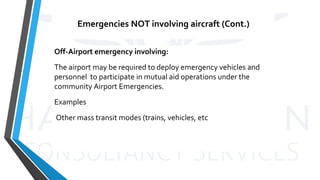
Off-Airport emergency involving:
The airport may be required to deploy emergency vehicles and
personnel to participate in mutual aid operations under the
community Airport Emergencies.
Examples
Other mass transit modes (trains, vehicles, etc
Emergencies NOT involving aircraft (Cont.)
Temporary loss of vital services:
• Electricity
• IT System failure
• Cyber attack
• Communications
• Water & sewage treatment
Stranded passengers in terminal building following:
• Cancellation of flights
• Severe weather conditions
Classification of Aircraft Emergencies
• The aircraft emergencies are generally classified as:
• Aircraft accident-
an aircraft accident which has occurred on or in the vicinity of the airport;
• Full emergency;
an aircraft approaching the airport is, or is suspected to be, in such
trouble that there is imminent danger of an accident; and
• Local standby”.
an aircraft approaching the airport is known or is suspected to have
developed some defect, but the trouble is not such as would normally
involve any serious difficulty in effecting a safe landing
19
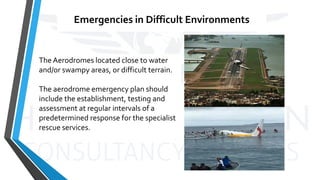
Emergencies in Difficult Environments
The Aerodromes located close to water
and/or swampy areas, or difficult terrain.
The aerodrome emergency plan should
include the establishment, testing and
assessment at regular intervals of a
predetermined response for the specialist
rescue services.
Emergencies in Difficult Environments (Cont’d)
Planning for Emergencies in difficult environments
• Identify the type of emergency
• Appoint a mission coordinator
• Search and Rescue action plan
• Potential Situations
• Search area(s)
• Execution
• Co-ordination
• Communication
Agencies Involve
a) Consider role the agencies may have in support of aircraft emergency or disaster
response plans.
a) Coordinate their local Emergency Operations Plans (EOP) with the AEP.
Agencies Involve
Agencies to be considered are:
a) air traffic services;
b) rescue and fire fighting services
c) police and/or security services;
d) airport authority;
e) medical services;
f) hospitals;
g) aircraft operators;
h) government authorities;
i) communication services;
j) Rescue co-ordination Centre;
k) Mutual Aid Agencies; and many others
The emergency plan is to have the co-operation and participation of all the concerned airport/community
authorities.
Agencies Involve
On Aerodromes Agencies
ATS,
RFF,
AM,
Health,
Security/Police, etc.
Off Aerodromes Agencies
Fire Dept,
Police,
Medical,
Ambulance,
Hospital,
Military,
Ports and Harbour Authority,
etc.
Airport Emergency Plan
Airport Emergency Plan (AEP) – Cont’d
2.2.1The airport emergency plan shall provide for the co-ordination of the
actions to be taken in an emergency occurring at an airport or in its vicinity.
Airport Services Manual, Doc. 9137, Part 7.
• Coordinated programme between the airport authority, stakeholders and
the surrounding community.
• Responsibilities are defined in the emergency plan.
• Instructions to all agencies.
• Provides guidance to Airport Emergency Planning Committee & serves as a
basis for testing the plan.
Airport Emergency Plan (AEP)
• Is a reference document for training & familiarization.
• Ensures maximum and efficient utilization of resources to minimize human
suffering and loss of life, as well as damage to property.
Emergency Plan (Cont.)
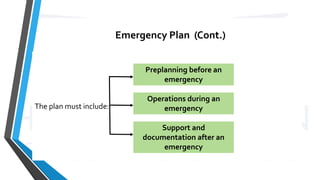
The plan must include:
Preplanning before an
emergency
Operations during an
emergency
Support and
documentation after an
emergency
Who is Responsible?
• The airport authority develops the emergency plan.
• Airport authority ensures that all agencies are
familiar with their responsibilities as well as other
agencies' duties.
Responsibility for the AEP
The airport operator is responsible for the establishment, promulgating and
implementing the AEP.
The AEP should describe the coordinated response of all relevant agencies that
can be of assistance.
The airport should ensure that all participating agencies having duties and
responsibilities are familiar with their assignments.
They should be familiar with other agencies duties in the plan as well.
The AEP must be reviewed at least once every 12 months by all the parties
involved.
Airport Emergency Plan
The airport emergency plan is to ensure that there is:
a) orderly and efficient transition from normal to emergency operations;
b) delegation of airport emergency authority;
c) assignment of emergency responsibilities;
d) authorization by key personnel for actions contained in the plan;
e) co-ordination of efforts to cope with the emergency; and
f) safe continuation of aircraft operations or return to normal operations as soon
as possible.
Mutual Aid Agreements
It is important that the airport authority establishes emergency mutual aid
agreements which define responsibilities and/or liabilities of each contributing
party with surrounding communities.
These agreements should include at least the following:
a) clarification of the political and jurisdictional responsibilities of the agencies.
b) establishment of the command authority; i.e. a single on-scene commander
(with designated alternates if necessary);
c) communication priorities at the accident site;
d) organization of emergency transportation facilities under a predesignated co-
ordinator (s)
Elements of an AEP
• A scope describing the extent of the plan and those involved in it.
• A description of the emergency communications network.
• A chain of command and identification of responsibilities for responders.
• An identification of specific actions and procedures for selected
emergencies.
• An agreement or description of what each supporting agency will provide.
• An airport grid map or other accident/location identifier system.
• Other information and documentation that pertain to implementing the
AEP.
Sample Outline of an AEP
Table of Contents
• General
Purpose
Responsibility Checklist
• EmergencyTelephone Number
• Emergency Organization Responsibilities
Airport
Government Agencies
Private Agencies etc.
Sample Outline of an AEP Cont’d
• Types and Levels of Emergencies
Aircraft incidents or accidents
Bomb incidents
Structural fires
Natural Disasters
Sabotage & Hijacking etc.
• Response Procedures
Sample Outline of an AEP Cont’d
• EmergencyAlarm Communication
• Removal of Disabled Aircraft
• Training Session
• Public Information
• Appendices
The End
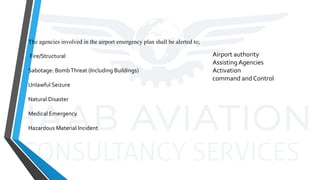
Airport authority
AssistingAgencies
Activation
command and Control
The agencies involved in the airport emergency plan shall be alerted to;
Fire/Structural
Sabotage: BombThreat (Including Buildings)
Unlawful Seizure
Natural Disaster
Medical Emergency
Hazardous Material Incident

AIRPORT EMERGENCY PLAN FAAN.pdf

  • 1.
  • 2.
  • 3.
    Objective At the endof the session participants should be able to; Demonstrate knowledge in airport emergency planning. • Describe airport emergency plans • Identify and appreciate the role of assisting agencies in AEP • Communication and Coordination activities of the emergency response structures.
  • 4.
    Outline • Airport EmergencyPlanning • Types of Emergencies • Emergency Organizations (Agencies) • Airport Emergency Plan • MutualAid Agreements
  • 5.
    What is AirportEmergency Planning? Aerodrome emergency planning is the process of preparing an aerodrome to cope with an emergency occurring at the aerodrome or in its vicinity.
  • 6.
    Objective of AirportEmergency Planning The objective of aerodrome emergency planning is to minimize the effects of an emergency, particularly in respect of saving lives and maintaining aircraft operations. • Reduce Loss of life and injuries Material damage Environmental damage • Maintain safe airport operations
  • 7.
    Airport Emergency Planning Purpose Theaerodrome emergency planning sets forth: • the procedures for coordinating the response of different aerodrome agencies (or services) and • those agencies in the surrounding community that could be of assistance in responding to the emergency.
  • 8.
    Types of Emergencies Differenttypes of emergencies which can be anticipated are: a) Emergencies involving aircraft, b) Emergencies not involving aircraft c) Compound emergencies
  • 9.
    Types of Emergencies a)Emergencies involving aircraft, • accident — aircraft on-airport • accident — aircraft off-airport land ii) water • incident — aircraft in flight i) severe air turbulence ii) decompression iii) structural failure • incident — aircraft on ground • incident — sabotage including bomb threat • incident — unlawful seizure
  • 10.
    Types of Emergencies b)Emergencies not involving aircraft.These include: • fire — structural • natural disaster • dangerous goods • medical emergencies Sabotage and bomb threats Directed at Airport operator Airlines or other tenants. May require national and international involvement.
  • 11.
    Types of Emergencies c)Compound emergencies. • 1) aircraft/structures • 2) aircraft/fuelling facilities • 3) aircraft/aircraft
  • 12.
    Emergencies NOT involvingaircraft (Cont.) Medical Emergency Contagious and infectious diseases: • Severe Acute Respiratory Syndrome (SARS) contingency plans. • Quarantine requirements for specific arriving or departing aircraft (Ebola, Covid-19 etc.) Collective food poisoning: • May involve food and beverage concessions in the terminal building or aircraft catering services.
  • 13.
    Emergencies NOT involvingaircraft (Cont.) Natural disasters • Storms • Flooding, • Earthquakes • Tsunamis*
  • 14.
  • 15.
    Emergencies involving aircraft(Cont.) On-Airport Accidents This refers to any incident that could cause personal injuries and/or damages to an aircraft. This includes aircraft crash, onboard fire and ground collision within the airport boundaries. Off-Airport Accidents • This refers to any incident that could cause personal injuries and/or damages to an aircraft outside the physical boundaries of the airport. • An off-Airport aircraft accident does not necessarily involve an aircraft departing or arriving at the airport.
  • 16.
    Emergencies NOT involvingaircraft (Cont.) Off-Airport emergency involving: The airport may be required to deploy emergency vehicles and personnel to participate in mutual aid operations under the community Airport Emergencies. Examples Other mass transit modes (trains, vehicles, etc
  • 17.
    Emergencies NOT involvingaircraft (Cont.) Temporary loss of vital services: • Electricity • IT System failure • Cyber attack • Communications • Water & sewage treatment Stranded passengers in terminal building following: • Cancellation of flights • Severe weather conditions
  • 18.
    Classification of AircraftEmergencies • The aircraft emergencies are generally classified as: • Aircraft accident- an aircraft accident which has occurred on or in the vicinity of the airport; • Full emergency; an aircraft approaching the airport is, or is suspected to be, in such trouble that there is imminent danger of an accident; and • Local standby”. an aircraft approaching the airport is known or is suspected to have developed some defect, but the trouble is not such as would normally involve any serious difficulty in effecting a safe landing
  • 19.
  • 20.
    Emergencies in DifficultEnvironments The Aerodromes located close to water and/or swampy areas, or difficult terrain. The aerodrome emergency plan should include the establishment, testing and assessment at regular intervals of a predetermined response for the specialist rescue services.
  • 21.
    Emergencies in DifficultEnvironments (Cont’d) Planning for Emergencies in difficult environments • Identify the type of emergency • Appoint a mission coordinator • Search and Rescue action plan • Potential Situations • Search area(s) • Execution • Co-ordination • Communication
  • 22.
    Agencies Involve a) Considerrole the agencies may have in support of aircraft emergency or disaster response plans. a) Coordinate their local Emergency Operations Plans (EOP) with the AEP.
  • 23.
    Agencies Involve Agencies tobe considered are: a) air traffic services; b) rescue and fire fighting services c) police and/or security services; d) airport authority; e) medical services; f) hospitals; g) aircraft operators; h) government authorities; i) communication services; j) Rescue co-ordination Centre; k) Mutual Aid Agencies; and many others The emergency plan is to have the co-operation and participation of all the concerned airport/community authorities.
  • 24.
    Agencies Involve On AerodromesAgencies ATS, RFF, AM, Health, Security/Police, etc. Off Aerodromes Agencies Fire Dept, Police, Medical, Ambulance, Hospital, Military, Ports and Harbour Authority, etc.
  • 25.
  • 26.
    Airport Emergency Plan(AEP) – Cont’d 2.2.1The airport emergency plan shall provide for the co-ordination of the actions to be taken in an emergency occurring at an airport or in its vicinity. Airport Services Manual, Doc. 9137, Part 7. • Coordinated programme between the airport authority, stakeholders and the surrounding community. • Responsibilities are defined in the emergency plan. • Instructions to all agencies. • Provides guidance to Airport Emergency Planning Committee & serves as a basis for testing the plan.
  • 27.
    Airport Emergency Plan(AEP) • Is a reference document for training & familiarization. • Ensures maximum and efficient utilization of resources to minimize human suffering and loss of life, as well as damage to property.
  • 28.
    Emergency Plan (Cont.) Theplan must include: Preplanning before an emergency Operations during an emergency Support and documentation after an emergency
  • 29.
    Who is Responsible? •The airport authority develops the emergency plan. • Airport authority ensures that all agencies are familiar with their responsibilities as well as other agencies' duties.
  • 30.
    Responsibility for theAEP The airport operator is responsible for the establishment, promulgating and implementing the AEP. The AEP should describe the coordinated response of all relevant agencies that can be of assistance. The airport should ensure that all participating agencies having duties and responsibilities are familiar with their assignments. They should be familiar with other agencies duties in the plan as well. The AEP must be reviewed at least once every 12 months by all the parties involved.
  • 31.
    Airport Emergency Plan Theairport emergency plan is to ensure that there is: a) orderly and efficient transition from normal to emergency operations; b) delegation of airport emergency authority; c) assignment of emergency responsibilities; d) authorization by key personnel for actions contained in the plan; e) co-ordination of efforts to cope with the emergency; and f) safe continuation of aircraft operations or return to normal operations as soon as possible.
  • 32.
    Mutual Aid Agreements Itis important that the airport authority establishes emergency mutual aid agreements which define responsibilities and/or liabilities of each contributing party with surrounding communities. These agreements should include at least the following: a) clarification of the political and jurisdictional responsibilities of the agencies. b) establishment of the command authority; i.e. a single on-scene commander (with designated alternates if necessary); c) communication priorities at the accident site; d) organization of emergency transportation facilities under a predesignated co- ordinator (s)
  • 33.
    Elements of anAEP • A scope describing the extent of the plan and those involved in it. • A description of the emergency communications network. • A chain of command and identification of responsibilities for responders. • An identification of specific actions and procedures for selected emergencies. • An agreement or description of what each supporting agency will provide. • An airport grid map or other accident/location identifier system. • Other information and documentation that pertain to implementing the AEP.
  • 34.
    Sample Outline ofan AEP Table of Contents • General Purpose Responsibility Checklist • EmergencyTelephone Number • Emergency Organization Responsibilities Airport Government Agencies Private Agencies etc.
  • 35.
    Sample Outline ofan AEP Cont’d • Types and Levels of Emergencies Aircraft incidents or accidents Bomb incidents Structural fires Natural Disasters Sabotage & Hijacking etc. • Response Procedures
  • 36.
    Sample Outline ofan AEP Cont’d • EmergencyAlarm Communication • Removal of Disabled Aircraft • Training Session • Public Information • Appendices
  • 37.
  • 38.
    Airport authority AssistingAgencies Activation command andControl The agencies involved in the airport emergency plan shall be alerted to; Fire/Structural Sabotage: BombThreat (Including Buildings) Unlawful Seizure Natural Disaster Medical Emergency Hazardous Material Incident