Air Crew Coordination KG 26 “Lowen”  I Gruppe
Definition Broadly defined, aircrew coordination is the interaction between aircraft crew members in the cockpit /bombardier /gunner stations necessary for the safe and effective performance of battle tasks.
Topics of Discussion Elements of Crew Coordination Crew Coordination Basic Qualities Crew Coordination Objectives Common Phrases
Elements of Crew Coordination Communicate Positively Direct Assistance Announce Actions Offer Assistance Acknowledge Actions Be Explicit Provide Aircraft Control and Obstacle Advisories Coordinate Action Sequence and Timing
Communicate Positively Good cockpit teamwork requires positive communication among crew members. Communication is positive when the sender directs, announces, requests, or offers information.  (“Gunner”) Bandit 5 Low engaging,  The receiver acknowledges the information; the sender confirms the information.  (“Pilot”) Roger Bandit 5 Low
Direct Assistance A crew member will direct assistance when a problem exists about aircraft control, position, or clearance.  Gunner:  “Pilot, we are drifting off course”   He will also direct assistance when he cannot operate or troubleshoot aircraft systems without help from the other crew members.  Bombadier:  “Pilot, I am unable to set airspeed calculation for bomb sight.”
Announce Actions To ensure effective and well-coordinated actions in the aircraft, all crew members must be aware of the expected movements and unexpected individual actions.  Pilot, “Initial Point” (IP) Inbound for strike.” Each crew member will announce any actions that affect the actions of the other crew members.  Pilot, “Heavy Flak, slow descent
Offer Assistance   A crew member will provide assistance or information that has been requested.  Pilot, “ You need help setting the sight?” He also will offer assistance when he sees that another crew member needs help.  Bombardier, “ Send airspeed data for sight adjustment.”
Acknowledge Actions   Communications in the aircraft must include supportive feedback to ensure that crew members correctly understand announcements or directives.  Bombardier, “Bombs away, egress.” Pilot, Roger, turning 180, climbing to 5500 meters.
Be Explicit   Crew members should use clear terms and phrases and positively acknowledge critical information.  They must avoid using terms that have multiple meanings, such as "Right," "Back up," or "I have it."  Crew members must also avoid using indefinite modifiers such as, "Do you see that plane?" or "You are coming in a little fast.  “ Use, you see that spit 6 high, over?”
Provide Aircraft Control and Obstacle Advisories Although the Pilot on the Controls is responsible for aircraft control, the other crew members may need to provide aircraft control information regarding airspeed, altitude, or obstacle avoidance.
Coordinate Action Sequence and Timing   Proper sequencing and timing ensure that the actions of one crew member mesh with the actions of the other crew members. Pilot, “Aircraft set for bomb run.” Bombardier, “Roger, Ready to bomb.”
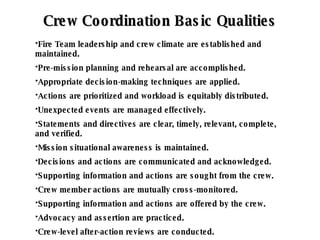
Crew Coordination Basic Qualities Fire Team leadership and crew climate are established and maintained.  Pre-mission planning and rehearsal are accomplished.  Appropriate decision-making techniques are applied.  Actions are prioritized and workload is equitably distributed.  Unexpected events are managed effectively.  Statements and directives are clear, timely, relevant, complete, and verified.  Mission situational awareness is maintained.  Decisions and actions are communicated and acknowledged.  Supporting information and actions are sought from the crew. Crew member actions are mutually cross-monitored.  Supporting information and actions are offered by the crew.  Advocacy and assertion are practiced.  Crew-level after-action reviews are conducted.
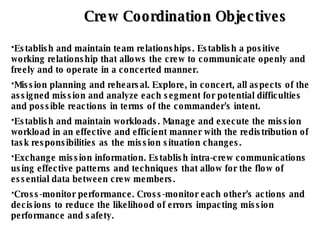
Crew Coordination Objectives Establish and maintain team relationships. Establish a positive working relationship that allows the crew to communicate openly and freely and to operate in a concerted manner. Mission planning and rehearsal. Explore, in concert, all aspects of the assigned mission and analyze each segment for potential difficulties and possible reactions in terms of the commander's intent. Establish and maintain workloads. Manage and execute the mission workload in an effective and efficient manner with the redistribution of task responsibilities as the mission situation changes. Exchange mission information. Establish intra-crew communications using effective patterns and techniques that allow for the flow of essential data between crew members. Cross-monitor performance. Cross-monitor each other's actions and decisions to reduce the likelihood of errors impacting mission performance and safety.
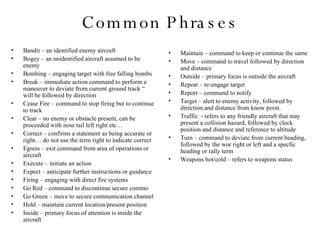
Common Phrases Bandit – an identified enemy aircraft Bogey – an unidentified aircraft assumed to be enemy Bombing – engaging target with free falling bombs Break – immediate action command to perform a maneuver to deviate from current ground track “ will be followed by direction Cease Fire – command to stop firing but to continue to track Clear – no enemy or obstacle present, can be proceeded with nose tail left right etc… Correct – confirms a statement as being accurate or right… do not use the term right to indicate correct Egress – exit command from area of operations or aircraft Execute – initiate an action Expect – anticipate further instructions or guidance Firing – engaging with direct fire systems Go Red – command to discontinue secure commo Go Green – move to secure communication channel Hold – maintain current location/present position Inside – primary focus of attention is inside the aircraft Maintain – command to keep or continue the same Move – command to travel followed by direction and distance Outside – primary focus is outside the aircraft Repeat – re-engage target Report – command to notify Target – alert to enemy activity, followed by direction and distance from know point. Traffic  - refers to any friendly aircraft that may present a collision hazard, followed by clock position and distance and reference to altitude Turn – command to deviate from current heading, followed by the wor right or left and a specfic heading or rally term Weapons hot/cold – refers to weapons status
"War is both a physical reality and a state of mind. War is ambiguous, uncertain, and unfair. When we are at war, we must think and act differently. We become more flexible and more adaptable.  We must anticipate the ultimate reality check -- combat."

Class Crew Coordination

  • 1.
    Air Crew CoordinationKG 26 “Lowen” I Gruppe
  • 2.
    Definition Broadly defined,aircrew coordination is the interaction between aircraft crew members in the cockpit /bombardier /gunner stations necessary for the safe and effective performance of battle tasks.
  • 3.
    Topics of DiscussionElements of Crew Coordination Crew Coordination Basic Qualities Crew Coordination Objectives Common Phrases
  • 4.
    Elements of CrewCoordination Communicate Positively Direct Assistance Announce Actions Offer Assistance Acknowledge Actions Be Explicit Provide Aircraft Control and Obstacle Advisories Coordinate Action Sequence and Timing
  • 5.
    Communicate Positively Goodcockpit teamwork requires positive communication among crew members. Communication is positive when the sender directs, announces, requests, or offers information. (“Gunner”) Bandit 5 Low engaging, The receiver acknowledges the information; the sender confirms the information. (“Pilot”) Roger Bandit 5 Low
  • 6.
    Direct Assistance Acrew member will direct assistance when a problem exists about aircraft control, position, or clearance. Gunner: “Pilot, we are drifting off course” He will also direct assistance when he cannot operate or troubleshoot aircraft systems without help from the other crew members. Bombadier: “Pilot, I am unable to set airspeed calculation for bomb sight.”
  • 7.
    Announce Actions Toensure effective and well-coordinated actions in the aircraft, all crew members must be aware of the expected movements and unexpected individual actions. Pilot, “Initial Point” (IP) Inbound for strike.” Each crew member will announce any actions that affect the actions of the other crew members. Pilot, “Heavy Flak, slow descent
  • 8.
    Offer Assistance A crew member will provide assistance or information that has been requested. Pilot, “ You need help setting the sight?” He also will offer assistance when he sees that another crew member needs help. Bombardier, “ Send airspeed data for sight adjustment.”
  • 9.
    Acknowledge Actions Communications in the aircraft must include supportive feedback to ensure that crew members correctly understand announcements or directives. Bombardier, “Bombs away, egress.” Pilot, Roger, turning 180, climbing to 5500 meters.
  • 10.
    Be Explicit Crew members should use clear terms and phrases and positively acknowledge critical information. They must avoid using terms that have multiple meanings, such as "Right," "Back up," or "I have it." Crew members must also avoid using indefinite modifiers such as, "Do you see that plane?" or "You are coming in a little fast. “ Use, you see that spit 6 high, over?”
  • 11.
    Provide Aircraft Controland Obstacle Advisories Although the Pilot on the Controls is responsible for aircraft control, the other crew members may need to provide aircraft control information regarding airspeed, altitude, or obstacle avoidance.
  • 12.
    Coordinate Action Sequenceand Timing Proper sequencing and timing ensure that the actions of one crew member mesh with the actions of the other crew members. Pilot, “Aircraft set for bomb run.” Bombardier, “Roger, Ready to bomb.”
  • 13.
    Crew Coordination BasicQualities Fire Team leadership and crew climate are established and maintained. Pre-mission planning and rehearsal are accomplished. Appropriate decision-making techniques are applied. Actions are prioritized and workload is equitably distributed. Unexpected events are managed effectively. Statements and directives are clear, timely, relevant, complete, and verified. Mission situational awareness is maintained. Decisions and actions are communicated and acknowledged. Supporting information and actions are sought from the crew. Crew member actions are mutually cross-monitored. Supporting information and actions are offered by the crew. Advocacy and assertion are practiced. Crew-level after-action reviews are conducted.
  • 14.
    Crew Coordination ObjectivesEstablish and maintain team relationships. Establish a positive working relationship that allows the crew to communicate openly and freely and to operate in a concerted manner. Mission planning and rehearsal. Explore, in concert, all aspects of the assigned mission and analyze each segment for potential difficulties and possible reactions in terms of the commander's intent. Establish and maintain workloads. Manage and execute the mission workload in an effective and efficient manner with the redistribution of task responsibilities as the mission situation changes. Exchange mission information. Establish intra-crew communications using effective patterns and techniques that allow for the flow of essential data between crew members. Cross-monitor performance. Cross-monitor each other's actions and decisions to reduce the likelihood of errors impacting mission performance and safety.
  • 15.
    Common Phrases Bandit– an identified enemy aircraft Bogey – an unidentified aircraft assumed to be enemy Bombing – engaging target with free falling bombs Break – immediate action command to perform a maneuver to deviate from current ground track “ will be followed by direction Cease Fire – command to stop firing but to continue to track Clear – no enemy or obstacle present, can be proceeded with nose tail left right etc… Correct – confirms a statement as being accurate or right… do not use the term right to indicate correct Egress – exit command from area of operations or aircraft Execute – initiate an action Expect – anticipate further instructions or guidance Firing – engaging with direct fire systems Go Red – command to discontinue secure commo Go Green – move to secure communication channel Hold – maintain current location/present position Inside – primary focus of attention is inside the aircraft Maintain – command to keep or continue the same Move – command to travel followed by direction and distance Outside – primary focus is outside the aircraft Repeat – re-engage target Report – command to notify Target – alert to enemy activity, followed by direction and distance from know point. Traffic - refers to any friendly aircraft that may present a collision hazard, followed by clock position and distance and reference to altitude Turn – command to deviate from current heading, followed by the wor right or left and a specfic heading or rally term Weapons hot/cold – refers to weapons status
  • 16.
    "War is botha physical reality and a state of mind. War is ambiguous, uncertain, and unfair. When we are at war, we must think and act differently. We become more flexible and more adaptable. We must anticipate the ultimate reality check -- combat."