





Session 6
David Mullich
Survey of the Videogame Industry
The Los Angeles Film School
Developers
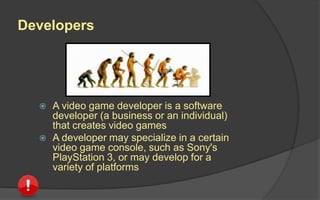
 A video game developer is a software
developer (a business or an individual)
that creates video games
 A developer may specialize in a certain
video game console, such as Sony's
PlayStation 3, or may develop for a
variety of platforms
Game Developer (Business)
 Owned and run by a
game publisher
 An independently owned
company that may work
for different publishers
A company that develops video games is also called a
Game Studio.
Game Studios may be:
Game Developer (Individual)
 One or more individuals
working freelance
A game developer may also be:
When applied to an individual, the term “game developer”
may also refer specifically to a game programmer. Game
programmers are also called:
• Coders
• Engineers
Development Teams
The lone, “auteur” game developer is a
myth.*
*Unless you’re Notch.
Are you Notch?
No, you are not.
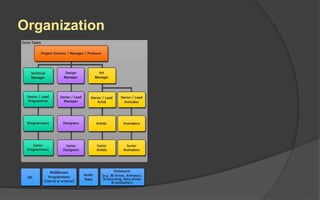
Organization
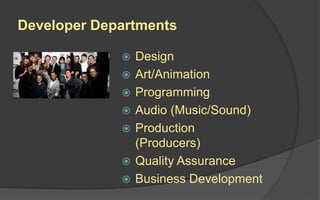
Developer Departments
 Design
 Art/Animation
 Programming
 Audio (Music/Sound)
 Project Management
 Quality Assurance
 Business Development
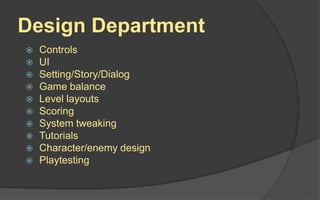
Design Department
 Controls
 UI
 Setting/Story/Dialog
 Game balance
 Level layouts
 Scoring
 System tweaking
 Tutorials
 Character/enemy design
 Playtesting
Level Designer
Day in the Life: Video Game Designer
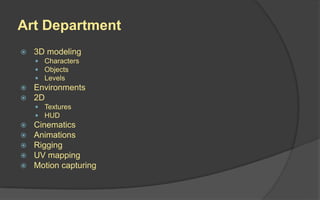
Art Department
 3D modeling
 Characters
 Objects
 Levels
 Environments
 2D
 Textures
 HUD
 Cinematics
 Animations
 Rigging
 UV mapping
 Motion capturing
Game Artist
Working in Games: Leader Artist (4:51)
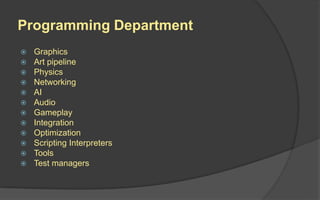
Programming Department
 Graphics
 Art pipeline
 Physics
 Networking
 AI
 Audio
 Gameplay
 Integration
 Optimization
 Scripting Interpreters
 Tools
 Test managers
Programmers
Extra Credits, Season 4, Episode 01 - So
You Want To Be a Developer (Part 1)
(6:57)
Programmers
Extra Credits, Season 4, Episode 02 - So
You Want To Be a Developer (Part 2)
(5:45)
Do I Need To Know Math?
Yes! Mathematics is not just for programmers!
Geometry is maths too. As are statistics. And
probability. And proportion. And even project
management and budgeting. Maths is
everywhere and it isn’t hard. Especially when it’s
applied. So let’s debunk that myth right here.
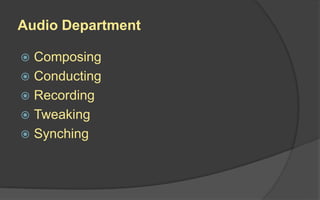
Audio Department
 Composing
 Conducting
 Recording
 Tweaking
 Synching
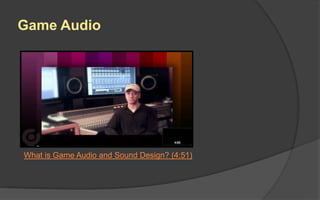
Game Audio
What is Game Audio and Sound Design? (4:51)
Project Management
The manager of a development team might be
called:
 Development Director
 Director
 Team Leader
 Project Manager
 Producer
What Does A Project Manager Do?
Gantt Chart – MS Project
What Does A Project Manager Do?
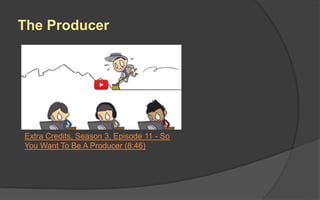
The Producer
Extra Credits, Season 3, Episode 11 - So
You Want To Be A Producer (8:46)
Business Development
 Responsible for finding sales and
growth opportunities
 Finding new clients
 Keeping existing clients
 Maintaining client satisfaction
Specialist Vs. Generalist
The industry has places for both, but in
different contexts.
Which one are you?
Hint: If you don’t know, you are not a specialist.
Production Phases
 Concept
 Pre-Production
 Production
 Post Production
Concept Phase
 Concept Document
 Project Plan & Budget
 Contract
Pre-Production
 Game Design Document (GDD): A document
describing the game vision and how the game
will work.
 Technical Design Document (TDD): A
document describing how the game will be
created
 Prototype/First Playable: An early playable
version of the game
 Detailed Schedule and Budget
Who Is Busy During Pre-
Production?
 Busiest: Designer
 Very Busy: Producer, Lead
Programmer, Lead or Conceptual
Artist
 Somewhat Busy: Other
Programmers, Artists
 Not Busy: Audio, Testers
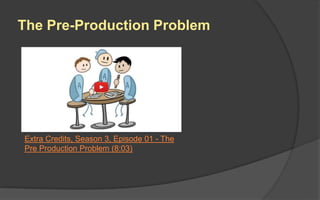
The Pre-Production Problem
Extra Credits, Season 3, Episode 01 - The
Pre Production Problem (8:03)
The Pre-Production Problem
What can you do about the problem of the
rest of the team being idle while only a few
members are doing preproduction?
If possible, do preproduction on the next
project while the rest of the team is
finishing up the current project.
Production
 Team ramps up (adds more people)
to create:
 All the game features (Alpha code)
 All the game assets (art and audio)
 All the game levels
Production Pipeline (Overview)
Production Pipeline (Details)
Managing Resources
 StarCraft
 Minerals
 Vespene gas
 Game Development
 People
 Money
 Time
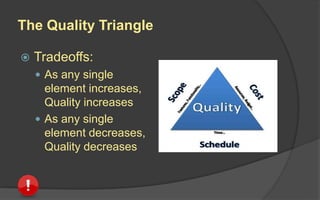
The Quality Triangle
 Tradeoffs:
 As any single element
increases, Quality
increases
 As any single element
decreases, Quality
decreases
Builds
 Daily builds
 Individual builds (such as for a
demonstration)
 Major builds (milestones)
 Lock down
Who Is Busy During
Production?
 Busiest: Programmers, Artists
 Very Busy: Producer, Designers
 Somewhat Busy: Audio
 A Little Busy: Testers
Post-Production
 The game is (nearly) finished and ready
for:
 Quality Assurance Testing
 Localization
 Porting
Localization Issues
 Translation
 Art asset changes
 Music changes
 Content changes
 UI changes
 Ratings
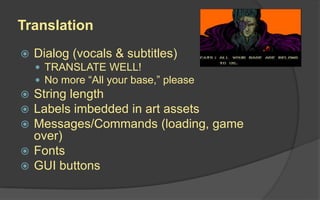
Translation
 Dialog (vocals & subtitles)
 TRANSLATE WELL!
 No more “All your base,” please
 String length
 Labels imbedded in art assets
 Messages/Commands (loading, game over)
 Fonts
 GUI buttons
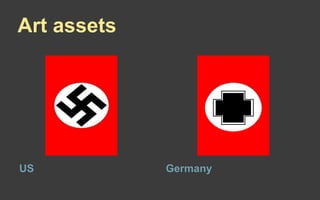
US
Art assets
Germany
Content Changes
History and even geography may need to be
“rewritten” for a given region.
 China & Taiwan
Regional Preferences
 Cameras and gameplay may need to be adjusted
for some regions.
 The US doesn’t like “grinding,” which is highly
popular in Asia
 US stories are often simplified and glorify
Americans, Japanese stories tend to be esoteric
 Japan doesn’t like “searching” for items
 Asia prefers linearity, the US prefers open-ended
 First Person mode tends to cause negative
physical reactions in Japan
Western Vs. Asian Views On
Gameplay
Extra Credits, Season 2, Episode 17 - The
Myth Of The Gun (5:53)
Who Is Busy During Post-
Production?
 Busiest: Programmers, Testers
 Very Busy: Producer
 Somewhat Busy: Designer
 A Little Busy: Artists, Audio
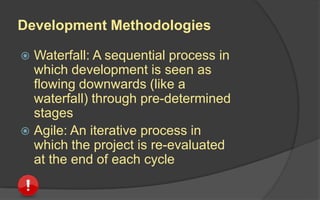
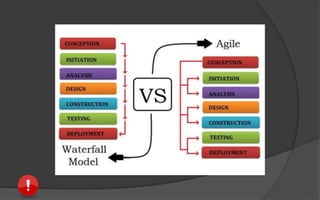
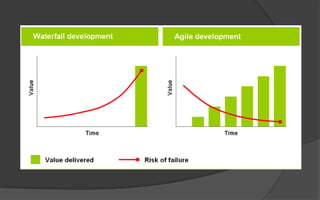
Development Methodologies
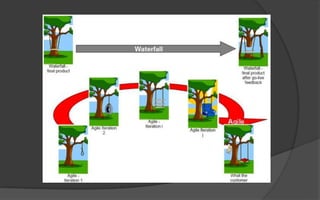
 Waterfall: A sequential process in
which development is seen as
flowing downwards (like a waterfall)
through pre-determined stages
 Agile: An iterative process in which
the project is re-evaluated at the end
of each cycle
Scrum
 A flexible holistic strategy where a
development team works together to
reach a common goal
 The word “scrum” is a rugby term,
referring to the manner of restarting
after a minor infraction
Stakeholder
A person, group, organization, or system who affects or
can be affected by an organization's actions. They
have a vested interest in the project.
Stakeholders may have different levels of involvement
in a project. Some may be merely contribute, while
others are more committed.
Stakeholders in a Game Project
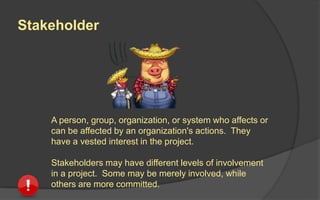
Committed (Pigs)
• Development Team
• Producer
• Quality Assurance
Contributors (Chickens)
• Sales
• Marketing
• Finance
• Customer
Roles
 Project Owner: Represents the stakeholders and
is the voice of the customer. S/he is accountable
for delivering value
 Team: Responsible for delivering a shippable
project in incremental steps
 Scrum Master: Enforces the rules of Scrum.
Responsible for removing obstacles to the team.
Acts as a buffer between the team and distracting
influences.
Project Backlog
 An ordered list of requirements for the product:
features, bug fixes, non-functional requirements
(such as documentation)
 The items are ordered by the Product Owner based
on considerations like risk, business value, etc.
 The features added to the backlog are commonly
written in a story format. (“As a user, I would like
to…”)
Scrum Elements
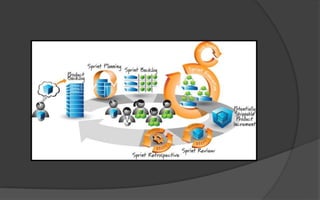
 Sprint: The basic unit of development
in Scrum. The sprint is a “timeboxed”
effort – normally between one week
and one month.
 Sprint Backlog: The list of tasks to be
accomplished during that sprint.
 Sprint Planning Meeting: At the
beginning of every sprint, a planning
meeting is held to decide what work is
to be done and prepare the sprint
backlog.
Daily Scrum (Daily Standup)
A timeboxed meeting (usually set to 15
minutes) of the development team. It
should be held at the same time and
location every day. Each team member
answers three questions:
 What have you done since yesterday?
 What are you doing today?
 Are there any obstacles?
End of Sprint
 Sprint Review Meeting: Completed
work is reviewed with the
stakeholders (“the demo”)
 Sprint Retrospective: The team
members discuss improvements to
the process
Scrum
Scrum Methodology an Agile Movie (6:12)
Hybrid
 An approach in which Scrum Sprints
occur between Waterfall Milestones
 Many game studios use a Hybrid
methodology rather than a pure
Agile approach
Naughty Dog
G4 Icons Episode #34: Naughty Dog
(22:42)
Testing vs. Playing
At home, you play games to have fun. You
get to choose what to play, when to play, and
how to play it.
Testing games can still be fun, but you have
fewer choices about what, when and how to
play. Everything you do when you play has a
purpose.
Purposes of Game Testing
 Find defects in the code or design
 Demonstrate which parts of the
game are working properly
Two Types of Testing
 Gameplay Testing
 “It’s too hard.”
 “The hats should be blue.”
 “Why can’t we have bigger guns?”
 Bug Testing
 “Game crashes when I do this…”
 “Quest giver doesn’t reward me after I turn quest
in.”
 “Barbie says ‘Ima kill you!’”
In Other Words
 Gameplay Testing is subjective and opinion
based
 Bug Testing is objective and fact based
QA Tools
 Test Kit (PC, console, etc.)
 Headphones
 Video/audio capture
 Test Plan
 Bug Database
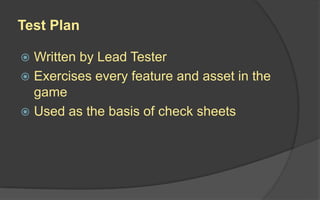
Test Plan
 Written by Lead Tester (or Project
Manager)
 Exercises every feature and asset in the
game
 Used as the basis of check sheets
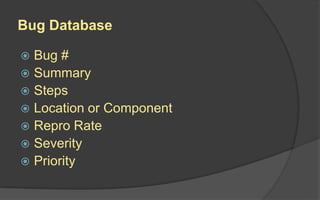
Writing a Bug Report
 Bug #
 Summary (Headline)
 Location or Component
 Description
 Expected Result / Actual Result (when bug is not
obvious)
 Steps to reproduce
 Reproduction Rate
 Severity
 Priority
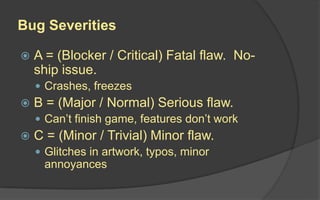
Bug Severities
 A = (Blocker / Critical) Fatal flaw. No-ship
issue.
 Crashes, freezes, can’t finish game
 B = (Major / Normal) Serious flaw.
 Features don’t work properly
 C = (Minor / Trivial) Minor flaw.
 Glitches in artwork, typos, minor annoyances
The Judger
 Step-by-step or checklist-based testing
 Conventional game-playing
 Repetitive testing
 Factual accuracy of game
 Concerned about game contents
 Requires a very structured, ordered,
predictable environment
The Perceiver
 Open-ended or outline-based testing
 Unconventional game-playing
 Testing variety
 Realistic experience of game
 Concerned about game context
 Like a laid-back approach
The QA Process
 QA Team tests build
 QA Team reports defects
 Development Team fixes defects
 QA Team tests new build
 QA Team verifies or rejects fixes
 QA Team tests for new defects
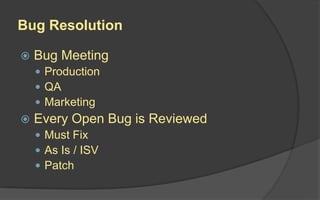
Bug Resolution
 Bug Meeting
 Production
 QA
 Marketing
 Every Open Bug is Reviewed
 Must Fix
 As Is / ISV
 Patch
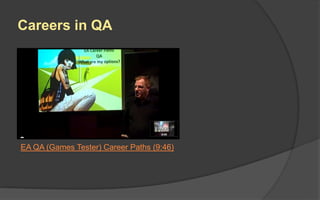
Careers in QA
EA QA (Games Tester) Career Paths (9:46)
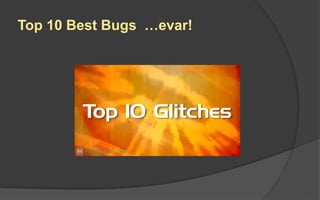
Top 10 Best Bugs …evar!
LAFS SVI Level 6 - Game Development

LAFS SVI Level 6 - Game Development

  • 1.
    Session 6 David Mullich Surveyof the Videogame Industry The Los Angeles Film School
  • 2.
    Developers  A videogame developer is a software developer (a business or an individual) that creates video games  A developer may specialize in a certain video game console, such as Sony's PlayStation 3, or may develop for a variety of platforms
  • 3.
    Game Developer (Business) Owned and run by a game publisher  An independently owned company that may work for different publishers A company that develops video games is also called a Game Studio. Game Studios may be:
  • 4.
    Game Developer (Individual) One or more individuals working freelance A game developer may also be: When applied to an individual, the term “game developer” may also refer specifically to a game programmer. Game programmers are also called: • Coders • Engineers
  • 5.
    Development Teams The lone,“auteur” game developer is a myth.* *Unless you’re Notch. Are you Notch? No, you are not.
  • 6.
  • 7.
    Developer Departments  Design Art/Animation  Programming  Audio (Music/Sound)  Project Management  Quality Assurance  Business Development
  • 8.
    Design Department  Controls UI  Setting/Story/Dialog  Game balance  Level layouts  Scoring  System tweaking  Tutorials  Character/enemy design  Playtesting
  • 9.
    Level Designer Day inthe Life: Video Game Designer
  • 10.
    Art Department  3Dmodeling  Characters  Objects  Levels  Environments  2D  Textures  HUD  Cinematics  Animations  Rigging  UV mapping  Motion capturing
  • 11.
    Game Artist Working inGames: Leader Artist (4:51)
  • 12.
    Programming Department  Graphics Art pipeline  Physics  Networking  AI  Audio  Gameplay  Integration  Optimization  Scripting Interpreters  Tools  Test managers
  • 13.
    Programmers Extra Credits, Season4, Episode 01 - So You Want To Be a Developer (Part 1) (6:57)
  • 14.
    Programmers Extra Credits, Season4, Episode 02 - So You Want To Be a Developer (Part 2) (5:45)
  • 15.
    Do I NeedTo Know Math? Yes! Mathematics is not just for programmers! Geometry is maths too. As are statistics. And probability. And proportion. And even project management and budgeting. Maths is everywhere and it isn’t hard. Especially when it’s applied. So let’s debunk that myth right here.
  • 16.
    Audio Department  Composing Conducting  Recording  Tweaking  Synching
  • 17.
    Game Audio What isGame Audio and Sound Design? (4:51)
  • 18.
    Project Management The managerof a development team might be called:  Development Director  Director  Team Leader  Project Manager  Producer
  • 19.
    What Does AProject Manager Do? Gantt Chart – MS Project
  • 20.
    What Does AProject Manager Do?
  • 21.
    The Producer Extra Credits,Season 3, Episode 11 - So You Want To Be A Producer (8:46)
  • 22.
    Business Development  Responsiblefor finding sales and growth opportunities  Finding new clients  Keeping existing clients  Maintaining client satisfaction
  • 23.
    Specialist Vs. Generalist Theindustry has places for both, but in different contexts. Which one are you? Hint: If you don’t know, you are not a specialist.
  • 25.
    Production Phases  Concept Pre-Production  Production  Post Production
  • 26.
    Concept Phase  ConceptDocument  Project Plan & Budget  Contract
  • 27.
    Pre-Production  Game DesignDocument (GDD): A document describing the game vision and how the game will work.  Technical Design Document (TDD): A document describing how the game will be created  Prototype/First Playable: An early playable version of the game  Detailed Schedule and Budget
  • 28.
    Who Is BusyDuring Pre- Production?  Busiest: Designer  Very Busy: Producer, Lead Programmer, Lead or Conceptual Artist  Somewhat Busy: Other Programmers, Artists  Not Busy: Audio, Testers
  • 29.
    The Pre-Production Problem ExtraCredits, Season 3, Episode 01 - The Pre Production Problem (8:03)
  • 30.
    The Pre-Production Problem Whatcan you do about the problem of the rest of the team being idle while only a few members are doing preproduction? If possible, do preproduction on the next project while the rest of the team is finishing up the current project.
  • 31.
    Production  Team rampsup (adds more people) to create:  All the game features (Alpha code)  All the game assets (art and audio)  All the game levels
  • 32.
  • 33.
  • 34.
    Managing Resources  StarCraft Minerals  Vespene gas  Game Development  People  Money  Time
  • 35.
    The Quality Triangle Tradeoffs:  As any single element increases, Quality increases  As any single element decreases, Quality decreases
  • 36.
    Builds  Daily builds Individual builds (such as for a demonstration)  Major builds (milestones)  Lock down
  • 37.
    Who Is BusyDuring Production?  Busiest: Programmers, Artists  Very Busy: Producer, Designers  Somewhat Busy: Audio  A Little Busy: Testers
  • 38.
    Post-Production  The gameis (nearly) finished and ready for:  Quality Assurance Testing  Localization  Porting
  • 39.
    Localization Issues  Translation Art asset changes  Music changes  Content changes  UI changes  Ratings
  • 40.
    Translation  Dialog (vocals& subtitles)  TRANSLATE WELL!  No more “All your base,” please  String length  Labels imbedded in art assets  Messages/Commands (loading, game over)  Fonts  GUI buttons
  • 41.
  • 42.
    Content Changes History andeven geography may need to be “rewritten” for a given region.  China & Taiwan
  • 43.
    Regional Preferences  Camerasand gameplay may need to be adjusted for some regions.  The US doesn’t like “grinding,” which is highly popular in Asia  US stories are often simplified and glorify Americans, Japanese stories tend to be esoteric  Japan doesn’t like “searching” for items  Asia prefers linearity, the US prefers open-ended  First Person mode tends to cause negative physical reactions in Japan
  • 44.
    Western Vs. AsianViews On Gameplay Extra Credits, Season 2, Episode 17 - The Myth Of The Gun (5:53)
  • 45.
    Who Is BusyDuring Post- Production?  Busiest: Programmers, Testers  Very Busy: Producer  Somewhat Busy: Designer  A Little Busy: Artists, Audio
  • 47.
    Development Methodologies  Waterfall:A sequential process in which development is seen as flowing downwards (like a waterfall) through pre-determined stages  Agile: An iterative process in which the project is re-evaluated at the end of each cycle
  • 51.
    Scrum  A flexibleholistic strategy where a development team works together to reach a common goal  The word “scrum” is a rugby term, referring to the manner of restarting after a minor infraction
  • 52.
    Stakeholder A person, group,organization, or system who affects or can be affected by an organization's actions. They have a vested interest in the project. Stakeholders may have different levels of involvement in a project. Some may be merely contribute, while others are more committed.
  • 53.
    Stakeholders in aGame Project Committed (Pigs) • Development Team • Producer • Quality Assurance Contributors (Chickens) • Sales • Marketing • Finance • Customer
  • 54.
    Roles  Project Owner:Represents the stakeholders and is the voice of the customer. S/he is accountable for delivering value  Team: Responsible for delivering a shippable project in incremental steps  Scrum Master: Enforces the rules of Scrum. Responsible for removing obstacles to the team. Acts as a buffer between the team and distracting influences.
  • 56.
    Project Backlog  Anordered list of requirements for the product: features, bug fixes, non-functional requirements (such as documentation)  The items are ordered by the Product Owner based on considerations like risk, business value, etc.  The features added to the backlog are commonly written in a story format. (“As a user, I would like to…”)
  • 57.
    Scrum Elements  Sprint:The basic unit of development in Scrum. The sprint is a “timeboxed” effort – normally between one week and one month.  Sprint Backlog: The list of tasks to be accomplished during that sprint.  Sprint Planning Meeting: At the beginning of every sprint, a planning meeting is held to decide what work is to be done and prepare the sprint backlog.
  • 58.
    Daily Scrum (DailyStandup) A timeboxed meeting (usually set to 15 minutes) of the development team. It should be held at the same time and location every day. Each team member answers three questions:  What have you done since yesterday?  What are you doing today?  Are there any obstacles?
  • 59.
    End of Sprint Sprint Review Meeting: Completed work is reviewed with the stakeholders (“the demo”)  Sprint Retrospective: The team members discuss improvements to the process
  • 60.
    Scrum Scrum Methodology anAgile Movie (6:12)
  • 61.
    Hybrid  An approachin which Scrum Sprints occur between Waterfall Milestones  Many game studios use a Hybrid methodology rather than a pure Agile approach
  • 62.
    Naughty Dog G4 IconsEpisode #34: Naughty Dog (22:42)
  • 64.
    Testing vs. Playing Athome, you play games to have fun. You get to choose what to play, when to play, and how to play it. Testing games can still be fun, but you have fewer choices about what, when and how to play. Everything you do when you play has a purpose.
  • 65.
    Purposes of GameTesting  Find defects in the code or design  Demonstrate which parts of the game are working properly
  • 66.
    Two Types ofTesting  Gameplay Testing  “It’s too hard.”  “The hats should be blue.”  “Why can’t we have bigger guns?”  Bug Testing  “Game crashes when I do this…”  “Quest giver doesn’t reward me after I turn quest in.”  “Barbie says ‘Ima kill you!’”
  • 67.
    In Other Words Gameplay Testing is subjective and opinion based  Bug Testing is objective and fact based
  • 68.
    QA Tools  TestKit (PC, console, etc.)  Headphones  Video/audio capture  Test Plan  Bug Database
  • 69.
    Test Plan  Writtenby Lead Tester (or Project Manager)  Exercises every feature and asset in the game  Used as the basis of check sheets
  • 70.
    Writing a BugReport  Bug #  Summary (Headline)  Location or Component  Description  Expected Result / Actual Result (when bug is not obvious)  Steps to reproduce  Reproduction Rate  Severity  Priority
  • 71.
    Bug Severities  A= (Blocker / Critical) Fatal flaw. No-ship issue.  Crashes, freezes, can’t finish game  B = (Major / Normal) Serious flaw.  Features don’t work properly  C = (Minor / Trivial) Minor flaw.  Glitches in artwork, typos, minor annoyances
  • 72.
    The Judger  Step-by-stepor checklist-based testing  Conventional game-playing  Repetitive testing  Factual accuracy of game  Concerned about game contents  Requires a very structured, ordered, predictable environment
  • 73.
    The Perceiver  Open-endedor outline-based testing  Unconventional game-playing  Testing variety  Realistic experience of game  Concerned about game context  Like a laid-back approach
  • 74.
    The QA Process QA Team tests build  QA Team reports defects  Development Team fixes defects  QA Team tests new build  QA Team verifies or rejects fixes  QA Team tests for new defects
  • 75.
    Bug Resolution  BugMeeting  Production  QA  Marketing  Every Open Bug is Reviewed  Must Fix  As Is / ISV  Patch
  • 76.
    Careers in QA EAQA (Games Tester) Career Paths (9:46)
  • 77.
    Top 10 BestBugs …evar!

Editor's Notes

  • #52 A bug is literally a recipe for disaster.
  • #73 Stakeholder (corporate), a person, group, organization, or system who affects or can be affected by an organization's actions.