









Mark Lintott May 2014
Who am I?
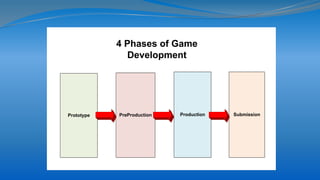
PreProductionPrototype Production Submission
4 Phases of Game
Development
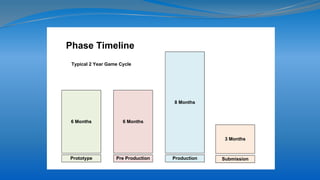
6 Months 6 Months
3 Months
8 Months
Pre ProductionPrototype Production Submission
Phase Timeline
Typical 2 Year Game Cycle
Development Gates
 Each of the Phases have a 1 or more Gates
 You pass each Gate before you move onto the next
 Each Gate passed requires more investment*
 Each Gate passed reduces project risk
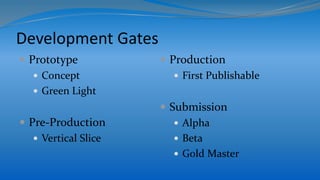
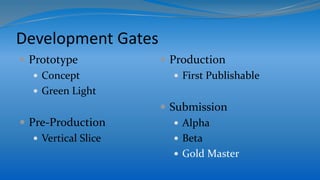
Development Gates
 Prototype
 Concept
 Green Light
 Pre-Production
 Vertical Slice
 Production
 First Publishable
 Submission
 Alpha
 Beta
 Gold Master
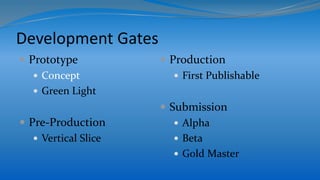
Development Gates
 Prototype
 Concept
 Green Light
 Pre-Production
 Vertical Slice
 Production
 First Publishable
 Submission
 Alpha
 Beta
 Gold Master
Prototype : Concept
“Grow your idea”
 Mostly paper based
 Mainly designers
 Lots of iteration
 Fail fast
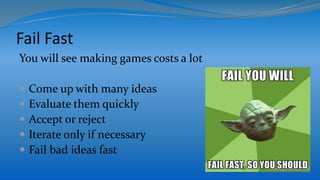
Fail Fast
You will see making games costs a lot
 Come up with many ideas
 Evaluate them quickly
 Accept or reject
 Iterate only if necessary
 Fail bad ideas fast
Development Gates
 Prototype
 Concept
 Green Light
 Pre-Production
 Vertical Slice
 Production
 First Publishable
 Submission
 Alpha
 Beta
 Gold Master
Prototype : Green Light
“Sell the concept”
 Animatics / Storyboard/ Art
 Elevator Pitch
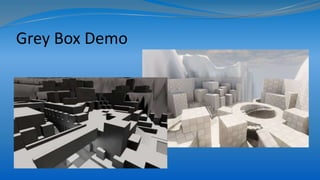
 Early “Grey Box” demo
Prototype : Green Light
“Sell the concept”
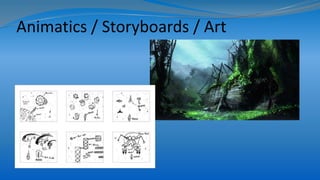
 Animatics / Storyboard/ Art
 Elevator Pitch
 Early “Grey Box” demo
Animatics / Storyboards / Art
Prototype : Green Light
“Sell the concept”
 Animatics / Storyboard/ Art
 Elevator Pitch
 Early “Grey Box” demo
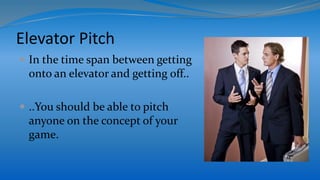
Elevator Pitch
 In the time span between getting
onto an elevator and getting off..
 ..You should be able to pitch
anyone on the concept of your
game.
Prototype : Green Light
“Sell the concept”
 Animatics / Storyboard/ Art
 Elevator Pitch
 “Grey Box” demo
Grey Box Demo
Development Gates
 Prototype
 Concept
 Green Light
 Pre-Production
 Vertical Slice
 Production
 First Publishable
 Submission
 Alpha
 Beta
 Gold Master
Pre-Production : Vertical Slice
“Prove you can make it”
 An entire “vertical slice” through the game
 Demonstrate every mechanic or feature
 Prove the core game play works and is fun
 Prove you have tools and pipelines in place
 Prove you can make it to budget
Development Gates
 Prototype
 Concept
 Green Light
 Pre-Production
 Vertical Slice
 Production
 First Publishable
 Submission
 Alpha
 Beta
 Gold Master
Production : First Publishable
“Make a sellable thing”
 From this point on you could stop production and sell
 Risk is now negligible
 A subset of levels that to release quality
 Marketing can really sell your game
 Demos, Magazine/Press coverage etc..
Development Gates
 Prototype
 Concept
 Green Light
 Pre-Production
 Vertical Slice
 Production
 First Publishable
 Submission
 Alpha
 Beta
 Gold Master
Submission : Alpha
“End to end experience”
 Must contain every level, feature, asset
 Not all polished, some areas might be
 Loads of bugs but you can play to the end
 1st Party QA fully involved
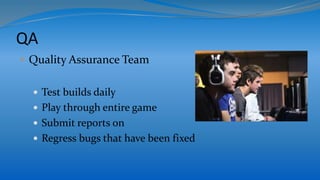
QA
 Quality Assurance Team
 Test builds daily
 Play through entire game
 Submit reports on
 Regress bugs that have been fixed
Submission : Alpha
“End to end experience”
 Must contain every level, feature, asset
 Not all polished, some areas might be
 Loads of bugs but you can play to the end
 1st Party QA fully involved
 Localisation begins
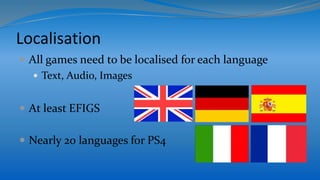
Localisation
 All games need to be localised for each language
 Text, Audio, Images
 At least EFIGS
 Nearly 20 languages for PS4
Development Gates
 Prototype
 Concept
 Green Light
 Pre-Production
 Vertical Slice
 Production
 First Publishable
 Submission
 Alpha
 Beta
 Gold Master
Submission : Beta
“The finished product”
 Localisation complete
 All assets polished to final quality
 Bugs should be minimal / non critical
 Must be TRC compliant
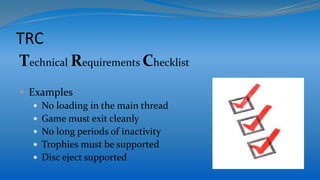
TRC
Technical Requirements Checklist
 Examples
 No loading in the main thread
 Game must exit cleanly
 No long periods of inactivity
 Trophies must be supported
 Disc eject supported
Development Gates
 Prototype
 Concept
 Green Light
 Pre-Production
 Vertical Slice
 Production
 First Publishable
 Submission
 Alpha
 Beta
 Gold Master
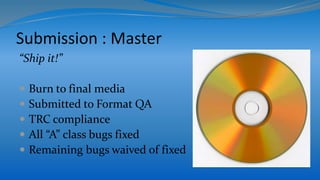
Submission : Master
“Ship it!”
 Burn to final media
 Submitted to Format QA
 TRC compliance
 All “A” class bugs fixed
 Remaining bugs waived of fixed
Development Team
 Typically split into 5 major areas
 Art
 Audio
 Code
 Design
 Production
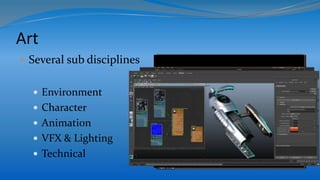
Art
 Several sub disciplines
 Environment
 Character
 Animation
 VFX & Lighting
 Technical
Audio
 Typical responsibilities
 Capturing and synthesising effects
 Adding audio effects and music to game
 Composing music
Code
 These are commonly separated into 2 flavours
 Content
 Technology
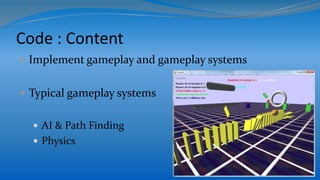
Code : Content
 Implement gameplay and gameplay systems
 Typical gameplay systems
 AI & Path Finding
 Physics
Code : Technical
 Implement runtime and tools
 Rendering
 Resource management
 Exporters and converters
 Game Editors
Design
 These are separated into 2 flavours
 Creative Designers
 Technical Designers
Design : Creative
 Paper based design
 Define gameplay in words and pictures
 Overall vision for the game
 How the levels and mechanics fit together
Design : Technical
 Gameplay implementation
 Scripting
 Adding gameplay to levels
 Triggers, pickups, spawn points
 Level balancing and fun factor
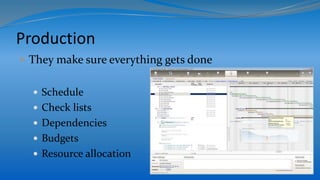
Production
 They make sure everything gets done
 Schedule
 Check lists
 Dependencies
 Budgets
 Resource allocation
Show me the money!
 Let’s consider a hypothetical 2 year console game
 We’ll work in Euros
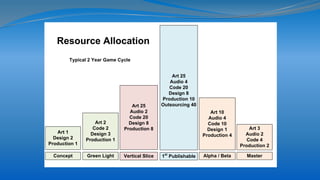
Art 1
Design 2
Production 1
Art 25
Audio 2
Code 20
Design 8
Production 8
Art 10
Audio 4
Code 10
Design 1
Production 4
Art 25
Audio 4
Code 20
Design 8
Production 10
Outsourcing 40
Vertical SliceConcept 1st
Publishable Alpha / Beta
Resource Allocation
Typical 2 Year Game Cycle
Art 2
Code 2
Design 3
Production 1
Green Light
Art 3
Audio 2
Code 4
Production 2
Master
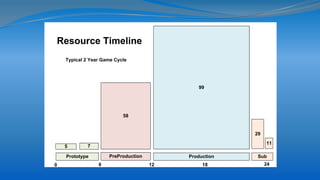
5
58
29
99
PreProductionPrototype Production Sub
Resource Timeline
Typical 2 Year Game Cycle
7
11
6 12 24180
MMR
Man Month Rate
 Sometimes referred to as “Burn Rate”
 Accounts for salary + running costs
 Let’s say ~7500 euros per man per month
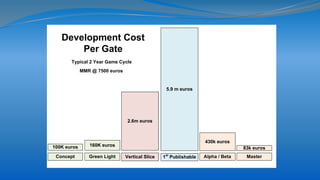
100K euros
2.6m euros
430k euros
5.9 m euros
Vertical SliceConcept 1st
Publishable Alpha / Beta
Development Cost
Per Gate
Typical 2 Year Game Cycle
160K euros
Green Light
83k euros
Master
MMR @ 7500 euros
Grand Total …
Grand Total
 Best part of 10.0M euros
 This is development cost
 Advertising + other costs could be 2x this
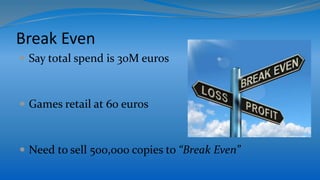
Break Even
 Say total spend is 30M euros
 Games retail at 60 euros
 Need to sell 500,000 copies to “Break Even”
It’s like the Movie Industry!
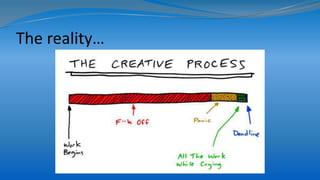
The reality…
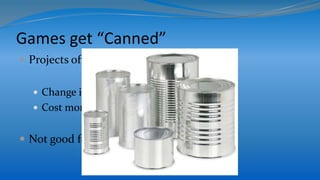
Games get “Canned”
 Projects often get “canned” or “axed”
 Change in trends?
 Cost more to finish than they would make?
 Not good for team morale
Crunch
 People always change their minds
 Ultimately they want to create the best they can
 This results in work last minute changes
 These result in the team having to stay out of hours to
get things done
 Some games have very long crunch times
Crunch
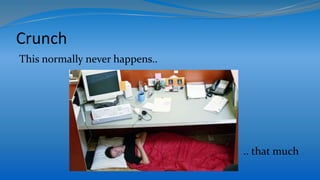
This normally never happens..
.. that much
Demo Driven Development
 Investors need to see visible progress
 More progress makes less risk
 Easy to get demo after demo
 Intrusive and distracting
Good Money?
 Average Developer Salary
 Anywhere between 20k - 60K
 Better off in banking!
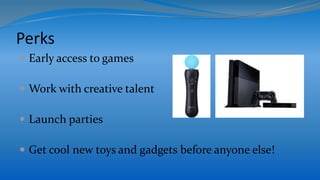
Perks
 Early access to games
 Work with creative talent
 Launch parties
 Get cool new toys and gadgets before anyone else!
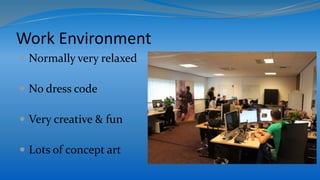
Work Environment
 Normally very relaxed
 No dress code
 Very creative & fun
 Lots of concept art
Work Ethic
 Most people love games more than money
 People collaborate and work as teams
 People stay late because they love what they do
Closing words
 Hopefully you’ve had a brief insight to the process
 It is a very fun, creative and challenging environment
 You now know why games cost you so much!
Thankyou
uk.linkedin.com/in/mrmarkie/
@rendertramp

Digibury: Sony Game developement process - Mark Linott

  • 1.
  • 3.
  • 5.
  • 6.
    6 Months 6Months 3 Months 8 Months Pre ProductionPrototype Production Submission Phase Timeline Typical 2 Year Game Cycle
  • 7.
    Development Gates  Eachof the Phases have a 1 or more Gates  You pass each Gate before you move onto the next  Each Gate passed requires more investment*  Each Gate passed reduces project risk
  • 8.
    Development Gates  Prototype Concept  Green Light  Pre-Production  Vertical Slice  Production  First Publishable  Submission  Alpha  Beta  Gold Master
  • 9.
    Development Gates  Prototype Concept  Green Light  Pre-Production  Vertical Slice  Production  First Publishable  Submission  Alpha  Beta  Gold Master
  • 10.
    Prototype : Concept “Growyour idea”  Mostly paper based  Mainly designers  Lots of iteration  Fail fast
  • 11.
    Fail Fast You willsee making games costs a lot  Come up with many ideas  Evaluate them quickly  Accept or reject  Iterate only if necessary  Fail bad ideas fast
  • 12.
    Development Gates  Prototype Concept  Green Light  Pre-Production  Vertical Slice  Production  First Publishable  Submission  Alpha  Beta  Gold Master
  • 13.
    Prototype : GreenLight “Sell the concept”  Animatics / Storyboard/ Art  Elevator Pitch  Early “Grey Box” demo
  • 14.
    Prototype : GreenLight “Sell the concept”  Animatics / Storyboard/ Art  Elevator Pitch  Early “Grey Box” demo
  • 15.
  • 16.
    Prototype : GreenLight “Sell the concept”  Animatics / Storyboard/ Art  Elevator Pitch  Early “Grey Box” demo
  • 17.
    Elevator Pitch  Inthe time span between getting onto an elevator and getting off..  ..You should be able to pitch anyone on the concept of your game.
  • 18.
    Prototype : GreenLight “Sell the concept”  Animatics / Storyboard/ Art  Elevator Pitch  “Grey Box” demo
  • 19.
  • 20.
    Development Gates  Prototype Concept  Green Light  Pre-Production  Vertical Slice  Production  First Publishable  Submission  Alpha  Beta  Gold Master
  • 21.
    Pre-Production : VerticalSlice “Prove you can make it”  An entire “vertical slice” through the game  Demonstrate every mechanic or feature  Prove the core game play works and is fun  Prove you have tools and pipelines in place  Prove you can make it to budget
  • 22.
    Development Gates  Prototype Concept  Green Light  Pre-Production  Vertical Slice  Production  First Publishable  Submission  Alpha  Beta  Gold Master
  • 23.
    Production : FirstPublishable “Make a sellable thing”  From this point on you could stop production and sell  Risk is now negligible  A subset of levels that to release quality  Marketing can really sell your game  Demos, Magazine/Press coverage etc..
  • 24.
    Development Gates  Prototype Concept  Green Light  Pre-Production  Vertical Slice  Production  First Publishable  Submission  Alpha  Beta  Gold Master
  • 25.
    Submission : Alpha “Endto end experience”  Must contain every level, feature, asset  Not all polished, some areas might be  Loads of bugs but you can play to the end  1st Party QA fully involved
  • 26.
    QA  Quality AssuranceTeam  Test builds daily  Play through entire game  Submit reports on  Regress bugs that have been fixed
  • 27.
    Submission : Alpha “Endto end experience”  Must contain every level, feature, asset  Not all polished, some areas might be  Loads of bugs but you can play to the end  1st Party QA fully involved  Localisation begins
  • 28.
    Localisation  All gamesneed to be localised for each language  Text, Audio, Images  At least EFIGS  Nearly 20 languages for PS4
  • 29.
    Development Gates  Prototype Concept  Green Light  Pre-Production  Vertical Slice  Production  First Publishable  Submission  Alpha  Beta  Gold Master
  • 30.
    Submission : Beta “Thefinished product”  Localisation complete  All assets polished to final quality  Bugs should be minimal / non critical  Must be TRC compliant
  • 31.
    TRC Technical Requirements Checklist Examples  No loading in the main thread  Game must exit cleanly  No long periods of inactivity  Trophies must be supported  Disc eject supported
  • 32.
    Development Gates  Prototype Concept  Green Light  Pre-Production  Vertical Slice  Production  First Publishable  Submission  Alpha  Beta  Gold Master
  • 33.
    Submission : Master “Shipit!”  Burn to final media  Submitted to Format QA  TRC compliance  All “A” class bugs fixed  Remaining bugs waived of fixed
  • 35.
    Development Team  Typicallysplit into 5 major areas  Art  Audio  Code  Design  Production
  • 36.
    Art  Several subdisciplines  Environment  Character  Animation  VFX & Lighting  Technical
  • 37.
    Audio  Typical responsibilities Capturing and synthesising effects  Adding audio effects and music to game  Composing music
  • 38.
    Code  These arecommonly separated into 2 flavours  Content  Technology
  • 39.
    Code : Content Implement gameplay and gameplay systems  Typical gameplay systems  AI & Path Finding  Physics
  • 40.
    Code : Technical Implement runtime and tools  Rendering  Resource management  Exporters and converters  Game Editors
  • 41.
    Design  These areseparated into 2 flavours  Creative Designers  Technical Designers
  • 42.
    Design : Creative Paper based design  Define gameplay in words and pictures  Overall vision for the game  How the levels and mechanics fit together
  • 43.
    Design : Technical Gameplay implementation  Scripting  Adding gameplay to levels  Triggers, pickups, spawn points  Level balancing and fun factor
  • 44.
    Production  They makesure everything gets done  Schedule  Check lists  Dependencies  Budgets  Resource allocation
  • 46.
    Show me themoney!  Let’s consider a hypothetical 2 year console game  We’ll work in Euros
  • 47.
    Art 1 Design 2 Production1 Art 25 Audio 2 Code 20 Design 8 Production 8 Art 10 Audio 4 Code 10 Design 1 Production 4 Art 25 Audio 4 Code 20 Design 8 Production 10 Outsourcing 40 Vertical SliceConcept 1st Publishable Alpha / Beta Resource Allocation Typical 2 Year Game Cycle Art 2 Code 2 Design 3 Production 1 Green Light Art 3 Audio 2 Code 4 Production 2 Master
  • 48.
    5 58 29 99 PreProductionPrototype Production Sub ResourceTimeline Typical 2 Year Game Cycle 7 11 6 12 24180
  • 49.
    MMR Man Month Rate Sometimes referred to as “Burn Rate”  Accounts for salary + running costs  Let’s say ~7500 euros per man per month
  • 50.
    100K euros 2.6m euros 430keuros 5.9 m euros Vertical SliceConcept 1st Publishable Alpha / Beta Development Cost Per Gate Typical 2 Year Game Cycle 160K euros Green Light 83k euros Master MMR @ 7500 euros
  • 51.
  • 52.
    Grand Total  Bestpart of 10.0M euros  This is development cost  Advertising + other costs could be 2x this
  • 53.
    Break Even  Saytotal spend is 30M euros  Games retail at 60 euros  Need to sell 500,000 copies to “Break Even”
  • 55.
    It’s like theMovie Industry!
  • 56.
  • 57.
    Games get “Canned” Projects often get “canned” or “axed”  Change in trends?  Cost more to finish than they would make?  Not good for team morale
  • 58.
    Crunch  People alwayschange their minds  Ultimately they want to create the best they can  This results in work last minute changes  These result in the team having to stay out of hours to get things done  Some games have very long crunch times
  • 59.
    Crunch This normally neverhappens.. .. that much
  • 60.
    Demo Driven Development Investors need to see visible progress  More progress makes less risk  Easy to get demo after demo  Intrusive and distracting
  • 61.
    Good Money?  AverageDeveloper Salary  Anywhere between 20k - 60K  Better off in banking!
  • 62.
    Perks  Early accessto games  Work with creative talent  Launch parties  Get cool new toys and gadgets before anyone else!
  • 63.
    Work Environment  Normallyvery relaxed  No dress code  Very creative & fun  Lots of concept art
  • 64.
    Work Ethic  Mostpeople love games more than money  People collaborate and work as teams  People stay late because they love what they do
  • 65.
    Closing words  Hopefullyyou’ve had a brief insight to the process  It is a very fun, creative and challenging environment  You now know why games cost you so much!
  • 66.