Investigation of the relationship
between livestock value chains and
nutritional status of women and
children: a pilot study in Kenya
A4NH Component 1: Enhancing Nutrition
in Value Chains
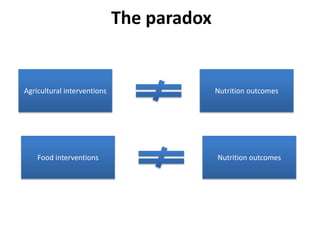
The paradox
Agricultural interventions Nutrition outcomes
Food interventions Nutrition outcomes
The questions
 Are livestock keepers, livestock eaters?
 How much do different ASF contribute to diets? Who gains
nutrition benefits and bears health risks?
 Are there health risks associated with dietary
transition/excessive consumption?
 What are the major constraints to ASF availability?
 How do consumers perceive quality & safety?
 How do culture & gender influence pathogen exposure &
nutritional benefits?
 Are there trade offs between food safety and nutritional
quality?
 Are there trade offs between food and feed?
 How does VC development influence safety & quality?
Hypothesis
There is an association between consumers’
access to and use of different food sources, in
particular livestock value chains, and their
nutritional status
Objectives
– To evaluate nutritional status, dietary adequacy and
dietary diversity of women and children.
– To assess consumer behaviour, preferences, choices and
consumption patterns.
– To investigate associations between nutritional
indicators, and the different types or clusters of livestock
value chains used by these consumers.
– To describe determinants of the livestock value chains
associated with poor nutritional status.
– To determine how animal source foods might help ensure
dietary adequacy by use of linear programming analysis.
– To develop a major research proposal on leveraging animal
source foods for nutrition based on the findings and
recommendations of the research.
Methods
- 200 household survey in poor areas of Nairobi
- Assess nutritional status of:
- Children between 1 and 3 years old
- Mother
- Nutritional indicators:
- Anthropometric measurement
- Dietary assessment (Diet recall 24h)
- Haemoglobin measurement
Methods II
- Assess livestock value chains used:
- Household products used: Type, origin, access,
affordability, temporal changes and other factors
- Livestock value chain analysis (Data obtained from another
project – Urban Zoonosis project)
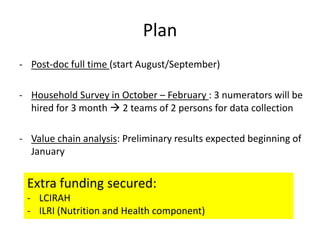
Plan
- Post-doc full time (start August/September)
- Household Survey in October – February : 3 numerators will be
hired for 3 month  2 teams of 2 persons for data collection
- Value chain analysis: Preliminary results expected beginning of
January
Extra funding secured:
- LCIRAH
- ILRI (Nutrition and Health component)
Thanks
Kathleen Colverson (ILRI)
Delia Grace (ILRI)
Silvia Alonso (ILRI)
Jonathan Rushton (RVC)
Barbara Häsler (RVC)
Pablo Alarcon (RVC)
Elaine Ferguson (LHSTM)
Eric Fèvre (UoE)

Session 2. Grace - Nutrition Outcomes and ASF Value Chains

  • 1.
    Investigation of therelationship between livestock value chains and nutritional status of women and children: a pilot study in Kenya A4NH Component 1: Enhancing Nutrition in Value Chains
  • 2.
    The paradox Agricultural interventionsNutrition outcomes Food interventions Nutrition outcomes
  • 3.
    The questions  Arelivestock keepers, livestock eaters?  How much do different ASF contribute to diets? Who gains nutrition benefits and bears health risks?  Are there health risks associated with dietary transition/excessive consumption?  What are the major constraints to ASF availability?  How do consumers perceive quality & safety?  How do culture & gender influence pathogen exposure & nutritional benefits?  Are there trade offs between food safety and nutritional quality?  Are there trade offs between food and feed?  How does VC development influence safety & quality?
  • 4.
    Hypothesis There is anassociation between consumers’ access to and use of different food sources, in particular livestock value chains, and their nutritional status
  • 5.
    Objectives – To evaluatenutritional status, dietary adequacy and dietary diversity of women and children. – To assess consumer behaviour, preferences, choices and consumption patterns. – To investigate associations between nutritional indicators, and the different types or clusters of livestock value chains used by these consumers. – To describe determinants of the livestock value chains associated with poor nutritional status. – To determine how animal source foods might help ensure dietary adequacy by use of linear programming analysis. – To develop a major research proposal on leveraging animal source foods for nutrition based on the findings and recommendations of the research.
  • 6.
    Methods - 200 householdsurvey in poor areas of Nairobi - Assess nutritional status of: - Children between 1 and 3 years old - Mother - Nutritional indicators: - Anthropometric measurement - Dietary assessment (Diet recall 24h) - Haemoglobin measurement
  • 7.
    Methods II - Assesslivestock value chains used: - Household products used: Type, origin, access, affordability, temporal changes and other factors - Livestock value chain analysis (Data obtained from another project – Urban Zoonosis project)
  • 8.
    Plan - Post-doc fulltime (start August/September) - Household Survey in October – February : 3 numerators will be hired for 3 month  2 teams of 2 persons for data collection - Value chain analysis: Preliminary results expected beginning of January Extra funding secured: - LCIRAH - ILRI (Nutrition and Health component)
  • 9.
    Thanks Kathleen Colverson (ILRI) DeliaGrace (ILRI) Silvia Alonso (ILRI) Jonathan Rushton (RVC) Barbara Häsler (RVC) Pablo Alarcon (RVC) Elaine Ferguson (LHSTM) Eric Fèvre (UoE)