A Community Participatory Intervention Model To Reduce The
Health Risks From Biogas Wastewater in Hanam Province, Vietnam
INTRODUCTION
In Vietnam, livestock production has been rapidly developing, i.e. increasing in the
number of animals in general, and in animal size/number of households in
particular. Waste in animal livestock amounted to 85 million tons per year and 37
million tons of wastewater per year (Vietnam rural agriculture, 2014). A large
amount of waste is directly disposed to the environment, causing environmental
pollution and adverse impacts on human health.
To address this situation, biogas system have applied to treat livestock waste in
commonly, in particular at the smallholder farms. However, most of smallholder
farms have not yet used the biogas correctly then biogas wastewater could affect
health and environment. We applied transdisciplinary and community
participatory approach (called Ecohealth approach) in research to improve
knowledge and practice of farmer for better operation of biogas systems and
treatment of waste.
The transdisciplinary approach is likely to be adopted widely in the intervention
program, particilar intervention programs to change the agriculture and rural
issues. Community priorities should be determined by local people. Then
community problem will be solved by knowledge of scientists and practical
experience of local people co-operation. It is core competency of the ecosystem
approach to health.
FBLI:FieldBuildingleadershipInitiative:
AdvancingEcohealthinSEA
Luu Quoc Toan, Nguyen Mai Huong, Nguyen Tien Thanh, Pham Thi Huong Giang, Hanh Tran-Thi-Tuyet, Tran Minh Hang, Dinh Xuan Tung, Phuc Pham-Duc, Hung Nguyen-Viet
Center for Public Health and Ecosystem Research, Hanoi University of Public Health
OBJECTIVES
The intervention program aimed to:
• Develop and implement a set of interventions tools by participatory of
transdisciplinary sectors.
• Improved knowledge and practices of farmer for better operation of biogas
systems and treatment of waste.
RESULTS
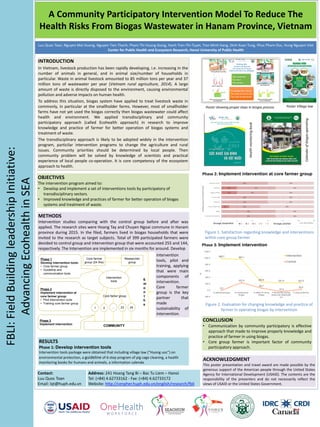
Phase 1: Develop intervention tools
Intervention tools package were obtained that including village law (“Huong uoc”) on
environmental protection, a guideline of 6-step program of pig cage cleaning, a health
monitoring books for humans and animals, a information calenda.
Contact:
Luu Quoc Toan
Email: lqt@huph.edu.vn
Address: 241 Hoang Tang Bi – Bac Tu Liem – Hanoi
Tel: (+84) 4.62733162 - Fax: (+84) 4.62733172
Website: http://cenpher.huph.edu.vn/english/research/fbli
1 2 … 23 24
Core famer group
COMMUNITY
Researcher
group
Core farmer
group (24 hhs)
Intervention
tools 6
m
o
n
t
h
s
Phase 1
Develop intervention tools:
• Core farmer group
• Guideline and
communication tools
Phase 2
Implement intervention at
core farmer group:
• Pilot intervention tools
• Training core farmer group
Phase 3
Implement intervention
Poster showing proper steps in biogas process Poster Village law
Calendarofbiogasoperating
Healthmonitoringbook
Phase 2: Implement intervention at core farmer group
8%
16%
16%
58%
58%
34%
50%
50%
34%
42%
50%
42%
42%
58%
50%
50%
50%
42%
50%
0 2 4 6 8 10 12
Environmental sanitation
Biogas
Human health risks
Huong Uoc
6-step model
Biogas calendar
Handbook
Huong Uoc poster
# OF PARTICIPANTS
KNOWLEDGEINTERVENTION
1 2 3 4 5Strongly dissatisfied Strongly satisfied
Phase 3: Implement intervention
ACKNOWLEDGMENT
This poster presentation and travel award are made possible by the
generous support of the American people through the United States
Agency for International Development (USAID). The contents are the
responsibility of the presenters and do not necessarily reflect the
views of USAID or the United States Government.
985.7 957.1
256.6 231.9 227.0
0.0
237.5
66.7
-37.2
25.5
-200.0
0.0
200.0
400.0
600.0
800.0
1000.0
1200.0
K-operating biogas K-maintainance
biogas
K-safety for using
biogas
P-Monitoring loading
waste and wastewater
out
P-using protectors
%
Intervention
Control
METHODS
Intervention studies comparing with the control group before and after was
applied. The research sites were Hoang Tay and Chuyen Ngoai commune in Hanam
province during 2015. In the filed, farmers lived in biogas households that were
invited to the research as target subjects. Total of 399 participated farmers were
devided to control group and intervention group that were accounted 255 and 144,
respectively. The Intervention are implemented in six months for around. Develop
intervention
tools, pilot and
training, applying
that were main
components of
intervention.
Core farmer
group is the key
partner that
made
sustainability of
intervention.
Figure 1. Satisfaction regarding knowledge and interventions
within core group farmer
CONCLUSION
• Communication by community participatory is effective
approach that made to improve properly knowledge and
practice of farmer in using biogas.
• Core group farmer is important factor of community
participatory approach.
Figure 2. Evaluation for changing knowledge and practice of
farmer in operating biogas by intervention

A community participatory intervention model to reduce the health risks from biogas wastewater in Hanam Province, Vietnam

  • 1.
    A Community ParticipatoryIntervention Model To Reduce The Health Risks From Biogas Wastewater in Hanam Province, Vietnam INTRODUCTION In Vietnam, livestock production has been rapidly developing, i.e. increasing in the number of animals in general, and in animal size/number of households in particular. Waste in animal livestock amounted to 85 million tons per year and 37 million tons of wastewater per year (Vietnam rural agriculture, 2014). A large amount of waste is directly disposed to the environment, causing environmental pollution and adverse impacts on human health. To address this situation, biogas system have applied to treat livestock waste in commonly, in particular at the smallholder farms. However, most of smallholder farms have not yet used the biogas correctly then biogas wastewater could affect health and environment. We applied transdisciplinary and community participatory approach (called Ecohealth approach) in research to improve knowledge and practice of farmer for better operation of biogas systems and treatment of waste. The transdisciplinary approach is likely to be adopted widely in the intervention program, particilar intervention programs to change the agriculture and rural issues. Community priorities should be determined by local people. Then community problem will be solved by knowledge of scientists and practical experience of local people co-operation. It is core competency of the ecosystem approach to health. FBLI:FieldBuildingleadershipInitiative: AdvancingEcohealthinSEA Luu Quoc Toan, Nguyen Mai Huong, Nguyen Tien Thanh, Pham Thi Huong Giang, Hanh Tran-Thi-Tuyet, Tran Minh Hang, Dinh Xuan Tung, Phuc Pham-Duc, Hung Nguyen-Viet Center for Public Health and Ecosystem Research, Hanoi University of Public Health OBJECTIVES The intervention program aimed to: • Develop and implement a set of interventions tools by participatory of transdisciplinary sectors. • Improved knowledge and practices of farmer for better operation of biogas systems and treatment of waste. RESULTS Phase 1: Develop intervention tools Intervention tools package were obtained that including village law (“Huong uoc”) on environmental protection, a guideline of 6-step program of pig cage cleaning, a health monitoring books for humans and animals, a information calenda. Contact: Luu Quoc Toan Email: lqt@huph.edu.vn Address: 241 Hoang Tang Bi – Bac Tu Liem – Hanoi Tel: (+84) 4.62733162 - Fax: (+84) 4.62733172 Website: http://cenpher.huph.edu.vn/english/research/fbli 1 2 … 23 24 Core famer group COMMUNITY Researcher group Core farmer group (24 hhs) Intervention tools 6 m o n t h s Phase 1 Develop intervention tools: • Core farmer group • Guideline and communication tools Phase 2 Implement intervention at core farmer group: • Pilot intervention tools • Training core farmer group Phase 3 Implement intervention Poster showing proper steps in biogas process Poster Village law Calendarofbiogasoperating Healthmonitoringbook Phase 2: Implement intervention at core farmer group 8% 16% 16% 58% 58% 34% 50% 50% 34% 42% 50% 42% 42% 58% 50% 50% 50% 42% 50% 0 2 4 6 8 10 12 Environmental sanitation Biogas Human health risks Huong Uoc 6-step model Biogas calendar Handbook Huong Uoc poster # OF PARTICIPANTS KNOWLEDGEINTERVENTION 1 2 3 4 5Strongly dissatisfied Strongly satisfied Phase 3: Implement intervention ACKNOWLEDGMENT This poster presentation and travel award are made possible by the generous support of the American people through the United States Agency for International Development (USAID). The contents are the responsibility of the presenters and do not necessarily reflect the views of USAID or the United States Government. 985.7 957.1 256.6 231.9 227.0 0.0 237.5 66.7 -37.2 25.5 -200.0 0.0 200.0 400.0 600.0 800.0 1000.0 1200.0 K-operating biogas K-maintainance biogas K-safety for using biogas P-Monitoring loading waste and wastewater out P-using protectors % Intervention Control METHODS Intervention studies comparing with the control group before and after was applied. The research sites were Hoang Tay and Chuyen Ngoai commune in Hanam province during 2015. In the filed, farmers lived in biogas households that were invited to the research as target subjects. Total of 399 participated farmers were devided to control group and intervention group that were accounted 255 and 144, respectively. The Intervention are implemented in six months for around. Develop intervention tools, pilot and training, applying that were main components of intervention. Core farmer group is the key partner that made sustainability of intervention. Figure 1. Satisfaction regarding knowledge and interventions within core group farmer CONCLUSION • Communication by community participatory is effective approach that made to improve properly knowledge and practice of farmer in using biogas. • Core group farmer is important factor of community participatory approach. Figure 2. Evaluation for changing knowledge and practice of farmer in operating biogas by intervention