Results from the test track in the eVALUE projectFredrik Bruzelius, Mattias Hjort, Håkan Andersson
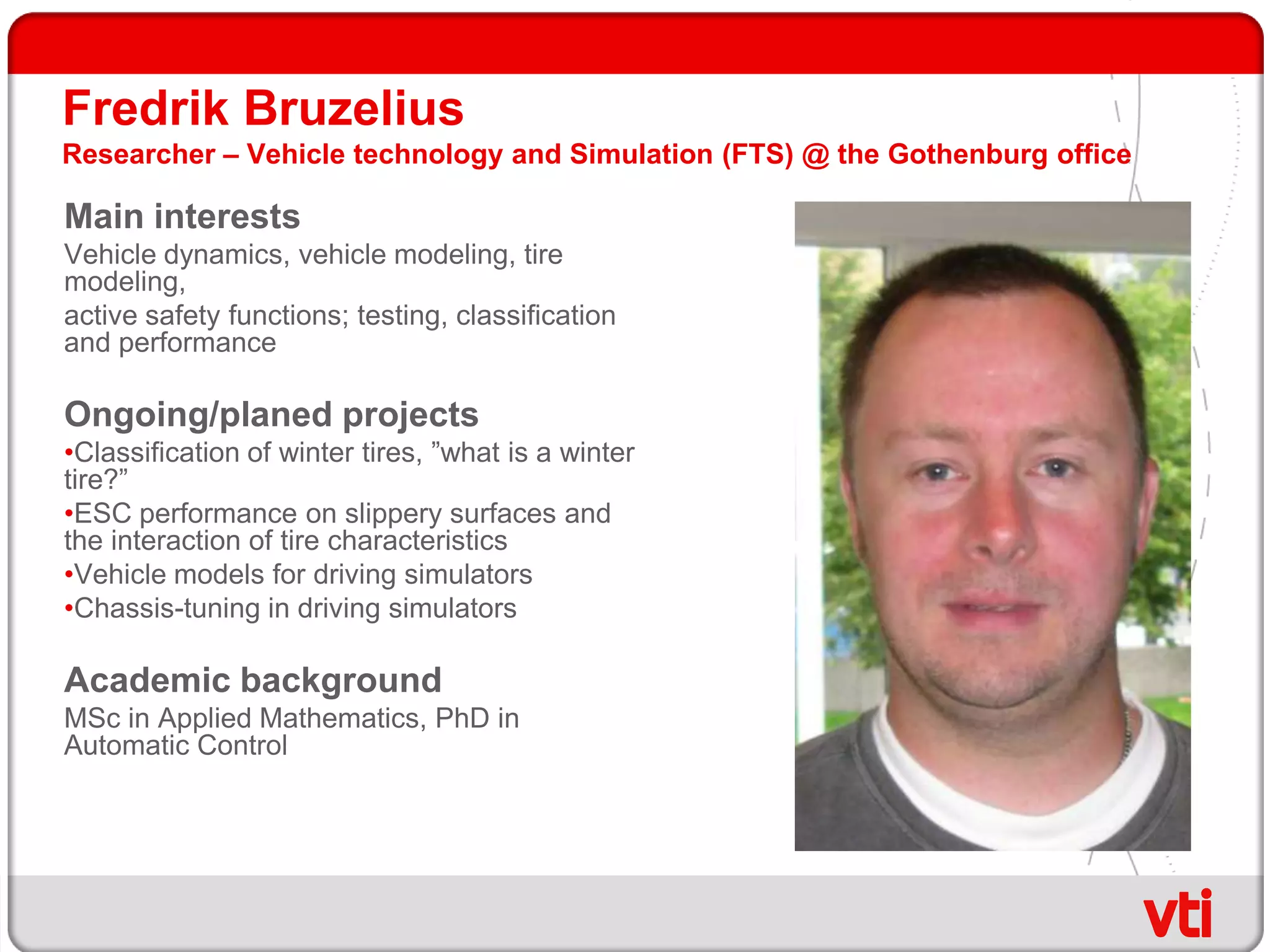
Fredrik BruzeliusResearcher – Vehicle technology and Simulation (FTS) @ the Gothenburg officeMain interestsVehicle dynamics, vehicle modeling, tire modeling, active safety functions; testing, classification and performanceOngoing/planed projectsClassification of winter tires, ”what is a winter tire?”
ESC performance on slippery surfaces and the interaction of tire characteristics
Vehicle models for driving simulators
Chassis-tuning in driving simulatorsAcademic backgroundMSc in Applied Mathematics, PhD in Automatic Control
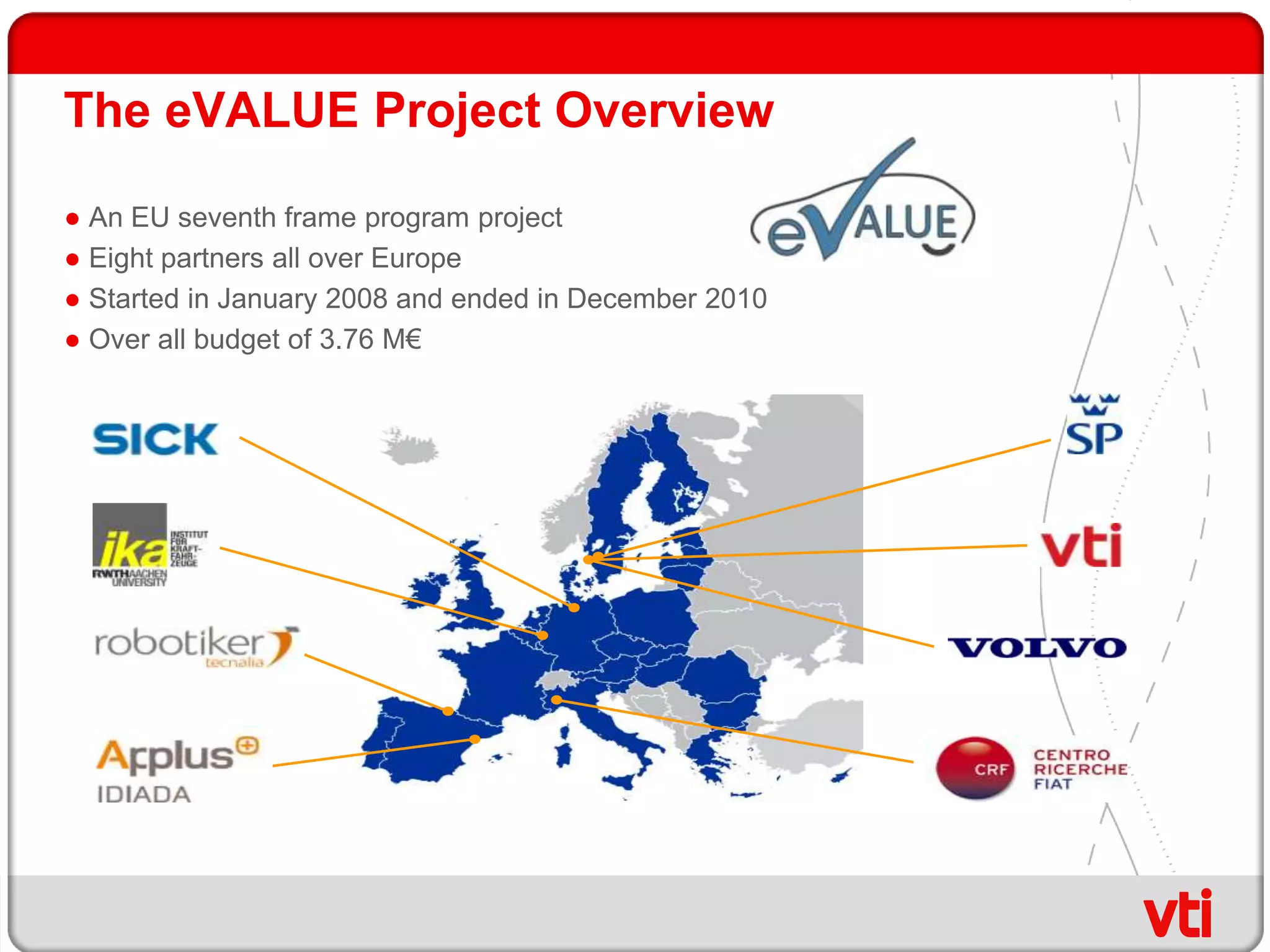
The eVALUE Project OverviewAn EU seventh frame program projectEight partners all over EuropeStarted in January 2008 and ended in December 2010Over all budget of 3.76 M€
Project objectives/motivation Active safety is a key measure when it comes to decreasing traffic accidents, injuries and deaths.
Active safety functions are introduced into new vehicles, so far only in premium vehicles.
However, and in opposition to passive safety, the car buyer cannot judge the performance of a vehicle’s active safety based on objective measures.
Every vehicle OEM is promoting active safety, but mainly on functionality rather than on safety impact.Need for objective test methods for active safety!Promote active safety by increase the public awareness through a test program (c.f. NCAP)
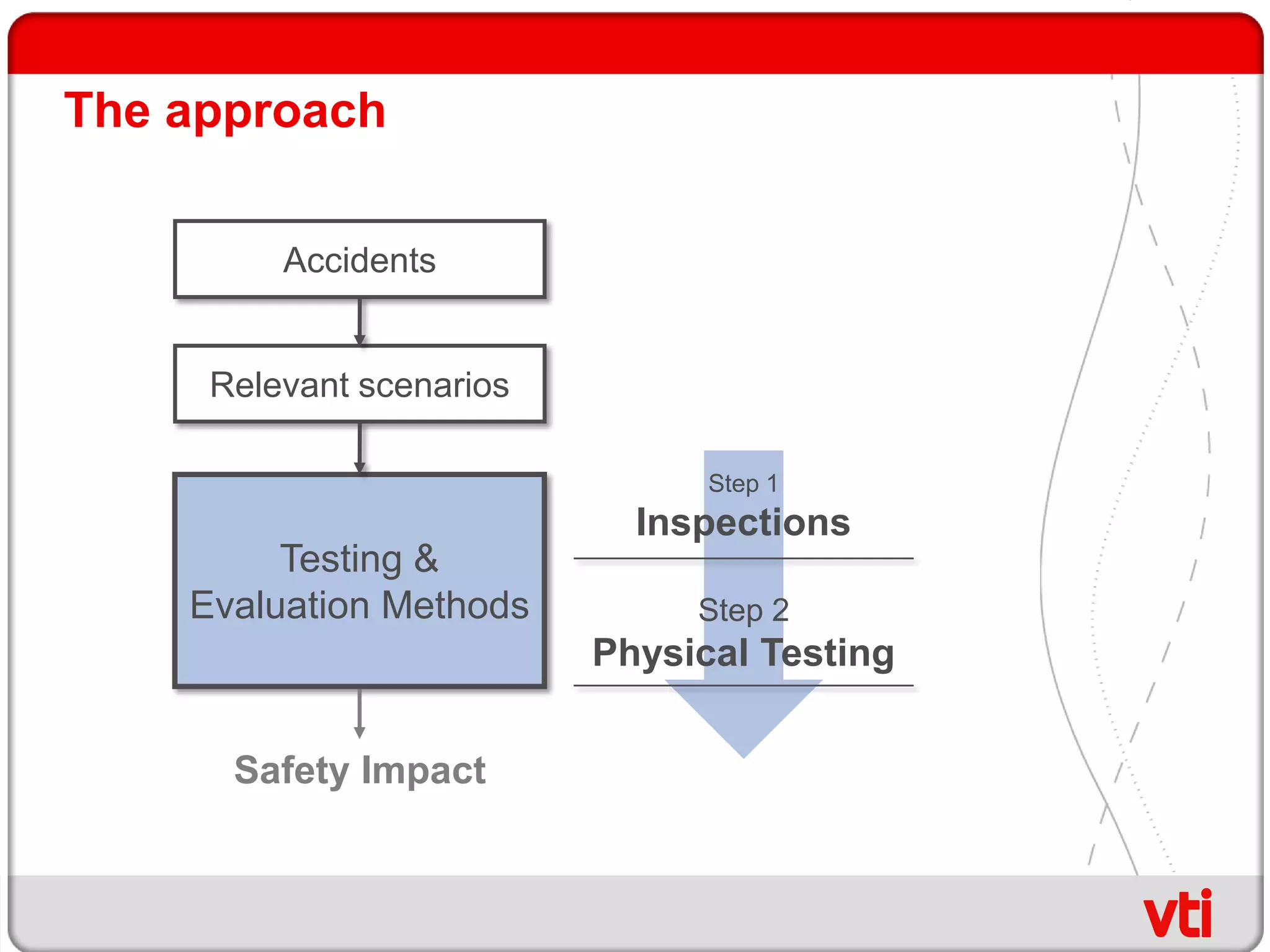
Support the development of active safety functionsThe approachAccidentsRelevant scenariosStep 1InspectionsTesting & Evaluation MethodsStep 2Physical TestingSafety Impact
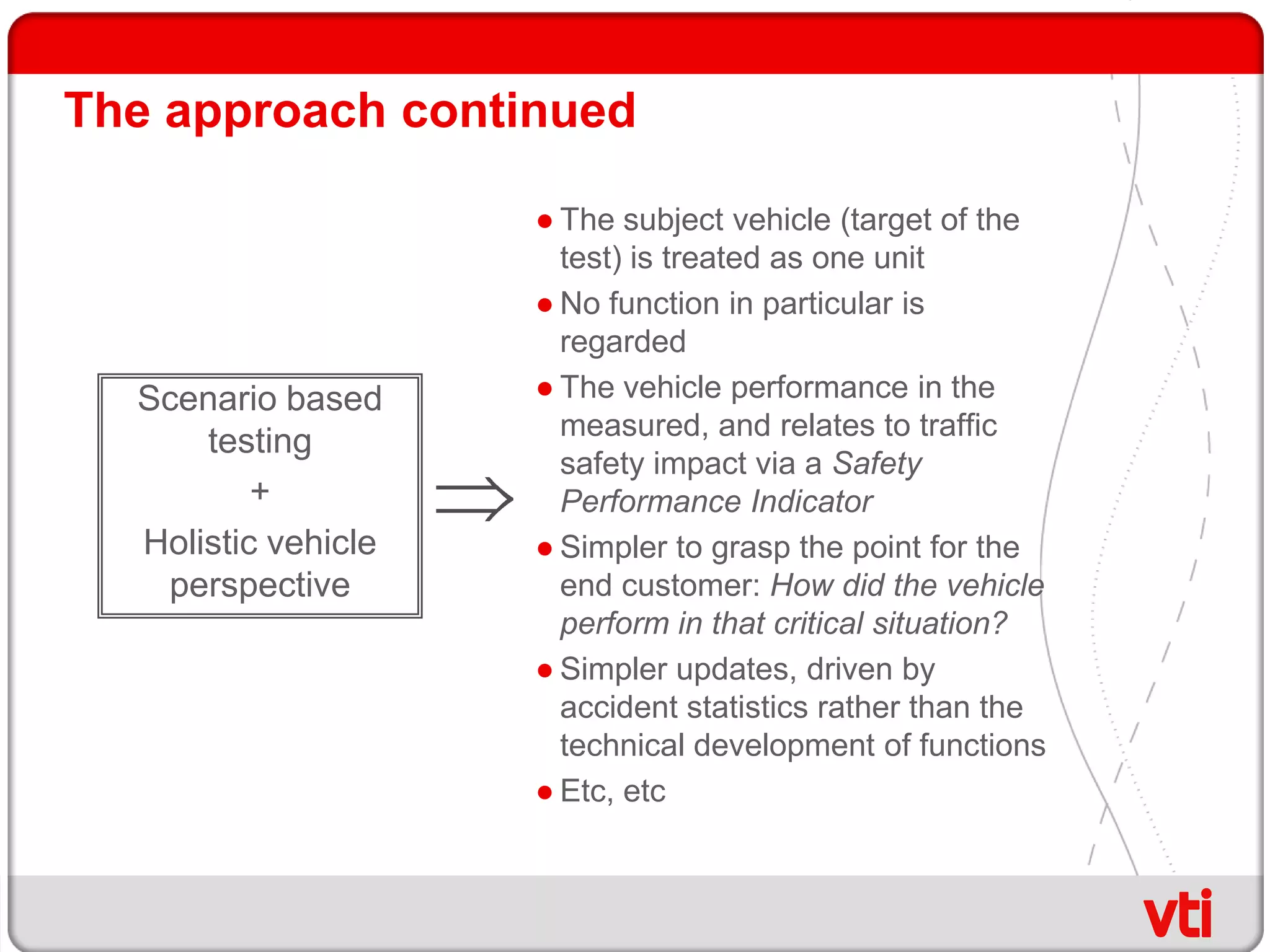
The approach continuedThe subject vehicle (target of the test) is treated as one unitNo function in particular is regardedThe vehicle performance in the measured, and relates to traffic safety impact via a Safety Performance IndicatorSimpler to grasp the point for the end customer: How did the vehicle perform in that critical situation?Simpler updates, driven by accident statistics rather than the technical development of functionsEtc, etcScenario based testing+Holistic vehicle perspective
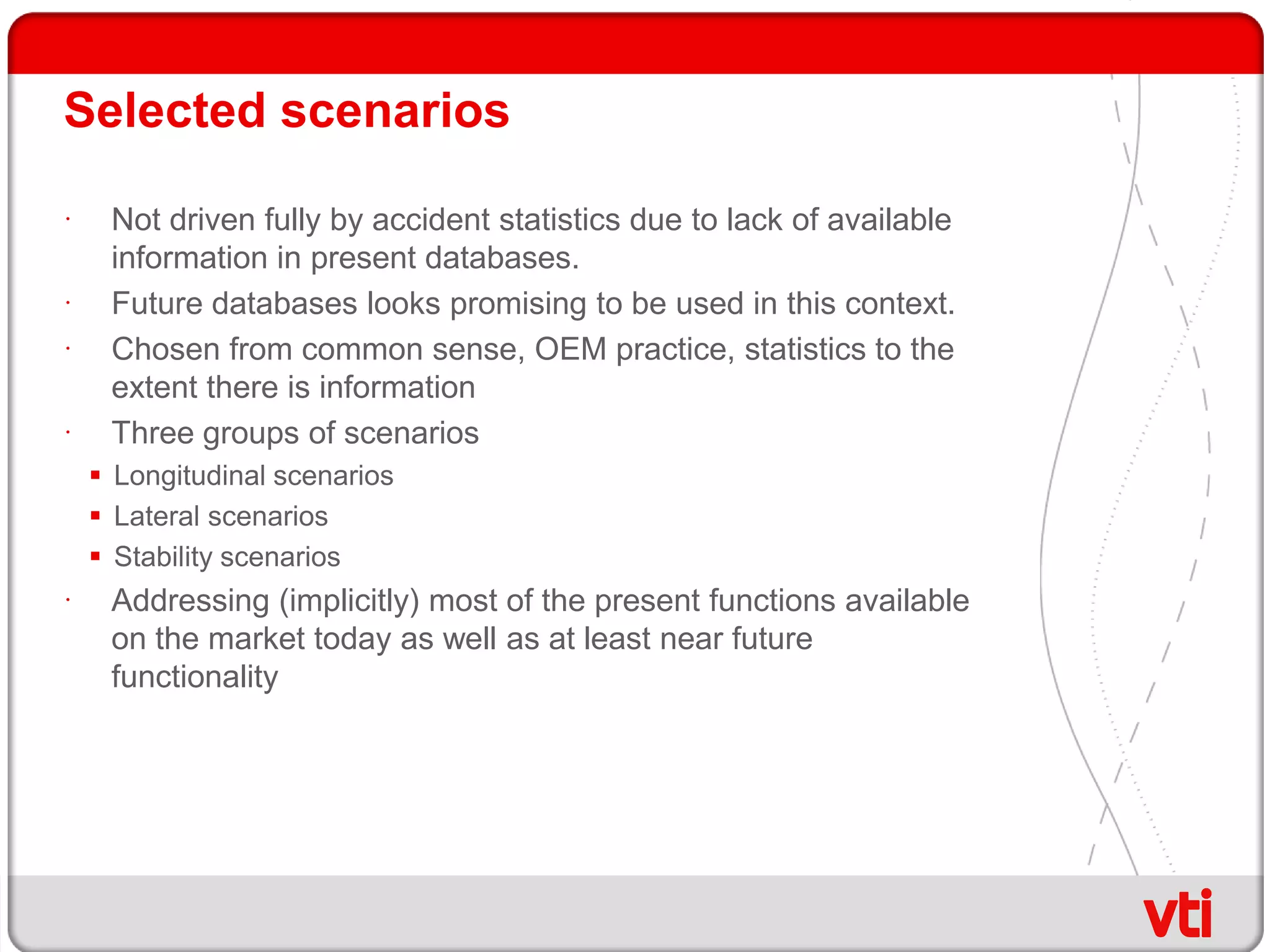
Selected scenariosNot driven fully by accident statistics due to lack of available information in present databases.
Future databases looks promising to be used in this context.
Chosen from common sense, OEM practice, statistics to the extent there is information
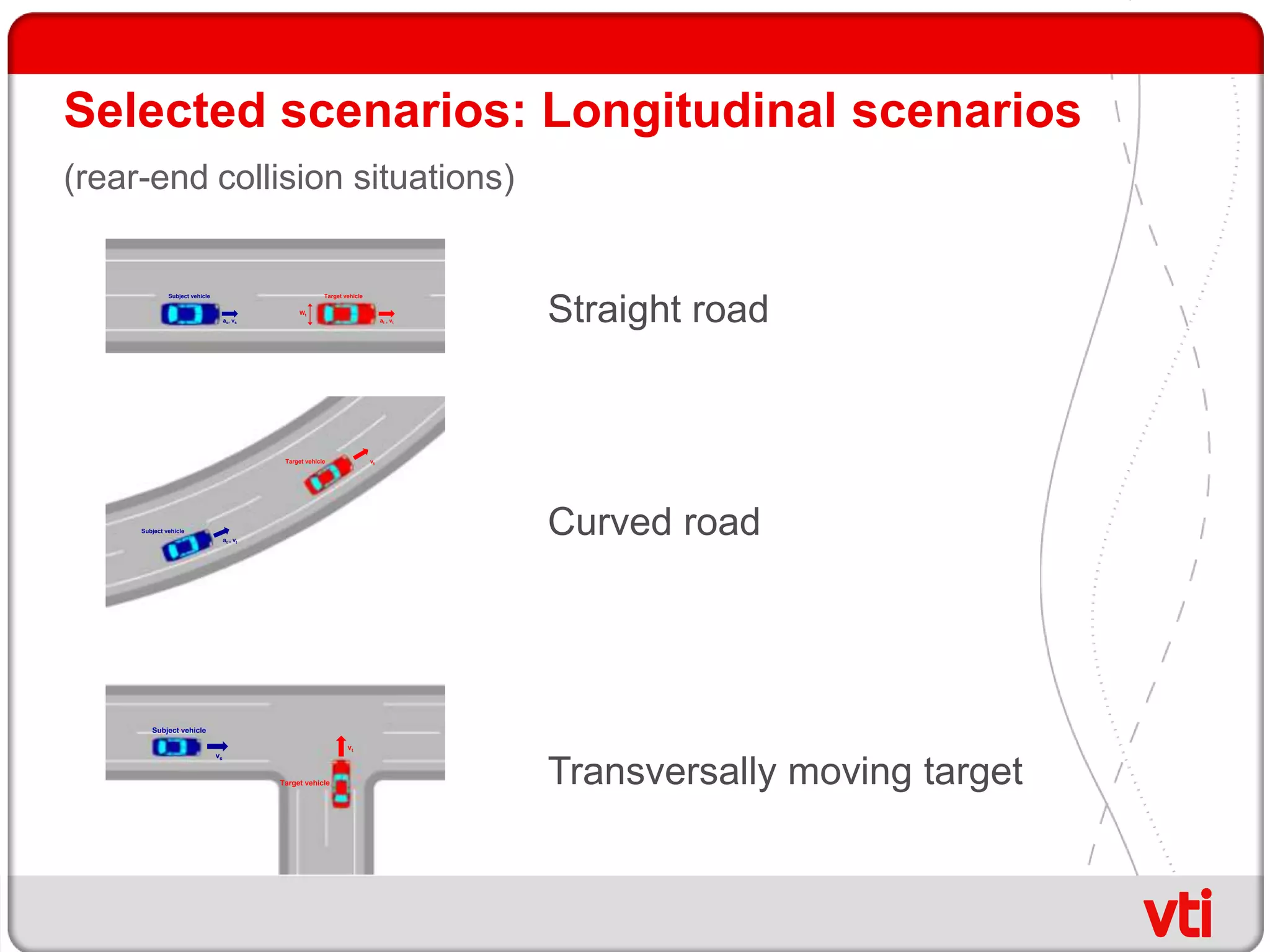
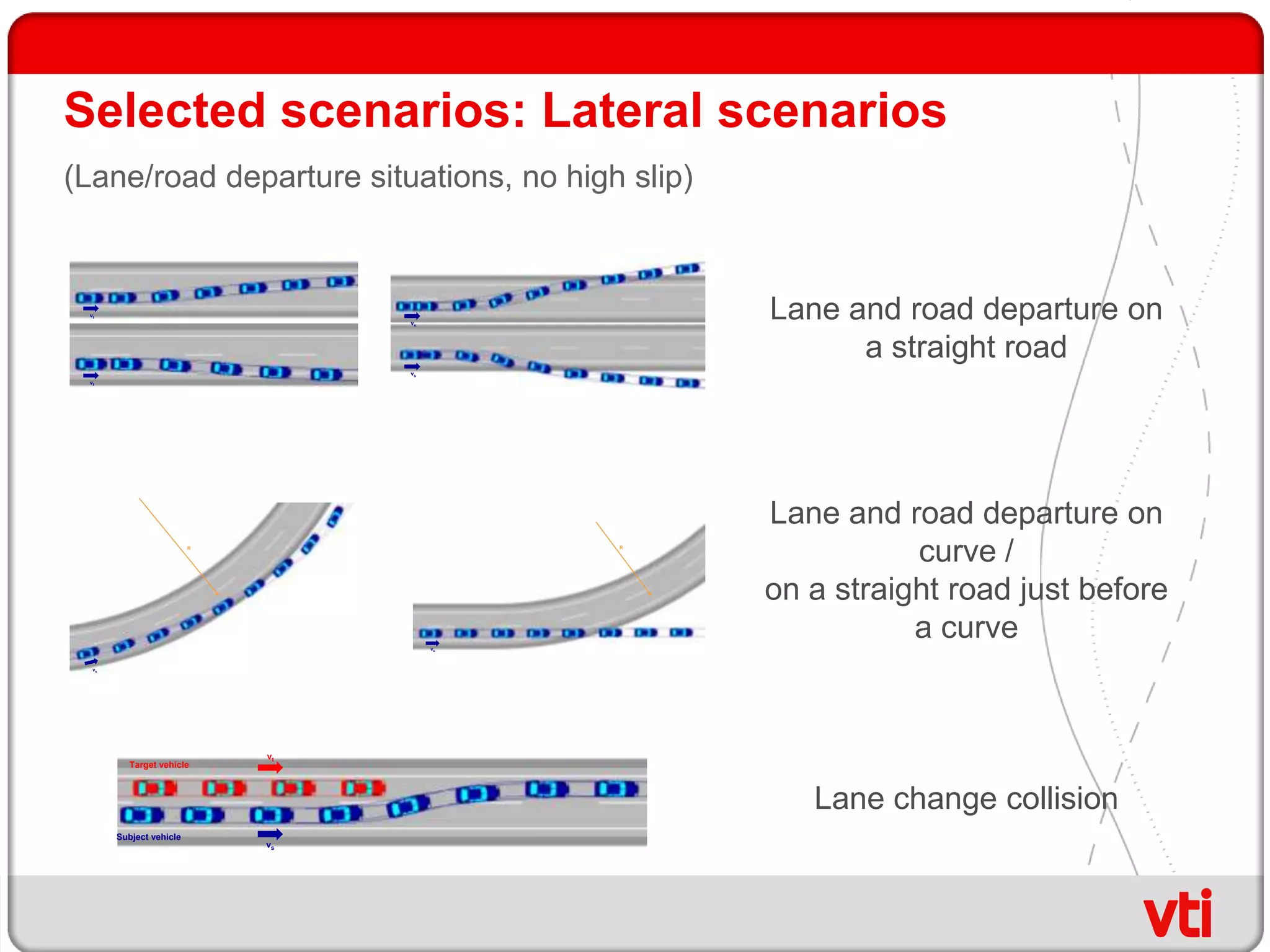
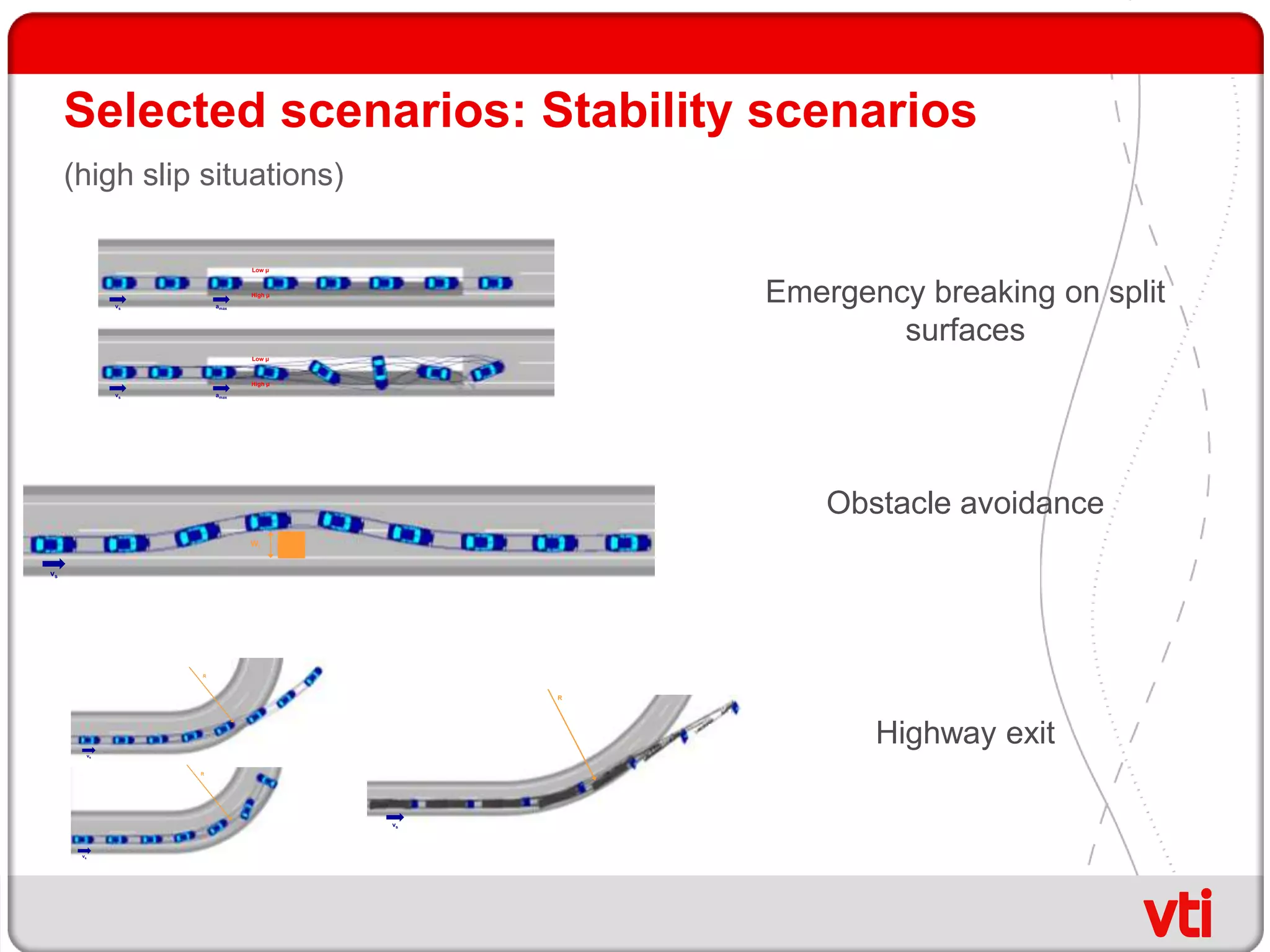
Three groups of scenariosLongitudinal scenariosLateral scenariosStability scenariosAddressing (implicitly) most of the present functions available on the market today as well as at least near future functionality Selected scenarios: Longitudinal scenarios(rear-end collision situations)Straight roadCurved roadTransversally moving target

Session 19 Fredrik Bruzelius

  • 1.
    Results from thetest track in the eVALUE projectFredrik Bruzelius, Mattias Hjort, Håkan Andersson
  • 2.
    Fredrik BruzeliusResearcher –Vehicle technology and Simulation (FTS) @ the Gothenburg officeMain interestsVehicle dynamics, vehicle modeling, tire modeling, active safety functions; testing, classification and performanceOngoing/planed projectsClassification of winter tires, ”what is a winter tire?”
  • 3.
    ESC performance onslippery surfaces and the interaction of tire characteristics
  • 4.
    Vehicle models fordriving simulators
  • 5.
    Chassis-tuning in drivingsimulatorsAcademic backgroundMSc in Applied Mathematics, PhD in Automatic Control
  • 6.
    The eVALUE ProjectOverviewAn EU seventh frame program projectEight partners all over EuropeStarted in January 2008 and ended in December 2010Over all budget of 3.76 M€
  • 7.
    Project objectives/motivation Activesafety is a key measure when it comes to decreasing traffic accidents, injuries and deaths.
  • 8.
    Active safety functionsare introduced into new vehicles, so far only in premium vehicles.
  • 9.
    However, and inopposition to passive safety, the car buyer cannot judge the performance of a vehicle’s active safety based on objective measures.
  • 10.
    Every vehicle OEMis promoting active safety, but mainly on functionality rather than on safety impact.Need for objective test methods for active safety!Promote active safety by increase the public awareness through a test program (c.f. NCAP)
  • 11.
    Support the developmentof active safety functionsThe approachAccidentsRelevant scenariosStep 1InspectionsTesting & Evaluation MethodsStep 2Physical TestingSafety Impact
  • 12.
    The approach continuedThesubject vehicle (target of the test) is treated as one unitNo function in particular is regardedThe vehicle performance in the measured, and relates to traffic safety impact via a Safety Performance IndicatorSimpler to grasp the point for the end customer: How did the vehicle perform in that critical situation?Simpler updates, driven by accident statistics rather than the technical development of functionsEtc, etcScenario based testing+Holistic vehicle perspective
  • 13.
    Selected scenariosNot drivenfully by accident statistics due to lack of available information in present databases.
  • 14.
    Future databases lookspromising to be used in this context.
  • 15.
    Chosen from commonsense, OEM practice, statistics to the extent there is information
  • 16.
    Three groups ofscenariosLongitudinal scenariosLateral scenariosStability scenariosAddressing (implicitly) most of the present functions available on the market today as well as at least near future functionality Selected scenarios: Longitudinal scenarios(rear-end collision situations)Straight roadCurved roadTransversally moving target
  • 17.
    Selected scenarios: Lateralscenarios(Lane/road departure situations, no high slip)Lane and road departure on a straight roadLane and road departure on curve /on a straight road just before a curveLane change collision
  • 18.
    Selected scenarios: Stabilityscenarios(high slip situations)Emergency breaking on split surfacesObstacle avoidanceHighway exit
  • 19.
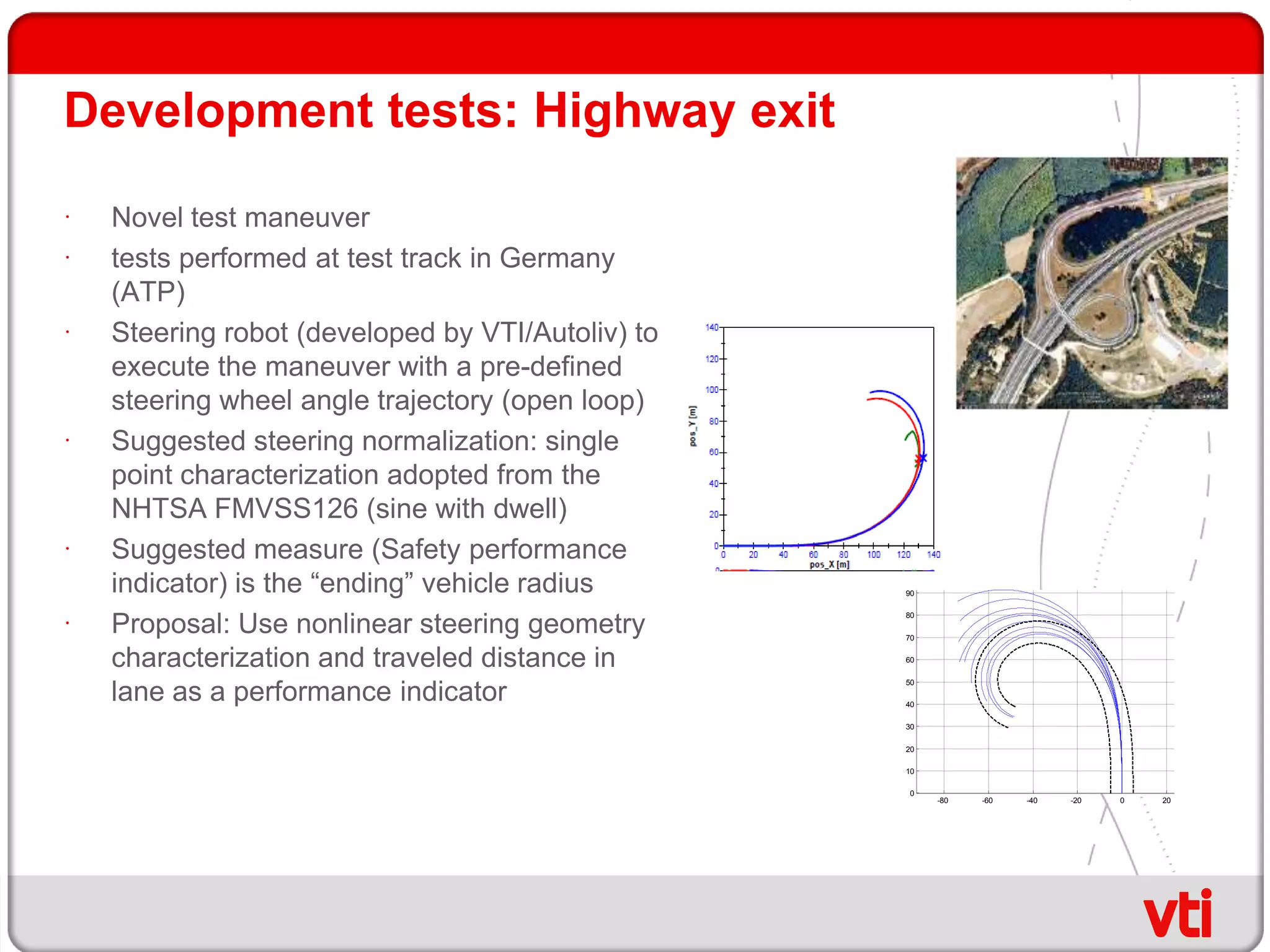
    Development tests: HighwayexitNovel test maneuver
  • 20.
    tests performed attest track in Germany (ATP)
  • 21.
    Steering robot (developedby VTI/Autoliv) to execute the maneuver with a pre-defined steering wheel angle trajectory (open loop)
  • 22.
    Suggested steering normalization:single point characterization adopted from the NHTSA FMVSS126 (sine with dwell)
  • 23.
    Suggested measure (Safetyperformance indicator) is the “ending” vehicle radius
  • 24.
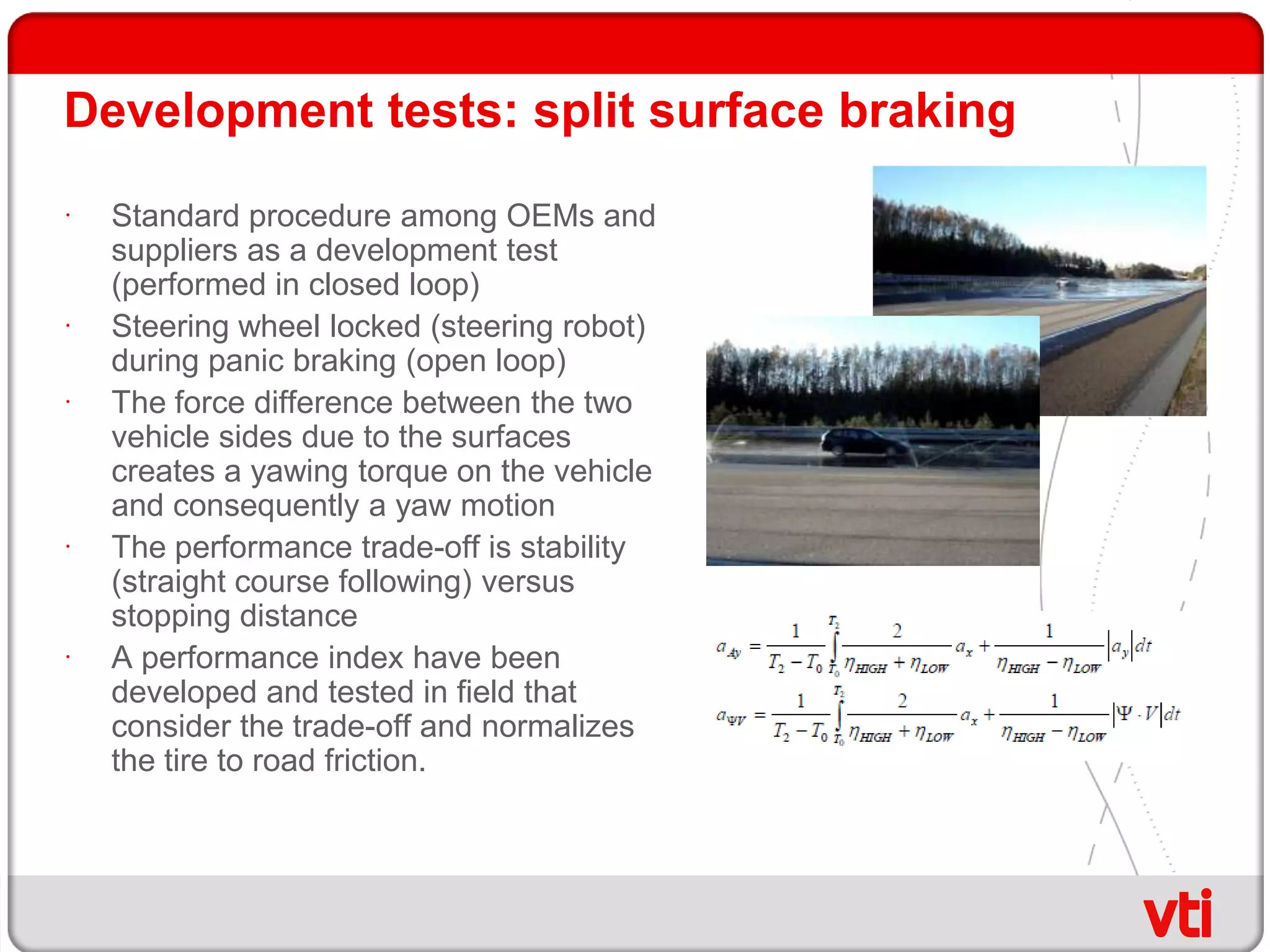
    Proposal: Use nonlinearsteering geometry characterization and traveled distance in lane as a performance indicator Development tests: split surface brakingStandard procedure among OEMs and suppliers as a development test (performed in closed loop)
  • 25.
    Steering wheel locked(steering robot) during panic braking (open loop)
  • 26.
    The force differencebetween the two vehicle sides due to the surfaces creates a yawing torque on the vehicle and consequently a yaw motion
  • 27.
    The performance trade-offis stability (straight course following) versus stopping distance
  • 28.
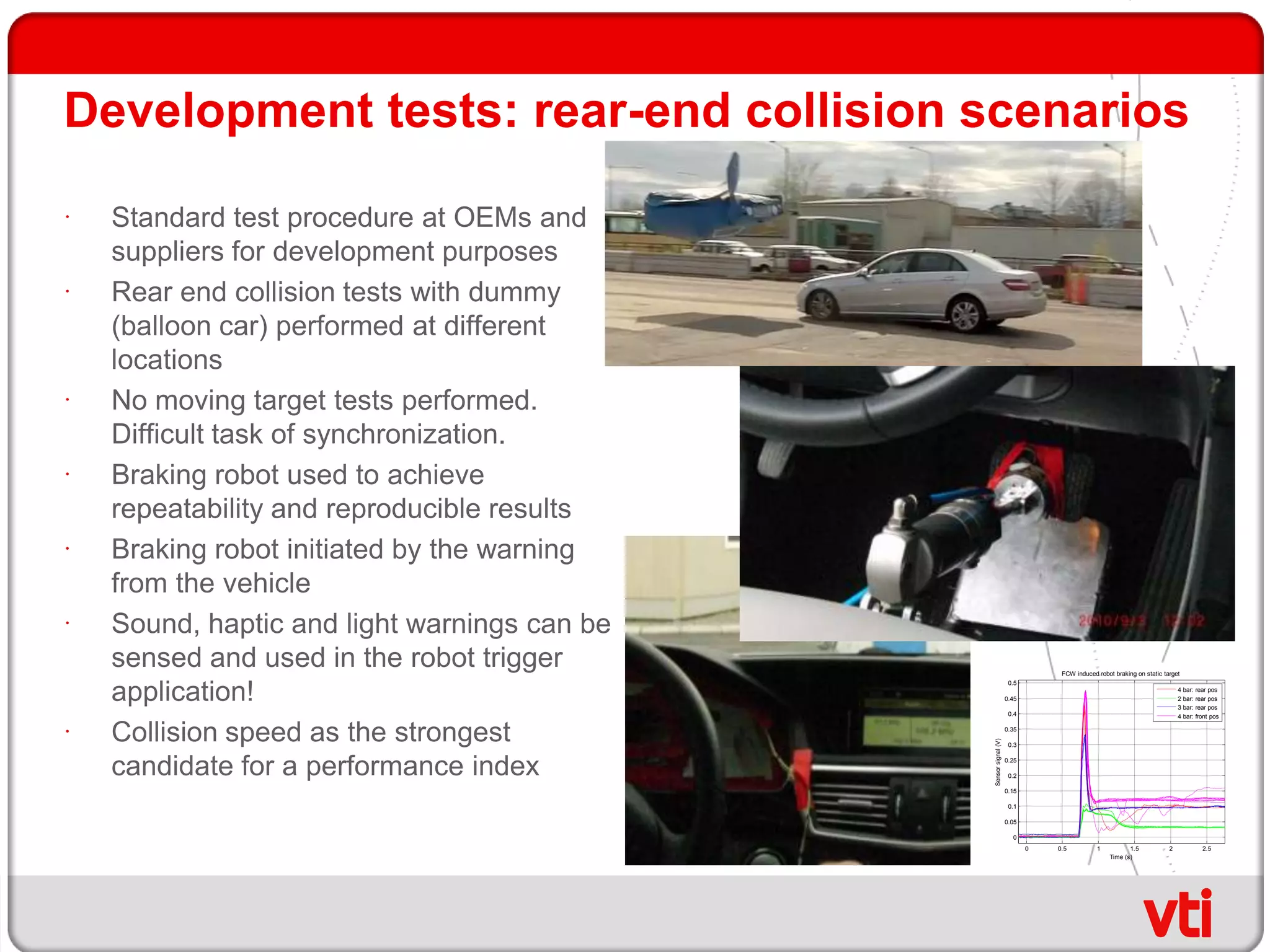
    A performance indexhave been developed and tested in field that consider the trade-off and normalizes the tire to road friction.Development tests: rear-end collision scenariosStandard test procedure at OEMs and suppliers for development purposes
  • 29.
    Rear end collisiontests with dummy (balloon car) performed at different locations
  • 30.
    No moving targettests performed. Difficult task of synchronization.
  • 31.
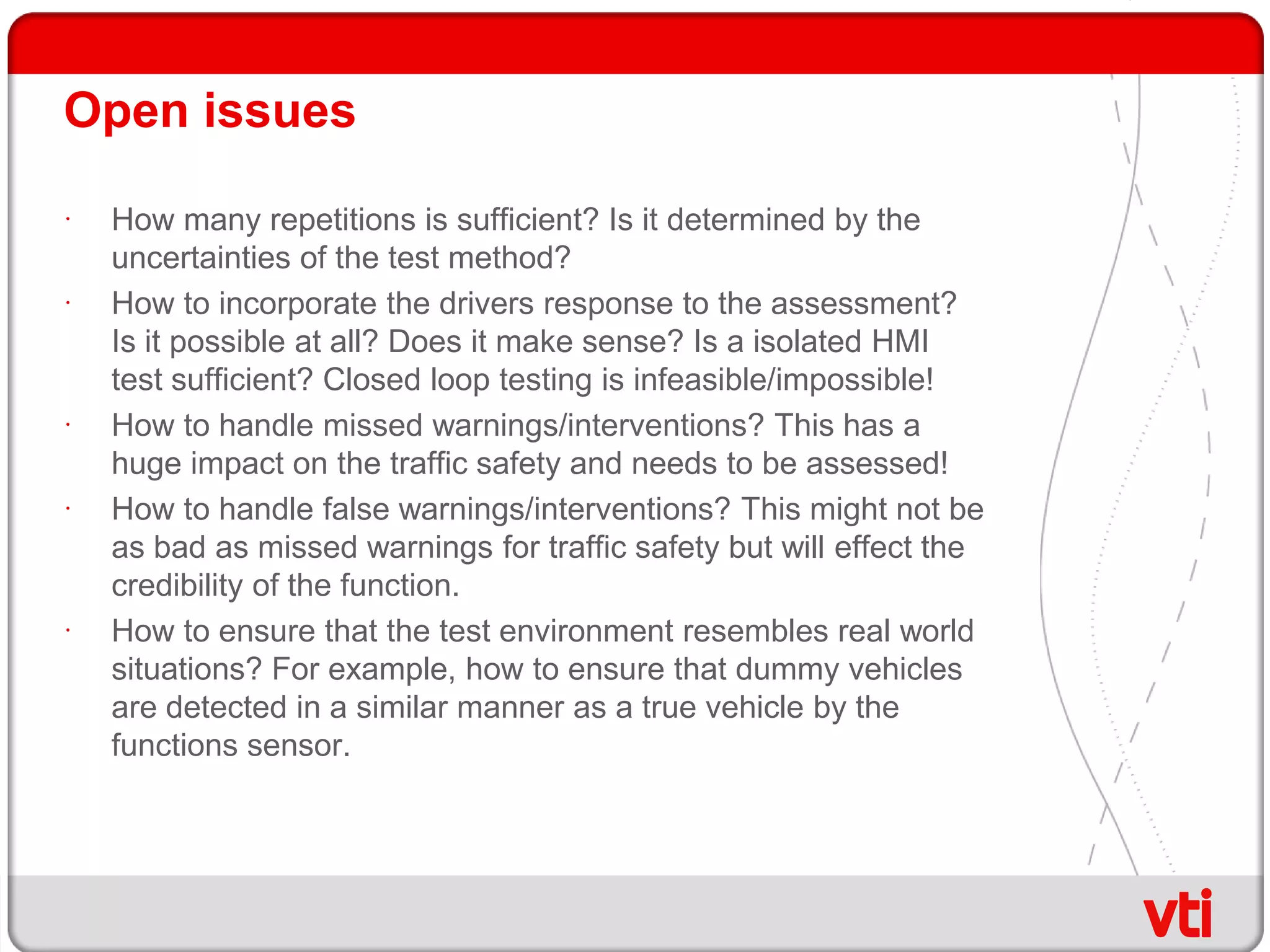
    Braking robot usedto achieve repeatability and reproducible results
  • 32.
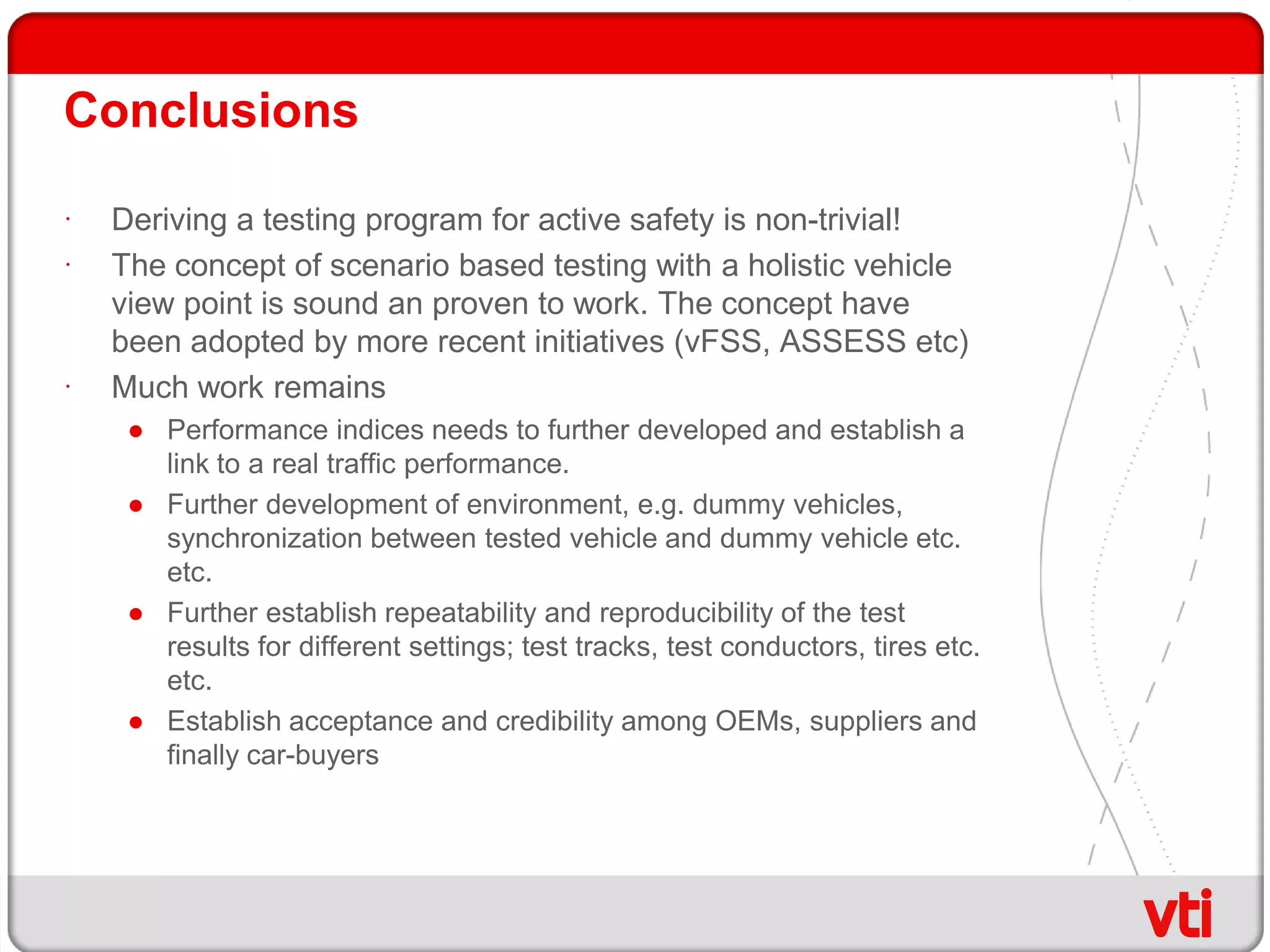
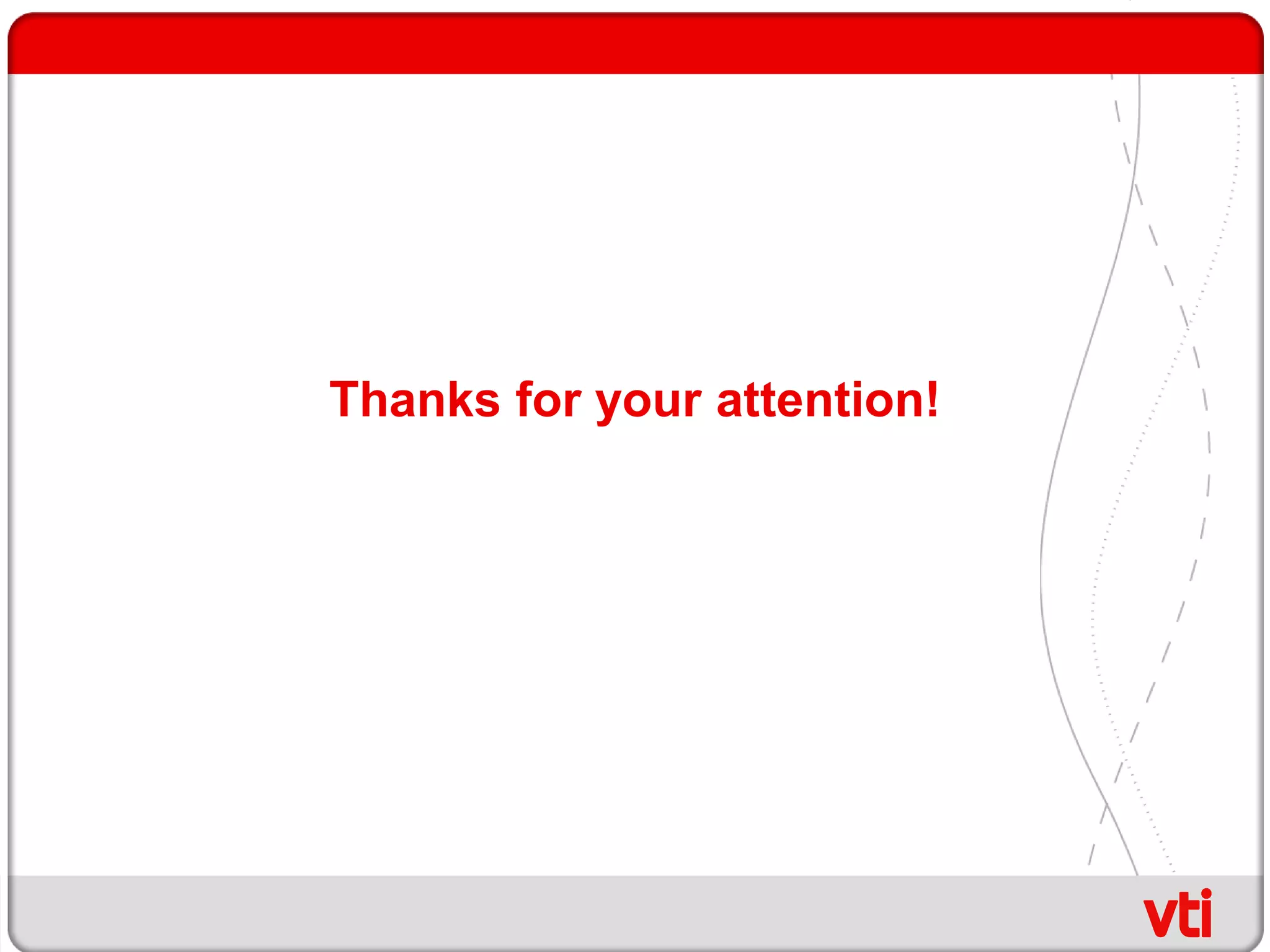
    Braking robot initiatedby the warning from the vehicle
  • 33.
    Sound, haptic andlight warnings can be sensed and used in the robot trigger application!
  • 34.
    Collision speed asthe strongest candidate for a performance indexOpen issuesHow many repetitions is sufficient? Is it determined by the uncertainties of the test method?
  • 35.
    How to incorporatethe drivers response to the assessment? Is it possible at all? Does it make sense? Is a isolated HMI test sufficient? Closed loop testing is infeasible/impossible!
  • 36.
    How to handlemissed warnings/interventions? This has a huge impact on the traffic safety and needs to be assessed!
  • 37.
    How to handlefalse warnings/interventions? This might not be as bad as missed warnings for traffic safety but will effect the credibility of the function.
  • 38.
    How to ensurethat the test environment resembles real world situations? For example, how to ensure that dummy vehicles are detected in a similar manner as a true vehicle by the functions sensor.ConclusionsDeriving a testing program for active safety is non-trivial!
  • 39.
    The concept ofscenario based testing with a holistic vehicle view point is sound an proven to work. The concept have been adopted by more recent initiatives (vFSS, ASSESS etc)
  • 40.
    Much work remainsPerformanceindices needs to further developed and establish a link to a real traffic performance.Further development of environment, e.g. dummy vehicles, synchronization between tested vehicle and dummy vehicle etc. etc.Further establish repeatability and reproducibility of the test results for different settings; test tracks, test conductors, tires etc. etc.Establish acceptance and credibility among OEMs, suppliers and finally car-buyers
  • 41.
    Thanks for yourattention!