EUROFOT: EUROPEAN LARGE-SCALE FIELD OPERATIONAL
           TEST ON ACTIVE SAFETY SYSTEMS

    Giancarlo Alessandretti1, Angelos Amditis2, Aria Etemad3, Christoph Kessler3
1. ALCOR - Italy
2. ICCS, Institute of Communications and Computer Systems - Greece
3. Ford Research & Advanced Engineering Europe - Germany


ABSTRACT
The European project “euroFOT” is developing a large scale assessment program for
advanced active safety systems in cars and trucks, based on Field Operational Tests with
normal drivers in ordinary traffic.
The experiments will provide insight into system performance and driver behaviour, as well
as the socio-economic impact, particularly on road safety and traffic efficiency.
This paper, after presenting the objectives of the project, outlines on-going activities and
some major results for the first year. The topics include research questions, experimental
design, test operation and data analysis. Coordination with parallel initiatives is also
discussed for this new class of experiments.

KEYWORDS
ADAS, Field Operational Tests, Evaluation

INTRODUCTION AND OBJECTIVES
The euroFOT project aims to demonstrate the benefits and to encourage the deployment
of Intelligent Vehicle Systems on European roads, focusing on Advanced Driver
Assistance Systems (ADAS) which have now reached a good level of maturity.
Previous experience worldwide has shown that Field Operational Tests (FOTs) are an
excellent method to collect real data, evaluate the impacts and enhance the take-up of
new solutions. These tests have also proved to be a powerful tool for gaining insight into
the usability of functions, when operated in the real environment, and for a sufficient long
time to reach the daily operational and behavioural level.
At the same time it is clear that such experiments require considerable resources and
efforts, and euroFOT therefore is also aiming to develop and validate a number of effective
and harmonised methodologies able to facilitate the operation of FOTs and to ensure a
high quality of scientific results.

In this context, the main objectives of euroFOT are the following:
   • To perform multiple coordinated tests of several Intelligent Vehicle Systems with
      ordinary drivers in real traffic;
   • To investigate performance, driver behaviour, and user acceptance;
   • To assess the impacts on safety, efficiency, and the environment using data in a
      variety of driving scenarios.

EuroFOT also intends to contribute to the on-going efforts for the diffusion of advanced
Vehicle Technologies and the promotion of a general European perspective. The following
two additional goals are therefore particularly important: consolidating a common approach


                                              Pag. 1
for FOTs, and raising awareness in the general public regarding the potentialities of driver
support functions, as well as a creating a wider socio-economic acceptance.

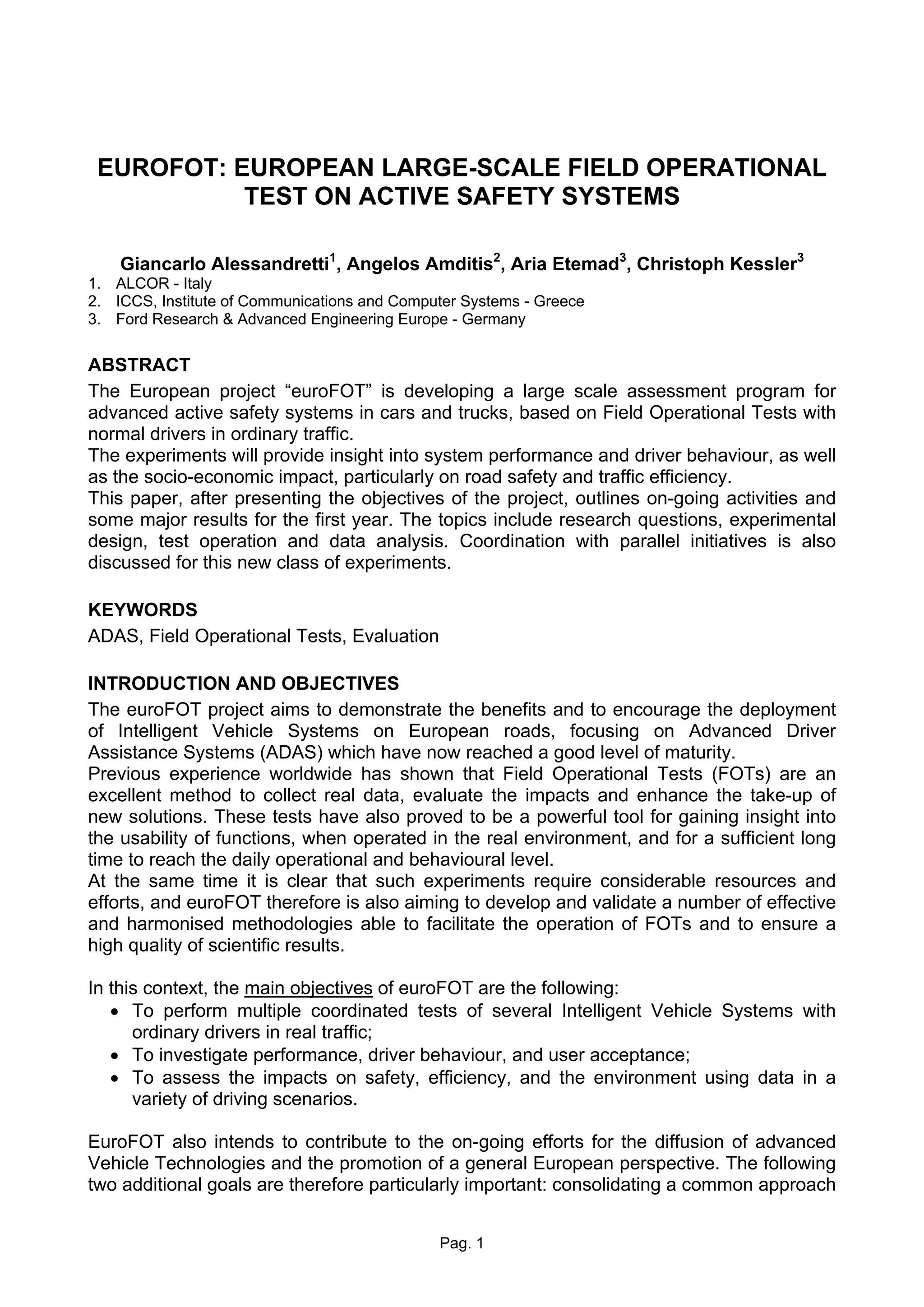
The nine functions under test in euroFOT are shown in the following figure: in general,
they are implemented by reliable systems and sensors, now offered on series production
vehicles. For the FOT, the project involves different vehicle fleets, with a total of 1390
passenger cars and 150 trucks; these fleets are coordinated by four Vehicle Management
Centres, and expected to travel in different European countries. The duration of each test
will be about 12 months, for a total exposure estimated as approximately 27 Millions km.


                                                          Longitudinal control functions
                                                            FCW Forward Collision Warning
                                                            ACC Adaptive Cruise Control
                                                            SL  Speed Regulation System
                                                          Lateral control functions
                                                            BLIS   Blind Spot Information System
                                                            LDW    Lane Departure Warning
                                                            IW     Impairment Warning
                                                          Other applications
                                                            CSW Curve Speed Warning
                                                            FEA Fuel Efficiency Advisor
                                                            SafeHMI Safe Human Machine Interaction


                     Fig. 1: Set of functions under test within euroFOT


EXPECTED RESULTS
By such a comprehensive approach, the project aims to obtain vehicle-based and driver-
based information that could encourage strategic decisions by different stakeholders, like
Manufacturers, Suppliers, Public Authorities, and User Groups.
On one side, vehicle manufactures and equipment suppliers can use the results of the
project to improve the system design, especially regarding the interaction with the user. On
the other hand, authorities and the clients will have a deeper understanding of the potential
benefits, especially on safety and efficiency: this will enable a stronger deployment of
Intelligent Vehicle Technologies.
A third important expected result is the increase of public awareness, gained through a
more direct exposure to these new technologies and also through an articulated plan to
disseminate the results. This will hopefully contribute to accelerate the market penetration
of mature ICT systems.

HIGHLIGHTS FOR ON-GOING ACTIVITIES
System specifications
A fundamental preparatory work has been carried out inside euroFOT on system
specifications, providing a description of the functions under test, their operation domain,
and especially the basic hypotheses which should be investigated by the experiments. In
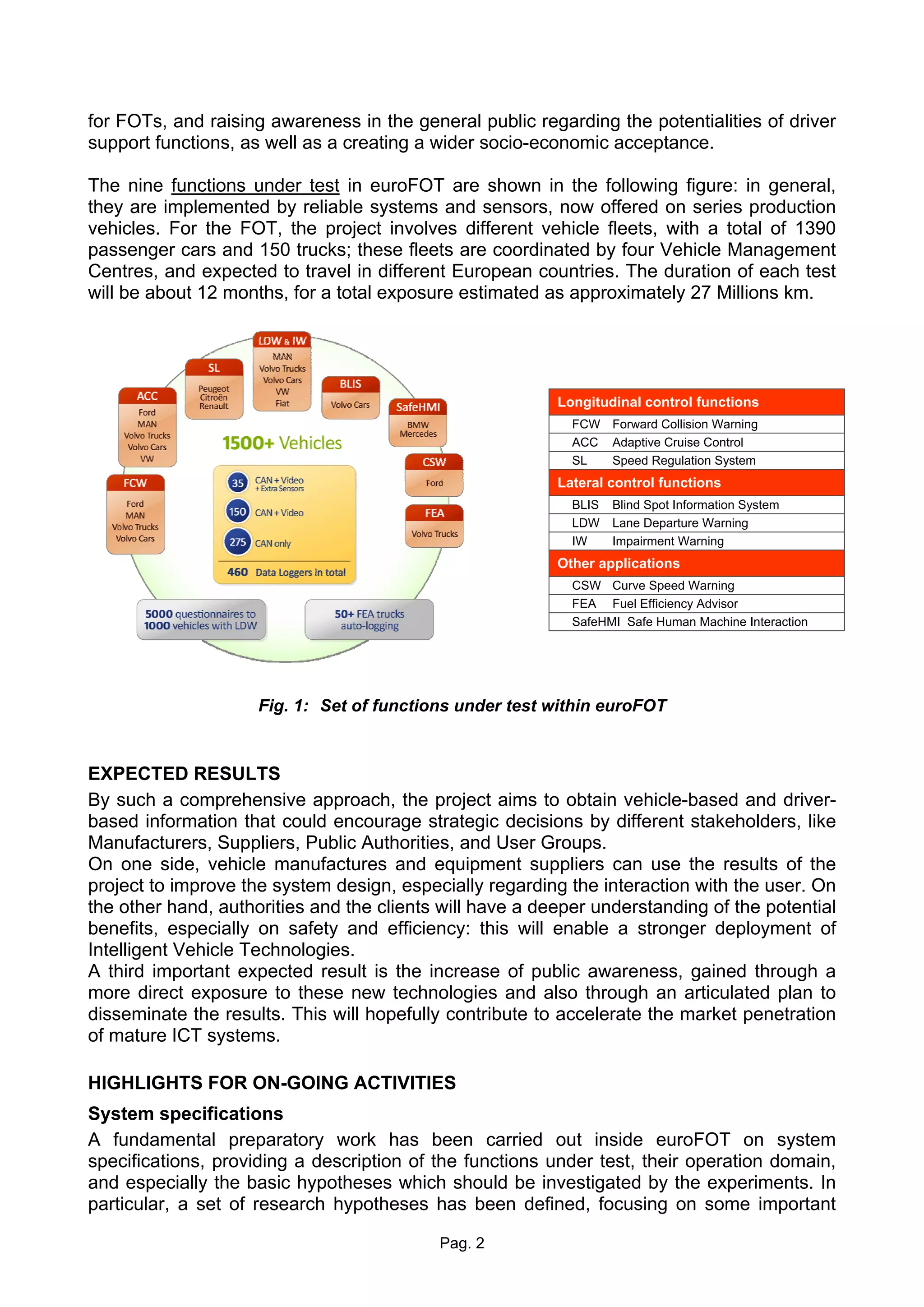
particular, a set of research hypotheses has been defined, focusing on some important

                                           Pag. 2
issues to be studied (Fig.2). For this process, the FESTA1 methodology has been applied,
with specific efforts towards creating a common and harmonised approach for all the
vehicle fleets within euroFOT.


              Fig. 2: Schematic of the process to define research hypotheses

This work has shown the importance of defining quite specific hypotheses, able to be
studied in clear and statistical terms. Priorities have been defined, considering that limited
time and resources will not permit to cover all the issues; at the same time it is important to
establish in advance, and not during the experiments, what are the questions to be
addressed.
A difficulty in such a large initiative has been providing the same framework for all the
functions, allowing at the same time a number of system-specific investigations required
by the stakeholders. This trade-off has been addressed by a common structure, coupled to
a flexible approach. A data base of the hypotheses specification, open to possible future
refinements, is now in place.
Another relevant point has been the treatment of integrated functions, since several
manufacturers are offering only a combination of driver support systems; the data analysis
will take care of these aspects, and will distinguish in particular between longitudinal and
lateral control functions.

In total, approximately 250 hypotheses have been examined and 84 of them prioritised.
The primary relevance of these hypotheses in term of impacts can be divided as follows:
driver behaviour (46%), safety (44%), and environment (10%).

The specification work has also defined several use cases, showing when the system
should be tested and in which driving conditions. For each case, the study has outlined
comparison situations, controlled factors and variable factors to be considered in the data
analysis. All these results constitute a key point for the subsequent steps addressing the
design and the implementation of the experiments.

Data Acquisition Systems
Data acquisition and data handling are fundamental enabling technologies for FOTs.
For this aspect, euroFOT is studying techniques able to provide robustness and high
reliability in all the test conditions, considering that no assistance from the experimenters
will be provided on a vehicle during the tests.
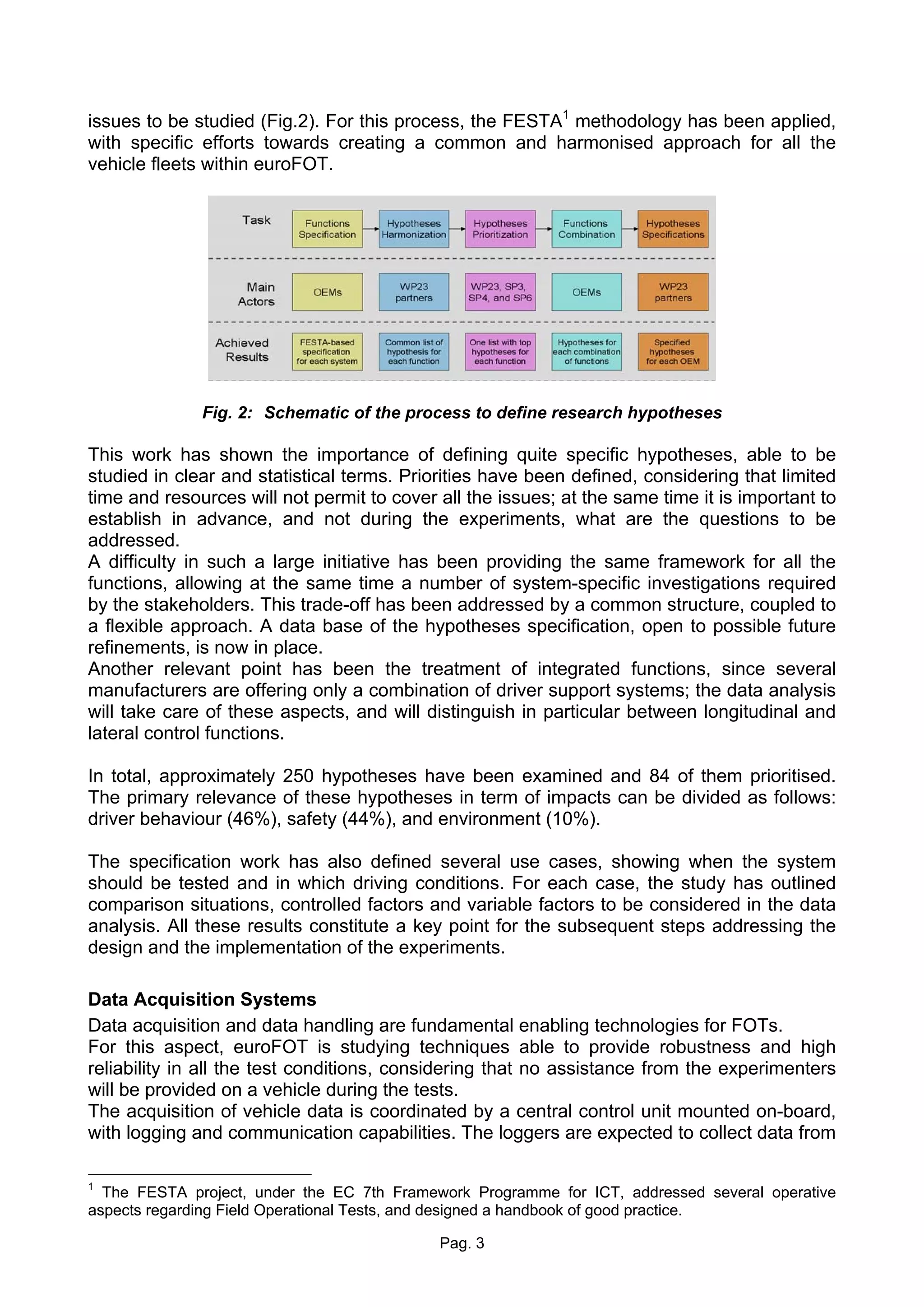
The acquisition of vehicle data is coordinated by a central control unit mounted on-board,
with logging and communication capabilities. The loggers are expected to collect data from

1
  The FESTA project, under the EC 7th Framework Programme for ICT, addressed several operative
aspects regarding Field Operational Tests, and designed a handbook of good practice.

                                            Pag. 3
the vehicle network, as well as from additional subsystems and sensors (e.g. video and
radar). In addition to these objective data, euroFOT has defined methods for subjective
data acquisition, which are beyond the scope of the present paper.

Three types of Data Acquisition Systems are considered within euroFOT:
  • CAN only, providing a basic functionality for vehicle data and GPS
  • CAN + video, since in a significant number of cases cameras will be used to record
     both the road and the driver
  • CAN + video + extra sensors, for a few vehicles equipped with radar/lidar, head/eye
     trackers and possibly other sensing devices

A typical example of data sources in a test vehicle is shown in Fig. 3.

Besides the standard mechanical and electrical requirements, several functional
requirements have been defined for Data Acquisition. The following aspects show some of
the peculiarities which a FOT has to address: protection of the proprietary vehicle data,
encryption of the data, driver annotation interface, possibility of audio recording, triggered
logging, and real-time clock to be synchronised with the GPS.
The number of channels to be detected from the CAN bus can be as high as 200 in certain
cases. The amount of data from all the low bandwidth data sources is estimated to be 10-
20MB/hour. The amount of video data is estimated in the range of a few hundreds
MB/hour. Storage capacity on board is designed for about two months of operation.
Data are then transferred to a data server periodically. The standard chosen technique is
wireless communication, but in some cases it is accepted that high volume data are
retrieved by exchanging the hard disk in the vehicle.

                                 GPS& GPRSAntennas                multipurpose camera

                                                                                       OR

                                            data logger
                                                                      accelerometer
                                     ECU            OBD                               ECU   radar
                                                    connector

                                            Vehicle CAN bus
                                                                   ECU      ECU

                   Standard with vehicle
                   Mandatory part of the instrumentation (data)
                   Optional part of the instrumentation


                          Fig. 3: Example of data sources on a test car


Design of Experiment and Data Analysis
Based on the systems specifications and the research hypotheses described above, a
fundamental step has been the definition of the overall design of experiment (DOE).

The driver, vehicle, and environmental elements of the tests have been considered.
Drivers will represent as much as possible the population of buyers, with professional
drivers considered in the case of trucks. Since it is known that variations between subjects
can be large for the metrics normally used in the case of ADAS, a within subject analysis is
the preferred approach, where the performance is compared with and without the system
for each individual driver. In any case, recording a suitable set of baseline conditions turns

                                                          Pag. 4
out to be one of the most important requirements, and a relevant factor for the correctness
of data analysis. For several functions, also a control group has been introduced.

The vehicles have been chosen based on the present European market, considerations on
technical feasibility, and some specific interests from manufacturers. They constitute a
representative set of passenger cars of different brands, pertaining to the middle and top
classes, and two fleets of heavy commercial vehicles.

Providing a suitable driving environment is the most challenging part of the DOE. The
approach within euroFOT has been to define a number of events which likely occur during
driving, and are specifically relevant to answer the questions of interest. An example of
event is an overtaking manoeuvre.
Specific situation variables, such as road type, weather, visibility, driver status, have been
also specified: they constitute a set of conditions which can characterise the surroundings
of a given event. Most importantly, the DOE has identified and specified a number of
performance indicators, describing driving behaviour, workload and acceptability (all of
these linked to road safety), traffic efficiency, and impacts on the environment. This goes
down to a detailed prescription of the actual metrics to be applied for each element.
Performance indicators will be the final outcome of the statistical analysis and the basis for
the overall evaluation. Examples of performance indicators are: mean speed, mean time
headway, frequency of brake pedal press, glance duration off-road.
In summary, the driving environment will not be controlled, due to the basic assumptions of
the FOT itself, but relevant driving conditions will be monitored and recognised; moreover,
the influence of situation variables will be studied. This approach is fundamental in order to
extract a manageable volume of data form the very large data base expected.

Within euroFOT 25 major events and 27 situation variables have been selected and a total
of 81 performance indicators. The DOE has also defined about 110 corresponding
measures to be considered in the experiment (i.e. quantities logged from the sensors,
derived quantities, or self reported values).
A final consideration regarding the DOE concerns the scheduling; it has been judged
absolutely necessary to plan an accurate and extensive pilot phase, addressing all the
aspects of the FOT. On one side pilot tests can provide important feedbacks to the
specifications and to the research questions, as well as to the DOE; on the other side they
permit to check a number of technical and organisational issues which must be settled
before the definitive experiment.


Vehicle Management Centres
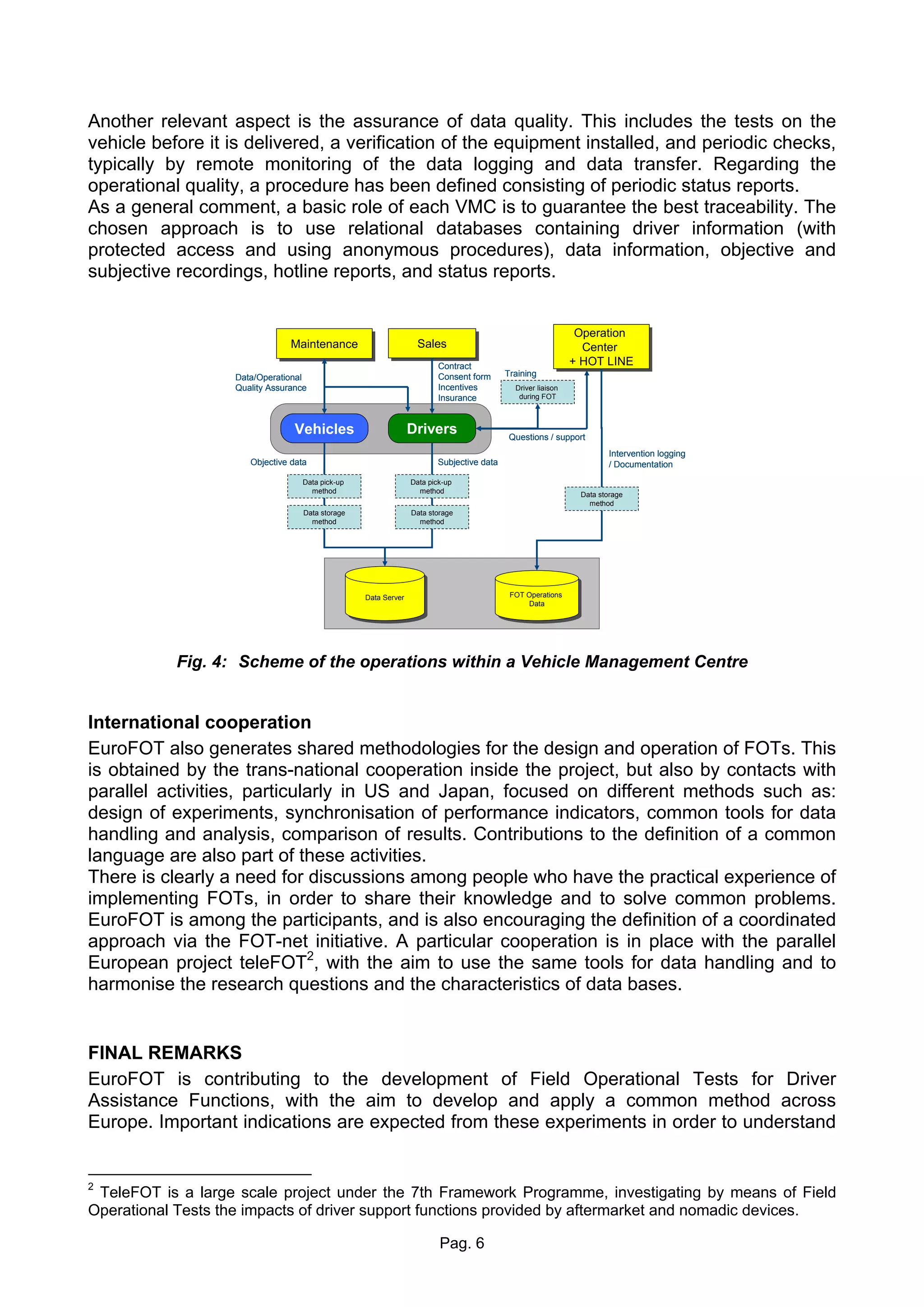
The practical operation of the FOTs is performed through Vehicle Management Centres
(VMCs), established in different countries. There are 4 VMCs in the euroFOT project, in
Sweden, Germany, France, and Italy. A scheme for the common structure of these VMCs
is shown in Fig. 4.
The recruitment of drivers is the first important responsibility of a VMC, to be organised
with the support of dealers or marketing departments. A specific consensus form has been
prepared to establish a relationship with the subjects under clear terms.
During the FOT, a driver liaison will be in charge of contacts with the driver for reasons
such as the administration of questionnaires, focus groups, data pick-up, or quality issues
(e.g.: camera misplaced, sensor damaged…). At the same time procedures for
maintenance will be put in place, and a hotline will be organised so that the driver has a
specific reference, in case he/she should contact the project staff.

                                            Pag. 5
Another relevant aspect is the assurance of data quality. This includes the tests on the
vehicle before it is delivered, a verification of the equipment installed, and periodic checks,
typically by remote monitoring of the data logging and data transfer. Regarding the
operational quality, a procedure has been defined consisting of periodic status reports.
As a general comment, a basic role of each VMC is to guarantee the best traceability. The
chosen approach is to use relational databases containing driver information (with
protected access and using anonymous procedures), data information, objective and
subjective recordings, hotline reports, and status reports.


                                                                                                               Operation
                                                                                                               Operation
                                 Maintenance
                                 Maintenance                       Sales
                                                                   Sales                                        Center
                                                                                                                 Center
                                                                          Contract                            + HOT LINE
                                                                                                              + HOT LINE
                    Data/Operational                                      Consent form     Training
                    Quality Assurance                                     Incentives         Driver liaison
                                                                          Insurance           during FOT


                                  Vehicles                    Drivers                       Questions / support
                                                                                                                       Intervention logging
                       Objective data                                    Subjective data                               / Documentation
                                    Data pick-up                  Data pick-up
                                      method                        method                                     Data storage
                                                                                                                 method
                                    Data storage                  Data storage
                                      method                        method


                                                   Data Server                              FOT Operations
                                                                                             FOT Operations
                                                    Data Server                                  Data
                                                                                                  Data


            Fig. 4: Scheme of the operations within a Vehicle Management Centre


International cooperation
EuroFOT also generates shared methodologies for the design and operation of FOTs. This
is obtained by the trans-national cooperation inside the project, but also by contacts with
parallel activities, particularly in US and Japan, focused on different methods such as:
design of experiments, synchronisation of performance indicators, common tools for data
handling and analysis, comparison of results. Contributions to the definition of a common
language are also part of these activities.
There is clearly a need for discussions among people who have the practical experience of
implementing FOTs, in order to share their knowledge and to solve common problems.
EuroFOT is among the participants, and is also encouraging the definition of a coordinated
approach via the FOT-net initiative. A particular cooperation is in place with the parallel
European project teleFOT2, with the aim to use the same tools for data handling and to
harmonise the research questions and the characteristics of data bases.


FINAL REMARKS
EuroFOT is contributing to the development of Field Operational Tests for Driver
Assistance Functions, with the aim to develop and apply a common method across
Europe. Important indications are expected from these experiments in order to understand


2
 TeleFOT is a large scale project under the 7th Framework Programme, investigating by means of Field
Operational Tests the impacts of driver support functions provided by aftermarket and nomadic devices.

                                                                          Pag. 6
driver behaviour, improve the design of the systems, and evaluate the impacts on traffic
safety and efficiency.
The experience gained in the first year of the project confirms several aspects under
discussion within the scientific community, starting from the consideration that only a FOT
can provide specific answers to several key elements for the deployment of Driver
Assistance Functions, based on road data. At the same time, it is clear that such
experiments require considerable resources for capturing a large amount of data over a
period of several months. Therefore, on-going initiatives which are promoting effective and
harmonised methods should be certainly encouraged.

Some important guidelines for the design and operation of a FOT have been derived from
the work performed in euroFOT.
A first aspect is the need to be quite specific in the definition of research hypotheses. In
addition, when several systems are tested, the experimental design should allow at the
same time an harmonised framework and application-specific investigations. In particular,
methods dealing with the combination of functions should be considered.
A second key element is the specification of baseline conditions in the design of
experiment: this is fundamental for the correctness of data analysis. Suitable metrics for
the performance indicators and clear definitions of the events to be analysed are also
relevant points.
From the operational point of view, the study has indicated some basic elements like:
procedures for risk management, a strong connection between the staff and the drivers,
and robust techniques for data acquisition. The implementation of extensive and accurate
pilot tests in the initial phase is considered a necessary step, since it can provide important
feedbacks to the specifications and also technical insight for the conduction of the
experiment.
The euroFOT project is now beginning the second year of work; the next phases will
address the implementation of pilot tests, followed by large scale experiments, and in
parallel the further refinement of the data analysis plan.

ACKNOWLEDGMENTS
EuroFOT is a large scale integrated project on Information and Communication
Technologies conducted under the Seventh Framework Programme of the European
Commission. The authors would like to thank all the project partners who contributed to
the topics outlined in the present paper.


                                            Pag. 7

Paper 3403

  • 1.
    EUROFOT: EUROPEAN LARGE-SCALEFIELD OPERATIONAL TEST ON ACTIVE SAFETY SYSTEMS Giancarlo Alessandretti1, Angelos Amditis2, Aria Etemad3, Christoph Kessler3 1. ALCOR - Italy 2. ICCS, Institute of Communications and Computer Systems - Greece 3. Ford Research & Advanced Engineering Europe - Germany ABSTRACT The European project “euroFOT” is developing a large scale assessment program for advanced active safety systems in cars and trucks, based on Field Operational Tests with normal drivers in ordinary traffic. The experiments will provide insight into system performance and driver behaviour, as well as the socio-economic impact, particularly on road safety and traffic efficiency. This paper, after presenting the objectives of the project, outlines on-going activities and some major results for the first year. The topics include research questions, experimental design, test operation and data analysis. Coordination with parallel initiatives is also discussed for this new class of experiments. KEYWORDS ADAS, Field Operational Tests, Evaluation INTRODUCTION AND OBJECTIVES The euroFOT project aims to demonstrate the benefits and to encourage the deployment of Intelligent Vehicle Systems on European roads, focusing on Advanced Driver Assistance Systems (ADAS) which have now reached a good level of maturity. Previous experience worldwide has shown that Field Operational Tests (FOTs) are an excellent method to collect real data, evaluate the impacts and enhance the take-up of new solutions. These tests have also proved to be a powerful tool for gaining insight into the usability of functions, when operated in the real environment, and for a sufficient long time to reach the daily operational and behavioural level. At the same time it is clear that such experiments require considerable resources and efforts, and euroFOT therefore is also aiming to develop and validate a number of effective and harmonised methodologies able to facilitate the operation of FOTs and to ensure a high quality of scientific results. In this context, the main objectives of euroFOT are the following: • To perform multiple coordinated tests of several Intelligent Vehicle Systems with ordinary drivers in real traffic; • To investigate performance, driver behaviour, and user acceptance; • To assess the impacts on safety, efficiency, and the environment using data in a variety of driving scenarios. EuroFOT also intends to contribute to the on-going efforts for the diffusion of advanced Vehicle Technologies and the promotion of a general European perspective. The following two additional goals are therefore particularly important: consolidating a common approach Pag. 1
  • 2.
    for FOTs, andraising awareness in the general public regarding the potentialities of driver support functions, as well as a creating a wider socio-economic acceptance. The nine functions under test in euroFOT are shown in the following figure: in general, they are implemented by reliable systems and sensors, now offered on series production vehicles. For the FOT, the project involves different vehicle fleets, with a total of 1390 passenger cars and 150 trucks; these fleets are coordinated by four Vehicle Management Centres, and expected to travel in different European countries. The duration of each test will be about 12 months, for a total exposure estimated as approximately 27 Millions km. Longitudinal control functions FCW Forward Collision Warning ACC Adaptive Cruise Control SL Speed Regulation System Lateral control functions BLIS Blind Spot Information System LDW Lane Departure Warning IW Impairment Warning Other applications CSW Curve Speed Warning FEA Fuel Efficiency Advisor SafeHMI Safe Human Machine Interaction Fig. 1: Set of functions under test within euroFOT EXPECTED RESULTS By such a comprehensive approach, the project aims to obtain vehicle-based and driver- based information that could encourage strategic decisions by different stakeholders, like Manufacturers, Suppliers, Public Authorities, and User Groups. On one side, vehicle manufactures and equipment suppliers can use the results of the project to improve the system design, especially regarding the interaction with the user. On the other hand, authorities and the clients will have a deeper understanding of the potential benefits, especially on safety and efficiency: this will enable a stronger deployment of Intelligent Vehicle Technologies. A third important expected result is the increase of public awareness, gained through a more direct exposure to these new technologies and also through an articulated plan to disseminate the results. This will hopefully contribute to accelerate the market penetration of mature ICT systems. HIGHLIGHTS FOR ON-GOING ACTIVITIES System specifications A fundamental preparatory work has been carried out inside euroFOT on system specifications, providing a description of the functions under test, their operation domain, and especially the basic hypotheses which should be investigated by the experiments. In particular, a set of research hypotheses has been defined, focusing on some important Pag. 2
  • 3.
    issues to bestudied (Fig.2). For this process, the FESTA1 methodology has been applied, with specific efforts towards creating a common and harmonised approach for all the vehicle fleets within euroFOT. Fig. 2: Schematic of the process to define research hypotheses This work has shown the importance of defining quite specific hypotheses, able to be studied in clear and statistical terms. Priorities have been defined, considering that limited time and resources will not permit to cover all the issues; at the same time it is important to establish in advance, and not during the experiments, what are the questions to be addressed. A difficulty in such a large initiative has been providing the same framework for all the functions, allowing at the same time a number of system-specific investigations required by the stakeholders. This trade-off has been addressed by a common structure, coupled to a flexible approach. A data base of the hypotheses specification, open to possible future refinements, is now in place. Another relevant point has been the treatment of integrated functions, since several manufacturers are offering only a combination of driver support systems; the data analysis will take care of these aspects, and will distinguish in particular between longitudinal and lateral control functions. In total, approximately 250 hypotheses have been examined and 84 of them prioritised. The primary relevance of these hypotheses in term of impacts can be divided as follows: driver behaviour (46%), safety (44%), and environment (10%). The specification work has also defined several use cases, showing when the system should be tested and in which driving conditions. For each case, the study has outlined comparison situations, controlled factors and variable factors to be considered in the data analysis. All these results constitute a key point for the subsequent steps addressing the design and the implementation of the experiments. Data Acquisition Systems Data acquisition and data handling are fundamental enabling technologies for FOTs. For this aspect, euroFOT is studying techniques able to provide robustness and high reliability in all the test conditions, considering that no assistance from the experimenters will be provided on a vehicle during the tests. The acquisition of vehicle data is coordinated by a central control unit mounted on-board, with logging and communication capabilities. The loggers are expected to collect data from 1 The FESTA project, under the EC 7th Framework Programme for ICT, addressed several operative aspects regarding Field Operational Tests, and designed a handbook of good practice. Pag. 3
  • 4.
    the vehicle network,as well as from additional subsystems and sensors (e.g. video and radar). In addition to these objective data, euroFOT has defined methods for subjective data acquisition, which are beyond the scope of the present paper. Three types of Data Acquisition Systems are considered within euroFOT: • CAN only, providing a basic functionality for vehicle data and GPS • CAN + video, since in a significant number of cases cameras will be used to record both the road and the driver • CAN + video + extra sensors, for a few vehicles equipped with radar/lidar, head/eye trackers and possibly other sensing devices A typical example of data sources in a test vehicle is shown in Fig. 3. Besides the standard mechanical and electrical requirements, several functional requirements have been defined for Data Acquisition. The following aspects show some of the peculiarities which a FOT has to address: protection of the proprietary vehicle data, encryption of the data, driver annotation interface, possibility of audio recording, triggered logging, and real-time clock to be synchronised with the GPS. The number of channels to be detected from the CAN bus can be as high as 200 in certain cases. The amount of data from all the low bandwidth data sources is estimated to be 10- 20MB/hour. The amount of video data is estimated in the range of a few hundreds MB/hour. Storage capacity on board is designed for about two months of operation. Data are then transferred to a data server periodically. The standard chosen technique is wireless communication, but in some cases it is accepted that high volume data are retrieved by exchanging the hard disk in the vehicle. GPS& GPRSAntennas multipurpose camera OR data logger accelerometer ECU OBD ECU radar connector Vehicle CAN bus ECU ECU Standard with vehicle Mandatory part of the instrumentation (data) Optional part of the instrumentation Fig. 3: Example of data sources on a test car Design of Experiment and Data Analysis Based on the systems specifications and the research hypotheses described above, a fundamental step has been the definition of the overall design of experiment (DOE). The driver, vehicle, and environmental elements of the tests have been considered. Drivers will represent as much as possible the population of buyers, with professional drivers considered in the case of trucks. Since it is known that variations between subjects can be large for the metrics normally used in the case of ADAS, a within subject analysis is the preferred approach, where the performance is compared with and without the system for each individual driver. In any case, recording a suitable set of baseline conditions turns Pag. 4
  • 5.
    out to beone of the most important requirements, and a relevant factor for the correctness of data analysis. For several functions, also a control group has been introduced. The vehicles have been chosen based on the present European market, considerations on technical feasibility, and some specific interests from manufacturers. They constitute a representative set of passenger cars of different brands, pertaining to the middle and top classes, and two fleets of heavy commercial vehicles. Providing a suitable driving environment is the most challenging part of the DOE. The approach within euroFOT has been to define a number of events which likely occur during driving, and are specifically relevant to answer the questions of interest. An example of event is an overtaking manoeuvre. Specific situation variables, such as road type, weather, visibility, driver status, have been also specified: they constitute a set of conditions which can characterise the surroundings of a given event. Most importantly, the DOE has identified and specified a number of performance indicators, describing driving behaviour, workload and acceptability (all of these linked to road safety), traffic efficiency, and impacts on the environment. This goes down to a detailed prescription of the actual metrics to be applied for each element. Performance indicators will be the final outcome of the statistical analysis and the basis for the overall evaluation. Examples of performance indicators are: mean speed, mean time headway, frequency of brake pedal press, glance duration off-road. In summary, the driving environment will not be controlled, due to the basic assumptions of the FOT itself, but relevant driving conditions will be monitored and recognised; moreover, the influence of situation variables will be studied. This approach is fundamental in order to extract a manageable volume of data form the very large data base expected. Within euroFOT 25 major events and 27 situation variables have been selected and a total of 81 performance indicators. The DOE has also defined about 110 corresponding measures to be considered in the experiment (i.e. quantities logged from the sensors, derived quantities, or self reported values). A final consideration regarding the DOE concerns the scheduling; it has been judged absolutely necessary to plan an accurate and extensive pilot phase, addressing all the aspects of the FOT. On one side pilot tests can provide important feedbacks to the specifications and to the research questions, as well as to the DOE; on the other side they permit to check a number of technical and organisational issues which must be settled before the definitive experiment. Vehicle Management Centres The practical operation of the FOTs is performed through Vehicle Management Centres (VMCs), established in different countries. There are 4 VMCs in the euroFOT project, in Sweden, Germany, France, and Italy. A scheme for the common structure of these VMCs is shown in Fig. 4. The recruitment of drivers is the first important responsibility of a VMC, to be organised with the support of dealers or marketing departments. A specific consensus form has been prepared to establish a relationship with the subjects under clear terms. During the FOT, a driver liaison will be in charge of contacts with the driver for reasons such as the administration of questionnaires, focus groups, data pick-up, or quality issues (e.g.: camera misplaced, sensor damaged…). At the same time procedures for maintenance will be put in place, and a hotline will be organised so that the driver has a specific reference, in case he/she should contact the project staff. Pag. 5
  • 6.
    Another relevant aspectis the assurance of data quality. This includes the tests on the vehicle before it is delivered, a verification of the equipment installed, and periodic checks, typically by remote monitoring of the data logging and data transfer. Regarding the operational quality, a procedure has been defined consisting of periodic status reports. As a general comment, a basic role of each VMC is to guarantee the best traceability. The chosen approach is to use relational databases containing driver information (with protected access and using anonymous procedures), data information, objective and subjective recordings, hotline reports, and status reports. Operation Operation Maintenance Maintenance Sales Sales Center Center Contract + HOT LINE + HOT LINE Data/Operational Consent form Training Quality Assurance Incentives Driver liaison Insurance during FOT Vehicles Drivers Questions / support Intervention logging Objective data Subjective data / Documentation Data pick-up Data pick-up method method Data storage method Data storage Data storage method method Data Server FOT Operations FOT Operations Data Server Data Data Fig. 4: Scheme of the operations within a Vehicle Management Centre International cooperation EuroFOT also generates shared methodologies for the design and operation of FOTs. This is obtained by the trans-national cooperation inside the project, but also by contacts with parallel activities, particularly in US and Japan, focused on different methods such as: design of experiments, synchronisation of performance indicators, common tools for data handling and analysis, comparison of results. Contributions to the definition of a common language are also part of these activities. There is clearly a need for discussions among people who have the practical experience of implementing FOTs, in order to share their knowledge and to solve common problems. EuroFOT is among the participants, and is also encouraging the definition of a coordinated approach via the FOT-net initiative. A particular cooperation is in place with the parallel European project teleFOT2, with the aim to use the same tools for data handling and to harmonise the research questions and the characteristics of data bases. FINAL REMARKS EuroFOT is contributing to the development of Field Operational Tests for Driver Assistance Functions, with the aim to develop and apply a common method across Europe. Important indications are expected from these experiments in order to understand 2 TeleFOT is a large scale project under the 7th Framework Programme, investigating by means of Field Operational Tests the impacts of driver support functions provided by aftermarket and nomadic devices. Pag. 6
  • 7.
    driver behaviour, improvethe design of the systems, and evaluate the impacts on traffic safety and efficiency. The experience gained in the first year of the project confirms several aspects under discussion within the scientific community, starting from the consideration that only a FOT can provide specific answers to several key elements for the deployment of Driver Assistance Functions, based on road data. At the same time, it is clear that such experiments require considerable resources for capturing a large amount of data over a period of several months. Therefore, on-going initiatives which are promoting effective and harmonised methods should be certainly encouraged. Some important guidelines for the design and operation of a FOT have been derived from the work performed in euroFOT. A first aspect is the need to be quite specific in the definition of research hypotheses. In addition, when several systems are tested, the experimental design should allow at the same time an harmonised framework and application-specific investigations. In particular, methods dealing with the combination of functions should be considered. A second key element is the specification of baseline conditions in the design of experiment: this is fundamental for the correctness of data analysis. Suitable metrics for the performance indicators and clear definitions of the events to be analysed are also relevant points. From the operational point of view, the study has indicated some basic elements like: procedures for risk management, a strong connection between the staff and the drivers, and robust techniques for data acquisition. The implementation of extensive and accurate pilot tests in the initial phase is considered a necessary step, since it can provide important feedbacks to the specifications and also technical insight for the conduction of the experiment. The euroFOT project is now beginning the second year of work; the next phases will address the implementation of pilot tests, followed by large scale experiments, and in parallel the further refinement of the data analysis plan. ACKNOWLEDGMENTS EuroFOT is a large scale integrated project on Information and Communication Technologies conducted under the Seventh Framework Programme of the European Commission. The authors would like to thank all the project partners who contributed to the topics outlined in the present paper. Pag. 7