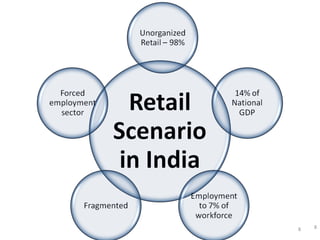
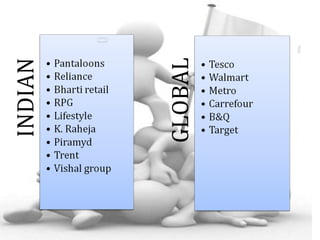

F.D.I. in Retail Sector

          SESSION 10
LEGAL ENVIRONMENT OF BUSINESS


                                1
Agenda

Retailing : An overview

Indian retail

FDI in Indian retailing

Why FDI?


                           2
Retailing : An overview


                          3
Retailing: An overview
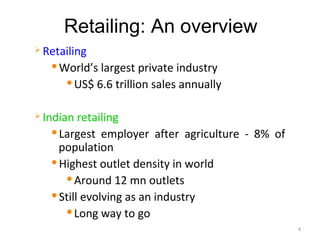
   Retailing
     World’s largest private industry

        US$ 6.6 trillion sales annually


   Indian retailing
      Largest employer after agriculture - 8% of

       population
      Highest outlet density in world

         Around 12 mn outlets

      Still evolving as an industry

         Long way to go

                                                    4
Retailing: An overview
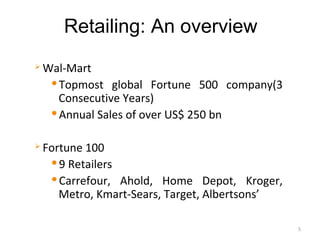
   Wal-Mart
     Topmost global Fortune 500 company(3

      Consecutive Years)
     Annual Sales of over US$ 250 bn


   Fortune 100
     9 Retailers

     Carrefour, Ahold, Home Depot, Kroger,

       Metro, Kmart-Sears, Target, Albertsons’

                                                 5
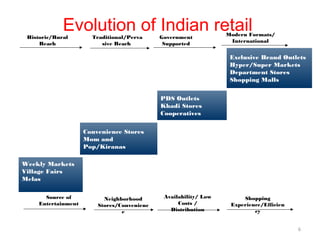
Evolution of Indian retail
 Historic/Rural        Traditional/Perva     Government           Modern Formats/
                                                                   International
     Reach                sive Reach          Supported

                                                                   Exclusive Brand Outlets
                                                                   Hyper/Super Markets
                                                                   Department Stores
                                                                   Shopping Malls


                                             PDS Outlets
                                             Khadi Stores
                                             Cooperatives

                     Convenience Stores
                     Mom and
                     Pop/Kiranas

Weekly Markets
Village Fairs
Melas

       Source of           Neighborhood       Availability/ Low        Shopping
     Entertainment       Stores/Convenienc         Costs /         Experience/Efficien
                                 e              Distribution               cy


                                                                                         6
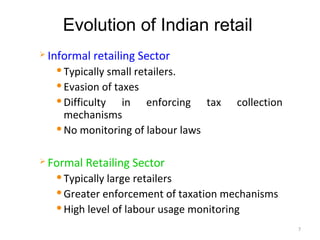
Evolution of Indian retail
   Informal retailing Sector
      Typically small retailers.
      Evasion of taxes

      Difficulty   in enforcing tax    collection
       mechanisms
      No monitoring of labour laws


   Formal Retailing Sector
      Typically large retailers
      Greater enforcement of taxation mechanisms

      High level of labour usage monitoring

                                                     7
8   8
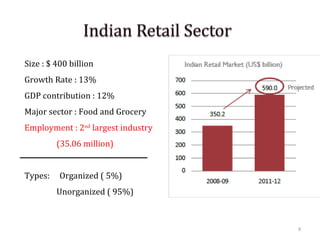
Size : $ 400 billion
Growth Rate : 13%
GDP contribution : 12%
Major sector : Food and Grocery
Employment : 2nd largest industry
         (35.06 million)


Types:    Organized ( 5%)
         Unorganized ( 95%)


                                    9
 Corporates are increasingly coming into this sector

 Demand of branded goods on a large scale

 Demand of new and varied products

 High quality product is preferred

 Varied window display

 E-tailers increase the presence
                                                        10
US
    Taiwan
  Malays ia
  Thailand
                                                                    O rg anis ed
 Indones ia
     C hina                                                         Unorg anis e
                                                                    d
      India

              0         20       40         60     80         100

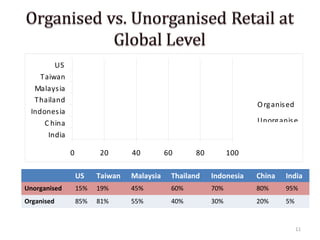
                  US    Taiwan   Malaysia    Thailand   Indonesia   China    India
Unorganised       15%   19%      45%         60%        70%         80%      95%
Organised         85%   81%      55%         40%        30%         20%      5%


                                                                                   11
CATEGORIES OF INDIAN RETAIL


                              12
Categories of Indian retail
   Corporate Houses
        Tatas: Tata Trent
        RPG group: Food World, Health & Glow, etc
        ITC: Wills Life Style
        Rahejas(Shoppers Stop), Hiranandani (Haiko), DLF(DT
         cinemas), etc.
   Dedicated brand outlets
        Nike, Reebok, Zodiac, etc
   Multi-brand outlets
        Vijay Sales, Viveks, Ritu Wear, Sehgal Bro, etc.
   Manufacturers/ Exporters
        Bata, Weekender, Lilliput                             13
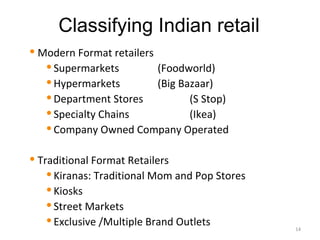
Classifying Indian retail
   Modern Format retailers
      Supermarkets         (Foodworld)
      Hypermarkets         (Big Bazaar)
      Department Stores           (S Stop)
      Specialty Chains            (Ikea)
      Company Owned Company Operated


   Traditional Format Retailers
       Kiranas: Traditional Mom and Pop Stores

       Kiosks

       Street Markets

       Exclusive /Multiple Brand Outlets
                                                  14
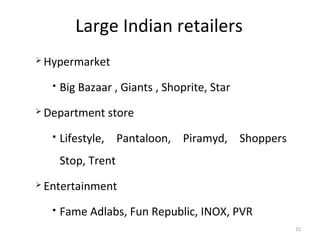
Large Indian retailers
   Hypermarket
        Big Bazaar , Giants , Shoprite, Star
   Department store
        Lifestyle, Pantaloon, Piramyd, Shoppers
         Stop, Trent
   Entertainment
        Fame Adlabs, Fun Republic, INOX, PVR
                                                   15
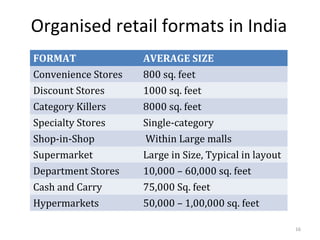
Organised retail formats in India
FORMAT               AVERAGE SIZE
Convenience Stores   800 sq. feet
Discount Stores      1000 sq. feet
Category Killers     8000 sq. feet
Specialty Stores     Single-category
Shop-in-Shop         Within Large malls
Supermarket          Large in Size, Typical in layout
Department Stores    10,000 – 60,000 sq. feet
Cash and Carry       75,000 Sq. feet
Hypermarkets         50,000 – 1,00,000 sq. feet

                                                        16
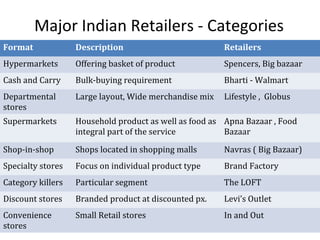
Major Indian Retailers - Categories
Format             Description                          Retailers
Hypermarkets       Offering basket of product           Spencers, Big bazaar
Cash and Carry     Bulk-buying requirement              Bharti - Walmart
Departmental       Large layout, Wide merchandise mix   Lifestyle , Globus
stores
Supermarkets       Household product as well as food as Apna Bazaar , Food
                   integral part of the service         Bazaar

Shop-in-shop       Shops located in shopping malls      Navras ( Big Bazaar)
Specialty stores   Focus on individual product type     Brand Factory
Category killers   Particular segment                   The LOFT
Discount stores    Branded product at discounted px.    Levi’s Outlet
Convenience        Small Retail stores                  In and Out
stores                                                                       17
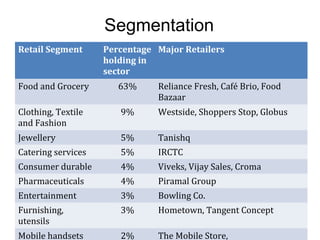
Segmentation
Retail Segment      Percentage Major Retailers
                    holding in
                    sector
Food and Grocery       63%     Reliance Fresh, Café Brio, Food
                               Bazaar
Clothing, Textile      9%      Westside, Shoppers Stop, Globus
and Fashion
Jewellery              5%      Tanishq
Catering services      5%      IRCTC
Consumer durable       4%      Viveks, Vijay Sales, Croma
Pharmaceuticals        4%      Piramal Group
Entertainment          3%      Bowling Co.
Furnishing,            3%      Hometown, Tangent Concept
utensils
                                                                 18
Mobile handsets        2%      The Mobile Store,
19
20
F.D.I.


         21
The commitment of money or
capital   to   purchase    financial
instruments or assets in order to
gain profitable returns.


                                       22
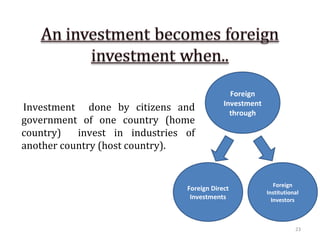
Foreign
                                            Investment
Investment done by citizens and               through
government of one country (home
country)   invest in industries of
another country (host country).


                                                            Foreign
                                Foreign Direct
                                                         Institutional
                                 Investments               Investors


                                                                    23
WHAT IS FDI?
Movement of capital
across national frontiers in
a manner that grants the
investor control over the
acquired asset.


                               24
WHAT IS FDI?
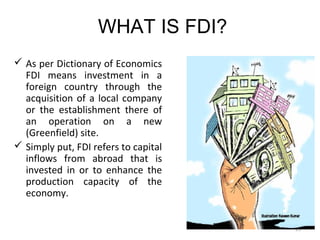
 As per Dictionary of Economics
  FDI means investment in a
  foreign country through the
  acquisition of a local company
  or the establishment there of
  an operation on a new
  (Greenfield) site.
 Simply put, FDI refers to capital
  inflows from abroad that is
  invested in or to enhance the
  production capacity of the
  economy.


                                      25
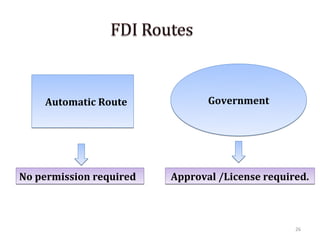
Automatic Route             Government


No permission required   Approval /License required.


                                                 26
What was the Criteria for FDI?
 1991-92 : Dr. Manmohan Singh, Finance Minister
   referred to certain criteria for allowing Foreign
   Direct Investment. These were :
1. Establishment of basic industries requiring huge
   capital and advanced sophisticated technology
2. Infrastructure projects like electricity generation,
   road, building, etc.
3. Projects which would generate employment

                                                          27
FDI Policy Initiatives
 1991- FDI allowed selectively up to 51% in priority
  sectors.
 1997-FDI allowed up to 100% in sectors like
  mining, manufacturing, Cash and carry/wholesale
  (under Govt. approval route).
 It was brought under the automatic route in
  2006.
                                                        28
FDI Policy Initiatives
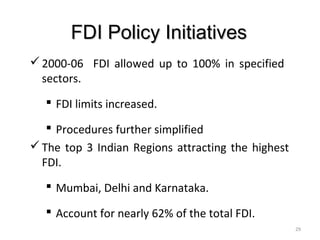
 2000-06 FDI allowed up to 100% in specified
  sectors.
    FDI limits increased.

    Procedures further simplified
 The top 3 Indian Regions attracting the highest
  FDI.
    Mumbai, Delhi and Karnataka.

    Account for nearly 62% of the total FDI.
                                                    29
FDI Policy Initiatives
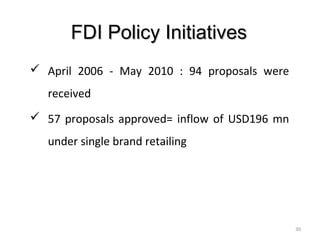
 April 2006 - May 2010 : 94 proposals were
   received
 57 proposals approved= inflow of USD196 mn
   under single brand retailing


                                               30
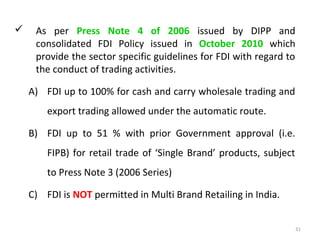
    As per Press Note 4 of 2006 issued by DIPP and
     consolidated FDI Policy issued in October 2010 which
     provide the sector specific guidelines for FDI with regard to
     the conduct of trading activities.

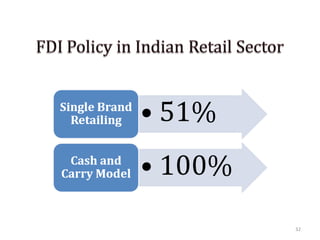
    A) FDI up to 100% for cash and carry wholesale trading and
        export trading allowed under the automatic route.

    B) FDI up to 51 % with prior Government approval (i.e.
        FIPB) for retail trade of ‘Single Brand’ products, subject
        to Press Note 3 (2006 Series)

    C) FDI is NOT permitted in Multi Brand Retailing in India.


                                                                     31
32
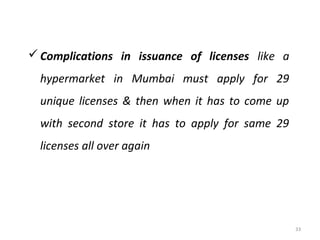
 Complications in issuance of licenses like a
  hypermarket in Mumbai must apply for 29
  unique licenses & then when it has to come up
  with second store it has to apply for same 29
  licenses all over again


                                                  33
34
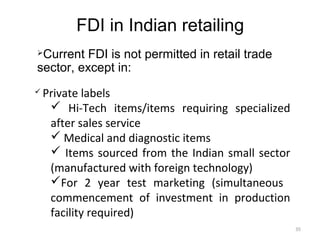
FDI in Indian retailing
Current FDI is not permitted in retail trade
sector, except in:
   Private labels
      Hi-Tech items/items requiring specialized
     after sales service
      Medical and diagnostic items
      Items sourced from the Indian small sector
     (manufactured with foreign technology)
     For 2 year test marketing (simultaneous
     commencement of investment in production
     facility required)
                                                    35
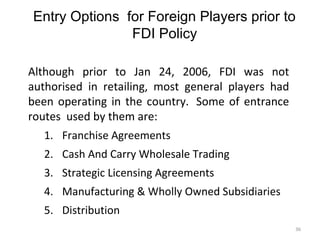
Entry Options for Foreign Players prior to
               FDI Policy

Although prior to Jan 24, 2006, FDI was not
authorised in retailing, most general players had
been operating in the country. Some of entrance
routes used by them are:
   1. Franchise Agreements
   2. Cash And Carry Wholesale Trading
   3. Strategic Licensing Agreements
   4. Manufacturing & Wholly Owned Subsidiaries
   5. Distribution
                                                    36
1. Franchise Agreements
   Foreign company gives name and technology to
    local partner. Gets royalty in return.
Easiest track to enter Indian market
In      franchising    and     commission   agents’
    services, FDI is allowed with the approval RBI
    under FEMA
E.g. Nike, Pizza Hut, Tommy Hilfiger, Marks
    and Spencer, Mango                                 37
2. Cash & Carry Wholesale Trading
 100% FDI is allowed in wholesale trading which involves
  building of a large distribution infrastructure to assist
  local manufacturers. E.g. Metro Cash & Carry
Entities established prior to 1997
     Allowed to continue with their existing foreign

      equity components.
     No FDI restrictions in the retail sector pre-1997

     Foodworld

         51:49 JV between RPG and Dairy Farm I’nal (it’s

        leading food retailer in India now)
        Mc Donalds


                                                              38
3. Strategic Licensing Agreements

foreign brands give exclusive licences and
 distribution rights to Indian companies
Indian companies sell it through their own
 stores,     or    enter     into     shop-in-shop
 arrangements or distribute the brands to
 franchisees
E.g.      Mango   with    Piramyd,   SPAR    with
 Radhakrishna Foodlands Pvt. Ltd.                    39
4. Manufacturing & Wholly Owned Subsidiaries

  Bata, Nike, Reebok, Adidas, etc. have wholly-
 owned subsidiaries in manufacturing which are
 treated as Indian companies and are, therefore,
 allowed to do retail
 They sell products to Indian consumers by

 franchising, internal distributors, existent Indian
 retailers, own outlets, etc.
 E.g. Nike entered through an exclusive licensing

 agreement with Sierra Enterprises but now has a
 wholly owned subsidiary, Nike India Private
 Limited

                                                       40
5.Distribution
   International company sets up local distribution
    office
   Supply products to Indian retailers to sell
   Also set up franchised outlets for brand
      E.g. Swarovski, Hugo Boss


                                                       41
On the last count……
In July 2010, Department of Industrial Policy and
Promotion (DIPP), Ministry of Commerce circulated a
discussion paper on allowing FDI in multi-brand retail. The
paper doesn’t suggest any upper limit on FDI in multi-
brand retail. If implemented, it would open the doors for
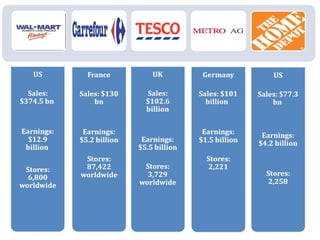
global retail giants (Wal-Mart, Carrefour and Tesco) to
enter and establish their footprints on the retail
landscape of India.


                                                              42
Let the liberalisation be in
steps rather than being a leap.


                                  43
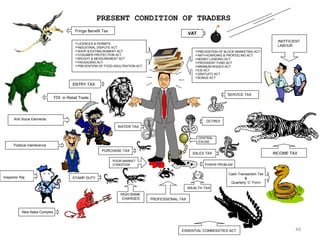
PRESENT CONDITION OF TRADERS
                                          Fringe Benefit Tax
                                                                                                   VAT
                                                                                                                                                INEFFICIENT
                                          LICENCES & PERMITS
                                          INDUSTRIAL DISPUTE ACT                                                                               LABOUR
                                          SHOP & ESTABLISHMENT ACT                                   PREVENTION OF BLOCK MARKETING ACT
                                          COSUMER PROTECTION ACT                                     ANTI-HOARDING & PROFEELING ACT
                                          WEIGHT & MEASUREMENT ACT                                   MONEY LENDING ACT
                                          PACKAGING ACT                                              PROVIDENT FUND ACT
                                          PREVENTION OF FOOD ADULTRATION ACT                         MINIMUM WAGES ACT
                                                                                                      ESI ACT
                                                                                                      GRATUITY ACT
                                                                                                      BONUS ACT

                                         ENTRY TAX

                                                                                                                      SERVICE TAX
                               FDI in Retail Trade


      Anti Socal Elements
                                                                                                            OCTROI
                                                                 WATER TAX


                                                                                                         CENTRAL
                                                                                                         EXCISE
      Political Interference
                                                        PURCHASE TAX
                                                                                                     SALES TAX                                INCOME TAX
                                                               POOR MARKET
                                                               CONDITION                                    POWER PROBLEM


                                                                                                                       Cash Transaction Tax
Inspector Raj                            STAMP DUTY                                                                             &
                                                                                                                        Quarterly ‘C’ Form
                                                                                                   WEALTH TAX
                                                                  HIGH BANK
                                                                   CHARGES      PROFESSIONAL TAX


           New Naka Complex


                                                                                              ESSENTIAL COMMODITIES ACT                                 44
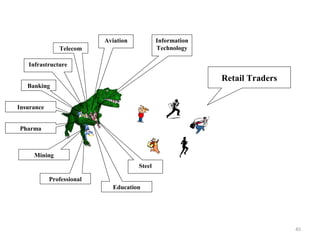
Aviation           Information
               Telecom                        Technology

   Infrastructure

                                                            Retail Traders
   Banking


Insurance


Pharma


     Mining
                                      Steel

            Professional
                             Education


                                                                             45
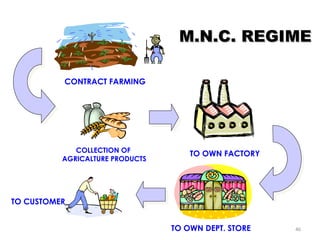
M.N.C. REGIME

          CONTRACT FARMING


             COLLECTION OF
                                     TO OWN FACTORY
          AGRICALTURE PRODUCTS


TO CUSTOMER


                                 TO OWN DEPT. STORE   46

Session 11 leb simple final

  • 1.
    F.D.I. in RetailSector SESSION 10 LEGAL ENVIRONMENT OF BUSINESS 1
  • 2.
    Agenda Retailing : Anoverview Indian retail FDI in Indian retailing Why FDI? 2
  • 3.
    Retailing : Anoverview 3
  • 4.
    Retailing: An overview  Retailing World’s largest private industry US$ 6.6 trillion sales annually  Indian retailing Largest employer after agriculture - 8% of population Highest outlet density in world Around 12 mn outlets Still evolving as an industry Long way to go 4
  • 5.
    Retailing: An overview  Wal-Mart Topmost global Fortune 500 company(3 Consecutive Years) Annual Sales of over US$ 250 bn  Fortune 100 9 Retailers Carrefour, Ahold, Home Depot, Kroger, Metro, Kmart-Sears, Target, Albertsons’ 5
  • 6.
    Evolution of Indianretail Historic/Rural Traditional/Perva Government Modern Formats/ International Reach sive Reach Supported Exclusive Brand Outlets Hyper/Super Markets Department Stores Shopping Malls PDS Outlets Khadi Stores Cooperatives Convenience Stores Mom and Pop/Kiranas Weekly Markets Village Fairs Melas Source of Neighborhood Availability/ Low Shopping Entertainment Stores/Convenienc Costs / Experience/Efficien e Distribution cy 6
  • 7.
    Evolution of Indianretail  Informal retailing Sector  Typically small retailers.  Evasion of taxes  Difficulty in enforcing tax collection mechanisms  No monitoring of labour laws  Formal Retailing Sector  Typically large retailers  Greater enforcement of taxation mechanisms  High level of labour usage monitoring 7
  • 8.
    8 8
  • 9.
    Size : $400 billion Growth Rate : 13% GDP contribution : 12% Major sector : Food and Grocery Employment : 2nd largest industry (35.06 million) Types: Organized ( 5%) Unorganized ( 95%) 9
  • 10.
     Corporates areincreasingly coming into this sector  Demand of branded goods on a large scale  Demand of new and varied products  High quality product is preferred  Varied window display  E-tailers increase the presence 10
  • 11.
    US Taiwan Malays ia Thailand O rg anis ed Indones ia C hina Unorg anis e d India 0 20 40 60 80 100 US Taiwan Malaysia Thailand Indonesia China India Unorganised 15% 19% 45% 60% 70% 80% 95% Organised 85% 81% 55% 40% 30% 20% 5% 11
  • 12.
  • 13.
    Categories of Indianretail  Corporate Houses  Tatas: Tata Trent  RPG group: Food World, Health & Glow, etc  ITC: Wills Life Style  Rahejas(Shoppers Stop), Hiranandani (Haiko), DLF(DT cinemas), etc.  Dedicated brand outlets  Nike, Reebok, Zodiac, etc  Multi-brand outlets  Vijay Sales, Viveks, Ritu Wear, Sehgal Bro, etc.  Manufacturers/ Exporters  Bata, Weekender, Lilliput 13
  • 14.
    Classifying Indian retail  Modern Format retailers  Supermarkets (Foodworld)  Hypermarkets (Big Bazaar)  Department Stores (S Stop)  Specialty Chains (Ikea)  Company Owned Company Operated  Traditional Format Retailers  Kiranas: Traditional Mom and Pop Stores  Kiosks  Street Markets  Exclusive /Multiple Brand Outlets 14
  • 15.
    Large Indian retailers  Hypermarket  Big Bazaar , Giants , Shoprite, Star  Department store  Lifestyle, Pantaloon, Piramyd, Shoppers Stop, Trent  Entertainment  Fame Adlabs, Fun Republic, INOX, PVR 15
  • 16.
    Organised retail formatsin India FORMAT AVERAGE SIZE Convenience Stores 800 sq. feet Discount Stores 1000 sq. feet Category Killers 8000 sq. feet Specialty Stores Single-category Shop-in-Shop Within Large malls Supermarket Large in Size, Typical in layout Department Stores 10,000 – 60,000 sq. feet Cash and Carry 75,000 Sq. feet Hypermarkets 50,000 – 1,00,000 sq. feet 16
  • 17.
    Major Indian Retailers- Categories Format Description Retailers Hypermarkets Offering basket of product Spencers, Big bazaar Cash and Carry Bulk-buying requirement Bharti - Walmart Departmental Large layout, Wide merchandise mix Lifestyle , Globus stores Supermarkets Household product as well as food as Apna Bazaar , Food integral part of the service Bazaar Shop-in-shop Shops located in shopping malls Navras ( Big Bazaar) Specialty stores Focus on individual product type Brand Factory Category killers Particular segment The LOFT Discount stores Branded product at discounted px. Levi’s Outlet Convenience Small Retail stores In and Out stores 17
  • 18.
    Segmentation Retail Segment Percentage Major Retailers holding in sector Food and Grocery 63% Reliance Fresh, Café Brio, Food Bazaar Clothing, Textile 9% Westside, Shoppers Stop, Globus and Fashion Jewellery 5% Tanishq Catering services 5% IRCTC Consumer durable 4% Viveks, Vijay Sales, Croma Pharmaceuticals 4% Piramal Group Entertainment 3% Bowling Co. Furnishing, 3% Hometown, Tangent Concept utensils 18 Mobile handsets 2% The Mobile Store,
  • 19.
  • 20.
  • 21.
  • 22.
    The commitment ofmoney or capital to purchase financial instruments or assets in order to gain profitable returns. 22
  • 23.
    Foreign Investment Investment done by citizens and through government of one country (home country) invest in industries of another country (host country). Foreign Foreign Direct Institutional Investments Investors 23
  • 24.
    WHAT IS FDI? Movementof capital across national frontiers in a manner that grants the investor control over the acquired asset. 24
  • 25.
    WHAT IS FDI? As per Dictionary of Economics FDI means investment in a foreign country through the acquisition of a local company or the establishment there of an operation on a new (Greenfield) site.  Simply put, FDI refers to capital inflows from abroad that is invested in or to enhance the production capacity of the economy. 25
  • 26.
    Automatic Route Government No permission required Approval /License required. 26
  • 27.
    What was theCriteria for FDI?  1991-92 : Dr. Manmohan Singh, Finance Minister referred to certain criteria for allowing Foreign Direct Investment. These were : 1. Establishment of basic industries requiring huge capital and advanced sophisticated technology 2. Infrastructure projects like electricity generation, road, building, etc. 3. Projects which would generate employment 27
  • 28.
    FDI Policy Initiatives 1991- FDI allowed selectively up to 51% in priority sectors.  1997-FDI allowed up to 100% in sectors like mining, manufacturing, Cash and carry/wholesale (under Govt. approval route).  It was brought under the automatic route in 2006. 28
  • 29.
    FDI Policy Initiatives 2000-06 FDI allowed up to 100% in specified sectors.  FDI limits increased.  Procedures further simplified  The top 3 Indian Regions attracting the highest FDI.  Mumbai, Delhi and Karnataka.  Account for nearly 62% of the total FDI. 29
  • 30.
    FDI Policy Initiatives April 2006 - May 2010 : 94 proposals were received  57 proposals approved= inflow of USD196 mn under single brand retailing 30
  • 31.
    As per Press Note 4 of 2006 issued by DIPP and consolidated FDI Policy issued in October 2010 which provide the sector specific guidelines for FDI with regard to the conduct of trading activities. A) FDI up to 100% for cash and carry wholesale trading and export trading allowed under the automatic route. B) FDI up to 51 % with prior Government approval (i.e. FIPB) for retail trade of ‘Single Brand’ products, subject to Press Note 3 (2006 Series) C) FDI is NOT permitted in Multi Brand Retailing in India. 31
  • 32.
  • 33.
     Complications inissuance of licenses like a hypermarket in Mumbai must apply for 29 unique licenses & then when it has to come up with second store it has to apply for same 29 licenses all over again 33
  • 34.
  • 35.
    FDI in Indianretailing Current FDI is not permitted in retail trade sector, except in:  Private labels  Hi-Tech items/items requiring specialized after sales service  Medical and diagnostic items  Items sourced from the Indian small sector (manufactured with foreign technology) For 2 year test marketing (simultaneous commencement of investment in production facility required) 35
  • 36.
    Entry Options forForeign Players prior to FDI Policy Although prior to Jan 24, 2006, FDI was not authorised in retailing, most general players had been operating in the country. Some of entrance routes used by them are: 1. Franchise Agreements 2. Cash And Carry Wholesale Trading 3. Strategic Licensing Agreements 4. Manufacturing & Wholly Owned Subsidiaries 5. Distribution 36
  • 37.
    1. Franchise Agreements  Foreign company gives name and technology to local partner. Gets royalty in return. Easiest track to enter Indian market In franchising and commission agents’ services, FDI is allowed with the approval RBI under FEMA E.g. Nike, Pizza Hut, Tommy Hilfiger, Marks and Spencer, Mango 37
  • 38.
    2. Cash &Carry Wholesale Trading  100% FDI is allowed in wholesale trading which involves building of a large distribution infrastructure to assist local manufacturers. E.g. Metro Cash & Carry Entities established prior to 1997  Allowed to continue with their existing foreign equity components.  No FDI restrictions in the retail sector pre-1997  Foodworld  51:49 JV between RPG and Dairy Farm I’nal (it’s leading food retailer in India now) Mc Donalds 38
  • 39.
    3. Strategic LicensingAgreements foreign brands give exclusive licences and distribution rights to Indian companies Indian companies sell it through their own stores, or enter into shop-in-shop arrangements or distribute the brands to franchisees E.g. Mango with Piramyd, SPAR with Radhakrishna Foodlands Pvt. Ltd. 39
  • 40.
    4. Manufacturing &Wholly Owned Subsidiaries  Bata, Nike, Reebok, Adidas, etc. have wholly- owned subsidiaries in manufacturing which are treated as Indian companies and are, therefore, allowed to do retail They sell products to Indian consumers by franchising, internal distributors, existent Indian retailers, own outlets, etc. E.g. Nike entered through an exclusive licensing agreement with Sierra Enterprises but now has a wholly owned subsidiary, Nike India Private Limited 40
  • 41.
    5.Distribution  International company sets up local distribution office  Supply products to Indian retailers to sell  Also set up franchised outlets for brand  E.g. Swarovski, Hugo Boss 41
  • 42.
    On the lastcount…… In July 2010, Department of Industrial Policy and Promotion (DIPP), Ministry of Commerce circulated a discussion paper on allowing FDI in multi-brand retail. The paper doesn’t suggest any upper limit on FDI in multi- brand retail. If implemented, it would open the doors for global retail giants (Wal-Mart, Carrefour and Tesco) to enter and establish their footprints on the retail landscape of India. 42
  • 43.
    Let the liberalisationbe in steps rather than being a leap. 43
  • 44.
    PRESENT CONDITION OFTRADERS Fringe Benefit Tax VAT INEFFICIENT LICENCES & PERMITS INDUSTRIAL DISPUTE ACT LABOUR SHOP & ESTABLISHMENT ACT PREVENTION OF BLOCK MARKETING ACT COSUMER PROTECTION ACT ANTI-HOARDING & PROFEELING ACT WEIGHT & MEASUREMENT ACT MONEY LENDING ACT PACKAGING ACT PROVIDENT FUND ACT PREVENTION OF FOOD ADULTRATION ACT MINIMUM WAGES ACT ESI ACT GRATUITY ACT BONUS ACT ENTRY TAX SERVICE TAX FDI in Retail Trade Anti Socal Elements OCTROI WATER TAX CENTRAL EXCISE Political Interference PURCHASE TAX SALES TAX INCOME TAX POOR MARKET CONDITION POWER PROBLEM Cash Transaction Tax Inspector Raj STAMP DUTY & Quarterly ‘C’ Form WEALTH TAX HIGH BANK CHARGES PROFESSIONAL TAX New Naka Complex ESSENTIAL COMMODITIES ACT 44
  • 45.
    Aviation Information Telecom Technology Infrastructure Retail Traders Banking Insurance Pharma Mining Steel Professional Education 45
  • 46.
    M.N.C. REGIME CONTRACT FARMING COLLECTION OF TO OWN FACTORY AGRICALTURE PRODUCTS TO CUSTOMER TO OWN DEPT. STORE 46

Editor's Notes

  • #9 The fast growth of the organized retail sector experienced in India over the last few years has been based upon the consumption demand of the rich and upper middle classes, whose disposable incomes have risen considerably. Technological upgradation has also accompanied this growth in organized retail. Growth occurring in both the organized as well as the unorganized retail sectors simultaneously is a chimera. The former grows necessarily at the cost of the latter therefore making job loss inevitable. At a time when organized retail in India is growing at a fast pace anyway and there is no dearth of indigenous capital, the entry of foreign capital which would accelerate the concentration of business in organized retail causing job loss at a massive scale is unwarranted.
  • #11 Varied window display : now a days retailers know that if your product is dosplayed properly acc. to the culture of the state you are operating in , will definaltey help you