A
    BRIEF REPORT

         ON

RETAIL SECTOR IN INDIA

     August 2012
A brief report on Retail sector in India


                                          1. RETAIL SECTOR IN INDIA

1.1         Overview

            Retailing in India is one of the business enterprises of its economy and accounts for 14 to
            15% of its GDP. The Indian retail market is estimated to be US$ 450 billion and one of the
            top five retail markets in the world. India is one of the fastest growing retail markets in the
            world. India's retailing industry is essentially owner manned small shops account for more
            than 90%. In 2010, larger format convenience stores and supermarkets accounted for about
            4% of the industry, and these were present only in large urban centres.

            Until 2011, Indian central government denied Foreign Direct Investment (FDI) in multi-
            brand retail, forbidding foreign groups from any ownership in supermarkets, convenience
            stores or any retail outlets. Even single-brand retail was limited to 51% ownership and a
            bureaucratic process.

            In November 2011, India's central government announced retail reforms for both multi-
            brand stores and single-brand stores. These market reforms paved the way for retail
            innovation and competition with multi-brand retailers such as Wal-Mart, Carrefour and
            Tesco, as well single brand majors such as IKEA, Nike, and Apple. The statement flickers
            intense activism, both in opposition and in support of the reforms. In December 2011,
            under pressure from the opposition, Indian government placed the retail reforms on hold till
            it reaches a consensus. In January 2012, India approved reforms for single-brand stores
            welcoming anyone in the world to innovate in Indian retail market with 100% ownership,
            but imposed the requirement that the single brand retailer source 30% of its goods from
            India. Indian government continues the hold on retail reforms for multi-brand stores.

            The Indian retail industry is generally divided into organized and unorganized retailing:

                 Organized retailing - Organized retailing refers to trading activities undertaken by
                  licensed retailers, those who have registered for sales tax, income tax, etc. These include
                  corporate-backed hypermarkets and retail chains, and also privately-owned large retail
                  businesses. Hence, organized retail which now constitutes a small four per cent of total
                  retail sector is growing at a much faster pace of 45-50% per annum and quadruples its
                  share in total retail trade to 16% by 2011-12.
                 Unorganized retailing - Unorganized retailing refers to the traditional forms of low-cost
                  retailing, for example, local kirana shops, owner-operated general stores, paan/beedi
                  shops, convenience stores, hand cart and street vendors, etc. The unorganized retail
                  sector is growing at about 10% per annum with sales rising from US$ 309 billion in
                  2006-07 to US$ 496 billion in 2011-12

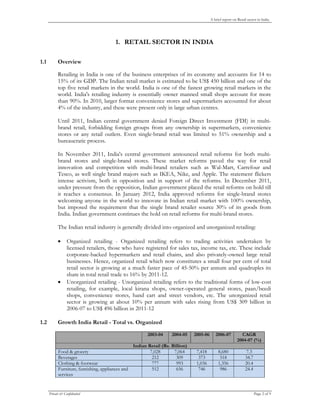
1.2         Growth India Retail - Total vs. Organized

                                                           2003-04     2004-05    2005-06      2006-07          CAGR
                                                                                                              2004-07 (%)
                                                    Indian Retail (Rs. Billion)
            Food & grocery                                  7,028       7,064      7,418         8,680              7.3
            Beverages                                        212         309        373           518              34.7
            Clothing & footwear                              777         993       1,036         1,356             20.4
            Furniture, furnishing, appliances and            512         656        746           986              24.4
            services


      Private & Confidential                                                                                              Page 2 of 9


A brief report on Retail sector in India


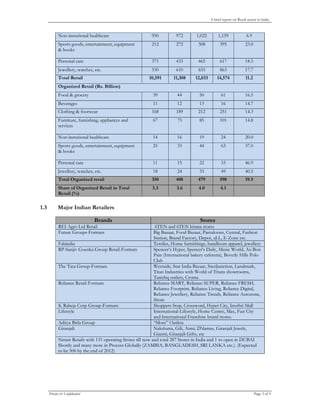
            Non-instutional healthcare                       950          972        1,022        1,159              6.9
            Sports goods, entertainment, equipment           212          272        308           395              23.0
            & books

            Personal care                                    371          433        465           617              18.5
            Jewellery, watches, etc.                         530          610        655           863              17.7
            Total Retail                                    10,591      11,308      12,033       14,574             11.2
            Organized Retail (Rs. Billion)
            Food & grocery                                    39          44          50            61              16.5
            Beverages                                         11          12          13            16              14.7
            Clothing & footwear                              168          189        212           251              14.3
            Furniture, furnishing, appliances and             67          75          85           101              14.8
            services

            Non-instutional healthcare                        14          16          19            24              20.0
            Sports goods, entertainment, equipment            25          33          44            63              37.0
            & books

            Personal care                                     11          15          22            33              46.9
            Jewellery, watches, etc.                          18          24          33            49              40.5
            Total Organized retail                           350          408        479           598              19.5
            Share of Organized Retail in Total               3.3          3.6         4.0          4.1
            Retail (%)

1.3         Major Indian Retailers

                                Brands                                                Stores
            REI Agro Ltd Retail                                6TEN and 6TEN kirana stores
            Future Groups-Formats                             Big Bazaar, Food Bazaar, Pantaloons, Central, Fashion
                                                              Station, Brand Factory, Depot, aLL, E-Zone etc.
            Fabindia                                          Textiles, Home furnishings, handloom apparel, jewellery
            RP-Sanjiv Goenka Group Retail-Formats             Spencer’s Hyper, Spencer's Daily, Music World, Au Bon
                                                              Pain (International bakery cafeteria), Beverly Hills Polo
                                                              Club
            The Tata Group-Formats                            Westside, Star India Bazaar, Steeljunction, Landmark,
                                                              Titan Industries with World of Titans showrooms,
                                                              Tanishq outlets, Croma.
            Reliance Retail-Formats                           Reliance MART, Reliance SUPER, Reliance FRESH,
                                                              Reliance Footprint, Reliance Living, Reliance Digital,
                                                              Reliance Jewellery, Reliance Trends, Reliance Autozone,
                                                              iStore
            K Raheja Corp Group-Formats                       Shoppers Stop, Crossword, Hyper City, Inorbit Mall
            Lifestyle                                         International-Lifestyle, Home Centre, Max, Fun City
                                                              and International Franchise brand stores.
            Aditya Birla Group                                “More” Outlets
            Gitanjali                                         Nakshatra, Gili, Asmi, D'damas, Gitanjali Jewels,
                                                              Giantti, Gitanjali Gifts, etc
            Nmart Retails with 131 operating Stores till now and total 287 Stores in India and 1 to open in DUBAI
            Shortly and many more in Process Globally (ZAMBIA, BANGLADESH, SRI LANKA etc.). (Expected
            to be 500 by the end of 2012)


      Private & Confidential                                                                                               Page 3 of 9


A brief report on Retail sector in India


                                         2. GOVERNMENT POLICIES

2.1      Background

         India has liberalized its single brand retail industry to permit 100% foreign investment, with
         regulatory issues and legal structures pertinent to establish operations in this new dynamic
         market. India’s retail industry is estimated to be worth approximately US$411.28 billion and is
         still growing, expected to reach US$804.06 billion in 2015. As part of the economic liberalization
         process set in place by the Industrial Policy of 1991, the Indian government has opened the retail
         sector to FDI slowly through a series of steps:

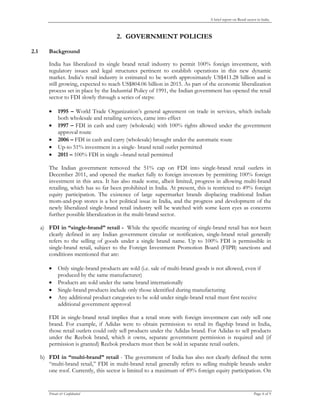
              1995 – World Trade Organization’s general agreement on trade in services, which include
               both wholesale and retailing services, came into effect
              1997 – FDI in cash and carry (wholesale) with 100% rights allowed under the government
               approval route
              2006 – FDI in cash and carry (wholesale) brought under the automatic route
              Up-to 51% investment in a single- brand retail outlet permitted
              2011 – 100% FDI in single –brand retail permitted

         The Indian government removed the 51% cap on FDI into single-brand retail outlets in
         December 2011, and opened the market fully to foreign investors by permitting 100% foreign
         investment in this area. It has also made some, albeit limited, progress in allowing multi-brand
         retailing, which has so far been prohibited in India. At present, this is restricted to 49% foreign
         equity participation. The existence of large supermarket brands displacing traditional Indian
         mom-and-pop stores is a hot political issue in India, and the progress and development of the
         newly liberalized single-brand retail industry will be watched with some keen eyes as concerns
         further possible liberalization in the multi-brand sector.

      a) FDI in “single-brand” retail - While the specific meaning of single-brand retail has not been
         clearly defined in any Indian government circular or notification, single-brand retail generally
         refers to the selling of goods under a single brand name. Up to 100% FDI is permissible in
         single-brand retail, subject to the Foreign Investment Promotion Board (FIPB) sanctions and
         conditions mentioned that are:

              Only single-brand products are sold (i.e. sale of multi-brand goods is not allowed, even if
               produced by the same manufacturer)
              Products are sold under the same brand internationally
              Single-brand products include only those identified during manufacturing
              Any additional product categories to be sold under single-brand retail must first receive
               additional government approval

         FDI in single-brand retail implies that a retail store with foreign investment can only sell one
         brand. For example, if Adidas were to obtain permission to retail its flagship brand in India,
         those retail outlets could only sell products under the Adidas brand. For Adidas to sell products
         under the Reebok brand, which it owns, separate government permission is required and (if
         permission is granted) Reebok products must then be sold in separate retail outlets.

      b) FDI in “multi-brand” retail - The government of India has also not clearly defined the term
         “multi-brand retail,” FDI in multi-brand retail generally refers to selling multiple brands under
         one roof. Currently, this sector is limited to a maximum of 49% foreign equity participation. On


         Private & Confidential                                                                                 Page 4 of 9


A brief report on Retail sector in India


      July 2010, the Department of Industrial Policy and Promotion (DIPP) and the Ministry of
      Commerce circulated a discussion paper on allowing FDI in multi-brand retail. The Committee
      of Secretaries, led by Cabinet Secretary, recommended opening the retail sector for FDI with a
      51% cap on FDI, minimum investment of US$100 million and a mandatory 50% capital
      reinvestment into backend operations. Notably, the paper does not put forward any upper limit
      on FDI in multi-brand retail

      The long-awaited scheme has been sent to the Cabinet for approval, but no decision has yet been
      made. There appears to be a broad consensus within the Committee of Secretaries that a 51%
      cap on FDI in multi-brand retail is acceptable. Meanwhile the Department of Consumer Affairs
      has supported the case for a 49% cap and the Small and Medium Enterprises Ministry has said
      the government should limit FDI in multi-brand retail to 18%.

c)    Government “safety valves” on FDI - There is concern about the competition presented to
      domestic competitors and the monopolization of the domestic market by large international
      retail giants. The Indian government feels that FDI in multi-brand retailing must be dealt with
      cautiously, given the large potential scale and social impact. As such, the government is
      considering safety valves for standardize FDI in the sector.

      For example:
      A stipulated percentage of FDI in the sector could be required to be spent on building back-end
      infrastructure, logistics or agro-processing units in order to ensure that the foreign investors
      make a genuine contribution to the development of infrastructure and logistics. At least 50% of
      the jobs in the retail outlet could be reserved for rural youth and a certain amount of farm
      produce could be required to be procured from poor farmers. A minimum percentage of
      manufactured products could be required to be sourced from the SME sector in India. To
      ensure that the public distribution system and the Indian food security system, is not weakened,
      the government may reserve the right to procure a certain amount of food grains. To protect the
      interest of small retailers, an exclusive regulatory framework is made to ensure that the retailing
      giants do not resort to predatory pricing or acquire monopolistic tendencies.

2.2   Benefits of FDI in multi-brand retail

      Soaring inflation is one of the driving motives behind this move towards multi-brand retail.
      Allowing international retailers such as Wal-Mart and Carrefour, which have already set up
      wholesale operations in the country, to set up multi-brand retails stores will assist in keeping
      food and commodity prices under control. Moreover, industry experts feel allowing FDI will cut
      waste, as big players will build backend infrastructure. FDI in multi-brand retail would also help
      narrow the current account deficit. Additional benefits include moving away from an industry
      focus on intermediaries and job creation.

                 Moving away from intermediary-only
                 Job creation
                 No threat to kiranas (mom-and-pop stores)


      Private & Confidential                                                                              Page 5 of 9


A brief report on Retail sector in India


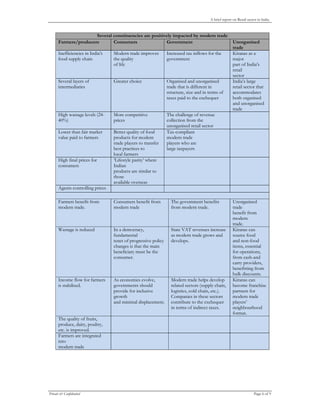
                      Several constituencies are positively impacted by modern trade
      Farmers/producers       Consumers                 Government                                    Unorganised
                                                                                                      trade
      Inefficiencies in India’s   Modern trade improves         Increased tax inflows for the         Kiranas as a
      food supply chain           the quality                   government                            major
                                  of life                                                             part of India’s
                                                                                                      retail
                                                                                                      sector
      Several layers of           Greater choice                Organised and unorganised             India’s large
      intermediaries                                            trade that is different in            retail sector that
                                                                structure, size and in terms of       accommodates
                                                                taxes paid to the exchequer           both organised
                                                                                                      and unorganised
                                                                                                      trade
      High wastage levels (24-    More competitive              The challenge of revenue
      40%)                        prices                        collection from the
                                                                unorganised retail sector
      Lower than fair market      Better quality of food        Tax-compliant
      value paid to farmers       products for modern           modern trade
                                  trade players to transfer     players who are
                                  best practices to             large taxpayers
                                  local farmers
      High final prices for       ’Lifestyle parity’ where
      consumers                   Indian
                                  products are similar to
                                  those
                                  available overseas
      Agents controlling prices

      Farmers benefit from        Consumers benefit from          The government benefits             Unorganised
      modern trade.               modern trade                    from modern trade.                  trade
                                                                                                      benefit from
                                                                                                      modern
                                                                                                      trade.
      Wastage is reduced          In a democracy,                 State VAT revenues increase         Kiranas can
                                  fundamental                     as modern trade grows and           source food
                                  tenet of progressive policy     develops.                           and non-food
                                  changes is that the main                                            items, essential
                                  beneficiary must be the                                             for operations,
                                  consumer.                                                           from cash-and
                                                                                                      carry providers,
                                                                                                      benefitting from
                                                                                                      bulk discounts.
      Income flow for farmers     As economies evolve,            Modern trade helps develop          Kiranas can
      is stabilised.              governments should              related sectors (supply chain,      become franchise
                                  provide for inclusive           logistics, cold chain, etc.).       partners for
                                  growth                          Companies in these sectors          modern trade
                                  and minimal displacement.       contribute to the exchequer         players’
                                                                  in terms of indirect taxes.         neighbourhood
                                                                                                      format.
      The quality of fruits,
      produce, dairy, poultry,
      etc. is improved.
      Farmers are integrated
      into
      modern trade


Private & Confidential                                                                                              Page 6 of 9


A brief report on Retail sector in India


                                     3. MAJOR GLOBAL PLAYERS

3.1   Wal-Mart

      Wal-Mart Stores, Inc., branded as Walmart since 2008 and Wal*Mart before then, is an American
      multinational retailer corporation that runs chains of large discount department stores and
      warehouse stores. The company is the world's third largest public corporation, according to the
      Fortune Global 500 list in 2012. It is also the biggest private employer in the world with over
      two million employees, and is the largest retailer in the world. Wal-Mart remains a family-owned
      business, as the company is controlled by the Walton family who own a 48% stake in Wal-Mart.
      Wal-Mart’s investments outside North America have had mixed results: its operations in the
      United Kingdom, South America and China are highly successful, whereas ventures in Germany
      and South Korea were unsuccessful.

      Sensing huge opportunities, Wal-Mart entered the Korea but adopted different strategies. Wal-
      Mart attempted to penetrate the Korean market by building stores in distant areas where land
      prices were low, replicating the US strategy of smaller-city store build-up. It had only 16 stores in
      all of Korea with just one in the Seoul metropolitan area and could not achieve economies of
      scale. The company expected the Korean consumers to drive to its stores for price shopping as
      American consumers do. However, this location strategy did not match well with the Korean
      consumers’ lifestyle and shopping habits. They prefer to buy smaller units on a more frequent
      basis and to have accessibility to a store within walking distance. As a result, Wal-Mart faced
      serious challenges in implementing its core competence in South Korea. Moreover, it could not
      enjoy its buyer power in the local vendor market and had no control over its Korean supply
      chain and procurement. Eventually, it packed its bags in 2006.

 3.1.1 Wal-Mart in India

      Bharti Wal-Mart Private Limited is a joint venture between Bharti Enterprises, one of India's
      leading business groups with interests in telecom, agri-business, insurance and retail, and Wal-
      Mart, the world’s leading retailer, renowned for its efficiency and expertise in logistics, supply
      chain management and sourcing. The joint venture is establishing wholesale cash-and-carry
      stores and back-end supply chain management operations in line with Government of India
      guidelines. Under the agreement, Bharti and Wal-Mart hold 50:50 stakes in Bharti Wal-Mart
      Private Limited. The first Wholesale Cash-and-carry facility named "Best Price Modern
      Wholesale" Opened in Amritsar in May 2009 and subsequently in Zirakpur (Near Chandigarh),
      Jalandhar, Kota, Bhopal, Ludhiana, Raipur, Indore, Vijaywada, Meerut, Agra, Lucknow, Jammu,
      Guntur, Aurangabad , Bathinda and Amravati.
      Bharti Wal-Mart strive to improve the quality of life for employees, customers and communities
      through various interventions and the Direct Farm Program is one of them

      Benefit to farmers:
       7-10% higher price to farmers than what they get from Mandi
       3-4% incentive for the quality of the produce farmers deliver to Bharti Wal-Mart based on
         customer requirement
       Expert advice on better crop planning and management
       Efficient crop calendar management aimed at catching early and late seasons for better prices
       Opportunity to maximize and improve income by offering better quality

            Benefit to stores & customers:
             Fresh produce


      Private & Confidential                                                                                Page 7 of 9


A brief report on Retail sector in India


                 Local source
                 Consistent quality
                 Safer food
                 Value for money
                 Lower cost compared to open market buys

3.2   Carrefour

      It is an international hypermarket chain headquartered in Boulogne Billancourt, France, in
      Greater Paris. It is one of the largest hypermarket chains in the world (with 1,395 hypermarkets
      at the end of 2009, the second largest retail group in the world in terms of revenue and third
      largest in profit after Wal-Mart and Tesco). Carrefour operates mainly in Europe, Argentina,
      Brazil, China, Colombia, Dominican Republic, United Arab Emirates and Saudi Arabia, but also
      has shops in North Africa and other parts of Asia, with most stores being of smaller size than
      hypermarket or even supermarket. Carrefour means "crossroads" in French. Previously the
      company head office was in Levallois-Perret, also in Greater Paris.

3.2.1 Carrefour in India

      The Carrefour Group announces the opening of its first cash & carry store in India in New
      Delhi under the name "Carrefour Wholesale Cash & Carry.” With a sales area of 5200 m2, this
      store located east of New Delhi in the Shahadra neighbourhood will offer more than 10.000
      SKUs in food and non-food to professional businesses, institutions, restaurants and local
      retailers. This opening is in line with the group's strategy to be present in major emerging
      markets that offer significant expansion and medium- and long-term growth opportunities.

      Carrefour Group Head Office Address:
      16th Flr Building 9 A Cyber City DLF Phase 3
      Gurgaon: 122001
      Haryana, India

3.3   Tesco

      It is a British multinational grocery and general merchandise retailer headquartered in Cheshunt,
      United Kingdom. It is the third-largest retailer in the world measured by revenues (after Wal-
      Mart and Carrefour) and the second-largest measured by profits (after Wal-Mart). It has stores in
      14 countries across Asia, Europe and North America and is the grocery market leader in the UK
      (where it has a market share of around 30%), Malaysia, the Republic of Ireland and Thailand.

3.3.1 Tesco in India

      Tesco has had a limited presence in India with a service centre in Bangalore, and outsourcing. In
      2008 Tesco announced their intention to invest an initial £60m ($115m) to open a wholesale
      cash-and-carry business based in Mumbai with the assistance of the Tata Group.

      The global service operations of Tesco HSC are involved in creating and executing strategic
      initiatives for Tesco retail stores worldwide. These strategic initiatives cover the IT, Business,
      Financial, Commercial and Property aspects, among others, of Tesco operations. The operations
      cover all internal and external platforms that drive Tesco's business, making it one of the world's
      most preferred retail stores. Tesco is the first major international retailer to have a fully-owned


      Private & Confidential                                                                              Page 8 of 9


A brief report on Retail sector in India


      support centre in India. We are dedicated to make the Tesco experience better for over 60
      million customers worldwide, simpler for over 500,000 employees and achieve cost-efficiencies.

3.4   IKEA

      IKEA is a privately held, international home products company that designs and sells ready-to-
      assemble furniture such as beds, chairs, desks, appliances and home accessories. The company is
      the world's largest furniture retailer. Founded in Sweden in 1943 by 17-year-old Ingvar Kamprad,
      The first IKÉA store was opened in Älmhult, Småland in 1953, while the first stores outside
      Sweden were opened in Norway (1963) and Denmark (1969). The stores spread to other parts of
      Europe in the 1970s, with the first store outside Scandinavia opening in Switzerland (1973),
      followed by Germany (1974). Things were going so well for the company, that in 1973, the
      company's German executives accidentally opened a store in Konstanz when they had meant to
      open one in Koblenz. Later that decade, stores opened in other parts of the world, including
      Japan (1974), Australia and Hong Kong (1975), Canada (1976) and Singapore (1978). IKEA
      further expanded in the 1980s, opening stores in France & Spain (1981), Belgium (1984), the
      United States (1985), the United Kingdom (1987) and Italy (1989) among other areas. The
      company expanded into more countries in the 1990s and 2000s. Germany, with 44 stores, is
      IKEA's biggest market, followed by the United States, with 37. At the end of 2009 financial year,
      the IKEA group had 267 stores in 25 countries.

      Swedish furniture home accessories IKEA is planning to enter India with a Euros 1.5 billion
      (around Rs 10,500 crores) investment in a single-brand retail venture. In the first phase it plans
      to set up 25 stores with an investment of Euros 600 million (around Rs 4,200 crores) in opening
      25 stores. The company has already sought government permission to set up a 100% Indian
      venture and has also promised to increase its sourcing from the country. In these stores
      companies are permitted to stock goods from one brand only. The entry also comes with the
      stipulation that at least 30% of the products have to be sourced from Indian micro, small and
      medium enterprises - a major area of concern for IKEA until recently.


      Private & Confidential                                                                              Page 9 of 9


Retail industry-in-india

  • 1.
    A BRIEF REPORT ON RETAIL SECTOR IN INDIA August 2012
  • 2.
    A brief reporton Retail sector in India 1. RETAIL SECTOR IN INDIA 1.1 Overview Retailing in India is one of the business enterprises of its economy and accounts for 14 to 15% of its GDP. The Indian retail market is estimated to be US$ 450 billion and one of the top five retail markets in the world. India is one of the fastest growing retail markets in the world. India's retailing industry is essentially owner manned small shops account for more than 90%. In 2010, larger format convenience stores and supermarkets accounted for about 4% of the industry, and these were present only in large urban centres. Until 2011, Indian central government denied Foreign Direct Investment (FDI) in multi- brand retail, forbidding foreign groups from any ownership in supermarkets, convenience stores or any retail outlets. Even single-brand retail was limited to 51% ownership and a bureaucratic process. In November 2011, India's central government announced retail reforms for both multi- brand stores and single-brand stores. These market reforms paved the way for retail innovation and competition with multi-brand retailers such as Wal-Mart, Carrefour and Tesco, as well single brand majors such as IKEA, Nike, and Apple. The statement flickers intense activism, both in opposition and in support of the reforms. In December 2011, under pressure from the opposition, Indian government placed the retail reforms on hold till it reaches a consensus. In January 2012, India approved reforms for single-brand stores welcoming anyone in the world to innovate in Indian retail market with 100% ownership, but imposed the requirement that the single brand retailer source 30% of its goods from India. Indian government continues the hold on retail reforms for multi-brand stores. The Indian retail industry is generally divided into organized and unorganized retailing:  Organized retailing - Organized retailing refers to trading activities undertaken by licensed retailers, those who have registered for sales tax, income tax, etc. These include corporate-backed hypermarkets and retail chains, and also privately-owned large retail businesses. Hence, organized retail which now constitutes a small four per cent of total retail sector is growing at a much faster pace of 45-50% per annum and quadruples its share in total retail trade to 16% by 2011-12.  Unorganized retailing - Unorganized retailing refers to the traditional forms of low-cost retailing, for example, local kirana shops, owner-operated general stores, paan/beedi shops, convenience stores, hand cart and street vendors, etc. The unorganized retail sector is growing at about 10% per annum with sales rising from US$ 309 billion in 2006-07 to US$ 496 billion in 2011-12 1.2 Growth India Retail - Total vs. Organized 2003-04 2004-05 2005-06 2006-07 CAGR 2004-07 (%) Indian Retail (Rs. Billion) Food & grocery 7,028 7,064 7,418 8,680 7.3 Beverages 212 309 373 518 34.7 Clothing & footwear 777 993 1,036 1,356 20.4 Furniture, furnishing, appliances and 512 656 746 986 24.4 services Private & Confidential Page 2 of 9  
  • 3.
    A brief reporton Retail sector in India Non-instutional healthcare 950 972 1,022 1,159 6.9 Sports goods, entertainment, equipment 212 272 308 395 23.0 & books Personal care 371 433 465 617 18.5 Jewellery, watches, etc. 530 610 655 863 17.7 Total Retail 10,591 11,308 12,033 14,574 11.2 Organized Retail (Rs. Billion) Food & grocery 39 44 50 61 16.5 Beverages 11 12 13 16 14.7 Clothing & footwear 168 189 212 251 14.3 Furniture, furnishing, appliances and 67 75 85 101 14.8 services Non-instutional healthcare 14 16 19 24 20.0 Sports goods, entertainment, equipment 25 33 44 63 37.0 & books Personal care 11 15 22 33 46.9 Jewellery, watches, etc. 18 24 33 49 40.5 Total Organized retail 350 408 479 598 19.5 Share of Organized Retail in Total 3.3 3.6 4.0 4.1 Retail (%) 1.3 Major Indian Retailers Brands Stores REI Agro Ltd Retail 6TEN and 6TEN kirana stores Future Groups-Formats Big Bazaar, Food Bazaar, Pantaloons, Central, Fashion Station, Brand Factory, Depot, aLL, E-Zone etc. Fabindia Textiles, Home furnishings, handloom apparel, jewellery RP-Sanjiv Goenka Group Retail-Formats Spencer’s Hyper, Spencer's Daily, Music World, Au Bon Pain (International bakery cafeteria), Beverly Hills Polo Club The Tata Group-Formats Westside, Star India Bazaar, Steeljunction, Landmark, Titan Industries with World of Titans showrooms, Tanishq outlets, Croma. Reliance Retail-Formats Reliance MART, Reliance SUPER, Reliance FRESH, Reliance Footprint, Reliance Living, Reliance Digital, Reliance Jewellery, Reliance Trends, Reliance Autozone, iStore K Raheja Corp Group-Formats Shoppers Stop, Crossword, Hyper City, Inorbit Mall Lifestyle International-Lifestyle, Home Centre, Max, Fun City and International Franchise brand stores. Aditya Birla Group “More” Outlets Gitanjali Nakshatra, Gili, Asmi, D'damas, Gitanjali Jewels, Giantti, Gitanjali Gifts, etc Nmart Retails with 131 operating Stores till now and total 287 Stores in India and 1 to open in DUBAI Shortly and many more in Process Globally (ZAMBIA, BANGLADESH, SRI LANKA etc.). (Expected to be 500 by the end of 2012) Private & Confidential Page 3 of 9  
  • 4.
    A brief reporton Retail sector in India 2. GOVERNMENT POLICIES 2.1 Background India has liberalized its single brand retail industry to permit 100% foreign investment, with regulatory issues and legal structures pertinent to establish operations in this new dynamic market. India’s retail industry is estimated to be worth approximately US$411.28 billion and is still growing, expected to reach US$804.06 billion in 2015. As part of the economic liberalization process set in place by the Industrial Policy of 1991, the Indian government has opened the retail sector to FDI slowly through a series of steps:  1995 – World Trade Organization’s general agreement on trade in services, which include both wholesale and retailing services, came into effect  1997 – FDI in cash and carry (wholesale) with 100% rights allowed under the government approval route  2006 – FDI in cash and carry (wholesale) brought under the automatic route  Up-to 51% investment in a single- brand retail outlet permitted  2011 – 100% FDI in single –brand retail permitted The Indian government removed the 51% cap on FDI into single-brand retail outlets in December 2011, and opened the market fully to foreign investors by permitting 100% foreign investment in this area. It has also made some, albeit limited, progress in allowing multi-brand retailing, which has so far been prohibited in India. At present, this is restricted to 49% foreign equity participation. The existence of large supermarket brands displacing traditional Indian mom-and-pop stores is a hot political issue in India, and the progress and development of the newly liberalized single-brand retail industry will be watched with some keen eyes as concerns further possible liberalization in the multi-brand sector. a) FDI in “single-brand” retail - While the specific meaning of single-brand retail has not been clearly defined in any Indian government circular or notification, single-brand retail generally refers to the selling of goods under a single brand name. Up to 100% FDI is permissible in single-brand retail, subject to the Foreign Investment Promotion Board (FIPB) sanctions and conditions mentioned that are:  Only single-brand products are sold (i.e. sale of multi-brand goods is not allowed, even if produced by the same manufacturer)  Products are sold under the same brand internationally  Single-brand products include only those identified during manufacturing  Any additional product categories to be sold under single-brand retail must first receive additional government approval FDI in single-brand retail implies that a retail store with foreign investment can only sell one brand. For example, if Adidas were to obtain permission to retail its flagship brand in India, those retail outlets could only sell products under the Adidas brand. For Adidas to sell products under the Reebok brand, which it owns, separate government permission is required and (if permission is granted) Reebok products must then be sold in separate retail outlets. b) FDI in “multi-brand” retail - The government of India has also not clearly defined the term “multi-brand retail,” FDI in multi-brand retail generally refers to selling multiple brands under one roof. Currently, this sector is limited to a maximum of 49% foreign equity participation. On Private & Confidential Page 4 of 9  
  • 5.
    A brief reporton Retail sector in India July 2010, the Department of Industrial Policy and Promotion (DIPP) and the Ministry of Commerce circulated a discussion paper on allowing FDI in multi-brand retail. The Committee of Secretaries, led by Cabinet Secretary, recommended opening the retail sector for FDI with a 51% cap on FDI, minimum investment of US$100 million and a mandatory 50% capital reinvestment into backend operations. Notably, the paper does not put forward any upper limit on FDI in multi-brand retail The long-awaited scheme has been sent to the Cabinet for approval, but no decision has yet been made. There appears to be a broad consensus within the Committee of Secretaries that a 51% cap on FDI in multi-brand retail is acceptable. Meanwhile the Department of Consumer Affairs has supported the case for a 49% cap and the Small and Medium Enterprises Ministry has said the government should limit FDI in multi-brand retail to 18%. c) Government “safety valves” on FDI - There is concern about the competition presented to domestic competitors and the monopolization of the domestic market by large international retail giants. The Indian government feels that FDI in multi-brand retailing must be dealt with cautiously, given the large potential scale and social impact. As such, the government is considering safety valves for standardize FDI in the sector. For example: A stipulated percentage of FDI in the sector could be required to be spent on building back-end infrastructure, logistics or agro-processing units in order to ensure that the foreign investors make a genuine contribution to the development of infrastructure and logistics. At least 50% of the jobs in the retail outlet could be reserved for rural youth and a certain amount of farm produce could be required to be procured from poor farmers. A minimum percentage of manufactured products could be required to be sourced from the SME sector in India. To ensure that the public distribution system and the Indian food security system, is not weakened, the government may reserve the right to procure a certain amount of food grains. To protect the interest of small retailers, an exclusive regulatory framework is made to ensure that the retailing giants do not resort to predatory pricing or acquire monopolistic tendencies. 2.2 Benefits of FDI in multi-brand retail Soaring inflation is one of the driving motives behind this move towards multi-brand retail. Allowing international retailers such as Wal-Mart and Carrefour, which have already set up wholesale operations in the country, to set up multi-brand retails stores will assist in keeping food and commodity prices under control. Moreover, industry experts feel allowing FDI will cut waste, as big players will build backend infrastructure. FDI in multi-brand retail would also help narrow the current account deficit. Additional benefits include moving away from an industry focus on intermediaries and job creation.  Moving away from intermediary-only  Job creation  No threat to kiranas (mom-and-pop stores) Private & Confidential Page 5 of 9  
  • 6.
    A brief reporton Retail sector in India Several constituencies are positively impacted by modern trade Farmers/producers Consumers Government Unorganised trade Inefficiencies in India’s Modern trade improves Increased tax inflows for the Kiranas as a food supply chain the quality government major of life part of India’s retail sector Several layers of Greater choice Organised and unorganised India’s large intermediaries trade that is different in retail sector that structure, size and in terms of accommodates taxes paid to the exchequer both organised and unorganised trade High wastage levels (24- More competitive The challenge of revenue 40%) prices collection from the unorganised retail sector Lower than fair market Better quality of food Tax-compliant value paid to farmers products for modern modern trade trade players to transfer players who are best practices to large taxpayers local farmers High final prices for ’Lifestyle parity’ where consumers Indian products are similar to those available overseas Agents controlling prices Farmers benefit from Consumers benefit from The government benefits Unorganised modern trade. modern trade from modern trade. trade benefit from modern trade. Wastage is reduced In a democracy, State VAT revenues increase Kiranas can fundamental as modern trade grows and source food tenet of progressive policy develops. and non-food changes is that the main items, essential beneficiary must be the for operations, consumer. from cash-and carry providers, benefitting from bulk discounts. Income flow for farmers As economies evolve, Modern trade helps develop Kiranas can is stabilised. governments should related sectors (supply chain, become franchise provide for inclusive logistics, cold chain, etc.). partners for growth Companies in these sectors modern trade and minimal displacement. contribute to the exchequer players’ in terms of indirect taxes. neighbourhood format. The quality of fruits, produce, dairy, poultry, etc. is improved. Farmers are integrated into modern trade Private & Confidential Page 6 of 9  
  • 7.
    A brief reporton Retail sector in India 3. MAJOR GLOBAL PLAYERS 3.1 Wal-Mart Wal-Mart Stores, Inc., branded as Walmart since 2008 and Wal*Mart before then, is an American multinational retailer corporation that runs chains of large discount department stores and warehouse stores. The company is the world's third largest public corporation, according to the Fortune Global 500 list in 2012. It is also the biggest private employer in the world with over two million employees, and is the largest retailer in the world. Wal-Mart remains a family-owned business, as the company is controlled by the Walton family who own a 48% stake in Wal-Mart. Wal-Mart’s investments outside North America have had mixed results: its operations in the United Kingdom, South America and China are highly successful, whereas ventures in Germany and South Korea were unsuccessful. Sensing huge opportunities, Wal-Mart entered the Korea but adopted different strategies. Wal- Mart attempted to penetrate the Korean market by building stores in distant areas where land prices were low, replicating the US strategy of smaller-city store build-up. It had only 16 stores in all of Korea with just one in the Seoul metropolitan area and could not achieve economies of scale. The company expected the Korean consumers to drive to its stores for price shopping as American consumers do. However, this location strategy did not match well with the Korean consumers’ lifestyle and shopping habits. They prefer to buy smaller units on a more frequent basis and to have accessibility to a store within walking distance. As a result, Wal-Mart faced serious challenges in implementing its core competence in South Korea. Moreover, it could not enjoy its buyer power in the local vendor market and had no control over its Korean supply chain and procurement. Eventually, it packed its bags in 2006. 3.1.1 Wal-Mart in India Bharti Wal-Mart Private Limited is a joint venture between Bharti Enterprises, one of India's leading business groups with interests in telecom, agri-business, insurance and retail, and Wal- Mart, the world’s leading retailer, renowned for its efficiency and expertise in logistics, supply chain management and sourcing. The joint venture is establishing wholesale cash-and-carry stores and back-end supply chain management operations in line with Government of India guidelines. Under the agreement, Bharti and Wal-Mart hold 50:50 stakes in Bharti Wal-Mart Private Limited. The first Wholesale Cash-and-carry facility named "Best Price Modern Wholesale" Opened in Amritsar in May 2009 and subsequently in Zirakpur (Near Chandigarh), Jalandhar, Kota, Bhopal, Ludhiana, Raipur, Indore, Vijaywada, Meerut, Agra, Lucknow, Jammu, Guntur, Aurangabad , Bathinda and Amravati. Bharti Wal-Mart strive to improve the quality of life for employees, customers and communities through various interventions and the Direct Farm Program is one of them Benefit to farmers:  7-10% higher price to farmers than what they get from Mandi  3-4% incentive for the quality of the produce farmers deliver to Bharti Wal-Mart based on customer requirement  Expert advice on better crop planning and management  Efficient crop calendar management aimed at catching early and late seasons for better prices  Opportunity to maximize and improve income by offering better quality Benefit to stores & customers:  Fresh produce Private & Confidential Page 7 of 9  
  • 8.
    A brief reporton Retail sector in India  Local source  Consistent quality  Safer food  Value for money  Lower cost compared to open market buys 3.2 Carrefour It is an international hypermarket chain headquartered in Boulogne Billancourt, France, in Greater Paris. It is one of the largest hypermarket chains in the world (with 1,395 hypermarkets at the end of 2009, the second largest retail group in the world in terms of revenue and third largest in profit after Wal-Mart and Tesco). Carrefour operates mainly in Europe, Argentina, Brazil, China, Colombia, Dominican Republic, United Arab Emirates and Saudi Arabia, but also has shops in North Africa and other parts of Asia, with most stores being of smaller size than hypermarket or even supermarket. Carrefour means "crossroads" in French. Previously the company head office was in Levallois-Perret, also in Greater Paris. 3.2.1 Carrefour in India The Carrefour Group announces the opening of its first cash & carry store in India in New Delhi under the name "Carrefour Wholesale Cash & Carry.” With a sales area of 5200 m2, this store located east of New Delhi in the Shahadra neighbourhood will offer more than 10.000 SKUs in food and non-food to professional businesses, institutions, restaurants and local retailers. This opening is in line with the group's strategy to be present in major emerging markets that offer significant expansion and medium- and long-term growth opportunities. Carrefour Group Head Office Address: 16th Flr Building 9 A Cyber City DLF Phase 3 Gurgaon: 122001 Haryana, India 3.3 Tesco It is a British multinational grocery and general merchandise retailer headquartered in Cheshunt, United Kingdom. It is the third-largest retailer in the world measured by revenues (after Wal- Mart and Carrefour) and the second-largest measured by profits (after Wal-Mart). It has stores in 14 countries across Asia, Europe and North America and is the grocery market leader in the UK (where it has a market share of around 30%), Malaysia, the Republic of Ireland and Thailand. 3.3.1 Tesco in India Tesco has had a limited presence in India with a service centre in Bangalore, and outsourcing. In 2008 Tesco announced their intention to invest an initial £60m ($115m) to open a wholesale cash-and-carry business based in Mumbai with the assistance of the Tata Group. The global service operations of Tesco HSC are involved in creating and executing strategic initiatives for Tesco retail stores worldwide. These strategic initiatives cover the IT, Business, Financial, Commercial and Property aspects, among others, of Tesco operations. The operations cover all internal and external platforms that drive Tesco's business, making it one of the world's most preferred retail stores. Tesco is the first major international retailer to have a fully-owned Private & Confidential Page 8 of 9  
  • 9.
    A brief reporton Retail sector in India support centre in India. We are dedicated to make the Tesco experience better for over 60 million customers worldwide, simpler for over 500,000 employees and achieve cost-efficiencies. 3.4 IKEA IKEA is a privately held, international home products company that designs and sells ready-to- assemble furniture such as beds, chairs, desks, appliances and home accessories. The company is the world's largest furniture retailer. Founded in Sweden in 1943 by 17-year-old Ingvar Kamprad, The first IKÉA store was opened in Älmhult, Småland in 1953, while the first stores outside Sweden were opened in Norway (1963) and Denmark (1969). The stores spread to other parts of Europe in the 1970s, with the first store outside Scandinavia opening in Switzerland (1973), followed by Germany (1974). Things were going so well for the company, that in 1973, the company's German executives accidentally opened a store in Konstanz when they had meant to open one in Koblenz. Later that decade, stores opened in other parts of the world, including Japan (1974), Australia and Hong Kong (1975), Canada (1976) and Singapore (1978). IKEA further expanded in the 1980s, opening stores in France & Spain (1981), Belgium (1984), the United States (1985), the United Kingdom (1987) and Italy (1989) among other areas. The company expanded into more countries in the 1990s and 2000s. Germany, with 44 stores, is IKEA's biggest market, followed by the United States, with 37. At the end of 2009 financial year, the IKEA group had 267 stores in 25 countries. Swedish furniture home accessories IKEA is planning to enter India with a Euros 1.5 billion (around Rs 10,500 crores) investment in a single-brand retail venture. In the first phase it plans to set up 25 stores with an investment of Euros 600 million (around Rs 4,200 crores) in opening 25 stores. The company has already sought government permission to set up a 100% Indian venture and has also promised to increase its sourcing from the country. In these stores companies are permitted to stock goods from one brand only. The entry also comes with the stipulation that at least 30% of the products have to be sourced from Indian micro, small and medium enterprises - a major area of concern for IKEA until recently. Private & Confidential Page 9 of 9